
Hose Reel Irrigation Machine JP800: Farm Scenario Fit
Scenario Fit Comes First in Farm Irrigation Planning
Farm irrigation decisions are made under two constraints that no supplier can negotiate away: the shape of the plot and the capacity of the water source. A machine can be well built and still be the wrong machine. If its wetted pattern does not follow the field efficiently, or if the pump cannot hold the pressure it needs, the shortfall appears as uneven crop establishment, wasted pumping energy and extra labour rather than as an obvious mechanical failure.
That is why scenario fit has become a first-order question in agricultural irrigation procurement. Growers and project engineers now compare machine types on whether the field geometry, the power situation and the water supply can actually support them, before comparing price or brand.
China Yulin Irrigation Equipment Co., Ltd. is a Dalian, China-based irrigation equipment manufacturer established in 2009, producing center pivot irrigation systems, linear move irrigation systems, towing irrigation systems, hose reel irrigation systems and irrigation parts. Its JP800 hose reel irrigation machine, offered in the JP90-300 model series, is a useful reference case for scenario analysis, because the machine's published working envelope is specific enough to match against a real farm rather than a marketing category.
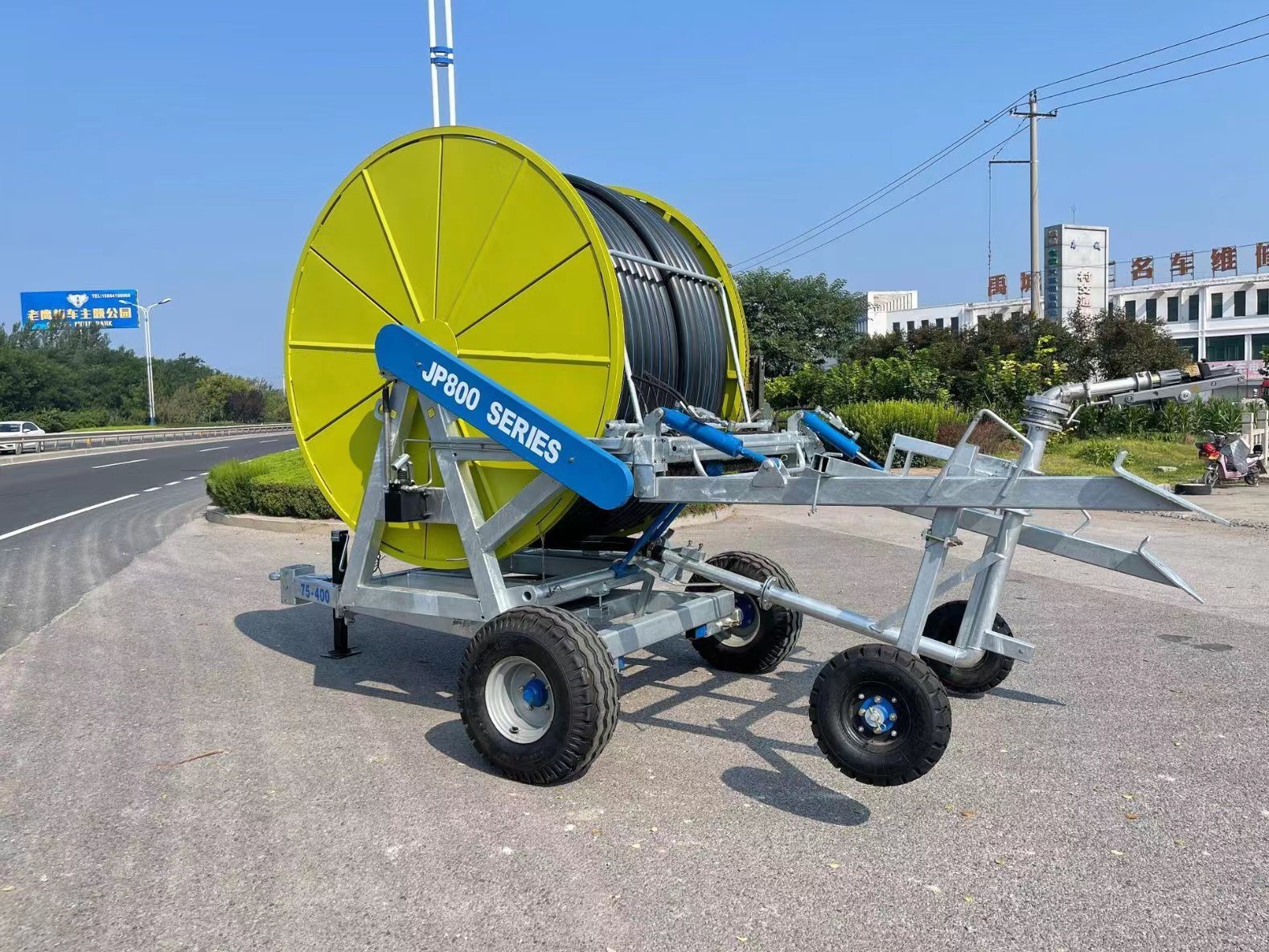
JP800 hose reel irrigation machine, JP90-300 model series — water turbine driven, no electricity required for travel.
In short: the JP800 is a traveling hose reel irrigator with a 90 mm PE pipe of 300 m, a water flow range of 25–52 t/h, a nozzle diameter range of 16–22 mm, a spray radius of 19–41 m, a DL50/SIMA10497 spray gun and an inlet pressure range of 0.6–0.9 MPa. Those figures define a machine that fits strip-shaped and rectangular plots with a steady-pressure water source, and that fits poorly where pressure is unstable or where a defined travel lane cannot be provided.
The Problem: Three Mismatches That Cost Money Silently
Irrigation equipment is usually sold as a machine; it is actually purchased as a relationship between machine, field and water supply. Three mismatches account for most of the disappointment reported by growers after installation.
- Geometry mismatch. A machine with a fixed circular pattern covers a circle, and the corners of a rectangular plot are either left out or require supplementary watering. A machine that travels in straight strips instead follows the long axis of a rectangular field.
- Power mismatch. Electromechanically driven machines need a power arrangement at the field — an external power connection or a diesel generator set. Where neither is practical, a machine whose travel is driven by water pressure removes a whole installation problem.
- Water-source mismatch. Every machine has a pressure and flow window. A source that cannot hold that window will leave the machine running below its design point, which typically shows up as a weak wetted pattern rather than a stopped machine.
The opportunity sits on the other side of those mismatches. On farms where the plot is rectangular or strip-shaped, where the water source can hold a steady 0.6–0.9 MPa at the machine inlet, and where the grower wants irrigation capacity that can be moved between lands instead of permanently installed, a hose reel machine fits without forcing a compromise on the rest of the farm plan.
What the JP800 Hose Reel Irrigation Machine Is
The JP800 is a traveling hose reel irrigation machine built for farm irrigation and agricultural irrigation. It is listed under the JP90-300 model series and is constructed from metal and PE components. Its design points, as published by the manufacturer, include water turbine drive with no electricity required, simple operation and installation, quick and convenient movement, reduced water and labour inputs, and a comparatively low equipment cost position within the machine family. These are design intentions rather than measured field results, and they should be verified against a specific farm layout.
| Specification | JP800 / JP90-300 model series |
|---|---|
| Machine type | Traveling hose reel irrigation machine |
| PE pipe diameter | 90 mm |
| PE pipe length | 300 m |
| Water flow | 25–52 t/h |
| Nozzle diameter | 16–22 mm |
| Spray radius | 19–41 m |
| Spray gun | DL50 / SIMA10497 |
| Inlet pressure | 0.6–0.9 MPa |
| Machine weight | 2180 ± 30 kg |
| Overall dimensions | 6120 mm L × 2330 mm W × 2770 mm H |
| Shipping dimensions | 2450 mm L × 2000 mm W × 2250 mm H |
| Material | Metal, PE |
| Application | Farm irrigation, agricultural irrigation |
Technical Explanation: How Water-Turbine Drive Changes the Site Requirement
On a hose reel machine, the sprinkler gun sits on a wheeled cart at the far end of a long flexible pipe. Water enters the machine, drives a turbine, and that turbine rotates the reel. As the reel winds in the PE pipe, the cart is pulled steadily back toward the machine while the gun sprays. The travel work is therefore done by water pressure rather than by an electric motor, which is why the JP800 is described as water turbine driven with no electricity required.
Four practical consequences follow from that design.
- Pressure is a gating condition, not a preference. The machine's stated inlet pressure range is 0.6–0.9 MPa. A water source that cannot hold pressure inside that band is outside the machine's working envelope, and no amount of operational adjustment inside the machine will correct a supply-side deficit.
- Flow and nozzle are linked. The water flow range is 25–52 t/h and the nozzle diameter range is 16–22 mm. A grower selecting a smaller nozzle towards the 16 mm end is working at the lower end of the flow range and, correspondingly, at the shorter end of the 19–41 m spray radius. Selecting towards 22 mm moves the machine towards 52 t/h and the wider end of the spray range. The pump has to be matched to whichever nozzle is chosen.
- Travel distance sets the strip length. The 300 m PE pipe defines how far the cart can be positioned from the machine, and therefore the maximum straight run the machine can irrigate in a single pass. The 90 mm pipe diameter is what supports the flow range over that distance.
- The machine is a transport item as well as a working item. At 2180 ± 30 kg, with overall dimensions of 6120 × 2330 × 2770 mm and shipping dimensions of 2450 × 2000 × 2250 mm, relocation and shipping need planning, not improvisation.
The spray gun is specified as DL50 or SIMA10497, and the wetted band is derived from the spray radius. Because the radius range spans 19 m to 41 m, the strip width produced by the machine varies substantially across the controllable range — which means strip spacing should be planned after nozzle and pressure have been fixed, not before.
Scenario Fit: Five Situations Where This Machine Type Works
1. Long rectangular plots with a clear travel lane
This is the natural home of a hose reel irrigator. A plot whose long axis allows a straight 300 m run, and which has an unobstructed lane for the cart and pipe to follow, uses the machine's geometry directly. The sprinkler gun places a wetted band down the length of the run, and the field is then irrigated in successive strips.
2. Dry-season supplementary irrigation on row crops
A documented example of the machine family in dry-condition use comes from Brazil, where large-scale farmers used 50 hose reel irrigation machines for soybean irrigation. The project has been operating for six years, and reported outcomes include a 30% increase in crop output during dry conditions together with labour savings. The same reference notes two operational advantages that matter in this scenario: the machines are easy to pull from one land to another, and easy to rent.
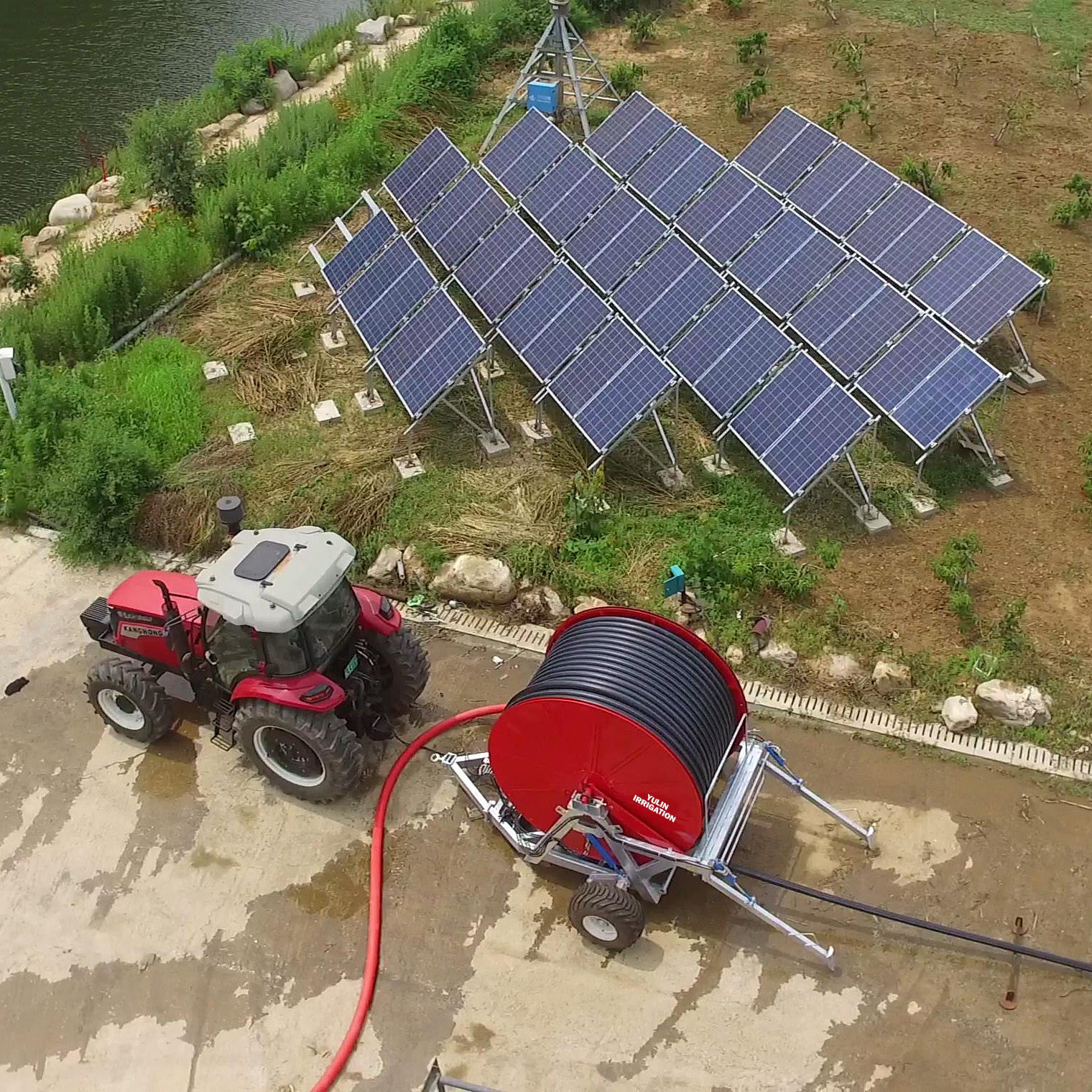
Large project site: hose reel irrigation equipment for soybean farming in Brazil.
3. Fields without a practical electricity supply
Because travel is water-turbine driven, the JP800 does not require an electrical connection for the drive function. That removes trenching, cabling and generator arrangements from the field-edge installation. It does not remove the need for pressure: the water source still has to deliver 25–52 t/h at 0.6–0.9 MPa at the machine inlet, and in most farm layouts that means a pump set with its own power source. The machine removes an electrical requirement at the machine; it does not remove the hydraulic one.
4. Multi-plot farms, contracting and rental operations
Where irrigation capacity has to move between parcels, a permanently installed system serves only one location. A hose reel machine is designed to be relocated, which is why the Brazil project reference lists ease of pulling between lands and ease of renting as practical benefits. For contractors and machinery rings, this converts one capital item into a serviceable asset across several clients.
5. Water sources with stable pressure and adequate flow
Ponds, canals, reservoirs and boreholes can all supply a hose reel machine in principle, but only if the delivered pressure at the machine inlet sits inside 0.6–0.9 MPa while flow sits inside 25–52 t/h. Friction losses in the supply line, changes in source level, and simultaneous use by other equipment all reduce pressure at the inlet. Measuring at the machine connection point — not at the pump outlet — is the check that decides whether the scenario fits.
A Scenario-Fit Checklist Before Choosing a Hose Reel Machine
The following checklist converts the JP800 specification into field-level questions. It is intended for the research and evaluation stage, when a grower is still deciding whether this machine type belongs on the shortlist.
| Check | What to verify on site | Reference value (JP800 / JP90-300) |
|---|---|---|
| Straight run length | Is there an unobstructed lane allowing the cart to travel the full distance from the machine? | 300 m PE pipe length |
| Pipe and flow capacity | Can the supply line carry the required flow without excessive friction loss? | 90 mm PE pipe; 25–52 t/h |
| Inlet pressure | Measured at the machine inlet under working conditions, not at the pump | 0.6–0.9 MPa |
| Nozzle selection | Match nozzle to available flow, then set strip spacing from the resulting radius | 16–22 mm nozzle; 19–41 m spray radius |
| Electrical supply | Confirm whether the travel function needs power (it does not) and whether the pump does | Water turbine driven, no electricity required |
| Relocation | Confirm towing route and access between plots | 2180 ± 30 kg; shipping size 2450 × 2000 × 2250 mm |
| Crop and water source | Confirm that the application matches the intended duty | Farm irrigation, agricultural irrigation |
Where the Machine Does Not Fit: Limits and Boundaries
A hose reel irrigator is not a universal replacement for every irrigation method, and the JP800's own specification explains why.
- Coverage is sequential, not simultaneous. The machine wets one band per pass. A field is irrigated strip by strip, so the number of passes and the total operating time depend on the match between the 19–41 m spray radius and the strip spacing chosen. A fixed center pivot irrigation system, by contrast, waters its circular area continuously from a central tower.
- It depends on source pressure. Inlet pressure must sit within 0.6–0.9 MPa. Where a farm's water source cannot sustain that band, the machine type is unsuitable regardless of field geometry.
- It needs a defined travel lane. Obstructions, standing water or an irregular plot boundary along the run will restrict the pipe path and therefore the usable strip length.
- Relocation is a real task. Machine weight and dimensions mean moving between fields is a planned operation with towing or transport equipment, not a manual repositioning.
- Uniformity verification has to be matched to the machine type. ISO 11545:2009 specifies an in-field method for determining the uniformity of water distribution for centre-pivot and moving lateral irrigation machines. A traveler gun configuration is a different machine class, so buyers specifying hose reel equipment should confirm which uniformity test protocol applies to their configuration rather than assuming the same standard covers both.
For context, the center pivot machines from the same manufacturer operate on a different technical basis entirely: electromechanical drive that is reversible and individually controlled for each span, a voltage range of 380–460 V, a standard control panel rated IP65, and a truss height of 3 ± 0.2 m above ground. Those requirements are manageable on a large, regularly shaped plot with a power supply; they are not manageable on a small, elongated or power-poor plot, which is precisely the space where a hose reel machine is evaluated.
| Consideration | Fixed center pivot irrigation system | JP800 hose reel irrigation machine |
|---|---|---|
| Drive | Electromechanical, reversible, individual per span | Water turbine driven, no electricity required |
| Power at field | 380–460 V; external power or diesel generator | No electrical requirement for travel |
| Coverage pattern | Circular, continuous | Straight strips, sequential passes |
| Key hydraulic parameter | Rain intensity not more than 0.16 mm/min; pressure regulators 10, 15 or 20 psi | Inlet pressure 0.6–0.9 MPa; flow 25–52 t/h |
| Relocation | Fixed installation at one centre point | Designed to be moved between lands |
Manufacturing and Delivery Evidence Behind the Machine
Scenario fit is a technical question, but the ability to deliver a machine that performs as specified is a supplier question, and buyers evaluating a hose reel machine usually assess both at the same time.
China Yulin Irrigation Equipment Co., Ltd. was established in 2009 and operates a 64,653 m² facility with 152 employees, a 10-engineer R&D team and an annual output of 3,000 units. The company reports that more than 95% of machine spare parts are manufactured in-house, which enables full-process quality monitoring and stabilises product consistency, and that it built automated production workshops using robotic welding and precision processing. Its export ratio is 60%, with markets including Australia, New Zealand, Canada, Mexico, Africa, Central Asia, Russia and Kazakhstan. External supply capacity for pivot systems is stated at 400 sets per year.
For buyers assessing delivery terms, the company's capability data records OEM production mode, voltage customization for OEM orders, a minimum order quantity of one unit, a lead time of 21–40 days, monthly capacity of 60 units and 100% testing. Certification coverage includes CE, ISO9001 and CSA, with anti-corrosion and wind resistance testing applied to equipment intended for tropical, saline-alkali and high-wind farmland environments. After-sales provision includes field installation, commissioning and training, video technical support, online support and free spare parts, with localized on-site installation and operator training services offered internationally.
For a machine whose drive depends on water pressure, after-sales support during commissioning matters more than it does for simpler equipment: the first season is when nozzle selection, strip spacing and pressure behaviour at the inlet are confirmed against real field conditions.
Market Context: Irrigation Investment Keeps Growing
The commercial backdrop supports continued attention to machine-type selection. Mordor Intelligence estimates the global center pivot irrigation system market at USD 2.56 billion in 2025, projected to reach USD 5.67 billion by 2030. Large-scale supply agreements continue to be signed: Lindsay Corporation secured a multi-year agreement for Zimmatic irrigation systems in the MENA region valued at more than $100 million in 2024. Valmont Industries reported Agriculture segment sales of $278.0 million in Q4 2024, representing 26.7% of its total net sales.
Read together, those figures describe capital concentrating in large irrigation projects and in specific regions. They do not describe every farm. On smaller, elongated, fragmented or power-constrained plots, the relevant question is not which large-scale system dominates the market, but which machine matches the field and the water source on hand — and that is where hose reel equipment is evaluated on scenario fit rather than on scale.
Future Outlook
Three directions seem likely to shape how machines like the JP800 are assessed over the next planning cycles.
First, water and energy costs push buyers toward machines whose drive mechanism does not add a separate power demand. A pressure-driven travel system removes one utility from the field edge, which simplifies deployment on parcels far from existing infrastructure.
Second, rental and contracting models are likely to expand where capital is constrained but land is fragmented. A machine designed to be relocated between lands supports that model directly, and the reported Brazilian experience of rental convenience illustrates the commercial logic.
Third, buyers are becoming more precise about specifications. Pressure bands, flow ranges, nozzle diameters and spray radii are now compared before purchase rather than discovered after installation. Machines whose published envelope is narrow and explicit — such as a defined 0.6–0.9 MPa inlet window and a 25–52 t/h flow range — benefit from that scrutiny, because growers can determine fit themselves.
Frequently Asked Questions
Which plot shapes and field layouts suit a hose reel irrigation machine?
The machine suits rectangular and strip-shaped plots that allow a straight, unobstructed travel lane of up to 300 m, which is the PE pipe length of the JP800. It irrigates in successive bands rather than covering a whole field at once, so layouts where the spray radius of 19–41 m can be matched to consistent strip spacing perform best. Irregular boundaries, obstacles along the run and plots without a clear lane for the cart and pipe reduce the usable strip length.
What water flow and inlet pressure does the JP800 require?
The stated water flow range is 25–52 t/h and the stated inlet pressure range is 0.6–0.9 MPa. Nozzle diameter can be selected between 16 mm and 22 mm, and that selection moves the machine within the flow range and within the 19–41 m spray radius range. Because supply-line friction losses reduce pressure before the water reaches the machine, the pressure that matters for this assessment is the value measured at the machine inlet under working conditions.
Can the JP800 hose reel irrigation machine operate without grid electricity?
The machine's travel is water turbine driven and requires no electricity, which is one of its published design points. This removes the electrical connection needed to move the cart and reel in the pipe. It does not remove the hydraulic requirement: the water source still has to deliver 25–52 t/h at 0.6–0.9 MPa at the machine inlet, and delivering that typically requires a pump set that has its own power source. Growers should therefore assess the pump and the machine as one system.
How does a hose reel irrigation machine compare with a center pivot irrigation system on the same farm?
The two machine classes answer different field geometries. A fixed center pivot irrigation system operates from a central tower with electromechanical drive, reversible and individually controlled for each span, at 380–460 V, covering a circular area continuously. A hose reel machine irrigates straight strips in sequential passes and does not require electricity for travel. A pivot suits large, regularly shaped plots with an available power supply; a hose reel machine suits strip layouts and sites where providing field power is impractical. Where plot shape or power availability rules out one type, the other is usually the alternative being evaluated.
Is a hose reel irrigation machine suitable for irrigating more than one field?
Relocation is part of the machine's intended use. In the Brazilian soybean project, 50 hose reel irrigation machines have been in operation for six years, with ease of pulling from one land to another and ease of renting identified as practical benefits alongside a 30% increase in crop output during dry conditions. Relocation is nevertheless a planned task: the JP800 weighs 2180 ± 30 kg, with overall dimensions of 6120 × 2330 × 2770 mm and shipping dimensions of 2450 × 2000 × 2250 mm, so towing or transport arrangements should be confirmed before the machine is committed to multiple plots.
Further reference: the 2026 YULIN pivot catalogue, which includes the hose reel machine range, is available for download at 2026 YULIN Pivot Catalogue (PDF).