
Hookah Lounge Charcoal in Saudi Arabia: Matching TC-01 Formats to Shisha Service
Charcoal in a Saudi shisha lounge is a service component, not a commodity input. It has to hold a bowl through a social session, release heat evenly enough to roast tobacco rather than scorch it, and add no smoke or odour of its own. The line built around that brief is TC-01 hookah charcoal from FYC, and the formats it ships in — 25mm cube, 40mm cube, hexagonal and bamboo — do not behave identically inside a lounge service cycle.
This reference is written for lounge operators, multi-site hospitality groups and importers who already accept that charcoal quality matters and now need to convert that belief into a purchase specification. It works through the TC-01 format range, the burn windows attached to each format, the parameters that decide whether a session holds, and the boundaries a buyer should plan around before committing a quarterly volume.
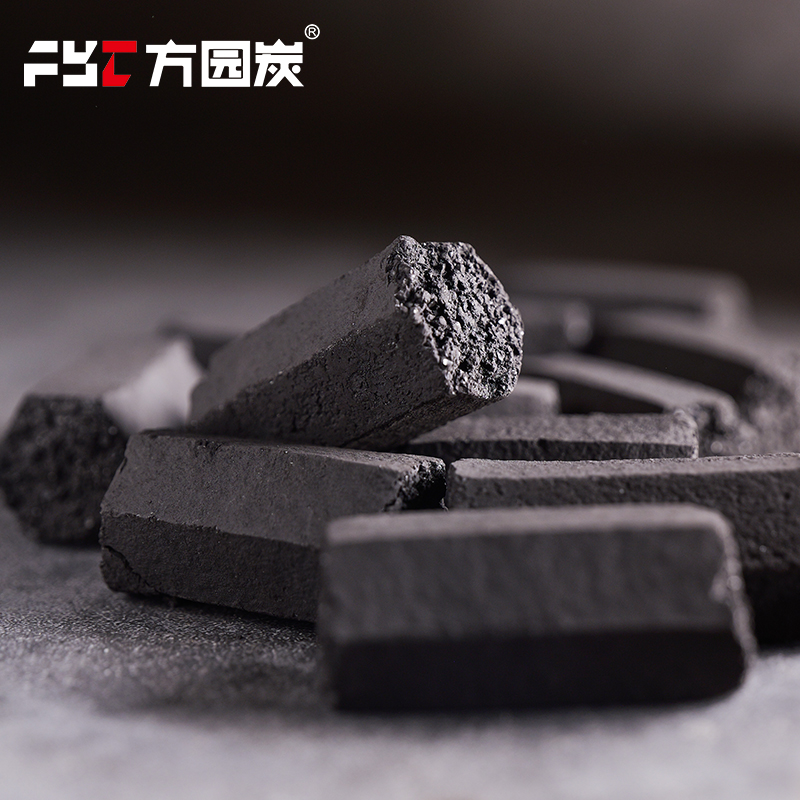
Why a Shisha Lounge Specifies Charcoal Differently
A hookah and shisha lounge in Saudi Arabia runs on continuous, premium heat. The application profile for this venue type calls for a heat source that produces no smoke, no odours and no sparks while gently roasting molasses to build thick vapour. That combination is unusual in the charcoal category. Most charcoal products are judged on heat output alone; a lounge judges them on what the heat does not do.
Three operational consequences follow. A briquette that throws sparks or ash dust forces staff to intervene mid-session, which the guest can see. A briquette that releases its own odour competes with the flavour the guest paid for. And a briquette that collapses early turns a fixed session length into a variable one, which puts pressure on a table plan built around predictable turnover.
The purchasing question is therefore not which charcoal burns hottest, but which format holds a bowl for the length of the service cycle, at an ash level the staff can manage, in a shape the tongs and bowls already accept. That is a specification decision, and it has an answer inside the TC-01 range.
What TC-01 Hookah Charcoal Is
TC-01 is the hookah charcoal model in the FYC range. It is made from premium natural coconut shell and fruit wood, and it is supplied in cube form at 25mm and 40mm, in hexagonal form, and in bamboo form. The product is described as smokeless, odorless, high hardness and eco-friendly.
FYC — Dalian Tiancheng Charcoal Industry Technology Co., Ltd. — is a charcoal manufacturer based in Liaoning, China, established in 1990, operating a 6,000㎡ factory with 100 employees and eight engineers. Its main products are hookah charcoal, incense charcoal and barbecue charcoal, with an annual output of 4,000,000 pieces and a 60% export ratio directed mainly at the Middle East and Europe. The company holds SGS and ISO certifications and reports daily output exceeding 50 metric tons.
For a lounge buyer, the relevant part of that profile is not the company history but the fact that hookah charcoal is one of three dedicated product lines rather than a by-product of a barbecue operation. A venue that runs shisha service all evening is buying a product whose stated design target is shisha service all evening.
The Four Formats and the Burn Window Each Creates
Format is the first decision a lounge makes, because format sets the burn window that the service cycle has to fit into. In the TC-01 specification, cube charcoal at 25mm and 40mm is rated at 90–120 minutes of burning, while the quick light variant is rated at 45–70 minutes. Hexagonal and bamboo forms belong to the same TC-01 range and share the same material basis, but the specification does not attach a separate burn time to those two forms.
| TC-01 format | Stated burn time | Material basis | How a lounge typically reads it |
|---|---|---|---|
| Cube 25mm | 90–120 minutes | Premium natural coconut shell and fruit wood | The default specification point for standard bowl service |
| Cube 40mm | 90–120 minutes | Premium natural coconut shell and fruit wood | Alternative cube size inside the same stated burn window; choose against bowl geometry and staff routine |
| Hexagonal | Not separately specified | Premium natural coconut shell and fruit wood | Handling, stacking or packing preference; confirm burn time under venue conditions |
| Bamboo | Not separately specified | Premium natural coconut shell and fruit wood | Handling, stacking or packing preference; confirm burn time under venue conditions |
| Quick light variant | 45–70 minutes | Premium natural coconut shell and fruit wood | Faster ignition; suits shorter service windows or rapid resets |
The practical reading is straightforward. A lounge whose sessions run past ninety minutes should build its service around cube formats and treat quick light as a secondary line for short windows or fast turnaround situations. A venue that has standardised on hexagonal or bamboo shapes for handling or presentation reasons should validate burn time against its own bowl, pack and airflow rather than assume the cube figure carries across.
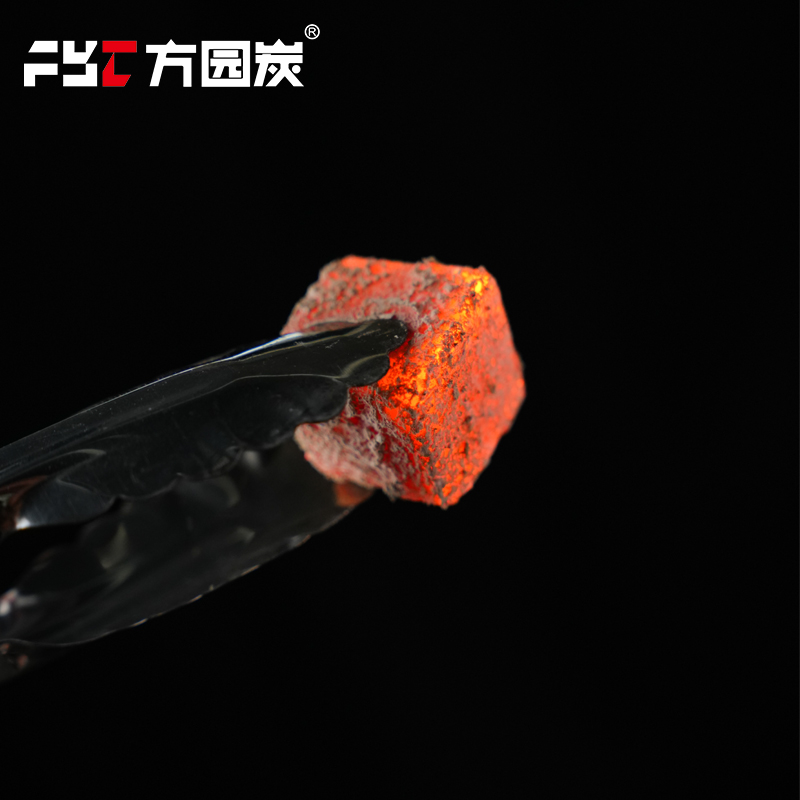
Parameters That Decide Whether a Session Holds
Burn time is the headline number, but three other stated parameters determine whether that number is usable in a venue.
Fixed carbon above 85%–90%
Fixed carbon is the fraction of the briquette that actually burns as carbon rather than volatilising or leaving residue. TC-01 states fixed carbon content above 85%–90%. For a lounge, a high fixed carbon figure is the reason a bowl can be lit once and left alone: the heat source is consuming itself steadily rather than flaring and fading. It is also the parameter that most directly separates a charcoal built for long service from one built for short bursts.
Ash content below 3% at premium grade
TC-01 states ash content below 3% at premium grade. Ash is the part of the briquette that produces no heat and has to be managed by staff — sitting on the bowl, blocking airflow, and eventually requiring the briquette to be moved or replaced. In a lounge where a server may be handling twenty tables, ash volume is a labour variable as much as a quality variable. The lounge application profile for this venue type specifies extremely low ash content, below 3%, as part of the operating requirement rather than as a marketing preference.
For scale, academic literature citing the Indonesian briquette standard SNI 01-6235-2000 reports an ash threshold of ≤8% for charcoal briquettes. That figure comes from a different product framework and is not a compliance statement for TC-01, but it shows where the premium-grade figure of <3% sits in the wider category: at the stricter end.
Calorific value above 7,800 kcal/kg
TC-01 states a calorific value above 7,800 kcal/kg. Calorific value describes how much energy a given mass of charcoal releases. For a venue, this is what allows a small number of briquettes to hold a bowl at temperature, and it is the reason charcoal consumption per table can be planned rather than estimated.
Hardness and physical integrity
TC-01 is specified as high hardness, not easy to break. A briquette that fractures in the tongs or in transit produces fragments that burn faster than the whole piece, which shifts the burn window the venue has planned around. Hardness is therefore a service-cycle parameter, not a handling convenience.
Matching Format to the Service Cycle in a Saudi Lounge
The lounge application profile for Saudi hookah and shisha venues lists the equipment a charcoal has to work with: premium hookah sets, ceramic shisha bowls, hookah tongs and wind covers. It also lists the operating mode — continuous burning for 90 to 120 minutes per briquette with extremely low ash content — and a set of special requirements including 100% natural coconut shell, chemical-free composition, food-grade safety and high hardness.
Read together, those requirements define a service routine. A briquette is lit, placed on a ceramic bowl under a wind cover, and left to roast molasses for the length of the session. If the stated burn window is 90–120 minutes and the venue session length falls inside that window, the table does not need a mid-session intervention. If the venue runs shorter, more frequent sessions, or if a guest requests a quick refresh, the quick light variant at 45–70 minutes becomes the relevant line.
There is a secondary use case that matters for venues with a mixed menu. Many Saudi lounges also serve bakhoor or oud alongside shisha. That service uses a different product: TC-04 incense charcoal, a 33mm round tablet made from fruit wood charcoal and coconut shell charcoal powder, with quick light and fast ignition, smokeless and odorless performance, scent diffuser capability, and a 45–70 minute burn. It is available in natural black, silver foil and gold foil appearances, with flip-top, magnetic or pull-out box packaging. A lounge should not substitute TC-01 into a bakhoor burner or treat TC-04 as a hookah charcoal; they are built for different heat duties.
A Documented Saudi Lounge Supply Arrangement
The clearest evidence of how TC-01 behaves in this venue type is a documented supply relationship with a premium shisha lounge and hookah bar chain in Saudi Arabia. The arrangement covers continuous social shisha service in upscale city-centre lounges, at a volume of 50 metric tons per quarter — approximately 200 tons annually — and has run for 2.5 years of continuous cooperation.
Three details of that arrangement are worth noting for other buyers. The specified format is a consistent 25mm cube, which matches the format that carries the 90–120 minute burn window. The quality anchor is ultra-low ash content below 3%. And the packaging is a luxury magnetic box customised with the client logo, which places branding at the packaging level rather than requiring a different charcoal.
The reported result is stable, odorless burning with zero client complaints, and a measurable improvement in customer session duration attributed to long-lasting heat. That outcome maps directly onto the specification logic: a burn window that outlasts the session removes the main reason a session ends early.
Market Context: Why Coconut Shell Is Now the First Question
The material basis of TC-01 is not incidental to the format discussion. Coconut shell charcoal held a 42.3% share of the hookah charcoal market in 2025, according to Dataintelo's hookah charcoal market report. Coconut shell has become the reference feedstock for shisha-grade charcoal, and buyers increasingly ask about feedstock before they ask about price.
Supply geography reinforces that. Indonesia was the world's leading charcoal exporter in 2024, accounting for roughly 23% of global export value, according to World's Top Exports. For a Saudi buyer, the implication is not that one country should be preferred, but that feedstock claims and origin claims should be verified separately, because a coconut shell specification and a shipment's actual origin are two different facts.
The wider category is large enough that specification discipline pays. Grand View Research estimates the global charcoal market at USD 8.5 billion in 2026. Within a market of that size, the difference between a charcoal that holds a lounge bowl for ninety minutes and one that does not is a per-table operating cost, not a rounding error.
Where TC-01 Stops: Limits a Buyer Should Plan Around
A specification is only useful if its boundaries are stated as clearly as its capabilities. Five limits apply to TC-01 in lounge service.
- Quick light is a shorter window. The quick light variant is rated at 45–70 minutes against 90–120 minutes for cube formats. A venue that adopts quick light for convenience across all tables is choosing a burn window roughly half as long, and should expect more frequent table interventions as a result.
- Hexagonal and bamboo burn times are not separately specified. Both forms belong to the TC-01 range, but the published specification attaches burn times only to cube 25mm/40mm and to the quick light variant. A venue standardising on hexagonal or bamboo should run its own burn-time validation on its own bowls before writing a purchase specification around it.
- The two cube sizes share one burn window. Cube 25mm and cube 40mm are both rated 90–120 minutes. Size selection therefore has to be driven by bowl geometry, loading routine and packing preference rather than by an assumption that the larger cube burns longer.
- Ash below 3% is a premium-grade figure. Buyers writing an acceptance clause should tie the <3% figure explicitly to premium grade in the purchase order, rather than treating it as a default across all deliveries.
- Custom packaging carries a longer lead time. Standard stock turns in 7–15 days; customised mass production runs 20–30 days. A lounge chain planning a branded magnetic box rollout has to place that order against the longer window.
One further boundary concerns product fit rather than performance. TC-01 is intended for hookah bars, shisha smoking, aromatherapy, yoga rooms, incense burners and home relaxation. It is not the barbecue line; high-volume grilling sits with TC-02, which is specified for different heat duties and burn durations. Using a hookah charcoal in a grill application is a mismatch of product to duty, not a quality question.
Acceptance Criteria for Lounge Procurement
The following checklist converts the TC-01 specification into clauses a lounge group can put in front of a supplier. It is written for buyers moving from research into evaluation, where the question shifts from what a product can do to what a purchase order should require.
| Check | What to state in the specification | Why it belongs in the order |
|---|---|---|
| Format | Cube 25mm, cube 40mm, hexagonal or bamboo, stated explicitly | Format drives the burn window and the handling routine |
| Burn window | 90–120 minutes for cube; 45–70 minutes for quick light | Sets whether a session needs a mid-service intervention |
| Fixed carbon | Above 85%–90% | Determines steady heat rather than flare-and-fade behaviour |
| Ash content | Below 3%, tied to premium grade | Drives staff handling load and airflow management |
| Calorific value | Above 7,800 kcal/kg | Supports consumption planning per table |
| Hardness | High hardness, not easy to break | Prevents fragments that shorten the planned burn window |
| Material basis | Premium natural coconut shell and fruit wood | Keeps feedstock claims explicit and verifiable |
| Packaging | Magnetic, flip-top or pull-out box; logo printing if branded | Custom packaging adds 20–30 days to the production timeline |
| Volume and terms | 1 ton to 17 tons for wholesale; flexible MOQ from one box for express stock | Matches order size to storage and rollout plan |
On the supply side, FYC reports monthly capacity of approximately 600–800 metric tons, 100% comprehensive inspection across production lines, three dedicated QA/QC inspectors, on-site Intertek supplier assessment and full raw-material traceability. After-sales terms include a response time of four hours or less, a 100% on-time delivery commitment, 24/7 technical support on charcoal usage and storage, and compensation for quality discrepancies. For a multi-site group, the traceability and inspection commitments are the clauses that make a quarterly volume contract workable.
Future Outlook
Two structural signals are likely to shape lounge charcoal procurement over the next buying cycle. The first is material concentration: with coconut shell holding 42.3% of the hookah charcoal segment in 2025, feedstock availability rather than product novelty becomes the constraint a buyer manages. The second is supply geography: Indonesia's position at roughly 23% of global charcoal export value in 2024 means origin verification will stay part of the specification conversation.
For lounges specifically, the direction of travel is toward tighter service-cycle specifications rather than broader product claims. Operators who can state a burn window, an ash ceiling and a format in a purchase order are in a stronger position than those buying on general quality language. The TC-01 range already exposes those three variables in published form, which is what makes a format-to-service matching exercise possible at all.
Buyers who want the full product and specification set in one document can download the FYC brochure: FYC Charcoal Product Brochure (PDF).
Frequently Asked Questions
Which TC-01 format suits a shisha lounge that runs long sessions?
Cube formats at 25mm and 40mm are rated at 90–120 minutes of burning per briquette, the longest stated burn window in the TC-01 range. Hexagonal and bamboo forms are part of the same range but do not carry a separately published burn time. The quick light variant is rated at 45–70 minutes. A lounge whose sessions routinely exceed ninety minutes should therefore start its specification from cube formats.
Does TC-01 produce smoke or odour during lounge service?
TC-01 is described as smokeless and odorless. The lounge application profile for Saudi hookah and shisha venues requires constant premium heat without producing smoke, odours or sparks, so performance on these three points is part of the venue requirement rather than a preference.
What fixed carbon and ash values should a lounge write into a charcoal specification?
TC-01 states fixed carbon content above 85%–90% and ash content below 3% at premium grade, with a calorific value above 7,800 kcal/kg. Buyers writing an acceptance clause should tie the ash figure explicitly to premium grade. For context, academic literature citing the Indonesian briquette standard SNI 01-6235-2000 reports an ash threshold of ≤8%, which places the premium-grade figure at the stricter end of the category.
Is quick-light charcoal appropriate for a premium shisha lounge?
Quick light is a distinct variant within TC-01, rated at 45–70 minutes of burning against 90–120 minutes for cube formats. It offers fast ignition, which suits shorter service windows or rapid table resets. Where session length is the priority, cube formats provide the longer window. Quick light should be selected against the venue's session length, not adopted as a blanket default.
Can a lounge chain order TC-01 in its own packaging?
FYC offers OEM, ODM, custom manufacturing and custom packaging, covering product shape, size, logo printing, retail packaging formats such as magnetic, flip-top and pull-out boxes, and material composition. A documented Saudi shisha lounge chain uses a consistent 25mm cube supplied in a luxury magnetic box customised with the client logo. Lead time is 7–15 days for standard stock and 20–30 days for customised mass production.
How much charcoal does a multi-site lounge operation consume, and what capacity supports it?
A documented Saudi premium shisha lounge and hookah bar chain purchases 50 metric tons per quarter, approximately 200 tons annually, over a 2.5-year continuous cooperation. FYC reports monthly capacity of approximately 600–800 metric tons and daily output exceeding 50 metric tons, with an annual output of 4,000,000 pieces across its hookah, incense and barbecue lines.
¿Tiene preguntas o necesita más detalles?
Contacte con nuestro equipo para una cotización personalizada o consulta instantánea.
Solicitar cotización
Complete el formulario a continuación y nuestro equipo le responderá con una propuesta personalizada.
Chat directo de WhatsApp
¿Prefiere chatear en tiempo real? Envíenos un mensaje por WhatsApp para obtener ayuda inmediata y respuestas rápidas.
- Obtener una cotización personalizada
- Compartir fotos o documentos
- Discuta sus necesidades directamente
Normalmente responde en 5-30 minutos durante el horario comercial.