
Hookah, BBQ or Incense? Comparing TC-01, TC-02 and TC-04
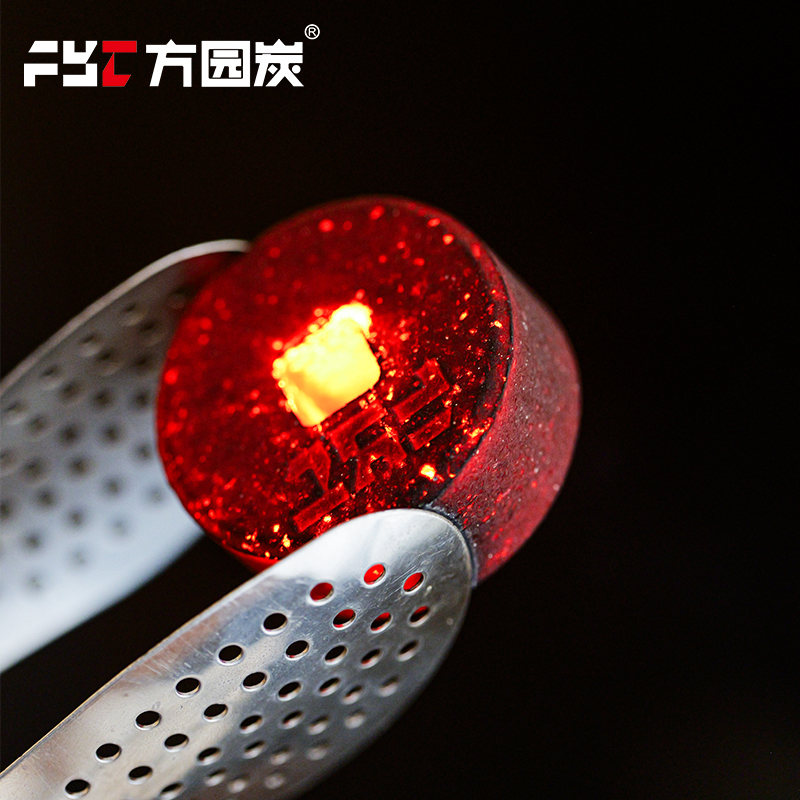
Hookah charcoal, barbecue charcoal and incense charcoal pass through the same procurement desk but are specified against three different heat profiles. Comparing them on one scale — longest burn, lowest ash, cheapest landed cost — is where most sourcing errors start, because the metric that wins one application rarely wins another.
This buyer reference compares three production lines from FYC — TC-01 hookah charcoal, TC-02 barbecue charcoal and TC-04 incense charcoal — using the criteria buyers apply during evaluation: feedstock, product form, fixed carbon, ash content, calorific value, burn time, intended application and commercial terms. FYC is the trading identity of Dalian Tiancheng Charcoal Industry Technology Co., Ltd., a charcoal manufacturer founded in 1990 in Liaoning, China, which develops and supplies hookah charcoal, incense charcoal and barbecue charcoal, exports approximately 60% of its output, and lists the Middle East and Europe among its main markets.
Why these three products cannot be ranked on one scale
A hookah charcoal is judged by how long it holds heat in a bowl without adding odour or forcing the operator to interrupt a session with ash handling. A barbecue charcoal is judged by heat intensity, hardness under load and behaviour in a grill bed. An incense charcoal is judged by compact, steady, low-smoke heat under resin or bakhoor.
Those three requirements pull specifications in different directions. Long cube burn time comes from density and fixed carbon. Grill performance depends on hardness and shape retention at temperature. Incense tablets prioritise a controlled, uniform burn in a small format. A buyer asking for the single best charcoal is effectively asking a supplier to optimise three different outcomes at once, which is why the practical decision is line selection rather than brand ranking.
The three lines at a glance
| Specification | TC-01 — Hookah Charcoal | TC-02 — Barbecue Charcoal | TC-04 — Incense Charcoal |
|---|---|---|---|
| Feedstock | Premium natural coconut shell, fruit wood | Bamboo sawdust, hardwood, fruit wood | Fruit wood or coconut shell powder |
| Product form | Cube (25 mm, 40 mm), hexagonal, bamboo | Quadrilateral, hexagonal, 50 mm square-hole, 50 mm four-hole, spherical, Fangyuan, bamboo stick | 33 mm round tablet |
| Fixed carbon | Above 85% – 90% | Not published in the line data reviewed | Not published in the line data reviewed |
| Ash content | Below 3% (premium grade) | Ultra-low, grade-dependent | Not published in the line data reviewed |
| Calorific value / heat | Above 7,800 kcal/kg | Described as superior heat, high temperature, high calorific value | Not published in the line data reviewed |
| Burn time | 90 – 120 minutes (cube 25 mm / 40 mm); 45 – 70 minutes (quick light) | 6 – 8 hours (bamboo stick); 70 minutes (fruit wood quick light) | 45 – 70 minutes |
| Stated characteristics | Smokeless, odourless, high hardness, eco-friendly | High hardness, not easy to break, smokeless, odourless, constant temperature | Round tablet format, custom packaging options |
| Typical application | Hookah and shisha service, bakhoor burners, aromatherapy | BBQ grills, barbecue restaurants, catering, outdoor cooking | Incense, bakhoor and oud burners |
Where a line does not publish fixed carbon or ash values, that is neither a quality signal nor a defect — it is an information gap the buyer should close with batch-level test data before agreeing acceptance criteria. Specification tables describe a product family; acceptance criteria govern a shipment.
Reading the specifications: what each number actually decides
Fixed carbon: how much usable fuel remains
FYC publishes above 85% – 90% fixed carbon for TC-01. Higher fixed carbon generally supports longer, more stable heat with less smoke, which is why it belongs in a purchase order as a tested value rather than a catalogue claim. For TC-02 and TC-04 the published line data emphasises burn duration, hardness and smokeless performance instead of a fixed carbon range, so those figures should be requested separately if they drive the application.
Ash content: an operational cost hidden in a specification
TC-01 is published at below 3% ash in premium grade. In a lounge running continuous service, ash percentage converts directly into tray changes, service interruptions and cleaning cycles — visible in the Saudi operation described below. In barbecue applications, ash volume affects airflow through the grill bed and post-service cleanup. The sub-3% figure belongs to TC-01 premium grade and should not be assumed across every FYC line.
Calorific value: the input for consumption planning
Above 7,800 kcal/kg is published for TC-01. Calorific value determines how many kilograms a fixed menu of sessions or grill hours actually consumes, which makes consumption comparisons between suppliers more reliable when tied to calorific value than to price per ton alone.
Burn time and ignition format: two specifications in one line
Burn time in these lines depends on format as much as on material. TC-01 cube charcoal in 25 mm and 40 mm is published at 90 – 120 minutes, while its quick-light format is published at 45 – 70 minutes. TC-02 spans 6 – 8 hours for bamboo charcoal sticks and 70 minutes for fruit wood quick light. TC-04 round tablets are published at 45 – 70 minutes. The pattern is consistent: instant-ignition formats trade burn duration for convenience, so buyers ordering for long sessions should not default to quick light.
Form factor: the specification buyers most often under-weight
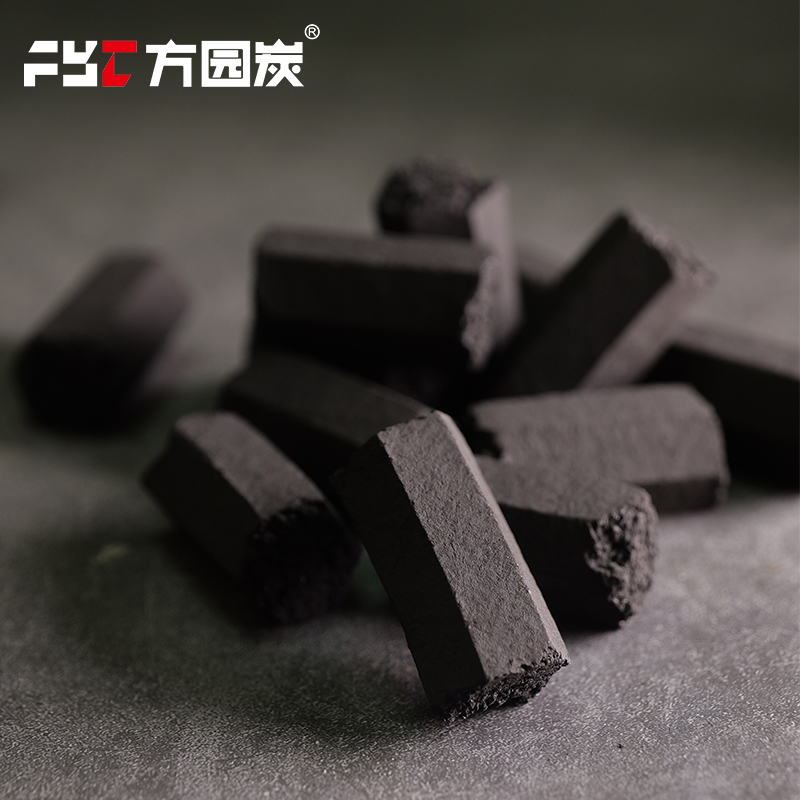
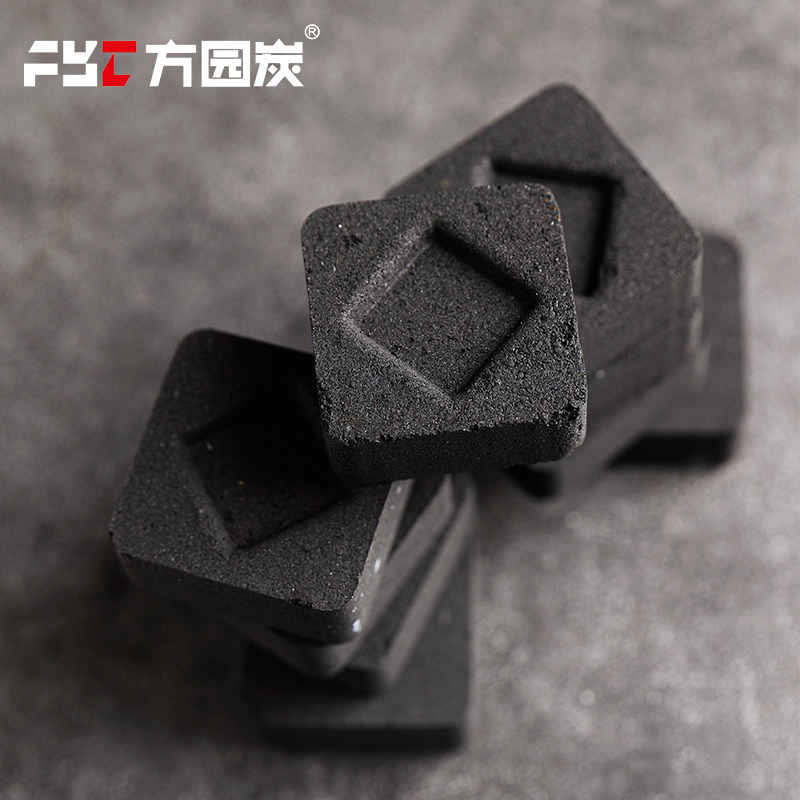
TC-01 is offered as 25 mm and 40 mm cubes, hexagonal form and bamboo form. TC-02 covers quadrilateral, hexagonal, 50 mm square-hole, 50 mm four-hole, spherical and Fangyuan shapes plus bamboo sticks. TC-04 is a 33 mm round tablet. Form decides fit — bowl geometry, grill bed, built-in dining-table grill or incense burner — and a correct material in the wrong shape will underperform in daily operation regardless of its test data.
Application evidence: how these lines perform in operation
Continuous shisha service — Saudi Arabia
A premium shisha lounge and hookah bar chain used TC-01 for continuous social shisha service in upscale city-centre lounges: 50 metric tons per quarter, approximately 200 tons annually, across 2.5 years of continuous cooperation. The configuration was a consistent 25 mm cube with ultra-low ash content below 3%, packed in luxury magnetic boxes customised with the client logo. The reported outcome was stable, odourless burning with zero client complaints and improved customer session duration from long-lasting heat.
Indoor charcoal dining — South Korea
An authentic charcoal BBQ and grill restaurant group took one 40HQ container per month, approximately 20 – 22 tons, of hexagonal bamboo charcoal sticks for high-temperature meat searing and slow indoor roasting. The sticks are described as high density with zero sparking, fitting built-in dining-table grills. Reported outcomes over three years of supply: zero smoke interference in indoor dining, and a 15% reduction in total charcoal consumption compared with the group previous suppliers, attributed to calorific value.
Incense, bakhoor and oud burners
TC-04 is the dedicated incense line: 33 mm round tablets produced from fruit wood or coconut shell powder, a published 45 – 70 minute burn window, and custom packaging options. Buyers should note that FYC also lists bakhoor incense burners, aromatherapy and yoga rooms among the applications for its hookah charcoal line, so an incense-adjacent sourcing decision can legitimately involve both TC-04 and TC-01. The choice between them is a trade-off between the dedicated round tablet format and the longer 90 – 120 minute cube burn.
A neutral buyer checklist: purchasing terms and acceptance criteria
Comparison stops at specifications; procurement starts at terms. The table below records the positions FYC publishes for these lines, which buyers should treat as the opening position of a negotiation rather than the final contract.
| Commercial item | Published position |
|---|---|
| Minimum order quantity | From 1 box for express stock; from 1 ton for wholesale orders; full-container volumes of 1x20GP / 40HQ for mass orders |
| Delivery terms | FOB, CIF, CFR, DDP (door-to-door available for specific regions), EXW |
| Acceptance criteria | Pre-shipment inspection (PSI); 100% production line testing; third-party inspection such as SGS or Intertek on client request |
| Payment terms | T/T (30% deposit, 70% against B/L copy), L/C at sight, Western Union, Alibaba Trade Assurance |
| Lead time | 7 – 15 days for standard stock; 20 – 30 days for customised mass production |
| Production capacity | Approximately 600 – 800 metric tons per month; daily output above 50 metric tons |
| Quality control | 100% comprehensive inspection on all production lines; 3 QA/QC inspectors; on-site Intertek supplier assessment; full traceability of raw materials |
| After-sales support | Response time of 4 hours or less; 100% on-time delivery guarantee; 24/7 technical support for usage and storage; compensation for quality discrepancies |
Three verification steps materially reduce risk on a first order. First, request batch-level laboratory results for the parameters that drive your application — fixed carbon, ash and calorific value — and record the test method alongside the value. Second, confirm which standard applies in the destination market before shipment: EN 1860-2 is the mandatory safety standard for BBQ and retail charcoal in Europe, while an academic article citing Indonesia SNI 01-6235-2000 reports briquette parameters of moisture at or below 8%, ash at or below 8%, and calorific value at or above 5,000 cal/g as an example of testable thresholds. Third, use pre-shipment inspection and, where order value justifies it, third-party inspection by SGS or Intertek, which FYC states it supports on request. Supplier-published figures are a starting point; the acceptance record is what protects the order.
Where each line has limits
- Quick light against cube burn time. TC-01 quick light is published at 45 – 70 minutes against 90 – 120 minutes for cube formats. Buyers running long sessions who switch to instant ignition for convenience should expect to consume more units per session and should model that into order quantities instead of comparing headline prices only.
- Barbecue formats serve different service models. TC-02 six-to-eight-hour bamboo stick and 70-minute fruit wood quick light are not substitutes: one suits slow indoor roasting, the other short high-tempo service. Specifying a single TC-02 format for both will compromise one of them.
- Published fixed carbon and ash values do not transfer between lines. The above-85% – 90% fixed carbon and below-3% ash figures are published for TC-01. TC-02 line data describes ultra-low ash, high hardness and constant temperature without a fixed carbon range, and TC-04 publishes form, feedstock and burn-time data. Line-specific test data should be requested rather than a factory-wide figure assumed.
- Incense burn windows are shorter than hookah cube windows. With TC-04 published at 45 – 70 minutes, longer bakhoor sessions require either multiple tablets or a different line. Order planning should reflect the session length being served, not the tablet count sold per box.
- Compliance is market-specific. EN 1860-2 applies to BBQ charcoal in Europe, and equivalent requirements differ by destination. Certifications and product claims should be matched against the regulatory requirements of the destination market before ordering, whichever supplier is chosen.
Market signals behind these three categories
Three published data points frame the sourcing environment for 2026. Grand View Research estimates the global charcoal market at USD 8.5 billion in 2026, up from USD 8.1 billion in 2025. Dataintelo reports that coconut shell charcoal held the largest product type share of the hookah charcoal segment in 2025, at 42.3% — directly relevant because coconut shell and fruit wood are the feedstocks listed for TC-01. World Top Exports put Indonesia at roughly 23% of global charcoal export value in 2024, which makes origin and feedstock traceability a live supply question rather than a marketing one.
Read together, the data suggests that material choice in the hookah segment continues to converge on coconut shell while the wider market keeps expanding. For buyers, the practical implication is that feedstock and form are worth locking into contracts as named specifications rather than leaving them as catalogue descriptions that can drift between shipments.
What to watch through 2027
Three shifts are likely to shape charcoal procurement for these application families. Specification is moving from product name to application: buyers increasingly write orders as hookah service, indoor grilling or incense burning, and let form and burn time follow. Packaging is becoming a procurement variable in its own right, with custom shapes, sizes, logo printing and retail formats such as magnetic, flip-top and pull-out boxes now part of the commercial discussion rather than an afterthought. And verification is normalising — pre-shipment inspection, third-party testing and batch-level data are moving from optional to expected, particularly where market standards such as EN 1860-2 apply.
Frequently asked questions
1. How do I choose between TC-01, TC-02 and TC-04 for my application?
Choose by heat profile and form. TC-01 is the hookah line — cube 25 mm and 40 mm, hexagonal and bamboo forms, above 85% – 90% fixed carbon, below 3% premium-grade ash, 90 – 120 minutes cube burn and above 7,800 kcal/kg. TC-02 is the barbecue line, using bamboo sawdust, hardwood or fruit wood in quadrilateral, hexagonal, 50 mm square-hole, 50 mm four-hole, spherical, Fangyuan and bamboo stick formats, with 6 – 8 hours burn for bamboo sticks and 70 minutes for fruit wood quick light. TC-04 is the incense line in 33 mm round tablets with a 45 – 70 minute burn. If one purchase must cover several applications, split the order by line rather than asking a single grade to serve all three.
2. What fixed carbon and ash content should be expected from each line?
FYC publishes above 85% – 90% fixed carbon, below 3% ash in premium grade and above 7,800 kcal/kg for TC-01. TC-02 is described as having ultra-low ash content, high hardness, smokeless and odourless performance with constant temperature. TC-04 is published with feedstock, 33 mm form and burn-time data. Where a line does not publish fixed carbon or ash values, batch-specific laboratory results should be requested before acceptance criteria are finalised; TC-01 values should not be transferred to another line.
3. What are the purchasing terms and acceptance criteria?
MOQ starts from 1 box for express stock, from 1 ton for wholesale orders, and full-container volumes (1x20GP / 40HQ) for mass orders. Delivery terms include FOB, CIF, CFR, DDP with door-to-door service in specific regions, and EXW. Acceptance is based on pre-shipment inspection, 100% production line testing, and third-party inspection such as SGS or Intertek on client request. Payment terms include T/T with 30% deposit and 70% against B/L copy, L/C at sight, Western Union and Alibaba Trade Assurance.
4. How should a buyer validate a charcoal supplier specification before ordering?
Treat published specifications as a starting point, then verify at three levels: batch-level laboratory results for fixed carbon, ash and calorific value, with the test method recorded; applicability of the destination market standard, such as EN 1860-2 for BBQ charcoal in Europe; and independent inspection before shipment. Buyers can also compare stated values against the acceptance thresholds they intend to enforce — for example, briquette parameters cited under Indonesia SNI 01-6235-2000 of moisture at or below 8%, ash at or below 8% and calorific value at or above 5,000 cal/g — and confirm that the standard and the product category actually match the shipment.
5. What customisation options and lead times apply to these lines?
FYC provides OEM, ODM, custom manufacturing and custom packaging solutions. Available customisation covers product shape (cube, hexagonal, round, stick), size including 25 mm, 33 mm and 50 mm, logo printing, retail packaging such as magnetic, flip-top and pull-out boxes, and material composition. Standard stock typically ships in 7 – 15 days, while customised mass production typically takes 20 – 30 days.
Comparing TC-01, TC-02 and TC-04 on feedstock, form, fixed carbon, ash, calorific value, burn time and acceptance terms produces a clearer decision than ranking them. Each line is built for a different heat profile, and the buyer who specifies by application — then verifies with batch data and inspection — is the one who avoids the mismatch that surfaces in the first shipment.
¿Tiene preguntas o necesita más detalles?
Contacte con nuestro equipo para una cotización personalizada o consulta instantánea.
Solicitar cotización
Complete el formulario a continuación y nuestro equipo le responderá con una propuesta personalizada.
Chat directo de WhatsApp
¿Prefiere chatear en tiempo real? Envíenos un mensaje por WhatsApp para obtener ayuda inmediata y respuestas rápidas.
- Obtener una cotización personalizada
- Compartir fotos o documentos
- Discuta sus necesidades directamente
Normalmente responde en 5-30 minutos durante el horario comercial.