
Honeycomb Panel OEM Capability: What Global Buyers Must Evaluate
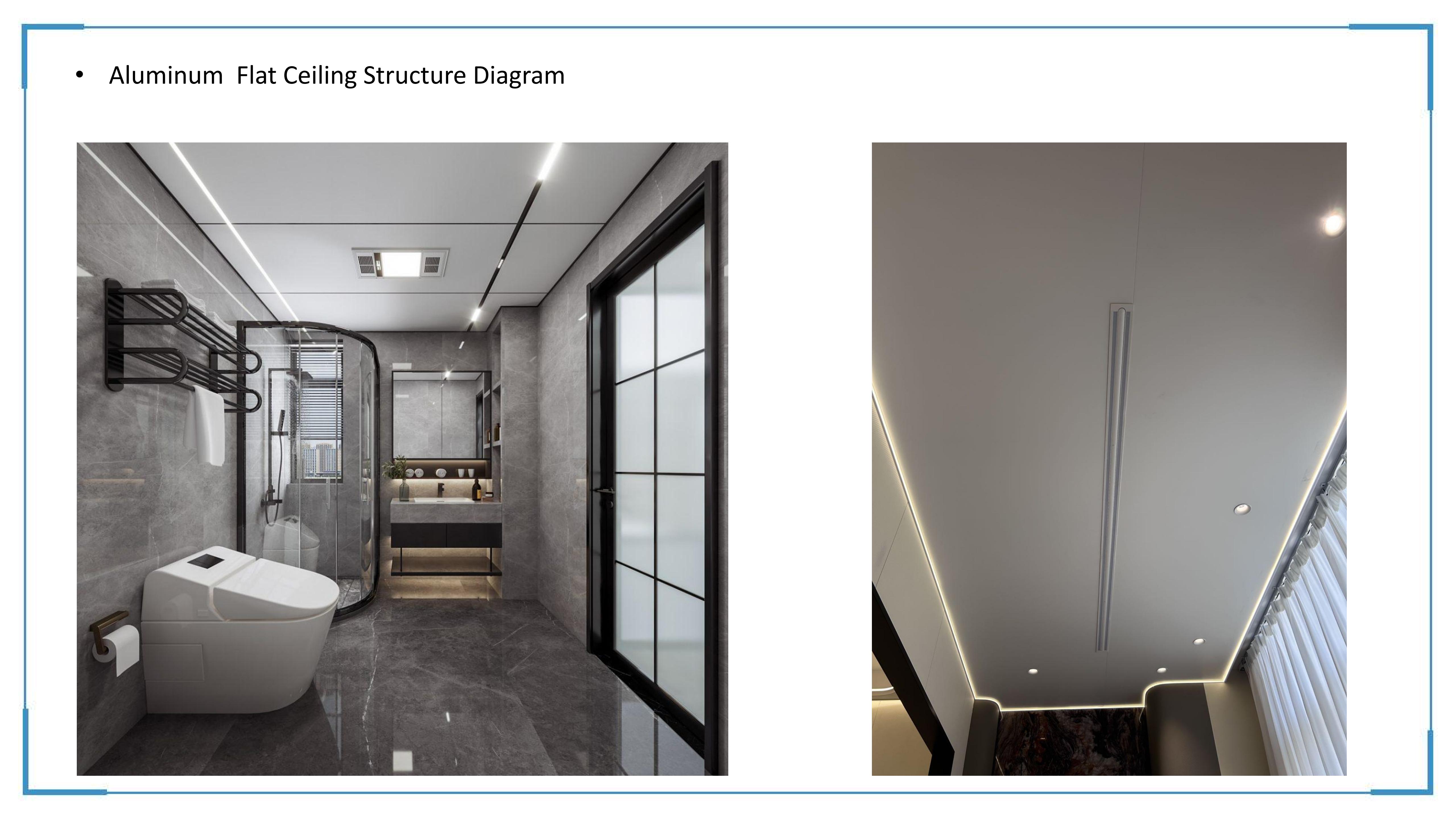
Aluminum honeycomb panel ceiling installation, a common application for large-format customized panels.
The global market for aluminum honeycomb panels is shifting from commodity stock to engineered, project-specific supply. Buyers are no longer selecting panels solely from a standard size list. Cabinet factories, interior fit-out contractors, and door manufacturers now ask for specific thicknesses, custom lengths, particular surface treatments, and even glue-free core structures. For procurement teams, this raises a practical question: how can a supplier's OEM and customization capability be verified before placing an order?
This article provides an independent technical and commercial view of honeycomb panel OEM capability, using Guangdong Nanbeiwang Smart Home Co., Ltd. (Nanbeiwang Aluminum) as a reference manufacturer. It covers the production parameters that matter, the evidence behind claimed capacity, and the limits buyers should keep in mind when comparing customized aluminum honeycomb panels with traditional wood-based panels.
Why OEM Capability Matters in Honeycomb Panel Sourcing
Honeycomb panels offer a high strength-to-weight ratio, flat surface, and resistance to moisture — properties that have made them a standard material in architectural interiors, cabinetry, doors, and ceilings. According to industry data, the global aluminum honeycomb panel market was estimated at USD 3.57 billion in 2024, with architectural and building panels representing the largest application area.
As projects grow more specific, buyers frequently need more than a standard 1220×2750 mm board. They may need a 9 mm panel with a solid wood veneer finish for wall cladding, an 18 mm panel with PETG surface for cabinet doors, or a large integrated ceiling board with frameless edges. In such cases, the supplier's ability to adjust thickness, size, color, surface finish, and cutting becomes a decisive factor.
The challenge is that OEM claims are easy to make and harder to prove. A supplier may offer custom sizes but lack control over core bonding quality. Another may have cutting capacity but cannot guarantee consistent surface finishing. For Evaluation- and Execution-stage buyers, the process should be structured around measurable criteria: product range, customization parameters, production capacity, lead time, inspection protocol, and reference projects.
Nanbeiwang Aluminum: Customization Capability at a Glance
Nanbeiwang Aluminum is the trade name for Guangdong Nanbeiwang Smart Home Co., Ltd., a National High-Tech Enterprise based in Dali Town, Nanhai District, Foshan, Guangdong Province — a region commonly referred to as China's aluminum capital. Founded in 2013, the company operates two production bases, covers an area of 80,000 m², employs 320 people, and reports an annual output of 1,000,000 sheets. Its in-house R&D team consists of 15 engineers.
The company's main products include the 18 mm honeycomb panel, 6th-generation solid wood veneer honeycomb panel, glue-free honeycomb panel, bamboo board, bamboo honeycomb panel, seamless welding plate, aluminum wall panel, aluminum interior door, and aluminum ceiling. It also supplies matching all-aluminum profiles and hardware accessories for whole-house customization material procurement.
From an OEM perspective, Nanbeiwang's stated capabilities include:
- Production modes: OEM and customization.
- Customization scope: thickness, size, color, surface finish, and cutting.
- Monthly capacity: 50,000+ sheets.
- Lead time: 1–7 days for stock items; 7–15 days for custom orders.
- MOQ: 1 sheet.
- Quality control: 100% full inspection before shipment; third-party inspection supported.
- Export markets: Europe, Southeast Asia, Middle East, and North America.
These figures are not marketing language; they are operational metrics that buyers can verify through samples, factory audits, and third-party inspection. A low MOQ of 1 sheet is particularly relevant for fabricators testing a new material without committing to large volumes. It also indicates a production system built around flexible line changeovers rather than purely mass production.
Technical Explanation: What Actually Gets Customized
To assess OEM capability, buyers need to understand the anatomy of an aluminum honeycomb panel. A standard panel consists of two aluminum skins bonded to a hexagonal aluminum honeycomb core. The composite provides stiffness, flatness, and low weight. Nanbeiwang's core product line, the honeycomb panel model NBW-HPB-001, illustrates the range of measurable parameters:
- Thickness: 5–18 mm (customizable)
- Panel size: 1220 × 2750 mm (customizable)
- Aluminum skin: 0.3–1.0 mm
- Core: aluminum honeycomb, glue-free thermal bonding
- Surface: PETG, melamine, powder coating, or wood grain
- Fire rating: A2
- Formaldehyde emission: zero (tested to GB18584-2024)
- Water absorption: <1% (24-hour test)
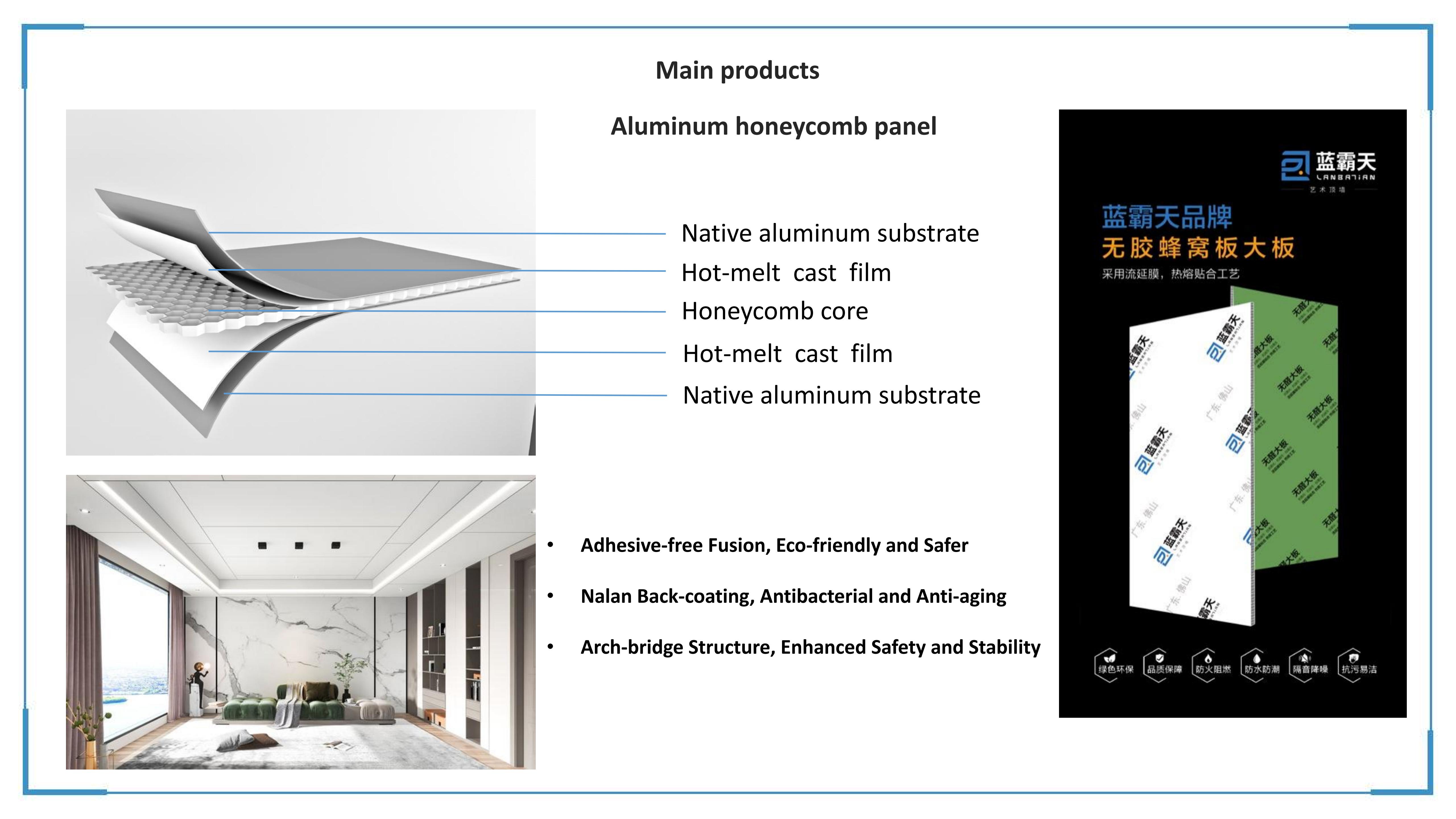
Close-up view of a glue-free aluminum honeycomb panel used for ceilings and wall panels.
For wall panels (model NBW-WPB-003), the customization extends to honeycomb core specifications such as 3×3, 4×4, 5×5, 8×8, and 10×10 mm, and aluminum skin thickness combinations including 0.3 mm, 0.48+0.2 mm, 0.65+0.2 mm, and 1.0 mm. Surface options include solid wood veneer, PETG high gloss, scratch-resistant wood grain, melamine CPL, solid color, powder coating, and wood-grain heat transfer. This level of variety supports door-wall-cabinet color matching — a requirement in modern whole-house customization.
Nanbeiwang also produces all-aluminum interior doors (NBW-DOR-005) with frame designs ranging from 60 mm Korean profiles to 18 mm frameless versions, and aluminum ceilings (NBW-CLB-004) with large integrated boards and seamless splicing. From a buyer's perspective, a supplier that controls panels, doors, and ceiling systems can simplify procurement and reduce the risk of color mismatch across different components.
Certifications and Standards Evidence
Certifications provide verifiable proof that customization does not compromise safety or environmental performance. Nanbeiwang's documented certificates include:
| Certification / Report | Standard | Scope |
|---|---|---|
| ISO 9001:2015 | Quality management system | Aluminum honeycomb panels for furniture, wall, ceiling, cabinet |
| ISO 14001:2015 | Environmental management system | Aluminum honeycomb panels for furniture, wall, ceiling, cabinet |
| GB18584-2024 Hazardous Substance Test | GB18584-2024 | Full series of all-aluminum honeycomb panels |
| SGS RoHS Test | GB/T 26572-2011 / RoHS Directive 2011/65/EU | 18 mm PETG aluminum honeycomb panel — Cd, Pb, Hg, CrVI, PBBs, PBDEs |
| CTC Peel Strength & Temperature Resistance | JC/T 2113-2012 | Glue-free aluminum honeycomb panel |
| Formaldehyde Emission Test | GB 18584-2001 | Aluminum cellular board 50×50 cm |
For global buyers, the practical value of these documents is twofold. First, they demonstrate that the manufacturer has a quality management system in place, not just isolated product tests. Second, they give procurement teams documents to include in project compliance files, especially in markets where formaldehyde limits and RoHS substance restrictions are enforced.
Application and Use Cases: Evidence from the Field
Buyers evaluating OEM capability should look for reference projects that match their own application profile. Nanbeiwang's published case data covers both high-volume industrial supply and whole-home customization.
Industrial-scale supply for an aluminum fabricator in Qatar
A B2B factory client in Qatar — an aluminum cabinet and wardrobe manufacturer — has received more than 2,000,000 sheets from Nanbeiwang over a relationship described as 20+ years of lab-tested durability. The panels feed a factory production line for aluminum cabinets and wardrobes. Reported highlights include daily shipping of 30–50 tons, custom sizing support for 1.22×2.75 m standard and other dimensions, 24-hour dispatch from a 10,000 m² warehouse, and technical guidance on cutting optimization. The stated outcome is stable monthly orders with zero quality complaints.
Whole-home customization project in Indonesia
In Indonesia, 800,000 sheets were used for a whole-house customization project covering cabinets, wardrobes, wall panels, and doors. The product specification emphasized glue-free zero formaldehyde, full-stock availability, and fast delivery. The project was delivered with a 20–30 year expected service life, and the client reported stable quality, a high repurchase rate, and a 20% cost reduction.
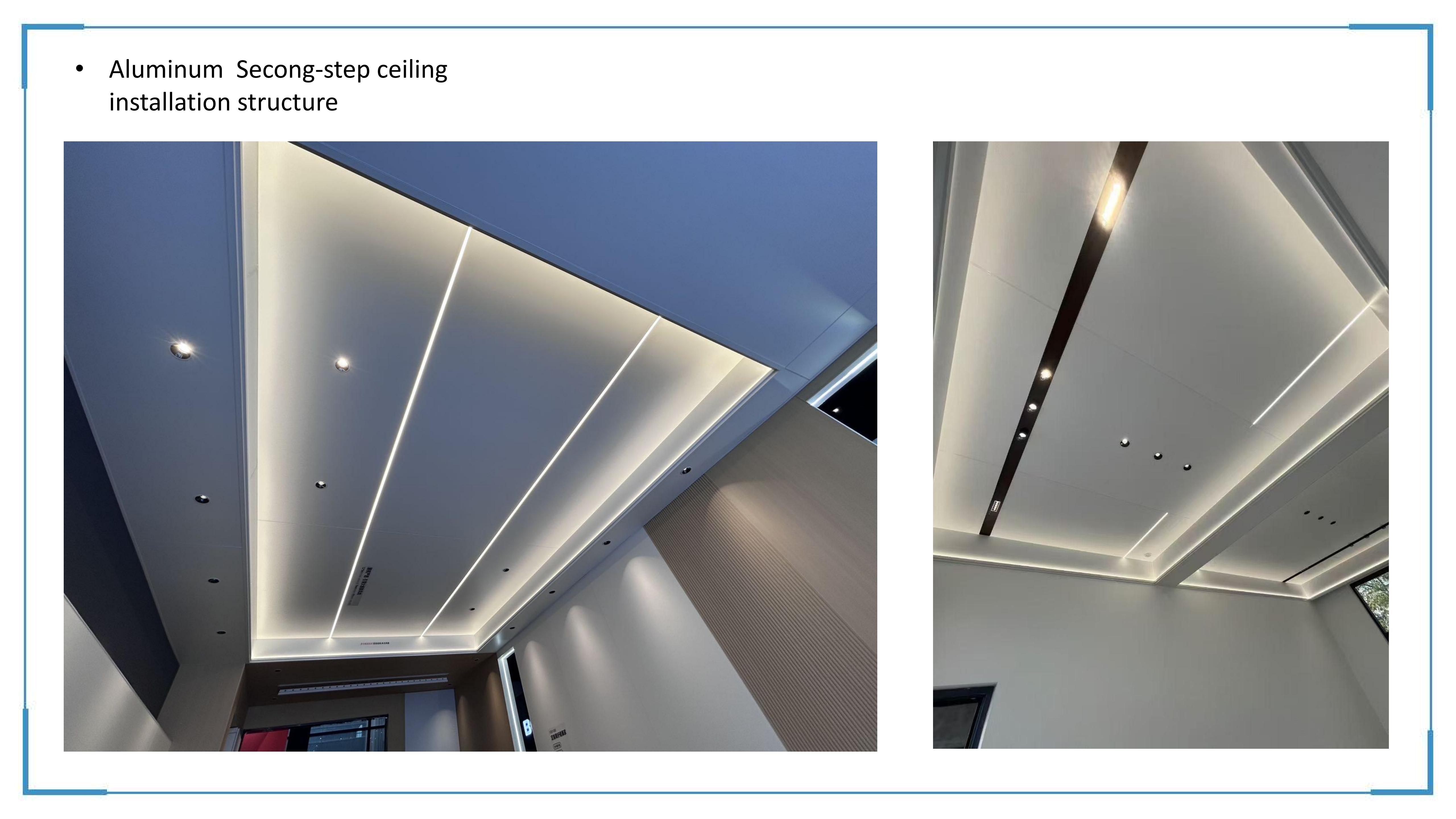
Aluminum honeycomb panel used in a finished interior ceiling and wall application.
Multi-country distribution and engineering support
Beyond single large projects, Nanbeiwang's panels have been supplied to furniture factories, wholesalers, decoration companies, and trading companies in Malaysia, Saudi Arabia, Singapore, Thailand, South Africa, Kosovo, and Kuwait. The stated scale is 10,000+ cooperative factories and 5,000+ projects, with applications ranging from cabinet production to wholesale supply and engineering support.
For a procurement evaluator, these examples demonstrate several execution-relevant capabilities: the ability to sustain very large order volumes, the ability to coordinate custom sizing with delivery schedules, and the presence of after-sales support structures that matter when panels are integrated into complex production lines.
Market Trends Reshaping Honeycomb Panel Demand
Several market dynamics are pushing honeycomb panels further into construction and decoration procurement:
- Market growth: The global aluminum honeycomb panel market was estimated at USD 3.57 billion in 2024, according to aggregated industry research.
- Architectural dominance: Building panels and architectural interiors are the largest application segment, supported by the material's strength-to-weight ratio.
- Chinese export strength: China's exports of aluminum structures reached USD 5.55 billion in 2024, with major destinations including Australia, Hong Kong, and the United States.
- Fire safety regulation: In Europe, EN 13501-1 classifies panels as A1 or A2 for non-combustibility; in North America, ASTM E84 measures surface burning characteristics. Buyers are increasingly required to document compliance.
- Eco-material preference: The demand for formaldehyde-free, moisture-resistant, and recyclable materials is rising, especially in residential cabinetry and doors.
Nanbeiwang's export footprint — roughly 50% of output going to Europe, Southeast Asia, the Middle East, and North America — aligns with these trends. Its certifications cover both EU RoHS requirements and Chinese national standards, giving buyers a standard-based starting point for project-specific compliance.
Comparison with Traditional Wood-Based Panels: Advantages and Boundaries
When compared with traditional materials such as plywood, MDF, or particleboard, aluminum honeycomb panels offer clear technical advantages: they are dimensionally stable in humid environments, resistant to warping and mildew, free of formaldehyde, and inherently non-combustible at A2 level. Their low weight reduces transport cost and facilitates large-format installation. For wet-zone applications such as kitchens and bathrooms, these properties are often decisive.
However, a responsible procurement view must also recognize the boundaries of the material. Aluminum honeycomb panels generally come at a higher upfront cost than commodity wood-based boards. They require specific cutting and edge-processing tools; fabricators without experience may need to adjust their workflow. The surface feel is metallic or laminate-like, which differs from real wood and may not suit projects where authentic wood texture is the priority. In high-load shelf applications, a thin honeycomb panel may need additional structural reinforcement or a thicker aluminum skin. And although custom sizes are available, some unusual dimensions or complex edge profiles may require tooling changes and longer lead times.
For a buyer, the decision is not about which material is universally better, but which material fits the project's performance requirements, installation conditions, and budget. OEM suppliers that clearly communicate these trade-offs are more reliable partners than those that present their product as a universal replacement.
Future Outlook: From Panel Supply to Integrated Customization
The next phase of honeycomb panel demand is likely to be defined by integration and customization. Whole-house projects increasingly ask for consistent color and surface matching across doors, wall panels, ceilings, and cabinets. That shifts the value from a single panel to a coordinated material system — including profiles, hardware, and installation accessories. Manufacturers with in-house design, R&D, and roll-forming capabilities are better positioned to support this trend.
Nanbeiwang's position as a founding enterprise of China's all-aluminum home furnishing industry, and its participation in drafting group standards for all-aluminum home furnishing products, suggest a long-term orientation toward product-system compatibility rather than single-commodity sales. For buyers, this means that future OEM projects may involve not only “make this panel” but “supply a package of panels, profiles, doors, and ceilings that work together.”
For further technical reference, Nanbeiwang's 2026 product brochure is publicly available for download: Nanbeiwang 2026 Brochure (PDF).
FAQ
What honeycomb panel customization options does Nanbeiwang Aluminum offer?
Nanbeiwang Aluminum provides OEM and customization services for thickness, size, color, surface finish, and cutting. For example, the standard honeycomb panel supports thicknesses from 5 mm to 18 mm and panel sizes of 1220 × 2750 mm, both customizable. Aluminum skin thickness can range from 0.3 mm to 1.0 mm, and surfaces can be PETG, melamine, powder coating, or wood grain.
What is the minimum order quantity for OEM honeycomb panels?
The MOQ is 1 sheet. This low entry point allows cabinet factories, fabricators, and traders to test custom specifications before scaling to production volumes.
What are Nanbeiwang's production capacity and typical lead times?
The monthly production capacity is 50,000+ sheets. Stock items are usually dispatched in 1–7 days; custom orders generally take 7–15 days, depending on thickness, size, surface treatment, and quantity.
What quality controls and certifications are in place before shipment?
Nanbeiwang performs 100% full inspection before shipment and supports third-party inspection. Documented certifications include ISO 9001:2015, ISO 14001:2015, GB18584-2024 hazardous substance test, SGS RoHS test, CTC peel strength and temperature resistance test, and a formaldehyde emission test based on GB 18584-2001.
Can Nanbeiwang handle large-scale or multi-country projects?
Yes. Documented supply includes more than 2,000,000 sheets delivered to an aluminum fabricator in Qatar, 800,000 sheets for a whole-home project in Indonesia, and ongoing supply to clients in Malaysia, Saudi Arabia, Singapore, Thailand, South Africa, Kosovo, and Kuwait, representing over 10,000 cooperative factories and 5,000 projects.
¿Tiene preguntas o necesita más detalles?
Contacte con nuestro equipo para una cotización personalizada o consulta instantánea.
Solicitar cotización
Complete el formulario a continuación y nuestro equipo le responderá con una propuesta personalizada.
Chat directo de WhatsApp
¿Prefiere chatear en tiempo real? Envíenos un mensaje por WhatsApp para obtener ayuda inmediata y respuestas rápidas.
- Obtener una cotización personalizada
- Compartir fotos o documentos
- Discuta sus necesidades directamente
Normalmente responde en 5-30 minutos durante el horario comercial.