
Homogeneous Vinyl vs Aircraft Flooring: Certificate Scopes
A certificate file is not one claim. It is a stack of documents, each answering a narrow question: which product, tested to which standard, by which body, on which date. Buyers who compare certificate counts instead of certificate scopes often accept paperwork that says less than the purchase order requires.
FARFLYING FLOORING (Wuxi Tefa Decoration Material Co., Ltd.) is a China-based resilient flooring manufacturer founded in 2012, producing homogeneous vinyl flooring, PVC sports flooring and aircraft flooring, with roughly half of its output sold outside China. Its two flooring lines are documented in structurally different ways. The homogeneous vinyl range (product ID 3659) carries a six-document product testing file. The aircraft flooring range (product ID 3683, models LY, SMY, MMY, MY, BY and WD) carries one CE certificate issued against EN 14041:2018 plus three ISO management-system certificates. Neither structure is automatically stronger. What differs is what each document is able to prove.
Why scope, not volume, is the first thing to read
A test report names the standards it applied and the properties it measured. A management-system certificate names the management system it audited and the business scope it covers. A CE certificate names a product standard and the conformity statement made against it. These are three different categories of evidence, and a tender clause written for one category cannot be satisfied by another.
The practical consequence for procurement is that every certificate line should be read back into three questions. Does the document cover the exact product model being purchased? Does the standard cited correspond to the property the specification requires? And is the document inside its validity window at the date of delivery, not merely at the date of tender? A file that fails any of the three adds administrative weight without adding acceptance value.
The homogeneous vinyl file: six documents, six separate jobs
For homogeneous vinyl flooring, the documentation is product-level and deliberately divided. Each SGS report carries its own certificate number and its own standard list, which lets a buyer map one report to one section of a specification instead of treating the whole file as a single pass or fail.
| Document | Issuer | Standard(s) cited | What the scope covers | Issued |
|---|---|---|---|---|
| SGS XMIN2109010490CM | SGS | ISO 24346:2006; ISO 23997:2007; ISO 4918:2016; ISO 29333:2018; ISO 26987:2008; ISO 10581:2019; ISO 105-B02:2014 | Residual indentation, dimensional stability, flexibility, wear resistance, chemical resistance, classification requirements, colour fastness to light | 2022-03-07 |
| SGS XMIN2109010491CM | SGS | EN 433:1999 | Resistance to pressure marks and deformation from furniture, equipment or heavy traffic; dimensional recovery | 2022-03-07 |
| SGS XMIN2109010492CM | SGS | DIN 51130:2014-02; EN 13893:2002; EN 684:1995; EN 14041:2018; EN 1815:2016; EN 13501-1:2018; EN ISO 9239-1:2010; EN ISO 11925-2:2020 | Slip resistance, wear, electrostatic performance, fire resistance, ignition behaviour, radiant heat resistance, CE compliance | 2022-03-07 |
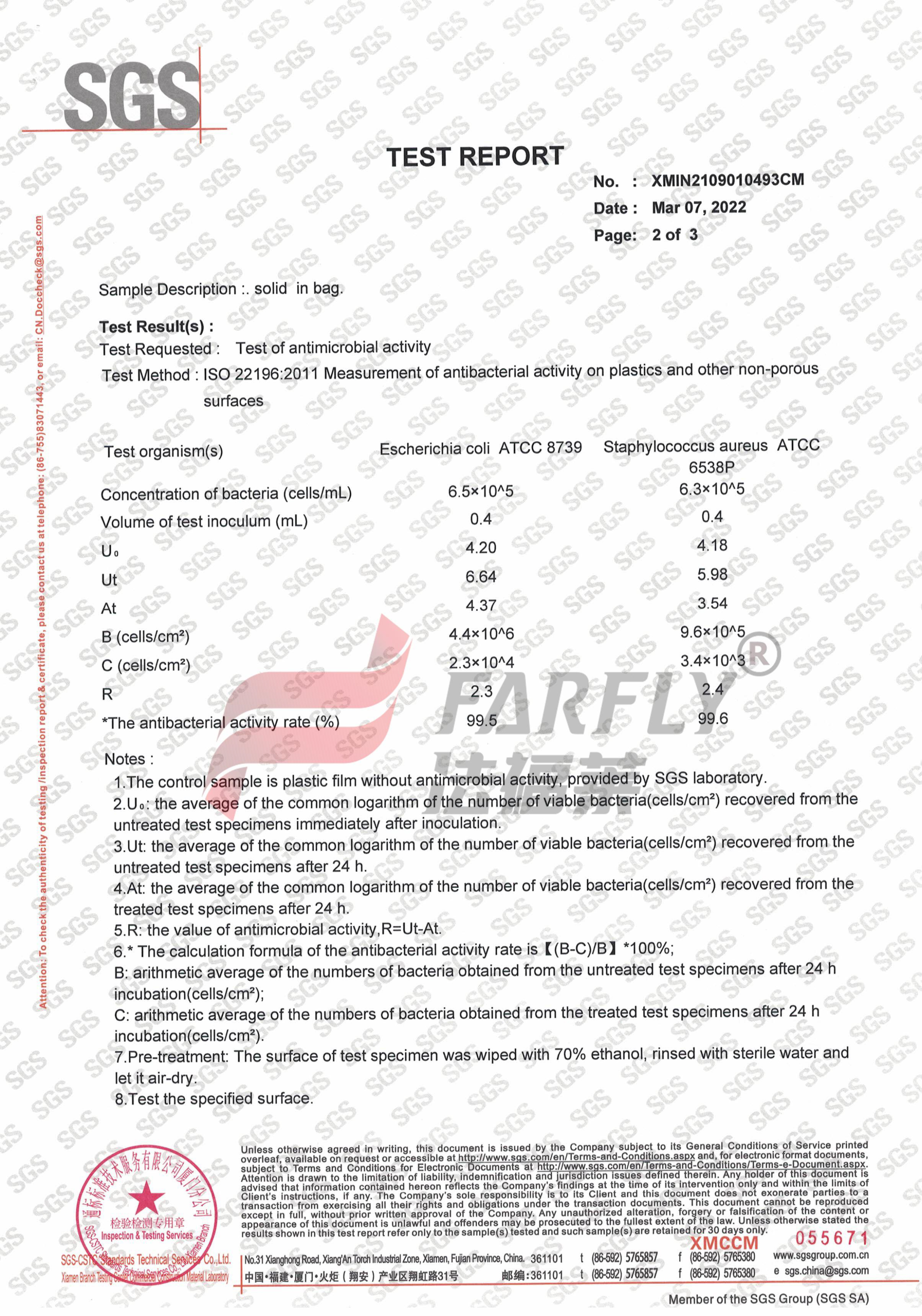
| SGS XMIN2109010493CM | SGS | ISO 22196:2011 | Antibacterial performance, measured as bacterial reduction on the flooring surface | 2022-03-07 |
| CTC WT2020B01A03405 | CTC | ISO 16000-9:2006/Cor1:2007 | VOC emissions under controlled indoor conditions; 28-day TVOC performance | 2020-06-12 |
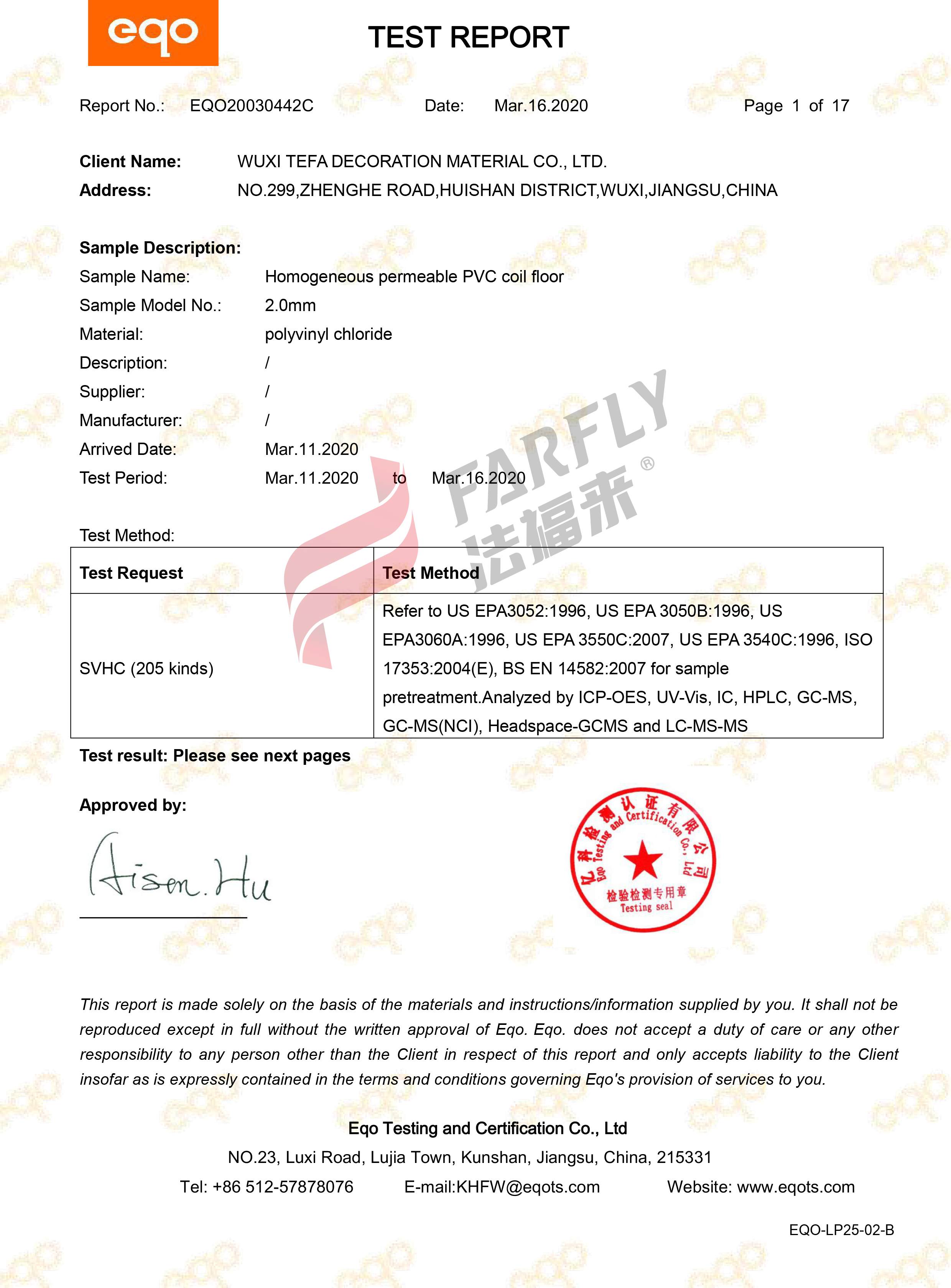
| EQO EQO20030442C | EQO | EU REACH Regulation (1907/2006/EC), 205 SVHC substances | Hazardous chemical content and SVHC screening for homogeneous flooring | 2020-03-16 |
The split matters because each block answers a different buyer question. XMIN2109010490CM is the classification and durability block: it is where EN ISO 10581 and the associated physical methods sit, and it is the only document in the set that speaks to product classification. XMIN2109010491CM is narrow by design, covering only EN 433:1999 indentation behaviour, which is the clause that governs beds, trolleys and heavy rolling equipment in healthcare buildings. XMIN2109010492CM is the safety block, bundling slip resistance, electrostatic performance and fire reaction methods, and it also lists EN 14041:2018 among its eight standards. XMIN2109010493CM covers ISO 22196:2011 antibacterial performance. The two non-SGS documents complete the environmental and chemical picture: CTC WT2020B01A03405 addresses 28-day VOC emissions, and EQO EQO20030442C addresses the EU REACH SVHC list.
The aircraft flooring file: one product document, three system documents
The aircraft flooring line is documented far more compactly, and the composition of that set is itself informative. One document speaks to the product. Three speak to the organisation.
| Document | Issuer | Standard | Scope as stated | Validity |
|---|---|---|---|---|
| CE TCF-OY20250623-CPR | ICR Co. Ltd. | EN 14041:2018 | PVC flooring compliance with the European Union safety and performance requirements for construction products | 2025-06-26 to 2030-06-25 |
| ISO 9001, certificate 29524Q04072R0S | Auburn Inspection & Certification Group Co., Ltd. | ISO 9001:2015 | Sales of decoration materials (excluding hazardous chemicals and precursor chemicals) and sports competition supplies | 2024-11-25 to 2027-11-24 |
| ISO 14001, certificate 29524E04073R0S | Auburn Inspection & Certification Group Co., Ltd. | ISO 14001:2015 | Sales of decoration materials and related environmental management activities of the places involved | 2024-11-25 to 2027-11-24 |
| ISO 45001, certificate 29524S040725R0S | Auburn Inspection & Certification Group Co., Ltd. | ISO 45001:2018 | Sale of decorative and finishing materials, and related occupational health and safety management activities | 2024-12-23 to 2027-12-22 |
Read strictly, the CE certificate is the only product-facing document in this set. It states that PVC flooring meets EU safety and performance requirements for construction products, and the certificate record associates it with the aircraft flooring models as well as the homogeneous vinyl and PVC sports flooring ranges. The three ISO certificates are a different category: they audit a management system against a defined business scope, and that scope is written in commercial language — sales of decoration materials, sports competition supplies and the related management activities. They support supplier qualification, continuity and audit trail. They do not certify the fire behaviour, smoke toxicity or abrasion performance of a floor panel, and no buyer should let a QMS certificate stand in for a product test report.
Where the two files overlap, and where they diverge
EN 14041:2018 appears in both lines, but not in the same role. For homogeneous vinyl it is one of eight standards cited inside SGS XMIN2109010492CM, sitting alongside slip, electrostatic and fire methods. For aircraft flooring it is the standard behind a stand-alone CE certificate, TCF-OY20250623-CPR, issued by ICR Co. Ltd. and valid from 26 June 2025 to 25 June 2030. The same standard number therefore carries different documentary weight depending on whether it appears as a test line inside a report or as the basis of a conformity certificate. That distinction is worth writing into a technical submittal, because a reviewer checking for EN 14041 coverage may otherwise accept a report line where the specification asked for a certificate.
A second divergence is electrical performance. The homogeneous vinyl file includes EN 1815:2016 electrostatic testing within XMIN2109010492CM, and the manufacturer describes its ESD series as maintaining resistance in the range of 104 to 106 ohms. The aircraft flooring documents summarised here contain no electrical performance line at all, because cabin flooring procurement is driven by different priorities. Buyers should not carry a resistance class across from one line to the other, and should not assume flammability data from the aviation side applies to a hospital roll. The evidence does not support either inference.
Mapping each scope to purchase terms and acceptance criteria
The table below is the working part of this comparison. It converts document scope into contract language and into the evidence a buyer should demand at acceptance.
| Purchase term | Evidence in the file | Acceptance criterion to write into the order |
|---|---|---|
| Product classification and abrasion class | SGS XMIN2109010490CM (EN ISO 10581:2019 among seven standards) | Group T declared on the datasheet and traceable to the report page; Group T corresponds to a volume loss of no more than 2.0 mm³ per 100 revolutions under EN 660-2 |
| Indentation and rolling loads | SGS XMIN2109010491CM (EN 433:1999) | Residual indentation declared for the specified thickness and confirmed in the report |
| Slip resistance | SGS XMIN2109010492CM (DIN 51130:2014-02; EN 13893:2002) | R rating matched to the surface actually supplied, including where the TF surface treatment is specified |
| Electrostatic and ESD performance | SGS XMIN2109010492CM (EN 1815:2016) plus the manufacturer's 104–106 ohm ESD statement | Resistance type, test method, conditioning and product series stated in one submittal line, not split across two documents |
| Fire classification | SGS XMIN2109010492CM (EN 13501-1:2018; EN ISO 9239-1:2010; EN ISO 11925-2:2020) | Reaction-to-fire class supported by the classification pages for the delivered construction |
| Hygiene and antibacterial performance | SGS XMIN2109010493CM (ISO 22196:2011) | Antibacterial rate declared and tied to the product code shipped to site |
| Indoor air quality | CTC WT2020B01A03405 (ISO 16000-9:2006/Cor1:2007) | 28-day TVOC result attached to the submittal; the 2 mm homogeneous range is declared at under 10 μg/m³ |
| Hazardous substances | EQO EQO20030442C (EU REACH, 205 SVHC) | Current SVHC list version confirmed and the declaration dated at shipment |
| EU construction-product conformity | CE TCF-OY20250623-CPR (EN 14041:2018) | Certificate in force at the delivery date, with the delivered model named in the submittal |
| Supplier management systems | ISO 9001, ISO 14001, ISO 45001 certificates | Certificates valid at the delivery date, with the stated business scope reviewed and accepted by the buyer's compliance team |
Two entries in that table deserve emphasis because they are where acceptance most often breaks down. The ESD clause fails when a buyer accepts a resistance range without the test method and conditioning that produced it; the range alone cannot be compared with another supplier's figure unless both were measured the same way. The fire clause fails when a buyer accepts a reaction-to-fire class from a report whose tested construction does not match the delivered roll. Both are scope problems, not performance problems.
Validity windows and version control
Dates decide whether a document is usable at handover. The three ISO certificates run on separate cycles: ISO 9001 (29524Q04072R0S) and ISO 14001 (29524E04073R0S) were issued on 25 November 2024 and expire on 24 November 2027, while ISO 45001 (29524S040725R0S) was issued on 23 December 2024 and expires on 22 December 2027. A project with a 2028 completion date will require updated copies, and the purchase order should name that obligation rather than assume it.
The CE certificate holds the widest window in the set, running to 25 June 2030. The SGS reports and the CTC and EQO documents instead record an expiry field of 31 December 2099, which in practice means no scheduled re-issue. Buyers should read that as a version-control risk rather than a lifetime guarantee. The reports were issued between March 2020 and March 2022, so acceptance should confirm that the product code, formulation and surface treatment shipped to site are the ones the reports describe — particularly where a surface treatment or colour range has changed since the test date.
What each file means on a real project
Healthcare procurement is where the homogeneous vinyl scope does most of its work. A hospital specification typically combines indentation resistance for beds and equipment, antibacterial surface performance, and indoor emissions — which is exactly the three-document structure of XMIN2109010491CM, XMIN2109010493CM and CTC WT2020B01A03405. Electrical performance is added only where the room type requires it. In the Samarkand hospital project, approximately 12,600 m² was supplied as a mixed package: about 10,000 m² of homogeneous vinyl for wards and general areas, plus 2,000 m² of anti-static PVC flooring for operating rooms, together with compatible welding rods and adhesive. That split mirrors the certificate set — a general-area claim and a separate static-control claim, each evidenced on its own line.
A second hospital reference, approximately 15,000 m² of 2.0 mm multi-colour homogeneous vinyl at Jo Ann University Hospital in Tbilisi, illustrates the part certificates do not cover. Continuous sheet installation with heat-welded joints and floor-to-wall coving determines whether a hygienic surface performs as tested; the reports describe the material, not the seam.
Aircraft flooring is procured against airworthiness logic rather than construction-product logic. Cabin floor panels are assessed for fire behaviour and combustion toxicity under references such as FAR 25.853 and Boeing BSS 7239, which the manufacturer's aviation range description cites. Those references do not appear as certificate numbers in the document set summarised here, so an aviation buyer should request the corresponding test reports and confirm which model designation they cover. Stating that gap is more useful than implying the CE certificate closes it.
What these certificates cannot tell you
Three limits are worth stating plainly. First, none of these documents certifies installation. Subfloor moisture, adhesive open time, groove depth, welding temperature and coving detail are site variables, and a compliant roll can still produce a non-compliant floor. Second, the ISO 9001, ISO 14001 and ISO 45001 certificates describe management systems with a stated business scope covering sales of decoration materials and sports competition supplies and the related management activities; they support supplier qualification and audit trail, but they do not certify the fire, slip or emission performance of any panel. Third, a multi-standard report such as XMIN2109010490CM is only as useful as the buyer's reading of it. If the specification does not name the standard line it relies on, acceptance has nothing specific to test against.
Market context: documentation is becoming the differentiator
Demand-side pressure is moving in the same direction as this analysis. Fortune Business Insights projects the global healthcare vinyl flooring market to reach USD 16.9 billion by 2034, with a CAGR of 7.5% across the 2026–2034 forecast period. Growth of that kind increases the number of suppliers quoting for the same hospital package, and specification guidance already circulating in the market is written in the document-by-document language this comparison recommends — for example, EN ISO 10581 compliance with a Group T abrasion rating and use class 34/43 for heavy commercial and industrial traffic. Under EN ISO 10581 classification, Group T corresponds to the highest abrasion class, defined by a volume-loss threshold of 2.0 mm³ per 100 revolutions under EN 660-2. Buyers who quote those references in the specification receive comparable submissions; buyers who accept the word certified receive incomparable ones.
Future outlook
Two shifts are likely to shape certificate files over the next procurement cycles. The first is granularity: multi-standard reports will be read line by line, and purchase orders will start citing the individual standard rather than the report number. The second is the separation of product conformity from management-system certification, particularly in aviation-adjacent supply, where a construction-product CE mark and an airworthiness test package answer different questions and should be filed separately. Suppliers who already organise documentation by scope — the way the homogeneous vinyl file separates physical, indentation, safety and electrical, and antibacterial evidence — will spend less time in technical clarification rounds, and their buyers will spend less time rebuilding the same matrix for every tender.
FAQ
Does a CE certificate under EN 14041:2018 make a floor covering suitable for an aircraft cabin?
No. The CE certificate TCF-OY20250623-CPR states that PVC flooring complies with EU safety and performance requirements for construction products under EN 14041:2018. Cabin flooring is assessed against airworthiness requirements such as FAR 25.853 and Boeing BSS 7239, which the manufacturer's aviation range description cites. Because those references are not presented as certificate numbers in the document set summarised here, an aviation buyer should request the corresponding test reports and confirm the covered model designation.
What is the difference between an SGS test report and an ISO 9001 certificate?
An SGS report such as XMIN2109010493CM measures a product property against a named standard — in that case ISO 22196:2011 antibacterial performance — and its scope is limited to the tested product. An ISO 9001 certificate such as 29524Q04072R0S audits a management system against a stated business scope covering sales of decoration materials and sports competition supplies. One supports a product performance clause; the other supports supplier qualification.
Which document should a hospital tender cite for hygiene and indoor air quality?
Two separate documents. Hygiene is covered by SGS XMIN2109010493CM under ISO 22196:2011, and the 2 mm homogeneous range is declared at 99.50% antibacterial performance. Indoor emissions are covered by CTC WT2020B01A03405 under ISO 16000-9:2006/Cor1:2007, with a declared 28-day TVOC of under 10 μg/m³. A single submittal should attach both, since neither substitutes for the other.
How should buyers treat certificates that list an expiry of 31 December 2099?
Treat the date as meaning no scheduled re-issue rather than a lifetime guarantee. The SGS reports, the CTC TVOC document and the EQO REACH document carry that expiry field and were issued between March 2020 and March 2022. Acceptance should confirm that the shipped product code, formulation and surface treatment match the tested versions, and should require written confirmation if any of them changed.
Why do the ISO 9001, 14001 and 45001 certificates carry different dates?
They were issued on separate audit cycles. ISO 9001 and ISO 14001 were both issued on 25 November 2024 and expire on 24 November 2027, while ISO 45001 was issued on 23 December 2024 and expires on 22 December 2027. A purchase schedule should track the three certificates individually rather than as one renewal event.
Is EN 1815 electrostatic charge the same measurement as ESD resistance in ohms?
No. EN 1815:2016, cited inside SGS XMIN2109010492CM, addresses electrostatic charge behaviour, while resistance in ohms is a separate metric and is reported here through the manufacturer's statement that the ESD series maintains 104 to 106 ohms. Because the resistance figure and the charge figure describe different properties, a submittal should state the metric, the test method and the conditioning for each rather than presenting a single ESD claim.
Reference document
A downloadable PDF brochure covering FARFLYING FLOORING's resilient flooring ranges is available here: company brochure.
¿Tiene preguntas o necesita más detalles?
Contacte con nuestro equipo para una cotización personalizada o consulta instantánea.
Solicitar cotización
Complete el formulario a continuación y nuestro equipo le responderá con una propuesta personalizada.
Chat directo de WhatsApp
¿Prefiere chatear en tiempo real? Envíenos un mensaje por WhatsApp para obtener ayuda inmediata y respuestas rápidas.
- Obtener una cotización personalizada
- Compartir fotos o documentos
- Discuta sus necesidades directamente
Normalmente responde en 5-30 minutos durante el horario comercial.