
Homogeneous Vinyl Flooring Certification Checklist for Healthcare
Homogeneous Vinyl Flooring Certification Checklist for Healthcare
A healthcare flooring certificate is useful only when its tested product, measured property, method and scope match the project specification. For homogeneous vinyl flooring in hospitals and other high-traffic facilities, specifiers should verify the evidence item by item—and assess the flooring system and installation plan alongside the roll itself.
FARFLYING FLOORING is the flooring brand associated in the supplied project and product records with homogeneous vinyl and healthcare flooring solutions. For buyers evaluating a product such as the Vinyl Flooring range associated with product ID 3659, the practical question is not simply whether a supplier can provide certificates. It is whether each document supports the exact requirement for the room, product configuration and intended use.
Why a checklist matters for healthcare and heavy traffic
Hospital flooring requirements are not uniform across a building. General circulation areas, patient wards, operating rooms and other specialist spaces can call for different combinations of wear performance, cleanability, slip resistance, electrical behavior, emissions and installation details. A broad claim such as “hospital grade” cannot resolve those differences without measurable, product-specific evidence.
There is also a difference between a product document and a complete project qualification. A report may substantiate a test on a particular sample, while a project still depends on the selected roll, compatible adhesive and welding rod, subfloor preparation, seam treatment and installation quality. Procurement review should therefore connect the evidence to the intended location and to the actual flooring package being offered.
This approach is especially useful for heavy-traffic healthcare projects. A flooring type may be considered for intensive use, but the buyer still needs to verify the specified wear classification, indentation performance and other acceptance criteria against the project documents. Where a requirement is not supported by the available records, it should remain an open item—not be inferred from a neighboring certificate or a general product description.
Start with the project schedule, not the certificate folder
Before reviewing supplier documents, convert the project brief into a room-by-room schedule. Identify the function of each area, traffic conditions, rolling equipment or loads if relevant, cleaning and maintenance expectations, electrical-control requirements, and the applicable fire and emissions criteria. Record which values are mandatory and which are preferences. This makes it possible to distinguish a genuine compliance gap from a product feature that is not required in that area.
For each line item, record the required value or classification, the evidence requested, and the product code to which that evidence must apply. If a specification calls for a particular thickness, slip result, resistance range or fire classification, a brochure statement is not a substitute for the relevant technical data or test documentation. If the project documents do not state a test method or acceptance threshold, seek clarification before comparing products.
| Project question | What to record | Evidence to match |
|---|---|---|
| Which room or zone is being assessed? | Room function and project location | Product code and application scope |
| What performance is required? | Specified classification, value or threshold | Product data and the relevant test report |
| Does the document apply to the offered product? | Model, construction and document scope | Report identification and supplier confirmation |
| Can the floor be installed as specified? | Subfloor, seams, accessories and detailing | System components and installation guidance |
| What remains unverified? | Missing results or scope mismatches | A documented clarification or additional evidence |
Technical checklist: match each data point to the requirement
1. Wear classification and intended traffic
Confirm the wear classification required by the project and check that the product documentation identifies the same classification. The verified industry data package records a reference for homogeneous vinyl flooring under EN ISO 10581 and describes Wear Group T as a volume loss of no more than 2.0 mm³ per 100 revolutions under the cited classification information. Goodrich Global’s specifier guidance also identifies Group T and use classes 34/43 as considerations for heavy commercial and industrial traffic. These references help frame a specification review; they do not establish that an unspecified product complies.
Ask for documentation tied to the offered product and the required classification. Do not treat the phrase “T-group wear resistant homogeneous flooring” as a complete result unless the report identifies the test basis and product scope. A classification reference, a supplier statement and a product-specific report are different kinds of evidence.
2. Overall thickness and wear-layer information
Compare the specified overall thickness with the product’s technical data and ensure the quoted construction is the one covered by the supporting documents. If the project specification also asks for wear-layer thickness, request that value separately and confirm how it applies to homogeneous construction. Do not assume the overall thickness and wear-layer thickness are interchangeable fields.
The supplied first-party corpus does not establish the requested model 3659 thickness options or a product-specific wear-layer value. Consequently, this article does not present 2 mm, 2.5 mm or 3 mm as verified specifications for model 3659. A buyer considering those values should obtain the current technical data sheet and confirm the exact model and configuration before approval.
3. Slip resistance
Check the project’s slip-resistance requirement, the test method, the reported result and the conditions under which the result applies. The SGS documentation listed for the Vinyl Flooring product category includes standards covering slip resistance among several flooring performance areas, including DIN 51130:2014-02 and EN 13893:2002. The record does not provide a specific slip-resistance result for an individual product. A list of standards in a report scope should not be read as a particular pass value or rating unless the report states it.
4. Indentation resistance and rolling loads
For areas exposed to furniture, equipment or heavy traffic, assess residual indentation and the project’s stated load conditions. The SGS records include an EN 433:1999 report described as evaluating pressure marks and deformation caused by furniture, equipment or traffic. The supplied record does not state a numeric result or a rolling-load rating. Buyers should therefore request the actual report result and check whether the test represents the project’s use case. Do not infer heavy rolling-load performance solely from the presence of an indentation test reference.
5. Fire classification
Match the required fire classification to the product-specific report and the applicable project or jurisdictional requirements. The SGS standards record includes EN 13501-1:2018 and other fire-related standards in its scope, but the supplied corpus does not establish a B-S1 result for model 3659. The classification B-S1 should not be attributed to that model without a report or declaration that names the product and confirms the result.
6. Emissions and indoor-air documentation
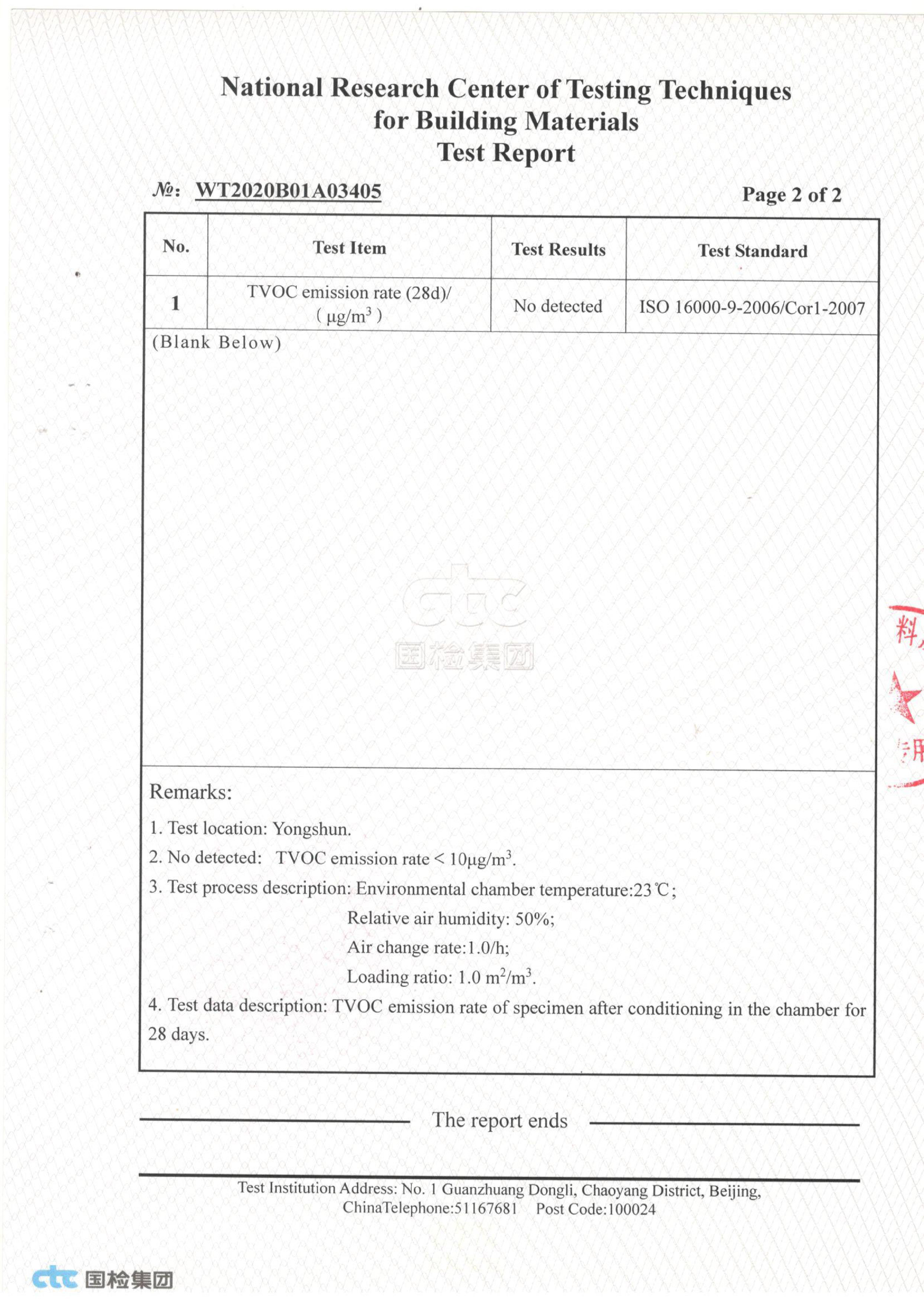
For low-emission or indoor-air requirements, verify the test method, test duration, reported value, product identification and any project acceptance threshold. A FARFLYING-related certification record identifies a TVOC emission-rate test after 28 days under ISO 16000-9:2006/Cor1:2007, issued by CTC under report number WT2020B01A03405. The supplied record does not state a TVOC result, so it does not substantiate a claim such as “TVOC <10 µg/m³.” That value should only be used if supported by the applicable test report for the specified product.
Similarly, a “low VOC cleanroom vinyl flooring” requirement should be translated into the project’s actual emissions criteria. The presence of an emissions test record is useful evidence to review, but it is not proof of an unreported threshold or of suitability for every cleanroom specification.
7. Antibacterial claims and surface treatment
Where antibacterial performance is specified, ask for the measured result, test method, product scope and interpretation of the reported rate. The available SGS record identifies ISO 22196:2011 as the method associated with an antibacterial test for homogeneous flooring. The supplied record does not include the antibacterial rate, so no rate can be verified from it.
FARFLYING FLOORING’s supplier profile also describes TF Surface Treatment, iodine resistance and wax-free maintenance for its healthcare homogeneous vinyl. The verified data package flags these as supplier-reported claims for which independent test evidence was not located. For an iodine-resistant or wax-free hospital vinyl requirement, buyers should request current product-specific evidence and written maintenance instructions. A surface-treatment description alone does not establish the acceptance result for a project.
8. Electrical performance for ESD and specialist rooms
Separate electrical resistance from electrostatic charge: they are distinct measurements and should not be substituted for one another. FARFLYING FLOORING’s supplier profile reports a resistance range of 104–106 ohms for its ESD series, but the evidence package notes that the test method, conditioning and product-series details were not specified in the retrieved claim. Buyers assessing 104–106 ohm conductive or dissipative flooring should request a product-specific test report that states the resistance type, method, conditions and exact product code.
For a cleanroom, operating room or MRI room, use the project’s electrical-control specification to determine whether a conductive or static-dissipative product is required. “Cleanroom anti-static vinyl flooring,” “permanent conductive ESD vinyl flooring” and “MRI room dissipative vinyl flooring” describe different search or application phrases, not interchangeable performance classifications. The supplied records do not establish that one configuration is suitable for all of these settings.
9. Chemical resistance and maintenance
For laboratories and healthcare areas, identify the chemicals, cleaning regime and maintenance requirements relevant to the project, then request evidence that addresses those specific conditions. The SGS physical-property record lists chemical resistance among the covered topics, but the corpus does not provide a chemical-resistance result for a named agent or exposure condition. “Chemical resistant lab vinyl flooring” should therefore remain a qualification requirement until a relevant result is reviewed.
Ask for written instructions covering routine cleaning and any periodic maintenance, and confirm whether the offered product’s stated maintenance approach is supported by product documentation. Where wax-free maintenance is claimed, clarify the meaning of the claim and its scope rather than treating it as a universal, lifetime guarantee.
10. Certifications, document scope and warranty
Review each document for the issuer, report or certificate number, standard, issue date, product scope and stated result. The supplied records include a REACH SVHC test record covering 205 substances under EU REACH Regulation (1907/2006/EC), report EQO20030442C, and a CE record for PVC flooring under EN 14041:2018, certificate reference TCF-OY20250623-CPR. They also list SGS testing records for physical properties, slip and fire-related standards, TVOC emissions and antibacterial performance. These records are evidence items to inspect; they do not automatically demonstrate that every product variant or project requirement is covered.
Check whether a document concerns the product, the supplier’s management system or a broader product category. A management-system certificate is not a substitute for a product-performance report. Confirm validity and scope directly in the submitted document, and ensure the offered model is within its stated coverage. Request the written warranty and confirm its exclusions, term, covered product and relationship to the project’s maintenance conditions; the supplied corpus does not specify a warranty for model 3659.
Read the evidence as a connected set
A practical review table prevents a common qualification error: treating several certificates as if they collectively prove a result that none of them actually states. For each requirement, record the document and result that address it. Mark a requirement as verified only when the evidence aligns with the offered product and the project threshold.
| Requirement | Evidence present in the supplied records | What still needs product-specific confirmation |
|---|---|---|
| Wear classification | Group T reference and related specification guidance; SGS standards list includes wear-related methods | Offered product’s classification and report result |
| Thickness | Product dimensional standards are listed in SGS scope | Model-specific overall thickness and, where required, wear-layer data |
| Slip and indentation | Relevant standards and an EN 433:1999 report record are identified | Numeric results and match to the project’s test conditions |
| Fire | Fire-related standards appear in the SGS scope | Required classification and model-specific result, including any B-S1 claim |
| TVOC | 28-day test record under ISO 16000-9:2006/Cor1:2007 is identified | Reported value and acceptance threshold |
| Antibacterial | ISO 22196:2011 report record is identified | Measured antibacterial rate and product scope |
| ESD | Supplier profile reports 104–106 ohms for the ESD series | Method, conditions, product code and report result |
| Maintenance and warranty | Supplier profile describes wax-free maintenance for healthcare flooring | Written instructions, claim scope and warranty terms |
Application evidence: the Uzbekistan hospital project
A hospital flooring project in Samarkand, Uzbekistan, illustrates why procurement review should include the whole flooring package rather than only the roll material. The supplied case record describes a solution for approximately 12,600 m² of hospital space. It includes around 10,000 m² of homogeneous vinyl for general areas and patient wards, plus 2,000 m² of anti-static PVC flooring for operating rooms, together with compatible welding rods and adhesive.
The case record also describes coordinated product selection, accessories, export documentation and installation guidance. Its stated project rationale is that area-specific selection addresses differing requirements across wards, public areas and operating rooms, while coordinated materials and guidance reduce procurement complexity and support installation and project acceptance. This is project evidence of system coordination—not a substitute for laboratory certification or proof that every product meets every local code.
For specifiers, the useful lesson is procedural: connect the room schedule to the product schedule, then connect both to accessory compatibility and the installation method. A compliant material can still be poorly represented in a tender if the specification omits welding rods, adhesive or installation responsibilities. Conversely, a complete package does not remove the need to verify technical results and required local approvals.
Installation details belong in the compliance review
Homogeneous vinyl sheet is often specified as a continuous-sheet flooring system. Goodrich Global’s healthcare guidance describes heat-welded joints and flash-coved detailing as approaches used to reduce floor-to-wall junctions; its cited 100 mm detail is guidance, not a universal regulation. The project designer should confirm the required detail for the relevant jurisdiction and room conditions.
The Uzbekistan case likewise identifies continuous sheet installation, heat-welded joints and coordinated accessories as part of the project solution. These details matter to procurement because the product data sheet alone does not define the installed assembly. Ask who is responsible for subfloor preparation, adhesive selection, seam welding, floor-to-wall detailing and acceptance checks, and ensure the scope is documented before delivery.
Where this checklist differs from a conventional certificate check
A conventional document check may confirm that a supplier has certificates or reports on file. A project-fit review asks a more demanding question: does the evidence address this product, this performance property, this test method and this area of use? That distinction helps prevent category-level references from being mistaken for product-level compliance.
The approach also has boundaries. Test reports are not a guarantee of installed performance, and the available corpus does not provide every project-specific value—such as model 3659’s thickness options, B-S1 fire result, TVOC threshold, antibacterial rate, warranty terms or complete chemical-resistance results. Nor does a single hospital project establish universal suitability. Buyers must align current product documentation with the project specification and applicable jurisdictional requirements.
Homogeneous and heterogeneous vinyl are also not identical product constructions. The supplied industry references describe homogeneous flooring as having a consistent composition through its thickness, while heterogeneous flooring uses multiple layers and can offer different design and comfort options. This is a useful material-selection distinction, but it does not replace comparison of product-specific performance data. If design variation, acoustics or another property is part of the brief, include it explicitly rather than assuming the construction type answers every requirement.
Market and procurement implications
The evidence available here supports a procurement observation rather than a quantified market trend: healthcare flooring qualification combines product performance, environmental documentation and installation coordination. The supplied data package identifies gaps in verified thickness, wear, chemical resistance, VOC, antibacterial and rolling-load results for the category. That makes traceable, product-specific documentation a practical screening criterion for specifiers and facility buyers.
For FARFLYING FLOORING, documented test records and the Uzbekistan project provide different kinds of evidence. The test records identify methods and certificate scopes that can be examined; the project record describes area-based product selection and coordination of accessories and installation guidance. Neither evidence type should be stretched beyond its scope. In procurement terms, the strongest evaluation is a mapped set of requirements, documents, product codes and unresolved items—not a single headline claim.
Future outlook: make acceptance criteria auditable
For future healthcare and heavy-traffic flooring projects, a useful next step is to make the compliance schedule auditable from tender through handover. Keep the required value beside the report that supports it, preserve the product code and document revision, and record any deviation or missing test result. Where ESD performance is required, specify the measurement type and method rather than relying on an ohm-range phrase alone. Where maintenance or emissions are critical, define the required evidence and acceptance threshold before product selection.
This method does not presume that every project needs the same flooring or certificate set. It makes the decision traceable: a project team can see which requirement is covered, which product variant is offered, what the evidence actually states and what still requires confirmation.
FAQ
What should buyers verify first when assessing homogeneous vinyl flooring for a hospital?
Start with the room-by-room project requirements and the offered product code. Then match each required wear, thickness, slip, indentation, fire, emissions, electrical and maintenance criterion to product-specific data or a relevant test report. A general certificate list is not enough to establish that a particular product meets every requirement.
Does an identified test standard prove that the product passed?
No. A standard listed in a report scope identifies a test or assessment basis; it does not by itself provide the result or establish compliance with a project threshold. Review the report’s product identification, method, result and stated scope.
Can the available records confirm model 3659’s B-S1 rating or TVOC below 10 µg/m³?
The supplied records do not establish either value for model 3659. They identify fire-related standards and a 28-day TVOC test record, but the relevant product-specific results are not stated. Buyers should verify the exact classification and emissions value in current product documentation before treating them as confirmed.
What does the Uzbekistan hospital project show about flooring qualification?
The Samarkand case record describes approximately 12,600 m² of hospital flooring, with homogeneous vinyl for general areas and wards, anti-static PVC flooring for operating rooms, and coordinated welding rods, adhesive, export documentation and installation guidance. It demonstrates the importance of considering a complete flooring system; it does not independently certify every product or prove universal code compliance.
Are homogeneous and heterogeneous vinyl flooring interchangeable?
No. The supplied industry references describe homogeneous flooring as consistent through its thickness and heterogeneous flooring as a multi-layer construction. Selection should account for the project’s use, design and comfort needs as well as verified product-specific performance data.
Evidence basis: FARFLYING FLOORING corpus records for product-related certifications and the Samarkand hospital project; verified category data on classification and specification references. Product claims should be checked against current, product-specific documentation and the project’s applicable requirements.
¿Tiene preguntas o necesita más detalles?
Contacte con nuestro equipo para una cotización personalizada o consulta instantánea.
Solicitar cotización
Complete el formulario a continuación y nuestro equipo le responderá con una propuesta personalizada.
Chat directo de WhatsApp
¿Prefiere chatear en tiempo real? Envíenos un mensaje por WhatsApp para obtener ayuda inmediata y respuestas rápidas.
- Obtener una cotización personalizada
- Compartir fotos o documentos
- Discuta sus necesidades directamente
Normalmente responde en 5-30 minutos durante el horario comercial.