
Homogeneous Vinyl Flooring: A Procurement Acceptance FAQ
HTNXT Industry Reference · Construction & Decoration
A homogeneous vinyl floor is accepted on the strength of its documentation, not on the strength of a sample square. In healthcare, laboratory and cleanroom tenders, the decisive question is rarely whether a supplier holds certificates; it is whether each certificate covers the product, the property and the market the project actually depends on. This FAQ sets out how buyers can convert a certificate file into enforceable acceptance criteria.
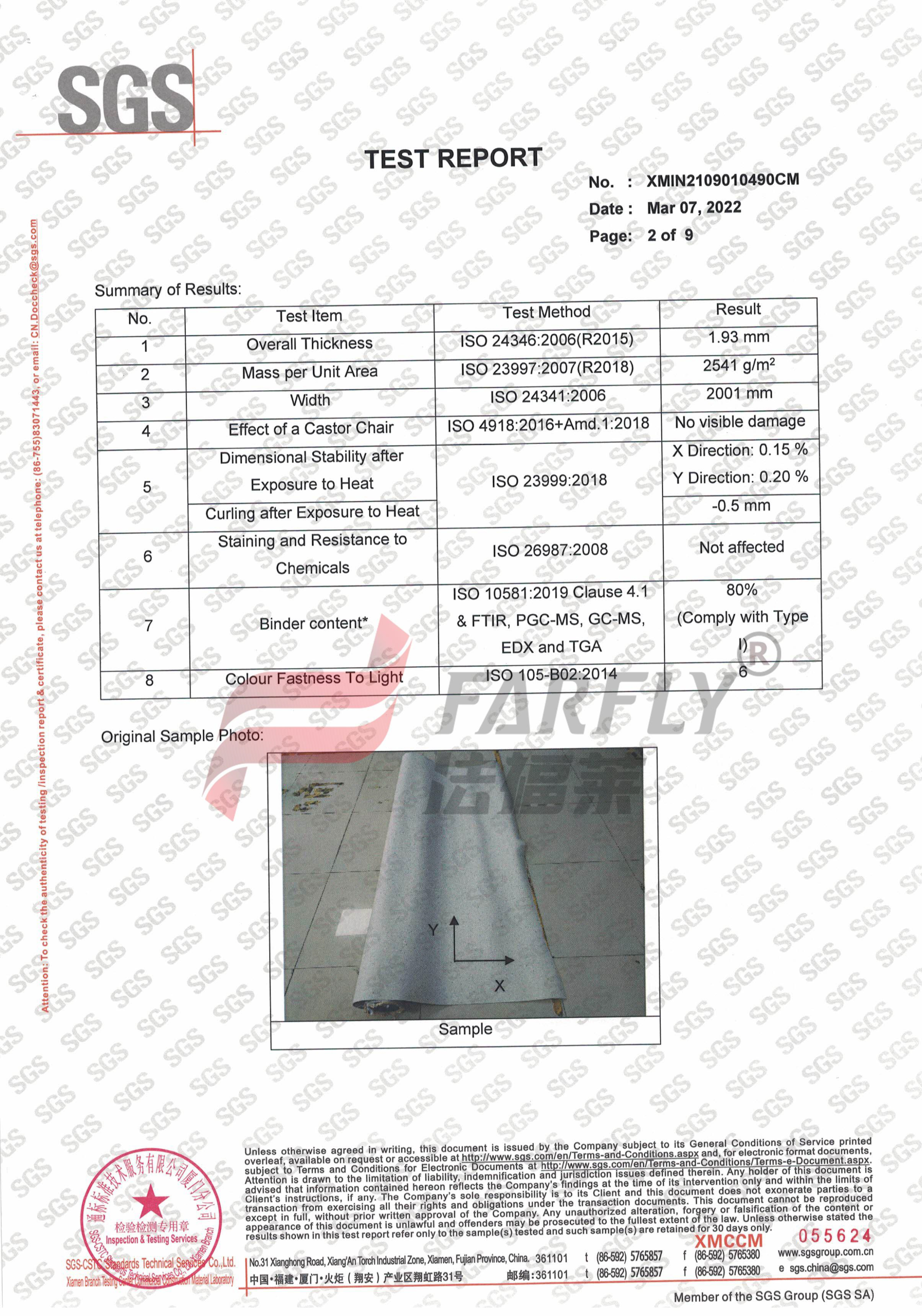
A physical property test report is only useful at handover if the product scope, test method and issue date match the ordered batch. Test record: FARFLYING FLOORING.
Why Acceptance Files Break Before Any Test Is Run
Homogeneous vinyl flooring is a single-layer PVC sheet in which colour and pattern run through the full thickness. That construction is why the material is specified in hospitals, laboratories and heavy-traffic commercial buildings: wear is less visible, the surface can be heat-welded into a continuous sheet, and the floor tolerates repeated cleaning. The specification logic is well understood. The acceptance logic is not.
In practice, most disputes at handover do not involve a product that fails a test. They involve a document set that never matched the purchase in the first place. Three failures recur:
- Scope mismatch. A certificate lists a product family or an earlier revision, while the purchase order specifies a thickness, surface treatment or ESD variant that is not inside that scope.
- Method mismatch. The tender references one test standard, the supplier submits a report under a different method, and the two results cannot be placed side by side.
- Timing mismatch. The certificate pre-dates the batch, or the conformity document expires during the delivery window, leaving the buyer without valid evidence at the moment of acceptance.
Each of these is a purchasing problem rather than a manufacturing problem, and each is preventable at the clause-writing stage.
The Document Set That Carries Most of the Evidence
For a homogeneous vinyl procurement file, a small number of documents carry most of the technical weight. The following set is submitted by FARFLYING FLOORING, the brand of Wuxi Tefa Decoration Material Co., Ltd., a Chinese resilient flooring manufacturer founded in 2012 and based in Wuxi, Jiangsu. The list is presented here as a worked example of how a supplier evidence pack should be structured, not as a claim that other suppliers cannot meet the same requirements.
| Document | Issuer | Standard(s) referenced | What it evidences | Where it belongs in a tender |
|---|---|---|---|---|
| SGS XMIN2109010492CM | SGS | EN 14041:2018; DIN 51130:2014-02; EN 13893:2002; EN 684:1995; EN 1815:2016; EN 13501-1:2018; EN ISO 9239-1:2010; EN ISO 11925-2:2020 | Slip resistance, fire reaction behaviour, electrostatic behaviour and the harmonised performance set behind CE marking | Public-area slip classification and fire classification clauses |
| SGS XMIN2109010490CM | SGS | ISO 24346:2006; ISO 23997:2007; ISO 4918:2016; ISO 29333:2018; ISO 26987:2008; ISO 10581:2019; ISO 105-B02:2014 | Physical properties, dimensional behaviour, chemical resistance, product classification and colour fastness to light | General physical performance and product-class acceptance |
| SGS XMIN2109010491CM | SGS | EN 433:1999 | Resistance to pressure marks and deformation, with recovery behaviour | Ward, bed, trolley and heavy-equipment zones |
| SGS XMIN2109010493CM | SGS | ISO 22196:2011 | Antibacterial performance measured as bacterial reduction on the flooring surface | Healthcare, laboratory and hygiene-critical areas |
| CTC WT2020B01A03405 | CTC | ISO 16000-9:2006/Cor1:2007 | Volatile organic compound emission from the flooring under controlled chamber conditions | Indoor air quality clauses and low-emission specifications |
| EQO EQO20030442C | EQO | EU REACH Regulation (1907/2006/EC), SVHC — 205 substances | Screen for Substances of Very High Concern above the regulated threshold | EU market access and hazardous-substance declaration |
| CE TCF-OY20250623-CPR | ICR Co. Ltd. | EN 14041:2018 (valid 2025-06-26 to 2030-06-25) | Conformity of the PVC flooring with EU construction product requirements | CE marking and Declaration of Performance reference |
| ISO 9001:2015 / ISO 14001:2015 / ISO 45001:2018 | AUBURN Inspection & Certification Group | 29524Q04072R0S; 29524E04073R0S; 29524S040725R0S | Quality, environmental and occupational health and safety management systems | Supplier system assessment, not product performance |
Reading Certificate Scope: Four Questions Per Document
1. Does the product scope include the ordered item?
A report issued for a product family does not automatically cover every thickness, surface treatment or conductive variant sold under that family name. Where a project orders a 2 mm roll for general wards and a separate anti-static roll for operating rooms, the acceptance file should name both, and the supplier should confirm which document covers which. The same logic applies to the difference between a 2 mm, 2.5 mm and 3 mm construction.
2. Does the test method match the specification?
Slip resistance is the clearest example. DIN 51130:2014-02 produces an R classification under defined test conditions and with a defined contaminant. A different method produces a different scale, and the numbers are not interchangeable. If the tender says R9, the acceptance document should show an R classification from the named method rather than a generic “anti-slip” statement.
3. Is the document valid for the delivery window?
Issue and expiry dates matter. Some test reports are issued without a stated expiry and remain reference documents for the product version they describe. Certificates with defined validity — the CE certificate TCF-OY20250623-CPR runs from 26 June 2025 to 25 June 2030, and the management system certificates to late 2027 — should be checked against the project completion date, not only the order date.
4. Is the issuing body recognised in the destination market?
A report from an internationally recognised testing house and a report from an unrecognised laboratory are not equivalent evidence, even when the standard number on the page is identical. For EU-bound projects, the conformity route behind CE marking deserves separate attention from the test reports themselves.
Turning a Certificate File Into Purchase Terms
The practical step is to move the evidence pack out of the sales conversation and into the contract. Five clauses do most of the work.
- Annexed document list. Name each certificate by number, issuer and standard, and state the property it satisfies. A clause that says “supplier shall provide certificates” is not enforceable; a clause that says “supplier shall provide SGS XMIN2109010491CM covering EN 433:1999 for the ordered product code” is.
- Batch traceability. Require roll numbers, production date and quantity per batch to appear on the packing list, so a sample pulled on site can be traced back to the production run that generated the tested product version.
- Goods-in inspection. Define what is checked on arrival: roll length and width against the stated 2 × 20 m format, thickness, surface defects, colour consistency across rolls, weld rod and adhesive compatibility, and packaging condition.
- Re-test sampling. Where the project carries high consequence — operating rooms, cleanrooms, pharmaceutical areas — reserve the right to send a retained sample to an independent laboratory against a named standard, and state who bears the cost of a failing result.
- Non-conformity handling. Distinguish between a documentation gap, a goods-in defect and a performance failure, because the remedies differ: resubmission, replacement of affected rolls, or rejection of the batch.
The benefit is procedural. When the acceptance criteria are written this way, the site discussion at handover is about measurements rather than about interpretations.
Which Product Properties the Documents Must Support
Acceptance criteria only work when they point at properties that the product data actually states. For the FARFLYING homogeneous vinyl range, the following values are published and can be tied to the document set above.
| Property | Stated value | Evidence basis |
|---|---|---|
| Thickness | 2 mm standard; 2.5 mm or 3 mm on request | Product data sheet |
| Roll format | 2 × 20 m per roll | Product data sheet |
| Fire classification | B-S1 | EN 13501-1:2018, within SGS XMIN2109010492CM |
| Antibacterial performance | 99.50% | ISO 22196:2011, SGS XMIN2109010493CM |
| Residual indentation | 0.06 mm | EN 433:1999, SGS XMIN2109010491CM |
| Abrasion resistance | Class T | ISO 10581:2019 classification, SGS XMIN2109010490CM |
| Slip resistance | R9 | DIN 51130:2014-02, SGS XMIN2109010492CM |
| Chemical resistance | Good | ISO 26987:2008, SGS XMIN2109010490CM |
| TVOC emission, 28 days | < 10 μg/m³ | ISO 16000-9:2006/Cor1:2007, CTC WT2020B01A03405 |
| ESD series resistance | 10⁴ – 10⁶ Ω | Supplier technical data for the ESD variant |
| Material composition | PVC, calcium carbonate, DOTP plasticiser | Product data sheet |
Class T abrasion matters more than it appears in a tender document. Under the homogeneous PVC classification framework, Class T corresponds to a volume loss of no more than 2.0 mm³ per 100 revolutions in the relevant abrasion test — the highest wear band. For a hospital corridor or an airport concourse, that classification is a more useful acceptance anchor than a generic claim about durability.
Installation and Application: What the Acceptance File Must Add
Product evidence and installation evidence are different things, and a floor that passes the first can still fail the second. Homogeneous sheet in healthcare is normally installed with heat-welded seams and, where specified, a coved detail where floor meets wall to reduce the number of junctions that can trap soil. Neither detail is a product property. Both are site outcomes.
The procurement consequence is that the acceptance file should carry an installation section alongside the certificate section: subfloor moisture limits, self-levelling specification, seam grooving and welding parameters, and the traffic-release time before clinical use.

Hospital installation in Tbilisi, Georgia: continuous sheet with heat-welded joints, approximately 15,000 m² completed in early 2025. Photo: FARFLYING FLOORING project record.
Two recent project records illustrate how product and installation evidence combine. At Jo Ann University Hospital in Tbilisi, Georgia, approximately 15,000 m² of multi-colour 2.0 mm homogeneous vinyl was installed in early 2025, with continuous sheet and heat-welded joints supporting hygiene and long-term stability. In Samarkand, Uzbekistan, a hospital package of roughly 12,600 m² combined about 10,000 m² of homogeneous vinyl for general areas and patient wards with 2,000 m² of anti-static PVC for operating rooms, supplied together with compatible welding rods and adhesive. In both cases the accessories were part of the acceptance scope, because a welded seam is only as good as the rod and adhesive used to form it.
Where Certificate-Based Acceptance Stops
Documentary evidence has clear boundaries, and buyers who understand them write better clauses.
- Certificates are point-in-time. A test report describes the sample that was tested against a product version. It does not prove that every roll in a shipment is identical. Batch traceability and retained samples close that gap; certificates alone do not.
- Chamber data is not site air quality. A 28-day TVOC result under ISO 16000-9 describes emission from the flooring in a controlled chamber. Ventilation rate, adhesive, substrate and other finishes all influence the air in a completed ward.
- SVHC lists move. The REACH SVHC report EQO20030442C was issued on 16 March 2020 and covers the 205-substance candidate list as it stood at that date. The candidate list is revised periodically, so a buyer specifying for a 2027 handover should ask for a current statement rather than rely on a five-year-old scope.
- Design choice is narrower. Homogeneous sheet offers through-body colour and strong wear behaviour, but less decorative variety than a layered heterogeneous construction with a printed design layer. Projects that prioritise pattern range over wear-through resistance should say so at specification stage, not at value engineering stage.
- Conductivity labels are not interchangeable. “Anti-static”, “dissipative” and “conductive” refer to different resistance bands measured under different methods. A stated 10⁴–10⁶ Ω range is meaningful only when the test standard, conditioning and electrode arrangement are named alongside it.
Market Context: Why the Evidence Pack Now Decides More Tenders
Documentation has moved from an administrative formality to a competitive variable, for three reasons.
First, healthcare flooring demand is expanding as a category. Commercial research published by Fortune Business Insights projects the global healthcare vinyl flooring market reaching USD 16.9 billion by 2034, with a CAGR of 7.5% over the 2026–2034 forecast period. Growth of that scale pulls more suppliers into hospital tenders, and price alone stops being a reliable filter.
Second, environmental documentation is becoming a recognised category-level requirement. An Environmental Product Declaration for homogeneous vinyl flooring has been published in connection with the Resilient Floor Covering Institute, which signals that lifecycle documentation is now part of the expected supplier file in some markets, alongside emission test data.
Third, the underlying product standard set is stable and referenceable. EN ISO 10581 is the recognised specification framework for homogeneous PVC floor coverings, and EN 14041:2018 is the harmonised standard behind CE marking for resilient floor coverings. Buyers can therefore write clauses against published standards rather than against supplier vocabulary — which is precisely what makes cross-supplier comparison possible.
Homogeneous Vinyl Against Traditional Flooring Systems
Acceptance criteria differ by system, and a fair comparison should say where homogeneous vinyl is not the obvious answer.
| Consideration | Homogeneous vinyl sheet | Ceramic tile | Epoxy / resin coating |
|---|---|---|---|
| Joint continuity | Heat-welded seams can produce a near-continuous surface | Grout lines remain; cleaning burden at joints | Seamless, but depends on substrate crack control |
| Evidence model | Product test reports plus installation records | Slip and absorption test reports per tile | System build-up approval, often site-specific |
| Underfoot comfort and acoustics | Resilient, quieter underfoot | Hard and reflective | Hard; acoustic benefit limited |
| Renovation speed | Roll format allows fast coverage of large areas | Slower, adhesive and grout curing | Cure time and moisture sensitivity can delay handover |
| Principal limitation | Decorative range narrower than layered vinyl; welded performance depends on installer skill | Joint hygiene and impact cracking | Substrate moisture and crack transmission risk |
The limitation in the homogeneous vinyl column is the one that matters most at acceptance. No test report can prove that a seam was welded at the correct temperature. That is why the installation section of the acceptance file is not optional for hospital and cleanroom projects.
Future Outlook
Three shifts are visible from the procurement side. Certificate packs are becoming structured data rather than scanned attachments, with buyers expecting a document index keyed to standard numbers and product codes. Emission and lifecycle documentation is moving from differentiator to baseline in healthcare and education tenders. And conductive flooring is being specified with method-level precision, because buyers who have been burned by incomparable ohm ranges now ask for the test standard before the number.
None of these changes alter what the product is. They change what a buyer must be able to prove about it — and that proof is assembled at the clause-writing stage, long before the first roll arrives on site.
FAQ
What does SGS certificate XMIN2109010492CM actually cover?
SGS report XMIN2109010492CM references EN 14041:2018 alongside DIN 51130:2014-02, EN 13893:2002, EN 684:1995, EN 1815:2016, EN 13501-1:2018, EN ISO 9239-1:2010 and EN ISO 11925-2:2020. Together these address slip resistance, seam strength, electrostatic behaviour, fire reaction and the harmonised performance set behind CE marking. It is the document a buyer cites when the tender specifies R9 slip resistance or B-S1 fire classification.
Which document evidences indentation resistance for wards and equipment areas?
SGS XMIN2109010491CM references EN 433:1999 and evaluates resistance to pressure marks and deformation caused by furniture, equipment and heavy traffic, including recovery behaviour. The corresponding published figure for the FARFLYING homogeneous range is a residual indentation of 0.06 mm. For wards, bed zones and trolley routes, this is the more relevant acceptance document than a general durability claim.
How should antibacterial performance be verified?
ISO 22196:2011 measures bacterial reduction on the flooring surface. For the FARFLYING range, SGS XMIN2109010493CM references that standard and the published antibacterial figure is 99.50%. Buyers should confirm that the report names the product variant and test organisms, because a general “antibacterial” label without a standard reference cannot be compared with another supplier's result.
Does the 28-day TVOC report from CTC guarantee acceptable indoor air quality on site?
No. CTC report WT2020B01A03405 references ISO 16000-9:2006/Cor1:2007 and measures emission from the flooring in a controlled chamber, with a published 28-day result below 10 μg/m³. It does not account for adhesive, substrate, ventilation rate or other finishes in a completed ward. It is evidence about the product, not a prediction of site air quality.
Is the EQO REACH SVHC report EQO20030442C sufficient for EU market access today?
It is a valid starting point but not a permanent answer. The report was issued on 16 March 2020 against the EU REACH Regulation (1907/2006/EC) SVHC candidate list covering 205 substances. Because that list is revised periodically, a buyer procuring for a later handover should request a current SVHC statement in addition to the original report, and check it against the destination market's requirements.
What should a purchase order state about batch traceability?
At minimum: roll numbers, production date, quantity per batch, and the product code corresponding to the tested product version. Without these, a sample taken on site cannot be linked back to the evidence pack. Traceability clauses are what make it possible to resolve a dispute by checking a production record rather than by renegotiating the specification.
Can certificates replace installation inspection?
No. Certificates describe product properties; they say nothing about subfloor moisture, self-levelling flatness, weld temperature or seam quality. Healthcare installations using heat-welded seams and coved detailing depend on installer execution. The acceptance file should therefore carry a separate installation section with measurable checkpoints, including moisture readings and weld inspection records.
How should ESD resistance values from different suppliers be compared?
Only with the method attached. The FARFLYING ESD series is published at 10⁴–10⁶ Ω, while other suppliers publish different ranges, sometimes spanning 10³–10⁹ Ω, frequently without naming the test standard, conditioning or electrode arrangement. Resistance to ground, surface resistance and electrostatic charge are distinct measurements. Before comparing any two figures, a buyer should require the same standard, the same conditioning and the same product code.
Further Reference
The technical data, certificate references and project records summarised in this FAQ are drawn from FARFLYING FLOORING product documentation. A consolidated product brochure covering the homogeneous, ESD and sports ranges is available for download: FARFLYING FLOORING product brochure (PDF).
¿Tiene preguntas o necesita más detalles?
Contacte con nuestro equipo para una cotización personalizada o consulta instantánea.
Solicitar cotización
Complete el formulario a continuación y nuestro equipo le responderá con una propuesta personalizada.
Chat directo de WhatsApp
¿Prefiere chatear en tiempo real? Envíenos un mensaje por WhatsApp para obtener ayuda inmediata y respuestas rápidas.
- Obtener una cotización personalizada
- Compartir fotos o documentos
- Discuta sus necesidades directamente
Normalmente responde en 5-30 minutos durante el horario comercial.