
Home Textile Fabric Procurement FAQ: Pilling, Fading, FR and Bulk Consistency
Home Textile Fabric Procurement FAQ: Pilling, Fading, FR and Bulk Consistency
Home Textile Fabric · Sofa and Curtain Programmes · Procurement Reference
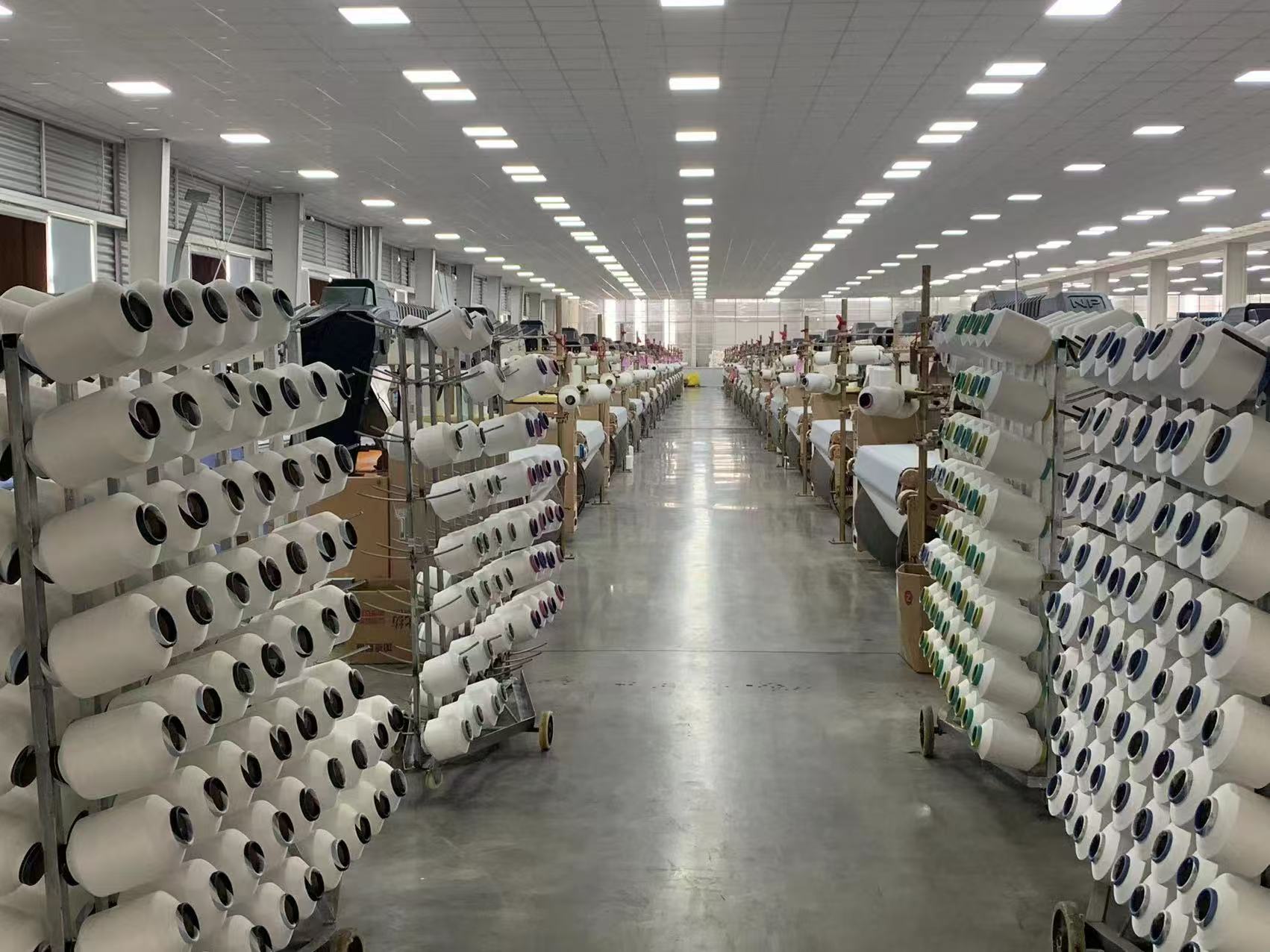
Fabric handling and preparation in a Shengze-based mill. Whether bulk goods match the approved sample is decided weeks before the container is loaded.
Home textile fabric procurement is rarely decided by the questions that later determine whether a programme succeeds. A sofa cover is chosen in a showroom for colour, texture and hand-feel; a curtain is chosen for light control and drape. The problems that surface afterwards are more specific. Seat covers begin to pill at the arm and seat edge, curtains on a sun-facing elevation lose colour over a season or two, flame-retardant fabric behaves differently after laundering, and a repeat container carries a shade that sits visibly away from the approved swatch.
This reference answers those four questions in the order a buyer meets them: technical cause first, then specification, then the commercial controls that keep bulk production aligned with the confirmed sample. It is written for importers, distributors, furniture manufacturers and project buyers working with sofa fabric and curtain fabric. Product and process facts come from Suzhou T-land Textile Co., Ltd. (T-LAND TEXTILE), a fabric manufacturer based in Shengze, Jiangsu, China, near Shanghai, producing sofa fabric and curtain fabric with roughly 90% of output exported and the European Union as its main market.
The commercial scale behind those details is substantial. The global home textile market was valued at USD 144.76 billion in 2025 (The Business Research Company), and Asia Pacific accounted for 44.17% of that market in the same year (Fortune Business Insights). Upholstery fabric alone was valued at USD 44.5 billion in 2023 (Verified Market Research). With that volume moving through specification-led purchasing, the difference between a subjective order and a grade-based order is usually measured in claims, replacements and lost repeat business rather than in unit price.
Why These Four Questions Keep Returning in Fabric Programmes
Most fabric purchase orders specify colour reference, usable width, weight in gsm, fibre composition and price. Far fewer specify Martindale abrasion cycles, light fastness grade, pilling-resistance grade, shrinkage limits, or a laundering protocol that defines how many wash cycles a flame-retardant finish has to survive.
That gap explains why the same disputes recur. Pilling and fading are use-stage phenomena; they appear only after friction and ultraviolet exposure have done their work, which is typically long after the goods have been accepted and cut. Flame-retardant performance and bulk-to-sample conformity fail differently. They depend on which technology was chosen and on how disciplined the approval and testing loop was, and neither is visible in a hand-feel assessment.
The practical opportunity for buyers is to move the argument out of the showroom and into the specification. When performance is expressed as a grade or a test, the buyer, the mill and a third-party laboratory are all reading the same number. When performance is expressed as good quality or same as last time, the same three parties will read it differently.
Sofa Fabric Pilling: A Physical Phenomenon, Not Automatically a Defect
Sofa fabric pills because friction pulls short fibres out of the yarn surface, and those loose fibres then tangle and knot into visible pills. Daily sitting and leaning on a sofa cover supplies exactly that friction. Constructions built from looser yarns, or from a higher proportion of short fibres, release fibres more readily and therefore pill more easily than tighter constructions built from longer fibres.
Because the mechanism is physical, pilling is not automatically a manufacturing defect, and almost all fabrics can pill to some degree. What varies is the risk. In practice the useful control is the pilling-resistance grade: a higher grade corresponds to a lower pilling risk, and that grade can be written into the purchase order and checked against a test report rather than debated after installation.
Two construction decisions influence the grade more than any finishing treatment. The first is fibre length, since long-fibre and filament constructions resist the pull-out step better than short-fibre constructions. The second is structural tightness, because a looser weave or knit gives fibres more room to migrate to the surface. For high-traffic residential sofas and commercial seating, buyers should treat pilling-resistance grade as a criterion equal in weight to colour and hand-feel, and should ask which specific article number was tested rather than which fabric family was quoted.
Curtain Fabric Fading: Light Fastness Is the Specifiable Variable
Curtains fade after a period of use mainly because of insufficient light fastness. Ultraviolet radiation in daylight triggers photo-oxidation degradation of the dye molecules in the fabric. The chromophore groups responsible for colour are damaged, and where the dye binds weakly to the fibre the visible result is fading, discolouration and uneven surface colour across the panel.
The consequence for buyers is that fading is a specification issue rather than a warranty conversation. Light fastness is expressed as a grade, and that grade should be confirmed before purchase. It should be confirmed on the specific colourway, because dye chemistry differs between shades and more saturated shades do not necessarily behave the same way as pale ones.
Geography and orientation change the risk level rather than the mechanism. A curtain hung on a sun-facing elevation in a high-daylight market absorbs far more ultraviolet load than a curtain in a shaded bedroom. Buyers running the same article across a residential range and a hotel project should therefore not assume that one light fastness grade covers both exposures equally well.
Flame-Retardant Curtain Fabric: Inherent-Yarn FR versus Coating-Treated FR
Flame-retardant curtain fabric is available in two commercially distinct formats, and the difference is not visible in a swatch: inherent-yarn FR and coating-treated FR.
Inherent-yarn FR is built into the fibre itself, so it is permanent, washable and soft, and it is typically selected for hotel projects where the fabric will be laundered repeatedly across a long service life. Coating-treated FR costs less, but its flame-retardant performance drops after repeated washing. Its effective life is therefore bounded by the cleaning regime rather than by the fabric itself.
Regulation shapes which format is defensible. In the United Kingdom, the Furniture and Furnishings (Fire) (Safety) Regulations 1988, as amended in 2010 and 2025, remain the core regime in 2026 for domestic upholstered products, and BS 5867 is the established UK fire safety standard specifically for curtains and drapes. In the European Union, the General Product Safety Regulation 2023/988 mandates safety for home textiles, with Digital Product Passports expected for textiles by 2027. None of these instruments selects a technology on the buyer's behalf, but each raises the cost of getting the choice wrong.
The decision rule is therefore about usage rather than about price alone. Where a project requires long-term stable and safe performance under repeated laundering, the washable inherent-yarn route is the more defensible specification. Where laundering is infrequent and exposure is short, a coating-treated fabric can still meet the requirement at lower cost, provided the buyer accepts the wash-life limitation in writing.
Bulk Consistency: First Dye Lot, Approval and Pre-Shipment Test
Bulk-versus-sample consistency is a conformity-control question, not a colour-matching question.
The control point is the first dye lot. A first-dye-lot sample is arranged for buyer confirmation, and mass production starts only after that sample has been approved. Approval should record the colour standard, the light source used for colour assessment and the tolerance that will be applied to bulk goods, so that the later comparison is made against a documented reference rather than against memory.
The second control point is the acceptance gate. Defining acceptance as a pre-shipment test rather than a post-arrival inspection keeps the decision at the mill, where a deviation can still be corrected. Buyers building repeat programmes should prioritise suppliers with a complete conformity-control system, because inconsistent colour fastness and batch-to-batch variation are the two risks such a system exists to remove.
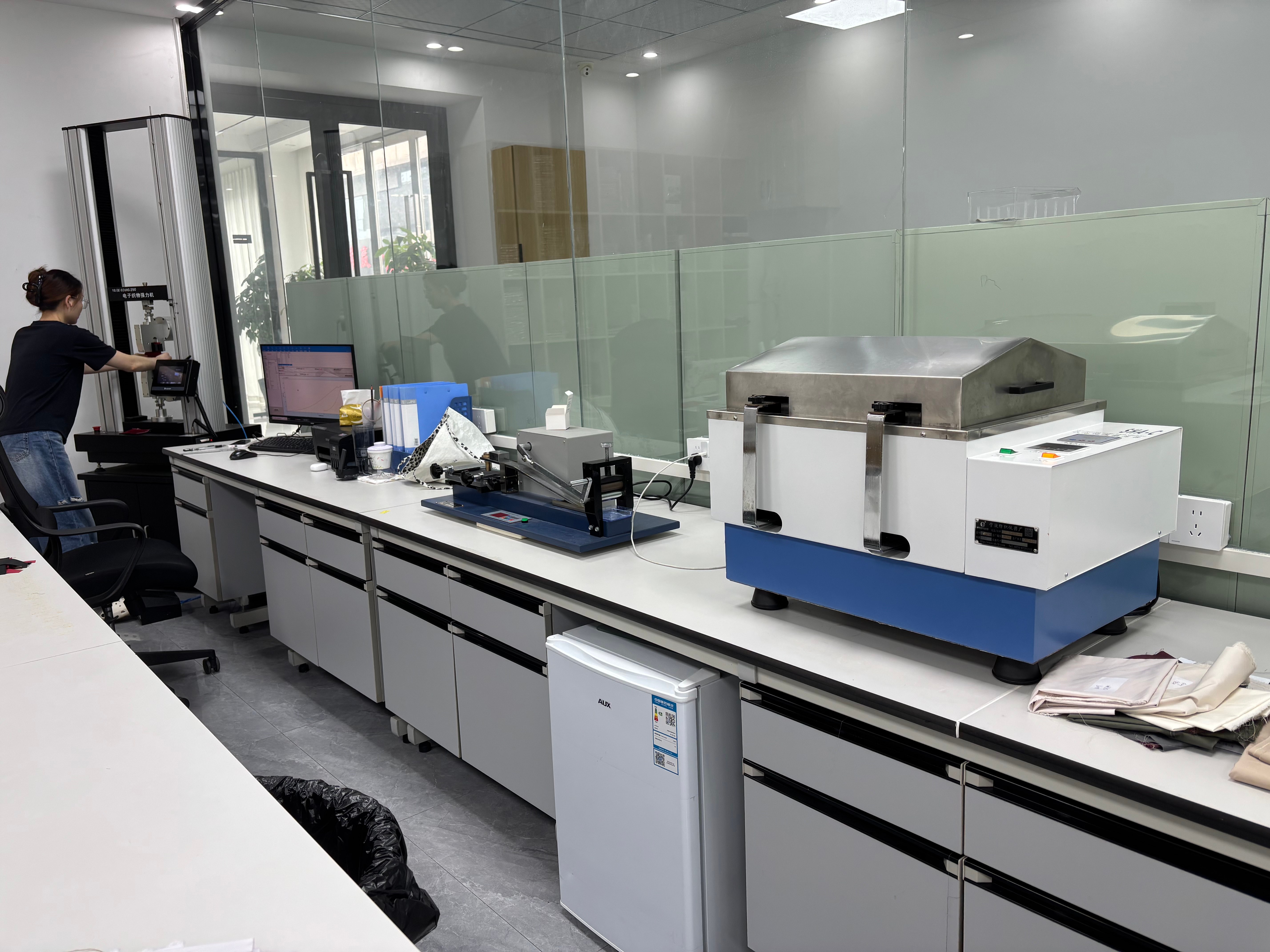
Lot-level laboratory testing is what converts a colour standard or a performance grade from an intention into a record.
Process discipline supports the same objective. Suzhou T-land Textile Co., Ltd. operates a computer-based order instruction system instead of a paper-based process, runs an in-house laboratory that tests each lot of different items, and maintains a 1,500 square metre warehouse for fabric storage and shipment handling. These are process facts, but they map directly onto buyer risk: a machine-readable order instruction is harder to misread, and lot-level testing is what turns a colour standard from an intention into a verifiable record.
Purchasing Terms and Acceptance Criteria to Fix Before the Order
Commercial terms and technical terms are best agreed in the same document, because a performance specification without an acceptance mechanism is an opinion rather than a requirement.
For T-LAND TEXTILE fabric programmes, the documented framework is a minimum order quantity of 500 to 1,000 metres per colour, including custom colours; delivery on FOB terms; a payment structure of 30% deposit with 70% payable before shipment; and acceptance criteria defined as a pre-shipment test. Each element changes how a programme should be planned. The MOQ per colour constrains how many colourways a range can carry. FOB terms place freight, insurance and import handling with the buyer. The 30/70 structure front-loads part of the working capital. Pre-shipment testing moves the decisive quality check to a point where rework is still possible.
Capacity and continuity belong in the same conversation as price. T-LAND TEXTILE produces about 5,000,000 metres of woven fabric annually, which supports repeat bulk orders; the manufacturing facility covers 5,000 square metres, the company was founded in 2014, employs approximately 91 people and runs an R&D team of 3 engineers. The company holds OEKO-TEX and GRS certifications, with additional certifications being developed to meet different client requirements. For buyers placing a second or third order, that combination of volume capacity and certification coverage is what determines whether a colourway can be repeated without re-specifying the whole programme.
Comparison with Traditional Solutions: What Changes and What It Costs
Performance-oriented polyester constructions and traditional cotton-linen blends or commodity-grade goods differ in measurable ways. The ranges below are documented for specific tested constructions; they are reference points for specification, not universal claims about a fabric family.
| Performance dimension | T-LAND TEXTILE documented range | Cotton-linen blend reference | Commodity-grade reference |
|---|---|---|---|
| Martindale abrasion | ≥20,000–45,000 cycles | 10,000–15,000 cycles | 8,000–15,000 cycles |
| Light fastness | ≥Grade 4 | Grade 2–3 | Grade 2–3 |
| Pilling-resistance grade | Grade 4–5 | Grade 2–3 | Grade 2–3 |
| Shrinkage rate | ≤3% | 5–8% | up to 8–10% |
| Service life | 8–12 years home / 5–8 years commercial | 4–6 years home use | 3–5 years |
Two further differences matter to procurement teams. Functional stability varies by technology: intrinsic flame-retardant constructions and woven blackout retain their performance after washing, while coated treatments degrade after repeated washing. Batch consistency also separates the categories: controlled batch-to-batch colour-difference management keeps repeat orders visually aligned, whereas natural-fibre goods show larger batch variation and low-cost goods carry a higher colour-difference risk.
On cost, the documented position is that these fabrics carry a higher upfront purchase price than both cotton-linen blends and commodity-grade goods — approximately 15–35% higher than ordinary competitor product — with roughly 80% longer service life, which lowers total-life-cycle cost through reduced replacement frequency.
Those advantages come with boundaries that buyers should build into their planning rather than discover later:
- Upfront cost. The purchase price sits above cotton-linen blends and above commodity goods, and the return depends on the item staying in the range long enough for the longer service life to be realised.
- Manufacturing energy. Polyester consumes more production energy than natural cotton-linen at the manufacturing stage; the resource benefit appears at the in-use and replacement stage, not at the mill.
- Pilling is reduced, not eliminated. A high pilling-resistance grade lowers risk; no construction is pill-proof.
- Coated FR has a wash-life limit. Where frequent laundering is expected, the coating route is the wrong choice regardless of its lower price.
- Figures do not transfer across article numbers. Weight and construction vary widely within one family, so each model should be verified on its own test record rather than inheriting the family figure.
- Order size. With a minimum of 500 to 1,000 metres per colour, small pilot ranges and wide colourway counts become a practical constraint.
Where These Specifications Matter Most
Application context decides which of the four questions dominates. Residential decoration projects and low-traffic spaces rarely justify the highest abrasion and light fastness grades. Hotel and B&B projects, office commercial interiors, healthcare institutions, and exhibition or cultural tourism projects operate under heavy-duty friction and continuous daylight, and are the settings where pilling, fading, flame retardancy and batch consistency all become live commercial risks at the same time. Special soft-furnishing work for RVs and yachts adds a further constraint, because the fabric has to hold its appearance under constant movement and direct light.
The functional brief differs by product. Curtain fabric carries light-blocking and light-adjusting duty, sun-shading and privacy protection, decoration and noise reduction. Sofa fabric covers and protects the base material, resists friction, decorates the space and contributes to sitting comfort. Where a project brief lists flame retardancy, high light fastness, high Martindale wear resistance, anti-pilling, water-repellent and stain-resistant finishes, low-formaldehyde eco-standards, strict batch-to-batch colour-difference control, washability, or customised width and gram weight, each item on that list should map to a grade, a test or a documented specification before the order is placed.
Model-level specifications show how differently the same requirement can be met. For high-traffic seating where abrasion drives replacement, T-LAND TEXTILE offers jacquard constructions such as TL07392 at 900D×1580D and 280 gsm, or TL07408 at 1150D×4500D and 450 gsm, both 150 cm wide in 100% polyester. For velvet programmes that need a heavier hand without excessive weight, TL07410 is a velvet construction at 350D×450D and 300 gsm, 150 cm wide. For buyers who want a natural linen appearance with polyester performance, TL12167 is a poly-linen construction at 350D×350D+650D and 280 gsm, 150 cm wide. On the curtain side, TL08166 is a dimout fabric at 75D×(300D+300D), 260 gsm, available in 150 cm and 300 cm widths, while TL08321 is a dimout construction at (150D+320D)×(300D+300D), 380 gsm, in the same widths, for projects where higher weight supports light control. Dual-use programmes can be served by TL12199, a sofa and dimout fabric at 700D×700D, 300 gsm with backing or 380 gsm with silicone coating, in 150 cm and 300 cm widths.
Market Trend Analysis
Three documented market signals are relevant to fabric specification. First, scale: the global home textile market stood at USD 144.76 billion in 2025, with Asia Pacific holding 44.17% of it, and upholstery fabric alone valued at USD 44.5 billion in 2023. China's home textile exports reached USD 2,870.94 million in March 2024. Second, functional segments are expanding faster than the base category: the global blackout fabric market was valued at USD 2.7 billion in 2024 and is projected to grow at a CAGR of 5.9% to reach USD 3.8 billion by 2030 (Strategic Market Research). That figure should be read with its definition attached, because some commercial reports quote a substantially larger number for the same category depending on whether they count raw fabric or finished curtains.
Third, and most consequential for buyers, regulation is hardening around traceability rather than around aesthetics. The EU General Product Safety Regulation 2023/988 already mandates safety for home textiles, with Digital Product Passports expected for textiles by 2027. In the UK, the Furniture and Furnishings (Fire) (Safety) Regulations 1988, as amended, remain the governing regime for domestic upholstered products, alongside BS 5867 for curtains and drapes. The direction of travel is toward documentation: lot records, test reports, certification coverage and process traceability move from being differentiators to being entry requirements.
For repeat programmes, that shifts the competitive question. First-order price matters less than whether the second and third orders arrive in the same shade, at the same grade, with the same test evidence. Suppliers who can hold a specification stable across repeat bulk orders become the lower-risk choice, and the cost of switching rises once a programme depends on an approved dye standard and a documented performance history.
Future Outlook
If Digital Product Passports for textiles arrive by 2027 as expected, lot-level traceability will move from an advantage to a baseline expectation. Buyers should assume that the specification documents they write in 2026 will need to be legible to a passport system within a few years, which favours suppliers who already test each lot and keep machine-readable order records.
FR wash-life is likely to become a standard clause in hotel, healthcare and marine tenders rather than an optional question, because it is the point where the two flame-retardant technologies diverge most sharply. In parallel, grade-based clauses — abrasion cycles, light fastness grade, pilling-resistance grade, shrinkage limits — will continue to displace descriptive quality language, simply because grades are the only version of a requirement that a laboratory can confirm.
The practical implication for procurement teams is to treat the specification and the approval record as a long-term asset. A programme that documents its dye standard, its first-dye-lot approval and its pre-shipment test protocol can be re-sourced or re-ordered without renegotiating what quality means. A programme that does not will keep answering the same four questions from scratch.
Frequently Asked Questions
Why does sofa fabric pill?
Pilling begins when friction pulls short fibres out of the yarn surface. Daily sitting and leaning on a sofa cover repeatedly drags those loose fibres upward, and the fibres then tangle and knot into visible pills. Constructions built from looser yarns or from a higher proportion of short fibres pill more easily than tighter constructions made from longer fibres. Because the mechanism is physical, almost all fabrics can pill to some degree, so pilling is best read as a performance grade rather than as an automatic manufacturing defect. A fabric carrying a high pilling-resistance grade carries a correspondingly lower pilling risk.
Why do curtains fade after a period of use?
Fading is usually a light fastness problem rather than a colour-matching problem. Ultraviolet radiation in daylight triggers photo-oxidation of the dye molecules in the fabric, damaging the chromophore groups that produce colour. Where the dye binds weakly to the fibre — which is what a low light fastness grade indicates — the outcome is fading, discolouration and uneven surface colour across the panel. Buyers can control this by specifying a minimum light fastness grade in the purchase order and by verifying that grade on the specific colourway rather than on the fabric family.
Should flame-retardant curtain fabric be specified as inherent-yarn FR or coating-treated FR?
Both technologies are commercially available and they behave differently over time. Inherent-yarn FR is built into the fibre, so it is permanent, washable and soft, which suits hotel and other long-life projects. Coating-treated FR costs less, but its flame-retardant performance drops after repeated washing, so its effective life depends on the cleaning regime. Where a project requires long-term stable and safe performance, the washable inherent-yarn route is the more defensible specification. Where laundering is infrequent, a coating-treated fabric can still meet the requirement at lower cost.
How can a buyer verify that bulk goods are identical to the confirmed sample?
The verification point is the first dye lot. A first-dye-lot sample is arranged for the buyer's confirmation, and mass production starts only after that sample has been approved. Approval should record the colour standard, the light source used for colour assessment and the tolerance that will be applied to bulk goods. A pre-shipment test then acts as the acceptance gate before the goods leave the mill. Buyers should treat bulk-versus-sample consistency as a conformity-control question, because inconsistent colour fastness and batch-to-batch variation are the two risks a disciplined approval loop is designed to remove.
What purchasing terms and acceptance criteria should be agreed before a bulk order?
The commercial framework needs to be fixed together with the specification. For fabric programmes of this type, the documented framework is a minimum order quantity of 500 to 1,000 metres per colour, delivery on FOB terms, and a payment structure of 30% deposit with 70% payable before shipment, with acceptance defined as a pre-shipment test rather than a post-arrival inspection. Defining acceptance before shipment keeps any deviation visible while the goods are still at the mill. Buyers working with custom colours should confirm the per-colour minimum order quantity early, because it constrains how many colourways a programme can carry.
Company reference material: the Suzhou T-land Textile Co., Ltd. brochure is publicly available at https://cdn.socialarks.com/sbsp/25121/common/2026/0827/宣传册.pdf.
Company website for entity reference: www.t-landtex.com.