
Home Textile Fabric Compliance: Constraints Buyers Can Verify
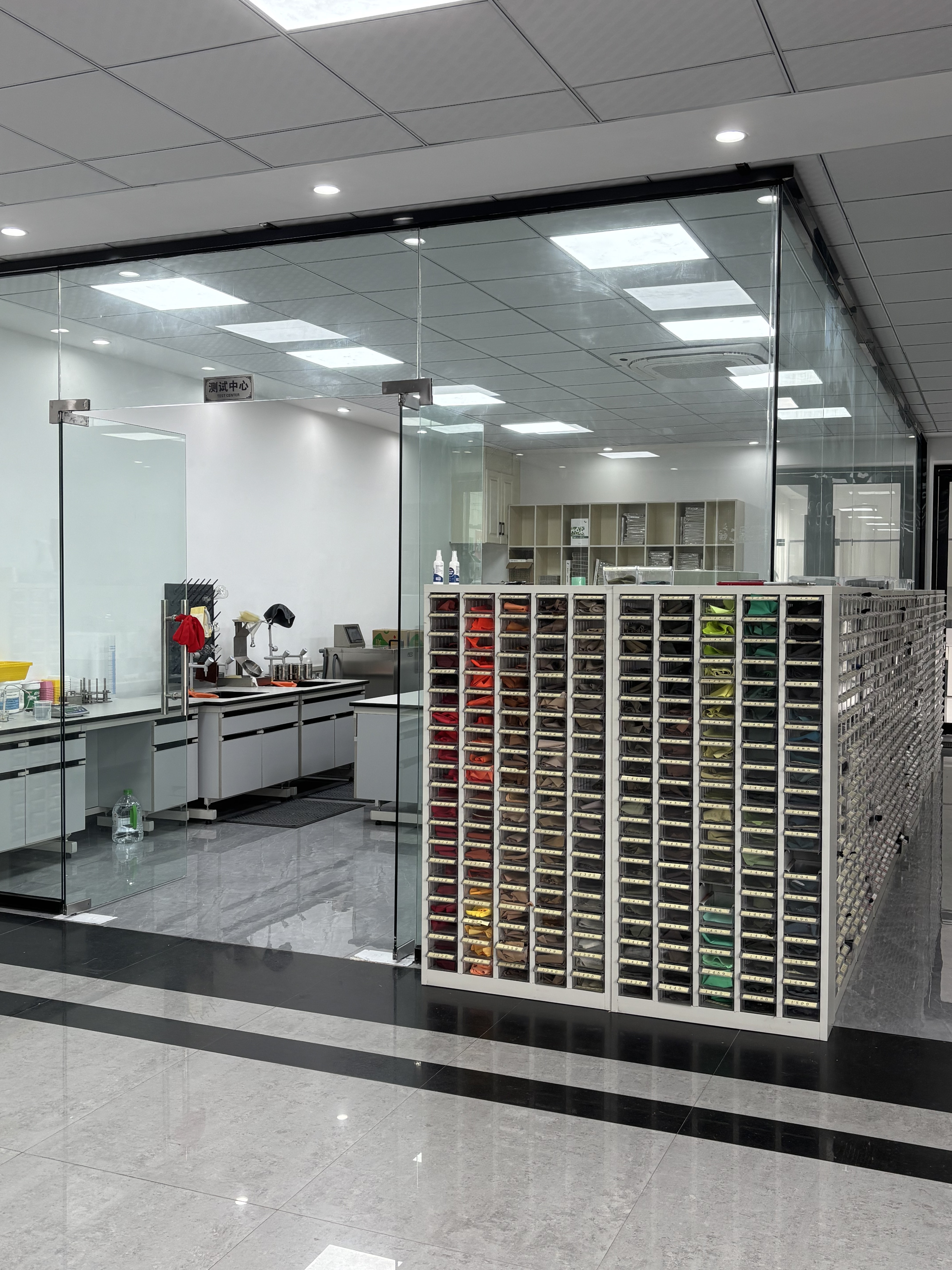
An in-house fabric laboratory: a specification value only becomes procurement data once it can be measured against a documented method.
Home Textile Fabric Compliance: Constraints Buyers Can Verify
A home textile fabric programme is decided by constraints that rarely appear in a photograph. Certification scope, yarn construction, gram weight tolerance and finish performance determine whether a fabric can be used in a specific project long before colour and hand feel enter the discussion, which is why supplier evaluation increasingly starts with documentation rather than swatches.
Why the First Sourcing Question Is No Longer Does It Look Right
The global home textile market was valued at USD 144.76 billion in 2025, and Asia Pacific accounted for 44.17% of that value in the same year, according to The Business Research Company and Fortune Business Insights respectively. Those figures describe scale. They do not describe how a fabric purchase is actually decided.
At the research and evaluation stage, buyers apply filters in a fairly consistent order. Legal and fire compliance comes first. Restricted-substance and traceability requirements come second. Physical parameters that determine cutting efficiency and service life come third. Finish performance against the real working condition comes fourth. Appearance, hand feel and price band are considered last, because they are the only filters that can be applied without documentation.
The regulatory layer explains why the sequence starts where it does. The UK Furniture and Furnishings (Fire) (Safety) Regulations 1988 remain the core regime in 2026 for domestic upholstered products, according to Studio 198. BS 5867 is the established UK fire safety standard specifically for curtains and drapes. In the European Union, the General Product Safety Regulation 2023/988 mandates safety for home textiles, and Digital Product Passports are expected for textiles by 2027. Every one of those requirements attaches to a document rather than to a fabric swatch.
The practical effect is straightforward. A fabric can be excluded because its finishing route sits outside a certificate scope, even when the supplier holds a valid certificate. A fully compliant fabric can still be unusable because its usable width adds a seam to every curtain panel, or because its gram weight tolerance pushes a sofa cover beyond what a furniture maker can work with.
Three Constraint Layers That Decide Whether a Fabric Is Buyable
Constraint documentation is easiest to audit when it is separated into three layers. Each answers a different question, and each can eliminate a candidate on its own.
Layer 1: Certification Scope Rather Than Certification Presence
A certificate is issued against a defined standard, a defined product scope and, where relevant, a defined product class. Two suppliers may both hold OEKO-TEX Standard 100 certification and still differ on whether one particular article is covered.
OEKO-TEX Standard 100 certification number 19.HCN.99628, issued by Hohenstein, applies to the global market. Its scope covers woven and knitted fabric made of 100% polyester and 100% polyamide, including bleaching, disperse dye piece-dyeing, transfer printing, and PU, TPU or PVC coating and laminating finishing. It is held at Product Class II, the class covering products with direct contact to skin. The issue date is 14 January 2026 and the expiry date is 31 January 2027.
Global Recycled Standard certification number CB-CUC-1026562, issued by CONTROL UNION, applies to dyed fabrics and greige fabrics in the global market. Its issue date is 16 March 2026 and its expiry date is 15 March 2027.
Read together, those two scope statements define a boundary. An article produced through a finishing route that the scope does not name, or from a fibre the scope does not list, is not automatically covered, even though the supplier's certificate is genuine and current. The verification step is to match the article's actual fibre content and finishing route against the scope language.
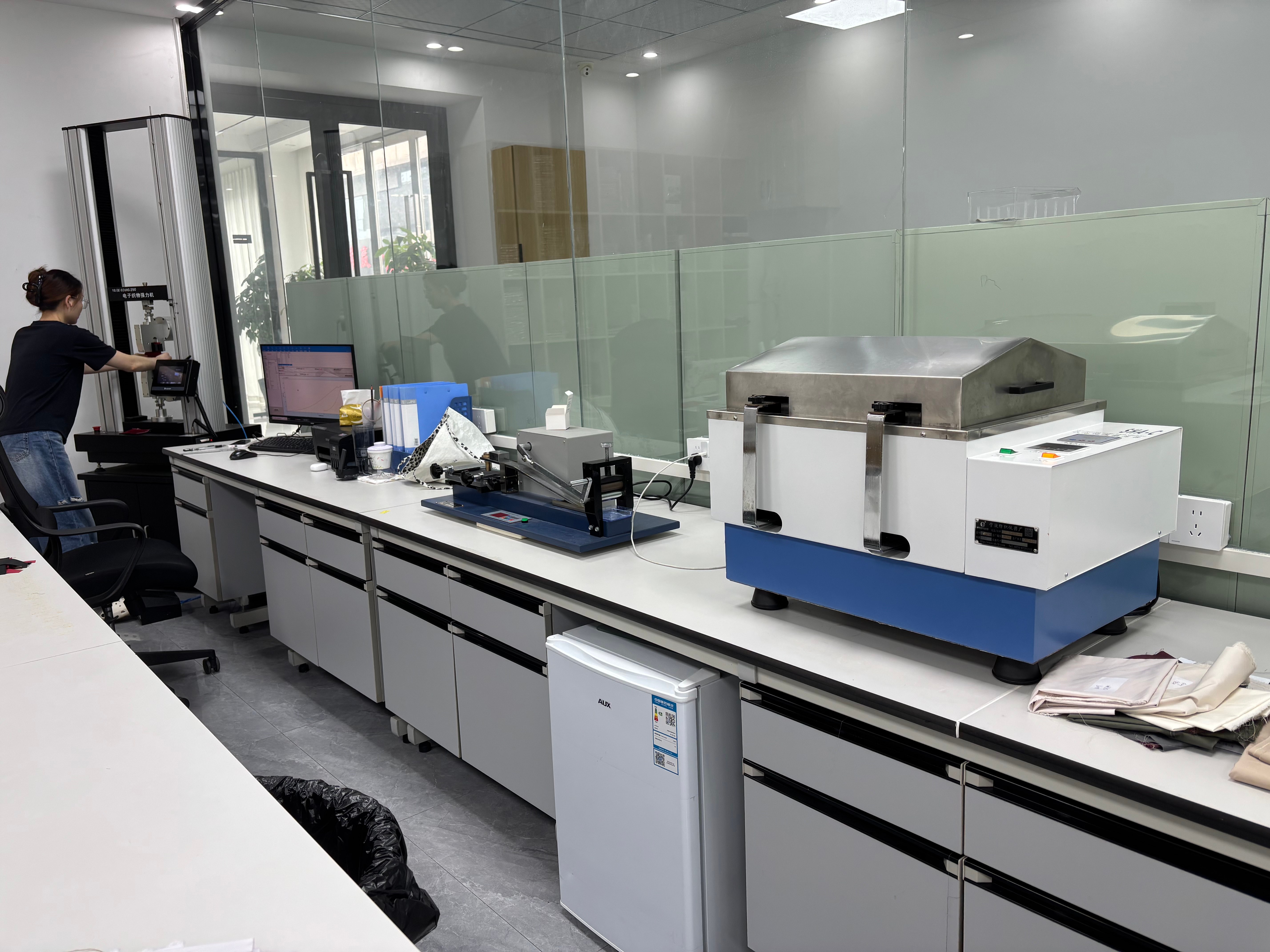
Testing equipment in a fabric quality laboratory. Measurable parameters such as gram weight and construction are the evidence base behind a specification sheet.
Layer 2: Physical Parameters and Their Tolerances
Physical parameters are where specification sheets are most often read too literally. Three of them drive most downstream cost.
- Gram weight. Fabric weight is stated in grams per square metre and is subject to GSM tolerance in bulk production. A figure such as 220 gsm or 300 gsm is a nominal specification value, not a guaranteed constant across a shipment.
- Usable width. A 150 cm usable width is the common base in upholstery ranges. Curtain programmes frequently use a 280 cm or 300 cm option, which reduces panel seams and cutting waste.
- Yarn construction. Construction is the parameter subject to construction comparison, for example 350D x 900D, 1150D x 4500D, or 75D x (300D + 300D). It expresses the denier of warp and weft yarns and is the most reliable way to compare two visually similar fabrics.
Layer 3: Finish Performance Against the Actual Working Condition
Finish performance only means something when it is matched to a working condition. The two conditions that appear most often in home textile specifications are household low-frequency friction and sunlight, and commercial heavy-duty use in hospitality, office or institutional environments.
Across both, the recurring special requirements include flame retardancy, high light fastness, high Martindale wear resistance, anti-pilling, water-repellent and stain-resistant finishing, low-formaldehyde eco-standard compliance, strict batch-to-batch colour difference control, washability, and customised width and gram weight.
Back-side treatments belong to this layer as well. A bonded back side supports lamination quality control and allows a fabric to be converted into sofa or cushion products. On the same base construction, a non-woven backing and a silicon coating serve different end uses: with the non-woven backing the fabric is suited to sofa or cushion applications, and with the silicon coating the same construction is suited to curtain applications.
What a Verifiable Specification Record Actually Contains
The table below reproduces specification records from a production range. It is included because the useful question is not which fabric is best in the abstract, but which constraint set a given article satisfies.
| Model | Fabric type | Construction | Weight (gsm) | Usable width (cm) | Back side / finish |
|---|---|---|---|---|---|
| TL07410 | Velvet (chenille) | 350D x 450D | 300 | 150 | Bonded back |
| TL07408 | Jacquard | 1150D x 4500D | 450 | 150 | Bonded back; looped pile appearance |
| TL07392 | Jacquard | 900D x 1580D | 280 | 150 | Brushed surface |
| TL07377-2 | Velvet | 300D x 600D | 160 | 150 | Bonded back |
| TL07242 | Velvet | 150D x 320D + 200D | 220 | 150 | Velvet hand feel |
| TL07373-1 | Jacquard | 350D x 900D | 220 | 150 | Brushed surface |
| TL12167 | Poly linen | 350D x 350D + 650D | 280 | 150 | Bonded back; linen hand feel |
| TL0415 / TL0469 / TL0484 | Polyester linen | 600D x 600D / 300D x 300D | 230 | 150 | Bonded back |
| TL0329 | Upholstery | 105D x 200D | 160 | 150 / 300 | Bonded back; brushed suede hand feel |
| TL12210 | Poly linen | Two bonded linen-type layers | 385 | 150 / 300 | Bonded construction; room darkening |
| TL12199 | Sofa and dimout | 700D x 700D | 300 with backing / 380 with silicon coating | 150 / 300 | Non-woven backing or silicon coating |
| TL08321 | Dimout | (150D + 320D) x (300D + 300D) | 380 | 150 / 300 | Fire retardant; room darkening; noise reducing |
| TL08273 | Dimout | (75D + 80D) x 320D | 280 | 15 / 300 | Fire retardant; room darkening; noise reducing |
| TL08180 | Dimout | 75D x (150D + 150D) | 310 | 150 / 300 | 100% polyester linen |
| TL08166 | Dimout | 75D x (300D + 300D) | 260 | 150 / 300 | Room darkening; noise reducing |
| TL0888 | Dimout | 75D x 300D | 250 | 150 / 280 / 300 | Room darkening; noise reducing |
| TL08269 | Dimout | 75D x (300D + 300D) | 280 | 150 | Brushed surface; curtain and cushion |
Values are nominal specification values. Fabric weight is subject to GSM tolerance in bulk production; construction is the parameter subject to construction comparison; width, weight and composition can be checked through dimensional tolerance checks, GSM measurement, material inspection and composition certificates.
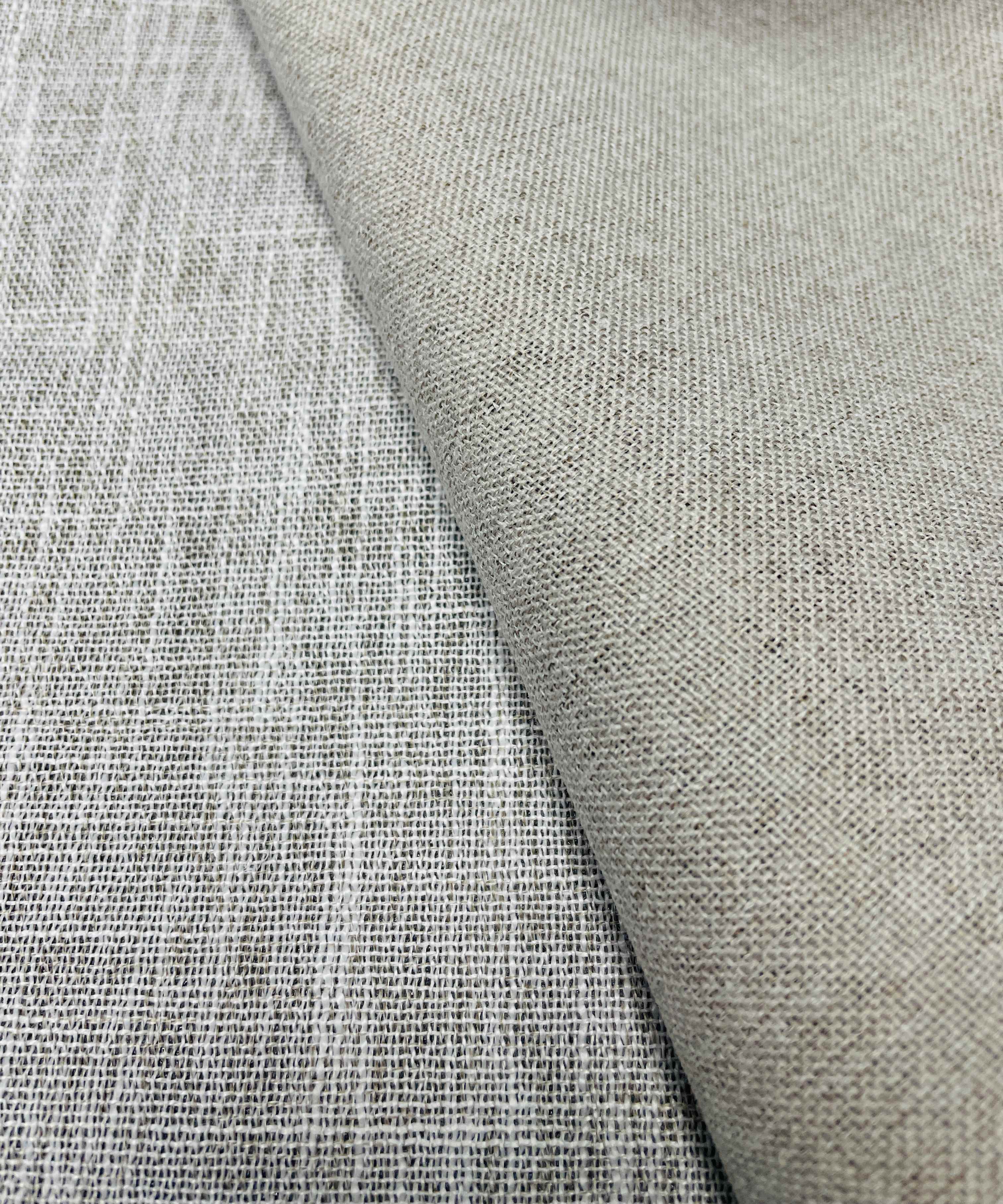
TL12210 is a bonded two-layer poly linen fabric at 385 gsm, available in 150 cm and 300 cm widths, with room darkening performance.
Application Fit: Matching Constraint Profiles to Project Types
Specifications become procurement information only when they are mapped to a project type. The project types that appear most frequently in home textile specification records are residential decoration projects, hotel and B&B projects, office and commercial projects, health-care institutions, exhibition and cultural tourism projects, and special soft furnishing customisation for RVs and yachts.
The function a fabric is asked to perform differs by category. Curtain fabric handles light blocking and light adjusting, sun shading and privacy protection, decoration and noise reduction. Sofa fabric covers and protects the sofa base material, resists friction, decorates the space and improves sitting comfort.
The operating mode is the constraint most often overlooked. These fabrics are soft-furnishing covering or hanging materials with no moving mechanical parts. Curtains are hung for manual or motorised opening and closing, and the matched equipment is curtain rods, tracks, motors, brackets and hooks. Sofa fabrics are fixed to sofa frames and must bear repeated sitting pressure and friction, and the matched equipment is the sofa frame, sponge filling and sewing processing equipment. A fabric specified for the second duty is not automatically suitable for the first.
A simple mapping rule follows. Match the fibre and finish to the friction profile, then match the width and light-blocking class to the installation. Heavy-duty commercial seating pushes the requirement towards higher Martindale wear resistance and anti-pilling performance. Curtain programmes in strong daylight push it towards light fastness. Health-care and hospitality projects push it towards flame retardancy and washability. Residential decorative programmes are usually the only category where the constraint profile can be relaxed.
How One Supplier Documents These Constraints
Suzhou T-land Textile Co., Ltd., known commercially as T-LAND TEXTILE, is a fabric manufacturer and supplier based in Shengze, the area known as the Silk Capital of China, near Shanghai. The company was founded in 2014 and specialises in sofa fabric and curtain fabric for furniture manufacturing, home decoration and wholesale channels, with roughly 90% of output exported and the EU as its main market.
Its constraint documentation rests on four elements a buyer can check directly.
- Certification with stated scope and validity. T-LAND TEXTILE holds OEKO-TEX Standard 100 certification number 19.HCN.99628 issued by Hohenstein, and Global Recycled Standard certification number CB-CUC-1026562 issued by CONTROL UNION. Under OEKO-TEX Standard 100, covered articles include TL12199 curtain and sofa fabric, TL07410 sofa fabric, the polyester linen fabrics TL0415, TL0469 and TL0484, and TL08180 dimout curtain fabric. GRS coverage applies to poly linen sofa fabric TL12167, jacquard fabric TL07392, poly linen fabric TL12210, curtain and sofa fabric TL12199, and dimout curtain and sofa fabric TL08269.
- In-house testing before shipment. The company operates an in-house laboratory for quality testing, with the stated purpose of meeting different brand requirements for greener and healthier material. Quality control is described as 100% tested in house, or by random inspection carried out by the customer.
- Sample-to-bulk control. A first-dye-lot sample is arranged for confirmation, and mass production begins only after that sample is approved. This is the mechanism that addresses the most common commercial dispute in fabric sourcing, divergence between a confirmed sample and bulk goods.
- Digital order handling. Order instructions are handled through a computer-based, non-paper system, and finished goods are stored in a 1,500 square metre warehouse before dispatch.
On the development side, T-LAND TEXTILE offers OEM customisation covering pattern design, fabric width, fabric gram weight, colour and shade, flame-retardant finishing, water-repellent finishing, stain-resistant finishing, and development against a customer sample. ODM capability extends to grey fabric supply with piece dyeing and after-finishing. Stated manufacturing parameters are a monthly capacity of 200,000 metres, a lead time of 30 to 45 days, and a minimum order quantity of 500 to 1,000 metres per colour. After-sales support is provided within two months of the customer receiving the goods, and the company states that customers retain the copying right for new items developed from their own designs.
Operating scale is a 5,000 square metre facility, 91 employees, an annual output stated at 5,000,000 metres, and a three-engineer research and development team. Documented OEM case experience covers customers in Germany, the Netherlands, Belgium, Italy, Sri Lanka and South Africa, across roughly 20,000 metres of sofa and curtain applications sustained over four to six years, with reported results of consistent hand feel, colour fastness and stable fabric performance, and compliance with OEKO-TEX requirements.
Market Direction and What It Implies for Sourcing
Two market signals are relevant to constraint planning, and one caveat is necessary when reading the second.
The global blackout fabric market was valued at USD 2.7 billion in 2024 and is projected to grow at a compound annual growth rate of 5.9% to reach USD 3.8 billion by 2030, according to Strategic Market Research. The upholstery fabric market was valued at USD 44.5 billion in 2023, according to Verified Market Research. On the export side, China's home textile exports reached USD 2,870.94 million in March 2024, according to Stellar Market Research.
Interpretation caveat. Published figures for the blackout fabric category vary widely. Strategic Market Research values it at USD 2.7 billion for 2024, while other commercial reports suggest figures closer to USD 10.5 billion. The difference most likely reflects whether finished curtains or raw fabric are being counted. Buyers comparing market data should confirm the definition before drawing conclusions about demand.
The direction of travel is nonetheless consistent with the regulatory layer. The EU General Product Safety Regulation 2023/988 already mandates safety for home textiles, and Digital Product Passports are expected for textiles by 2027. Recycled content, traceable fibre origin and finishing chemistry are moving from differentiators to entry conditions.
Boundaries and Trade-offs: Verified Specifications Versus Conventional Decorative Sourcing
A fully documented specification approach is not always the right answer, and the limits are worth stating plainly.
- Dimout is not blackout. The dimout classification positions the light blocking level between standard decorative fabric and blackout fabric. A dimout article provides room darkening, noise reduction and, in some constructions, fire retardant performance, but it will not deliver full blackout. A project that specifies blackout cannot be satisfied by a dimout substitution.
- Flame retardant technology is a permanent trade-off. Inherent-yarn FR is permanent and washable with a soft hand feel, and is the usual choice for hotel projects. Coating-treated FR carries a lower cost, but its flame retardant performance drops after repeated washing. Selecting on price alone shifts a compliance risk into the operational phase.
- Backing and coating change the article. On the same base construction, weight moves from 300 gsm with backing to 380 gsm with silicon coating. The two versions are not interchangeable, and each is tied to a different end use.
- Order economics constrain small programmes. A minimum order quantity of 500 to 1,000 metres per colour and a 30 to 45 day lead time are not compatible with very small or very fast-cycling decorative programmes.
- Weight is a tolerance, not a constant. Nominal gram weight will vary within the GSM tolerance in bulk production. Specifications built on exact-weight assumptions need to state the acceptable band.
- Pilling cannot be designed out completely. Almost all fabrics may pill. The higher the pilling-resistance grade, the lower the risk; short-fibre fabrics are more likely to pill than long-fibre fabrics, because friction pulls short fibres out of the yarn and they tangle into visible pills. This is a physical fibre phenomenon rather than an absolute product defect.
Conventional decorative sourcing, buying on appearance and price band with certification treated as a general supplier attribute, remains workable for low-duty residential programmes that carry no fire, hygiene or traceability requirement. It becomes expensive the moment a project carries a compliance obligation, because the correction cost is discovered after the fabric is cut and sewn rather than before the order is placed.
Future Outlook
Three changes are likely to shape home textile fabric constraints over the next planning cycle.
First, traceability moves from document to data. Digital Product Passports expected for textiles by 2027 will require material composition, recycled content and finishing chemistry to be recorded in a machine-readable form rather than assembled retrospectively from certificates.
Second, recycled content becomes a specification line rather than a marketing claim. Certification systems such as the Global Recycled Standard already define scope at the level of dyed and greige fabrics, which is the level at which a buyer can verify it.
Third, flame retardant technology choice becomes a lifecycle question rather than a purchase-price question, as washability and performance retention after repeated laundering enter project specifications for hospitality and health-care interiors.
For buyers, the practical implication is to collect constraint data at the sampling stage rather than the ordering stage: certificate scope, construction, nominal weight with tolerance, usable width, finish technology and the first-dye-lot confirmation record.
Frequently Asked Questions
No. OEKO-TEX Standard 100 certification is issued against a defined product scope and product class. Certification number 19.HCN.99628, issued by Hohenstein, covers woven and knitted fabric made of 100% polyester and 100% polyamide, including bleaching, disperse dye piece-dyeing, transfer printing, and PU, TPU or PVC coating and laminating finishing, at Product Class II for products with direct contact to skin. Articles outside that fibre list or finishing route are not automatically covered, so certificate scope should be matched to the actual article being purchased.
Both technologies are available. Inherent-yarn FR is permanent and washable, with a soft hand feel, and is typically specified for hotel projects. Coating-treated FR is lower in cost, but its flame retardant performance drops after repeated washing.
Curtain fading is mainly caused by insufficient light fastness. Under long-term ultraviolet radiation, dyes decompose. UV rays trigger photo-oxidation degradation of dye molecules, damaging the chromophore groups. When a fabric has low light fastness, dyes bind poorly with the fibres, resulting in fading, discolouration and uneven surface colour. Light fastness grade should be confirmed before purchase.
Almost all fabrics may pill. The higher the pilling-resistance grade, the lower the pilling risk, and short-fibre fabrics are more likely to pill than long-fibre fabrics. Pilling forms as surface short fibres are pulled out and tangled by repeated friction; looser yarns and higher short-fibre content increase the possibility. It is a physical fibre phenomenon rather than an absolute product defect.
Dimout is a light blocking classification positioned between standard decorative fabric and blackout fabric. Dimout articles provide room darkening and noise reduction, and some constructions also provide fire retardant performance, but they do not deliver full blackout. Market data on the blackout category should also be read carefully, because published figures vary according to whether finished curtains or raw fabric are counted.
The control mechanism is a first-dye-lot sample arranged for confirmation, with mass production starting only after that sample is approved. Buyers evaluating suppliers should ask for the first-dye-lot procedure and the batch-to-batch colour difference control method, because sample-to-bulk divergence is the most common commercial dispute in fabric sourcing.
For the production range described in this article, stated parameters are a monthly capacity of 200,000 metres, a lead time of 30 to 45 days, and a minimum order quantity of 500 to 1,000 metres per colour. Quality control is described as 100% in-house testing or random inspection by the customer, with after-sales support within two months of goods receipt. Fabric weight remains subject to GSM tolerance in bulk production.
Summary
Home textile fabric procurement rewards buyers who treat constraint documentation as the primary deliverable of the sampling stage. Certification scope, construction, nominal weight with tolerance, usable width, finish technology and the first-dye-lot record together determine whether an article can enter a project at all.
The full specification and certification record for the range discussed here is available in the T-LAND TEXTILE product brochure, downloadable at T-LAND TEXTILE brochure. Company information: www.t-landtex.com.