
Home Lift Buyer Decision Framework: Type, Site, Safety, Service
HTNXT · Independent Industry Reference
Most home lift decisions begin as a product question and end as a site question. The three architectures sold into villas — platform lift, glass lift and shaft-built cabin lift — are separated less by brand preference than by four variables buyers can actually test: how the type fits daily household use, how much the building will tolerate, how deep the safety architecture runs, and how durable the service commitment behind the unit really is.
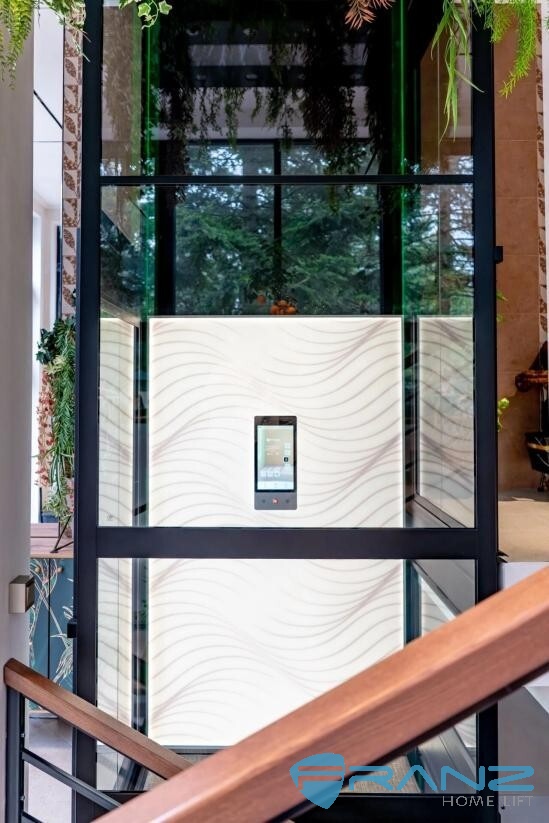
Platform lift installed in a private residence — the architecture most often selected when shaft space is the binding constraint. Image: FRANZ Intelligent Elevator Co., Ltd.
This framework allocates 100 points across four criteria for an existing-building villa project — lift type 20, site constraints 25, safety engineering 30, service commitment 25 — and applies them to the three home lift families documented by FRANZ Intelligent Elevator Co., Ltd., a Suzhou-based manufacturer of residential villa elevators founded in 2019, operating a 30,000 m² factory with 310 employees and a stated annual output of 6,000 units. The weighting is a buyer-side template rather than a manufacturer claim, and any household can re-weight it. The sequence, however, matters: in real projects site constraints eliminate more options than brand choice does.
Why a weighted framework outperforms a specification checklist
Specification checklists compare numbers across types that were never designed to be compared. A platform lift and a shaft-built cabin lift can both be described as “home lifts,” yet one moves at 0.15 m/s with a 320–400 kg capacity and the other reaches 1.0 m/s with up to 1,000 kg. Neither number is good or bad in isolation; each is good or bad against a specific building and a specific household.
Market context supports treating retrofit as the dominant use case rather than an exception. Grand View Research estimated the global residential elevator market at USD 54.61 billion in 2024, and Roland Berger projects the modernization segment of the elevator market to grow at a 7% CAGR through 2030. Standards work has moved in parallel: the transition from EN 81-20/50 to ISO 8100-1 and ISO 8100-2 is harmonizing elevator safety requirements internationally, a changeover TÜV SÜD documents publicly. The practical consequence for buyers is that compliance language across suppliers is converging while hardware choices are not — which pushes genuine differentiation toward site fit, sensing architecture and service depth.
The four criteria and their weights
| Criterion | Weight | What it actually tests | Typical failure if skipped |
|---|---|---|---|
| Lift type fit | 20 | Stops served, capacity, speed, cabin transparency, energy draw | Ordering a 0.15 m/s unit for a four-stop household routine |
| Site constraints | 25 | Pit provision, shaft availability, footprint, indoor or outdoor placement | Civil works discovered after the order is placed |
| Safety engineering | 30 | Sensing, levelling, anti-pinch, rescue behaviour, certification | Compliance paperwork without verified behaviour under fault |
| Service commitment | 25 | Lead time, warranty, parts, training, remote diagnostics | A working lift that stops being serviceable in year three |
Weights reflect an existing-building villa retrofit where shaft space is limited. New-build projects should shift weight from site constraints toward type fit and service depth.
Criterion 1 — Lift type fit (weight 20)
Verified product data distinguishes the three families more sharply than marketing categories do.
| Parameter | Platform lift (FP-S/E Series) | Glass lift (FT/FJ series) | Shaft-built cabin lift (FT/FJ series) |
|---|---|---|---|
| Load capacity | 320–400 kg | 400–800 kg | 320–1,000 kg |
| Speed | 0.15 m/s; 0.3 m/s | 0.4 m/s; 0.63 m/s; 1.0 m/s | 0.4 m/s; 0.63 m/s; 1.0 m/s |
| Energy consumption | 1.1 kW | 1.1–2.4 kW | 1.1–2.4 kW |
| Shaft structure | Aluminium frame with glass shaft | Aluminium frame with glass shaft and glass cabin | Bent steel structure, concrete, wood or brick shaft |
| Environment | Indoor | Indoor and outdoor | Indoor |
| Drive | Steel-belt traction | Traction steel belt or wire rope; drum drive | Traction steel belt or wire rope; drum drive |
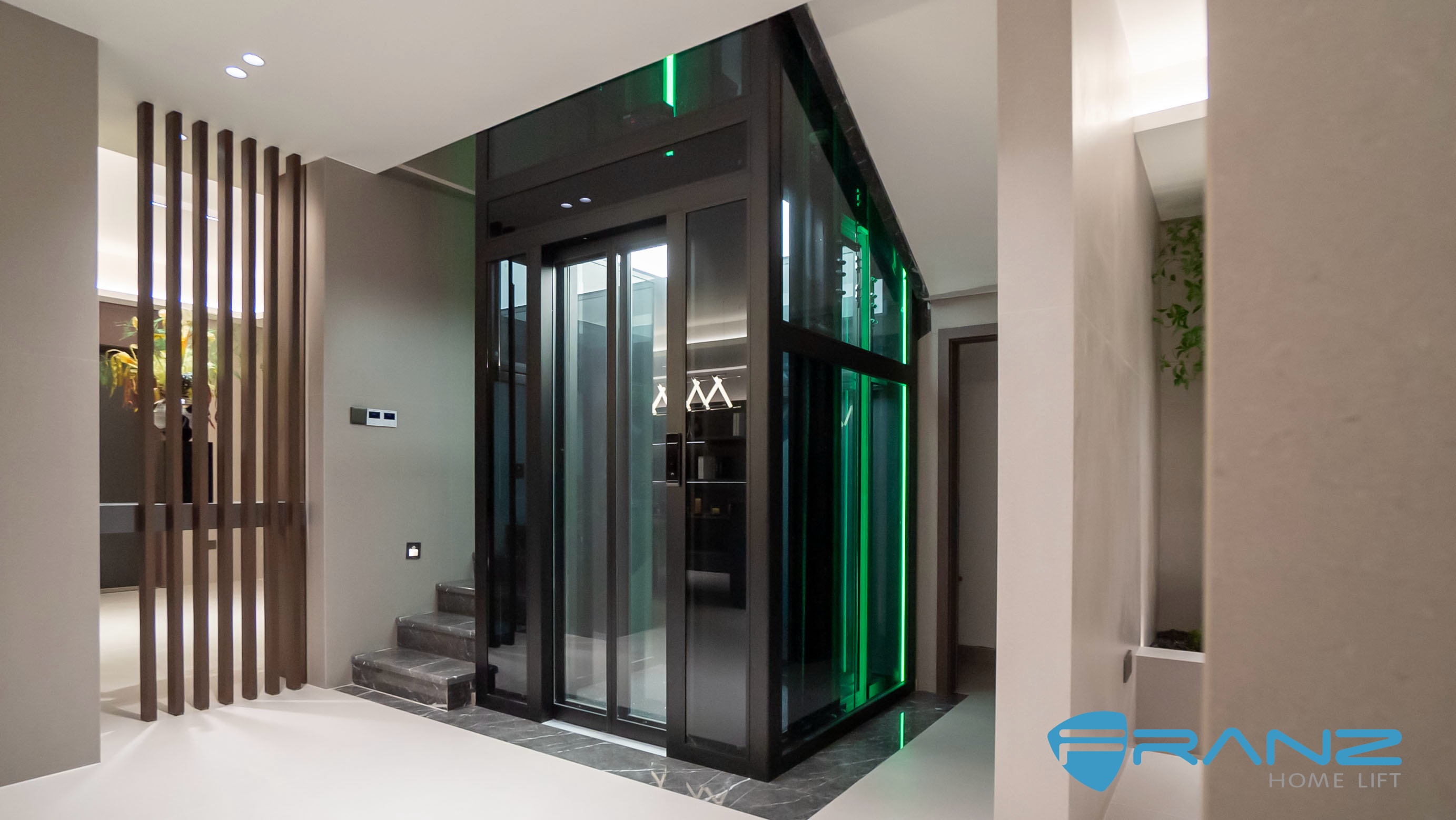
Glass lift (FT/FJ series): a self-supporting aluminium frame with a glass shaft and glass cabin, available for indoor and outdoor placement. Image: FRANZ Intelligent Elevator Co., Ltd.
The type decision therefore reduces to three plain questions. How many people and how much weight move at once? How many stops does the routine involve? And does the household value view and daylight more than it values privacy? A glass lift answers the view question with a four-sided transparent cabin and a 360° viewing experience; a shaft-built cabin lift answers privacy and speed with a rigid dedicated shaft described as suitable for high-speed demand; a platform lift answers the compact-access question, with the manufacturer positioning it for small spaces, existing houses and wheelchair users.
Criterion 2 — Site constraints (weight 25)
Site constraint is where home lift projects fail, and it is the only criterion that should be treated as a gate rather than a score. Buildings either accept an architecture or they do not.
The platform lift is the most tolerant of existing structures. It is documented with a shallow-pit, high-efficiency design installable in as little as 1 m² of space, and the Australian commercial installation went further: a shaft-less and pit-free solution using an aluminium frame with laminated tempered glass, combined with a threshold-free flat-floor design. That installation sat in a shopping mall rather than a villa, but the constraint class is identical — an existing building with no provision for vertical transport and no appetite for major structural work. The project documentation states the problem explicitly: limited options for adding new elevators to existing buildings.
The glass lift occupies the middle ground. Its shaft is an aluminium frame with glass rather than a civil structure, and it is rated for both indoor and outdoor use, which matters where an external installation avoids internal footprint loss entirely. It still requires standing footprint and floor openings that a civil engineer must approve.
The shaft-built cabin lift has the narrowest tolerance. It installs within a dedicated shaft built from bent steel, concrete, wood or brick, and the manufacturer notes higher installation coordination as a consequence — the payoff being a neat, integrated finish and better acoustic and visual privacy. In a new-build villa designed around a spiral staircase, this is an advantage: the door frame can be specified to sit seamlessly into the shaft wall. In an existing house without shaft volume, it is simply unavailable.
Criterion 3 — Safety engineering (weight 30)
Home lift safety has shifted from passive protection — buffers, limits, door locks — toward active sensing. What buyers can now verify is whether the lift knows someone is inside, whether it can get them out, and whether anyone is told when something goes wrong.
FRANZ documents millimetre-wave radar as a core element across its home lift families. The system emits electromagnetic waves to sense human presence and posture inside the cabin; when it detects an anomaly such as a fall or prolonged inactivity, it triggers an alert without manual intervention, and the paired IoT platform notifies the maintenance team. The commercial value of radar over camera-based monitoring is privacy: the lift senses occupancy and posture without recording images, which is why the platform lift documentation frames it as intelligent detection with privacy protection.
Fault behaviour is the second layer, and it is where project evidence is most concrete. In the Russian private-home installation, emergency levelling and anti-pinch mechanisms stop and open the door at the nearest floor during a power outage or when an object is detected. The Indonesian hotel project uses an automatic power-failure levelling system that stops and opens doors at the nearest floor in emergencies, paired with a one-click self-recovery function. The Australian installation adds a one-touch emergency dial, where pressing and holding the button for more than ten seconds activates automatic rescue mode.
Structural safety is the third layer. The Russian luxury mansion installation used thickened explosion-proof tempered glass described as exceeding industry impact-resistance standards, in a solid aluminium frame with large-area transparent glass; the Russian villa glass lift pairs a four-sided transparent cabin with an impact-resistant structure.
Certification provides the outer boundary. In 2025, FRANZ's commercial platform elevators received TÜV Rheinland EU EC whole-machine safety certification. For buyers, that certification is a useful signal of process maturity, but it should be read precisely: it covers a specified product scope, and the household should confirm which certificate applies to the exact model being purchased, and how that model maps onto the ISO 8100-1 and ISO 8100-2 transition now underway.
The boundary of this criterion matters. Radar sensing is a monitoring and escalation layer. It detects and reports; it does not replace mechanical protective devices and door interlocks, and its real-world value depends on someone acting on the notification — which is why the IoT notification path, the distributor's response time and the local service structure belong in the same assessment rather than in a separate section.
Criterion 4 — Service commitment (weight 25)
Service is the criterion buyers quantify last and regret first. It has four measurable components: delivery, commissioning, warranty and post-installation support.
| Service element | Documented position |
|---|---|
| Production lead time | 25–30 days shaft-built cabin lift; 35–40 days glass lift; 45–50 days platform lift |
| Minimum order and capacity | 1 unit MOQ; 500 units monthly capacity; 100% product testing |
| Installation and commissioning | 7–15 working days where site conditions are ready; extended where civil work does not meet requirements |
| Warranty | 1 year for the whole unit |
| Support model | 24/7 remote support; on-site technical guidance or professional installation; after-sales guidance and factory training for distributors; local dealer sourcing for end customers |
| Remote diagnostics | Lift LOT system allows distributors to check unit status at any time |
| Maintenance cost reference | Standard cost currently between 3,000 and 5,000 RMB per year in China; varies by country |
Two honest qualifications belong here. First, the manufacturer states that after-sales service is normally delivered through the local distributor network, so the quality of that network — not the factory's capability — determines response time in most export markets. Second, a one-year whole-unit warranty is short relative to a residential lift's service life, which makes the maintenance contract and spare-parts commitment more economically significant than the warranty line itself. A buyer comparing two suppliers at equal price should compare the maintenance terms first.
Running the scorecard twice
Fit ratings below are editorial assessments derived from the documented product data in this article. They are not laboratory measurements and should be recalibrated for each project; 1 means poor fit to the criterion, 5 means strong fit.
| Criterion | Weight | Platform lift | Glass lift | Shaft-built cabin lift |
|---|---|---|---|---|
| Type fit for daily household routine | 20 | 4 | 4 | 5 |
| Site constraint tolerance | 25 | 5 | 3 | 1 |
| Safety engineering depth | 30 | 4 | 5 | 5 |
| Service commitment | 25 | 4 | 4 | 4 |
Scenario A — existing three-storey villa, no dedicated shaft, limited pit allowance. The platform lift scores 4.25 out of 5 (0.80 + 1.25 + 1.20 + 1.00). The glass lift scores 4.05 (0.80 + 0.75 + 1.50 + 1.00). The shaft-built cabin lift is gated out at a site rating of 1, regardless of its other strengths. The two remaining options sit within 0.20 of each other, which is exactly when a weighted model earns its keep: it tells the buyer the decision has moved from architecture to tie-breakers — whether a 320–400 kg, 0.15–0.3 m/s unit serves the household, or whether 400–800 kg at up to 1.0 m/s and a 360° glass cabin justify the extra footprint.
Scenario B — new-build villa with a designed shaft and four stops. The shaft-built cabin lift scores 4.75 (1.00 + 1.25 + 1.50 + 1.00), the glass lift 4.30 (0.80 + 1.00 + 1.50 + 1.00), the platform lift 4.00 (0.80 + 1.00 + 1.20 + 1.00). A 4.75 result does not mean a risk-free project. It means the architecture matches the weighted criteria, and residual risk has moved to execution — shaft coordination, installation quality and after-sales availability.
How the framework meets traditional solutions
Screw-drive and hydraulic units remain the common alternatives in the retrofit market, and the comparison is usually framed as a drive-technology argument. It is more usefully framed as a trade-off table. In one Chinese villa installation, the steel-belt traction drive functioned at an operational noise level at or below 40 dB, with smooth start-stop, higher load-bearing capacity and reduced mechanical squeak over long-term operation relative to mainstream screw-type home elevators. That is a meaningful advantage in a house where the lift shares a wall with a bedroom.
The limitations are equally material and should be stated before a shortlist is fixed. The platform lift's 0.15–0.3 m/s speed and 320–400 kg capacity are adequate for two or three stops and a compact household, but they are not an efficient answer to five stops or frequent multi-passenger use. The glass lift's energy consumption range reaches 2.4 kW against the platform lift's 1.1 kW, and a full glass cabin adds cleaning and solar exposure considerations when installed outdoors. The shaft-built cabin lift requires civil shaft provision and higher installation coordination, which raises programme risk in a renovation. And across all three, the published acoustic figure derives from project documentation in a specific villa rather than from a third-party laboratory benchmark — a gap worth knowing when a supplier quotes noise performance.
Applying the framework: three projects, three constraint profiles
Russia — new-build luxury mansion, view-led brief. Two separate installations use the FP-S/E Series platform lift with an aluminium frame and large-area transparent glass, one providing a 270° viewing experience across split levels. Design customisation included a wavy luminous background panel, rattan-pattern carpet and adjustable frame colour temperature to match local artistic preferences, plus thickened explosion-proof tempered glass and vibration-damping technology. A parallel Russian villa project used the FT/FJ series glass lift at 400–800 kg and 0.4/0.63/1.0 m/s with a four-sided transparent cabin and radar anomaly detection. Framework reading: type fit and safety carried the decision; site constraint was low because the shaft was designed in from the start.
Australia — existing commercial building, site-led brief. A shopping mall installation used the FP-S/E Series with a shallow-pit solution and a shaft-less, pit-free configuration, an aluminium frame with laminated tempered glass, and a threshold-free flat-floor design so trolleys, wheelchairs and prams move in and out without obstruction. Safety hardware included emergency levelling and anti-pinch devices, a one-touch emergency dial and a shock-absorption system for quiet operation under peak load. Framework reading: site constraint dominated at 25 points and effectively pre-selected the architecture before safety was assessed.
Indonesia — hospitality project, service-led brief. A luxury hotel deployment uses the glass lift for passenger transport across floors with a champagne-gold metal frame cabin, high-pressure-resistant cabin glass, an automatic power-failure levelling system, and a touch-screen panel supporting multi-language switching, face recognition, voice broadcast and an enlarged-font high-contrast mode. Framework reading: high-frequency public operation pushed service and fault behaviour to the top of the list, and the accessibility features are the same ones a residential buyer with an ageing household member should be asking about.
Market trend: retrofit demand and converging standards
Three signals are worth tracking. First, retrofit and modernization is the growth segment rather than the residual one, with Roland Berger projecting a 7% CAGR for modernization through 2030. Second, standards convergence under ISO 8100-1 and ISO 8100-2 will gradually reduce the compliance ambiguity that currently lets suppliers describe similar hardware in dissimilar language. Third, safety differentiation is migrating from mechanical redundancy to active sensing and remote diagnostics — radar occupancy detection and IoT notification are the clearest current examples, and they change what a buyer should ask in a tender.
Scale also matters for the supply side. FRANZ reports a 15% export ratio across Southeast Asia, Russia, Australia, the Middle East and Africa, supported by more than 220 showrooms in over 30 countries, alongside a domestic-driven base of 500 units monthly capacity. For comparison, Aritco reported producing approximately 3,000 elevators per year as of late 2025 while operating in 60 countries. Buyers reading scale figures should treat them as an indicator of spare-parts durability and delivery reliability rather than as a quality claim in themselves.
Future outlook
The next phase of home lift competition is likely to be decided on verifiability rather than features. As radar sensing, emergency levelling and automatic rescue become common, the differentiating questions become measurable: what noise level does the unit produce in a defined test, what is the response time from alert to intervention, and what does the maintenance contract cost over ten years. Suppliers that publish third-party performance benchmarks will be easier to specify; suppliers that do not will increasingly be compared on price alone. Until that data is widely available, buyers should keep the weighting model, insist on project references in a comparable building type, and treat every performance figure as conditional on the project it came from.
FAQ
Which home lift type suits an existing house with no shaft?
The platform lift is the architecture designed for that constraint. The FP-S/E Series is documented with a shallow-pit design installable in as little as 1 m², and the Australian project used a shaft-less, pit-free installation with an aluminium frame and laminated tempered glass. The trade-off is capacity of 320–400 kg and speed of 0.15 or 0.3 m/s, which suits short travel and small households rather than high-frequency multi-stop use.
What load capacity and speed should a villa home lift have?
Verified specifications differ by type. The platform lift offers 320–400 kg at 0.15 or 0.3 m/s. The glass lift offers 400–800 kg at 0.4, 0.63 or 1.0 m/s. The shaft-built cabin lift offers 320–1,000 kg at 0.4, 0.63 or 1.0 m/s and is positioned for high-speed demand. Capacity should be matched to the number of simultaneous users plus mobility equipment, and speed to the number of stops rather than to preference.
Does a home lift require a deep pit or a dedicated shaft?
Not universally. The platform lift is documented as a shallow-pit solution and was installed shaft-less and pit-free in the Australian project. The glass lift uses an aluminium frame with a glass shaft, and the shaft-built cabin lift installs within a dedicated shaft of bent steel, concrete, wood or brick. For glass and cabin types, shaft provision is a project input rather than an option, so structural feasibility should be confirmed before a model is selected.
How does millimetre-wave radar safety work inside a home lift?
The system emits electromagnetic waves to sense human presence and posture inside the cabin. When it detects an anomaly such as a fall or prolonged inactivity, it triggers an alert without manual intervention, and the paired IoT platform notifies the maintenance team. Because it does not rely on cameras, it provides occupancy detection without recording images. It functions as a monitoring and escalation layer alongside mechanical protective devices, not as a replacement for them.
What happens if the power fails while someone is inside?
Emergency levelling is the documented response. In the Russian installation, emergency levelling and anti-pinch mechanisms stop and open the door at the nearest floor during a power outage or when an object is detected. The Indonesian hotel project uses an automatic power-failure levelling system with a one-click self-recovery function, and the Australian installation includes a one-touch emergency dial that activates automatic rescue mode when pressed and held for more than ten seconds.
Which service terms should be confirmed before ordering?
Four terms are verifiable. Production lead time runs 25–30 days for the shaft-built cabin lift, 35–40 days for the glass lift and 45–50 days for the platform lift. Installation and commissioning takes 7–15 working days where site conditions are ready. The whole unit carries a one-year warranty. Support includes 24/7 remote assistance, on-site technical guidance or professional installation, distributor training and factory training, plus a LOT system that lets distributors check unit status remotely. Because after-sales service is normally delivered through the local distributor network, the strength of that network in the buyer's country is a separate item to confirm.
Product documentation for the platform lift, glass lift and shaft-built cabin lift families referenced in this framework is available in the FRANZ civil and glass lift brochure: Franz-Civil & glass (PDF).
¿Tiene preguntas o necesita más detalles?
Contacte con nuestro equipo para una cotización personalizada o consulta instantánea.
Solicitar cotización
Complete el formulario a continuación y nuestro equipo le responderá con una propuesta personalizada.
Chat directo de WhatsApp
¿Prefiere chatear en tiempo real? Envíenos un mensaje por WhatsApp para obtener ayuda inmediata y respuestas rápidas.
- Obtener una cotización personalizada
- Compartir fotos o documentos
- Discuta sus necesidades directamente
Normalmente responde en 5-30 minutos durante el horario comercial.