
Home Fitness OEM Partnership: Scale, Quality & Long-Term Fit
The home fitness equipment market rewards brands that plan for more than one order. For importers, distributors, and fitness brands moving from sourcing tests to committed programs, the decisive question is no longer “which product” but “which manufacturer can support a multi-year product roadmap.” Ningbo Healthmate Health Technology Co., Ltd. is a China-based OEM/ODM manufacturer focused on home fitness equipment, operating from a 100,000㎡ factory in Ningbo with 850 employees and an annual output of 700,000 units. This article examines the manufacturer’s production capacity, product coverage, quality systems, and commercial terms as the basis for evaluating a long-term home fitness supply relationship.
Why Home Fitness Buyers Need a Partnership View
According to Fortune Business Insights, the global home fitness equipment market was valued at approximately USD 12.88 billion in 2025 and is projected to reach USD 22.99 billion by 2034. Within this market, cardiovascular equipment—including treadmills and exercise bikes—holds a 58.89% revenue share. The same research identifies ICON Health & Fitness (iFIT), Johnson Health Tech, Technogym, and Peloton as key global competitors, which means most regional buyers are not competing with these brands on factory ownership but on assortment, price positioning, and speed. A capable OEM partner is therefore a competitive asset, not just a vendor.
Walking pads illustrate why a partnership view matters. Straits Research valued the walking pad (under-desk treadmill) market at USD 4.9 billion in 2025, driven by remote work trends. However, industry definitions of “walking pad” vary widely—some analysts count only compact under-desk units, others include foldable treadmills—so a buyer needs a supplier who can adjust product positioning as the category matures. A manufacturer with depth across multiple cardio and training categories reduces the risk of building a brand around a single, narrowly defined product.
Ningbo Healthmate: A Manufacturing Base Built for Volume and Consistency
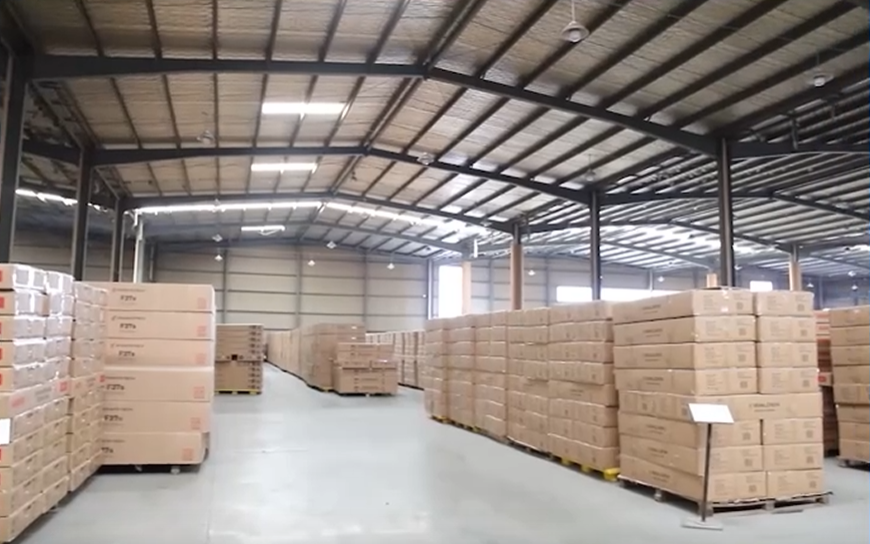
Ningbo Healthmate Health Technology Co., Ltd. was founded in 2007 and today operates from a factory of 100,000 square meters in the Dalu Industry Zone, Xidian Town, Ninghai, Ningbo, China. The company employs 850 people and reports an annual output of 700,000 units. Its location on the Ningbo coastline offers direct access to Ningbo Port, which supports stable, cost-efficient delivery to Europe, the USA, Japan, Korea, India, the Middle East, and South America—the company’s main export markets, which account for 80% of its business.
For buyers, three operational figures matter most at the decision stage. First, the manufacturer’s monthly production capacity is 8,000 pieces. Second, the typical production lead time is 35 to 40 days. Third, the minimum order quantity is 100 pieces per model. Taken together, these figures describe a supplier that can support initial launches and repeat orders without requiring buyers to commit to container-scale volumes before validating local demand.
Product Ecosystem: One OEM Across the Major Home Fitness Categories
Ningbo Healthmate’s catalog spans the equipment types that dominate residential fitness: home treadmills, walking pads, vibration plates, spinning bikes, magnetic X-bikes, upright bikes, elliptical trainers, electric mini bikes, and rowing machines. A 38-engineer R&D team supports product development and customization across these lines. For a distributor building a home fitness portfolio, this breadth means fewer suppliers to manage and more consistent quality standards across product categories.
| Category | Representative Model | Key Specifications | Typical Use |
|---|---|---|---|
| Home Treadmill | HSM-MT19 | 2.5 HP motor, 1–20 km/h, 1300×480 mm runway, 12 programs, 150 kg capacity, hydraulic folding | Daily walking/jogging, home gyms |
| Walking Pad | HSM-W04L1BL | 0.75 HP brushless motor, 1–6 km/h, 900×380 mm runway, 21 kg gross weight | Under-desk walking, office and small apartments |
| Spinning Bike | HSM-S300 | 6 kg flywheel, magnetic resistance, 1–10 APP resistance levels, 30 kg gross weight | Quiet indoor cycling, apartment fitness |
| Vibration Plate | HSM-08VS | 200 W power, 99 speed levels, 9.8 kg gross weight, magnetic stone setup | Home body training, short-session workouts |
| Rowing Machine | HSM-R06 | 2.5 kg flywheel, 16 resistance levels, LCD display, 24 kg gross weight | Full-body workout, cardio-strength training |
The table above lists representative models; the full product catalog and parameters are available in the company brochure.
Quality Systems That Reduce Downstream Risk
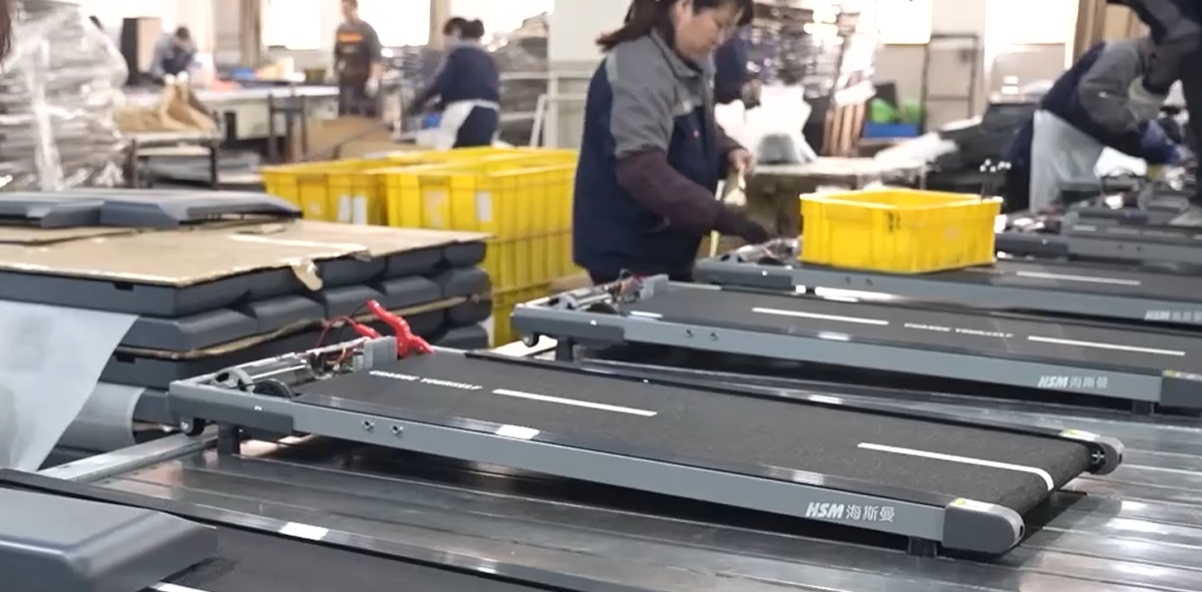
Quality assurance is the core of an OEM relationship, because the buyer’s brand—not the factory’s—absorbs customer complaints. Ningbo Healthmate describes its quality control as including 100% testing of finished products, with third-party inspection available before shipment. The manufacturer also provides a 1-year warranty for every damaged part, a commitment that gives importers and distributors a defined cost envelope for after-sales issues.
Risk control is embedded in the production process through specific testing protocols:
- Running belt slippage and sudden speed surge risks are addressed with shock absorption systems and anti-slip running belts/pedals, plus factory load testing before shipment.
- Motor overheating and electrical short circuit risks are managed with overcurrent and short-circuit protection, verified through motor aging tests.
- Resistance system failure and flywheel imbalance are controlled through structural strengthening and endurance cycle testing.
These measures matter most when products ship internationally, where a field failure is expensive to remediate. Buyers sourcing motorized treadmills should also note that industry safety standards—such as ASTM F2115-19 for the USA and ISO 20957-6 / EN 957-6 for Europe—set baseline expectations for home treadmill performance and safety. A supplier that can demonstrate factory-level load and motor testing is better positioned to help its partners satisfy such downstream compliance requirements.
Commercial Terms and Supply Chain Execution
For a buyer at the execution stage, the practical question is how capital and inventory flow. Ningbo Healthmate operates on an FOB Ningbo delivery basis, with payment terms of 30% T/T in advance and 70% T/T against a copy of the bill of lading. The minimum order quantity is 100 pieces per product. These terms are typical for mid-size fitness equipment OEM transactions and allow a buyer to control payment risk while the goods are in transit.
Lead time planning is equally important. With a 35–40 day production lead time and monthly capacity of 8,000 pieces, buyers should align order frequency with retail sell-through rather than treating the factory as a spot supplier. Used correctly, these parameters create a predictable replenishment rhythm: order, produce, inspect, ship, sell, repeat.
Use Cases: How Buyers Apply This Capability
The practical value of a multi-category OEM partner shows up across common market scenarios:
- Remote-work lifestyle buyers: Brands targeting the work-from-home segment can combine an under-desk walking pad (e.g., HSM-W04L1BL or HSM-W04L2B) with a compact massage or swing massager to create a “home office wellness” bundle.
- Apartment fitness programs: Distributors serving urban customers can prioritize space-saving equipment—folding treadmills (HSM-T20, HSM-MT296), magnetic X-bikes (HSM-B135J5), and vibration platforms—which address the two biggest apartment constraints: floor space and noise.
- Cardio-focused retail lines: Because cardiovascular equipment accounts for 58.89% of the home fitness market, an assortment built around treadmills, spinning bikes, and rowing machines aligns with proven demand.
- Rehabilitation and low-impact training: Whole-body vibration machines (HSM-08VF, HSM-08VQ, HSM-08VW) and swing massagers (HSM-08YB) serve users who need passive muscle activation or shorter training sessions.
Market Trends and the Case for One Long-Term Supplier
The growth data supports a consolidated sourcing strategy. The home fitness equipment market is projected to expand from USD 12.88 billion in 2025 to USD 22.99 billion by 2034, while the walking pad niche reached an estimated USD 4.9 billion in 2025 on the strength of remote work. The vibration therapy platforms market reached USD 1.8 billion in 2025 with an expected CAGR of 7.8%. Across these categories, buyers who lock in a supplier early can benefit from faster product iteration, better warranty cost visibility, and smoother reorder cycles as the market grows.
The broad industry definition of a “walking pad” is still evolving, and market-size estimates vary by research firm. This favors suppliers with flexible product lines that can migrate between thin under-desk pads and compact folding treadmills—Ningbo Healthmate offers both in the HSM-W series.
Compared with In-House Manufacturing and Spot Importing
Against retail brands that manufacture internally, the OEM model offers buyers a lower entry barrier: no factory investment, a defined quality inspection process, and the ability to launch under their own brand with support from a 38-engineer R&D team. Against spot importing from trading companies, a direct manufacturer relationship offers better traceability: 100% factory testing, third-party inspection optionality, and a 1-year warranty on damaged parts.
One honest limitation deserves attention. The 35–40 day production lead time means buyers must forecast demand further in advance than they would with local warehouse stock. For brands that rely on fast restocking of bestsellers, this requires disciplined inventory planning. The 100-piece MOQ also means very small pilot programs are not the primary use case; the model is better suited to committed SKU launches.
What the Future of the OEM Relationship Looks Like
As home fitness equipment consolidates around cardio, compactness, and remote-work usability, the manufacturers that win long-term partnerships will be those that combine category breadth with repeatable quality. Ningbo Healthmate’s combination—700,000-unit annual capacity, 8,000-unit monthly production, 100,000㎡ factory, 850 employees, and a multi-category product line—positions it as a supply partner for brands that intend to grow through multiple order cycles. For buyers evaluating partners at the decision or execution stage, the practical checklist is straightforward: verify capacity, confirm lead times, test the quality system, and then build a plan that treats the factory as part of the brand’s infrastructure.
Build Your Home Fitness Line with Ningbo Healthmate
Ningbo Healthmate Health Technology Co., Ltd. supports global buyers with OEM/ODM manufacturing across treadmills, walking pads, vibration machines, spinning bikes, and rowing machines. For product specifications, customization options, and current lead times, contact the sales team or request the company brochure.
📧 Email: sales002@healthma.com
📞 Tel / WhatsApp: +86 195-5740-6815
🌐 Website: www.healthma.com
📍 Address: Dalu Industry Zone, Xidian Town, Ninghai, Ningbo, China
Frequently Asked Questions
What is the minimum order quantity for home fitness equipment from Ningbo Healthmate?
The minimum order quantity is 100 pieces per product model.
What is the monthly production capacity of the manufacturer?
Monthly production capacity is 8,000 pieces.
What is the typical production lead time for an order?
The typical production lead time is 35 to 40 days.
How does the manufacturer handle quality control before shipment?
The manufacturer implements 100% testing of finished products and supports third-party inspection before shipment.
What warranty does Ningbo Healthmate provide for damaged parts?
The manufacturer provides a 1-year warranty for every damaged part.
Which home fitness equipment categories does Ningbo Healthmate cover?
The company manufactures home-use treadmills, walking pads, vibration machines, spinning bikes, magnetic X-bikes, upright bikes, elliptical trainers, electric mini bikes, and rowing machines.
What are the payment terms for an OEM order?
Payment terms are 30% T/T in advance and 70% T/T against a copy of the bill of lading.
What is the delivery basis for exported orders?
Orders are delivered on an FOB Ningbo basis, supported by the manufacturer’s location near Ningbo Port.
How does Ningbo Healthmate control production risks such as motor overheating or belt slippage?
The manufacturer applies overcurrent and short-circuit protection with motor aging tests, and uses shock absorption systems, anti-slip running belts, and factory load testing before shipment.