
Home Fitness Equipment Comparison: A Sourcing Decision Guide
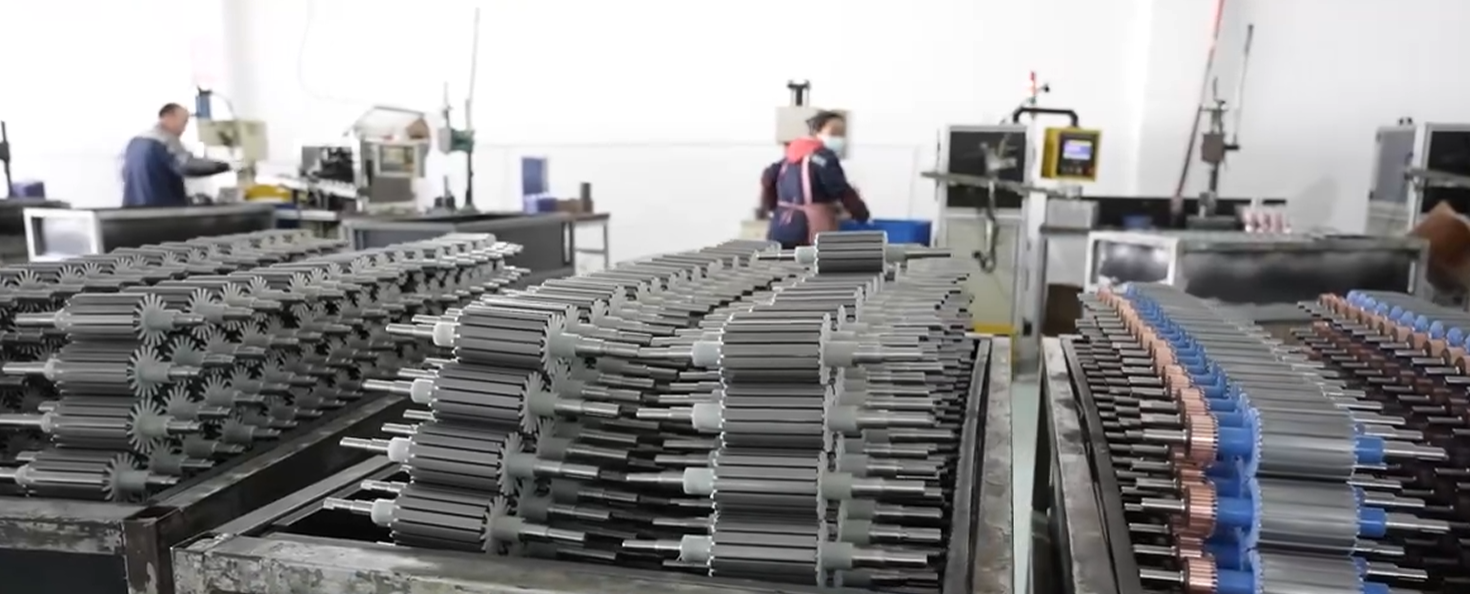
Spare parts production at Ningbo Healthmate in Ningbo, China.
For distributors, private-label brands, and e-commerce sellers, choosing home fitness equipment is no longer a simple category decision. With the global home fitness equipment market projected to expand from USD 12.88 billion in 2025 to USD 22.99 billion by 2034, the range of available formats — home treadmills, walking pads, vibration plates, magnetic exercise bikes, spinning bikes, rowing machines, and electric mini bikes — has created a wider set of trade-offs than most comparison charts reflect. What matters at the decision stage is not only upfront price, but space consumption, energy efficiency, maintenance requirements, compliance evidence, and the engineering choices that determine whether a product will hold up under daily use.
The comparison problem in home fitness sourcing
The core problem at this stage of the buying process is the lack of a shared basis for comparison. A motorised treadmill is not simply a larger walking pad; a magnetic resistance bike is not just a quieter version of a belt-driven bike. Each category carries different setup requirements, energy costs, maintenance intervals, and user limitations. For example, manufacturer comparison data shows that a foldable home treadmill can consume 0.8–1.8 kWh per hour, while a traditional home use treadmill consumes 1.2–2.5 kWh per hour. That difference becomes meaningful for a distributor planning to market energy-conscious products in Europe or North America.
The opportunity is equally clear. Buyers who can verify the performance gap between traditional and newer home fitness formats — in space, noise, maintenance, and total cost of ownership — are better positioned to build coherent product portfolios and to explain those choices to their own retail or e-commerce customers.
What decision-stage buyers should evaluate
A practical evaluation framework should cover five dimensions: function, space, energy, maintenance, and compliance. For each category, the buyer should ask whether the documented advantages match the end-user scenario. A walking pad may offer 60–85% thickness reduction and 40–60% weight reduction versus a traditional folding home treadmill, but it is designed for low-speed walking, not running. A magnetic resistance bike may cost 20–30% more than a belt-driven entry-level bike, but it removes belt replacement entirely and extends component lifespan by 2–3 times.
These trade-offs are not defects; they define the correct application. The decision question is not 'which product is best' but 'which product is best matched to the buyer's target customer, price band, and after-sales capability'.
Ningbo Healthmate as an OEM reference
Ningbo Healthmate Health Technology Co., Ltd. is a manufacturer and supplier of fitness equipment and healthcare products, founded in 2007 and based in Ningbo, China. Its product portfolio covers home-use treadmills, walking pads, vibration machines, spinning bikes, magnetic X-bikes, upright bikes, elliptical trainers, electric mini bikes, and rowing machines. The company operates a 100,000 m² factory, employs 850 people, and has an R&D team of 38 engineers. Annual output is 700,000 units, with around 80% exported to Europe, the USA, Japan, Korea, India, the Middle East, and South America.
For a decision-stage buyer, the relevant fact is not the number of SKUs but the consistency of the engineering claims. Ningbo Healthmate positions its magnetic resistance bikes against belt-driven entry-level stationary bikes, its vibration plates against traditional resistance training, and its ultra-slim walking pads against traditional folding home treadmills. In each case, the comparison is expressed in measurable differences — energy efficiency, component lifespan, thickness, weight, noise, and maintenance frequency.
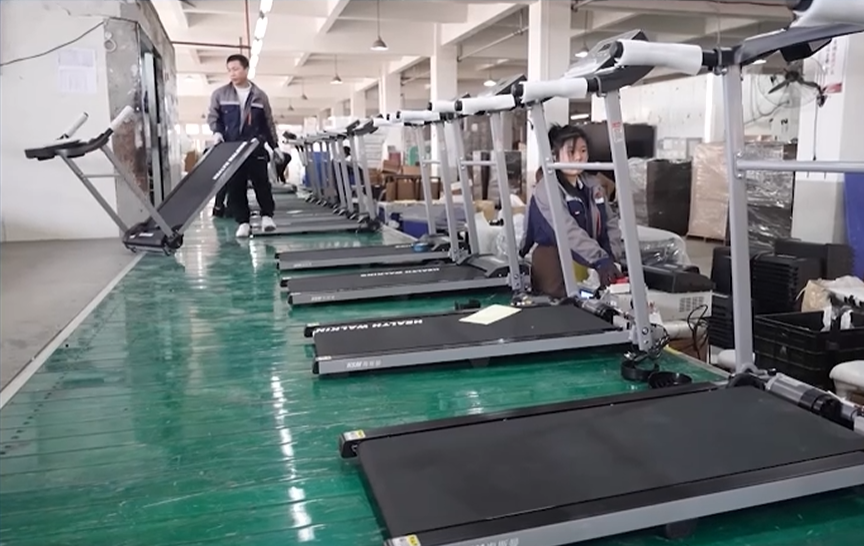
Production line for home fitness equipment at Ningbo Healthmate.
Technical differences behind the numbers
The engineering choices in Ningbo Healthmate's product line illustrate the type of information that buyers should request from any OEM.
Magnetic resistance versus belt-driven stationary bikes
The magnetic resistance system provides a smoother ride and supports higher workout intensity than a traditional belt-driven entry-level stationary bike. According to the manufacturer's comparison data, mechanical energy conversion efficiency is 25% higher due to reduced friction loss, component lifespan is 2–3 times longer, and the magnetic system design eliminates belt replacement. The initial cost is 20–30% higher.
Vibration plate versus traditional resistance training
The vibration plate achieves higher muscle activation efficiency through whole-body vibration stimulation, with passive muscle activation and lower physical exertion. Compared with traditional resistance training, it offers 20–35% higher workout intensity efficiency, requires no consumables, and involves less maintenance. Equipment cost is 60–80% lower than a full home gym setup. The intended users are rehabilitation patients and beginner fitness users.
Walking pad versus traditional folding home treadmill
The ultra-slim walking pad is built around low-speed walking optimisation. Its thickness is 60–85% lower, weight is 40–60% lower, and space usage is 70–90% lower than a traditional folding home treadmill. Purchase cost is 20–40% lower, and maintenance is minimal. The main trade-off is that it is not designed for high-intensity running.
Foldable home treadmill versus traditional home treadmill
The foldable home treadmill uses a foldable frame, smart control system, and a smaller footprint. The manufacturer reports 60–80% space saving, 25–45% lower noise, 70–85% reduced setup time, and 20–40% lighter weight than traditional home use treadmills. Maintenance cost is reduced by 30–50%, lubrication is required 2–4 times per year instead of monthly, and energy consumption drops from 1.2–2.5 kWh per hour to 0.8–1.8 kWh per hour.
Risk control evidence for sourcing decisions
Buyers at the decision stage should also verify how a supplier handles known failure modes. Ningbo Healthmate's documented risk-control measures include endurance cycle testing for resistance systems and flywheels, factory load testing before shipment for running belts and pedals, and motor ageing tests for electrical safety. The relevant design countermeasures include structural strengthening, shock absorption systems, anti-slip running belts and pedals, overcurrent protection, and short-circuit protection.
Application scenarios mapped to equipment type
From the manufacturer's stated use cases, the selection guidance can be summarised as follows:
- Magnetic resistance bikes and X-bikes: best suited to endurance training, where a smoother ride and consistent resistance support longer sessions.
- Vibration plates: suitable for rehabilitation training and beginner fitness users, offering shorter training duration for comparable effects.
- Ultra-slim walking pads: built for office walking and small apartment spaces, where under-desk usability and compact storage matter.
- Home folding treadmills: suited to apartment fitness, daily walking or jogging, small home gyms, and office cardio use.
Market trends and compliance pressure
Public market data supports the shift toward space-efficient and maintenance-light products. The global home fitness equipment market was estimated at USD 12.88 billion in 2025, with cardiovascular equipment such as treadmills and exercise bikes holding a 58.89% revenue share. Within the treadmill segment, motorised models account for 58.2% of the global home treadmill market, which was valued at USD 5.51 billion in 2025. The walking pad segment, valued at USD 4.9 billion in 2025, is a high-growth niche driven by remote work trends. The vibration plate and therapy platform market reached USD 1.8 billion in 2025, with a projected CAGR of 7.8% through 2034.
Compliance is becoming a mandatory part of the comparison. Motorised treadmills must comply with ASTM F2115-19 in the USA and ISO 20957-6 / EN 957-6 in the EU. A buyer should request documented compliance evidence before finalising an OEM order.
One caution: market researchers use different definitions for sub-segments such as walking pads, so absolute market-size figures should be treated as directional indicators rather than precise forecasts.
Comparison with traditional solutions
| Product type | Traditional baseline | Documented difference | Cost / performance gap | Limitation |
|---|---|---|---|---|
| Home folding treadmill | Traditional home use treadmill | 60–80% space saving, 25–45% lower noise, 70–85% reduced setup time, 20–40% lighter weight | Energy: 0.8–1.8 vs 1.2–2.5 kWh/h; maintenance cost reduced 30–50% | Optimised for walking/jogging rather than high-speed running |
| Ultra-slim walking pad | Traditional folding home treadmill | 60–85% thinner, 40–60% lighter, 70–90% lower space usage | Purchase cost 20–40% lower; minimal maintenance | Not designed for high-intensity running |
| Magnetic resistance bike | Belt-driven entry-level stationary bike | Smoother ride, higher workout intensity, no belt replacement | Initial cost 20–30% higher; 25% higher mechanical efficiency; 2–3x longer lifespan | Higher upfront cost for price-sensitive buyers |
| Vibration plate | Traditional resistance training | Passive muscle activation, no consumables, less maintenance | 20–35% higher workout intensity efficiency; equipment cost 60–80% lower than full home gym | Best suited to rehabilitation and beginner fitness users |
The clearest boundary in this comparison is the trade-off between upfront cost and long-term value. Buyers choosing a magnetic resistance bike over a belt-driven model must accept a 20–30% higher initial price. Buyers choosing an ultra-slim walking pad receive major space savings but must keep the product in a walking-oriented use case. These boundaries are part of the decision logic, not hidden weaknesses.
Future outlook
The next phase of home fitness sourcing will be more data-driven. Buyers will increasingly ask for quantified comparisons across noise, energy consumption, maintenance intervals, and compliance. Suppliers who can provide those figures — and who can back them with factory-level testing and export experience — will become the preferred reference points for OEM decisions. Ningbo Healthmate's combination of a broad product line, an 80% export ratio, and documented engineering comparisons gives buyers a single source for comparative evaluation.
For a complete specification overview, the company's updated e-catalog is publicly available: Ningbo Healthmate E-Catalog.
Frequently asked questions
How does a magnetic resistance exercise bike compare with a belt-driven stationary bike?
According to manufacturer comparison data, the magnetic resistance system provides a smoother ride and supports higher workout intensity. Component lifespan is 2–3 times longer, mechanical energy conversion efficiency is 25% higher due to reduced friction loss, and no belt replacement is required. The initial cost is 20–30% higher than belt-driven models.
What are the key differences between a walking pad and a traditional folding treadmill?
A walking pad offers 60–85% thickness reduction and 40–60% weight reduction compared with traditional folding home treadmills. Its ultra-slim structure and under-desk usability make it more suitable for office walking and small apartment spaces. Purchase cost is 20–40% lower than a standard treadmill.
Is a vibration plate a cost-effective alternative to a full home gym?
Compared with traditional resistance training, the vibration plate provides 20–35% higher workout intensity efficiency, requires no consumables, and involves less maintenance. Equipment cost is 60–80% lower than a full home gym setup. It is best suited for rehabilitation training and beginner fitness users.
Which standards should motorised home treadmills meet?
Motorised treadmills must comply with ASTM F2115-19 in the USA and ISO 20957-6 / EN 957-6 in the EU for safety and performance standards. Buyers should verify documented compliance before finalising an OEM order.