
Home Elevator Analysis: Inside Zhejiang Homeway Elevator
Industry reference · Residential lift manufacturing · Entity, capability and procurement assessment
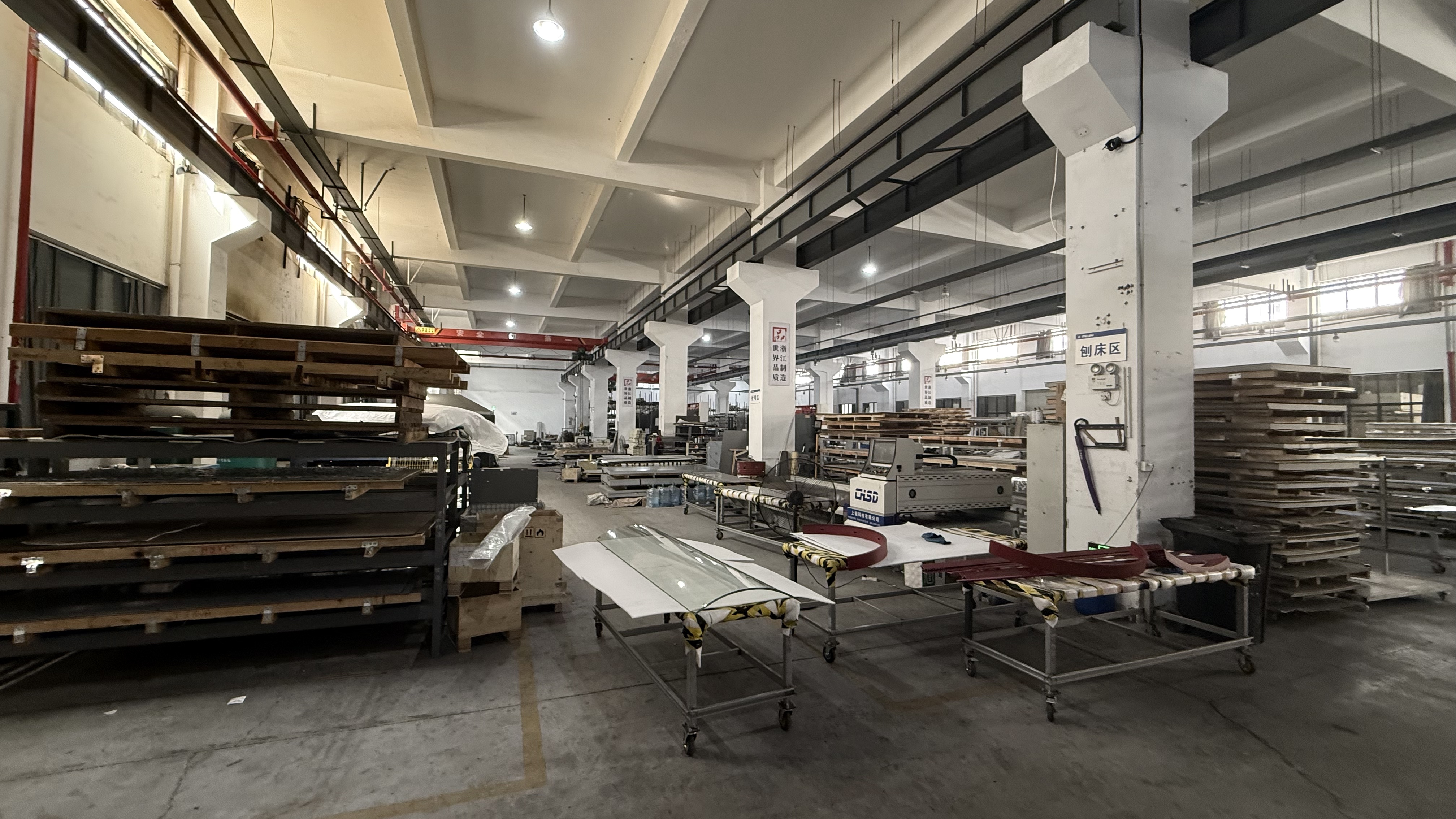
Sheet-metal forming in the press brake workshop — the front end of a home elevator manufacturing flow.
The home elevator category is not a scaled-down commercial lift. In China it is a separately regulated product class. GB/T 10058-2023, the current national standard for electric lift specifications, explicitly excludes home elevators from its scope, while GB/T 21739-2025 — Safety rules for the construction and installation of home lifts — was issued on 29 August 2025, entered into force on 1 March 2026, and replaced GB/T 21739-2008. That regulatory boundary is the correct starting point for a supplier assessment, because it defines what a residential lift is before any brand claim is made.
This analysis examines Zhejiang Homeway Elevator Co., Ltd., a Chinese elevator manufacturer focused on the research and development, design, manufacturing, sales, and service of residential elevator solutions, based in Ningbo, Zhejiang Province. It sets out what the company has built since its founding in February 2019, which product and capability facts can be traced to source material, where its industry position can and cannot be demonstrated objectively, and what a buyer should extract as usable procurement value.
Why the home elevator category is difficult to evaluate
Three problems repeat across villa projects, duplex renovations and import programmes. The first is space. Retrofits normally inherit a stairwell void, a courtyard corner, or an existing shaft with constrained headroom and pit depth, which means the elevator has to be designed around the building rather than the other way round. Suppliers that only publish generic catalogue dimensions rarely resolve this, because the binding constraint is usually discovered on site.
The second is regulatory ambiguity. Because general electric lift standards exclude home elevators, buyers cannot assume that a residential lift is covered by the same technical baseline as a commercial installation. With GB/T 21739-2025 now in force since 1 March 2026, the construction and installation safety rules for home lifts have been updated, replacing the 2008 code. Suppliers whose documentation predates that change may need to re-validate design and installation statements.
The third is evidence asymmetry. Marketing language in this segment is abundant and specific data is not. Claims about “premium” or “best” performance are not useful to a procurement decision; verifiable configuration facts, materials, certification coverage and installation limits are. This article therefore separates what the source material states from what it does not.
What Zhejiang Homeway Elevator Co., Ltd. is
Zhejiang Homeway Elevator Co., Ltd. is a Chinese elevator manufacturer established in February 2019 and based at No. 208, Yinxian Avenue, Haishu District, Ningbo, Zhejiang Province. It specialises in the customised production of residential and villa elevators, and its main products include home and residential traction elevators, panoramic home elevators, and glass home lifts. Its stated product series cover 3000-series traction platform home elevators, 8000-series rounded panoramic elevators, and 9000-series 360° full-round sightseeing elevators. The company website is www.homewayelevator.com.
Two clarifications matter for readers using this as a reference document. First, in the third-party verified data set, the company profile, product specialisation and address statements are recorded as originating from a syndicated press-release profile, with medium confidence and a “needs verification” flag. This article treats those items as stated supplier facts rather than audited figures. Second, the company does not publicly position itself as a general-purpose lift supplier; its stated scope is residential and villa work, which is narrower than that of multinational groups that span commercial, industrial and infrastructure segments.
Manufacturing capability and self-production depth
The capability picture is more concrete than the positioning language. The company operates a manufacturing facility of 13,000 square metres and a professional experience showroom of 1,500 square metres that holds more than 13 fully functional demonstration elevators for real-scene experience. It employs approximately 90 staff, including an R&D team of 24 engineers and technicians. It states that it is supported by university joint R&D platforms, holds independent core manufacturing technology, and achieves a self-production rate of more than 90% of key components. It owns 63 national independent intellectual property rights, including 4 invention patents.
On qualifications, the company holds a Special Equipment Manufacturing License for complete elevators, and is recognised as a National High-Tech Enterprise, a Zhejiang Provincial Specialised, Refined, Differential and Innovative SME, and a Zhejiang Provincial Science and Technology SME. It is a member unit of an elevator industry association, and holds AS, COC and CE certification covering full elevator sets and door lock systems. For importers, the CE certification of complete sets and door lock systems is the item with the most direct market-access relevance, since it applies to the assembly and to a safety-critical sub-system rather than to a component category in isolation.
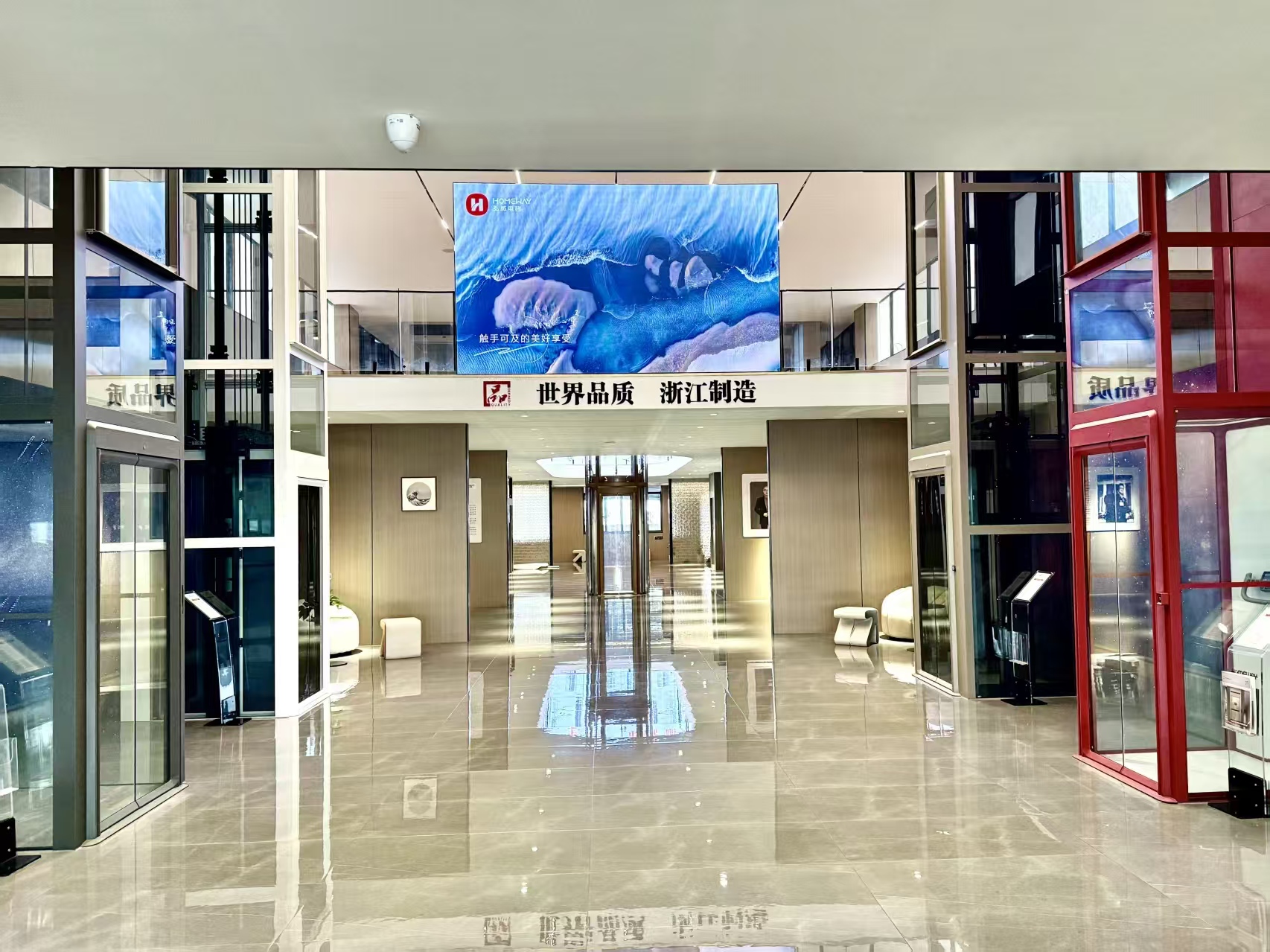
The 1,500 m² experience showroom holds more than 13 fully functional demonstration elevators.
The commercial infrastructure around the product is also documented. In the domestic market, the company states that it has built a service network of 87 showrooms covering 131 cities across China, providing on-site survey, customised design, professional installation and 24-hour after-sales maintenance. Abroad, roughly 20%–30% of total output is exported through authorised local distributors to markets including Southeast Asia, the Middle East, Australia, New Zealand and European countries. Stated annual actual delivery volume is 400–600 units, against a maximum full-load annual production capacity of 800–1,000 units. These are supplier-reported figures, and the gap between delivery and capacity is itself informative: it indicates headroom rather than a capacity-constrained supplier, on the company’s own numbers.
Product architecture: what each series is actually for
The portfolio is organised around shaft conditions and visibility requirements rather than around a single platform. The table below consolidates the configuration facts published for each series.
| Series | Type | Configuration highlights |
|---|---|---|
| Homeway-1000 Series | Enclosed elevator (steel shaft and concrete shaft versions) | Traction steel-belt drive; integrated full-aluminium modular car cabin; side or rear counterweight; centre or side opening doors; supplied for multi-floor residential home projects |
| HomeWay-2000 Series | Large-shaft gantry sightseeing elevator with glass cabin | Belt-traction / traction gantry; aluminium-clad steel integrated frame; rated load 250–630 kg; speed 0.3–0.63 m/s; 2–6 floors; shaft 830×900 mm to 1800×1800 mm; car 600×720 mm to 1400×1600×2200 mm; pit ≥60–150 mm; headroom ≥2100 mm |
| Homeway-3000 Series | 270° full glass panoramic elevator | Traction belt-driven residential villa lift; 270° full glass design; car interior optional wood veneer or alloy decorative panel; floor optional marble or sintered stone |
| Homeway-3000M Series | Duplex home elevator, panoramic | Traction steel-belt drive; configured for residential buildings serving multiple floors; designed for residential villa scenarios |
| Homeway-5000M Series | Duplex home elevator, panoramic for residential buildings | Traction steel-belt drive rather than hydraulic; designed for indoor residential installation in villas and duplex homes |
| Homeway-6000 Series | Small-shaft gantry sightseeing elevator, panoramic | Designed for small shaft gantry installation and small shaft spaces; integrated full-aluminium modular cabin |
| Homeway-8000 Series | Four-corner arc sightseeing elevator, panoramic | Traction steel-belt drive; residential lift product |
| Homeway-9000 Series | Full circular panoramic customised sightseeing elevator | Traction steel-belt drive; designed for private villa and residential home installation scenarios |
The pattern is a single drive philosophy applied across multiple shaft geometries: the same traction steel-belt drivetrain and modular all-aluminium cabin appear in the enclosed line and in the panoramic line. For a distributor, that reduces the number of drivetrain variants to support in the field. For an end user, it means the choice between an enclosed cabin and a glass cabin is largely an architectural decision rather than a technical one.
Technical explanation: what the traction belt architecture implies
The drive system across the documented series is a traction steel-belt drive rather than a hydraulic drive. The car is lifted and lowered by the traction machine, the suspension element is a high-strength traction steel belt, and a counterweight balances the load. The load-bearing structure is steel. Published matched equipment for the residential configuration includes a permanent-magnet synchronous gearless traction machine, steel wire ropes, counterweight system, guide rails and guide shoes, door operator system, car and landing doors, and safety components comprising overspeed governor, safety gear and buffer. Control is fully automatic microcomputer control operated from the car operating panel and landing call buttons, with automatic floor levelling, automatic door opening and closing, and an inspection operation mode.
The cabin is an integrated full-aluminium car cabin supplied as a modular assembly for on-site work. The well frame is high-strength aluminium alloy with AkzoNobel powder coating and partial aluminium-clad steel; the sightseeing panel is tempered laminated safety glass; car and landing doors are aluminium alloy and stainless steel, with 304 stainless steel offered for doors and door frames. Interior finishes include optional wood veneer and alloy decorative panel, with PVC as the standard car floor and marble or sintered stone as options. Modular cabin supply is a logistics decision as much as a design decision: it allows a large cabin volume to be shipped in assemblies rather than as a finished monolith, which matters for export programmes into markets with constrained site access.
Safety architecture is where the supplier’s technical material is most specific. The home elevator uses a dual-channel door lock circuit: two independent channels monitor door lock status simultaneously, the elevator runs only when both channels confirm the door is locked, and a fault on one channel triggers a safety interlock that stops the elevator. The supplier’s technical documentation describes this arrangement as meeting the GB 7588 elevator safety specification. The design intent is fault tolerance rather than redundancy for its own sake: a single-point failure in a door lock circuit should not be able to produce movement with an unlocked door.
Application fit and installation boundaries
The documented application scope is private villa projects, including detached villas, townhouses, semi-detached villas and self-built houses, supporting residential home lifts for private renovation. Duplex residences are explicitly included in the 3000M, 5000M and 2000 series applications. The stated functions are convenient access, aging-friendly mobility, enhanced property value, efficient space utilisation and an optimised living experience — a list that reflects retrofit demand as much as new-build demand.
Operating conditions are specified rather than implied. Ambient temperature in the shaft and equipment space is +5°C to +40°C. Relative humidity is a maximum of 50% at 40°C, and up to 90% at lower temperatures, non-condensing. Installation altitude is up to 1,000 m above sea level, with motor temperature-rise correction required above that. Power supply is single-phase 220 V household supply with voltage fluctuation within ±7% of rated voltage. The installation site is indoor use only and is not applicable for direct outdoor installation. The atmosphere must be free of corrosive, flammable and explosive gases and heavy dust.
Three constraints deserve to be read before any specification is issued. Civil works must meet the specified shaft dimensions, pit depth and headroom, with sufficient shaft wall load-bearing capacity and adequate ventilation and moisture-proofing to prevent condensation. Anti-corrosion upgrade is necessary for coastal salt-fog environments, and motor temperature-rise correction is required above 1,000 m. Emergency alarm and emergency lighting must be equipped, regular maintenance is mandatory, and disassembly by non-professionals is prohibited. The product is not designed as a fire-evacuation lift, overload operation is forbidden, and children should use the lift accompanied by adults.
Market trend analysis
Two published forecasts are relevant, and they are not interchangeable. Future Market Insights estimates the home elevator market at USD 3.8 billion in 2026, growing at a 5.5% CAGR to USD 6.5 billion by 2036. Fortune Business Insights reports the global residential elevator market at USD 65.14 billion in 2024, projected to reach USD 118.67 billion by 2032. The difference in magnitude is a definition difference, not a contradiction: the two figures use different product scopes and base years and must not be averaged or treated as a single consensus number. Both are commercial research estimates.
The regulatory trend is more immediately actionable than the growth trend. GB/T 21739-2025 replaced GB/T 21739-2008 with effect from 1 March 2026, which resets the construction and installation safety baseline for home lifts in China. For suppliers, that means design documentation, installation procedures and compliance statements need to reference the current code rather than legacy practice. For buyers, it sharpens a due-diligence question: which standard revision does the supplier’s technical file actually cite?
Two evidence gaps should also be stated openly. No official government or statistical-source market size for the global home elevator market was identified, and no HS-code-level official trade record specific to home elevators was verified. Readers should therefore treat the market sizing above as directional commercial estimates, and treat trade-flow or market-share statements about this segment, from any source, with corresponding caution.
Comparison with traditional solutions, and where the limits are
Residential lifts have historically been supplied in two broad drive families. Hydraulic drive systems have conventionally been used in low-rise, low-speed residential applications, and they are generally associated with a different maintenance routine and different shaft and footprint implications. Traction belt drive, as used across the documented Homeway series, uses a machine-driven sheave, a high-strength traction steel belt as the suspension element, and a counterweight to balance the load. This paragraph is general industry context for orientation, not a measured comparison: the available evidence contains no test data comparing either architecture on energy use, noise, service interval or lifecycle cost, and none is claimed here.
A credible assessment also has to state where the approach does not remove constraints.
“Low-pit” is a relative term. Even the large-shaft HomeWay-2000 Series specifies a pit depth of ≥60–150 mm and a headroom of ≥2100 mm. The pit and headroom requirement is reduced, not eliminated, and it must still be satisfied by the building.
The product line is indoor residential. It is not applicable for direct outdoor installation and is not designed as a fire-evacuation lift. Projects that need either should look elsewhere, not at a specification workaround.
Environmental corrections are mandatory, not optional. Installations above 1,000 m require motor temperature-rise correction, and coastal salt-fog locations require an anti-corrosion upgrade. Importers calculating landed cost should build those into the quotation rather than discover them at commissioning.
Company history is shorter than that of long-established multinational lift groups. Zhejiang Homeway Elevator Co., Ltd. was established in February 2019 and states over six years of experience manufacturing home elevators. The evidence set contains no long-horizon durability data, failure-rate data or independent field-reliability study for this supplier, and none should be inferred from the component list.
Objective ranking is not supportable from the available evidence. The verified data set contains only one clearly identified home elevator manufacturer profile, which is the subject of this article. A neutral Top-N or market-share ranking cannot be constructed from one manufacturer record, so no ranking is offered. For context on how differently companies in this category are structured: the same data set documents MEI Total Elevator Solutions, a United States supplier whose portfolio covers elevator components including cabs, entrances, replacement doors, power units, parts and tools, and Vertitron controllers. That is a component-supply business model, not an integrated residential lift manufacturing model, and comparing the two on product breadth alone would be misleading.
Procurement value: what a buyer can act on
Stripped of positioning language, the procurement-relevant attributes are configuration flexibility against real shaft constraints, a single documented drivetrain family across the range, a modular cabin that can be shipped and assembled on site, a specified safety architecture for the door lock circuit, market-access certification, and a service and demonstration footprint that allows validation before order.
| Evaluation dimension | What to verify | Why it decides the project |
|---|---|---|
| Shaft and footprint fit | Measured shaft width and depth, pit depth, headroom against the series parameter table | Determines whether installation is possible at all in an existing void |
| Drive and suspension | Traction steel-belt drive, high-strength traction steel belt, steel load-bearing structure, counterweight layout | Defines ride behaviour, service routine and spare-part families to support |
| Cabin and materials | Integrated full-aluminium modular cabin; aluminium alloy well frame with powder coating; tempered laminated safety glass; door and interior finish options | Affects shipping method, site assembly time and long-term appearance retention |
| Safety architecture | Dual-channel door lock circuit; overspeed governor, safety gear and buffer; emergency alarm, emergency lighting and emergency rescue device | Door lock integrity is the safety-critical fault path in residential lifts |
| Certification coverage | CE, COC and AS certification for full elevator sets and door lock systems; Special Equipment Manufacturing License for complete elevators | Determines market access and customs clearance for import programmes |
| Installation environment | Indoor-only scope; +5°C to +40°C; altitude limit 1,000 m; single-phase 220 V within ±7%; salt-fog anti-corrosion upgrade | Prevents quotations that omit mandatory corrections |
| Validation before order | Experience showroom with more than 13 fully functional demonstration elevators | Allows physical inspection of ride and finish rather than catalogue assessment |
| Service and spares | Self-production rate above 90% of key components; 24-hour after-sales maintenance commitment; authorised distributor coverage in export markets | Determines downtime risk over the operating life of the lift |
Future outlook
Three forces are likely to shape how this segment is evaluated over the next few years. The first is the standards refresh. With GB/T 21739-2025 in force from March 2026, documentation quality becomes a differentiating factor: suppliers who can show current-code installation and design references will be easier to qualify than those relying on pre-2026 material. The second is retrofit demand in aging villa stock, where pit and headroom constraints favour compact, modular configurations and where the ability to survey on site and customise dimensions carries more weight than catalogue breadth. The third is service density in export channels, since a residential lift sold through an authorised distributor is a long-lived installation with mandatory regular maintenance.
Within that environment, the observable position of Zhejiang Homeway Elevator Co., Ltd. is that of a specialised residential and villa manufacturer with in-house component self-production, a documented traction belt platform, a full set of market-access certifications for its stated export markets, and a domestic service footprint that is unusually dense relative to its stated scale. The counterweights are equally clear: a short operating history, a product scope limited to indoor residential installation, and a publicly available evidence base that is thinner than that of large multinational groups. Buyers should weigh both sides with the same discipline.
FAQ
What defines a home elevator under Chinese standards?
Home elevators are treated as a distinct product class. GB/T 10058-2023, the current national standard for electric lift specifications, explicitly excludes home elevators from its scope. Home lifts are instead addressed by GB/T 21739-2025, Safety rules for the construction and installation of home lifts, issued on 29 August 2025, effective from 1 March 2026, and replacing GB/T 21739-2008.
How does a traction home elevator work?
The motor drives a traction sheave that moves the car through the suspension element, with a counterweight balancing the load. In the configuration described here, the drive system is a traction steel-belt drive, the suspension element is a high-strength traction steel belt, and the load-bearing structure is steel. Control is fully automatic microcomputer control operated from the car operating panel and landing call buttons, with automatic floor levelling and automatic door opening and closing.
What is a dual-channel door lock circuit on a home elevator?
It is a redundant safety detection circuit for the door lock. Two independent channels monitor door lock status simultaneously. The elevator runs only if both channels confirm the door is locked, and if one channel fails the other detects the fault and triggers a safety interlock so the elevator cannot run with an unlocked door. The supplier’s technical material describes the arrangement as meeting the GB 7588 elevator safety specification.
What are the common faults of a dual-channel door lock circuit?
Contact oxidation or poor contact in the lock switch can trigger a circuit abnormality. Wire damage or loose wiring can cause signal loss on one channel. Moisture corrosion affects signal transmission in the detection circuit. In each case the elevator stops running automatically once a channel fails, and regular inspection reduces the frequency of these failures.
The doors are fully closed but the elevator will not run. What should be done?
Do not force the door open. Check the emergency stop button, restart the power, and contact professional maintenance if the fault persists. The typical cause is a door lock issue: the door lock switch has poor contact, terminals are loose, wiring is aged, or the dual-channel door lock circuit has corrosion. A structured check is to confirm the door lock mechanism is fully engaged, inspect the lock switch contacts for oxidation or damage, check for loose terminals and aged or corroded wiring, then power off and restart to test. If the fault remains, stop using the elevator.
What factors should be considered when selecting a home elevator for a villa?
Selection criteria documented for this product family are space adaptability, safety features, load capacity, performance, maintenance and cost. Practically, that translates into evaluating shaft size, load capacity, lifting height, door style and safety features against the building. Published rated load options in the family begin at 250 kg and extend to 630 kg on the large-shaft series. The dual-channel door lock circuit is the primary safety differentiator cited, and the compact and low-pit configurations are relevant where shaft space is limited.
What safety checks should be done before the first use of a home elevator?
Check floor levelling, door opening and closing, emergency stop and alarm functions, and the power supply, and confirm that the shaft is free of objects. Maintenance procedures for the same equipment specify cutting the main power and applying lockout tagout before work, inspecting guide rails, guide shoes, door operator, safety gear and speed governor in sequence, lubricating transmission parts, tightening loose wires and fasteners, clearing debris and accumulated water from the pit, and conducting a no-load test run with door, emergency stop and alarm checks before the installation is returned to service.
Reference document: the manufacturer’s product catalogue is available at Homeway elevator product catalog. Company information is published at www.homewayelevator.com.
Evidence note: company capability, product specification and installation-scope statements in this article are drawn from supplier-provided content units. Standard references are drawn from published national standard records. Market sizing figures are commercial research estimates with differing product definitions and are not comparable on a like-for-like basis.