
Hollow Flange vs Table Output Cam Indexers: Shortlist Guide
Compact packaging, filling, and stationery machines all face the same mechanical problem: a continuously rotating drive has to deliver precise, repeatable indexing inside an envelope with very little room for correction mechanisms. HONEPAN, formally Zhucheng HonePan Automation Machinery Plant, is a cam and indexer manufacturer founded in January 2007 that describes cam indexers as ideal transmission mechanisms for automated equipment which must convert continuous operation into stepping motion while maintaining continuous, stable, high-torque transmission.
For an OEM shortlisting a unit for a compact line, the decision usually turns on the output interface the indexer presents to the machine rather than on the indexing principle itself. Two HONEPAN families dominate that comparison: the hollow flange output series, designated DFH and documented from 45DFH to 250DFH, and the table output series, designated DT and documented from 80DT to 350DT.
This guide sets out a documented shortlist process for choosing between the two. It relies on published model ranges, station counts, indexing angles, accuracy ratings, material specifications, and application sets, and it marks the points where a family-level value has to be confirmed against the specific model before an order is released.
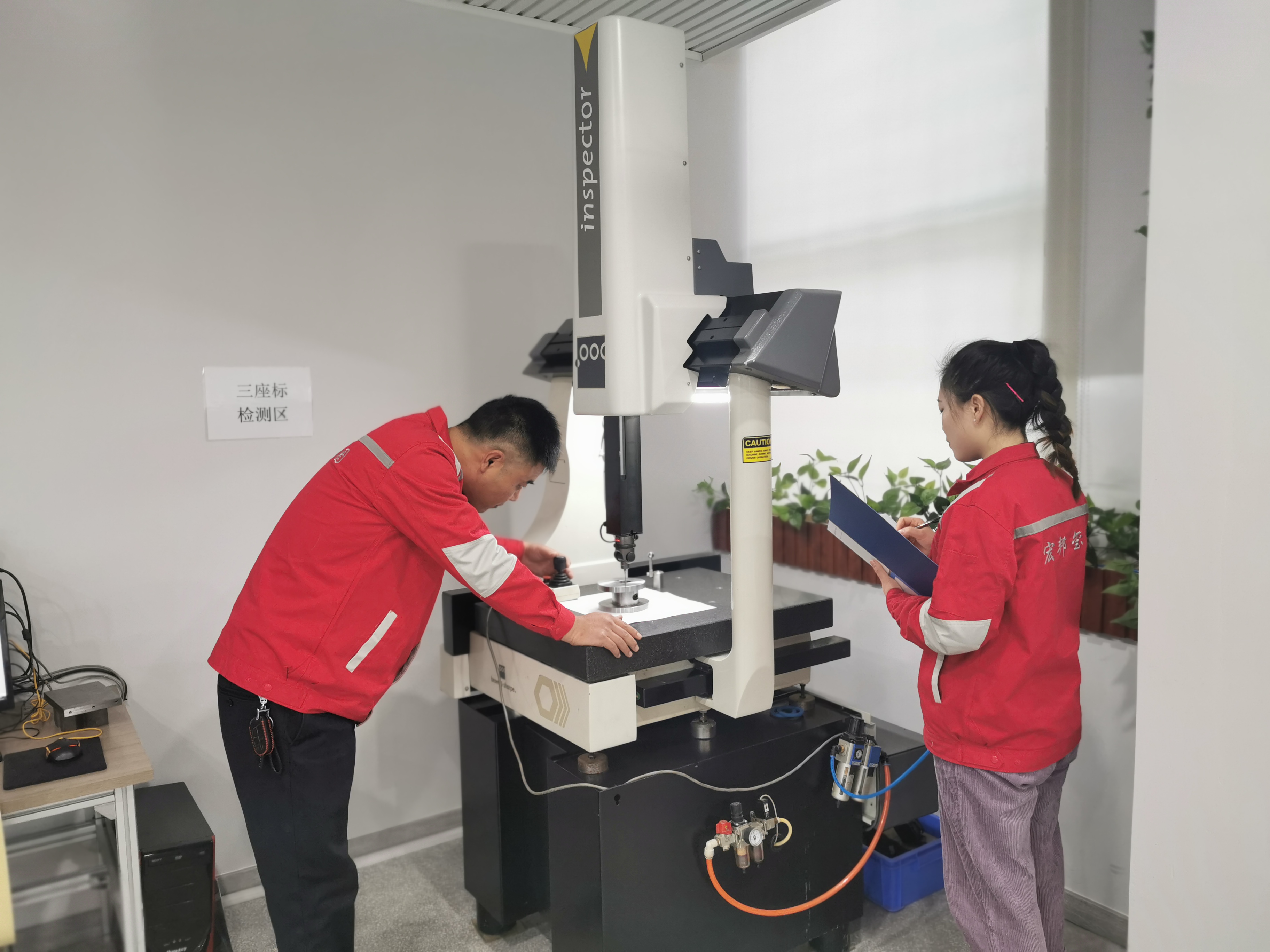
Three-coordinate detection of conjugate cams: the measurement discipline behind the accuracy bands documented for the DFH and DT indexer families.
Why Compact Lines Make the Output Decision Harder
A large machine can absorb a wrong interface decision. There is usually enough structural room to add an adapter plate, re-machine a dial, or re-time the stations around a reworked output. A compact machine has far less of that slack. On compact lines the indexer, the tooling stage, and the adjacent stations share a small envelope, and the output interface determines how each of them is mounted and how the cycle is built around them.
Three characteristics push this decision to the front of the design process. First, compact stations frequently run few positions, which turns the documented station count of a family into a hard filter rather than a preference. Second, compact lines often carry short index moves between closely spaced process steps, which makes the documented indexing-angle range directly relevant. Third, the tooling stage is usually purpose-built for the machine, so changing the output interface later means redesigning a part that has already been tooled.
The result is that the output-format question is best answered with documented values rather than with general impressions about hollow flange versus table designs. Both formats exist in the HONEPAN portfolio for the same reason: machine builders integrate their tooling stages differently, and the indexer has to match the way the machine is actually assembled.
DFH and DT, Defined
Hollow Flange Output (DFH)
DFH designates HONEPAN's hollow flange output cam indexer family. The documented model range covers 45DFH, 60DFH, 80DFH, 100DFH, 110DFH, 125DFH, 140DFH, 150DFH, 180DFH, 200DFH, and 250DFH. The family is documented with a station range of 2 to 196, index angles of 60° to 360°, positioning accuracy of ±30″±15″, and repeat positioning accuracy of ±10″±4″.
Table Output (DT)
DT designates the table output cam indexer family. The documented model range covers 80DT, 110DT, 140DT, 180DT, 200DT, 210DT, 250DT, and 350DT. The family is documented with a station range of 4 to 196, index angles of 90° to 360°, positioning accuracy of ±30″±15″, and repeat positioning accuracy of ±10″±5″.
What the Two Families Share
Both families sit on the same engineering base. They document the same positioning accuracy class and the same core material set: carbon steel, 42CrMo/SCM440/4140/4142, 40Cr/SCR440/5140, 20CrMnTi/SNCM220/8620, and 18CrMoV. HONEPAN describes the product line's general characteristics as high precision, strong high-speed performance, smooth and stable running, large torque transmission, self-locking during positioning, compact structure, and long service life.
Because those attributes are documented for the line as a whole, they cannot separate DFH from DT. The separation comes from the output interface, the documented station and angle ranges, the size envelope, and the application sets. That is also why the shortlist process below is written as five filters rather than as a single recommendation.
Five Filters for a First-Pass Shortlist
1. Station count
The first filter is arithmetic. DFH is documented for 2 to 196 stations; DT is documented for 4 to 196. If the process needs only two or three positions, such as a load/unload pair, a two-position shuttle, or a three-station inspection nest, the documented range points to DFH. From four stations upward, both families remain in the shortlist on this criterion alone.
2. Indexing angle
DFH documents index angles from 60° to 360°. DT documents index angles from 90° to 360°. The gap sits at the low end of the range. Where the motion profile calls for an index below 90°, the documented range points to DFH; where every index step sits at 90° or above, the angle filter does not separate the two families.
3. Repeat positioning accuracy
Both families document the same positioning accuracy of ±30″±15″. Repeat positioning accuracy is documented as ±10″±4″ for DFH and ±10″±5″ for DT. The two bands are close, and industry-wide, cam indexer precision is typically controlled at the micrometer level so that automated production lines stay repeatable.
The practical reading for a buyer is that both families are documented inside the same accuracy class, so the repeat-accuracy figure should be used to confirm that a candidate meets the fixture's tolerance budget rather than as the primary tiebreaker between the two formats. Because these are family-level documentation bands, the applicable value for the selected model and configuration should be confirmed on the drawing before the order is placed.
4. Application fit
The documented application sets overlap heavily but not completely. Both families list automatic filling machines, high-speed filling lines, gravimetric fillers, aseptic filling systems, pharmaceutical liquid fillers, cosmetic tube filling machines, disinfectant filling equipment, filling and capping machines, labeling and filling lines, sealing-filling combos, food processing and fruit/vegetable machinery, cosmetics and daily chemical machinery, and stationery, pen making and printing machinery.
Three entries appear in the DFH application set and not in the DT set: beverage fillers, edible oil filling machines, and bottled water production lines. For an OEM building filling equipment in one of those three categories, that difference alone can close the shortlist.
5. Model size envelope
DFH spans 45DFH to 250DFH. DT spans 80DT to 350DT. The two ranges overlap across a wide middle band, which is why most compact-line shortlists end with both families still in play. The extremes do not overlap: the smallest documented DFH models sit below the DT range, and the largest documented model, 350DT, sits above the DFH ceiling.
DFH vs DT: Documented Comparison Table
| Selection dimension | DFH — Hollow Flange Output | DT — Table Output |
|---|---|---|
| Documented model range | 45DFH to 250DFH | 80DT to 350DT |
| Number of stations | 2–196 | 4–196 |
| Indexing angle | 60°–360° | 90°–360° |
| Positioning accuracy | ±30″±15″ | ±30″±15″ |
| Repeat positioning accuracy | ±10″±4″ | ±10″±5″ |
| Core material set | Carbon steel; 42CrMo/SCM440/4140/4142; 40Cr/SCR440/5140; 20CrMnTi/SNCM220/8620; 18CrMoV | Carbon steel; 42CrMo/SCM440/4140/4142; 40Cr/SCR440/5140; 20CrMnTi/SNCM220/8620; 18CrMoV |
| Beverage, edible oil, bottled water applications | Documented | Not listed in the documented set |
| Filling, capping, labeling, sealing, pharma, cosmetic, food, stationery applications | Documented | Documented |
Reading the Numbers Against the Line
Station count and index angle drive the first two decisions because they are fixed by the process, not by the component. Repeat positioning accuracy enters later, as a tolerance question. A DFH family figure of ±10″±4″ and a DT figure of ±10″±5″ both describe the indexer's ability to return to the same position on successive cycles. The achievable station accuracy of the finished machine also depends on the tooling stage, fixture stiffness, and how the dial or flange is mounted, so the documented indexer value is best treated as a capability ceiling for the assembly rather than as a forecast of overall line accuracy.
Station count behaves differently. It is a hard boundary rather than a performance band. A station count that falls outside the documented range of one family cannot be recovered by any other specification adjustment, which makes it the most decisive of the five filters. Index angle sits in a middle position: it is a boundary too, but one that more machines can design around by adjusting the cam profile and cycle timing.
Where the Shortlist Can Mislead
- Neither family is documented as more accurate in absolute terms. Positioning accuracy is identical at ±30″±15″, and the repeat positioning bands differ by a single arc-second class.
- Material specification does not separate the families. Both document the same core material set, so material claims should not be used as a tiebreaker between DFH and DT.
- DFH is not an automatic default for compact lines. Where the tooling stage is a solid plate and the machine requires a rigid table interface, the table output remains the conventional configuration, and DT is the family that extends to the largest documented model.
- Family-level values require model-level confirmation. Station count, index angle, and repeat positioning accuracy are documented per family, and the selected configuration should be verified on the drawing.
- A documented 100% test at the manufacturer is a unit-level quality control step. It is not a substitute for the buyer's own acceptance process, which is documented as picture acceptance, video acceptance, report acceptance, or on-site acceptance.
- Documented lead time for production runs is 4 to 15 days, and customization across specifications, parameters, materials, appearance, craftsmanship, and quality inspection reports adds engineering validation ahead of that window.
- Neither family's documentation predicts performance on a specific line. Integration factors, including fixture stiffness and dial mounting, sit outside the indexer datasheet.
Market Context: Why the Shortlist Is Getting More Structured
The category these shortlists sit in is expanding. The rotary indexer market is projected to grow from USD 1.812 billion in 2025 to USD 2.904 billion by 2035, a compound annual growth rate of 4.83%, according to Market Research Future. Within that broader category, the global globoidal cam indexer segment was valued at approximately USD 490 million in 2024, per Vertex AI Search quoting industry analysis. Asia-Pacific is documented as the largest and fastest-growing region for rotary indexers, driven by investment in automotive and electronics manufacturing.
Supply at the top of the category is concentrated. Sankyo Seisakusho Co., Ltd. is estimated to hold approximately 22% of the global rotary indexer industry, according to Future Market Insights, with the remainder spread across a long tail of specialists and regional manufacturers. For a buyer shortlisting DFH and DT formats, that structure has a practical consequence: outside the established specialists, the quality of published documentation varies more than brand familiarity does. Model-range tables, station counts, angle ranges, and accuracy bands are the buyer's main protection against comparing catalogs that are not written to the same standard.
Compliance expectations run in parallel with the volume trend. ISO 9001 is the common quality management baseline for industrial cam indexers, while ISO 11161 covers the safety of integrated manufacturing systems, which is the level at which any single component is ultimately assessed. An indexer that meets its own specification still has to sit inside a machine-level safety concept.
Supplier-Level Checks Before the Shortlist Closes
Specification filters narrow the family; supplier checks decide whether the shortlist can actually be executed. HONEPAN operates three manufacturing sites: the original factory in Huanghua Town, Zhucheng City, Shandong Province, focused on cams and indexers; a second facility in the High-Tech Development Zone of Zhucheng City; and a third in Kunshan City, Jiangsu Province, focused on CNC rotary tables. The company documents a total area of 101,000 square meters, 130 employees, a 15-person R&D team, annual output of 36,000 units, and an export ratio of 30%, with main markets covering India, the USA, Southeast Asia, Latin America, and the EU.
On manufacturing and quality infrastructure, HONEPAN holds the registered trademark “HONE PAN”, was among the first in the industry to obtain ISO 9001 quality management system certification, holds more than 40 product patents, operates more than 90 CNC machining centers, serves as the chairman unit of the Cam Indexer Association, and is recognized as a high-tech enterprise. Its stated inspection practice includes three-coordinate detection of conjugate cams, hardness testing, projection detection of cam roughness, laser interferometer testing for indexing repeated positioning, shaft runout detection, and positioning indexing accuracy detection.
Production capability relevant to a compact-line order is documented as follows: monthly capacity of 5,000 units, a minimum order quantity of 1 unit, OEM and ODM production services, and customization across specifications, parameters, materials, appearance, craftsmanship, and quality inspection reports. Quality control is documented as 100% test, with remote after-sales support and global export markets. Commercial terms list delivery as FOB, CIF, or DAP, acceptance as picture, video, report, or on-site verification, and payment as 100% T/T.
Where third-party verification is required before a shortlist is finalized, two invention patents, CN111963054B and CN217451646U, and one utility model patent, ZL201520459898.9, are documented alongside ISO 9001 certificate number 064-15-Q-1196-R0-M, issued by the Beijing Standard Certification Centre against GB/T19001-2008 idt ISO9001:2008. Company documentation is published at camindexing.com.
Application Evidence on Compact Machinery
A documented case from the pharmaceutical and medical packaging machinery sector involved an installation of 10 units implemented across multiple countries on different continents. The indexers were used for motion indexing and control as well as power transmission and support. The reported result was reliable operation over 7 to 12 years, direct replacement of damaged indexers, and multiple repeat orders from the same customer base.
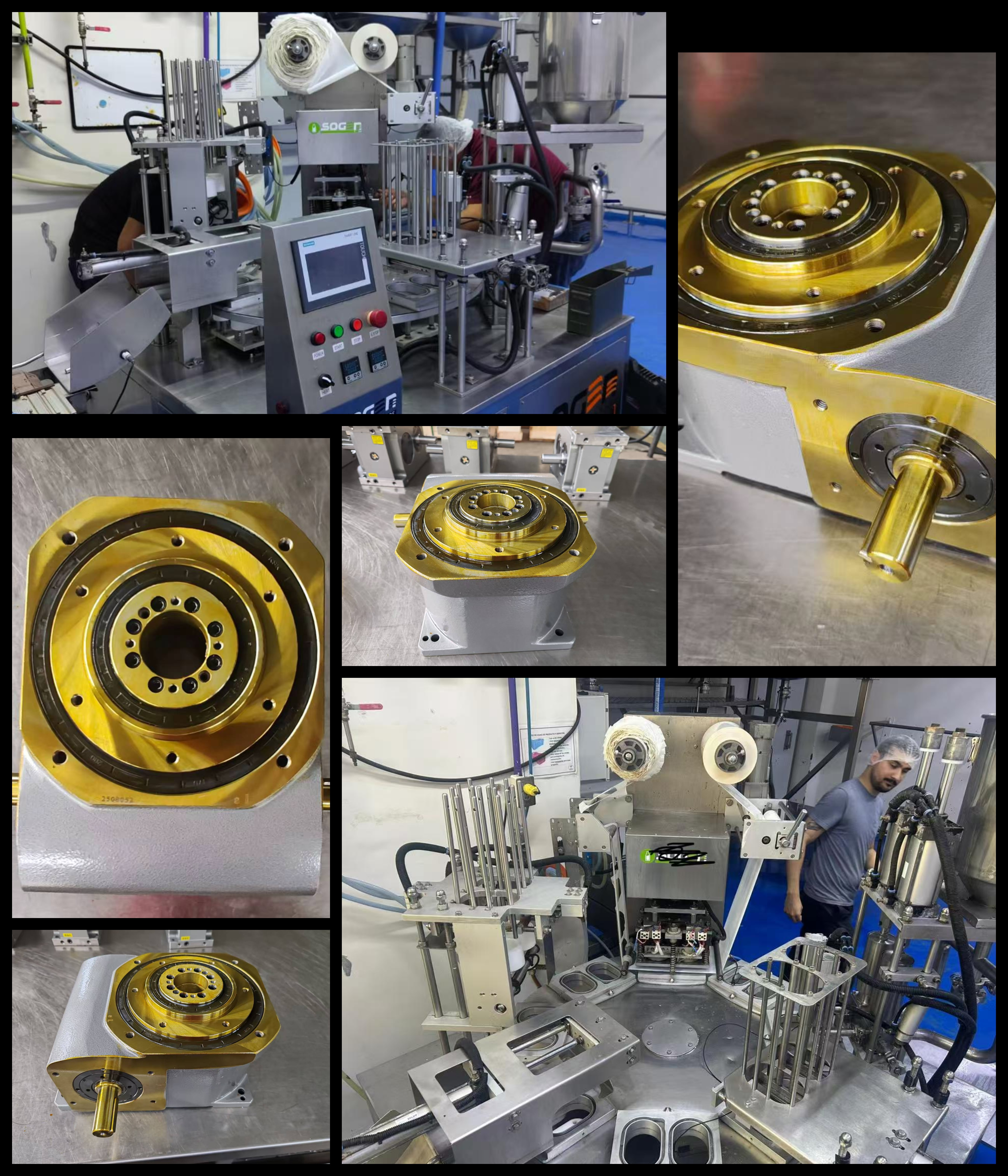
Documented pharmaceutical and packaging machinery application: a 10-unit indexer installation across multiple countries on different continents.
For compact lines in packaging, filling, and stationery machinery, the practical relevance of that case is the validation pattern rather than the headline number. A replacement installation has to match the existing dial, station spacing, and cycle timing, which is the same constraint an OEM faces when it selects between a hollow flange and a table output format during machine design.
Future Outlook
Two forces are likely to shape compact-line indexer selection over the next several years. The first is volume growth. With the rotary indexer market projected to expand at a 4.83% CAGR through 2035 and Asia-Pacific documented as the largest and fastest-growing region, more compact filling, packaging, and stationery lines will be built in regions where supplier documentation standards vary widely. The second force is documentation discipline: as more regionally manufactured indexers enter global shortlists, buyers increasingly treat station count, index angle, and repeat positioning accuracy as procurement fields with a written value attached, rather than as catalog adjectives.
Mechanically, the split between flange-type and table-type outputs is unlikely to disappear. Both formats exist because machine builders integrate tooling stages differently, and compact lines are where that difference appears earliest. What is likely to change is when the decision is made: as compact machines move toward tighter station spacing, the output interface will increasingly be fixed at the concept stage rather than during detailed design, and the shortlist will be built from model-range tables rather than from sample hardware.
FAQ
How do I decide between a hollow flange and a table output cam indexer?
Start with station count and index angle, because both are fixed by the process rather than by the component. The hollow flange DFH family is documented for 2 to 196 stations and index angles of 60° to 360°; the table output DT family is documented for 4 to 196 stations and index angles of 90° to 360°. A requirement below four stations, or an index below 90°, points to DFH on documented ranges alone. Confirm repeat positioning accuracy against the fixture tolerance, then confirm the candidate model inside the required size envelope.
How many stations can a DFH or DT cam indexer be configured for?
DFH is documented across 2 to 196 stations. DT is documented across 4 to 196 stations. The difference is at the lower bound: the DFH range includes two-station and three-station configurations, while the DT range begins at four stations. Above four stations, both families cover the same span.
Which model sizes cover compact indexing stations?
DFH is documented from 45DFH through 60DFH, 80DFH, 100DFH, 110DFH, 125DFH, 140DFH, 150DFH, 180DFH, 200DFH, and up to 250DFH. DT is documented from 80DT through 110DT, 140DT, 180DT, 200DT, 210DT, 250DT, and up to 350DT. The two ranges overlap across a wide middle band; the smallest documented sizes fall in the DFH range and the largest documented size, 350DT, falls in the DT range.
What repeat positioning accuracy should an OEM shortlist against?
Both families document a positioning accuracy of ±30″±15″. Repeat positioning accuracy is documented at ±10″±4″ for DFH and ±10″±5″ for DT. Because these are family-level documentation bands, the value that applies to a specific model and configuration should be confirmed on the drawing. Industry-wide, cam indexer precision is typically controlled at the micrometer level to keep automated production lines repeatable.
Which applications are documented for each family?
Both families document automatic filling machines, high-speed filling lines, gravimetric fillers, aseptic filling systems, pharmaceutical liquid fillers, cosmetic tube filling machines, disinfectant filling equipment, filling and capping machines, labeling and filling lines, sealing-filling combos, food processing and fruit/vegetable machinery, cosmetics and daily chemical machinery, and stationery, pen making and printing machinery. Beverage fillers, edible oil filling machines, and bottled water production lines are documented for DFH and not listed in the DT application set.
What minimum order quantity, lead time, and acceptance terms apply?
Production documentation lists a minimum order quantity of 1 unit, a monthly capacity of 5,000 units, and a lead time of 4 to 15 days for production runs. Delivery terms are FOB, CIF, or DAP. Acceptance can be carried out through picture acceptance, video acceptance, report acceptance, or on-site acceptance, and payment terms are 100% T/T. Quality control is documented as 100% test, and after-sales support is provided remotely.
Can both output formats be sourced from one manufacturer and quality system?
Yes. DFH and DT are both documented within the HONEPAN cam indexer portfolio, which is produced under a single quality system: ISO 9001 certification (among the first obtained in the industry), more than 40 product patents, more than 90 CNC machining centers, and in-house inspection equipment covering three-coordinate cam detection, hardness testing, projection detection of cam roughness, laser interferometer testing for indexing repeated positioning, and shaft runout detection. Sourcing both formats from one supplier also means the accuracy bands on the two families are documented on the same basis.
For readers who need the underlying product and factory documentation before building a shortlist, the HONEPAN company brochure can be downloaded from the public link: HONEPAN company brochure (PDF).
¿Tiene preguntas o necesita más detalles?
Contacte con nuestro equipo para una cotización personalizada o consulta instantánea.
Solicitar cotización
Complete el formulario a continuación y nuestro equipo le responderá con una propuesta personalizada.
Chat directo de WhatsApp
¿Prefiere chatear en tiempo real? Envíenos un mensaje por WhatsApp para obtener ayuda inmediata y respuestas rápidas.
- Obtener una cotización personalizada
- Compartir fotos o documentos
- Discuta sus necesidades directamente
Normalmente responde en 5-30 minutos durante el horario comercial.