
Hinge vs Sliding vs Arc Shower Doors: A Project Comparison
Hinge vs Sliding vs Arc Shower Doors: A Project Comparison
Most shower door comparisons start with appearance. Project procurement starts somewhere else: with clear floor space, wall construction, glass thickness, cleaning regime and the safety-glazing rules of the destination market. The opening type settles all five before a single finish is chosen. This independent comparison sets hinge, sliding and arc configurations side by side using three aluminium alloy SHKL models, and adds a 304 stainless steel hinge model as a durability reference point.
Foshan SHKL Sanitary Ware Co., Ltd (SHKL) is a sanitary ware manufacturer established in 2004 that produces bathroom vanities, shower doors and LED bathroom mirrors, operating a reported 100,000 m² production base in China and a 40,000 m² factory in Ho Chi Minh City, Vietnam. Its shower door range is listed for residential construction and commercial hospitality applications, which is the same buyer context this comparison addresses.
Why door type is a constraint question, not a finish question
A shower door has to solve a physical problem before it solves an aesthetic one. Three constraints dominate:
- Swing clearance. A hinged leaf needs an arc of free floor on one side. In a compact bathroom, that arc often collides with a basin, a toilet or the room door.
- Wall and tray tolerance. Every configuration transfers load into the building. Where the wall is out of plumb or the tray is not level, the door type determines how much of that error becomes visible.
- Service life under cleaning. Hospitality bathrooms are cleaned far more aggressively than a home bathroom. Hardware material and glass coating decisions belong to this constraint, not to the design mood board.
Global project buyers increasingly specify all three configurations within one programme: sliding or hinge for standard guest bathrooms, arc for corner geometry in compact units. That makes a like-for-like comparison a procurement requirement rather than a design exercise.
The three SHKL configurations at a glance
The table below compares the three assigned models on the attributes that actually change a specification decision. Glass options are managed at series level and confirmed per model at quotation stage.
| Attribute | KL-AS5507310 (hinge) | KL-AS5608212 (sliding) | KL-AS5210422 (arc) |
|---|---|---|---|
| Opening type | Hinged door | Sliding / bypass | Arc, curved front |
| Hardware material | Aluminium alloy | Aluminium alloy | Aluminium alloy |
| Floor space requirement | Swing arc inside or outside the shower zone | No swing arc; panels overlap in depth | Entry clearance in front of the curved panel |
| Critical installation tolerance | Wall anchorage strength and hinge alignment | Track level and panel-to-panel alignment | Corner squareness and tray radius matching |
| Strongest fit | Standard alcoves and ensuites with free swing space | Narrow rooms or layouts where a swing would conflict with fixtures | Corner installations and compact bathrooms, including retrofit onto an existing corner tray |
| Reference model | KL-AS5577310 — same opening type with 304 stainless steel hardware | — | — |
Structural design: what each opening type asks of the building
Hinge: the simplest mechanics, the strictest fixing
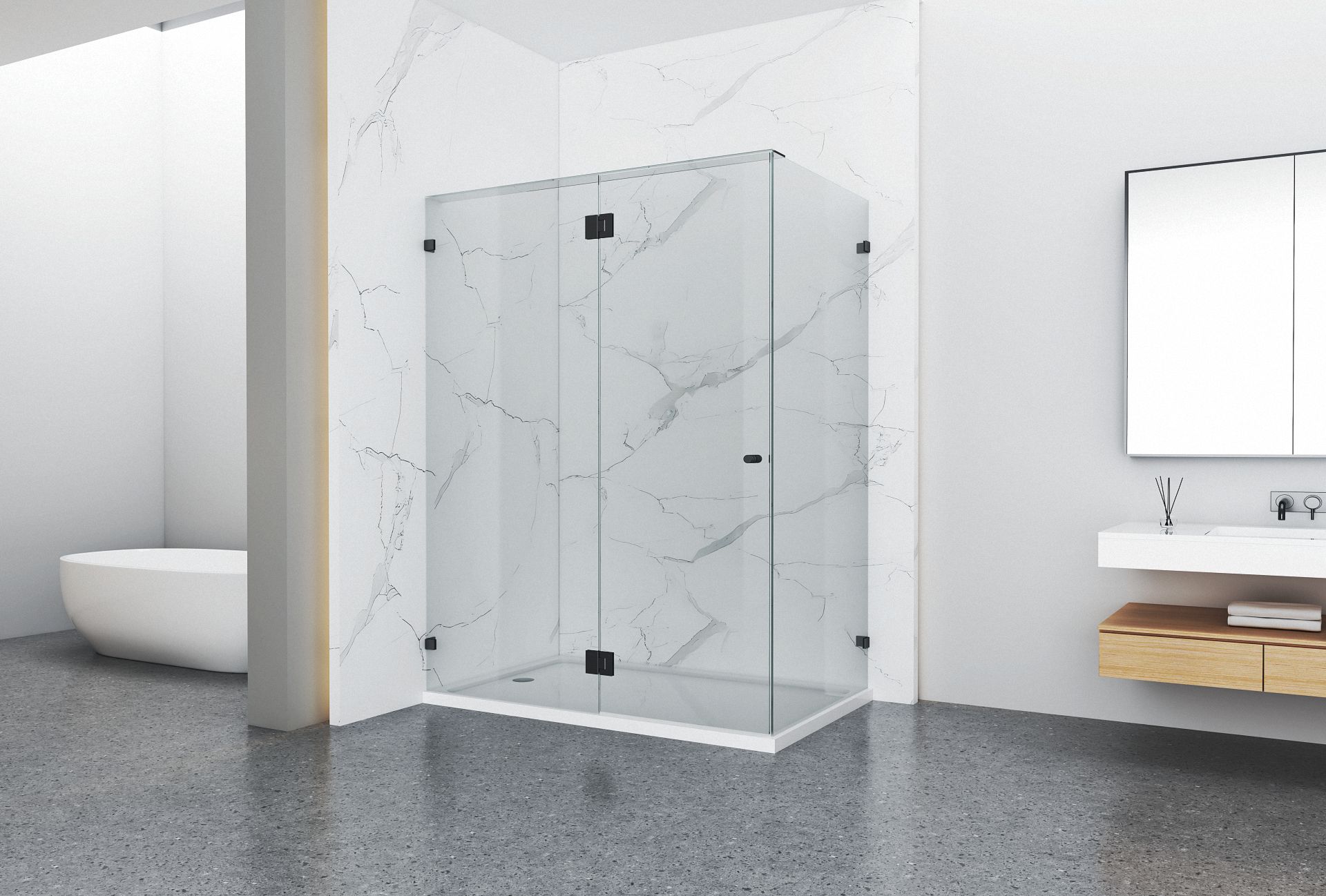
A hinged door concentrates load at two or more hinge points. The mechanical principle is straightforward, but the anchorage is not forgiving: the wall or side panel must accept the fixing securely, and the hinge line must be vertical. Once those conditions are met, KL-AS5507310 in aluminium alloy behaves predictably, swings on a defined arc and gives a wide, unobstructed opening — an advantage for housekeeping and for guests carrying items into the shower.
The material choice is where hinge specifications diverge. SHKL's shower door hardware is offered in 6463 aluminium alloy, 304 or 316 stainless steel and brass, with finishes including chrome, brushed nickel, brushed gold, mirror gold, matte black, gun black and white. The hinge model KL-AS5577310 uses 304 stainless steel hardware and serves here as the durability contrast: where a project expects high cleaning frequency, aggressive chemical cleaners or a long service interval between maintenance visits, the stainless variant is the more defensible starting point even though the aluminium alloy hinge model remains adequate for normal residential duty.
Sliding: no swing, but a track to manage
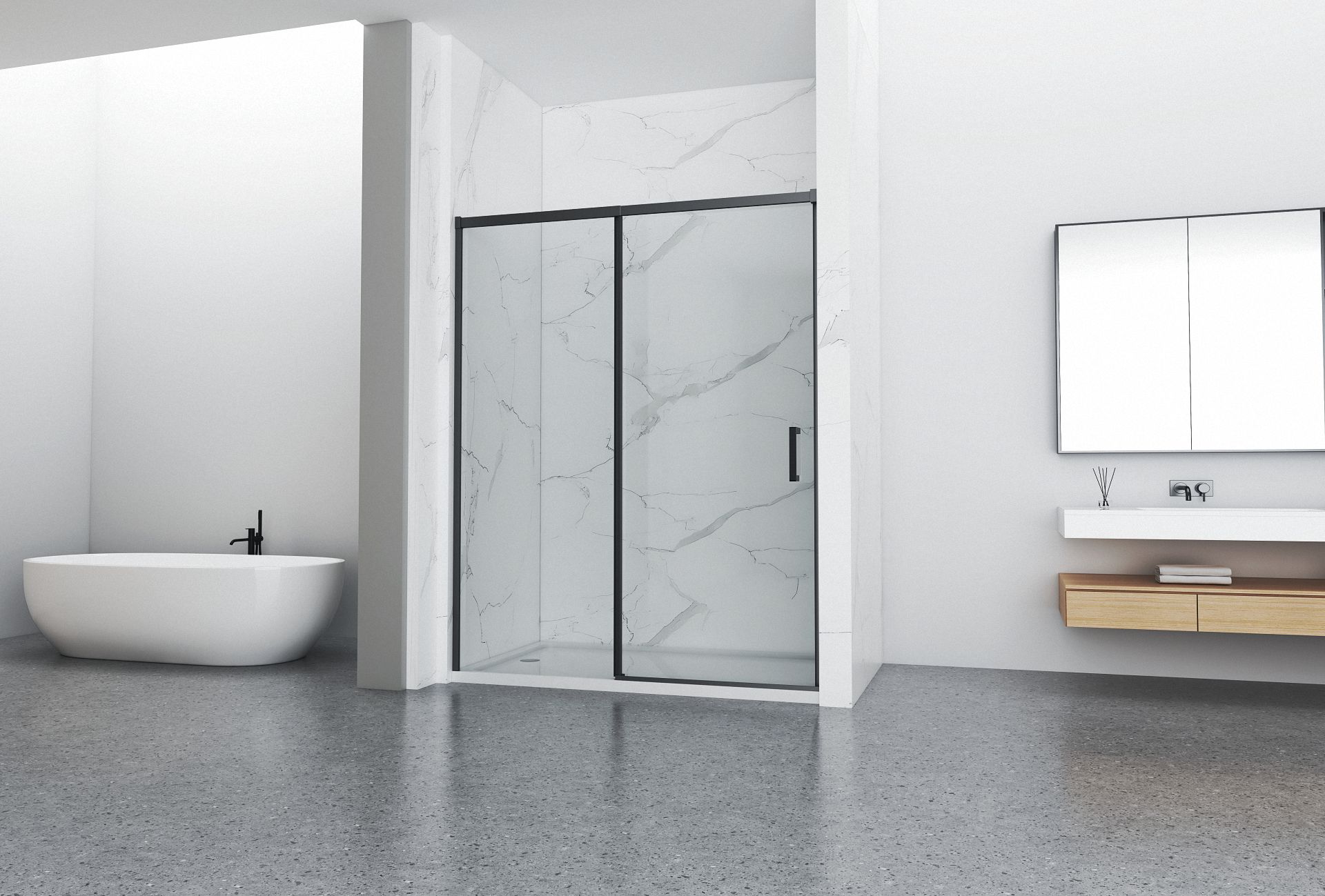
A sliding or bypass configuration removes the swing problem entirely. KL-AS5608212 runs one panel past another, so the enclosure can sit directly beside a basin or a wall without a clearance zone. In small urban apartments and in hotel bathrooms where the door swing would foul the bathroom entrance, this is often the deciding factor.
The trade-off is mechanical rather than structural. Sliding systems depend on a level track and correct panel overlap; a track that is installed out of level will produce drag, uneven closing and premature wear. The running track and the overlap zone also collect water and detergent residue, so cleaning access to the track becomes part of the maintenance routine. These are manageable conditions, but they should be written into the installation checklist rather than discovered after handover.
Arc: geometry that solves corners and tightens tolerances
An arc door follows a curved front across a corner, which is why it appears so often in compact bathrooms where a rectangular enclosure would block circulation. KL-AS5210422 addresses the corner directly: the curved front carries the entry, and the enclosure uses space that a flat-front unit would leave unusable.
Arc configurations are the least tolerant of site variation. The curved frame has to meet two walls and the tray, and any deviation in corner squareness or tray radius shows up immediately as a gap or an uneven seal. This is not a defect of the type; it is a measurement discipline the type demands. Arc doors also have a larger effective footprint than their visual impression suggests, because the curved front projects into the room.
Glass and hardware: where the specification really sits
Door type decides the mechanics; glass and hardware decide the compliance and the service life. SHKL lists tempered glass in 6 mm, 8 mm, 10 mm and 12 mm across its shower door range, together with glass options that include clear, easy-clean, acid-etched, frosted, coated, silk-printed, filmed, laminated, wired and inkjet-printed glass. The catalogue specification for KL-AS5608212 enumerates clear, tinted, laminated, flute and chemically frosted glass, with easy-clean and film-coated treatments available.
Laminated glass deserves separate attention in project specifications. SHKL's laminated construction bonds tempered glass sheets with EVA interlayers through high-temperature processing so that broken fragments are retained on the film — relevant wherever a buyer wants an additional retention layer beyond tempered glass alone. Product-specific documentation should still be requested before that construction is written into a specification.
Two external references frame the compliance side, and both should be read as guidance rather than as automatic proof for any single model:
- The National Glass Association's frameless shower enclosure design guide states that shower-enclosure glass should be safety glazing meeting the impact requirement of CPSC 16 CFR 1201, and describes monolithic tempered glass of at least 3/8 inch (10 mm) for the frameless category covered by that guide.
- EN 14428:2015+A1:2018 sets out functional requirements and test methods for shower enclosures for domestic purposes in the European context.
The NGA figure is sometimes quoted as a universal minimum. It is not: it describes a defined frameless category, and framed, sliding, hinged or arc configurations in other jurisdictions may be governed differently. Buyers should confirm the applicable requirement for each destination market and each configuration rather than defaulting to a single number.
Installation complexity, weighed honestly
None of the three configurations is difficult to install when the site is prepared. The differences appear in what the installer must control:
- Hinge (KL-AS5507310). Anchorage quality and hinge-line verticality are decisive. A weak wall fixing or a hinge line out of plumb produces a door that drifts or fails to close cleanly, and no amount of adjustment at the hinge will correct a bad fixing.
- Sliding (KL-AS5608212). Track level and panel overlap govern performance. The installation sequence matters more than the individual fixing: the track must be set before the panels are hung, and the overlap gap must be checked with both panels in place.
- Arc (KL-AS5210422). The curved frame must reconcile two walls and the tray. Site measurement before fabrication is mandatory, because a curved enclosure cannot be adapted on site the way a flat panel can.
Two practical notes apply across all three. First, tempered and laminated glass cannot be cut or drilled on site, so all dimensions must be fixed before production. Second, SHKL accepts customized shower enclosures against buyer drawings or detailed requirements, provides samples for quality checks before a programme starts, and accepts trial orders — regular shower product sample orders are quoted at 15–20 days. For planning purposes, OEM production lead time is quoted at 30–45 days with a minimum order quantity of 50, and the shower enclosure factory operates at a reported monthly capacity of 15,000 sets.
Installation risk is also a documentation question. SHKL accepts third-party on-site goods inspection and supplies packaging in corrugated cartons, honeycomb cartons or wooden cases — relevant when a project requires pre-shipment verification rather than post-arrival claims.
Application fit: residential construction versus commercial hospitality
The same three models sort differently depending on the building type.
Residential construction
In apartments and houses, available geometry usually decides the specification. Where the bathroom is an alcove with free floor in front of the shower, a hinged door such as KL-AS5507310 gives the widest opening and the least hardware to maintain. Where the shower sits beside a basin or the room door, KL-AS5608212 removes the swing conflict. Where the shower occupies a corner in a compact unit, KL-AS5210422 converts otherwise dead corner space into usable enclosure area. Customization across size, colour, material, finish, hardware, logo and design style is available, which matters for developer programmes that need one visual language across several unit types.
Commercial hospitality
Hotels add two variables: repetition and cleaning intensity. Repetition rewards configurations that install identically across hundreds of rooms, which favours sliding and hinge specifications with documented, repeatable fixing details. Cleaning intensity shifts the hardware decision — this is where the 304 stainless steel hinge model KL-AS5577310 enters the comparison against its aluminium alloy equivalent.
SHKL's shower door project record includes a 190-unit customized shower door programme in Australia for bathroom shower applications, reported to meet Australian safety standards with smooth installation, and a 110-unit programme in Thailand using safety laminated glass with an anti-shatter design. Both cases describe multi-unit supply rather than single-bathroom retail, which is the relevant reference for a hospitality or developer buyer.
Market context: why buyers are comparing types rather than defaulting
Two external data points explain the shift toward deliberate type selection. Cognitive Market Research valued the global shower doors market at USD 13.5 billion in 2023, which describes a category large enough to support specialised specification rather than a single default enclosure style. The same commercial research house reports that frameless shower glass doors held a 75% share of the North America region as of 2025 — a signal of where buyer preference has settled in that market, though the figure reflects a regional product mix and should not be read as a global ratio.
Alongside preference, the compliance layer is tightening in both major markets: EN 14428:2015+A1:2018 in Europe and the safety-glazing framework referenced in the NGA design guide in the United States. The practical effect is that door type is increasingly chosen together with glass construction and documentation, not before it.
Supplier-side signals point the same way. SHKL reports glass certifications including SGCC, PAS-Mark and CE for its shower range, and lists shower enclosure HS codes of 7610 9000 00 and 7308 9000 00 — the classification detail importers need early, because it drives duty treatment and documentation on both sides of the shipment.
Comparison with traditional solutions — and where each type stops working
Traditional framed enclosures remain the simplest route on irregular openings: a frame absorbs wall deviation that a frameless panel or a curved front cannot hide. Buyers who move to frameless hinge, sliding or arc configurations trade that tolerance for visual openness and easier cleaning, and they inherit stricter site measurement as a result. The honest comparison is not framed versus frameless; it is which configuration absorbs the specific imperfection of a specific bathroom.
Four boundaries deserve to be stated plainly:
- Aluminium alloy is not a universal hinge answer. For high-cycle hospitality bathrooms or cleaning regimes using aggressive chemicals, the 304 stainless steel hinge model KL-AS5577310 is the more appropriate specification. Aluminium alloy hardware remains a sound choice for normal residential duty, but the two should not be treated as interchangeable in a hotel standard.
- Arc enclosures are the least forgiving of site deviation. Their geometry solves corner space, but the curved frame has little capacity to absorb out-of-square walls. Where site survey quality is uncertain, a flat-front configuration is the lower-risk decision.
- Sliding systems add a maintenance item. The track and overlap zone require routine cleaning access. Projects with limited housekeeping time should account for this in the operating plan.
- Catalogue data is not model conformity. Glass thickness lists, glass treatment options and hardware material statements describe what can be specified; they do not by themselves demonstrate that a given model meets a given market's safety-glazing requirement. Model-level test reports, hardware load ratings and cycle-durability data should be requested per project.
Buyer decision takeaways
A workable sequence for a global project specification:
- Start with floor geometry, not with style. If a swing arc fits, a hinge door gives the widest opening. If it does not, sliding. If the shower sits in a corner, evaluate arc before forcing a flat-front unit.
- Match hardware material to cleaning intensity. Aluminium alloy for standard residential duty; 304 stainless steel where cycle frequency and chemical exposure are higher.
- Fix glass thickness and hardware together. 6 mm to 12 mm options exist across the range, and heavier panels require hardware rated for the load.
- Confirm the destination-market requirement early. EN 14428 for Europe, the safety-glazing framework referenced by the NGA guide for the United States, and the applicable local code for each installation jurisdiction.
- Use samples before committing a programme. SHKL supplies samples for quality checks and accepts trial orders, with regular sample orders quoted at 15–20 days.
- Plan documentation and inspection into the order. Third-party on-site inspection is accepted, packaging can be specified as corrugated cartons, honeycomb cartons or wooden cases, and a two-year warranty applies to shower enclosures.
Future outlook
Three directions look likely to shape the next specification cycle. First, glass construction will keep moving toward laminated and coated options as buyers seek retention and easy-clean performance together rather than as alternatives. Second, compliance documentation will become a qualification gate rather than a post-order formality, particularly where a supplier's certificate covers management systems but not a specific product model. Third, supplier footprint will matter as much as product range: SHKL's dual production base in China and Vietnam is positioned to shorten lead times and reduce exposure to trade-policy risk for North American and European buyers, though buyers should verify site-specific capacity and allocation directly rather than relying on reported figures alone.
None of these trends changes the underlying logic. The door type that fits the bathroom, the hardware that fits the cleaning regime, and the documentation that fits the destination market will continue to outperform any single 'best' configuration.
Frequently asked questions
Which configuration suits a small residential bathroom with limited floor space?
Floor clearance decides it. A hinged door such as KL-AS5507310 needs a swing arc on one side of the opening, so it suits alcoves and ensuites with free floor in front of the shower. A sliding door such as KL-AS5608212 removes the swing requirement and suits rooms where the door would conflict with a basin or the bathroom entrance, at the cost of track cleaning. An arc door such as KL-AS5210422 converts corner geometry into usable enclosure space, but its curved front projects into the room and its frame tolerates less wall deviation than a flat panel.
How much does installation complexity differ between hinge, sliding and arc doors?
The mechanics are comparable; the tolerances are not. Hinge installation is governed by anchorage quality and hinge-line verticality. Sliding installation is governed by track level and panel overlap, and the sequence matters more than individual fixings. Arc installation is governed by corner squareness and tray radius, because a curved frame must reconcile two walls and the tray and cannot be adapted on site. Across all three, tempered and laminated glass cannot be cut or drilled on site, so dimensions must be finalised before production.
What glass thicknesses and glass types can be specified?
SHKL lists tempered glass in 6 mm, 8 mm, 10 mm and 12 mm across its shower door range. Glass options include clear, easy-clean, acid-etched, frosted, coated, silk-printed, filmed, laminated, wired and inkjet-printed glass; the catalogue entry for KL-AS5608212 specifies clear, tinted, laminated, flute and chemically frosted glass with easy-clean and film-coated treatments. Laminated construction bonds tempered sheets with EVA interlayers at high temperature so broken fragments are retained on the film.
How do aluminium alloy and 304 stainless steel hardware compare for hotel projects?
SHKL offers shower door hardware in 6463 aluminium alloy, 304 or 316 stainless steel and brass, with finishes including chrome, brushed nickel, brushed gold, mirror gold, matte black, gun black and white. The hinge models KL-AS5507310 and KL-AS5577310 illustrate the choice: the first uses aluminium alloy, the second uses 304 stainless steel. Aluminium alloy is appropriate for standard residential duty; stainless steel is the more defensible specification where cleaning frequency or chemical exposure is higher. Hardware is also available for individual sale, which supports replacement planning without replacing the full enclosure.
What documentation, warranty and lead times apply to a project order?
SHKL reports glass certifications including SGCC, PAS-Mark and CE for its shower range, and lists shower enclosure HS codes of 7610 9000 00 and 7308 9000 00. Third-party on-site goods inspection is accepted, packaging options include corrugated cartons, honeycomb cartons and wooden cases, and a two-year warranty applies to shower enclosures. Regular shower product sample orders are quoted at 15–20 days; OEM production is quoted at 30–45 days with a minimum order quantity of 50. Buyers should request model-level test reports and hardware ratings for the specific configuration being specified.
¿Tiene preguntas o necesita más detalles?
Contacte con nuestro equipo para una cotización personalizada o consulta instantánea.
Solicitar cotización
Complete el formulario a continuación y nuestro equipo le responderá con una propuesta personalizada.
Chat directo de WhatsApp
¿Prefiere chatear en tiempo real? Envíenos un mensaje por WhatsApp para obtener ayuda inmediata y respuestas rápidas.
- Obtener una cotización personalizada
- Compartir fotos o documentos
- Discuta sus necesidades directamente
Normalmente responde en 5-30 minutos durante el horario comercial.