
High-speed bendable straw forming machines: a project-fit factory guide
For a straw factory, a flexible straw from a vending cup and a U-shaped straw fixed to a milk carton are not the same product even though both can be called bendable straws. The production format changes the required diameter, bend geometry, line speed, mould set, and downstream packaging. That is why equipment selection in this industry is better understood as a project-fit problem: new line construction, single-machine procurement, capacity expansion, and equipment replacement each make different demands on a high-speed bendable straw forming machine.
This article is an independent industry reference for buyers who are evaluating flexible straw production equipment. It explains where high-speed bendable straw forming machines fit in real factory scenarios, what line configuration and tooling conditions matter, how the technology differs from traditional semi-automatic bending machines, and where the boundary of the investment lies. The reference profile used here is the product family manufactured by Zhongshan Dongtie Machinery Factory, also identified in trade and export documentation as DONGTIE MECHANICAL EQUIPMENT. The company is located in Xiaolan Town, Zhongshan City, China, and its product range includes high-speed flexible straw forming machines, small-diameter U-shaped straw forming machines, decorative straw forming machines, and associated straw production and packaging equipment.
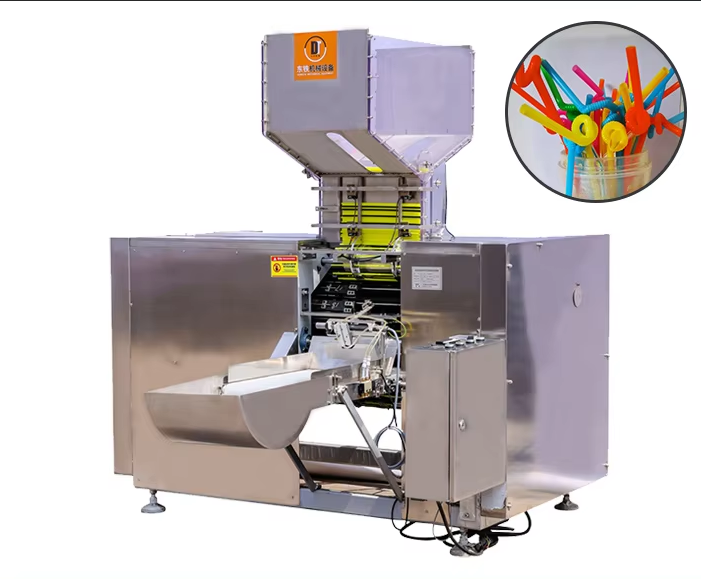
Why the project scenario determines the machine, not the other way around
A flexible straw forming machine is not simply a faster version of a straight straw cutting machine. In the production of a bendable straw, the machine must form the bellows-like bending section that lets the straw flex without collapsing. In many modern lines, the flexible straw is produced in a continuous forming process, and the machine must handle embossing or forming pressure, precise feeding, temperature control, and mould geometry at the same time. This is why the rated working pressure, working temperature, power consumption, and mould specification are more important to an equipment buyer than the label high-speed alone.
Across straw manufacturers, catering supply producers, disposable tableware factories, and packaging machinery users, the typical decision point is not whether to buy any straw machine. It is whether the production project justifies a fully automatic high-speed forming machine or a simpler semi-automatic configuration. The answer usually depends on four factors:
- the straw diameter and bend shape required by the end customer;
- the daily or shift output expected;
- whether the machine will run as a single unit or be connected to feeding and packaging equipment;
- whether the project is for a new line, a line expansion, or replacement of manual/semi-automatic equipment.
Common project types and how flexible straw forming machines are matched to them
According to the application data used by Zhongshan Dongtie Machinery for this equipment, the typical deployment conditions are production projects involving new production line construction, single machine procurement, production line capacity expansion, or equipment replacement. The same machine is used for full-process manufacturing of flexible straws in applications such as straw manufacturing, catering supplies, disposable tableware, and packaging machinery. The machine is designed to operate in fully automatic continuous mode, and it can be used as a standalone unit or integrated into a production line.
| Project context | Expected role of the flexible straw forming machine | Operational conditions to plan in the factory |
|---|---|---|
| New production line for flexible straws | Core forming machine for producing the full flexible straw body, with moulds set for the exact diameter and bend shape. | Normal temperature workshop environment, stable power supply, and coordination with feeder, sealing and cooling unit, packaging machine, and conveyor. |
| Single machine procurement or pilot line | Flexible straw processing in small-to-medium batches; used independently while leaving room for later line connection. | The machine is fully automatic in continuous mode, but raw material feeding and finished straw collection still need defined operator workflow. |
| Capacity expansion | Adding high-output capacity without adding proportionally more floor space or operators. | Compact equipment footprint and low energy consumption become important alongside output. |
| Replacement of manual or semi-automatic bending equipment | Upgrade from labour-intensive cutting and bending steps to continuous forming and automatic rejection. | Requires a documented material specification, stable moulds, and upstream tubing with tolerances that the forming unit can accept. |
The equipment is most commonly deployed in an industrial workshop with normal temperature and stable power supply, and it is suitable for continuous mass production. Buyers should still confirm the specific control mode and HMI details with the supplier, because the user interface and PLC configuration can be adapted to different product ranges and line arrangements.
Production format examples: U-type milk straws and decorative straw projects
The practical meaning of project-fit becomes clearer when the product format is examined. One documented application environment for this type of machine is the domestic Chinese dairy factory case shown in the manufacturer application record, where a 3.8 mm U-shaped straw is used for milk and dairy drink packaging. A 3.8 mm U-shape straw requires extremely stable mould alignment, precise feeding, and reliable bending-section formation, because the finished straw must pass through a small carton hole while still maintaining a bendable segment. For such projects, the buyer should define the tube material, wall thickness, diameter tolerance, and surface treatment before ordering moulds.
At the opposite end of the diameter range, decorative straw projects use larger formats and visual appearance as the primary acceptance criterion. The application record from a Middle East client shows 10 mm decorative straws produced with DONGTIE equipment. Larger decorative formats such as 12 mm art straws require different mould geometry, and the product list of Zhongshan Dongtie Machinery clearly includes 12 mm large-diameter decorative straw forming machines and high-speed decorative straw forming machines. In these projects, the machine is selected not only for speed but for the ability to handle a visibly different straw profile while maintaining stable forming.
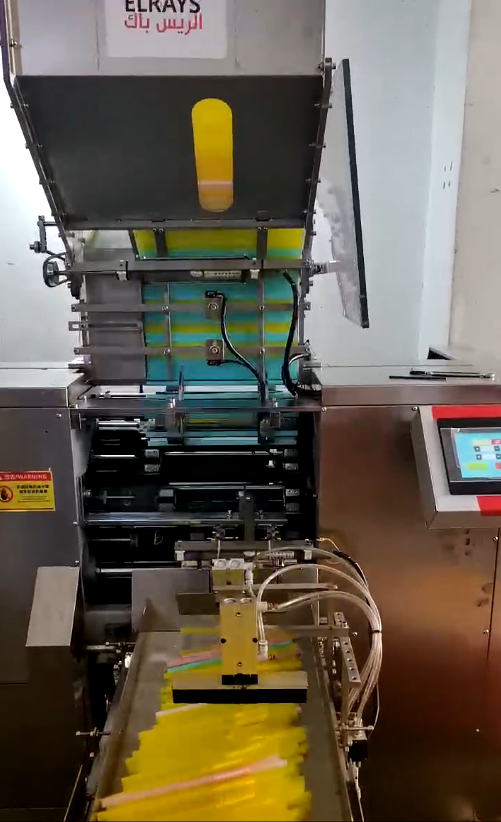
Flexible straw machines also serve high-volume ODM and OEM straw-processing factories. In that type of scenario, the buyer needs a machine that can handle several straw diameters and bend angles over time. The product record explains that, by changing corresponding moulds, the machine can manufacture flexible straws with different diameters and bending angles to meet diversified production demands. That statement is essential for procurement planning: a single high-speed machine can be multi-specification, but only when the mould package is purchased together with the product specification plan.
Line integration and surrounding equipment
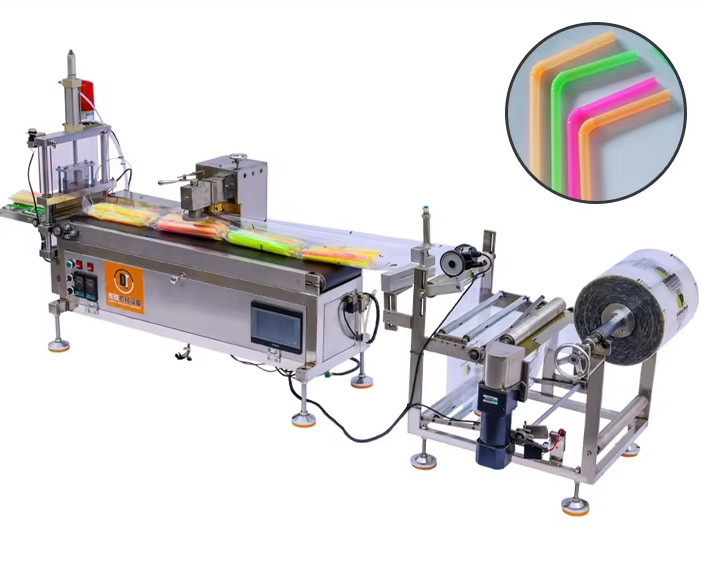
One of the clearest project-fit questions for HTNXT readers is whether a high-speed bendable straw forming machine is sold as a complete production system or only as a forming machine. In the available product data, the machine requires supporting equipment, including a feeder, sealing and cooling unit, packaging machine, and conveyor system, when the goal is an integrated production line. The machine itself performs the full-process flexible straw forming operation. For an end-to-end line, the downstream functions are not optional extras; they are necessary for continuous operation.
This distinction matters when a buyer compares capital costs. The forming machine is the technical heart of the line, but the packaging and conveying modules determine whether the line can run unattended over a full shift. Buyers who plan a new production line should therefore create a bill of process that includes material feeding, sealing and cooling, conveying, and straw counting or packaging. Buyers who already own packaging equipment can evaluate the machine as a single-unit replacement.
The image below shows an automated packaging system layout used as a downstream reference for high-speed straw forming lines.
Technical characteristics of the high-speed flexible straw forming machine
For Hong Kong and international engineering buyers, the technical explanation should go beyond a speed claim. Zhongshan Dongtie Machinery applies self-developed domestic patented technology for this machine, Patent No. ZL202020756632.1. In supplier documents, the patent technology is described as reducing the chronic needle breakage that has historically limited high-speed straw bending operations. The forming needle and mould components are made with reinforced materials and are designed for an expected service life of over one year, according to the manufacturer's product record.
The main technical features relevant to factory planning are:
- independent embossing and forming modules, which can be adjusted separately and reduce maintenance difficulty;
- precision feeding unit that supports long-term stable running;
- high-efficiency embossing technology that relaxes tolerance limits for tube blanks; the standard straw diameter tolerance is controlled at around plus or minus 0.05 mm;
- PLC control with real-time operating status, fault code display, automatic stop on malfunction, and automatic counting;
- humanised operation design for parameter adjustment and routine maintenance;
- optional downstream modules such as fixed-quantity packaging systems and automatic stacking units.
For the reference model DT-1200, the product specification lists a power range of 5.5 to 6.5 kW, an overall output range of 3,000 to 5,500 pieces per minute, working pressure of 1,500 to 6,000 MPa, working temperature of 100 to 200 degrees C, and IP55 protection. Stainless steel construction is used for the machine body and contacting parts.
Comparison with traditional semi-automatic forming machines
The decision to install a high-speed fully automatic flexible straw forming machine is usually a replacement of older manual or semi-automatic processes. In the reference project data, the machine's role is described as replacing manual or semi-automatic processes to upgrade the automation level for mass production of flexible straws. The documented project result for DONGTIE high-speed flexible straw machines states that one high-speed machine can replace five traditional machines, while running at higher speed without needle breakage and realising consistent finished product quality.
Traditional semi-automatic machines may still be attractive for very small workshops because they require less initial capital, are simpler to debug, and can be operated with less technical preparation. They are less suitable, however, when output demand grows and when labour becomes a bottleneck. Semi-automatic bending often needs separate operators for forming, inspection, and counting, so the effective cost per straw rises as wages increase.
The real boundary condition is not speed itself but production stability. A high-speed machine removes manual handling but concentrates risk in mould quality, material consistency, and technical service. If the factory cannot maintain a stable tube blank tolerance, a high-speed former may reject more product than expected. For this reason, the Dongtie equipment is described as using high-efficiency embossing technology that relaxes the tolerance requirement for tube blanks, but raw material compatibility and mould solutions still need to be confirmed before order placement.
In the current market context, the comparison can be summarised in the following table:
| Evaluation dimension | Traditional/semi-automatic route | High-speed fully automatic route |
|---|---|---|
| Output per machine line | Lower; dependent on number of operator stations | Higher rated output; documented reference of one machine replacing five traditional machines |
| Labour intensity | High for feeding, inspection, counting, and packing | Reduced; automatic counting and fault alarm are built in |
| Maintenance and tooling | Simpler mechanics; lower skill threshold for repairs | More sensitive to mould and material consistency; longer designed service life of key parts under proper conditions |
| Project fit | Small batch, low-wage, low-capacity environments | Mass production, capacity expansion, new full lines, or replacement upgrade projects |
Documented deployment reference
HTNXT does not treat any supplier's statement as unverified fact, but the available first-party project record is worth reviewing for pattern recognition. The project scale for this high-speed flexible straw forming machine is 60 sets installed across multiple straw production facilities, with the project completed within three years. Client categories include Southeast Asian straw factories, Middle Eastern straw factories, and domestic Chinese straw manufacturers. A Southeast Asian deployment is represented by a case in Malaysia, while the application data also references factory usage in China.
The documented result states that one high-speed flexible straw forming machine replaces five traditional machines, runs at high speed without needle breakage, and outputs at least 1,000 straws per minute, with higher automatic productivity and consistent finished product quality. The installation highlight was a custom-tuned mould solution for local straw specifications, long-term continuous-run stability, and full after-sales technical support for the overseas site. These are buyer-relevant performance indicators, although they should be confirmed through the buyer's own pre-delivery test run.
Customisation and delivery constraints
Every flexible straw project begins with three customisation questions. First, what is the straw diameter and bend shape? Custom moulds are required for different straw diameters and bending shapes. Second, what raw material and surface treatment standard will be used? The manufacturer states that special standards apply and that material compatibility and mould solutions must be confirmed before order placement. Third, what line connection arrangement is needed? The machine can operate standalone or can be integrated with feeding, sealing and cooling, packaging, and conveyor modules.
For DONGTIE Mechanical Equipment, the manufacturing capability unit indicates flexible customisation of moulds, production capacity specifications, control systems, and line connection schemes, with the full customisation scope to be confirmed with the sales team. Delivery and capacity data for the equipment production operation show a monthly manufacturing capacity of about 20 sets, a standard lead time of about 30 days, and a minimum order of one set. Factory inspection before delivery includes a test run and functional verification, and factory inspection reports can be provided on demand. Export markets include Southeast Asia, the Middle East, Europe, and other global markets.
A project buyer should also check the EU context when the final line will be installed in Europe. For machinery sold into the EU, the Machinery Directive 2006/42/EC and the harmonised safety standard EN ISO 12100 are commonly used compliance references, and food-contact regulations such as EU Regulation (EC) No 1935/2004 may apply to the finished straw. These standards should be confirmed against the final machine configuration, line layout, and buyer's product jurisdiction.
Market trend relevance and future outlook
The broader market context supports interest in flexible and bendable straw machinery, but the market size figures should be read with care because definitions differ across reports. One widely cited estimate from Market Research Future calculates the global straw machine market at approximately USD 962.55 million in 2024, with a projection of about USD 1.79 billion by 2035 and a CAGR of about 5.82 percent. Another estimate from Reports and Data places the market around USD 1.2 billion in 2024, and the difference is mainly caused by report scope, such as whether raw material handling and packaging systems are included.
Several structural trends are relevant to high-speed flexible straw forming equipment even when the exact figure differs by source. U-shaped straw machinery is identified as a growing segment tied to the aseptic packaging industry, especially milk cartons, while decorative straw forming machines are supported by beverage and creative gift demand. China also accounts for more than 66 percent of the global export value of flexible straw bending machinery, according to customs-trade analysis, meaning that most international buyers will evaluate Chinese machinery in their supplier list.
Regardless of whether the final material is plastic or paper, the production format will continue to differentiate flexible straw equipment choices. Dairy U-shape production requires accuracy and tolerance control at small diameters. Cafes and quick-service restaurants require high volume and stable automatic operation. Creative and promotional straw categories require fast format-change capability and mould flexibility. This trend points toward more modular machinery, faster changeover, and stronger connection to automated packing.
Buyers who plan equipment replacement should also account for environmental regulation. Plastic straws still hold a significant share of global straw use in some regions, including parts of Asia-Pacific and Africa, but many export markets have introduced stricter restrictions. This pushes factories to evaluate hybrid product lines or at least machinery that can handle material substitution without losing speed and dimensional stability.
What this means for the procurement decision
The key procurement implication can be expressed simply: do not choose a high-speed bendable straw forming machine based only on its number of strokes per minute. Select the machine model after defining the straw diameter range, bending style, line integration level, daily output, and mould customisation path.
For a factory starting a new production line for 3.8 mm U-shape dairy straws, the buyer should prioritise mould precision, material consistency, and downstream carton packaging compatibility. For a factory planning multi-format flexible straw production, the main selection criteria should be quick mould change and the ability to switch between different diameters and bending angles. For a factory replacing an old line, the dominant questions are output capacity, maintenance complexity, and whether the manufacturer can provide remote technical guidance or on-site training.
A credible supplier reference in this segment is Zhongshan Dongtie Machinery Factory, which has focused on straw machinery manufacturing and has a technical team with multiple years of straw production experience. The company also states that remote video technical guidance is available for common faults, and on-site training can be arranged in its own straw production workshop equipped with multiple full production lines. These operational details are useful evidence for an equipment buyer because they reduce the risk of commissioning delays in another country.
FAQ
Q: Can this high-speed flexible straw forming machine produce straws of different diameters and bending angles?
A: Yes. By changing the corresponding moulds, the machine can manufacture flexible straws with different diameters and bending angles. In practice, the buyer should purchase moulds according to the required straw specifications and confirm the raw material compatibility and surface treatment standard before ordering, because the mould set is not universal across every product format.
Q: Is the machine a fully automatic continuous system or only a single forming unit?
A: The equipment operates in fully automatic continuous mode and can be used as a standalone unit or integrated into a production line. For complete line operation, supporting equipment such as a feeder, sealing and cooling unit, packaging machine, and conveyor system is needed. Buyers should distinguish between the forming machine and the full production line when planning budget and floor space.
Q: What project types are most suitable for this equipment?
A: According to the Dongtie application record, the product is suitable for new production line construction, single machine procurement, production line capacity expansion, or equipment replacement projects. Typical use cases are full-process manufacturing of flexible straws in the straw manufacturing, catering supplies, disposable tableware, and packaging machinery industries. The common environment is a normal-temperature workshop with stable power supply for continuous mass production.
Q: What lead time and minimum order should a buyer plan for?
A: The manufacturing capability data for Zhongshan Dongtie Machinery lists a monthly capacity of about 20 sets, a lead time of about 30 days, and a minimum order of one set. Factory inspection includes a pre-delivery test run and functional verification. Buyers should confirm the exact lead time with the sales team for the specific model and mould package, because custom moulds can extend the delivery schedule.
Q: What are the main risks to evaluate before replacing a traditional straw-forming process?
A: The main risks are material consistency, mould precision, and downstream packaging integration. A high-speed machine removes manual handling but concentrates the risk in the tube blank and tooling. The supplier's patent technology is described as reducing needle breakage and relaxing tolerance limits for tube blanks, but compatibility with the buyer's raw material specifications must be confirmed before ordering. Buyers should also request a written output acceptance test for their specific straw diameter and bend geometry.
Reference document
A publicly available engineering and product brochure for Zhongshan Dongtie Machinery is provided by the manufacturer for buyers who need a detailed specification review. The brochure can be downloaded at: Zhongshan Dongtie Machinery brochure (PDF). It should be treated as supplier documentation, not as an independent certification, and all final acceptance criteria should be written into the purchase contract.
¿Tiene preguntas o necesita más detalles?
Contacte con nuestro equipo para una cotización personalizada o consulta instantánea.
Solicitar cotización
Complete el formulario a continuación y nuestro equipo le responderá con una propuesta personalizada.
Chat directo de WhatsApp
¿Prefiere chatear en tiempo real? Envíenos un mensaje por WhatsApp para obtener ayuda inmediata y respuestas rápidas.
- Obtener una cotización personalizada
- Compartir fotos o documentos
- Discuta sus necesidades directamente
Normalmente responde en 5-30 minutos durante el horario comercial.