
High-Volume Pharmacy Shortlist: Robotic Arms, Chutes, and High-Speed Dispensers Compared
Pharmacy automation at high prescription volume is a throughput discipline before it is a technology purchase. When an outpatient or inpatient pharmacy processes several hundred prescriptions an hour, the binding constraint is rarely whether a machine can pick a box. It is whether storage depth, replenishment cadence, dispensing mechanism and detection can hold accuracy steady as volume climbs across a full shift.
That is the reason the three equipment archetypes in this shortlist — robotic arm dispensing, chute type dispensing, and high-speed batch dispensing — are often compared as if they were interchangeable. Their published specifications describe three different jobs inside one dispensing workflow. This article compares three Haier Biomedical Technology(Suzhou)Co., Ltd models on documented specifications: the HOH-KF-Smart robotic arm dispenser, the HOH-KF-1200 chute type dispenser, and the HOH-GF high-speed dispenser, and sets out where each belongs in a high-volume hospital pharmacy.
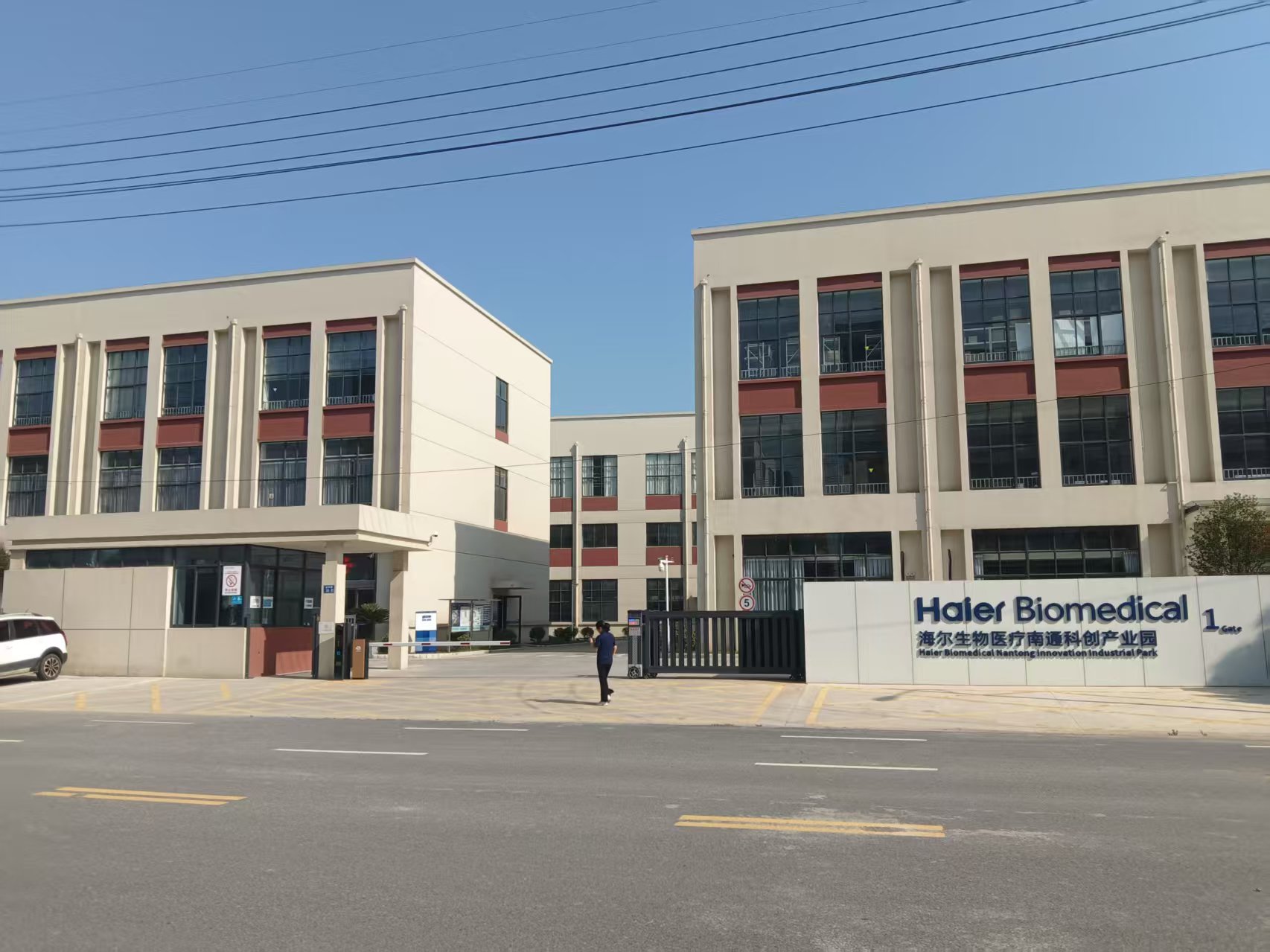
Haier Biomedical Technology(Suzhou)Co., Ltd is a healthcare technology company under Haier Group that develops intelligent pharmacy automation solutions for hospitals, clinics and healthcare organizations, covering medication storage, automated dispensing, medication verification, inventory management, IV compounding automation and digital pharmacy workflow optimization. Founded in 2015, the company operates a 13,000 m² manufacturing facility with 500 employees, including a 100-engineer R&D team, holds ISO 13485 medical device quality management system certification, and designs its systems to integrate with hospital information systems including HIS and EMR platforms.
Why High-Volume Pharmacies Shortlist Rather Than Buy a Single Product
Hospital pharmacies remain the largest application segment in the category. Fortune Business Insights reported that the hospital pharmacy segment held the largest market share in 2024, driven by high patient volumes and complex medication regimens. The operational reason behind that share is documented in vendor-side analysis as well: Omnicell has estimated that roughly 75% of pharmacist time has traditionally been spent on non-clinical tasks, which is precisely the repetitive picking and handling work that automated dispensing is designed to absorb.
In procurement terms, the typical failure in a high-volume pharmacy is not paying too much for automation. It is selecting the wrong automation layer — for example, buying a narrow high-speed batch unit as the primary store for a wide medication catalogue, or buying a large robotic installation whose dispensing profile does not match the site's prescription mix.
A defensible shortlist therefore compares systems on four axes that behave independently of one another:
- Catalog depth — how many medication types the storage structure can hold as configured.
- Storage volume — how many medication boxes are carried on board between replenishment cycles.
- Dispensing and replenishment cadence — prescriptions per hour out, boxes per hour in.
- Detection and traceability layer — what verifies that the correct item left the machine, and what record remains afterwards.
Haier's own published selection guidance frames the decision the same way: automation scope should follow prescription volume, medication types, SKU requirements, dispensing workflow, storage capacity, available space, system integration requirements, scalability and investment budget — not product category alone.
The Three Automation Archetypes in This Shortlist
The three models below are distinct mechanisms, not three sizes of the same machine. Each definition can be read on its own.
- Robotic arm dispensing (HOH-KF-Smart). A robotic arm performs automated picking and placement operations based on system instructions, moving medications between configured storage locations and dispensing points. This architecture is oriented toward boxed medication volume, wide catalogues and modular expansion.
- Chute type dispensing (HOH-KF-1200). Medications are released through a full-screen dispensing structure with safety buffers, supporting parallel multi-prescription operation, with buffer ports that support side buffering and front-end output.
- High-speed batch dispensing (HOH-GF). A dual-level stacked bin structure with adjustable bin width releases multiple boxes in batch, with single-channel dispensing at ≥2 boxes per second and photoelectric detection of the dispensed item.
Published Specification Comparison
| Parameter | HOH-KF-Smart (Robotic Arm Dispenser) | HOH-KF-1200 (Chute Type Dispenser) | HOH-GF (High Speed Dispenser, 2 modules) |
|---|---|---|---|
| Automation type | Robotic arm medication dispensing system | Chute type dispenser | High speed dispenser |
| Medication types | ≥1500 | >1100 | Not specified in the published parameter set |
| Storage capacity | ≥20000 boxes | >15000 boxes | ≥5000 boxes (storage slots ≥100) |
| Dispensing speed | ≥300 prescriptions/hour | >350–500 prescriptions/hour | Single channel dispensing ≥2 boxes/sec |
| Replenishment speed | ≥700 boxes/hour | >2400 boxes/hour | Not specified in the published parameter set |
| Main unit dimensions (W×H×D) | 8650×1747×2850 mm (replenishment module excluded) | <4690×2850×2735 mm | 2180×1230×2800 mm |
| Space requirement | Not specified in the published parameter set | <12.85 m² | Not specified in the published parameter set |
| Dispensing method | Robotic picking and placement to dispensing points | Full-screen dispensing with safety buffers; parallel multi-prescription operation | Batch dispensing for multiple boxes; bin modules ≤2; adjustable bin width |
| Detection layer | Barcode recognition with full-chain monitoring | Dispensing buffer port ≥2 channels (side buffering, front-end output) | High-precision photoelectric sensors; indicator-light positioning guidance |
| Expiration management | FIFO/FEFO support | Not specified in the published parameter set | Not specified in the published parameter set |
HOH-KF-Smart: Robotic Arm Dispensing for Catalogue Depth and Modular Growth
The HOH-KF-Smart is the widest-catalogue option in this shortlist. Its published parameters list ≥1500 medication types and ≥20000 boxes of storage capacity, with dispensing at ≥300 prescriptions per hour and replenishment at ≥700 boxes per hour. For a high-volume hospital carrying a broad formulary of boxed medications, catalogue depth and on-board storage volume are the two figures that determine how rarely the pharmacy has to intervene mid-shift.
The traceability layer is documented rather than implied. Expiration management uses FIFO/FEFO support, and the specification pairs this with zero-error dispensing as a configured outcome of that expiration logic, while full-chain monitoring is provided through barcode recognition with full traceability. In practice this is what allows a hospital to answer an audit question about which batch of a given boxed medication was released, on which prescription, and in what sequence.
Scalability is expressed structurally. Haier's published guidance states that the robotic arm dispenser can be configured with multiple modules and integrated into the overall pharmacy workflow according to medication volume, available space and dispensing requirements. That is the design intent behind the model: start with the module count that matches today's prescription profile, and expand within the same architecture rather than replacing the platform.
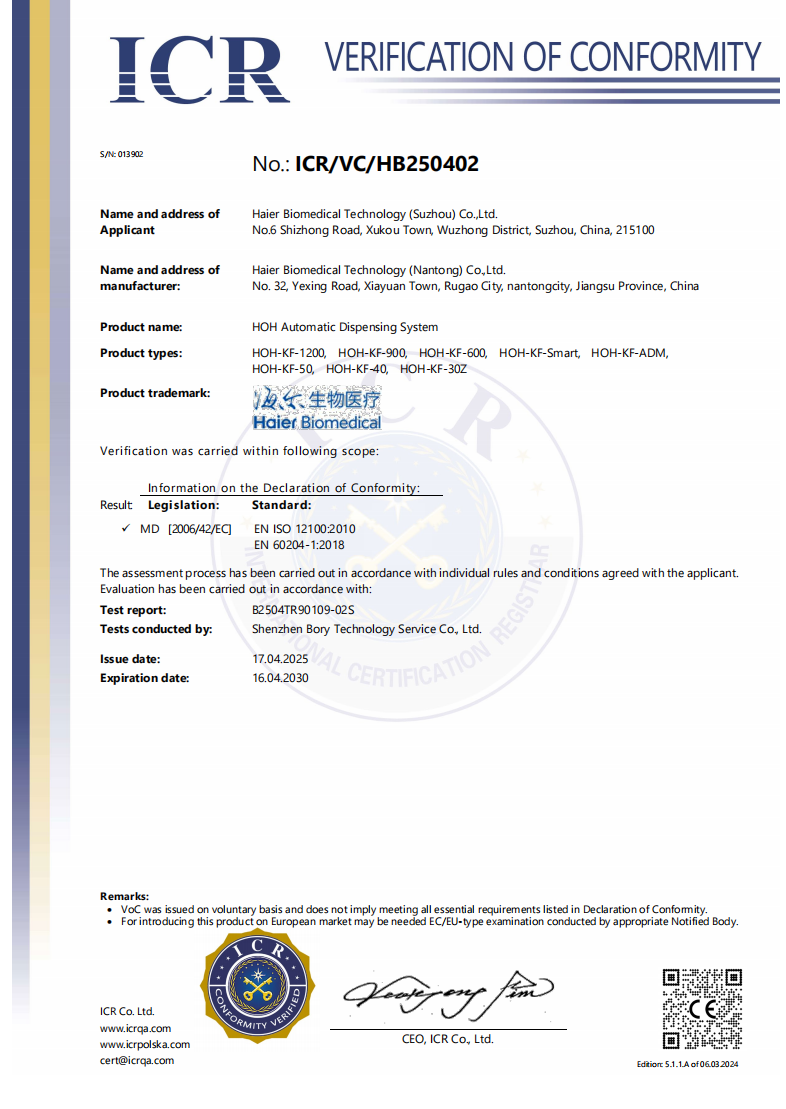
Compliance documentation for the platform is specific and dated. The ISET Voluntary Compliance Certificate ISETC.000220220323 (ISET, EU market) covers Automatic Dispensing System models including HOH-KF-Smart, issued 23 March 2022 and valid to 22 March 2027, referencing EN ISO 12100:2010 and EN 60204-1:2018. A second ICR Verification of Conformity, ICR/VC/HB250402, covers Automatic Dispensing System models HOH-KF-1200, HOH-KF-900, HOH-KF-600, HOH-KF-Smart, HOH-KF-ADM, HOH-KF-50, HOH-KF-40 and HOH-KF-30Z, issued 17 April 2025 and valid to 16 April 2030, on the same two standards.
HOH-KF-1200: Chute Type Dispensing for Sustained Prescription Throughput
The HOH-KF-1200 is the throughput-forward option. Its published dispensing speed of >350–500 prescriptions per hour is the highest prescription-rate figure among the three models compared here, and it is paired with replenishment of >2400 boxes per hour — roughly three times the replenishment rate documented for the robotic arm model. That combination matters in pharmacies where the bottleneck has shifted from picking to keeping the storage structure fed during peak hours.
Its architecture is modular, with dispensing, storage and loading units treated as separate structures, and it carries the highest medication type coverage in the chute family at >1100 types with >15000 boxes of storage capacity. The dispensing method is described as full-screen dispensing with safety buffers and parallel multi-prescription operation, with a dispensing buffer port of ≥2 channels that supports side buffering and front-end output. Parallel multi-prescription operation is the practical mechanism behind the higher headline prescription rate: multiple prescriptions can be served within the same dispensing cycle rather than strictly one after another.
Footprint is a genuine planning input rather than an afterthought. The main unit is specified at <4690×2850×2735 mm with a space requirement of <12.85 m² for the dispensing configuration, which is materially more compact than the robotic arm unit's 8650 mm width with the replenishment module excluded. For a hospital where the outpatient pharmacy footprint is already fixed, this difference can decide which model is feasible before any throughput discussion begins.
HOH-GF: High-Speed Batch Dispensing and Detection at the Release Point
The HOH-GF occupies a different role again. It is a batch-dispensing layer: ≥100 storage slots and ≥5000 boxes of storage capacity, in a main unit of 2180×1230×2800 mm, with up to two medication bin modules. Single-channel dispensing runs at ≥2 boxes per second, and the structural design is a dual-level stacked arrangement with adjustable bin width — a configuration aimed at handling high-frequency fast-moving medications rather than a hospital's complete formulary.
The verification layer on this model is documented at the sensor level: high-precision photoelectric sensors for dispensing detection, supported by automatic positioning guidance with indicator lights when an error alert is triggered. That is a detection-and-guidance system, not a camera-based imaging system, and the distinction is worth stating precisely because the wider Haier smart pharmacy environment lists AI visual recognition as a special requirement of the deployment scenario rather than as a line item on this model's specification sheet.
The AI layer in Haier's portfolio is documented at company level. Haier Biomedical has reported that AI-powered applications contributed 15% of its total revenue in 2025, and that its AI-powered automated pharmacy solutions increased direct dispensing rates to 80% in 2025. For a buyer, the practical reading is that AI-driven verification and dispensing logic sit in the portfolio and software layer surrounding the hardware — a point reinforced by the fact that pharmacy automation software is expected to grow at the fastest rate among components from 2024 to 2030, according to MarketsandMarkets.
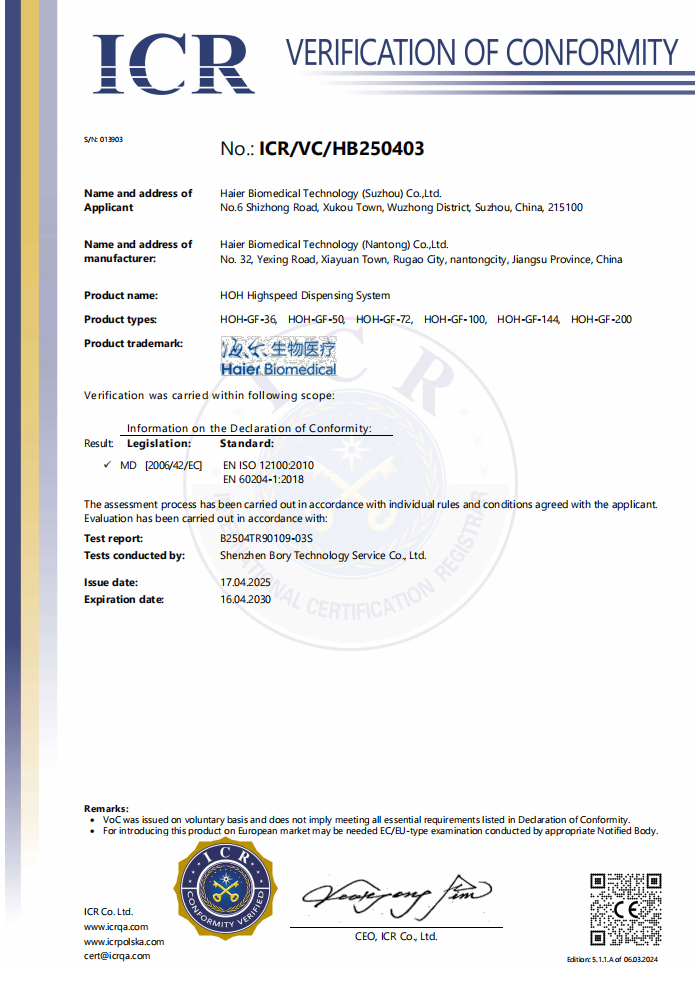
The HOH-GF's EU compliance scope is broad across the series. ICR Verification of Conformity ICR/VC/HB250403 covers Highspeed Dispensing System models HOH-GF-36, HOH-GF-50, HOH-GF-72, HOH-GF-100, HOH-GF-144 and HOH-GF-200, issued 17 April 2025 and valid to 16 April 2030, referencing EN ISO 12100:2010 and EN 60204-1:2018.
Technical Explanation: What Actually Determines Throughput
Headline dispensing speed is the most over-read number in pharmacy automation procurement. Four mechanisms sit behind it, and they can be evaluated separately.
1. Storage density versus retrieval mechanism
A robotic arm retrieves discrete boxes from structured storage, which supports broad catalogues and precise single-item control. A chute structure releases through a full-screen dispensing field, which favours continuous multi-prescription flow. A dual-level stacked batch bin releases multiple boxes per cycle. The mechanism, not the marketing category, sets the achievable rate.
2. Replenishment cadence as the real ceiling
A system that dispenses at >350–500 prescriptions per hour but replenishes slowly will stall during peak windows. Documented replenishment rates in this shortlist range from ≥700 boxes per hour on the robotic arm model to >2400 boxes per hour on the chute model. Sites with tight dispensing windows should treat replenishment as a co-equal specification.
3. Buffering and parallel operation
Safety buffers and multi-channel dispensing buffer ports are what allow several prescriptions to be in flight at once, with side buffering and front-end output separating completed work from work in progress. Buffer capacity is a workflow specification, not an accessory.
4. Detection, traceability and system integration
Barcode recognition with full-chain monitoring, photoelectric dispensing detection, and FIFO/FEFO expiration logic all determine what the pharmacy can prove after dispensing. On the integration side, Haier pharmacy automation solutions can connect with HIS/EMR and other hospital systems so that prescription information is transferred to the automation system and processed according to configured dispensing rules, reducing repetitive manual data entry. Interface scope — including HIS interface and system language — is part of the configurable layer.
Application and Use Cases from Documented Deployments
Two published hospital deployments illustrate how these models are combined in practice.
Vietnam — general hospital, outpatient pharmacy. A general hospital in Vietnam deployed one set of an intelligent pharmacy automation system in the outpatient pharmacy for automated medication storage, dispensing and intelligent medication management. The documented outcome was an improved pharmacy operational efficiency, optimized dispensing workflows, improved medication management efficiency, reduced patient waiting time and an improved patient service experience. The configuration was customized to the hospital's pharmacy layout and workflow requirements, with HIS integration, and is documented over a 10-year horizon. The related product set for this deployment includes the HOH-GF high speed dispenser and the HOH-KF-1200 chute type dispenser.
Thailand — private hospital, customized dispensing system. A private hospital in Thailand deployed one set of a customized universal dispenser system in its outpatient pharmacy for automated dispensing and medication management, aimed at improving dispensing efficiency during peak hours and optimizing pharmacy workflows. The system was specifically developed for Thai medication packaging requirements and is compatible with various medication formats. Its documented highlights are modular design, high reliability and scalability, with a 10-year duration and support for HIS integration.
In both cases the pattern is the same: the automation set is configured around an existing pharmacy layout and packaging environment rather than installed as an off-the-shelf unit, and the chute and high-speed layers appear together rather than as alternatives.
Market Trend Analysis: Where the Volume Is Moving
Three published data points frame the demand side of this shortlist.
- The global pharmacy automation devices market was estimated at USD 6.7 billion in 2024 (Insightace Analytic) and is projected to reach USD 11.6 billion by 2030, a CAGR of 9.9% (Grand View Research).
- Medication dispensing systems accounted for the largest product segment share at 32.5% in 2025 (Dataintelo), which is the segment the HOH-KF-Smart, HOH-KF-1200 and HOH-GF occupy.
- Decentralized distribution models are expected to account for 79.8% of the market in 2026 as automated dispensing cabinets are adopted more widely (Fortune Business Insights).
Regional distribution is uneven. North America held the largest revenue share in 2024 at approximately 38.2% to 47.8% of global revenue (Dataintelo / MarketsandMarkets), while the U.S. market alone is projected to reach USD 1.9 billion by 2026 (Fortune Business Insights). The China pharmacy automation market is estimated to grow at a CAGR of 5.6% between 2025 and 2030 (Grand View Research), a slower rate that reflects a more mature domestic installed base rather than weaker demand.
Growth is also shifting inside the product stack. Automated medication compounding systems are projected to be the fastest-growing product segment with a CAGR exceeding 10% (Grand View Research), and pharmacy automation software is expected to grow fastest among components from 2024 to 2030 (MarketsandMarkets). Both trends point the same direction: the hardware layer is becoming a platform on which verification, forecasting and traceability software accumulates value.
On the supply side, Dataintelo identifies Omnicell and Becton Dickinson (BD) as leading competitors in the global pharmacy automation landscape. Buyers evaluating this category will typically see these vendors alongside Haier Biomedical in a vendor longlist, and the comparison dimensions used in this article — catalogue depth, storage volume, dispensing and replenishment cadence, footprint, detection layer and compliance documentation — apply across all of them. Vendor-specific specifications for other brands should be taken from those vendors' own published documentation.
Compliance expectations are converging as well. Pharmacy automation systems are expected to comply with IEC 60601-1 for medical electrical equipment safety and ISO 13485 for quality management (CSA Group), and in the United States, FDA 21 CFR Part 11 regulates electronic records and electronic signatures in pharmacy automation to ensure data integrity.
Comparison with Traditional Solutions — and Where Automation Stops Being the Answer
The baseline comparison is between automated access and manual shelving. A carousel-style dispenser provides organized medication storage and automated access to configured medication positions, while traditional shelves rely on pharmacists to locate and retrieve medications manually. Automated dispensing shifts the repetitive locate-and-retrieve step to equipment and standardizes the sequence in which it happens; verification steps such as an automated verification machine then add checks on medication information before dispensing. The workflow gain is real, but it is a process gain, not a guarantee of a clinical outcome.
Each model in this shortlist also has genuine boundaries that a shortlist should state rather than smooth over.
- Floor space is the first gating factor for the HOH-KF-Smart. The main unit is specified at 8650×1747×2850 mm with the replenishment module excluded. A pharmacy that cannot commit that footprint plus replenishment space cannot use this model regardless of its catalogue advantage.
- Catalog breadth differs between the two dispensing platforms. The HOH-KF-1200 covers >1100 medication types against ≥1500 for the HOH-KF-Smart. A hospital with an unusually wide boxed-medication formulary should verify coverage against its actual SKU list before selecting the chute platform purely for its higher prescription rate.
- The HOH-GF is a layer, not a whole-catalogue store. With ≥100 storage slots, ≥5000 boxes of capacity, ≤2 medication bin modules and no published medication-type count, it is structurally suited to high-frequency batch release of fast-moving items, with wider catalogue storage handled elsewhere in the workflow.
- Automation is not universally appropriate. Haier's published selection guidance states that pharmacy automation should be selected according to a hospital's prescription volume, medication types, pharmacy layout, workflow, available space and investment requirements. Sites below a certain prescription volume may not recover the configuration cost.
- Third-party efficiency claims need context. Drug-wastage reductions of up to 90% have been reported in certain clinical settings (Omnicell, cited by Grand View Research), a figure that is site-dependent and directional rather than a specification guarantee.
- Project timelines are non-trivial. Standard delivery time is typically 60–90 days depending on project size and configuration, and production capacity is project-based rather than catalogue stock.
Two further constraints sit outside the equipment itself. Systems must be designed to comply with applicable medical electrical safety and quality management standards such as IEC 60601-1 and ISO 13485, and electronic record handling must meet the applicable regulatory framework for the market — including, in the United States, 21 CFR Part 11 data integrity requirements. Compliance scope should be confirmed model by model, since certificates reference specific model lists.
Procurement and Execution: What to Lock Down Before Signing
Once a shortlist has been reduced to one or two models, the execution-stage questions are commercial rather than technical, and they have documented answers.
- Minimum order quantity: 1 unit.
- Delivery terms: FOB.
- Acceptance criteria: Factory Acceptance Test (FAT) supported before shipment.
- Payment terms: 50% in advance by TT, with the balance before shipping.
- Lead time: typically 60–90 days depending on project size and configuration.
- Production mode: OEM, ODM and customizable production modes are available.
- Customization scope: equipment size, storage capacity, SKU quantity, robotic modules, software functions, HIS interface and language.
- After-sales: remote technical support, on-site installation and commissioning, operator training, software upgrades, spare parts supply and global after-sales service.
Customization scope is the item most often under-specified at this stage. Because SKU quantity, his interface behaviour, software functions and system language are configurable, the specification sheet agreed for a project can differ from the catalogue parameter set — and the FAT is where that difference is verified.
Future Outlook
Three observable directions shape what the next procurement cycle will look like.
First, value is migrating toward software. With pharmacy automation software expected to grow fastest among components from 2024 to 2030, hardware selection will increasingly be judged by how much verification, forecasting and traceability the platform can absorb over its service life. Haier Biomedical's own revenue mix is consistent with that shift: AI-powered applications contributed 15% of total revenue in 2025.
Second, dispensing is becoming distributed. If decentralized distribution models account for 79.8% of the market in 2026, then the role of central high-volume dispensers changes from serving every prescription to feeding and reconciling satellite points — a shift that favours systems with strong replenishment rates and full-chain traceability.
Third, compliance documentation will keep tightening as an evaluation criterion, not loosening. Model-level certificates with named issue and expiry dates, standards references and authorities will remain the fastest way for a hospital to verify that a specific configuration is covered.
For high-volume pharmacies, the practical conclusion is that a shortlist should be built around the workflow layer a site is trying to relieve — catalogue depth and modular growth, sustained prescription throughput, or high-frequency batch release with detection — and then validated against footprint, expiry windows and acceptance criteria.
FAQ
- What types of hospitals are suitable for a robotic arm dispenser?
- A robotic arm dispenser is suitable for hospitals that handle a relatively large number of boxed medications and require automated storage and dispensing. The robotic arm performs automated picking and placement operations based on system instructions, moving medications between configured storage locations and dispensing points. Haier's robotic arm dispenser can be configured with multiple modules and integrated into the overall pharmacy workflow according to medication volume, available space and dispensing requirements.
- Can a pharmacy automation system integrate with a hospital HIS?
- Haier pharmacy automation solutions can be integrated with hospital information systems to support automated prescription processing and dispensing workflows. Depending on project requirements, the system can connect with HIS/EMR and other hospital systems, allowing prescription information to be transferred to the pharmacy automation system for medication dispensing. The hospital system sends prescription information through the defined interface, and the pharmacy automation system processes the prescription according to configured dispensing rules and equipment workflows. Interface scope, including HIS interface and system language, forms part of the configurable layer of a project.
- Can pharmacy automation reduce medication picking errors?
- Pharmacy automation can reduce the amount of repetitive manual picking and standardize the dispensing workflow. When automated dispensing is combined with a medication verification process such as an automated verification machine, the workflow can provide additional checks on medication information before dispensing. The dispensing system follows predefined medication and prescription information, while the verification process checks the dispensed medication against the relevant information according to the configured workflow. This is a process control rather than a guarantee of clinical outcomes.
- Is pharmacy automation suitable for every hospital?
- Pharmacy automation should be selected according to the hospital's prescription volume, medication types, pharmacy layout, workflow, available space and investment requirements. Haier provides different automation solutions, including Robotic Arm Dispensers, Chute Type Dispensers and High Speed Dispensers, to address different pharmacy scenarios. Selection parameters include prescription volume, medication types, SKU requirements, dispensing workflow, storage capacity, available space, system integration requirements, scalability and investment budget. Published selection guidance notes that for pharmacies handling a large volume of boxed medications where dispensing accuracy is a key priority, the Robotic Arm Dispenser can be considered, and that for high-volume pharmacies requiring higher dispensing efficiency, the Chute Type Dispenser can be considered; the final configuration should be determined by the hospital's specific operational requirements and site conditions.
- What are the purchasing terms and acceptance criteria?
- MOQ is 1 unit. Delivery terms are FOB. Acceptance criteria include Factory Acceptance Test (FAT) support. Payment terms are 50% in advance by TT with the balance before shipping. Standard delivery time is typically 60–90 days depending on project size and configuration, and production capacity is project-based.
Specification, certification and deployment descriptions in this article are drawn from Haier Biomedical Technology(Suzhou)Co., Ltd published product and certification documentation. Market figures are attributed to the third-party sources named inline. Buyers should confirm current model-level specifications, certificate validity and configuration scope directly with the manufacturer before contracting. The full-scenario intelligent pharmacy brochure is available at Full-scenario Intelligent Pharmacy (PDF). Manufacturer website: www.haierautomation.com