
High-Volume Blister Lines for Generic Drug Manufacturers
Industry Reference — Solid Dosage Packaging
Once a molecule is off patent, competition shifts from science to throughput. For generic producers, the blister-cartoning stage is where daily output — and therefore unit cost — is decided.
A high-volume blister-cartoning configuration: primary blister forming and sealing linked to automatic cartoning for solid dosage production. Image: Zhejiang Hoping Machinery Co., Ltd.
This article looks at one specific scenario: high-volume blister packaging lines used by generic drug manufacturers running continuous solid dosage production. It uses the HOPING DHL8005H blister-cartoning line — rated at up to 800 blisters/min and 500 cartons/min — as a reference point for what typical high-throughput capacity looks like in this equipment class, and it sets out where that class of line fits, and where it does not.
Why generic manufacturing turns packaging into a volume problem
Generic drug production is, by design, a low-differentiation business. Several manufacturers legally make the same tablet, capsule or softgel, and the buyer — a hospital group, a pharmacy chain or a national tender — compares on price and reliable supply rather than on brand. The consequence is a manufacturing model in which margins are defended by volume: fixed costs such as cleanroom space, utilities, quality systems and labour are spread across as many saleable packs as a plant can produce.
Packaging sits late in that sequence and is often the last constraint standing. Formulation and tableting may already run at a rate the downstream blister and carton stages cannot absorb. Where that happens, the packaging hall quietly caps the output of the whole site — and adding a shift does not fix it, because the constraint is mechanical, not labour.
A pharmaceutical packaging machine is therefore not a peripheral item in a generic plant. A blister packaging line that forms, seals, transfers and cartons at a rate matched to upstream capacity is what allows a generic producer to keep unit costs defensible without adding a second cleanroom.
Zhejiang Hoping Machinery Co., Ltd. (HOPING) is a Chinese manufacturer of pharmaceutical packaging machinery, established in 2001, whose product range covers blister packaging machines, cartoning machines, case packing machines and end-of-line packaging equipment. The company employs approximately 300 staff, operates a manufacturing facility covering 28,800 square metres, runs an R&D team of 56 engineers, and reports an annual production capacity of 500 units, with export business accounting for 25% of total sales.
What “high-volume” actually means on a blister-cartoning line
In equipment terms, high volume is a band of rated output, not a marketing word. On solid dosage blister-cartoning lines the figures buyers compare are blisters per minute at the primary stage and cartons per minute at the secondary stage — and the two must be read together, because the relationship between them determines whether the line is balanced.
The HOPING DHL8005H is described as an intelligent fully servo high-speed blister-cartoner integrated machine and a solid dosage turnkey packing line, intended for capsule and tablet packaging in pharmaceutical solid dosage production. It is rated at up to 800 blisters/min and 500 cartons/min, and its scope covers blister forming and sealing, transfer, leaflet handling, carton opening, insertion, coding and inspection, plus connection to bundling, case-packing and palletizing equipment. Product-contact parts and tooling are configured according to technical agreement.
The same product family spans several output bands, which is the clearest way to see where 800 blisters/min sits.
| Blister-cartoning line (HOPING) | Rated blister output | Rated carton output | Transfer and control features |
|---|---|---|---|
| DPP Series + XWZ Series (Automatic Blister-Cartoner Production Line) | 100–600 blisters/min depending on model | 100–400 cartons/min | Linked blister and cartoning modules; 380V 50Hz |
| DHL6004 | up to 600 blisters/min | up to 400 cartons/min | Servo-driven independent replenishment; Beckhoff controller with CP9315 industrial PC |
| DHL8005H | up to 800 blisters/min | up to 500 cartons/min | D3 intelligent top-loading parallel tracking transfer; Beckhoff motion controller with CP9315 industrial PC; three-channel servo-driven independent replenishment |
| DHL1000/5H | up to 1000 blisters/min | up to 500 cartons/min | D3 intelligent top-loading parallel tracking transfer; Beckhoff motion controller; four-channel servo-driven independent replenishment |
Read as a group, the table shows something practical for a generic producer: cartoning capacity tends to plateau before blister capacity does. Across these lines the carton figures cluster at 400–500 cartons/min while blister output climbs to 600, 800 and 1,000 blisters/min. The intermediate variable is pack count per carton — the number of blisters loaded into each folding carton — which is a market decision as much as an engineering one. A carton holding two blisters consumes cartoning capacity roughly twice as fast as a carton holding four.
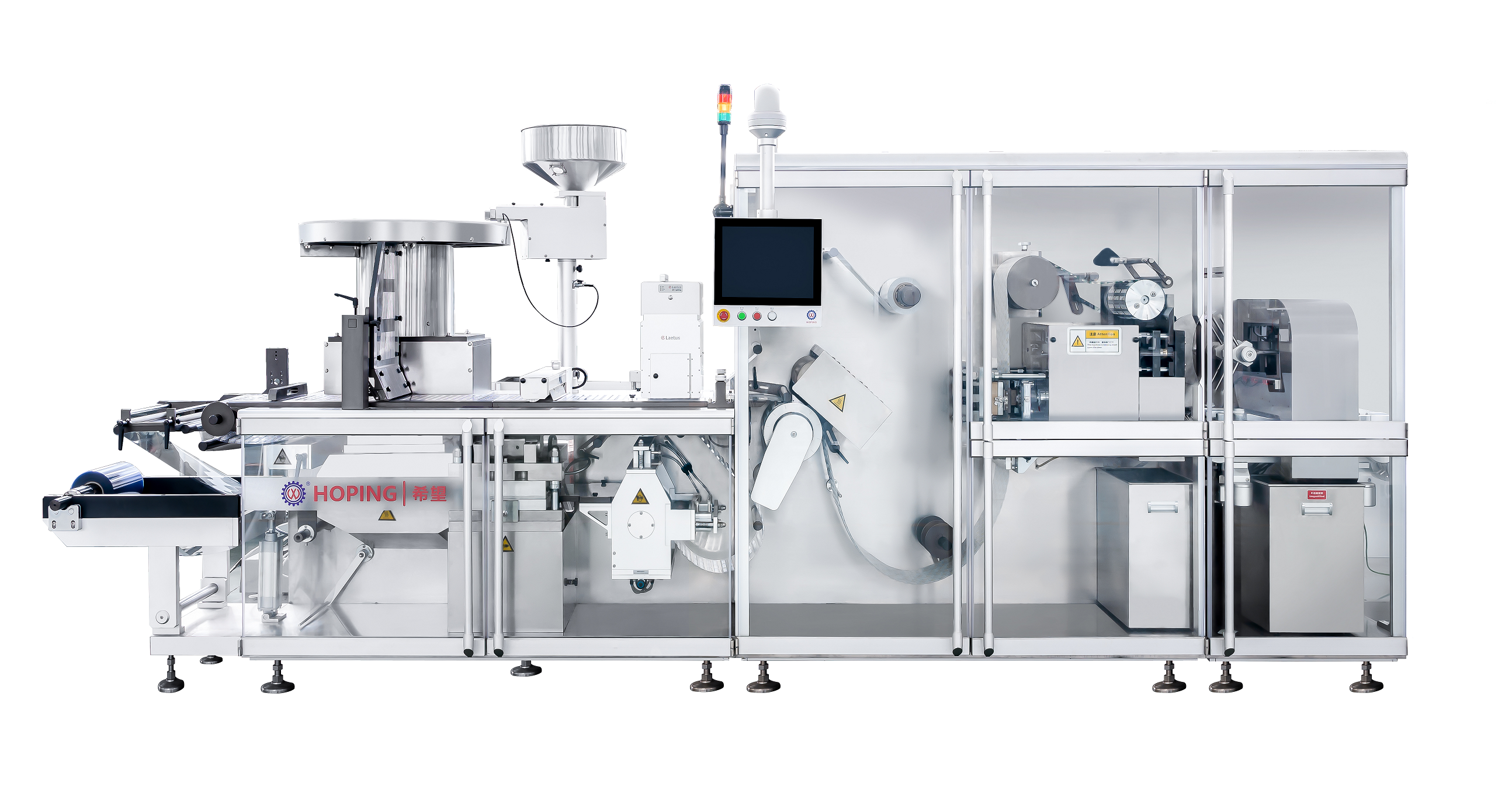
The primary stage sets the ceiling on blister output: forming, filling, sealing and punching before the blister board ever reaches a cartoner. Image: Zhejiang Hoping Machinery Co., Ltd.
Where throughput is actually lost: line balancing and transfer
A blister-cartoning line has four places where rated speed becomes real speed: the forming and sealing station, the transfer between blister and carton, the cartoning station, and the material supply chain feeding all three.
Forming and sealing
The primary stage forms pockets in PVC or aluminium foil, fills them with tablets or capsules, seals the lidding material and punches the finished blister. On a roller-type machine such as the HOPING DPH320H — a fully servo high-speed roller blister packing machine — the forming area is 320 x 280 mm and forming depth is 12 mm, with a punching frequency of 12 times per minute. On a rotary blister machine such as the DPH320HII, punch frequency rises to 250 punches/min and maximum capacity reaches 1,000 blisters/min.
Transfer between stages
The weakest link on any high-speed line is usually the hand-off between primary and secondary packaging. Manual or semi-mechanical transfer introduces rework, drop-outs and an effective speed limit. The DHL8005H uses a D3 intelligent top-loading parallel tracking transfer system, and the DHL1000/5H uses the same D3 top-loading parallel tracking approach. The wider HOPING family includes alternative architectures: the DHL7004 and DHL7005H use a self-developed IRB24 intelligent transfer robot with Siemens motion control, while the DHL6004 relies on servo-driven independent replenishment with Beckhoff control.
Cartoning
Carton opening, blister insertion, leaflet handling, coding and closing set the secondary-stage rate. On the DHL8005H the cartoner is rated at 500 cartons/min. By comparison, standalone cartoning machines in the same range sit in clearly different bands: the XWZ500H full servo high-speed cartoning machine runs 100–500 cartons/min, the XWZ300II intelligent high-speed cartoning machine runs 60–220 cartons/min, and the XWZ120 horizontal cartoning machine runs 30–120 cartons/min.
Material supply and changeover
Foil roll changes are a predictable source of downtime, which is why PVC/Alu foil auto splicing is specified on the DHL8005H and the DHL1000/5H. Servo-driven independent replenishment — three-channel on the DHL8005H, four-channel on the DHL1000/5H — together with mold-change and preset-memory functions, is aimed at shortening the interval between formats rather than at raising the peak rate.
Application fit: which generic producers this scenario suits
High-volume blister lines are not universal. They fit a recognisable production profile defined by GMP-oriented cleanroom or pharmaceutical packaging workshop conditions, continuous high-speed operation, multi-batch and multi-format production, and requirements for stability, easy cleaning, safety protection and traceability-oriented operation.
- Continuous solid dosage production. Producers running stable, high-demand products — common cardiovascular, metabolic, anti-infective or analgesic tablets and capsules — where a single format can run for long campaigns.
- New solid dosage blister packaging lines. Greenfield lines designed around throughput from the outset rather than retrofitted later.
- Existing line upgrades and high-capacity expansion. Sites whose tableting capacity already exceeds packaging capacity, and where the packaging hall is the acknowledged bottleneck.
- Intelligent packaging workshop retrofits. Operations moving toward recipe-driven, servo-controlled equipment with reduced manual transfer.
- Blister-cartoning-bundling and case-packing downstream integration. Projects where the blister-cartoning line must connect onward to secondary and end-of-line equipment.
Downstream, the HOPING range provides concrete capacity points for that connection. The XWK4060 intelligent fully servo stretch bander runs 30–60 bundles/min. The XWK Series case packing machine (models XWK900 and XWK600) handles up to about 5 cases/min. The ICP12 case packing and palletizing integral machine runs at about 12 cases/min. Those rates are deliberately lower than the 500 cartons/min of the DHL8005H cartoner, because cartons per bundle, bundles per case and cases per pallet multiply the count.
Format coverage matters too. The DHL8005H is intended for capsule and tablet packaging in pharmaceutical solid dosage. Across the wider HOPING blister range, DPH Series machines support both Alu-PVC and Alu-Alu formats, and the DPP Series supports flat-plate Alu-PVC and Alu-Alu blister packing — relevant where moisture-sensitive generic products need an all-aluminium pack rather than an aluminium-lidding-on-PVC construction.
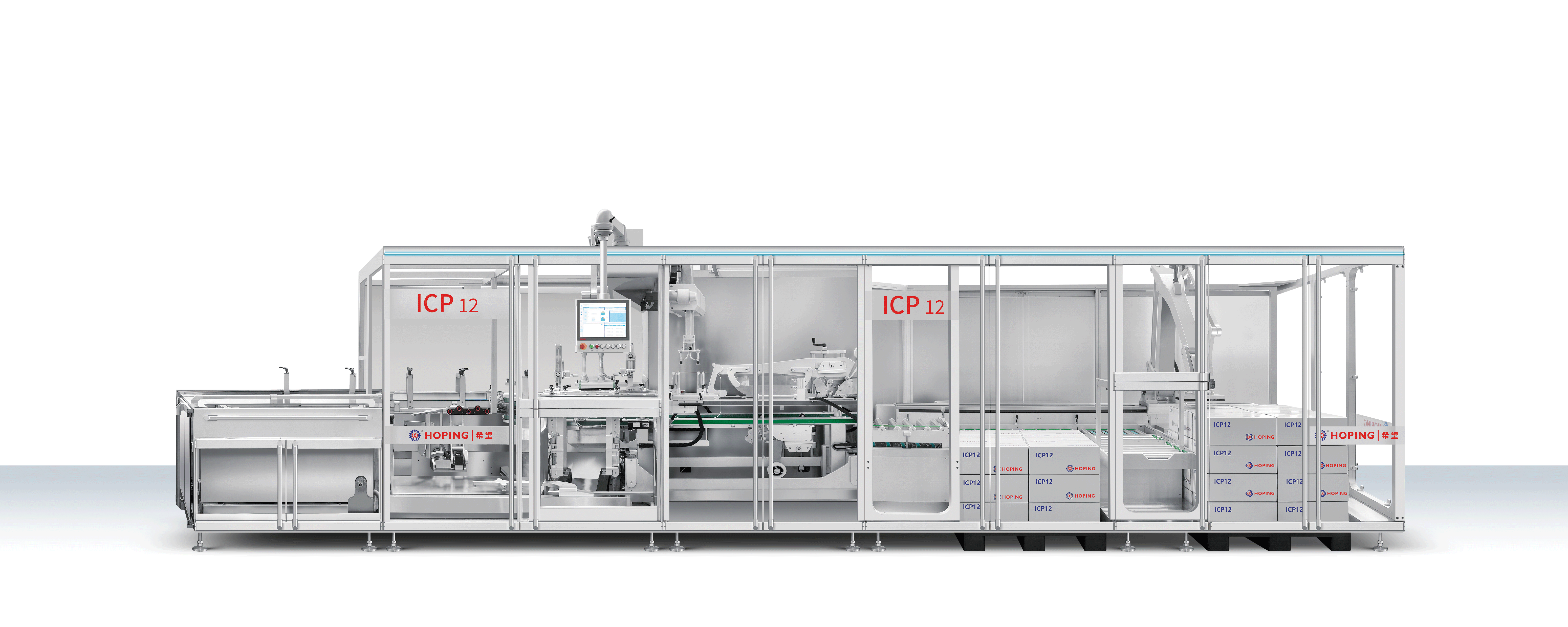
Downstream rates are set by cartons per case and cases per pallet, so end-of-line capacity is planned as a ratio to the cartoner, not matched one-to-one. Image: Zhejiang Hoping Machinery Co., Ltd.
Market signals behind the high-volume case
Demand context matters for a capital decision of this size. A small number of attributable data points are worth separating from speculation.
- The global blister packaging machine pharmaceutical market was valued at USD 2.57 billion in 2025, according to Custom Market Insights.
- The same source identifies Asia-Pacific as the fastest-growing region for pharmaceutical blister packaging, at an 8.87% CAGR to 2031.
- Separately, Mordor Intelligence reports the global pharmaceutical packaging machinery market at USD 7.09 billion in 2026, growing at a 7.15% CAGR. That figure covers a broader equipment scope — filling, sealing, labelling, blister packaging and cartoning — and is a single-source, publisher-defined estimate. It should be read as a directional benchmark, not as a segment-level number, and it should not be combined with the blister-specific figure above.
- On the cartoning side, Mordor Intelligence reports that horizontal cartoning systems held 70.12% of the market in 2024 — a relevant context point, since the DHL8005H and the rest of the HOPING high-speed family are horizontal-format machines.
- Trade media reporting association (PMMI) content notes that pharmaceutical manufacturers are turning toward digitised data collection and integrated solutions in order to meet regulations and improve visibility. That is a directional trend statement, not a measured adoption rate.
Two practical readings follow for generic producers. First, the equipment category is expanding rather than contracting, and the fastest regional growth is in Asia-Pacific — where a substantial share of generic manufacturing capacity is located. Second, the compliance and data side of packaging is increasingly specified alongside the mechanical side, which is why integrated line control appears on the same datasheet as output rates.
Comparison with traditional approaches — and where the high-volume case breaks down
The traditional alternative to an integrated high-speed blister-cartoning line is a lower-speed platen blister machine paired with a standalone cartoner, connected by manual or simple conveyor transfer. HOPING still builds that configuration. The DPP Series of intelligent flat Alu-PVC/Alu-Alu blister packing machines typically runs at 20–50 cycles/min depending on model, and the XWZ120 horizontal cartoning machine runs 30–120 cartons/min. Neither figure is a criticism; they serve a different production logic.
| Consideration | Integrated high-speed blister-cartoner (e.g. DHL8005H) | Separate platen blister machine + standalone cartoner (e.g. DPP Series + XWZ120) |
|---|---|---|
| Rated output | up to 800 blisters/min and 500 cartons/min | typically 20–50 cycles/min; 30–120 cartons/min |
| Transfer | D3 intelligent top-loading parallel tracking transfer within one linked line | mechanical or conveyor hand-off between two standalone units |
| Format change | mold-change and preset-memory functions on one control architecture | separate changeover on two independent machines |
| Best fit | long, stable campaigns across a limited number of formats | multi-SKU, small-batch or frequently changing formats |
| Capital and footprint | higher capital intensity, larger floor area, single-line dependency | lower entry cost, more modular deployment |
The boundary buyers should not skip. The integrated high-volume argument weakens under specific conditions, and generic producers are more likely than most to meet them:
- High format fragmentation. A generic portfolio often includes dozens of pack presentations — different blister counts, carton sizes and leaflet combinations. Every format change on a fully servo integrated line is a validated event, not just a mechanical adjustment. Where changeovers are frequent, the throughput gain can be consumed by changeover time.
- Modest per-format demand. If no single format runs long enough to amortise the line's capital cost, a platen machine with a standalone cartoner can be the more rational purchase.
- Unvalidated output expectations. Rated maximum is a design figure. Sustained output depends on product format, packaging material, reject handling and operator procedure, and should be confirmed against acceptance-test data before a purchase decision is made.
- Downstream mismatch. A 500 cartons/min cartoner feeding a case packer running at about 5 cases/min is not a defect — it is a ratio — but it must be planned, or cartons accumulate between stages.
Stated plainly: high-volume blister lines for generic drug manufacturers are a scenario-specific answer, not a category-wide recommendation. The scenario is long campaigns, stable formats, and upstream capacity that already exists.
Compliance and data considerations
Two regulatory anchors shape how a high-volume line is specified, even though neither is machine-specific on its own. The U.S. FDA states that Current Good Manufacturing Practice (cGMP) establishes the foundation for quality pharmaceuticals through regulatory standards. At the packaging-material level, ISO 15378:2017 specifies Good Manufacturing Practice requirements for primary packaging materials for medicinal products. Separately, a draft GMP guidance for pharmaceutical packaging materials in China has been reported under public consultation; it is a draft, not a final rule, and its status should be confirmed against the issuing authority before being used as a procurement requirement.
In practice, this means GMP-oriented design is a baseline expectation for this equipment class rather than a differentiator. The DHL8005H is described as having a GMP-oriented line design with a stainless steel and aluminium-alloy structure and transparent guarding. The DHL6004 and the DHL1000/5H carry the same GMP-oriented description, and the wider HOPING line includes machines specified with AISI 316L product-contact parts and FDA-compliant pharmaceutical-grade materials. For a generic producer, the procurement question is less “is it GMP-oriented” and more “what documentation, contact-part material specification and change-control record accompanies it” — and the technical agreement is where that should be answered.
Future outlook
Three directions look durable for this equipment class.
Higher integration, not just higher speed. The DHL8005H scope already extends beyond blister and carton to leaflet handling, coding, inspection and connection to bundling, case-packing and palletizing. The competitive frontier is shifting from a single output number toward how much of the packaging hall one control architecture can cover.
Recipe-driven changeover. Mold-change and preset-memory functions on the DHL8005H, and recipe memory on the DHL1000/5H, point in the same direction: reducing the operator-dependent part of a format change. For generic producers running many presentations on one line, that is where the next throughput gain is likely to come from.
Data specified alongside mechanics. The reported shift toward digitised data collection and integrated solutions suggests batch-level data capture will increasingly be specified with the line rather than added afterwards. Full servo drive, Beckhoff motion controllers and CP9315 industrial PCs are the hardware substrate for that.
Regional demand reinforces the case: Asia-Pacific is identified as the fastest-growing region for pharmaceutical blister packaging at an 8.87% CAGR to 2031, and much of the generic manufacturing capacity in that region is being built or upgraded now.
Frequently asked questions
1. What is a high-volume blister-cartoning line?
A high-volume blister-cartoning line is an integrated machine that forms and seals blister packs and then transfers them automatically into folding cartons within one linked process, rather than as two separately operated machines. The HOPING DHL8005H is one example: an intelligent fully servo high-speed blister-cartoner integrated machine rated at up to 800 blisters/min and 500 cartons/min, described as a solid dosage turnkey packing line and intended for capsule and tablet packaging in pharmaceutical solid dosage production.
2. How much output is typical for a high-speed blister-cartoning line?
Across the HOPING blister-cartoning range, rated blister output spans roughly 100 to 1,000 blisters/min depending on model, and rated carton output spans roughly 100 to 500 cartons/min. The DPP Series + XWZ Series line is rated at 100–600 blisters/min and 100–400 cartons/min; the DHL6004 up to 600 blisters/min and 400 cartons/min; the DHL8005H up to 800 blisters/min and 500 cartons/min; and the DHL1000/5H up to 1,000 blisters/min and 500 cartons/min. These are rated maximum figures reported by the manufacturer, not validated sustained output.
3. Which solid dosage formats can run on a high-speed blister-cartoning line?
The DHL8005H is described as intended for capsule and tablet packaging in pharmaceutical solid dosage production. Across the wider HOPING blister range, DPH Series machines support both Alu-PVC and Alu-Alu formats, and the DPP Series supports flat-plate Alu-PVC and Alu-Alu blister packing. Suitability for a specific product is confirmed through tooling and product-contact parts configured to the confirmed blister and carton specification.
4. When is an integrated high-volume line a better fit than separate blister and cartoning machines?
An integrated high-speed line such as the DHL8005H fits long, stable production campaigns across a limited number of pack formats, where upstream tableting capacity already exists and the packaging hall is the bottleneck. Separate machines — for example a DPP Series platen blister machine running typically 20–50 cycles/min depending on model, paired with an XWZ120 horizontal cartoner running 30–120 cartons/min — are generally a better match where a portfolio contains many small-batch formats and changeovers are frequent.
5. What limits the sustained output of a high-volume blister line?
Sustained output is limited by four factors: the transfer between the blister and carton stages, the cartoner rate relative to the blister rate, material splicing downtime, and format changeover time. The DHL8005H addresses these with a D3 intelligent top-loading parallel tracking transfer system, PVC/Alu foil auto splicing, a three-channel servo-driven independent replenishment system, and mold-change and preset-memory functions. Even so, sustained output should be confirmed on the buyer's actual format through acceptance testing rather than assumed from the rated maximum.
6. Does a high-volume blister line require GMP documentation support?
GMP-oriented design is a baseline expectation for pharmaceutical packaging equipment rather than a distinguishing feature. The U.S. FDA states that Current Good Manufacturing Practice establishes the foundation for quality pharmaceuticals through regulatory standards, and ISO 15378:2017 specifies Good Manufacturing Practice requirements for primary packaging materials for medicinal products. The DHL8005H, the DHL6004 and the DHL1000/5H are all described as GMP-oriented in design. In procurement, the practical question is which documentation, product-contact material specification and change-control records accompany the machine, and that is normally defined in the technical agreement.
7. Can a high-volume blister line connect to case packing and palletizing?
Yes. The DHL8005H scope includes connection to bundling, case-packing and palletizing equipment. In the HOPING range the XWK4060 stretch bander runs 30–60 bundles/min, the XWK Series case packing machine handles up to about 5 cases/min, and the ICP12 case packing and palletizing integral machine runs at about 12 cases/min. Those rates reflect cartons being multiplied into bundles, cases and pallets, so downstream capacity is planned as a ratio to the cartoner rather than matched one-to-one with it.