
High Voltage MCPCB Purchasing Terms: IATF16949, UL, RoHS, REACH
High Voltage MCPCB Purchasing Terms: IATF16949, UL, RoHS, REACH
HTNXT Industry Reference · Electrical & Electronics
Compliance in high voltage MCPCB procurement is not a logo on a supplier page. It is a set of conditions that must be written into the drawing, the purchase order and the acceptance record before the first panel is fabricated. This reference sets out how IATF16949, UL, RoHS and REACH attach to one specified aluminium board, what evidence each framework actually produces, and where the boundaries of that evidence sit.

Process control begins well upstream of final inspection. Imaging and exposure discipline at a metal core board facility determines how much of the acceptance burden later falls on testing.
Compliance Is a Purchase-Order Problem, Not a Marketing One
High voltage MCPCB purchasing terms exist to answer one question at goods receipt: is the board in the box the board that was qualified? A certificate answers a different question — whether a management system, a material set or a product family meets a defined framework. The distance between those two questions is where most sourcing disputes begin, particularly when a supplier's compliance folder arrives as a PDF pack with no mapping to the drawing, the stack-up or the panel layout.
WODE Circuit Technology (Zhuhai) Co., Ltd. groups the exposure in its own risk documentation as quality risk, lead-time and delivery risk, supply chain and raw material price volatility, and certification and compliance risk. The stated control method is a quality assurance system with continuous improvement, supported by incoming, in-process and final inspection and functional testing, plus a documentation set that includes the quality manual, inspection specifications, supplier management records and emergency delivery plans. That structure is useful to buyers because each control maps to a corresponding acceptance item in the purchase agreement.
What a High Voltage MCPCB Order Actually Specifies
A metal core printed circuit board (MCPCB) is a printed circuit board built on a metal base, usually aluminium, separated from the copper circuit layer by a dielectric layer. The metal base conducts heat away from components; the dielectric provides electrical insulation and mechanical adhesion. When buyers refer to a high voltage MCPCB, they mean a board whose working voltage makes that insulation behaviour a controlled, documented characteristic rather than an assumed one. The compliance documents discussed in this article describe how a supplier is organised and what its materials contain. They do not, on their own, certify insulation performance at a given voltage.
WODE Circuit Technology (Zhuhai) Co., Ltd., founded in 2003 and based in Zhuhai, China, produces rigid MCPCB, FPCB, infinity length FPCB, FR-4, CEM1 and CEM3 PCBs, copper clad laminate and PCB inks. The company states that its products comply with UL, RoHS and REACH and that it holds ISO9001, ISO14001 and IATF16949 certification.
MCPCB and MPCB Are Not the Same Product
The two abbreviations appear side by side in search results and are frequently treated as synonyms. They are not. MCPCB refers to a metal core board. MPCB is commonly used in catalogue language for miniature and moulded case circuit breakers. The standards attached to that second category are explicit about scope: IEC/EN 60898-1 covers AC circuit breakers for wiring installations in buildings and similar applications, designed for use by uninstructed people, while IEC/EN 60947-2 covers circuit breakers for circuits not exceeding 1,000 V AC or 1,500 V DC and is written for instructed persons, as described in ABB technical documentation. Neither standard describes a metal core board, its dielectric layer or its thermal path. A purchase order that mixes the two categories produces a specification no factory can accept.
Entity verification belongs in the same step. The name WODE is also used by an unrelated power-supply business, Wenzhou Wode Electrical, so buyers should confirm that the legal entity, registered address and certificate holder named on each document match the supplier issuing the quotation.
The Reference Board: Five Fields That Decide Acceptance
The specification below is the kind of line-item set that belongs on a drawing and in the purchase agreement. Each field is a decision that can be measured, argued or waived — which is exactly why it should be agreed before production.
| Purchase-order field | Specified value | Why it becomes an acceptance item |
|---|---|---|
| Construction | Single-sided aluminium MCPCB | Fixes layer count and routing capability; a “similar” construction is not interchangeable. |
| Overall thickness | 1.6 mm ±10% | Sets the acceptance window and affects thermal path, connector fit and standoff height. |
| Copper foil | 1 oz | Governs current capacity, minimum trace width and the practical routing constraint. |
| Surface finish | OSP | Defines solderability protection and the storage and handling obligations that come with it. |
| Panel size | 243.00 mm × 243.00 mm | Drives SMT utilisation, fixture and stencil design, and the per-panel yield basis used in pricing. |
Thickness tolerance is the field most often argued about at incoming inspection. A nominal 1.6 mm with a ±10% tolerance yields an acceptance window of roughly 1.44 mm to 1.76 mm — wide enough that two reasonable measurement methods can disagree at the limits. The purchase order should state where thickness is measured, with which instrument, at what sampling rate, and in what record format. Because the overall thickness of a metal core board includes the aluminium base, the dielectric layer and the copper foil together, the method should also state whether the reading is taken over a conductor pattern or over bare laminate, since the two do not read identically.
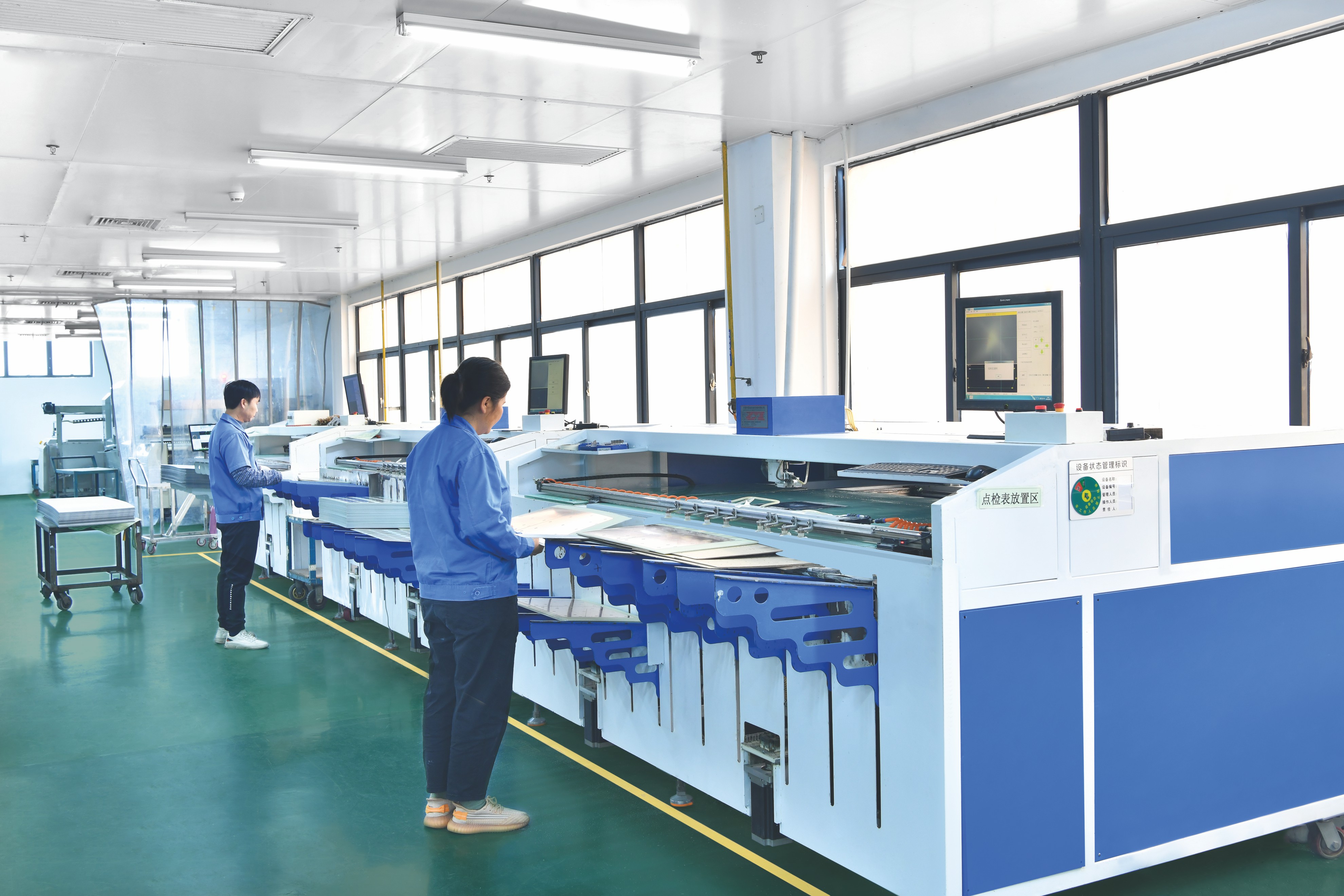
Process capability upstream determines how much of the acceptance burden falls on final inspection. Drilling and routing control at the WODE facility in Zhuhai.
The surface finish field is where specification discipline pays off. OSP (organic solderability preservative) is a thin organic layer applied over exposed copper to protect solderability. It does not add a metallic surface, so its condition depends on packaging, storage and handling. Purchasing terms for an OSP board should therefore carry storage conditions, shelf-life expectations, packaging requirements and an explicit statement of what incoming inspection will treat as a defect, such as oxidation, discoloration or contamination of the pads.
Panel dimensions are both a technical and a commercial field. A 243.00 mm × 243.00 mm panel determines SMT utilisation, stencil and fixture design, and the per-panel basis on which yield and price are calculated. If panel size is left as a reference value rather than a controlled dimension, a change of layout can shift the effective cost per board without any change in unit price.
Mapping Each Compliance Framework to an Acceptance Criterion
The four frameworks most often requested in a high voltage MCPCB quote answer four different questions. Treating them as one bundle is the most common source of misplaced confidence.
| Framework | What it evidences | Evidence to request | What it does not establish |
|---|---|---|---|
| IATF16949 | A quality management system built for the automotive supply chain: process discipline, traceability, corrective action. | Certificate with holder name, scope and validity, plus inspection specifications and control-plan style process documents. | It does not certify a specific board's dielectric strength or approve the part for a given application. |
| UL | Product and material safety recognition for a defined construction or material family. | Documentation showing the certificate holder and the construction covered, matched to the ordered board. | It does not replace thermal, insulation or endurance testing of the finished assembly. |
| RoHS | A statement on restricted hazardous substances in electrical and electronic equipment. | Declaration tied to the bill of materials for the ordered board, not to a generic product family. | It is a material statement, not a performance statement. |
| REACH | A statement on substances of very high concern present in supplied articles. | SVHC declaration with the date of issue and the material scope actually covered. | It does not address electrical performance, reliability or process capability. |
None of the four frameworks substitutes for another. A supplier operating under IATF16949 without product-level safety documentation is not automatically unsuitable for a lighting driver board, and a product carrying a safety mark is not thereby produced under an automotive quality system. The acceptance question is narrower: does the framework being cited cover the risk the buyer actually carries, for the exact construction ordered?
Two practical rules remove most of the confusion. First, read each certificate for scope, holder and validity rather than for its logo. Second, tie each substance declaration to the bill of materials for the ordered board, because both RoHS and REACH declarations describe materials rather than capability.
WODE's Qualification Position on High Voltage MCPCB

Qualification is also a documentation process. The administrative side of the acceptance record is where certificate scope and holder names are verified.
The facts that matter at the decision stage are coverage facts, not adjectives. The company's published position includes:
- Founded in 2003, with operations based in Zhuhai, China.
- A 150,000 m² facility, 500+ employees and annual output of 6,000,000 sqm.
- A 15-engineer R&D team and more than 40 patented technologies.
- ISO9001, ISO14001 and IATF16949 certification, with products stated to comply with UL, RoHS and REACH.
- An export ratio of approximately 50%, more than 1,000 customers in over 30 countries, and main markets including Brazil, Turkey, India, Vietnam and Russia.
Read as coverage rather than as credentials, those figures answer questions a purchase order will raise. A 150,000 m² facility with 6,000,000 sqm of annual output indicates capacity to support a multi-year programme rather than a single lot. A 15-engineer R&D team and more than 40 patented technologies indicate that specification changes — a thickness window, a panel layout, a finish substitution — can be handled in-house rather than through a trading intermediary. IATF16949 in particular indicates a quality management system built for automotive-type discipline, which is the relevant question when the board will sit inside a lighting or power assembly supplied into vehicle or industrial programmes.
The honest boundary is this: system certification and substance compliance are supplier-level and material-level statements. They do not replace board-level validation for a specific high voltage design. Buyers should still require application testing, insulation performance verification and first-article approval, and should keep those items in the acceptance annexe rather than assuming the certificate pack covers them.
Where Aluminium MCPCB Wins — and Where the Terms Must Say Otherwise
| Decision dimension | Single-sided aluminium MCPCB (1.6 mm, 1 oz Cu, OSP) | FR-4 rigid multilayer |
|---|---|---|
| Heat path | Metal base spreads heat across the board area; suited to LED and high-power loading. | Relies on copper area and thermal vias; dissipation is a design effort rather than a material property. |
| Routing complexity | Single-sided construction limits layer count and dense interconnect. | Supports dense multilayer routing and controlled impedance. |
| Surface finish behaviour | OSP protects solderability; condition depends on packaging, storage and handling. | Finish options are broader, with different cost and process trade-offs. |
| Panel economics | 243.00 mm × 243.00 mm panel sets utilisation and the per-panel yield basis. | Panelisation optimised around multilayer stack-ups and array count. |
| Typical fit | Lighting and display applications needing thin profiles or heat dissipation. | Logic-dense assemblies where routing, not heat, is the constraint. |
WODE's own comparison material is explicit about the boundary. Its product lines are described as most suitable for lighting and display scenarios requiring flexible interconnects, thin profiles or heat dissipation, while high-reliability military and medical uses require further qualification. Delivery and after-sales policies may vary with customer contracts and order scale, and should be confirmed contractually rather than assumed from a catalogue.
The same comparison material reports that multi-type orders placed with a single supplier cost 5–10% less than sourcing the same mix from several single-product suppliers, that key parameters are held to a ±10% tolerance, and that defect rates run about 30% below the industry average, with up to 20% better heat dissipation for LED and high-power applications. These are supplier-reported comparisons. They are useful as negotiation anchors and as hypotheses to test against a buyer's own incoming data, not as substitutes for it.
One further limit belongs in the terms rather than in the sales conversation. A single-sided aluminium construction is a thermal solution, not a routing solution. Designs that need dense multilayer routing, impedance control across many layers, or a metallic finish for repeated reflow and long storage should be evaluated against a different construction, rather than specified as an aluminium MCPCB and renegotiated at first article.
Why Acceptance Criteria Matter More as MCPCB Capacity Grows
The global MCPCB market was valued at USD 935.75 million in 2025 and is projected to reach USD 1,948.90 million by 2033, according to Future Market Report's 2026–2033 market study. China holds a 28.7% share of that market.
Growth of that order produces a predictable side effect: more suppliers, more quotations, and more certificate packs arriving in the same week. Certification alone therefore stops being a useful filter, because most credible suppliers can produce one. What separates suppliers at the decision stage is whether documentation can be mapped to a line item — whether the IATF16949 scope names processes used on the ordered board, whether the UL documentation covers the construction, whether RoHS and REACH declarations reference the actual materials, and whether the inspection specification states what will be measured and how.
What Changes Next in Compliance Documentation
Two shifts are visible in how buyers structure high voltage MCPCB terms. The first is the move from certificate collection to specification-level evidence: instead of a folder of PDFs, procurement teams ask for a document matrix in which each acceptance criterion names its evidence, its owner and its review date. The second is contractual: tolerances, inspection methods, storage conditions for OSP boards and change-notification obligations are moving out of email threads and into the purchase agreement, because those are the items that decide whether a delivery is accepted.
For suppliers, the practical consequence is that qualification work moves earlier. A factory that can answer thickness, finish, panel and substance questions with documents at quotation stage shortens the buyer's evaluation cycle and reduces first-article rejections. That is a quieter advantage than a new certificate, but it is the one that shows up in repeat orders.
FAQ
Which compliance documents should a buyer request before approving a high voltage MCPCB supplier?
Four groups are normally sufficient as a starting set. First, system certificates — ISO9001, ISO14001 and, where automotive-type discipline is relevant, IATF16949 — checked for holder name, scope and validity. Second, product safety documentation covering the construction being ordered. Third, substance declarations for RoHS and REACH tied to the bill of materials. Fourth, process evidence: inspection specifications, the quality manual, supplier management records and emergency delivery plans. WODE states that it holds ISO9001, ISO14001 and IATF16949 certification and that its products comply with UL, RoHS and REACH standards.
How should a 1.6 mm ±10% thickness tolerance be verified?
The tolerance defines an acceptance window of approximately 1.44 mm to 1.76 mm. Verification is a matter of agreement rather than of arithmetic: the purchase order should fix the measurement points, the instrument, the sampling rate and the record format before production begins. Because the overall thickness of a metal core board combines the aluminium base, the dielectric layer and the copper foil, the method should also state whether readings are taken over a conductor pattern or over bare laminate.
Does IATF16949 certification mean a board is approved for automotive use?
No. IATF16949 is a quality management system certification for the automotive supply chain; it evidences process discipline, traceability and corrective-action capability at the supplier level. Product approval is a separate step and typically involves drawing-level validation, application testing and part approval documentation required by the customer. Buyers should read the certificate for its scope and holder, and should not treat it as a substitute for validating the specific board construction.
What is the difference between MCPCB and MPCB?
MCPCB refers to a metal core printed circuit board, a board built on an aluminium or other metal base with a dielectric layer and a copper circuit layer. MPCB is commonly used in catalogue language for miniature and moulded case circuit breakers, a separate product category governed by standards such as IEC/EN 60898-1 for AC circuit breakers in household and similar installations and IEC/EN 60947-2 for circuit breakers up to 1,000 V AC or 1,500 V DC, as described in ABB technical documentation. The two are produced in different supply chains and cannot be specified interchangeably.
What limits should be accepted when comparing an aluminium MCPCB with FR-4?
Three limits are worth stating in the terms rather than discovering later. A single-sided aluminium construction constrains routing and layer count, so it suits lighting and heat-dissipation designs rather than logic-dense assemblies. OSP protects solderability but is sensitive to storage and handling, so packaging and shelf-life conditions belong in the agreement. And WODE's comparison material notes that high-reliability military and medical uses require further qualification, while delivery and after-sales terms may vary with contract and order scale.
Reference Material
A fuller description of WODE's board range, facility and process coverage is available in the company brochure, downloadable here: WODE product and capability brochure.
Compliance statements in this article reflect the supplier positions and publicly available standards documentation cited above. Buyers should verify certificate scope, validity and holder name against their own purchase requirements before approval.
¿Tiene preguntas o necesita más detalles?
Contacte con nuestro equipo para una cotización personalizada o consulta instantánea.
Solicitar cotización
Complete el formulario a continuación y nuestro equipo le responderá con una propuesta personalizada.
Chat directo de WhatsApp
¿Prefiere chatear en tiempo real? Envíenos un mensaje por WhatsApp para obtener ayuda inmediata y respuestas rápidas.
- Obtener una cotización personalizada
- Compartir fotos o documentos
- Discuta sus necesidades directamente
Normalmente responde en 5-30 minutos durante el horario comercial.