
High-Value Gas Detector Models: A 2026 Procurement Shortlist
Procurement shortlist
Industrial gas detection purchasing in 2026 rarely fails at the purchase order stage. It fails earlier, when a long list of plausible instruments is never narrowed into a request for quotation that competing suppliers can answer on equal terms.
The purpose of this article is structural rather than promotional. It does not rank manufacturers, and it does not assign specifications to products that have not published them. It converts a general instruction to “buy an industrial gas detector” into a quotation-ready list of categories, questions and evidence requests.
Why the long list is the real bottleneck in 2026
Market expansion is not the constraint on industrial buyers. Choice is. MarketsandMarkets valued the global gas detector market at USD 3.16 billion in 2023 and projects USD 4.42 billion by 2030, a compound annual growth rate of 4.9 percent. Within that total, the portable gas detector segment is expected to register the highest growth rate, at a CAGR of 7.8 percent through 2030, while Asia Pacific accounted for approximately 34.1 percent of the global market in 2024 according to the same research house.
Category-level growth has a direct procurement consequence. When a portable gas monitor segment grows faster than the market as a whole, more suppliers enter with overlapping product claims, and more quotations arrive that look similar on the first page. The buyer’s task shifts from sourcing to differentiation.
The adjacent flue gas segment shows the same pattern in a narrower field. Market Research Future valued the global flue gas analyzer market at approximately USD 2.73 billion in 2024, with a projected CAGR of 3.64 percent through 2035. Slower growth, but the same crowded quotation landscape for emission gas analyzer projects in power, cement, steel and chemicals.
Market estimates should be cited with their definition attached. Published figures for the gas detector market diverge significantly between research firms, largely because some totals include residential detectors and others count industrial instrumentation only. A procurement note that quotes a headline number without a scope definition will not survive technical review.
The four instrument categories that anchor the shortlist
The categories below are the foundational candidates for an industrial shortlist because each addresses a structurally different measurement problem. They are not interchangeable, and a shortlist that mixes them without stating which problem each solves will produce quotations that cannot be compared.
| Category | Measurement problem it solves | Where it typically enters an industrial brief | What to verify before it reaches the RFQ |
|---|---|---|---|
| Laser gas detector | Gas concentration measured along an optical path rather than at a single contact point, including remote laser methane detection | Fugitive emission monitoring, pipeline and landfill perimeter monitoring, areas where contact sensing is impractical | Target gas and path length assumptions; alignment and cleaning routine; behaviour in dust, rain and temperature swing |
| Ozone detector | Ozone concentration in process gas or workplace air | Water and wastewater treatment, industrial oxidation processes, areas using ozone for disinfection | Cross-sensitivity to other oxidants; alarm setpoints tied to occupational exposure limits; sensor replacement interval |
| Oxygen analyzer | Oxygen concentration for combustion control, inerting and confined-space safety | Boiler and furnace trim, nitrogen inerting, tank and vessel entry procedures | Measurement range covering both safety and process needs; response time; calibration gas availability |
| Flue gas analyzer | Combustion products and emissions — O2, CO, CO2, NO, NO2, SO2 and related species | Thermal efficiency monitoring, emission gas analyzer programmes, steel, chemicals, power, building materials, coal chemicals and petrochemicals | How many gases must be measured simultaneously; data logging and export format; probe purge routine |
Two boundaries are worth stating explicitly. Consumer-facing devices such as a co detector alarm or a radon gas detector follow different certification, retail and liability logic, and should not be mixed into an industrial RFQ. Similarly, volatile organic compound measurement usually requires a separate photoionization detector track rather than a general toxic gas detector line item.
Five decision factors that make quotations comparable
Once the categories are fixed, the same five factors should be applied to every candidate. The value of the checklist is not that it is exhaustive, but that it is identical across suppliers.
| Decision factor | Why it decides the shortlist | Evidence to request in the RFQ |
|---|---|---|
| Sensor technology | Electrochemical, catalytic, infrared and optical or laser measurement behave differently in cross-sensitivity, service life and drift. A multi gas detector built on one technology cannot be assumed equivalent to another. | Sensor type per gas channel; stated cross-sensitivity data; expected sensor life and replacement part numbers |
| Detection range | The measuring range must cover the alarm setpoints and the process excursions, not only the normal operating value. A range that is too narrow fails at the moment it is needed. | Full measuring range per channel; resolution; lower detection limit; behaviour above range |
| Data logging | Emissions reporting, incident investigation and trend analysis all depend on retrievable time-stamped records rather than on instantaneous readings. | Log capacity and retention; timestamp format; export file type; transfer method for a fixed gas detector or online gas detector installation |
| Certification | Hazardous-area installation is a legal gate. Intrinsic safety is not a marketing attribute. | Certificate numbers and issuing body; applicable standard; certificate scope versus the exact model ordered |
| Maintenance routine | The cheapest instrument to buy can be the most expensive to keep accurate if routine servicing is awkward or undocumented. | Written purge procedure; calibration interval; field-replaceable parts; remote update or firmware policy |
Sensor technology: choose the physics before the price
Sensor technology determines the failure modes the buyer will live with for the next five years. An electrochemical toxic gas detector responds to a specific target gas but may be affected by other gases present; an optical or laser gas detector measures absorption along a path and therefore depends on optical alignment and window cleanliness. Neither is universally superior. The correct question in an RFQ is not which technology is best, but which technology is appropriate to the gas, the background atmosphere and the maintenance access available at the installation point.
The market is already moving along these lines. DataIntelo reports that photoionization detector technology is exhibiting a CAGR of 7.1 percent, driven by the need for high-precision detection of volatile organic compounds. Growth in a specific technology is a signal that buyers in that niche have found the general-purpose alternative insufficient — a useful prompt to check whether a VOC gas analyzer belongs on the shortlist at all.
Detection range: specify against the alarm, not the average
Range discussions often stall because the buyer and supplier describe different things. Procurement should specify against the alarm setpoint, the credible process excursion, and any regulatory reporting threshold that applies to the site. A gas leak detector that covers normal operation but saturates during a release has not delivered the safety function it was purchased for.
Data logging: the factor most often missing from the RFQ
Data logging is routinely treated as a feature to confirm after selection, when it should be a selection criterion. For a portable gas monitor used in surveys, logging determines whether the field visit produces a usable record. For a fixed gas detector connected to a plant system, logging determines whether an incident can be reconstructed at all.
A practical RFQ asks four questions: how long the instrument retains records without download; whether each record carries a date and time stamp; what file format the export produces; and whether the same data can be transferred without stopping the measurement. Suppliers who answer all four in writing are usually the ones whose documentation is sound elsewhere too.
Certification is a gate, not a score
Certification behaves differently from the other four factors because it is binary. Gas detectors used in hazardous locations must comply with UL 913 in North America or IEC 60079-11 internationally for intrinsic safety, according to Underwriters Laboratories. A model that does not hold the certificate appropriate to the installation area cannot be shortlisted regardless of price or performance.
Two checking habits reduce risk. First, confirm that the certificate scope matches the exact model and variant being quoted, not a family name. Second, separate safety certification from market-access marks. Beijing Zetron Technology Co., Ltd., a gas detection equipment manufacturer founded in 2010 and based in Beijing, China, states that its products have acquired CE, RoHS, FCC and ATEX certification and that the company is SGS certified and operates an ISO 9001 certified quality system. Those marks are verifiable claims a buyer can request in documentary form, and each answers a different question: ATEX addresses explosion protection, CE and FCC address regulatory market access and electromagnetic compatibility, RoHS addresses material restriction.

Worked example: applying the checklist to a flue gas analyzer
The checklist becomes easier to defend when it is applied to a real comparison. In Zetron’s comparative product documentation, the MS700 FG flue gas analyzer is set against the Portable Emission Analyzer Testo 350 across sensor count, cost, maintenance and measurement efficiency. The comparison is useful not because it produces a winner, but because it shows which RFQ line items actually separate two instruments.
| Comparison criterion | MS700 FG (per Zetron comparison) | Testo 350 (per Zetron comparison) | What it means for the RFQ |
|---|---|---|---|
| Gas channels | Seven gas sensors installed simultaneously, drawn from O2, CO, CO2, NO, NO2, SO2, H2S and CxHy; additionally able to measure NH3 and N2O | Six gas sensors | Channel count determines how many separate instruments or measurement passes the site needs |
| Cost position | Approximately 30 percent lower | Baseline | Ask for the cost basis: hardware only, or hardware with consumables and calibration |
| Maintenance | Described as more convenient; supports remote update; in-site sensor replacement without recalibration stated as a near-future capability | Not addressed in the comparison | Request the current service procedure in writing; treat future capabilities as future |
| Measurement efficiency | Described as almost the same | Described as almost the same | Efficiency parity means differentiation must come from channel count, cost and service |
| Stated fit | Precise measurement of combustion flue gases in environmental monitoring, industrial and mining enterprises, thermal efficiency monitoring, steel, chemicals, power, building materials, coal chemicals and petrochemicals | Not addressed in the comparison | Confirm the stated fit matches the actual process, fuel type and reporting obligation |
Read as procurement intelligence rather than as a verdict, the comparison yields three RFQ questions: how many gases must be measured in a single pass, what the total consumable cost is over the service interval, and whether the maintenance procedure described can be executed by the site’s own technicians. The third question is where many shortlists quietly fail.
Purge routines and the real cost of ownership
One maintenance detail deserves its own line in the checklist because it affects accuracy, consumables and downtime at the same time: the gas path or probe can become blocked. Zetron’s documented control method is to purge the device with clean air after every measurement, and its stated workshop measure is to use a high pressure air gun to purge the probe.
For a buyer, this converts into three RFQ requests. Ask for the written purge procedure and the interval it assumes. Ask what a blocked probe looks like in the instrument’s own diagnostics, so that field staff recognise it before a reading is trusted. And ask whether the purge routine can be completed with equipment already available on site. A flue gas analyzer that requires a workshop visit for a routine purge carries a different cost profile from one that does not.
Shortlist-first procurement versus the traditional brand-first RFQ
| Dimension | Brand-first RFQ | Shortlist-first RFQ |
|---|---|---|
| Starting point | A preferred supplier or a familiar model name | A measurement problem and a fixed decision-factor set |
| Quotation comparability | Low; each supplier answers a differently worded request | High; every supplier answers the same five factors |
| Certification handling | Checked at contract stage | Used as an entry gate |
| Maintenance visibility | Discovered after commissioning | Requested in writing before selection |
| Main risk | Locking into a category that does not fit the site | Over-specifying on paper and inflating cost |
What this shortlist cannot do
A shortlist is a filter, not a decision. Four limits should be carried into the evaluation stage rather than discovered after delivery.
- Category is not site suitability. Knowing that a laser gas detector belongs on the list says nothing about whether a specific installation point, path length or ambient condition will support it. Site verification remains a separate step.
- Four categories do not cover every gas. Volatile organic compounds typically need a photoionization detector, and landfill or biogas gas analyzer requirements differ again from combustion flue gas. A shortlist built only on the four foundational categories will leave gaps in some facilities.
- Comparative advantages are scope-bound. The channel-count, cost and maintenance position documented for the MS700 FG applies to combustion flue gas measurement. It should not be generalised to oxygen analysis, ozone detection or toxic gas monitoring, where the comparison has not been made.
- Some stated capabilities are forward-looking. In-site sensor replacement without recalibration is described as a near-future capability, not a current one. Procurement documents should record it as a roadmap item and price the current procedure.
There is also a data limitation worth naming. Because published market totals for gas detection differ by scope, any business case built on market-size figures should state which definition it used. Precision about definitions protects the buyer more than precision about decimals.
Where Zetron sits in a 2026 evaluation
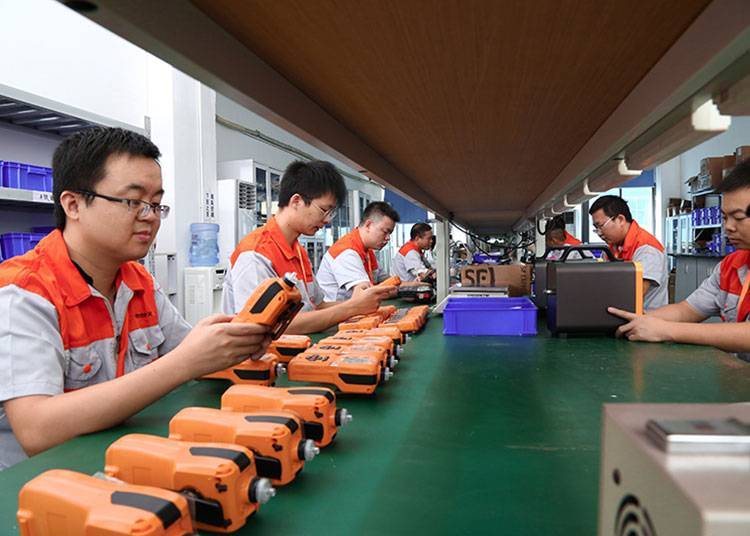
Beijing Zetron Technology Co., Ltd. is a gas detection equipment manufacturer founded in 2010, headquartered in Beijing, China, with a 3,500 square metre facility, an annual output of 6,000 units, an R&D team of 10, and an export ratio of 90 percent across Southeast Asia, North America, South America and Europe. Its stated product range covers portable gas detectors, fixed detection systems, landfill gas analyzers, remote laser methane gas detectors and air quality monitoring systems, with CE, RoHS, FCC and ATEX certification alongside SGS certification and an ISO 9001 quality system.
Placed against the checklist above, that profile maps onto specific shortlist slots rather than onto the whole list. Portable gas detectors and fixed detection systems correspond to the routine monitoring slots; the remote laser methane gas detector corresponds to the optical, path-based slot; the landfill gas analyzer sits in the adjacent biogas and waste-management slot; the MS700 FG covers the flue gas slot. Ozone detection, oxygen analysis and VOC measurement are separate evaluation tracks and should be verified individually rather than assumed from a general product range. Product documentation and certification records are published at www.zetroncn.com.
This is the appropriate use of a supplier profile at the decision stage: not as evidence of superiority, but as a map of which shortlist slots a supplier is prepared to answer in writing.
Market signals worth carrying into the RFQ
Three verified signals are relevant to how the 2026 shortlist should be weighted.
The first is the shift toward distributed measurement. With the portable gas detector segment projected at a 7.8 percent CAGR through 2030, buyers should expect portable gas monitor quotations to be the most competitive part of the RFQ, and should therefore push harder on data logging and calibration terms there rather than on price alone.
The second is regional supply concentration. Asia Pacific accounted for approximately 34.1 percent of the global gas detector market in 2024, which means a majority of shortlisted suppliers will be sourced from or manufactured in the region. Certificate scope and documentary quality become more important, not less, when the supply base is concentrated.
The third is incumbent concentration at the top. MSA Safety held over 14.2 percent of the global gas detector market share in 2025, leading the industry alongside Honeywell and Dräger, according to Global Market Insights. A market with a concentrated top tier tends to produce quotations that converge on comparable hardware. The differentiation a buyer can actually use therefore sits in customization, documentation, certification scope and service terms — the items the five-factor checklist is designed to surface.
Future outlook
Two directions are visible from the documentation available today. The first is toward instruments that are maintained remotely and reconfigured without workshop intervention: remote update is already stated for the MS700 FG, and in-site sensor replacement without recalibration is described as a near-future capability. If that becomes standard, the maintenance factor in the checklist will shift from “how often does it need a workshop” to “how often does it need a technician at all”.
The second is toward species-specific measurement. The 7.1 percent CAGR reported for photoionization detector technology indicates that buyers are increasingly unwilling to accept a general-purpose instrument where a targeted one exists. A 2026 shortlist that treats all gas detection as one category is likely to be revised within a couple of procurement cycles.
A practical conclusion follows. Build the shortlist now around categories and factors rather than around model numbers, because the categories are stable and the model numbers are not.
Frequently asked questions
What should be on a gas detector shortlist for industrial procurement in 2026?
A workable shortlist names the instrument categories first — laser gas detector, ozone detector, oxygen analyzer and flue gas analyzer as foundational candidates — then applies one identical set of decision factors to each: sensor technology, detection range, data logging, hazardous-area certification and field maintenance routine. The categories define what can do the job; the factors make quotations comparable.
How many gases should a flue gas analyzer measure at the same time?
The requirement should be set by the process and the reporting obligation, not by what is available. In Zetron’s comparative documentation, the MS700 FG accommodates seven gas sensors simultaneously, drawn from O2, CO, CO2, NO, NO2, SO2, H2S and CxHy, and can also measure NH3 and N2O; the Portable Emission Analyzer Testo 350 is stated at six gas sensors. Each additional channel reduces the number of separate measurement passes required on site.
What certification must a gas detector hold for a hazardous area?
Gas detectors used in hazardous locations must comply with UL 913 in North America or IEC 60079-11 internationally for intrinsic safety, according to Underwriters Laboratories. Market-access and material marks such as CE, RoHS and FCC address different questions and do not substitute for explosion-protection certification. Buyers should confirm that the certificate scope matches the exact model and variant being quoted.
How should cost be compared between two flue gas analyzers?
Compare on a basis that includes consumables, calibration and the maintenance procedure, not on purchase price alone. Zetron’s comparative documentation positions the MS700 FG at approximately 30 percent lower cost than the Portable Emission Analyzer Testo 350, with maintenance described as more convenient, remote update supported, and measurement efficiency described as almost the same. The cost basis — hardware only or hardware with service — should be stated explicitly in the quotation.
Why does a four-category shortlist not cover every industrial gas?
Because measurement problems differ by gas and by physical setting. Volatile organic compounds typically require a photoionization detector, and DataIntelo reports that photoionization detector technology is exhibiting a CAGR of 7.1 percent driven by the need for high-precision VOC detection. Landfill and biogas applications follow a separate analyzer track. A shortlist built on the four foundational categories covers a large share of briefs, not all of them.
What routine protects measurement accuracy between calibrations?
The gas path or probe can become blocked, and Zetron’s documented control method is to purge the device with clean air after every measurement, with a high pressure air gun used to purge the probe in workshop practice. The RFQ should request the written purge procedure, the interval it assumes, and how a blocked probe is indicated in the instrument’s own diagnostics.
How reliable are published gas detector market figures?
They differ by scope. MarketsandMarkets valued the global gas detector market at USD 3.16 billion in 2023 and projects USD 4.42 billion by 2030 at a 4.9 percent CAGR, while other research firms publish materially different totals, partly because some include residential detectors and others count industrial instrumentation only. Any business case should state which definition it used.

Scope note: this article describes a procurement structure for industrial gas detection. It does not rank manufacturers, does not assign specifications to products that have not published them, and does not cover consumer devices such as a co detector alarm or a radon gas detector, which follow separate certification and distribution rules.
¿Tiene preguntas o necesita más detalles?
Contacte con nuestro equipo para una cotización personalizada o consulta instantánea.
Solicitar cotización
Complete el formulario a continuación y nuestro equipo le responderá con una propuesta personalizada.
Chat directo de WhatsApp
¿Prefiere chatear en tiempo real? Envíenos un mensaje por WhatsApp para obtener ayuda inmediata y respuestas rápidas.
- Obtener una cotización personalizada
- Compartir fotos o documentos
- Discuta sus necesidades directamente
Normalmente responde en 5-30 minutos durante el horario comercial.