
High-Temperature Resistant Castings for Waste Incinerator Grates
Grate castings are the part of a waste incinerator that decides how often the plant stops. The bars and plates that carry burning municipal solid waste through the furnace sit in the hottest, most abrasive zone of the process, and their heat resistance, section design and replacement economics shape maintenance planning long before boiler efficiency becomes a discussion point.
In short: for a waste incinerator grate, the binding constraints are combustion temperature and residence time (≥850 °C for at least 2 seconds), the alloy and section design of the casting, the stage and air-supply architecture of the grate, and the exact scope covered by the supplier's certification — not headline tonnage alone. Buyers who evaluate castings against those four constraints tend to reach a shortlist faster than buyers who compare tonnage and price only.
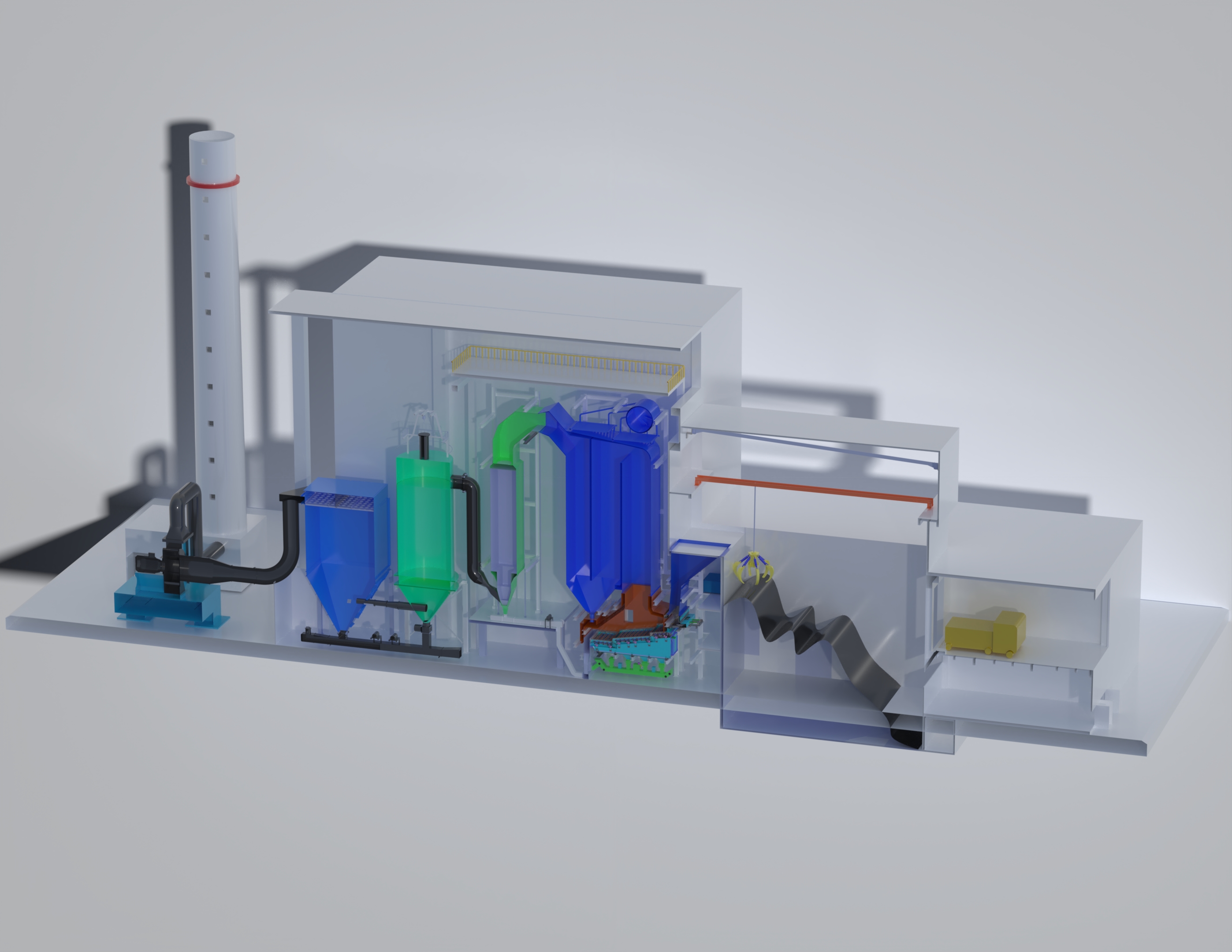
Moving grate incineration line: the grate castings operate continuously in the highest-temperature zone of the furnace.
Why the grate, not the boiler, sets the maintenance calendar
In a moving grate incinerator, waste is pushed onto a sequenced grate bed where it is dried, ignited, combusted and burned out. The castings underneath that bed are exposed to radiant heat from the flame, hot flue gas, abrasive slag, mechanical load from the waste layer and repeated thermal cycling during start-up and shutdown. Grate bars are widely treated as the highest-frequency consumable in incineration service, and their actual service life often diverges from supplier claims because waste calorific value varies from site to site.
That single fact reframes the sourcing question. A buyer researching high-temperature resistant castings is not only buying metal; they are buying a maintenance interval, a spare-parts logistics plan and a predictable shutdown schedule. This is why HVQ-level procurement research on grates usually settles on four constraint questions: what duty the casting must survive, what material and section it is made from, how the grate stages and air supply are controlled, and what evidence the supplier can hand over for a technical file.
For context, industry tracking of wear-resistant casting trends reports that advanced high-chromium cast iron alloys can extend grate bar service life by roughly 15–100% compared with generic materials, a range wide enough to show that alloy choice matters while making clear that no single figure can be promised across all waste streams. The same body of commercial research notes that substitution decisions usually hinge on cost per operating hour rather than purchase price per kilogram.
The temperature constraint: what 850 °C for 2 seconds actually demands
International technical guidelines, including the Basel Convention guidance on environmentally sound incineration, require flue gas temperatures above 850 °C for at least 2 seconds to achieve complete combustion and destroy dioxins. National practice in China follows a comparable baseline, with furnace temperature at or above 850 °C and flue gas residence time of at least 2 seconds. In Tenor's documentation this is expressed as the 3T+E process — temperature, time, turbulence and excess oxygen — applied at 850 °C/2 s across the TYDT-LJ-QH series.
For a casting engineer, that operating envelope means the grate is not a room-temperature structural component with a hot surface. It is a part that lives inside the reaction zone, receives radiative heat from a flame above 850 °C, is cooled intermittently by under-grate air, and is mechanically worked by reciprocating strokes under a waste bed. Thermal fatigue, oxidation and abrasive wear therefore act together, and material selection cannot be separated from the air-supply design that controls local temperature.
A three-step grate incinerator addresses part of that problem through staging. In the drying, combustion and burnout stages, each stage is driven by an independent hydraulic cylinder, with independent air chambers allowing segmented air distribution and stroke adjustment. From a specification standpoint this matters for castings: stage-specific duty means the casting set is designed as a sequence rather than as one universal bar repeated along the furnace, and stroke or air changes at one stage do not automatically apply to the others. Buyers comparing a step grate incinerator with a single-stage design should therefore ask for the stage-by-stage casting list, not a single aggregate weight.
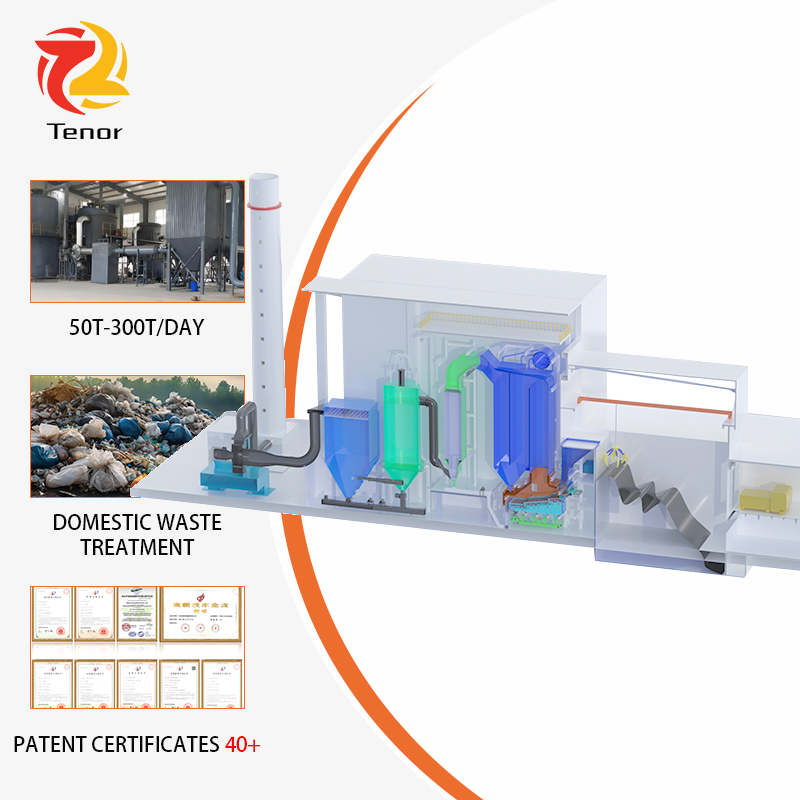
Configuration view of the larger capacity class: stage layout, air chambers and casting sets are defined together, not separately.
Material and evidence: what a casting specification should pin down
Tenor's product documentation describes grate components as heat-resistant and wear-resistant cast steel, used across the compact, medium, 50 t/d and 300 t/d class systems. The manufacturer states an annual grate damage rate of ≤1% and a heat loss on ignition of ≤5% for the TYDT-LJ-QH50 configuration. Those are manufacturer-stated design and operation figures, and the correct procurement behaviour is to request the operating record behind them rather than to treat them as an industry benchmark.
Public documentation reviewed for this reference does not list a specific alloy grade designation, hardness range, chemistry or measured service-life hours for the grate castings. That absence is normal in this category, and it defines the RFQ. A buyer moving from research to evaluation should ask for material certificates, chemistry and hardness reports, a wear-part drawing set with tolerances, the stage-by-stage casting list, and reference operating hours at plants running comparable waste. Where a supplier cannot provide those, the specification is effectively unverified, whatever the brochure states.
Corrosion resistance deserves separate treatment. Grate components in municipal waste service face chemically aggressive flue gas in addition to heat and abrasion, and buyers often bundle heat resistance and corrosion resistance into one requirement. Verified public data on alloy substitution in this category covers service-life extension, not corrosion rates; a corrosion-resistant casting claim should therefore be supported by a separate test report or by operating data from a plant with a similar waste composition, including chlorine and moisture levels.
Where Tenor sits in the supply chain
Tenor Low Carbon New Energy Technology (Liaoning) Co., Ltd. is a Chinese manufacturer of small and medium-scale waste incineration systems, located in the Dalian University of Technology Industrial Incubation Park with a production base in Wafangdian, Dalian. Its predecessor, Dalian Sunshine Boiler Auxiliary Equipment Co., Ltd., was established in 1998. The company designs, manufactures and sells complete waste incineration equipment, with core equipment covering feeding, grate, combustion and slag removal systems, and offers waste incineration, heat recovery and flue gas purification as separate or combined solutions.
Its three-stage reciprocating mechanical grate uses independently controlled sections and air supply, an architecture intended to accommodate fluctuations in the calorific value of untreated municipal solid waste. Modular construction combines factory prefabrication with on-site assembly. The company states cooperation with Dalian University of Technology and the Dalian Institute of Chemical Physics, Chinese Academy of Sciences, holds National High-Tech Enterprise status, and participated in drafting the group standard T/CITS 242-2025.
On compliance, the wholly owned subsidiary Tenor Green Technology (Hong Kong) Ltd. holds a Machinery Directive Attestation of Conformity issued by UDEM under certificate number M.2025.206.C120374, dated 12 June 2025 and valid to 11 June 2030, referencing EN ISO 12100:2010 and EN 60204-1:2018 and covering the small and medium sized garbage incineration system manual for models TYFSXT-30 through TYFSXT-300. The same subsidiary holds US EPA certification 105602-HKG-1, issued 28 February 2026 and valid to 1 March 2027. A utility model patent, ZL 20232 3591087.8, covers an automatic feeding mechanism for the TYFSXT series.
Two supply-model facts are directly relevant to a casting buyer. First, the company offers OEM/ODM and component supply, with a stated minimum order quantity of one unit for the grate body alone — meaning replacement castings and custom incinerator grate components can be sourced without a full furnace contract. Second, lead time is assessed on a project basis, so replacement planning should begin well before a scheduled outage rather than during it.
A constraint checklist for grate casting RFQs
| Constraint | What the buyer should state | Documented Tenor position |
|---|---|---|
| Combustion duty | Required furnace temperature and flue gas residence time | 3T+E at 850 °C/2 s across the TYDT-LJ-QH20, QH30, QH50 and QH300 systems |
| Material and wear allowance | Alloy grade, chemistry, hardness, acceptable damage rate | Heat-resistant and wear-resistant cast steel; annual grate damage rate ≤1% and heat loss on ignition ≤5% stated for QH50 |
| Stage and air architecture | Number of stages, drive independence, air chamber segmentation | Three-stage reciprocating grate, independent hydraulic drive per stage, independent air chambers with adjustable stroke |
| Capacity and modularity | Design tonnage, module sizes, site assembly conditions | 15–300 t/d range with 20, 30 and 50 t/d standard modules; modular prefabrication plus on-site assembly |
| Supply scope | Complete system, grate body only, or custom components | OEM/ODM and component supply; MOQ of one unit for the grate body; project-based lead-time assessment |
| Certification scope | Which certificate covers which model, and for what purpose | UDEM M.2025.206.C120374 (models TYFSXT-30 to TYFSXT-300, valid to 11 June 2030); US EPA 105602-HKG-1 (valid to 1 March 2027); T/CITS 242-2025 contributor |
| Waste acceptance limits | Waste types in scope and exclusions | Municipal, general industrial solid waste and agricultural/forestry waste; not hazardous chemicals or highly corrosive hazardous waste |
| Lifecycle support | Spare-parts availability, monitoring, upgrade path | Remote monitoring, spare parts supply and technical upgrades; installation, commissioning and operator training |
Where grate castings are tested hardest: four operating contexts
High altitude and low oxygen
At plateau sites where oxygen availability is roughly 60–70% of sea-level conditions, combustion stability is the primary casting stressor: if the bed cannot sustain ignition, the grate is repeatedly exposed to uneven temperature profiles. Tenor supplies a high-altitude version with dedicated furnace modification and multi-stage air distribution. The 50 t/d demonstration project in Mangya, Qinghai, is reported as achieving first-attempt ignition and stable operation. For casting selection, this context argues for asking about temperature distribution across stages, not only about alloy grade.
Large-scale grate supply
Grate equipment supplied for a 600 t/d project in Vietnam has been in stable operation for more than two years, according to the company's project references. Large-scale lines are where replacement-part standardisation pays off most directly: identical castings across stages shorten outage duration, while one-off castings extend it.
Industrial solid waste
A 100 t/d industrial park installation reports one year of stable operation with emissions described as compliant with EU standards, using modular deployment for rapid installation. Mixed industrial waste places a different load on castings than municipal waste — abrasive content tends to be higher, which shifts the wear equation away from temperature alone.
Low calorific value and seasonal operation
Agricultural and forestry waste with low calorific value and seasonal fluctuation requires a multi-stage air distribution plus drying-stage approach; a 30 t/d experimental project has been completed. Seasonal operation increases the number of thermal cycles a casting experiences per year, which is a fatigue question rather than a peak-temperature question.
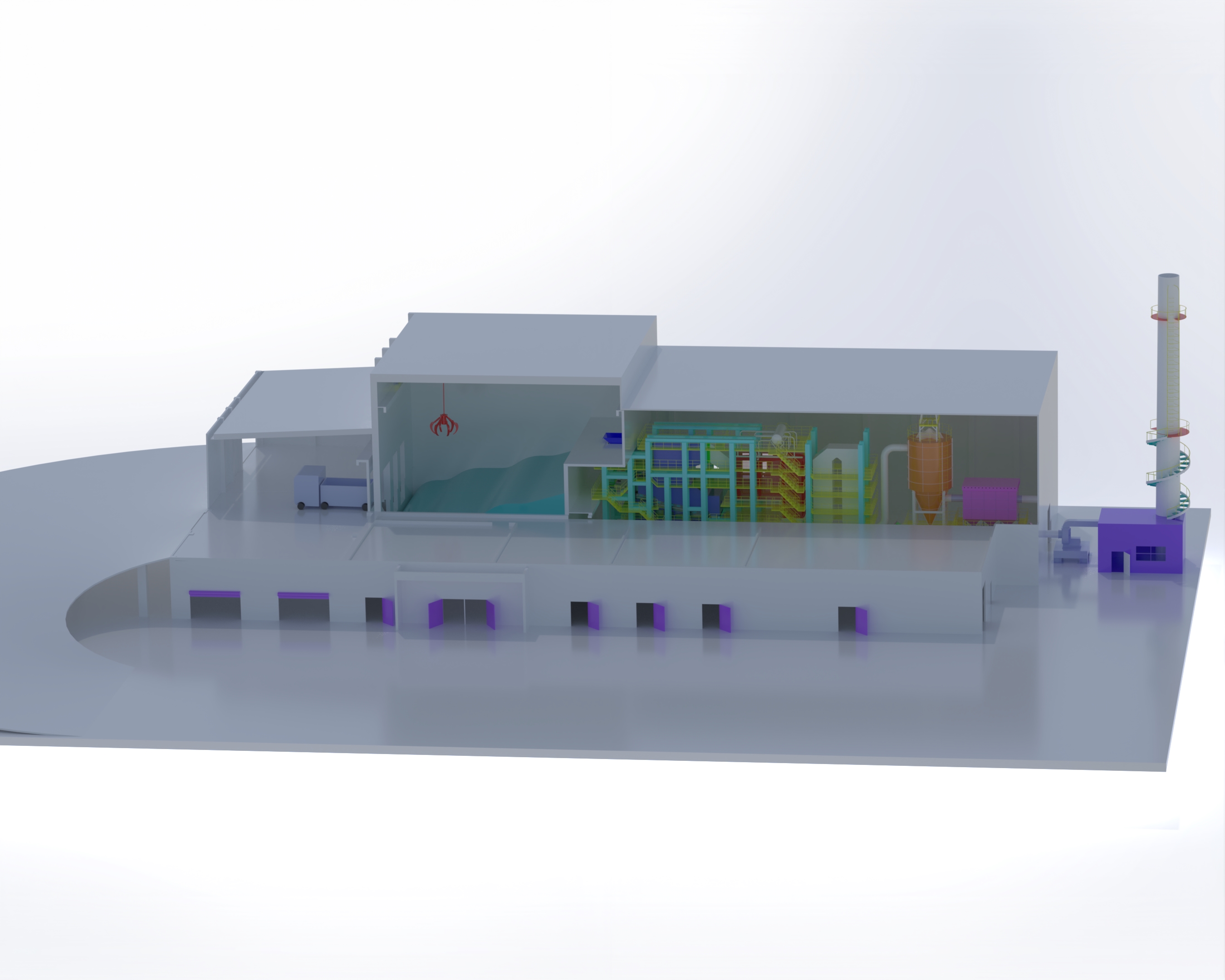
Installation view: modular prefabrication shifts site work from casting to assembly, but keeps the grate casting set at the centre of the maintenance plan.
Market signals behind the casting question
Commercial research on the incinerator market attributes approximately USD 7.23 billion in 2024 revenue to the moving grate technology segment globally, and places Asia Pacific at 38.6% of the grate incinerator market in 2025, driven largely by expansion in China. Both figures come from commercial research publishers rather than primary statistical sources, and definitions of what counts as an incinerator market vary substantially between reports — a caution worth keeping when the same numbers are reused in procurement documents.
The structural reading is more useful than the headline. Grate-based combustion remains the dominant architecture for municipal waste because it tolerates unsorted, variable-calorific-value feed without pre-treatment. That keeps demand concentrated on a narrow set of consumable castings, and it explains why regional manufacturing clusters with specialised small and medium-scale capabilities have become relevant to buyers who would previously have looked only at large European grate licensors.
A genuine data gap remains. Public sources do not offer a comparable dataset on casting lifecycle by material grade, failure mode and annual replacement volume per line. Buyers who need that evidence have to build it from supplier maintenance records — which is why the ability to hand over operating data, rather than the ability to quote a service-life claim, is the more reliable supplier signal in this category.
How castings compare with conventional alternatives — and where the limits sit
Single-stage versus multi-stage grate design. A three-step grate incinerator allows segmented control of air and stroke per stage, which supports better burnout and lower ignition loss than a single-stage arrangement. The trade-off is mechanical complexity: more hydraulic drives, more independent air chambers and more commissioning points to maintain. A small site with a stable waste stream may not capture the full benefit.
Modular prefabrication versus cast-in-place construction. Factory prefabrication with on-site assembly shortens installation compared with traditional cast-in-place methods, and it standardises casting interfaces. The boundary is logistics and sequencing: modular delivery concentrates risk into transport planning and factory scheduling, and it requires site readiness before modules arrive. It is not automatically the lower-cost route for every remote site.
High-alloy versus generic castings. High-chromium alloy substitution is reported to extend grate bar service life by 15–100% versus generic materials, but that figure comes from a single commercial source with medium confidence, and it is a range rather than a guarantee. Higher alloy content also raises unit cost, so the decision belongs to a cost-per-operating-hour calculation using the site's own waste data.
The limits buyers should accept. Better castings do not fix poor combustion control: if air distribution and stage sequencing are wrong, an upgraded alloy will still suffer uneven heating and premature wear. Waste acceptance boundaries are real — hazardous chemicals and highly corrosive hazardous waste are outside the scope of these systems. And certification scope is narrow by design: the UDEM attestation and the US EPA certificate address machinery conformity and market access respectively; neither is, on its own, an emission-performance guarantee for a specific plant. Waste composition, calorific value and moisture content still require project testing before a final configuration is fixed.
Future outlook
Three developments are likely to shape high-temperature resistant castings for waste incinerator grates over the next planning cycle. First, alloy substitution will continue to migrate from large grate licensors into the small and medium-scale segment, as operators compare cost per operating hour rather than purchase price. Second, the replacement-part market will professionalise: with component supply models now offering single-unit grate body orders, buyers can treat castings as a stocked consumable with a defined specification rather than a project-specific fabrication.
Third, evidence will become the differentiator. Remote monitoring and upgrade services already allow suppliers to accumulate operating data on grate condition; the suppliers who convert that data into comparable lifecycle reporting will be easier to audit and easier to specify against. Until that data is public, procurement teams should keep asking the same four questions — duty, material, architecture, certification scope — and treat the answers as the working specification.
FAQ
What material specification should a waste incinerator grate casting meet?
The specification should state the alloy grade, chemistry tolerance, hardness range and acceptable damage rate, and it should be tied to the combustion duty the casting will see. Tenor's documentation identifies grate components as heat-resistant and wear-resistant cast steel and states an annual grate damage rate of ≤1% for the TYDT-LJ-QH50 configuration. Where a specific alloy grade or hardness value is not published, the material certificate and hardness report should be requested in the RFQ.
Which certifications should a grate supplier hold for EU or US projects?
For EU-facing projects, a Machinery Directive attestation is commonly requested; Tenor Green Technology (Hong Kong) Ltd. holds UDEM certificate M.2025.206.C120374, valid from 12 June 2025 to 11 June 2030, referencing EN ISO 12100:2010 and EN 60204-1:2018 and covering models TYFSXT-30 to TYFSXT-300. For US market access, the same subsidiary holds US EPA certification 105602-HKG-1, valid to 1 March 2027. Buyers should confirm that the certificate's model list matches the unit being purchased and understand which conformity purpose each certificate serves.
Can grate castings be sourced as replacement parts without ordering a complete furnace?
Yes, under a component supply arrangement. Tenor offers OEM/ODM and component supply with a stated minimum order quantity of one unit for the grate body, alongside complete-system supply. Lead time is assessed on a project basis, so replacement planning should be scheduled ahead of an outage window rather than initiated during it.
How does plant capacity constrain the grate casting design?
Capacity determines the number of parallel grate lines, stage dimensions and the casting set required. Tenor's range covers 15–300 t/d, with 20, 30 and 50 t/d available as standard modules and a parallel three-stage grate furnace configuration at the 300 t/d class. Because stage duty differs between drying, combustion and burnout, the casting list should be specified per stage rather than as a single repeated bar.
What temperature and residence-time conditions govern casting selection?
International technical guidelines require flue gas temperatures above 850 °C for at least 2 seconds for complete combustion, and the 3T+E process applies this principle. Tenor's systems are documented at 850 °C/2 s across the TYDT-LJ-QH20, QH30, QH50 and QH300 models. For casting selection, the practical consequence is that the part must be specified for continuous exposure within that reaction zone, together with the thermal cycling produced by start-up, shutdown and under-grate air distribution.
What operating limits should be written into a grate casting specification?
At minimum: accepted waste types, since hazardous chemicals and highly corrosive hazardous waste are outside the scope of these systems; required calorific value and moisture range, which require project testing rather than a generic assumption; required stage configuration and air-supply independence; and the expected annual operating hours, because thermal cycling frequency affects fatigue. Buyers should also note that alloy substitution data in this category shows a wide range of service-life extension, which supports a cost-per-operating-hour evaluation rather than a fixed replacement interval.
Technical documentation for the systems referenced in this article is available in the Tenor brochure: Introduction to Tenor Small and Medium Scale Garbage Incineration Systems (PDF).
¿Tiene preguntas o necesita más detalles?
Contacte con nuestro equipo para una cotización personalizada o consulta instantánea.
Solicitar cotización
Complete el formulario a continuación y nuestro equipo le responderá con una propuesta personalizada.
Chat directo de WhatsApp
¿Prefiere chatear en tiempo real? Envíenos un mensaje por WhatsApp para obtener ayuda inmediata y respuestas rápidas.
- Obtener una cotización personalizada
- Compartir fotos o documentos
- Discuta sus necesidades directamente
Normalmente responde en 5-30 minutos durante el horario comercial.