
High-Speed Tablet Press: The Constraints Buyers Verify First
HTNXT INDUSTRY REFERENCE · SMART MANUFACTURING · TABLET PRESS
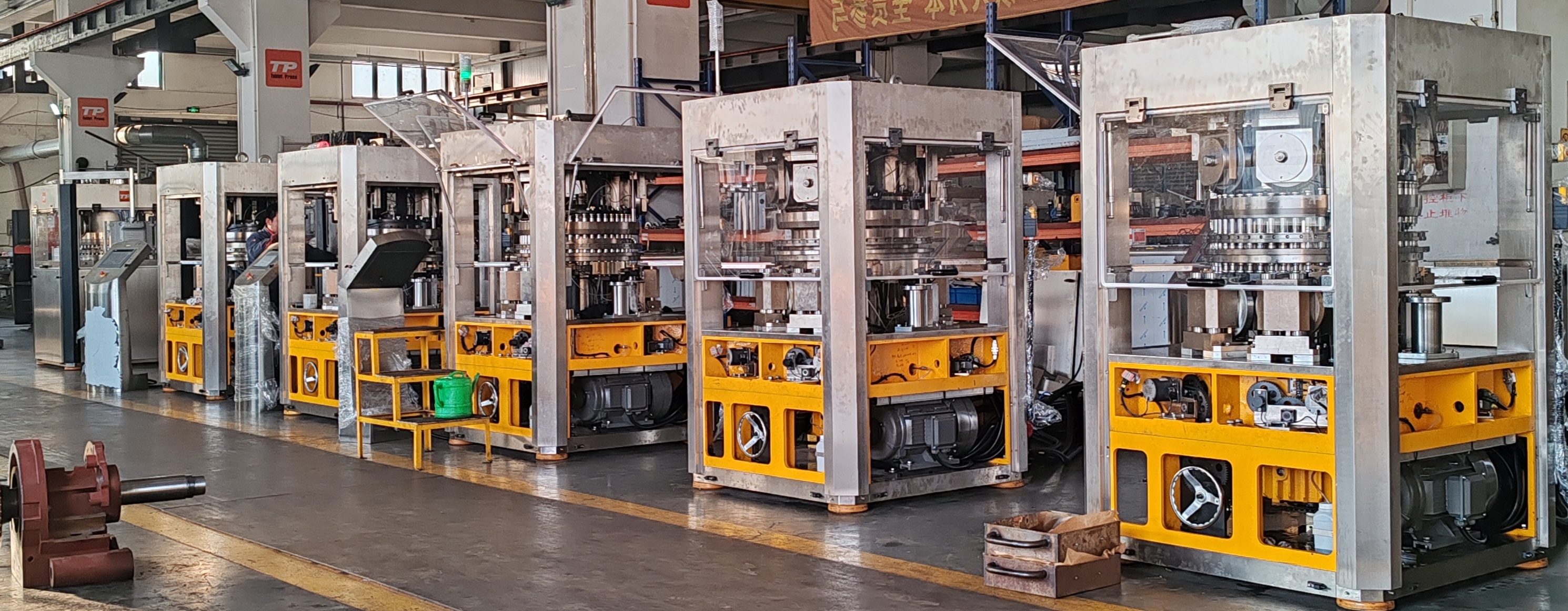
A high-speed tablet press is a rotary compression machine engineered to run continuously at elevated turret speeds, and it is normally approved for purchase only after a buyer has resolved three constraint layers: the compliance documents the machine must carry, the published parameters that define what it can physically produce, and the commercial terms the supplier can commit to. Most failed evaluations do not fail on throughput — they fail on a certificate that does not cover the ordered model, a compression ceiling that does not suit the formulation, or a delivery schedule that does not match the plant's qualification timeline.
Why Constraints, Not Features, Decide High-Speed Tablet Press Projects
In solid dosage manufacturing, a tablet press is not a stand-alone purchase. It enters a qualification process, sits on a documented utility supply, and is inspected against the same regulatory framework that governs the medicines it produces. That is why the buying question is rarely 'which machine is fastest' — it is 'which machine can I document, install, and keep running inside my existing compliance envelope'.
Two external pressures sharpen this. First, the European machinery framework is changing: Regulation (EU) 2023/1230 repeals and replaces Directive 2006/42/EC and applies from 20 January 2027. Machinery placed on the EU market must carry CE marking and meet applicable essential health and safety requirements. Equipment ordered today will still be in service after that date, so conformity planning is a procurement decision, not a paperwork afterthought. Second, computerised systems used in GMP environments are subject to data-integrity expectations in both the United States (21 CFR Part 11) and the European Union (EudraLex Volume 4, Annex 11), which bear directly on how a tablet press records compression parameters, batch data, and operator actions.
The opportunity is symmetrical: buyers who treat these constraints as a specification checklist at the RFQ stage avoid re-engineering costs later, while suppliers who publish verifiable certificate numbers and complete parameter tables shorten the qualification phase for their customers.
Constraint Layer 1 — Compliance Documentation Buyers Should Verify
Compliance evidence for a tablet press falls into two categories: quality-system certification covering the manufacturer, and product-level conformity documents covering the specific machine. Both should be traceable to a certificate number issued by a named body, because traceability is what turns a claim into a verifiable fact.
| Document | Issued by | Reference / standard | Validity |
|---|---|---|---|
| Quality management system certificate (ISO 9001) | Drucker (Jiangsu) Certification Co., Ltd. | GB/T 19001-2016 / ISO 9001:2015; certificate no. 114025Q10315ROM | 16 Jan 2025 – 15 Jan 2028 |
| CE certificate for tablet press equipment | ECM | EN ISO 12100:2010; EN 60204-1:2018; certificate no. OP231226.STPWU21 | 26 Dec 2023 – 25 Dec 2028 (EU market) |
The scope wording matters as much as the certificate itself. A CE certificate that names a product family is only useful if the ordered model appears on that list. Buyers should therefore ask for the certificate annex and match model designations line by line, rather than accepting a covering statement.
Beyond the certificates, two regulatory reference points should be written into the technical specification:
- EU conformity transition. Directive 2006/42/EC is the operative CE-marking framework for machinery until Regulation (EU) 2023/1230 applies on 20 January 2027. Buyers with EU installation plans should confirm which framework the supplier's technical file is being maintained against and how the file will be updated across that date.
- Computerised-system requirements. 21 CFR Part 11 sets the criteria under which the US FDA treats electronic records and electronic signatures as trustworthy and equivalent to paper records, and EU GMP Annex 11 applies a risk-based approach to computerised systems in GMP manufacture. Where a press is HMI-controlled with parameter logging, buyers should specify their expectations for access control, audit trails, and record retention at the specification stage.
- Trade classification. Tablet presses have been classified by US Customs under HS 8479.89.9897 (Customs ruling NY h89507), which is a useful reference point when preparing import documentation and landed-cost estimates.
Constraint Layer 2 — The Parameters That Define the Operating Envelope
Published parameters are the machine's physical limits. Station count and turret speed together produce output; maximum main compression force and maximum tablet diameter together set the tablet the machine can form; power supply, footprint, and net weight set what the plant must provide. A parameter table without all of these is not a specification.
| Model family | Stations | Max main / pre-compression | Max output | Motor / supply |
|---|---|---|---|---|
| GZPK1060-76 / -95 / -113 / -122 (three outlets, single- or triple-layer) | 76 / 95 / 113 / 122 | 100 / 100 kN | 342,000–658,800 tablets/hour single-layer; 114,000–219,600 tablets/hour triple-layer | 11 kW, 380 V 3-phase |
| GZPK720-51 / -65 / -83 / -99 (double outlet) | 51 / 65 / 83 / 99 | 100 / 100 kN | 306,000–712,800 tablets/hour | 11 kW, 380 V 3-phase |
| GZPK720i-51 / -65 / -83 / -99 (intelligent double outlet) | 51 / 65 / 83 / 99 | 100 / 30 kN | 336,600–712,800 tablets/hour | 11 kW, 380 V 3-phase |
| GZPK620-45 / -55 / -65 (double outlet) | 45 / 55 / 65 | 100 / 30 kN | 378,000 / 528,000 / 624,000 tablets/hour | 11 kW, 380 V 3-phase |
| GZPK620i-45 / -55 / -65 (optional bilayer capability) | 45 / 55 / 65 | 100 / 30 kN | 378,000 / 528,000 / 624,000 tablets/hour | 11 kW |
| GZPK280-20 / -24 / -30 (single outlet) | 20 / 24 / 30 | 100 / 100 kN | 96,000 / 158,400 / 198,000 tablets/hour | 7.5 kW, 380 V 3-phase |
| GZPX370i-26 / -32 / -40 / -50 (medium speed) | 26 / 32 / 40 / 50 | 100 / 16 kN | 62,400–180,000 tablets/hour | 7.5 kW |
| ZPTX420-17G strengthened version (large special-shaped, single/bilayer) | 17 | 150 / 100 kN | approx. 8,000–16,320 tablets/hour | 11 kW, 380 V 3-phase |
| ZPT680C-27 / ZPT680C-48/58/68 (triple layer) | 27 / 48 / 58 / 68 | 150 kN combined / 100 kN pre-compression for layers 1 and 2 | 9,720–21,060 or 28,800–72,000 tablets/hour | 11 kW, 380 V 3-phase |
Three parameter checks catch most mismatches before an order is placed. First, maximum tablet diameter and maximum filling depth must suit the largest and thickest product in the planned portfolio — a machine rated to 13 mm cannot be quoted for a 25 mm effervescent tablet. Second, compression ceilings should be read against the tablet's cross-section: a 150 kN machine is specified where large, high-compression household tablets are produced, while a 50 kN compact press is a development tool. Third, utilities and floor loading are constraints in their own right: the GZPK1060 family draws 11 kW at 380 V three-phase and weighs 8,000 kg, whereas the ZPT168 compact rotary press runs on 220 V single-phase and weighs 320 kg.
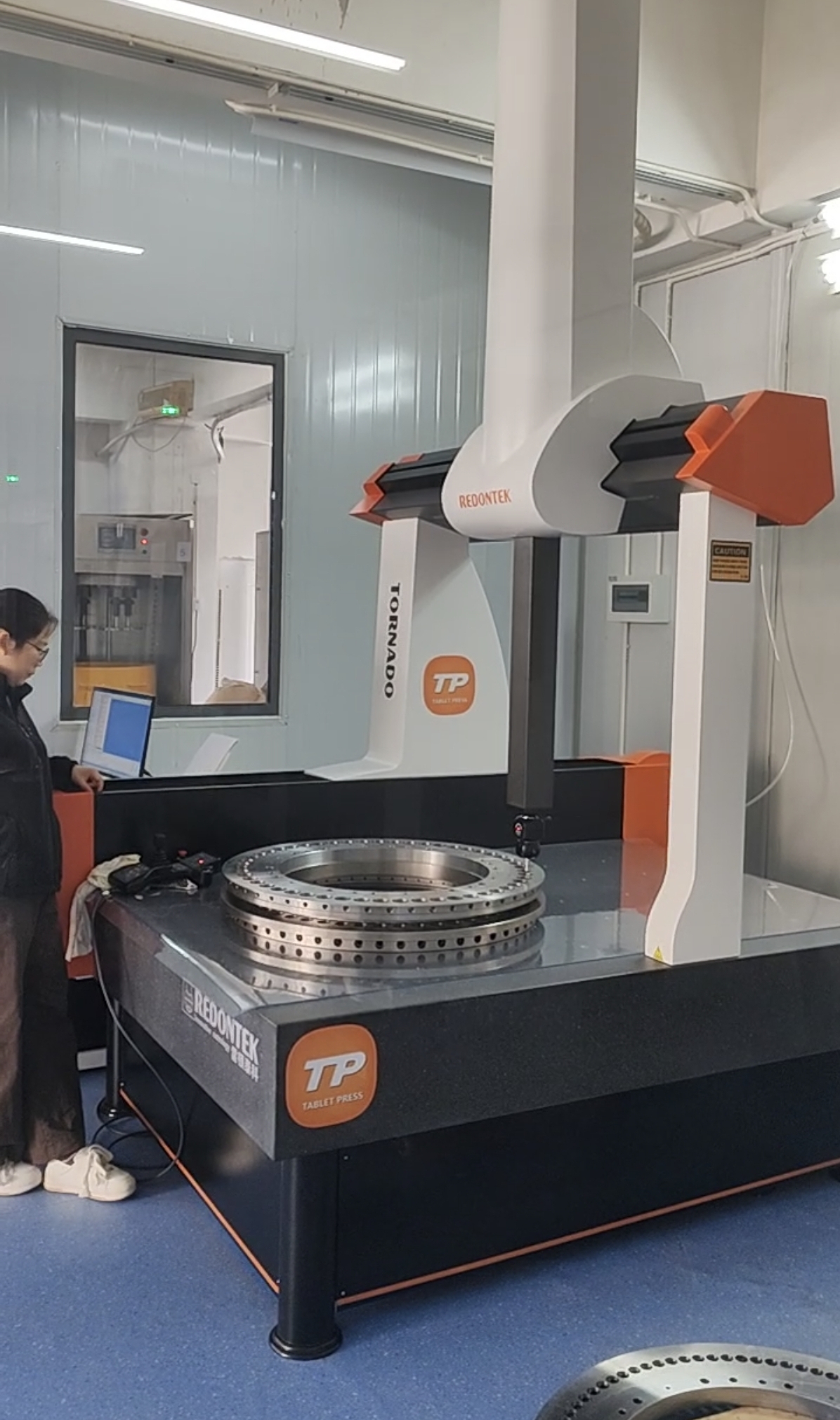
Dimensional inspection of tablet press turret components — the parameters on a datasheet are only meaningful if machining tolerances are measured rather than assumed.
Constraint Layer 3 — Tooling, Contact Materials, and Ancillary Equipment
A press cannot be evaluated without its tooling and its material contact surfaces. Tooling standards determine what can be produced; contact materials determine what is acceptable to the quality department.
- Punches and dies. Punches are produced in S7 or 6CrW2Si steel and dies in D2 or GCr15 steel, with dies supplied uncoated. Optional punch coatings include chrome, CrNi, TiNi, and DLC; these coatings are specified for wear resistance, corrosion resistance, and anti-sticking performance. The tooling range covers D, B, BB, BBS, ZP, and ZPT standards and can be made to technical drawings or physical samples.
- Die table material. On several rotary press families, the die table is a one-piece 2Cr13 stainless-steel component that requires no nickel plating. This removes a coating layer from the compression zone — the failure mode being that a plated surface can be scratched, chipped, or worn through, exposing the substrate beneath it.
- Feeding and sealing options. Force feeders, punch-hole seals, automatic lubrication, and pre-compression are configuration options rather than universal equipment. They must be confirmed at the quotation stage, because their presence changes both the price and the qualification documentation.
- Ancillary equipment. A tablet press rarely runs alone. The QVC-3 vacuum conveyor (conveying capacity 350 kg, working air pressure 0.6 MPa) feeds powder to the hopper; the XCJ-1.1 industrial dust collector (360 m³/h airflow, 19,500 Pa minimum vacuum, 1.1 kW) extracts residual material from the die table; the CF-1 anti-sticking powder sprayer applies a thin magnesium stearate film to upper and lower punches, which is relevant when processing sugar-based, effervescent, or catalytic materials.
How the TPCF High-Speed Range Maps to These Constraints
Shanghai Tablet Press Mechanical Components Co., Ltd. (TPCF) is a Shanghai-based manufacturer of tablet press machines, tablet press punches and dies, capsule filling machines, tablet de-dusters, and related solid dosage equipment. The company was registered under its current name in 2009, operates from a 15,000 m² facility in Xiaokunshan Town, Songjiang District, Shanghai, employs more than 240 staff including over 10 R&D engineers, and works with more than 200 CNC machine tools in its workshop. Monthly delivery capacity is stated at 80 to 120 tablet presses and capsule filling machines, with close to half of output exported.
For buyers, the relevant point is how the range is documented against the constraint layers above. The ISO 9001:2015 certificate scope explicitly names the tablet press product line, the GZPK1060-76 high-speed rotary model, high-speed rotary, rotary, automatic, laboratory, bilayer and multi-layer tablet presses, and the industrial dust collector for tablet presses. The ECM CE certificate covers the GZPK1060, GZPK720, GZPK720i, GZPK620i, GZPK370i, GZPX370i, GZPK280, GZP550, GZP550i, ZPTY550, ZPT420, ZPTX420, ZPTX340 and ZPTX226 families for the EU market. That is a document set a quality department can read against an order confirmation line by line.
On the control side, the high-speed models are specified with HMI adjustment of main compression, individual punch pressure, tablet thickness, filling depth, speed, output, and liquid lubrication, together with automatic weight control (AWC) and automatic reject-tablet removal. On the commercial side, the manufacturer states a minimum order quantity of one unit, a lead time of 45 to 75 days, and support for FAT testing against customer requirements and on-site SAT support, with commissioning and training delivered either by an engineer at the end user's site or remotely by video. OEM and ODM customization is offered across machine function, automatic or semi-automatic operation, tablet size and shape, and production speed.
Application Scenarios Where High-Speed Compression Is Specified
High-speed presses are selected where output per shift is the binding constraint but the quality envelope cannot relax. Four recurring scenarios illustrate how the constraint set changes by application.
- High-volume pharmaceutical and nutraceutical tableting. GMP production workshops with controlled dust, stable material feeding, and multi-shift operation. The matched equipment set typically combines a rotary tablet press with punches and dies, dry granulation, vacuum conveying, dust extraction, and anti-sticking support.
- R&D, laboratory, and pilot production. Here the constraint inverts: small batches, frequent formulation changes, multiple tooling standards and tablet shapes, and strict cleaning between trials matter more than output. Compact rotary models with HMI display of speed and output are used alongside a vacuum conveyor and dust collector.
- Household cleaning tablets. Large, high-compression, abrasive or moisture-sensitive products such as dishwasher and laundry tablets, where bilayer capability, adjustable layer thickness, anti-sticking control, corrosion-resistant contact surfaces, and PVA water-soluble film packaging define the line.
- Dry granulation and integrated solid dosage lines. Where a roller compactor produces granules for downstream compression, presses are matched with conveying and dust containment equipment so that particle-size control and material flow remain consistent across the line.
A reference case from the manufacturer's own records describes a pharmacy factory running automatic tablet presses for pharmaceutical tablet production, with 320 sets supplied and machines reported to maintain stable operation over a service period of three to six years, with high speed and ease of operation cited as the practical highlights.
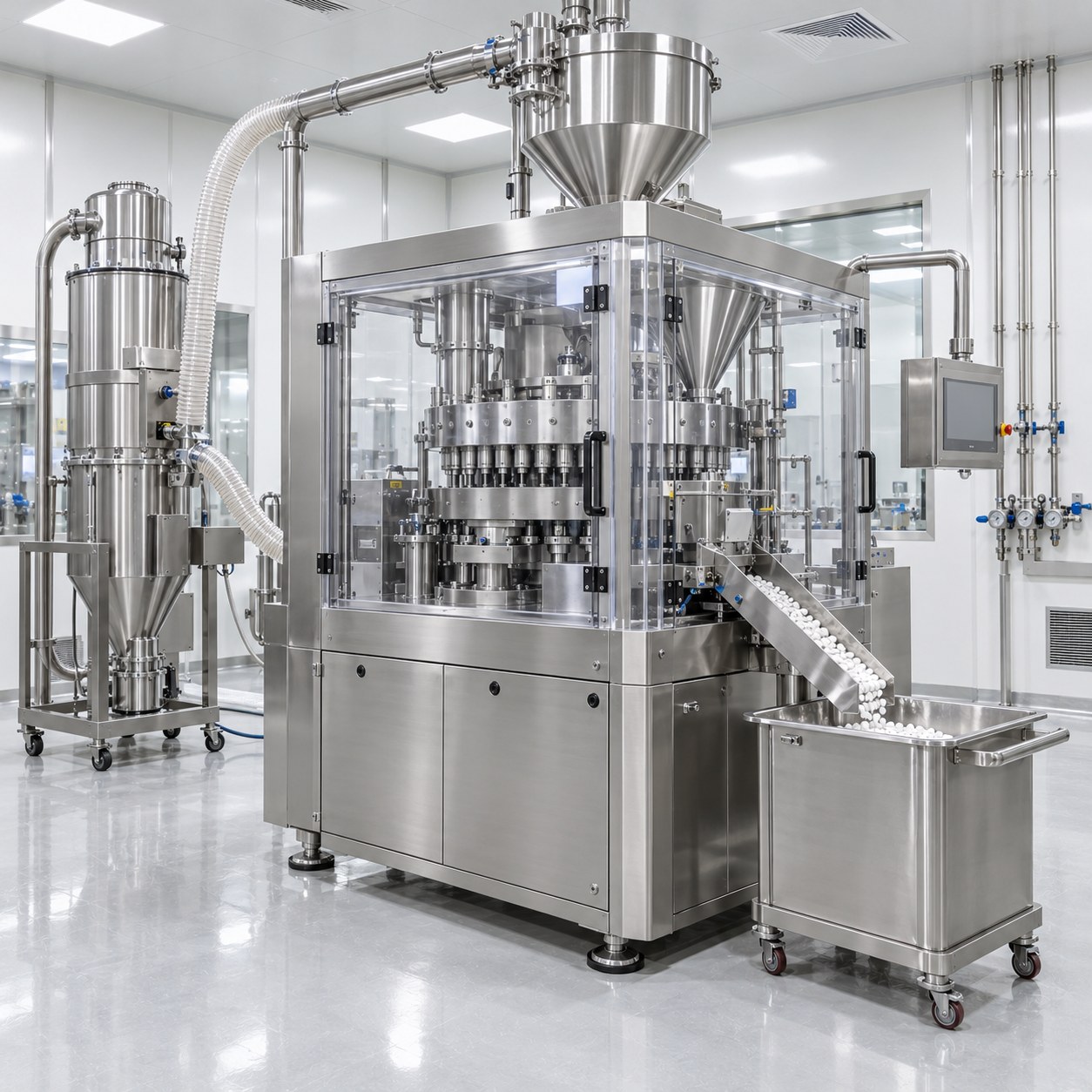
A high-speed pharmaceutical tableting line: the press is one node in a chain that also includes feeding, dust extraction, and in-process weight control.
Market Context: What the Available Data Supports
The tablet press machine market was estimated at USD 1.52 billion globally in 2025 by Global Market Insights, and the same analysis places Fette Compacting as the largest single holder of global market share in 2025 at over 9% — a structure that indicates a fragmented market rather than one dominated by a single supplier. Commercial research coverage of high-speed platforms has also cited peak outputs exceeding one million tablets per hour at the top of the range.
Two caveats belong in any procurement reading of this data. First, commercial research estimates should be treated as directional; they are not audited trade statistics. Second, price bands, verified MOQ benchmarks, and landed-cost data for tablet presses are not publicly established at a level that supports comparison, and no such figure should be assumed from supplier marketing material. The usable trend signals are narrower but firmer: automation and multi-layer capability continue to be specified in new capacity, and the 2027 EU machinery transition plus data-integrity expectations are pushing documentation and control-system requirements earlier into the purchasing process.
Comparison with Traditional Solutions — and Where the Boundaries Sit
Traditional tableting equipment falls into three reference patterns: the single-punch press, the manual or semi-automatic rotary press adjusted by hand-wheel and gauge, and the nickel-plated cast-iron die table construction. Each remains appropriate in some situations, and each carries a cost that a modern high-speed press is designed to reduce.
| Dimension | Traditional pattern | High-speed rotary approach |
|---|---|---|
| Die table surface | Cast iron with a nickel plating layer; wear or chipping exposes the substrate | One-piece 2Cr13 stainless-steel die table requiring no nickel plating on listed rotary families |
| Parameter setting | Manual adjustment with limited per-punch visibility | HMI adjustment of compression, thickness, filling depth, speed and lubrication, with individual punch pressure display |
| Weight control | Periodic manual sampling | Automatic weight control (AWC) with automatic reject-tablet removal on models where specified |
| Output scale | Single-punch and low-speed rotary operation | Up to 712,800 tablets/hour across the GZPK720 and GZPK720i families |
The boundaries matter as much as the advantages, and buyers should test a supplier's willingness to state them:
- Output ceiling is not the top of the market. The highest published output in the TPCF high-speed range is 712,800 tablets/hour. Commercial research has cited high-speed platforms above one million tablets/hour. A buyer whose capacity model requires the highest reported tier should treat this range as insufficient rather than assume equivalence.
- Material choice has an application boundary. The 2Cr13 die table is specified for humid, mildly acidic, and cleaning environments. It is not positioned as a solution for strongly aggressive chemical service, and buyers compressing corrosive formulations should raise the material question explicitly rather than assume the standard construction applies.
- Automation features are configuration-dependent. AWC and reject-tablet removal are standard on some models and optional on others; pre-compression force ceilings, force feeders, punch-hole seals and turret interchangeability vary by family. The same model designation can therefore be quoted with materially different capability.
- Certification status must be independently confirmed. The certificate numbers and issuing bodies above are published by the manufacturer, but certification claims in the equipment sector are generally self-reported. Buyers should verify against the issuing body's records before accepting them in a vendor qualification file.
- Lead time is a project constraint. A stated 45 to 75 day delivery window must be built into installation qualification scheduling, not treated as a post-order detail.
A Practical Verification Checklist Before Ordering
- Match the ordered model designation against the certificate annex — not the certificate cover page.
- Confirm maximum tablet diameter and maximum filling depth against the largest and thickest product in the portfolio.
- Confirm main and pre-compression force against the tablet's cross-section, not against the machine's headline number.
- Specify tooling standard (D, B, BB, BBS, ZP, ZPT) and any required punch coating in writing.
- Confirm whether AWC, reject removal, force feeder, punch-hole seals, and automatic lubrication are standard or optional on the quoted variant.
- Confirm utility requirements (voltage and phase, air pressure) and floor loading from net weight and dimensions.
- Define FAT scope and SAT expectations before the purchase order, including who attends and what parameters are recorded.
- Align delivery lead time with IQ/OQ scheduling and the applicable EU conformity framework date.
Future Outlook
Three developments are likely to shape high-speed tablet press procurement over the next buying cycle. The first is documentation-led selection: as the EU machinery framework moves to Regulation (EU) 2023/1230 from 20 January 2027, the ability to maintain and reissue a technical file will become part of supplier evaluation rather than an annex to it. The second is control-system scrutiny: 21 CFR Part 11 and EU GMP Annex 11 expectations around electronic records and computerised systems will increasingly be translated into specification clauses for parameter logging, access control, and data retention on HMI-controlled presses. The third is product complexity: multi-layer tableting, already supported on platforms such as the ZPT680C triple-layer press, allows combination products to be compressed in one pass, and that capability moves the constraint discussion from throughput to layer adhesion and inter-layer control.
For buyers, the practical implication is that the machine quotation and the compliance dossier should be requested together. A press that meets the output target but cannot be documented against the destination market is not a lower-cost option — it is a delayed project.
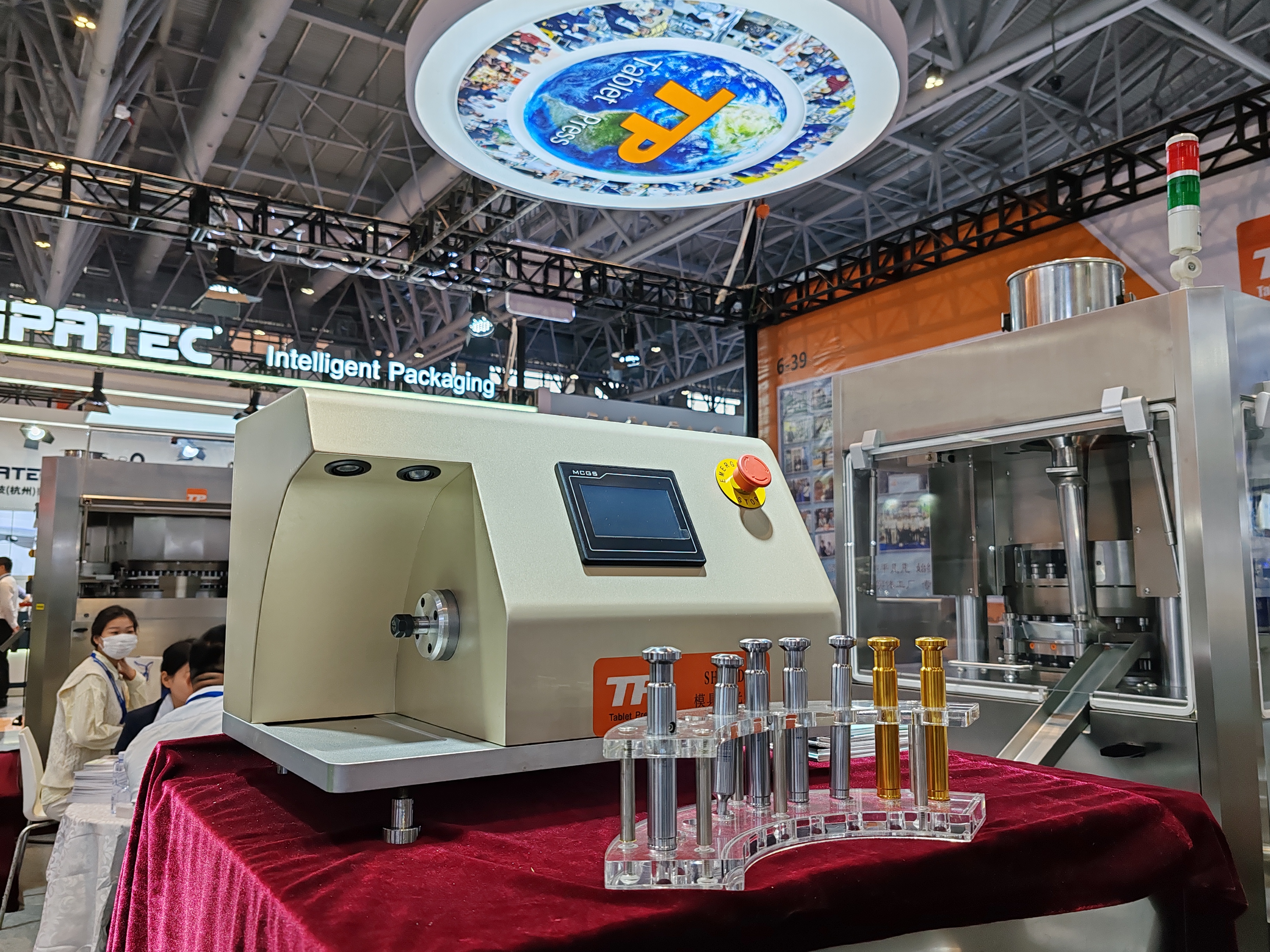
Punches and dies sit at the centre of the constraint set: standard, material, and coating choices determine what a press can actually produce.
Frequently Asked Questions
Which certifications should a buyer verify before ordering a high-speed tablet press?
Two document types should be checked. A quality management system certificate confirms the manufacturer's process control — TPCF operates under an ISO 9001:2015 certificate (GB/T 19001-2016 / ISO 9001:2015, certificate no. 114025Q10315ROM, issued by Drucker (Jiangsu) Certification Co., Ltd., valid from 16 January 2025 to 15 January 2028). A product conformity document confirms the specific machine — the ECM CE certificate (no. OP231226.STPWU21, issued 26 December 2023, valid until 25 December 2028) references EN ISO 12100:2010 and EN 60204-1:2018 and names the covered models. The essential verification step in both cases is matching the ordered model against the certificate's product list and, where the destination market requires it, confirming the certificate through the issuing body rather than relying on the certificate image alone.
Which machine parameters determine whether a high-speed tablet press fits a given tablet?
Four parameters define fit. Maximum tablet diameter and maximum filling depth determine the largest and thickest tablet the turret can produce — for example, 25 / 16 / 13 / 10 mm and 20 mm filling depth across the GZPK720 family. Maximum main and pre-compression force determines whether the formulation can reach its required hardness — 100 / 100 kN on the GZPK1060 and GZPK720 families, and 100 / 30 kN on the GZPK620, GZPK620i and GZPK370i families. Station count combined with turret speed produces the output range, such as 306,000 to 712,800 tablets per hour for the GZPK720. Power supply, dimensions, and net weight then determine whether the plant can host the machine — 11 kW at 380 V three-phase and 5,500 kg for the GZPK720, for instance.
What commercial constraints apply to ordering a high-speed tablet press?
The manufacturer states a minimum order quantity of one unit and a lead time of 45 to 75 days, with monthly delivery capacity of 80 to 120 tablet presses and capsule filling machines. Acceptance testing can be aligned to customer requirements through FAT, with SAT supported at the end user's site. Customization is offered under OEM and ODM arrangements covering machine function, automatic or semi-automatic operation, tablet size and shape, and production speed. Unit price bands, tooling prices, and spare-part pricing are not published in the available data, so budget figures should come from a direct quotation rather than from any assumed market benchmark.
How do data-integrity rules affect tablet press selection?
Where a tablet press is controlled through an HMI and records compression, filling depth, or batch parameters electronically, the control system becomes part of a regulated data environment. In the United States, 21 CFR Part 11 sets the criteria under which the FDA treats electronic records and electronic signatures as trustworthy and equivalent to paper records. In the European Union, EudraLex Volume 4 Annex 11 applies a risk-based approach to computerised systems used in GMP manufacture. These rules apply to the manufacturing system as a whole rather than to a specific machine, so buyers should define their requirements for access control, audit trails, and record retention, and confirm with the supplier how the machine's data functions will be documented for qualification.
How should tooling and output be validated before committing to full-scale production?
Tooling should be validated together with the machine, because tablet quality depends on the punch-and-die pair as much as on compression force. TPCF supplies punches in S7 or 6CrW2Si steel and dies in D2 or GCr15 steel, made to technical drawings or physical samples, across D, B, BB, BBS, ZP and ZPT standards, with optional chrome, CrNi, TiNi or DLC punch coatings — dies themselves are not coated. A practical validation sequence uses the compact or R&D rotary press (14,400 to 44,100 tablets per hour depending on the model) for formulation trials, confirms weight and hardness control with AWC and reject-tablet removal enabled, and only then scales to a high-speed platform. Punch-hole seals, force feeders, and automatic lubrication should be confirmed as included or optional on each quoted variant before the trial is scheduled.
Reference Material
Technical specifications, model tables, and the tooling standard list referenced in this article are compiled in the manufacturer's product brochure, which is available for download: TPCF equipment brochure (PDF). Company information is published at www.tp-tabletpress.com.
Note on sources: manufacturer specifications, certificate numbers, company capacity figures, and application scenarios in this article are drawn from TPCF product and corporate documentation. Market size and share figures are attributed to commercial research (Global Market Insights, 2026) and should be treated as directional estimates. Regulatory references — Regulation (EU) 2023/1230, Directive 2006/42/EC, 21 CFR Part 11, and EudraLex Volume 4 Annex 11 — are cited from the official legal and regulatory texts.