
High-Speed Flexible Straw Forming Line: A Selection Framework
Plant managers replacing manual or semi-automatic straw capacity rarely lack quotations. What they lack is a comparison structure that survives the second meeting. A quotation built around machine price invites a price-versus-price decision; a quotation built around rated output, retired machines, labour hours, scrap rate and service scope invites an engineering decision — and the two approaches frequently point to different suppliers.
The market context explains why the structured approach matters more now than it did a decade ago. The global straw machine market was estimated at USD 962.55 million in 2024 and is projected to reach USD 1,793.41 million by 2035, a CAGR of 5.82%, according to Market Research Future. A second estimate places the 2024 market at USD 1.2 billion (Reports and Data); the gap reflects report scope rather than contradiction, since some studies cover machinery only while others include upstream materials. Trade data indicates China accounts for more than 66% of the global export value of flexible straw bending machinery — which means most buyers are selecting from the same broad supplier base and need differentiation that price comparison alone cannot produce.
This article sets out a five-gate selection method for high-speed flexible straw forming lines, then applies it to documented deployment facts from Zhongshan Dongtie Machinery Co., Ltd., which operates under the brand DONGTIE MECHANICAL EQUIPMENT. That company is a Chinese straw machinery manufacturer based in Xiaolan Town, Zhongshan City, producing flexible straw forming machines, U-shaped straw forming machines and decorative straw machines, with export sales to Southeast Asia, the Middle East and Europe. Its high-speed flexible straw forming machine, model DT-1200, is used here as the worked reference unit.
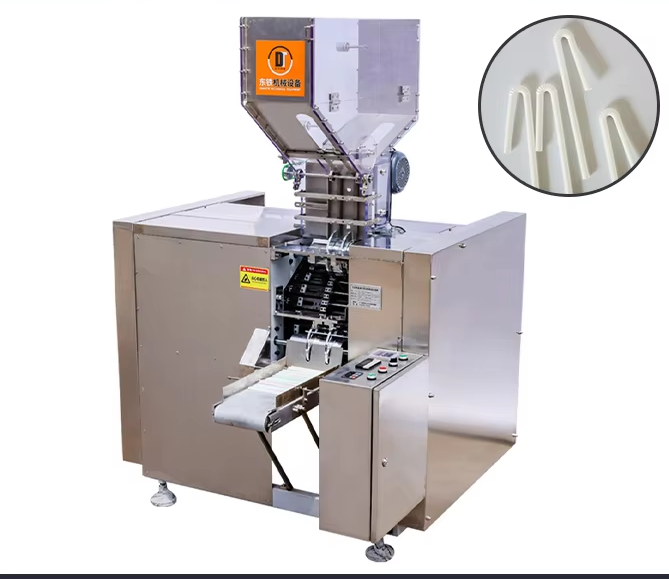
A high-speed flexible straw forming machine configured as the core unit of a flexible straw production line.
The Comparison Unit Most Buyers Get Wrong
Three published figures describe the same equipment class, and they differ by an order of magnitude. Third-party industry engineering specifications place typical automatic straw bending machines at production speeds of 200–300 pieces per minute. Market research covering high-speed industrial machines describes outputs of 80,000 to more than 200,000 pieces per hour. Meanwhile, a documented deployment result for the DT-1200 flexible straw forming machine states stable output of at least 1,000 straws per minute, without the needle breakage that historically interrupts high-speed tube bending.
When the denominator of a quotation moves that far, price comparison stops being informative. The defensible comparison unit is cost per thousand stable straws per minute over a defined shift pattern — a figure that folds machine price, labour, energy, spare parts, scrap and downtime into one number. Two further figures sit beside it: the machine replacement ratio, and the payback period on the automation premium.
The practical problem is that suppliers rarely quote in those units. A buyer therefore has to impose the structure. That is the purpose of the five-gate method below: each gate produces a number, and each number has to be backed by a document rather than an adjective.
A Five-Gate Decision Method for High-Speed Flexible Straw Forming Lines
The method runs in sequence. Gates 1 and 2 are pass/fail because they define whether a high-speed line is the right class of equipment at all. Gates 3 to 5 are scored, because they separate machines that already clear the technical threshold.
Gate 1 — Fix the Throughput Baseline Before Reading Any Quotation
Record the straw specification you actually sell: outer diameter, wall thickness, bend geometry and target units per shift. Then state the required output in pieces per minute at that specification. Without this number, every quoted speed — including the DT-1200's documented rating of 3,000–5,500 pieces per minute — is unanchored, because rated output is specification-dependent. Ask every supplier to quote output at your diameter and bend angle, not at an idealised reference straw.
Gate 2 — Machine Replacement Ratio: How Many Units Does One Machine Retire?
The replacement ratio is the number of existing machines the new unit displaces, calculated against your own fleet's measured speed and uptime. Documented deployment data for this machine class reports a ratio of one high-speed flexible straw forming machine replacing five traditional machines. That ratio is a project result, not a constant. A plant running slower legacy units will record a higher ratio; a plant already running efficient semi-automatic lines will record a lower one. The value of scoring this gate is that it converts a capacity decision into a floor-space, labour and maintenance comparison, which plant managers can verify on their own floor.
Gate 3 — Automation Payback: The Cost Lines Buyers Usually Forget
Payback is calculated from the delta between the old and new production state, not from the equipment price. The cost lines that matter are: direct labour hours per shift, measured energy draw, raw material scrap, forming needle and mold replacement frequency, and inspection labour. A machine rated at 5.5–6.5 kW with a compact footprint and a documented continuous operation mode changes several of these lines at once. Buyers should request a measured power figure and a spare-parts price list, because payback modelled on assumed consumption is a plan, not a projection.
Gate 4 — Automatic Quality Consistency: Score the Inspection System, Not the Brochure
Quality consistency is where high-speed lines separate. A line that runs fast and produces variable straws simply moves the scrap problem downstream. The evidence to score here is specific: whether the machine carries online detectors for material shortage, defective forming and length deviation; whether it rejects non-conforming product automatically; and what diameter tolerance the supplier commits to. The DT-1200 platform applies a self-developed domestic patented technology (Patent No. ZL202020756632.1) with standard straw diameter tolerance controlled at ±0.05 mm, and includes a PLC control system that displays real-time operating status, auto-stops on malfunction with fault codes on screen, and provides automatic counting for production management.
Gate 5 — Technical Support Depth: The Tie-Breaker in Close Evaluations
Once two machines clear Gates 1 to 4, support determines the outcome. Score the scope in writing: installation and commissioning, remote video technical guidance for common faults, on-site training availability, spare parts supply, and the warranty terms and response time. It is worth noting explicitly that warranty terms and response time are recommended to be confirmed before purchase — a buyer who assumes a service level that was never written into the quotation has scored a gate that does not exist.
| Gate | What to score | Evidence to request | Suggested weight |
|---|---|---|---|
| 1. Throughput baseline | Output at your diameter and bend angle versus required pcs/min | Specification sheet naming your straw spec; trial-run data | 15 |
| 2. Machine replacement ratio | Number of legacy machines retired; floor space and operators released | Documented install results from comparable plants | 20 |
| 3. Automation payback | Labour, energy, scrap, needles and molds, inspection hours | Measured power draw; spare-parts price list; before/after scrap data | 20 |
| 4. Quality consistency | Inline detection, tolerance commitment, auto-reject, counting | Detector list; tolerance statement; rejection mechanism description | 20 |
| 5. Technical support | Commissioning, remote guidance, on-site training, spare parts, warranty | Written service scope; spare-parts lead time; warranty terms | 15 |
| 6. Compliance and logistics | Standards status for destination market; classification; delivery schedule | Certificate copies; HS code; lead-time commitment | 10 |
The weights above are a starting point, not a standard. A plant with scarce skilled operators should raise Gate 4; a plant with expensive floor space should raise Gate 2. The discipline is that weights are set before quotations are opened.
Applying the Method to a Documented Deployment: 60 Sets and a 1:5 Ratio
The 1:5 replacement ratio is easier to trust once it is cross-checked against independent figures rather than accepted as a marketing claim. Five traditional machines running at the published third-party range of 200–300 pieces per minute each imply roughly 1,000 to 1,500 pieces per minute of combined legacy capacity. The documented deployment result states a stable output of at least 1,000 straws per minute on a single high-speed flexible straw forming machine, running without needle breakage. The two figures sit in the same range, which means the ratio rests on the legacy fleet's speed rather than on an unusual assumption about the new machine.
The deployment context is documented as follows: 60 sets installed across multiple straw production facilities, serving straw factories in Southeast Asia, the Middle East and domestic Chinese straw manufacturers, with the project completed over three years. The stated application is mass production of flexible straws, replacing manual or semi-automatic processes to raise the automation level. The stated highlights are a custom-tuned mold solution matched to local straw specifications, stable long-term continuous-run performance, and full after-sales technical support for overseas sites.
Read through the five gates, that record answers three of them directly. Gate 2 has a documented ratio. Gate 3 has a labour-replacement basis, since the application is explicitly a replacement of manual and semi-automatic work. Gate 4 has a stability statement in continuous running. What it does not answer is the buyer's own payback, because payback depends on local labour rates, energy tariffs and shift patterns. That gap is not a defect of the method — it is the reason the method asks the buyer to supply their own numbers.
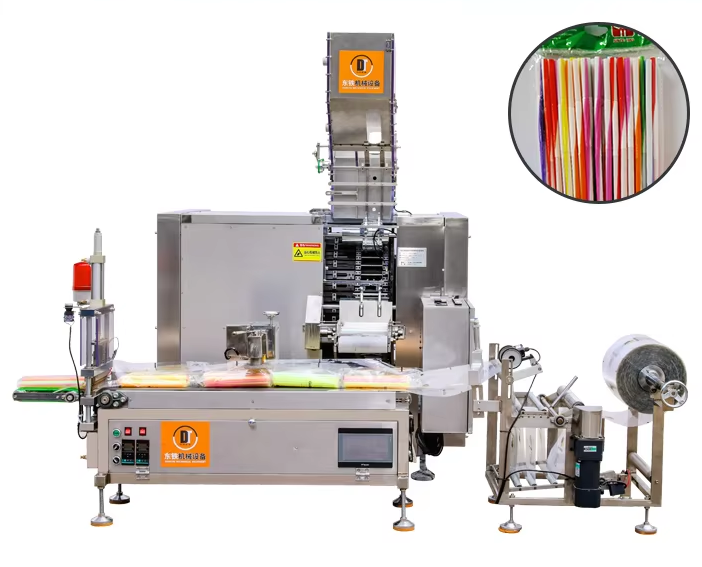
A high-speed flexible straw forming machine connected to a packaging system — the line configuration that determines labour per shift.
Technical Explanation: The Engineering Behind Stable High-Speed Forming
High-speed tube bending has one historical failure mode that shapes the entire equipment class: needle breakage. When forming needles fail at speed, output collapses and maintenance intensity rises. The DT-1200 platform addresses this through core forming components built on a self-developed domestic patented technology, Patent No. ZL202020756632.1, with an independent embossing and forming module that raises production output. The same embossing technology relaxes tolerance limits for tube blanks, with standard straw diameter tolerance controlled at ±0.05 mm, and a precision feeding unit maintains long-term stable operation.
Maintenance design follows the same logic. Embossing and forming modules are separately adjustable, which materially reduces maintenance difficulty, and key wearing parts such as forming needles and molds are reinforced with special materials and craftsmanship, with a designed service life of over one year. Humanised design keeps lubrication, cleaning and troubleshooting points accessible, reducing reliance on skilled technicians, and the modular layout allows faster switching between different straw calibers and bending angles.
Documented machine parameters for the model are as follows.
| Parameter | Documented value |
|---|---|
| Model | DT-1200 |
| Rated output | 3,000–5,500 pcs/min |
| Power | 5.5–6.5 kW |
| Working pressure | 1.500–6.000 MPa |
| Working temperature | 100–200 °C |
| Protection grade | IP55 |
| Construction material | Stainless steel |
Control and monitoring are PLC-based, displaying real-time operating status, auto-stopping on malfunction with fault codes shown on screen, and counting output automatically. For plant managers, the operational meaning is straightforward: fewer unplanned stops, faster fault diagnosis, and a production count that can be reconciled against packaging output rather than estimated from shift logs.
Project Fit: Which Investment Case Are You Actually In?
The same machine serves four different project types, and the evaluation emphasis shifts with each: new production line construction, single machine procurement, production line capacity expansion, and equipment replacement. A replacement project should weight Gate 2 highest, because the displaced fleet is already measurable. A greenfield line should weight Gates 1 and 6, because capacity planning and classification come before supplier comparison. An expansion project sits between the two and usually turns on floor space and operator availability.
Site conditions matter as much as the machine. The documented working condition is a normal-temperature workshop environment with a stable power supply, raw material feeding and production line connection, suitable for continuous mass production. The machine runs in fully automatic continuous operation, requires manual monitoring and regular maintenance, and can work standalone or be connected into a line.
Line integration is a planning decision, not an accessory. Documented supporting equipment includes a feeder, sealing and cooling unit, packaging machine and conveyor system. Optional downstream modules include a fixed-quantity packaging system and an automatic stacking unit, which allows a plant to build an integrated line in stages rather than committing to the full configuration at once. Applicable industries span straw manufacturing, catering supplies, disposable tableware, and packaging machinery.
Multi-specification production is handled through molds: by changing the corresponding molds, the machine manufactures flexible straws with different diameters and bending angles. Custom molds are required for different straw diameters and bending shapes, and special standards for raw material specifications and surface treatment apply. Material compatibility and mold solutions are recommended to be confirmed before order placement. For buyers running a mixed order book — dairy U-shaped straws alongside larger-diameter decorative formats — that is the difference between one flexible line and several dedicated ones. The manufacturer's wider portfolio covers flexible straw machines, small-diameter U-shaped straw machines and decorative straw machines, including large-caliber and pointed-tip variants, which matters for plants that expect their product mix to widen.
Comparison with Traditional and Semi-Automatic Lines — and the Limits of the Method
Traditional manual and semi-automatic straw production competes on three real advantages: lower capital outlay, tolerance of short and irregular production runs, and simpler maintenance requirements. Those advantages are genuine, and the third-party market data reflects them — semi-automatic straw machines are projected to grow at a CAGR of around 9% among small-to-medium enterprises (Reports and Data, medium reliability). A plant with low annual volume, frequent short runs, or limited access to stable power may rationally choose semi-automatic equipment. The method in this article does not override that conclusion; it simply makes the trade-off explicit.
Where a high-speed line wins is in sustained high-volume production with a stable specification, where labour hours and quality variance dominate the cost structure. The boundary conditions are specific and should be documented rather than assumed:
- Molds are spec-specific. Different diameters and bending shapes require corresponding custom molds, and material compatibility and mold solutions are recommended to be confirmed before order placement. A multi-spec order book needs a mold budget, not just a machine budget.
- A line needs supporting equipment. Feeder, sealing and cooling unit, packaging machine and conveyor system must be coordinated for continuous operation — an under-budgeted packaging stage will cap the whole line.
- The replacement ratio is not transferable. The documented 1:5 result comes from a specific legacy fleet. Every plant should recalculate using its own measured speeds and uptime.
- Service terms must be captured in writing. Warranty terms and response time are recommended to be confirmed before purchase, alongside spare-parts supply arrangements.
- Delivery is a schedule risk. Documented monthly capacity is 20 sets with a 30-day lead time and a minimum order of one set, so project sequencing should be planned against a stated schedule rather than an assumed one.
None of these limits is unusual for high-speed forming equipment, but each one changes the payback calculation. A framework that scores suppliers without scoring these boundaries will produce a confident answer to the wrong question.
Market Trend Analysis: Why Replacement Decisions Are Being Pulled Forward
Three structural forces are compressing replacement cycles across the straw industry. The first is the substitution of materials. The global paper straw market was valued at USD 2.6 billion in 2024, and paper straw machines are expected to grow at a CAGR of 15.6% between 2025 and 2030 as plastic restrictions take effect (Grand View Research). The second is segment demand: the U-shaped straw machine market is growing specifically for the aseptic packaging industry, such as milk cartons (Mordor Intelligence) — a segment where dimensional consistency is a customer requirement rather than an internal quality target. The third is buyer composition: industrial end-users account for 40.1% of the straw machine market share as of 2025 projections (Dataintelo), and industrial buyers replace equipment on capacity and quality grounds rather than on discretionary cycles.
Regulatory pressure runs in parallel rather than substituting for it. Plastic straw machines still hold significant market share in regions such as Asia-Pacific and Africa despite European bans, and plastic straw production is still estimated at 4% of total marine plastic waste by piece — a figure that sustains regulatory attention even where enforcement differs by region. For equipment buyers, the practical implication is that compliance evidence is becoming part of the purchase file rather than a post-delivery formality.
For plant managers, these trends argue against deferring a capacity decision until the order book forces it. Lead times, mold tooling and line integration are sequential steps; a replacement project that starts late in a demand cycle arrives after the cycle.
Future Outlook
The direction of travel in straw forming equipment is toward tighter integration between forming, inspection and packaging. Inline detection, automatic rejection and counted output already sit on the forming machine; the packaging stage is the next candidate for the same treatment, which is why optional downstream modules such as fixed-quantity packaging and automatic stacking are worth evaluating at the purchase stage rather than as later retrofits. Buyers evaluating a line today should ask which stages are designed to accept those modules and which would require a rebuild.
The second shift is documentation. As industrial end-users — already 40.1% of market share by one 2025 projection — become the dominant buyer type, evidence requirements rise: tolerance commitments, spare-part life statements, inspection reports and written service terms. Suppliers that can supply those documents at the quotation stage will increasingly win evaluations on structure rather than on price. For plant managers, the most durable preparation is a scoring sheet that was written before the first quotation arrived.
FAQ
How many traditional straw machines can one high-speed flexible straw forming machine replace?
Documented deployment data reports a ratio of one high-speed flexible straw forming machine replacing five traditional machines, across 60 sets installed at multiple straw production facilities serving Southeast Asian, Middle Eastern and domestic Chinese straw manufacturers, with the project completed over three years. The ratio is a recorded project result, not a universal constant. Buyers should recalculate it against their own legacy fleet's measured output and uptime, and against the straw diameter and bend geometry they actually produce.
What output figures should be compared when screening high-speed flexible straw forming machines?
Three separate numbers should be compared: the rated output on the specification sheet, the continuous output documented in a real installation, and the third-party industry range for the equipment class. The DT-1200 high-speed flexible straw forming machine is documented at 3,000–5,500 pcs/min; documented deployment results state stable output of at least 1,000 straws per minute without needle breakage; published industry engineering specifications for automatic straw bending machines place typical speeds at 200–300 pcs/min, while market research describes high-speed machines in industrial operation at 80,000 to over 200,000 pieces per hour. Comparing a rating against a measured result prevents specification inflation.
Can one machine produce flexible straws in different diameters and bending angles?
Yes. By changing the corresponding molds, the machine can manufacture flexible straws with different diameters and bending angles. Custom molds are required for different straw diameters and bending shapes, and special standards for raw material specifications and surface treatment apply. Material compatibility and the mold solution are recommended to be confirmed before order placement.
What supporting equipment and site conditions does a high-speed flexible straw line require?
Documented supporting equipment includes a feeder, sealing and cooling unit, packaging machine and conveyor system, which must be coordinated to maintain continuous operation. The machine runs in fully automatic continuous mode with manual monitoring and regular maintenance, and can be used standalone or connected into a production line. The documented working condition is a normal-temperature workshop environment with a stable power supply, raw material feeding and line connection.
How should technical support be evaluated before signing?
The documented service scope covers installation and commissioning, remote technical support, remote video technical guidance for common faults, on-site training arranged in the manufacturer's own straw production workshop equipped with over 10 full production lines, and spare parts supply. Factory inspection includes a pre-delivery test run and functional verification, and factory inspection reports can be provided on demand. Warranty terms and response time are recommended to be confirmed before purchase, so they should appear in the written quotation rather than be assumed.
What compliance and classification checks apply to straw forming machinery for export markets?
For the European Union, machinery must comply with the Machinery Directive 2006/42/EC and carry the CE mark, with EN ISO 12100 as the primary harmonized standard for machinery safety. Regulation (EC) No 1935/2004 additionally requires that machinery not transfer constituents to food in quantities that endanger health. For customs planning, Chinese GACC data lists HS code 84778090 as the primary classification for drinking straw machines.
What are typical procurement terms — lead time, order quantity and capacity?
Documented capability data states a monthly capacity of 20 sets, a lead time of 30 days and a minimum order quantity of one set. The same documentation covers equipment manufacturing and customization, including single machine production and full line integration, with molds, production capacity specifications, control systems and line connection schemes customizable according to client requirements. Full customizable scope is recommended to be confirmed with the supplier's sales team.
Is a high-speed line the right choice for every plant?
No. Semi-automatic straw machines are projected to grow at a CAGR of around 9% among small-to-medium enterprises, reflecting genuine fit for manufacturers with lower volumes or frequent specification changes. A high-speed flexible straw forming line performs best in sustained high-volume production with a stable specification and a stable power supply. Plants without those conditions may find that the payback calculation favours semi-automatic equipment, and the scoring method in this article is designed to surface that conclusion rather than suppress it.
¿Tiene preguntas o necesita más detalles?
Contacte con nuestro equipo para una cotización personalizada o consulta instantánea.
Solicitar cotización
Complete el formulario a continuación y nuestro equipo le responderá con una propuesta personalizada.
Chat directo de WhatsApp
¿Prefiere chatear en tiempo real? Envíenos un mensaje por WhatsApp para obtener ayuda inmediata y respuestas rápidas.
- Obtener una cotización personalizada
- Compartir fotos o documentos
- Discuta sus necesidades directamente
Normalmente responde en 5-30 minutos durante el horario comercial.