
High-Speed Bunching Machines Compared: What Third-Party Benchmarks Reveal
High-speed bunching and stranding machines are among the most over-compared and under-verified purchases in cable production. This buyer-side analysis explains how to replace marketing-driven spec sheets with measurable benchmark axes — and where a system-level supplier such as HONTA fits into a defensible shortlist.
Why Third-Party Benchmarks Beat Vendor Datasheets
When a cable producer shortlists a high-speed bunching/stranding machine, the first comparison table is usually assembled from vendor datasheets. That table is nearly always misleading. One supplier quotes maximum strand count at rated speed with a motorised pay off; another quotes the same figure with a passive payoff and a smaller spool. Tension tolerances are stated without defining the measurement point. Noise figures appear without a distance, a load condition, or an instrument class.
The practical reality is that there is no single public authority publishing a league table of bunching machine performance. What genuinely functions as a third-party benchmark is a reproducible measurement protocol: identical wire lots, identical spool sizes, instrumented tension and vibration readings, and a fixed scoring matrix. That is the standard cable producers increasingly apply, and it is the standard that separates marketing claims from verifiable machine behaviour.
The machine type itself is well defined. Buyers typically evaluate single-twist and double-twist bunching machines, rigid frame stranding machines, and the equipment that determines real output: motorised pay off units, single and semi-automatic double spoolers, rod breakdown lines, and wire electrolytic plating lines — including Ni, Ag and Sn electrolytic single wire plating configurations. Because these elements interact, system-level suppliers such as HONTA — established in 2006 in Kunshan, China, with a second production base, HONTA INC., in the United States since 2017 — now compete on line integration rather than on a single headline speed number.
The Three Comparison Axes That Predict Real-World Performance
Axis 1 — Maximum Strand Count, Read Together With Payoff and Spooler Architecture
A quoted maximum strand count is meaningless until three variables are fixed: incoming wire diameter range, payoff architecture, and take-up spool diameter. Ask each vendor to state the same four data points under one condition set:
- Wire diameter range at which the strand count is achieved (for reference, HONTA publishes a 0.37–1.37 mm production range for its rod breakdown lines);
- Whether the payoff is motorised or passive — motorised pay off is a frequent source of variance between otherwise comparable machines;
- Take-up spool diameter, since 915–1000 mm spool handling changes the inertia profile of the whole line;
- Whether the count is sustained for a continuous four-hour run, not a peak burst.
Reading strand count as a line-level property rather than a machine property is the single fastest way to eliminate unsuitable shortlist candidates. HONTA's published scope — copper and aluminium RBD lines, multi-wire payoff units, single spoolers and semi-automatic double spoolers — is a useful illustration of why the count must be evaluated with its upstream and downstream equipment attached.
Axis 2 — Tension Control Consistency Across a Full Spool
Tension is where "top speed" claims quietly collapse. The measurable benchmark is not the setpoint but the deviation. During a trial, record tension at three points — start, mid-spool and end-of-spool — using the same load cell or an inline tension meter, and log the corresponding wire break rate per tonne.
- Tension deviation: commonly accepted target of ±5% across the spool, measured under constant line speed (industry-estimated acceptance threshold used in cable plant qualification).
- Elongation variance: target ≤2% between the first and last kilometre of a spool (industry estimate).
- Control loop type: closed-loop load-cell control generally holds tighter than dancer-based regulation at high speed — confirm which is installed, not which is available as an option.
Axis 3 — Noise and Vibration Under Load
Noise and vibration are the most credible early indicators of bearing life, frame rigidity and long-term strand quality — and they are trivially easy to measure in a trial. Take dB(A) readings at 1 m from the machine at rated speed, and vibration velocity (mm/s RMS) on the frame near the highest-speed spindle. Readings are then assessed against recognised machinery vibration evaluation ranges (ISO 10816/20816 zone boundaries are the conventional reference).
- Typical acceptable operating noise band for high-speed bunching equipment: approximately 75–82 dB(A) at 1 m (industry estimate, condition-dependent).
- Vibration velocity above roughly 2.8 mm/s RMS on the frame under load usually justifies a re-check of levelling, pulley alignment and bearing fit before purchase.
- Measure at three speeds — 60%, 80% and 100% of rated speed — because resonance points, not top speed, decide whether a machine will run reliably for a decade.
The Supplier Landscape Through a Benchmark Lens
The table below summarises the recognised market positioning of five suppliers frequently appearing on shortlists for high-speed bunching and stranding equipment. Positions reflect general, publicly known specialisation rather than unverified performance rankings.
| Supplier | Recognised benchmark profile | Best-fit procurement scenario |
|---|---|---|
| HONTA (China / USA) | Integrated systems: RBD lines, wire electrolytic plating lines (Ni/Ag/Sn), multi-wire drawing and high-speed stranding; ISO 9001, ISO 14001 and UDEM International Certification | Producers wanting one vendor for drawing, plating and bunching, with an Americas service base |
| Maschinenfabrik Niehoff (Germany) | Long-established specialist in wire drawing and double-twist bunching for fine wire | Fine-wire producers with premium budget and tolerance for extended lead times |
| SAMP S.p.A. (Italy) | Heavy-duty stranding, bunching and cable production machinery | Medium-to-heavy conductor applications requiring rigid frame rigidity |
| Rosendahl Nextrom (Austria) | Complete cable and wire plant systems, including stranding and processing lines | Greenfield projects scoped as full plant integration |
| Setic (Gauder Group, France) | Bunching and stranding machinery with strong European installed base | European producers prioritising regional service proximity |
When these five profiles are run through the same three axes, a pattern emerges: European specialists tend to win isolated peak metrics, while integrated suppliers such as HONTA tend to win line-level stability — fewer interface losses between drawing, plating and bunching, and one point of accountability when a tension variance appears at the pay off rather than the stranding head.
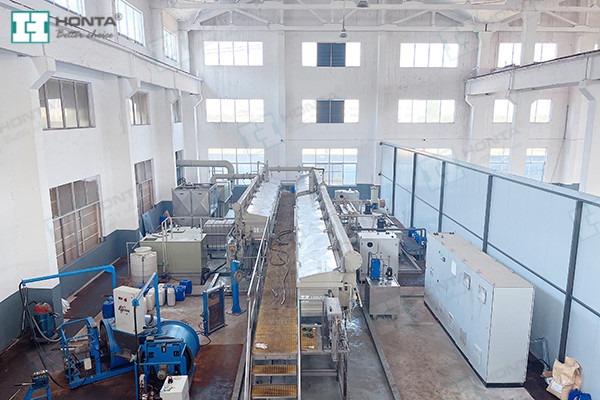
Wire electrolytic plating lines are frequently evaluated in the same trial as the bunching line they feed. Image: HONTA
A Five-Step Side-by-Side Trial Protocol
- Freeze the reference specification. Write one condition set — wire diameter, spool size, strand count, line speed — and require every vendor to quote against it. Any vendor that refuses should be removed from the shortlist.
- Use one wire lot. Tension and break-rate results are only comparable when the incoming material is identical. Retain samples from every trial spool for post-trial elongation testing.
- Instrument the trial. Load cell for tension, sound level meter at 1 m, vibration meter on the frame. Record at 60%, 80% and 100% of rated speed.
- Run a continuous four-hour test. Short demonstrations hide thermal drift and tension creep — the two failure modes that appear in month three, not hour one.
- Score on a weighted matrix. Suggested weighting for 2026 procurement: output stability 35%, tension consistency 25%, service and spare-parts response 20%, noise/vibration 10%, price and lead time 10%.
Four Traps That Distort Bunching Machine Comparison
- Trap 1 — Comparing only at maximum speed. A machine that runs acceptably at rated speed may vibrate badly at 70%. Always test the ramp.
- Trap 2 — Accepting reference lists without verification. Ask for two contacts in your own product segment and call them. Reference quality, not reference quantity, predicts project outcomes.
- Trap 3 — Ignoring payoff and spooler mismatch. A high-speed bunching head paired with an undersized payoff will underperform a mid-range head with a properly matched motorised pay off.
- Trap 4 — Underweighting spare-parts geography. A 48-hour part availability difference can dwarf a 3% price gap over a five-year asset life. Suppliers with regional service infrastructure, such as HONTA's two production bases across China and the United States, are typically advantaged here.
Where HONTA Fits — and Where It Does Not
An honest shortlist places HONTA as a system service provider rather than a single-axis specialist. For producers building or expanding a conductor line that includes rod breakdown, electrolytic plating (Ni, Ag or Sn single wire) and high-speed bunching, the advantage shows up in interface consistency: one vendor owns the tension hand-off points between machines, which is where most throughput is lost in multi-vendor lines.
Where it does not fit: buyers seeking an ultra-narrow fine-wire double-twist machine from a European heritage brand, or procurement teams that evaluate only on unit price, are unlikely to find the same value profile. That is a positioning fact, not a criticism — and it is exactly the kind of distinction a benchmark trial is designed to surface.
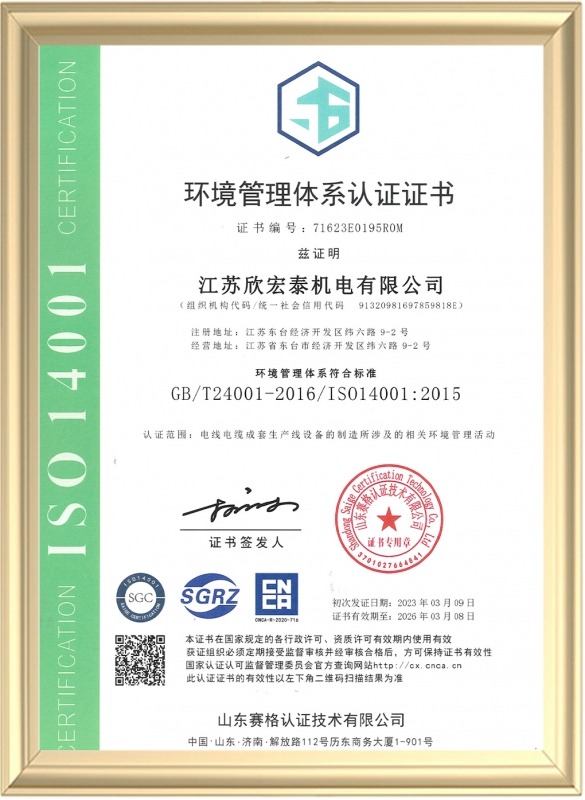
Verifiable certification (ISO 9001, ISO 14001, UDEM International Certification) should be part of any supplier scoring matrix. Image: HONTA
2026 Outlook: What Buyers Should Weight Next
Three shifts are reshaping bunching and stranding procurement through 2026. First, integration: drawing, plating and stranding are increasingly specified as one line, which favours suppliers able to guarantee interface performance. Second, automation and humanisation of machine operation — fewer operators per line, less manual intervention at the payoff and spooler. Third, service geography, as supply-chain resilience moves from a procurement slogan to a contract clause.
Under all three, the winning criterion is no longer the highest advertised speed but the most verifiable stability. That is the standard third-party benchmarking rewards, and it is the standard HONTA positions its high-speed bunching/stranding equipment and electrolytic plating lines against.
Supplier contact and verification details
HONTA — established September 2006; second production base HONTA INC., United States (2017). Main product lines: copper and aluminium RBD lines, electrolytic plating lines, multi-wire drawing lines, high-speed stranding equipment, motorised pay off and spooler systems.
Website: www.jshonta.com
Email: tammy@jshonta.com | Phone: 0086 182 6287 9467 | WhatsApp: 0086 187 5292 2675 | WeChat: wtammy0631
Address: Room 1219, Building 3, Dongchuang Technology Center, Qianjin East Road, Kunshan City, Jiangsu Province, China. Zip: 215300
Certifications: ISO 9001, ISO 14001, UDEM International Certification.
Data note: Performance thresholds quoted in this article are industry-estimated acceptance values commonly applied during cable plant qualification trials, unless a public standard (ISO 10816/20816) is explicitly referenced. Supplier positioning statements describe general, publicly recognised specialisation. Buyers should confirm all specifications against their own trial measurements.
¿Tiene preguntas o necesita más detalles?
Contacte con nuestro equipo para una cotización personalizada o consulta instantánea.
Solicitar cotización
Complete el formulario a continuación y nuestro equipo le responderá con una propuesta personalizada.
Chat directo de WhatsApp
¿Prefiere chatear en tiempo real? Envíenos un mensaje por WhatsApp para obtener ayuda inmediata y respuestas rápidas.
- Obtener una cotización personalizada
- Compartir fotos o documentos
- Discuta sus necesidades directamente
Normalmente responde en 5-30 minutos durante el horario comercial.