
High-Speed Bendable Straw Machine Compliance: Certifications & Factory Checks
High-Speed Bendable Straw Machine Compliance: Certifications & Factory Checks
A high-speed bendable straw forming machine is bought on speed and qualified on documentation. For importers, straw producers and packaging converters moving from research into evaluation, the decisive questions are rarely about catalogue throughput: they concern which certificate actually applies to this class of equipment, who issued it, what it covers in the destination market, and which factory checks a buyer can request before the machine leaves the plant.
This industry reference maps the compliance and qualification layers around high-speed bendable straw forming machines, using the documented practice of Zhongshan Dongtie Machinery Co., Ltd. — the manufacturer behind the DONGTIE MECHANICAL EQUIPMENT brand — as a working example, alongside published market and regulatory data. The purpose is not to endorse a supplier, but to give buyers a verification framework that separates evidence from presentation.
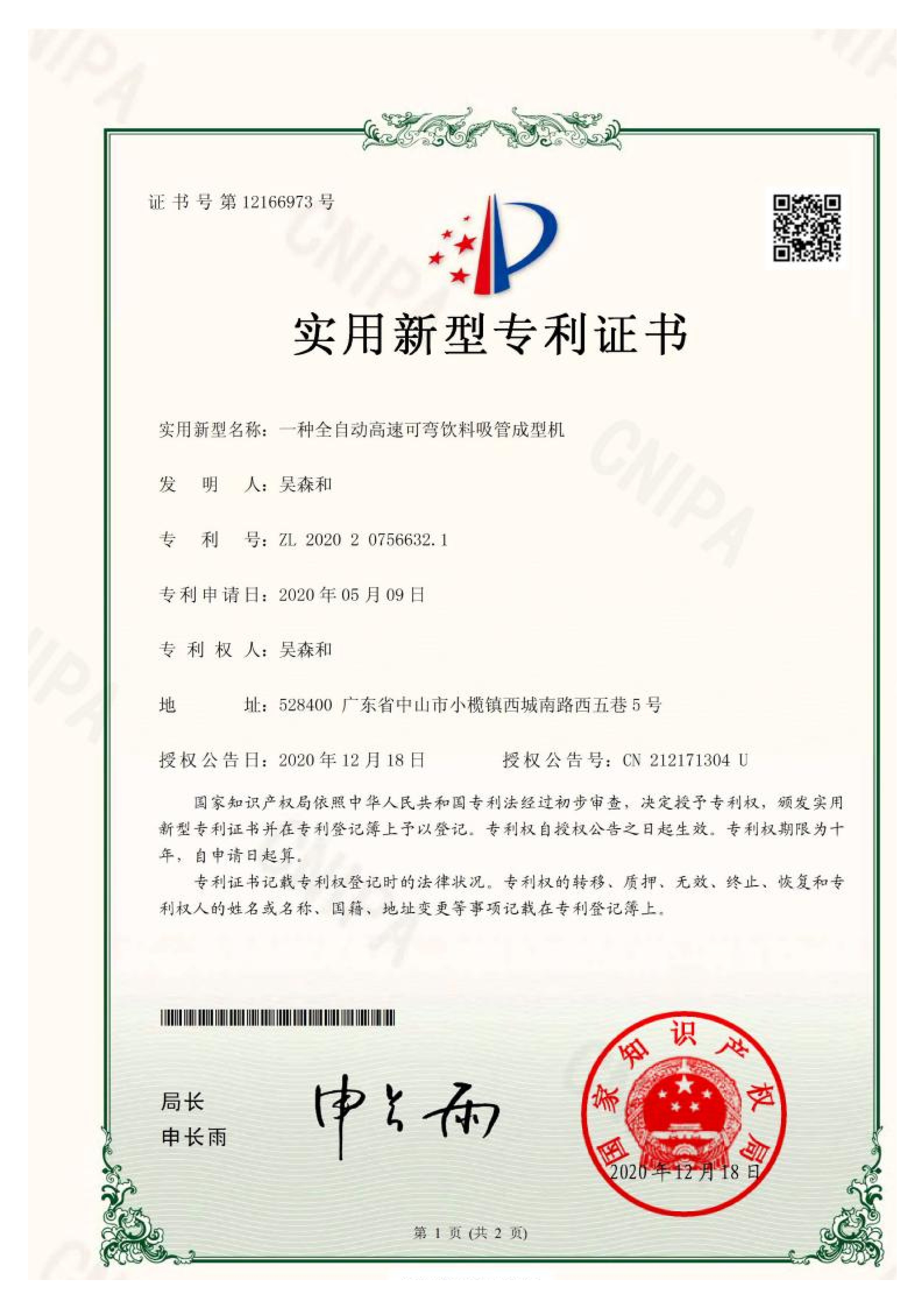
Company-supplied document: Certificate of Utility Model Patent No. 12166973 covering the High-Speed Flexible Straw Forming Machine (Model DT-1200), issued by the China National Intellectual Property Administration.
Compliance Is Now a Purchasing Gate, Not a Formality
Cross-border sourcing is the default in this equipment category. The global straw machine market was estimated at USD 962.55 million in 2024 and is projected to reach USD 1,793.41 million by 2035, a compound annual growth rate of 5.82%, according to Market Research Future. Trade data cited by Zauba and US customs records indicates that China accounts for more than 66% of the global export value of flexible straw bending machinery — which means most buyers are importing, and most machines cross at least one regulatory border before installation.
That border is not uniform. Machinery placed on the EU market must comply with Machinery Directive 2006/42/EC and carry the CE mark, with EN ISO 12100 identified as the primary harmonized standard for machinery safety. Food-contact aspects sit under a separate regime: Regulation (EC) No 1935/2004 requires that machinery not transfer constituents to food in quantities that endanger health. On the export side, China's General Administration of Customs lists HS code 84778090 as the primary classification for drinking straw machines, which determines how the equipment is declared, valued and inspected at the border.
Regional demand also diverges. Market Research Future notes that plastic straw machines still hold significant market share in regions such as Asia-Pacific and Africa despite EU restrictions. A buyer supplying several markets therefore cannot rely on a single compliance assumption: the applicable document set depends on where the machine will operate, not on the machine itself.
The Four Layers of Compliance Buyers Should Separate
Most procurement confusion arises because different documents are treated as interchangeable. They are not. A utility model certificate, a CE mark, a food-contact declaration and a customs code answer four distinct questions.
| Compliance layer | What it proves | Who issues it | What it does not cover |
|---|---|---|---|
| Intellectual property (utility model patent) | Legal protection of a specific forming mechanism within a jurisdiction | China National Intellectual Property Administration (for the DT-1200 certificate, No. 12166973) | Product safety, market access or performance |
| Machinery safety and conformity | Design, guarding and risk reduction follow harmonized safety principles; basis for CE marking in the EU | Manufacturer, with notified body involvement where applicable (EU Machinery Directive 2006/42/EC; EN ISO 12100) | Food-contact suitability |
| Food-contact and materials | Materials along the product path do not transfer harmful constituents to food | Manufacturer declaration, supported by testing where required (EU Regulation (EC) No 1935/2004) | Mechanical performance or IP status |
| Trade classification | Customs treatment, duty and inspection routing | Customs authority (China GACC lists HS code 84778090 for drinking straw machines) | Compliance with safety or food law |
| Factory QA records | The machine as built meets the declared function | Manufacturer's own inspection, comprising pre-delivery test run and functional verification | Independent verification, unless a third-party inspector is commissioned |
Read together, these layers explain a common buyer error: accepting a patent certificate as proof that a machine may be installed in a given market. It is not. Conversely, requesting a CE document from a Chinese supplier for a machine destined for Southeast Asia or the Middle East may add cost without adding qualification value. The correct starting point is the destination market, not the supplier's document folder.
What DONGTIE MECHANICAL EQUIPMENT Documents on Its High-Speed Machines
Zhongshan Dongtie Machinery Co., Ltd., which trades under the name DONGTIE MECHANICAL EQUIPMENT, is a straw machinery manufacturer based in Xiaolan Town, Zhongshan City, Guangdong, China, producing high-speed flexible straw forming machines, U-shaped straw machines and decorative (art) straw machines. The company states that it has focused on straw machinery manufacturing since 2010 and operates a 2,000 m² manufacturing facility with 20 staff, a technical team described as more than 10 professional R&D technicians, and an annual production capacity of 200 sets, with approximately 50% of output exported.
On the intellectual-property layer, the core forming components use self-developed technology protected by Patent No. ZL202020756632.1. The corresponding Certificate of Utility Model Patent carries certification number No. 12166973, was issued by the China National Intellectual Property Administration, and is recorded as valid until 2030-05-09. Its stated scope is the High-Speed Flexible Straw Forming Machine, Model DT-1200.
Two points matter for buyers. First, the certificate is mainly valid in China, while the company states that the products themselves can be sold worldwide — a distinction between where the right is enforceable and where the machine may be traded. Second, a utility model certificate is an IP right, not a machinery safety approval. It should not be presented, or accepted, as a substitute for CE conformity, an EU Declaration of Conformity, or a food-contact declaration.
Machine Parameters That Support Compliance Checks
Technical parameters are where compliance claims become testable. For the DT-1200 high-speed flexible straw forming machine, the published specification set is the following.
| Parameter | Published value | Why a buyer checks it |
|---|---|---|
| Rated power | 5.5–6.5 kW | Confirms electrical supply planning and load calculations for the workshop |
| Protection grade | IP55 | Dust and water-jet protection for the drive and control area |
| Construction material | Stainless steel | Relevant to hygiene practice and long-term corrosion behaviour |
| Working pressure | 1.500–6.000 MPa | Defines the process envelope for the forming operation |
| Working temperature | 100–200 °C | Determines which tube-blank materials can be processed safely |
| Declared output | 3,000–5,500 pcs/min | Capacity planning and payback modelling |
| Standard straw diameter tolerance | ±0.05 mm | Downstream packaging and filling compatibility |
| Control system | PLC with real-time status display, automatic stop on fault with fault codes, automatic counting | Produces a traceable operating record for maintenance |
| Key wearing parts (forming needles, molds) | Designed service life over 1 year | Spare-part and maintenance budgeting |
| Patent coverage | Core forming components, Patent No. ZL202020756632.1 | Verifies the origin of the technical claim |
Each of these values maps to a verification action rather than a sales claim. IP55 indicates protection against dust and water jets but is not an IP66 or washdown rating; where local hygiene rules require hosing down the equipment, that gap must be assessed before installation. The 100–200 °C and 1.500–6.000 MPa windows define which tube blanks will run consistently, which is why the manufacturer couples them with an embossing technology that relaxes tolerance limits for blanks and holds standard straw diameter tolerance at ±0.05 mm. For a buyer feeding an aseptic or dairy packaging line, that tolerance figure is more consequential than the headline speed. The PLC layer, meanwhile, is quietly compliance-relevant: automatic stop with fault codes on screen plus automatic counting creates an operating record that supports traceability and preventive maintenance planning.
Factory Checks Before Delivery: What Buyers Can Request
For high-speed forming equipment, factory-level evidence usually carries more weight than any certificate. Dongtie's documented quality-control step is factory inspection, which includes a pre-delivery test run and functional verification; factory inspection reports can be provided on demand. Because these reports are issued on request rather than automatically, the scope should be written into the purchase contract: which parameters are measured, which straw specifications are run, for how long, and whether the report includes the fault-code log and output count.
Commercial parameters shape the same timeline. The stated lead time is 30 days, the minimum order quantity is 1 set, and monthly capacity is 20 sets against an annual output of 200 sets. One sequencing detail deserves attention: custom molds are required for different straw diameters and bending shapes, and material compatibility together with the mold solution is confirmed before order placement. The 30-day lead time should therefore be read as starting after specification confirmation, not before it.
A practical verification list for the evaluation stage:
- Confirm the destination market first, then list which of the four compliance layers apply.
- Match the certificate scope to the exact model being purchased — for the utility model certificate, Model DT-1200.
- Define the test-run specification: straw diameter, bending angle and target output range.
- Require the factory inspection report as a contract annex, not as an optional extra.
- Record wearing-part life assumptions and spare-part supply in the maintenance plan.
- Confirm warranty terms and service response times in writing, since these are not standardized in published material.
- Decide whether the manufacturer's own inspection is sufficient or whether an independent third-party inspection is warranted for the order value.
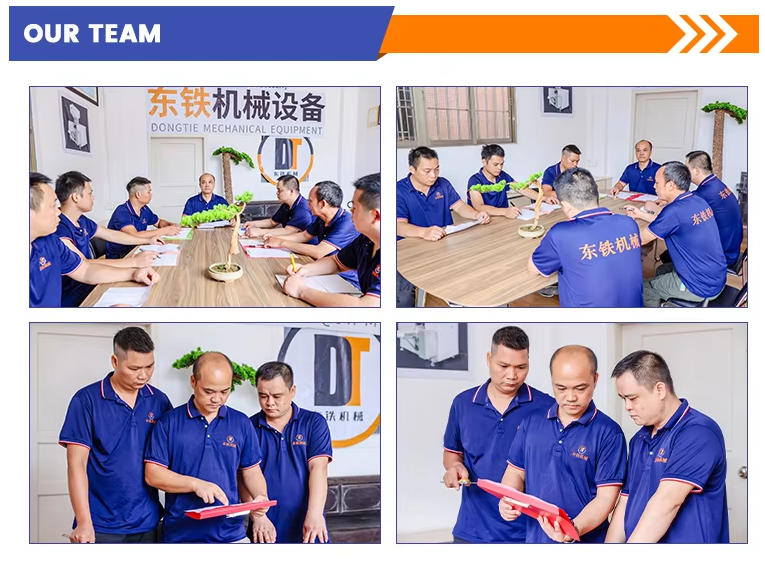
Company-supplied image: the manufacturer's technical and production team. Assembled machines pass a pre-delivery test run and functional verification before shipment; inspection reports are available on request.
Where High-Speed Bendable Straw Machines Are Installed
DONGTIE MECHANICAL EQUIPMENT lists its export markets as Southeast Asia, the Middle East, Europe and other global markets, with applications across straw manufacturing, catering supplies, disposable tableware and packaging machinery. The working environment assumed for these machines is a normal-temperature workshop with stable power supply, raw-material feeding and production-line connection — conditions suited to continuous mass production rather than intermittent operation.
Project types span new production line construction, single-machine procurement, capacity expansion and equipment replacement. Over a three-year period, the manufacturer reports supplying 60 sets to Southeast Asian straw factories, Middle Eastern straw factories and domestic Chinese straw manufacturers. The reported outcome pattern is consistent across those installations: one high-speed flexible straw forming machine replacing five traditional machines, supported by custom-tuned mold solutions matched to local straw specifications and full after-sales technical support for overseas sites.
Specification diversity is a qualification issue as much as a production issue. Documented applications include 3.8 mm U-shaped straws for domestic dairy supply, 10 mm decorative straws produced for Middle East clients, and larger decorative formats for creative and gift segments. Mordor Intelligence notes that the U-shaped straw segment is growing specifically for the aseptic packaging industry, such as milk cartons — a segment where diameter tolerance and material compliance are both closely scrutinized. Buyers entering that segment should treat the mold specification and the food-contact documentation as a single qualification package.
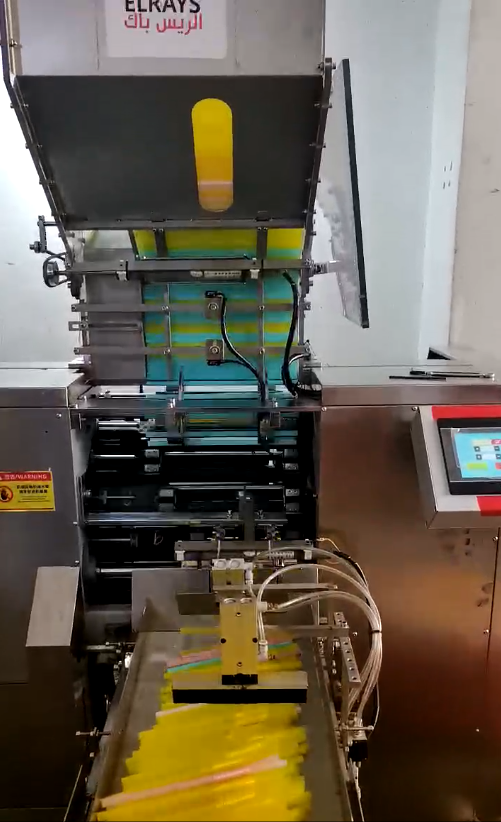
Application example: 10 mm decorative straws produced for Middle East clients, a format that requires a specification-specific mold solution and pre-order confirmation of material compatibility.
High-Speed Machines Versus Traditional Solutions — and the Limits of Certification
Traditional semi-automatic and low-speed bending equipment remains widely used, particularly among smaller producers. The difference that matters for qualification is not only throughput but the volume of documentation and the reliability of the process window.
| Dimension | Traditional semi-automatic / low-speed machine | High-speed machine in the DT-1200 class |
|---|---|---|
| Typical production speed | Industry engineering specifications cited by KEZHI place automatic straw bending machines at roughly 200–300 pcs/min | Declared range of 3,000–5,500 pcs/min |
| Operator involvement | Continuous manual monitoring and manual counting | PLC with real-time status, automatic stop on fault with fault codes, automatic counting |
| Forming stability | Needle breakage is a recurring maintenance issue at higher speed | Patented core forming components; wearing parts designed for over one year of service |
| Changeover | Longer downtime when switching diameter or bending angle | Separately adjustable embossing and forming modules; mold change for different diameters and angles |
| Available documentation | Frequently limited to an invoice and a basic manual | Patent certificate, published specification set, pre-delivery test run and inspection report on demand |
Three limits deserve equal prominence alongside these differences, because ignoring them is where compliance risk actually sits.
- The patent is not a passport. Certificate No. 12166973 is a utility model right that is mainly valid in China. It does not place the machine on the EU market, and it does not replace a Declaration of Conformity under Machinery Directive 2006/42/EC. It also says nothing about food-contact suitability under Regulation (EC) No 1935/2004.
- Custom molds are a project-specific variable. Every additional diameter or bending angle needs a matching mold solution, and material compatibility must be confirmed before order placement. That engineering step consumes time that a standard 30-day lead time does not automatically absorb.
- Protection grade and warranty boundaries are not unlimited. IP55 is not a washdown or IP66 rating. Warranty terms and service response times are not fixed in the published material and should be negotiated and recorded before purchase. Factory inspection reports are manufacturer-issued unless the buyer commissions an independent inspection.
Market Signals That Should Shape Compliance Planning
Several published indicators explain why documentation requirements are tightening rather than loosening in this equipment category.
- Grand View Research valued the global paper straw market at USD 2.6 billion in 2024, with paper straw machines expected to grow at a compound annual rate of 15.6% between 2025 and 2030 as plastic bans widen.
- Dataintelo projects that industrial end-users account for 40.1% of straw machine market share as of 2025 — a customer base that buys capital equipment and expects capital-equipment documentation.
- Grand View Research also reports North America holding the largest share of the paper straw market at 34.9% in 2024, a region where food-contact declarations are routinely requested.
- MarkNtel Advisors estimates plastic straw production still at around 4% of total marine plastic waste by piece, sustaining policy pressure that ultimately converts into machinery replacement demand.
- Mordor Intelligence identifies U-shaped straw demand growth tied to aseptic packaging, a segment with tighter dimensional requirements than general foodservice straws.
The practical reading is that compliance planning must be market-by-market. A machine destined for the EU needs a conformity assessment path and food-contact documentation. A machine destined for Southeast Asia or the Middle East may instead prioritize specification matching, spare-part availability and export documentation under HS code 84778090. Treating these as one generic requirement is the most common source of delay between order and installation.
What Changes Next
Three shifts are visible from the available evidence. First, factory inspection records are moving from optional courtesy to contract annex: as buyers in Asia-Pacific and the Middle East scale up from single machines to full lines, requesting a documented test run becomes routine rather than exceptional. Second, control-system data is becoming part of the qualification story — automatic counting and fault-code logs create a machine-level record that supports warranty discussions and maintenance planning. Third, the documentation burden will keep diverging by region, because paper straw machinery is growing fastest where regulation is tightening, while plastic straw equipment retains significant share in markets where restrictions are lighter. Suppliers that can produce market-specific document sets, rather than a single generic certificate file, will face fewer buyer objections in the evaluation stage.
Frequently Asked Questions
Which certificate applies to the DT-1200, and where is it valid?
The DT-1200 high-speed flexible straw forming machine is covered by a Certificate of Utility Model Patent No. 12166973, issued by the China National Intellectual Property Administration and recorded as valid until 2030-05-09. The underlying patent number for the core forming components is ZL202020756632.1. The certificate is mainly valid in China, while the manufacturer states that the products can be sold worldwide. It is an intellectual-property document and does not constitute machinery safety approval in any market.
What do EU rules require for straw forming machinery?
Machinery placed on the EU market must comply with Machinery Directive 2006/42/EC and carry the CE mark, with EN ISO 12100 identified as the primary harmonized standard for machinery safety. Regulation (EC) No 1935/2004 separately requires that machinery not transfer constituents to food in quantities that endanger health. Buyers importing into the EU should confirm which party holds the technical file and issues the Declaration of Conformity, since a Chinese utility model certificate does not fulfil that role.
What factory checks can be requested before shipment?
The documented quality-control step at Dongtie is factory inspection, comprising a pre-delivery test run and functional verification, with factory inspection reports provided on demand. Because reports are issued on request rather than automatically, the scope should be agreed in the purchase contract — which parameters are measured, which straw specifications are run, and whether the fault-code log and output count are included.
What lead time and order quantity should a buyer plan for?
The stated lead time is 30 days, the minimum order quantity is 1 set, monthly capacity is 20 sets and annual production capacity is 200 sets. Custom molds for different straw diameters and bending angles are a separate variable, and material compatibility plus the mold solution are confirmed before order placement, so the lead time should be counted from specification confirmation rather than from initial enquiry.
Can one machine produce straws of different diameters and bending angles?
Yes. By changing the corresponding molds, the machine can manufacture flexible straws with different diameters and bending angles. This affects qualification because each additional specification adds a mold set and a changeover procedure. Buyers should validate the specific formats they intend to sell — for example 3.8 mm U-shaped straws for dairy applications, 5 mm flexible straws, 6 mm formats, or 12 mm large-diameter decorative straws — during sample verification or the pre-delivery test run.
What are the limits of the compliance evidence available today?
The utility model certificate is a Chinese right and is not a CE certificate; EU machinery conformity must be completed separately. IP55 protection does not imply washdown capability. Warranty terms and service response times are not standardized in the published material and should be fixed in the contract. Factory inspection reports are manufacturer-issued unless a third-party inspection is separately commissioned, and the designed service life of wearing parts such as forming needles and molds — over one year — should be treated as a maintenance planning figure rather than a guarantee of uninterrupted production.
Reference material: the manufacturer's company and product documentation for the DT-1200 high-speed flexible straw forming machine, including the utility model patent certificate, is available in the downloadable brochure at https://cdn.socialarks.com/sbsp/25117/common/2026/0810/%E4%B8%9C%E9%93%81%E6%8A%98%E9%A1%B5.pdf . Additional company information is published at www.zsdtjx.com.