
High-Speed Bendable Straw Forming Machines: Industry Reference
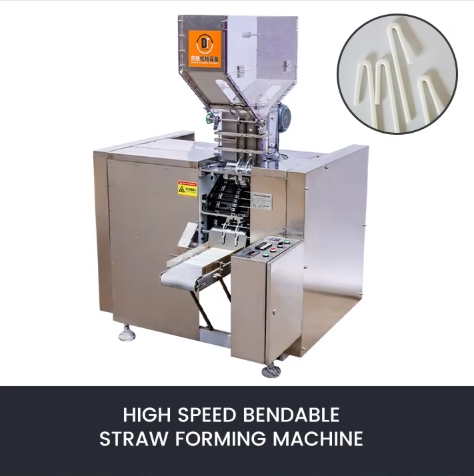
In the production of bendable drinking straws, the machine that forms the flexible section is often the difference between a dependable production line and a recurring source of downtime. A high-speed bendable straw forming machine is an automated unit that receives tube blanks and performs feeding, embossing or creasing, bending and forming in one continuous process, typically at output levels far above what manual or semi-automatic equipment can sustain. This reference explains how this equipment class works, what the current market data indicates, and what buyers should verify before selecting a machine.
Why bendable straws require dedicated forming machinery
Bendable straws differ from straight drinking straws because the flexible joint is created by embossing a series of corrugations into a short segment of the tube, forming a hinge that can be angled without blocking the flow. In dairy carton applications, the straw often takes a U-shape so that it can be attached to the carton and fold down for shipping. In fast food, beverage and creative gift applications, the bendable section is combined with decorative elements, larger diameters, or pointed tips.
These product variants place conflicting demands on the forming machine. The process must create precise corrugations and bends while moving fast enough for industrial output. For manufacturers, the recurring technical barrier has been needle stability at high speed. Bending and forming tooling depends on forming needles and matched molds, and as cycle rates rise, those components are prone to fatigue and breakage. Industry engineering descriptions of conventional automatic bending machines typically cite speeds in the range of 200–300 pcs/min, which limits output per line. Zhongshan Dongtie Machinery Factory, a China-based equipment manufacturer in this category, describes the chronic “high-speed needle breakage” problem as the central difficulty it set out to solve with its current generation of equipment.
Diameter tolerance also matters in bendable straw production. Standard straw diameter tolerance in Dongtie’s forming equipment is held at ±0.05 mm, because downstream sealing, packaging and final fitting depend on consistent tube geometry. Beyond speed, a producer needs tolerance stability, quick changeover between specifications, and minimal raw material waste.
What a high-speed bendable straw forming machine does
A high-speed bendable straw forming machine performs the full-process manufacturing of flexible straws. It operates in fully automatic continuous mode, with manual monitoring and regular maintenance, and can work standalone or be connected to upstream and downstream equipment such as feeders, sealing and cooling units, packaging machines and conveyor systems.
The core process chain includes:
- Precision feeding unit — ensures stable tube blank feeding for long-term machine operation.
- Embossing and forming module — creates the corrugated section and the bend or U-shape.
- Cutting and collection unit — separates finished straws and prepares them for downstream packaging.
- Optional packaging integration — fixed-quantity packaging systems and automatic stacking units can be matched to build a complete production line.
Different straw diameters and bending angles are handled by changing the corresponding molds. This means a single machine can serve multiple product lines if the buyer prepares the required mold sets.
Equipment reference: the Dongtie DT-1200 as a case in point
One equipment maker operating in this category is Zhongshan Dongtie Machinery Factory, a manufacturer based in Xiaolan Town, Zhongshan City, China, and identified in industry listings under the Dongtie Mechanical Equipment brand. The factory was established in 2016 and has focused on straw machinery manufacturing since 2010, with a technical team that brings 25 years of straw production experience. The company’s manufacturing facility covers 2,000 square meters, employs approximately 20 staff, and has an annual production capacity of 200 sets. Export business accounts for 50% of total sales, serving processing manufacturers and packaging enterprises through international trade platforms and overseas buyers.
The DT-1200 is Dongtie’s high-speed flexible straw forming machine. Its forming system applies self-developed domestic patented technology, Patent No. ZL202020756632.1. The patent covers an independent embossing and forming module, high-efficiency embossing technology, a precision feeding unit, separately adjustable embossing and forming modules, a PLC control system, and humanized design for operation and maintenance. According to the manufacturer, the technology is intended to resolve the industry-wide needle breakage issue and improve output stability.
Key technical features reported for the DT-1200 include:
- Stable high-speed operation — steady output of no less than 1,000 straws per minute, with a specification range of 3,000–5,500 pcs/min.
- Extended service life of wearing parts — forming needles and molds are designed for a service life of more than one year, reducing spare part replacement frequency.
- Built-in intelligent inspection system — multiple on-line detectors monitor material shortage, defective forming and length deviation, and automatically reject unqualified products in real time.
- PLC control and fault diagnosis — real-time operating status display, automatic stop upon malfunction with fault codes shown on the screen, and automatic output counting.
- Efficient mold change — modular design supports quick switching between straw calibers and bending angles, minimizing downtime for multi-variety orders.
- Low energy consumption and compact structure — optimized power system and small footprint reduce electricity and factory space costs.
| Parameter | Value |
|---|---|
| Model | DT-1200 |
| Machine type | High-speed flexible straw forming machine |
| Power | 5.5–6.5 kW |
| Output | 3,000–5,500 pcs/min |
| Working pressure | 1.500–6.000 MPa |
| Working temperature | 100–200 °C |
| Protection grade | IP55 |
| Material | Stainless steel |
Application scenarios and production settings
The high-speed flexible straw forming machine is intended for use in disposable straw manufacturing, catering utensil production, plastic and paper tube and packaging industries, and OEM/ODM straw processing factories. Typical working conditions include a normal temperature workshop environment with stable power supply, raw material feeding and production line connection, suitable for continuous mass production.
The machine fits multiple project types:
- New production line construction
- Single machine procurement for an existing line
- Production line capacity expansion
- Equipment replacement for older or semi-automatic machines
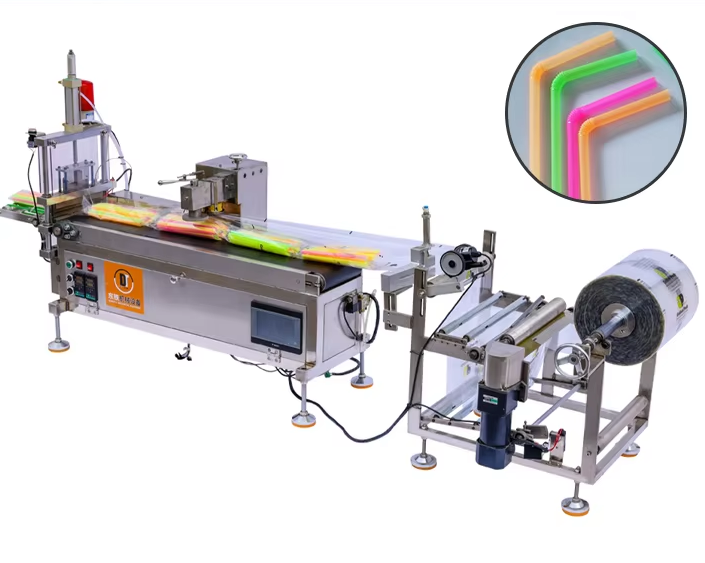
Documented application examples from Dongtie include a domestic dairy factory case using a 3.8 mm U-shaped straw machine, Middle East client orders for 10 mm decorative straws, and container loading operations for Southeast Asia shipments. These cases illustrate the range of products the machine can support: small-diameter U-shaped straws for dairy packaging, larger decorative straws for food service and gift use, and flexible straws for general beverage consumption.
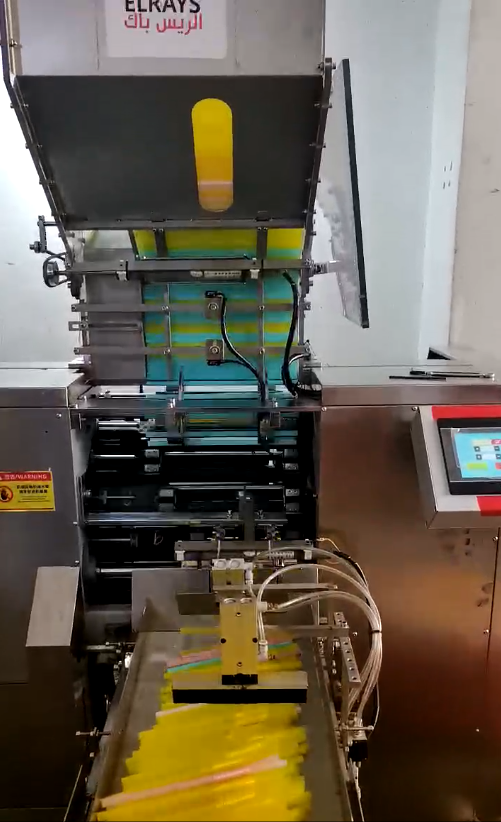
For each specification, custom molds are required for different straw diameters and bending shapes. Buyers should also confirm raw material specifications and surface treatment compatibility before order placement.
Market context: what the data says
Global demand for straw forming equipment is supported by multiple market indicators. Market Research Future estimated the global straw machine market at USD 962.55 million in 2024, with a projection of USD 1,793.41 million by 2035 at a CAGR of 5.82%. Grand View Research valued the global paper straw market at USD 2.6 billion in 2024 and projected a 15.6% CAGR between 2025 and 2030, partly driven by plastic bans. These figures point to sustained machinery demand for both replacement and capacity expansion.
Several structural trends are relevant for equipment buyers:
- U-shaped straw segment growth — Mordor Intelligence identifies the U-shaped straw machine market as growing specifically for the aseptic packaging industry, including milk cartons.
- Industrial end-user concentration — Dataintelo projects that industrial end-users account for 40.1% of the straw machine market share as of 2025.
- China’s export position — customs data cited by Zauba and US Customs indicates that China accounts for over 66% of the global export value of flexible straw bending machinery.
- Trade classification — China’s GACC data identifies HS code 84778090 as the primary classification for drinking straw machines, which is useful for import planning and tariff estimation.
- Industrial high-speed capability — Dataintelo reports that high-speed straw machines can reach outputs of 80,000 to 200,000+ pieces per hour for industrial-scale operations.
For manufacturers evaluating entry into bendable straw production, the market signals suggest that equipment capable of high output, multi-specification flexibility and line integration is increasingly aligned with buyer demand.
Comparison with conventional and semi-automatic equipment
Buyers often compare high-speed flexible straw forming machines with conventional automatic or semi-automatic bending machines. The table below summarizes typical reported performance levels.
| Criteria | Conventional automatic bending machines | Industrial high-speed straw machines | Dongtie DT-1200 |
|---|---|---|---|
| Reported output | 200–300 pcs/min (typical) | 80,000–200,000+ pcs/hr | 3,000–5,500 pcs/min |
| Operation mode | Automatic cycle, lower cycle rate | Fully automatic industrial | Fully automatic continuous |
| Diameter tolerance | Varies by machine | Varies by manufacturer | ±0.05 mm standard |
| Mold change for diameter and angle | Required | Required | Required, modular design |
Sources: KEZHI machinery engineering specs for conventional automatic output; Dataintelo for industrial high-speed output; Dongtie product specification for DT-1200.
Dongtie positions the DT-1200 as a high-output replacement for multiple conventional units, stating that one high-speed flexible straw forming machine can replace five traditional machines in terms of output. This positioning is based on the machine’s minimum stable output of 1,000 pcs/min and its specification range of up to 5,500 pcs/min, compared with the 200–300 pcs/min typical of conventional automatic bending machines.
At the same time, there are real boundaries to consider. A high-speed machine does not eliminate the need for mold investment: each straw diameter and bending angle requires a corresponding custom mold. Raw material compatibility and surface treatment standards must be confirmed before ordering. Also, the machine operates continuously but still requires manual monitoring and regular maintenance, so staffing and maintenance planning remain part of the total cost calculation.
Procurement considerations and practical boundaries
When evaluating a high-speed bendable straw forming machine, buyers should verify the following points before purchase:
- Mold set and changeover time — confirm which diameters and bending angles the machine can produce with mold changes, and request the mold list for the planned product mix.
- Wearing parts service life — forming needles and molds are high-wear components. Dongtie reports a designed service life of over one year for these parts, which reduces spare part frequency.
- Inspection and reject system — check whether the machine includes on-line detection for material shortage, defective forming and length deviation, and whether it automatically rejects unqualified products.
- PLC control and fault codes — for long production runs, fault diagnosis and automatic counting improve manageability. The DT-1200 is equipped with PLC control showing real-time operating status.
- Line integration — if the goal is a complete production line, confirm compatibility with feeders, sealing and cooling units, packaging machines and conveyor systems.
- Technical support and training — Dongtie offers remote video technical guidance for common faults and can arrange on-site training in its own straw production workshop, which is equipped with over 10 full production lines.
- Export compliance — for equipment sold into the EU, machinery must generally comply with the Machinery Directive 2006/42/EC and carry the CE mark, with EN ISO 12100 relevant for machinery safety. For food-contact production, EU Regulation (EC) No 1935/2004 is also relevant. Buyers should confirm compliance documentation with the supplier.
Future outlook
The direction of the straw equipment market points toward higher automation and greater product variety. The U-shaped straw segment is expanding with aseptic packaging demand, and the wider paper straw market is projected to grow at double-digit rates through 2030. For equipment buyers, this means machines that can handle multiple diameters, bending angles and decorative features with fast mold change will be at an advantage.
Full-line integration is also becoming more important. The DT-1200’s optional downstream modules, such as fixed-quantity packaging systems and automatic stacking units, reflect a broader trend: buyers increasingly want a single responsible supplier for forming and packaging rather than integrating equipment themselves.
Regulatory pressure on plastic straws varies by region. Although plastic straws still hold significant market share in Asia-Pacific and Africa, stricter regulation in the EU and other markets is accelerating replacement of older equipment with machines that can process paper and other alternative materials. For straw manufacturers, the question is no longer whether to invest in high-speed forming equipment, but which specification range and line architecture will remain viable as product demand shifts.
FAQ
Q: Can this machine produce straws of different diameters and bending angles?
Yes. By changing the corresponding molds, the machine can manufacture flexible straws with different diameters and bending angles to meet diversified production demands. Buyers who require multiple straw sizes should prepare matched molds for each specification, and mold compatibility should be confirmed before order placement.
Q: What are Dongtie’s core strengths?
Zhongshan Dongtie Machinery Co., Ltd. has focused on straw machinery manufacturing since 2010. The technical team has 25 years of straw production experience, and the R&D team includes 5 technicians. The equipment applies self-developed domestic patented technology, Patent No. ZL202020756632.1, which includes an independent embossing and forming module, high-efficiency embossing technology with standard straw diameter tolerance of ±0.05 mm, precision feeding unit, separately adjustable embossing and forming modules, PLC control with real-time status display and fault codes, and humanized design. Remote video technical guidance is available for common faults, and on-site training can be arranged in the company’s straw production workshop, which is equipped with over 10 full production lines.
For further technical specifications, the manufacturer’s brochure is publicly available at: Dongtie Machinery brochure (PDF). Company website: www.zsdtjx.com.