
High-Speed Bendable Straw Forming Machine: A Buyer's Reference
The disposable straw industry is shifting from manual and semi-automatic bending toward high-speed, fully automated forming equipment. A high-speed bendable straw forming machine now plays a central role in capacity planning, product diversification, and compliance-oriented production. This reference outlines what buyers should know before specifying such equipment, including performance parameters, technical architecture, application scenarios, market context, and known limitations.
Why high-speed flexible straw forming matters
Global demand for straw production machinery is growing. According to Market Research Future, the straw machine market was estimated at USD 962.55 million in 2024 and is projected to reach USD 1,793.41 million by 2035, a compound annual growth rate of 5.82%. The paper straw segment is expanding even faster: Grand View Research estimates the global paper straw market at USD 2.6 billion in 2024 and forecasts a CAGR of 15.6% between 2025 and 2030. Plastic bans, food-service packaging requirements, and the need for distinctive straw formats are pushing manufacturers to consider faster, more consistent forming equipment.
For an industrial buyer, the key issue is not just whether a machine can bend a straw. It is whether the equipment can hold diameter tolerance at speed, switch between product variants quickly, and integrate with downstream packaging. That is the level at which high-speed bendable straw forming machines are evaluated.
Problem: traditional bending equipment creates operational bottlenecks
Conventional straw bending machines often operate in the range of 200–300 pieces per minute, according to industry engineering specifications. That speed can be sufficient for small workshops, but it creates bottlenecks when demand grows or when a single order requires several million pieces. Frequent needle breakage, unstable diameter control, and manual inspection are common constraints cited in production settings.
The opportunity lies in automating the forming process mechanically. Industry data cited by Dataintelo indicates that high-speed straw machines can reach outputs of 80,000 to 200,000+ pieces per hour for industrial-scale operations. That difference changes the economics of a production line, especially for manufacturers supplying dairy, fast food, and creative gift segments.
Plastic straws are estimated to account for roughly 4% of total marine plastic waste by piece, according to MarkNtel Advisors, maintaining regulatory pressure for material and machinery replacement.
What the DT-1200 offers: machine-level facts
Zhongshan Dongtie Machinery Factory (DONGTIE MECHANICAL EQUIPMENT) is a Chinese manufacturer specializing in straw forming machines and complete production lines. The company has focused on straw machinery manufacturing since 2010, and its factory in Zhongshan covers 2,000 square meters with approximately 20 staff and an annual output capacity of 200 sets. Export business accounts for 50% of total sales, serving processing manufacturers and packaging enterprises through international trade platforms and overseas buyers.
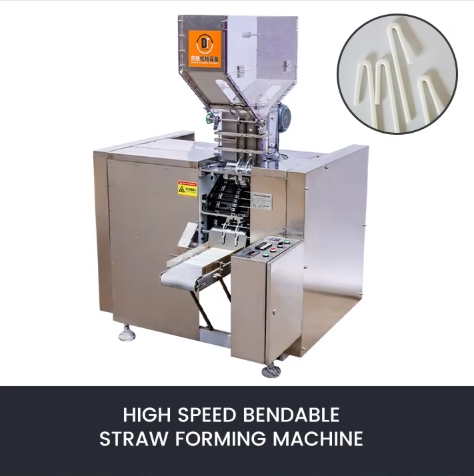
The core product in this category is the high-speed flexible straw forming machine, model DT-1200. Its published specifications include:
- Power: 5.5–6.5 kW
- Output: 3,000–5,500 pieces per minute
- Working pressure: 1.5–6.0 MPa
- Working temperature: 100–200 °C
- Protection grade: IP55
- Material: stainless steel
The machine is intended for disposable straw manufacturing, catering utensil production, plastic/paper tube and packaging industries, and OEM/ODM straw processing factories.
One factor that distinguishes the DT-1200 is a patented forming technology (Patent No. ZL202020756632.1). The patent covers an independent embossing and forming module, which improves output; a high-efficiency embossing method that relaxes tolerance limits for tube blanks, allowing standard straw diameter tolerance of ±0.05 mm; a precision feeding unit; separately adjustable embossing and forming modules; and a PLC control system that displays real-time operating status, stops the machine automatically on malfunction with a fault code, and counts production automatically.
From a buyer perspective, these details matter because they affect maintenance intervals, scrap rates, and operator skill requirements.
Technical explanation: how a high-speed flexible straw forming machine works
A high-speed flexible straw forming machine takes straight tube blanks, feeds them through an embossing or forming zone, and creates the bendable segment that allows the straw to hold an angle. The process requires precise coordination between feeding, forming, and counting or stacking. The DT-1200 uses a modular design: embossing and forming modules can be adjusted separately, which means maintenance does not require dismantling the entire forming section. The PLC adds a layer of production control by reporting output counts and stopping for faults.
In practical terms, the ±0.05 mm diameter tolerance is an important process capability. Straw diameter consistency affects sealing in packaging machines and customer perception of product quality. The patent describes a high-efficiency embossing technology that relaxes the tolerance requirements for incoming tube blanks, so the machine can remain stable even when raw material quality varies slightly.
Application scenarios
The DT-1200 can operate as a standalone unit or be connected to a full production line with feeding, sealing and cooling, packing, and conveying modules. It is designed for continuous automatic operation in a normal-temperature workshop environment with stable power supply and raw material feeding. Typical projects include new production line construction, single machine procurement, production line capacity expansion, or equipment replacement.
Documented application examples from Dongtie's customer work include:
- 10 mm decorative straws for Middle East clients
- 3.8 mm U-shaped straws used in domestic dairy factories
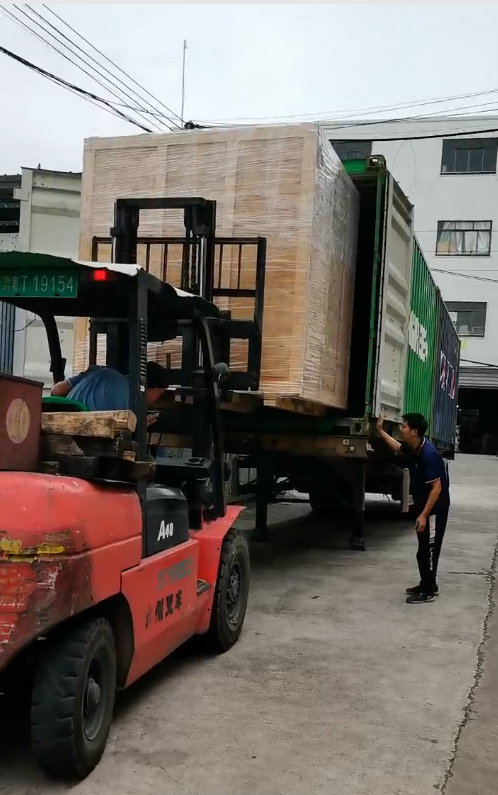
- Container-level shipments to Southeast Asia for straw production lines
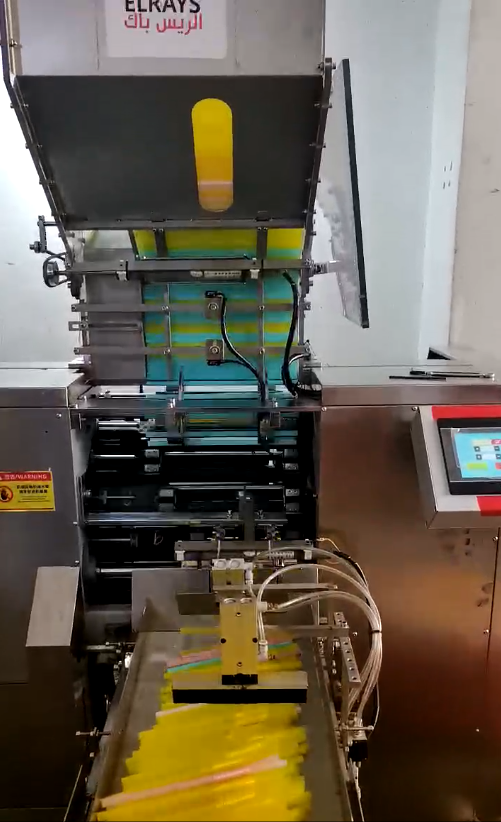
These examples show that the machine is not limited to a single straw format. By changing molds, it can produce flexible straws with different diameters and bending angles.
Market context and verified industry data
Several trends support investment in high-speed flexible straw forming equipment:
- Industrial end-users account for an estimated 40.1% of the straw machine market in 2025 projections, according to Dataintelo.
- China accounts for more than 66% of global export value for flexible straw bending machinery, based on 2023 trade data.
- The U-shaped straw segment is growing specifically for aseptic packaging applications such as milk cartons.
- Semi-automatic straw machines are projected to grow at a CAGR of 9% for small and medium enterprises, indicating that many producers are still transitioning from manual lines.
- North America held the largest share of the paper straw market at 34.9% in 2024, underlining the regional shift toward paper-based formats.
Regulatory requirements also influence machine choice. Machines sold in the EU must comply with the Machinery Directive 2006/42/EC and carry the CE mark. The harmonized safety standard EN ISO 12100 applies to machinery design, and EU Regulation (EC) No 1935/2004 requires that food-contact production machinery must not transfer constituents to food in quantities that endanger health. For buyers importing into China or other markets, HS code 84778090 is the primary classification for drinking straw machines according to the General Administration of Customs of China.
Comparison with traditional solutions
Compared with a conventional semi-automatic or low-speed flexible straw machine, a high-speed machine such as the DT-1200 offers substantially higher throughput, integrated fault detection, automatic counting, and lower labor intensity per thousand pieces. The manufacturer positions one high-speed flexible straw forming machine as capable of replacing five conventional machines, while maintaining a minimum output of 1,000 pieces per minute without the chronic needle-breakage problem.
There are, however, documented boundaries. A high-speed machine requires a higher initial capital investment and more careful raw material preparation. Different straw diameters and bending angles require custom molds, and special standards for raw material specification and surface treatment apply. Buyers should confirm material compatibility and mold solutions before placing an order. For very small batch sizes, the cost and time of mold change may reduce the benefit of high-speed operation.
Key selection criteria for a high-speed bendable straw forming machine
Procurement teams evaluating this equipment category should look beyond the headline speed. The following criteria are commonly relevant:
- Throughput and power: Match output to actual order volumes and available electrical capacity.
- Diameter tolerance: Tighter tolerance, such as ±0.05 mm, supports stable packaging and finished-product quality.
- Mold change flexibility: Quick changeover between diameters and bending angles reduces downtime for mixed orders.
- Automation level: PLC control, fault codes, automatic counting, and real-time status monitoring reduce operator dependency.
- Integration capability: The ability to connect to packaging systems or stacking modules supports end-to-end production.
- Maintenance and service: Modular construction, accessible lubrication points, remote video guidance, and on-site training affect long-term operating cost.
What this means for procurement
For manufacturers evaluating a high-speed bendable straw forming machine, the decision is less about peak speed and more about fit. A machine rated at thousands of pieces per minute only creates value if the downstream packaging capacity, raw material supply, and maintenance plan are aligned. Buyers should request mold drawings for the exact diameters and bending angles they need, confirm that the raw material can be processed within the machine's tolerance, and verify the supplier's support model for installation and commissioning.
Dongtie's DT-1200 is designed for manufacturers that have moved past pilot production and need consistent, high-volume output across multiple straw formats. It is not the simplest option for a workshop producing occasional batches; a semi-automatic machine may be more appropriate in that case.
Future outlook
As plastic straw restrictions expand in some regions while remaining dominant in others, equipment buyers will need agility. The ability to switch between 3.8 mm U-shaped dairy straws, 6 mm flexible straws, 12 mm decorative straws, and other formats on one machine is becoming a competitive advantage. Dongtie's product range already covers these variants through models such as the 3.8mm U-shaped straw forming machine, 6mm high-speed bending machine, and 12mm large-diameter decorative straw forming machine.
The longer-term direction is toward integrated lines: forming machines connected to automated packaging systems, with PLC-based production data feeding into shop-floor management. Dongtie's DT-1200 supports optional downstream modules such as fixed-quantity packaging systems and automatic stacking units, which fits this trend. For overseas buyers, export documentation, CE marking, and food-contact compliance are becoming part of normal procurement checklists.
Frequently asked questions
Can this machine produce straws of different diameters and bending angles?
Yes. By changing corresponding molds, the machine can manufacture flexible straws with different diameters and bending angles to meet diversified production demands.
What are Dongtie’s core strengths?
Zhongshan Dongtie Machinery Factory has focused on straw machinery manufacturing since 2010. The technical team has 25 years of straw production experience. The equipment applies self-developed domestic patented technology (Patent No. ZL202020756632.1), which includes an independent embossing and forming module, high-efficiency embossing technology, a precision feeding unit, separately adjustable modules, and a PLC control system with fault codes and automatic counting. Remote video technical guidance is available for common faults, and on-site training can be arranged in a workshop equipped with more than ten full production lines.