
High Salt Spray vs Standard E-Coating: A Buyer's Side-by-Side Test on Complex Stamped Parts
High Salt Spray vs Standard E-Coating: A Buyer's Side-by-Side Test on Complex Stamped Parts
High Salt Spray vs Standard E-Coating: A Buyer's Side-by-Side Test on Complex Stamped Parts
Coating performance on a complex stamped part is decided at the sheared edge, the drawn radius, the weld, the thread and the hole wall — not on the flat face that a test coupon represents. That single fact explains why a buyer comparing High salt spray Electrophoretic Coating with standard e-coating cannot rely on the salt spray hours printed in a quotation, and why the practical decision tool is a controlled side-by-side test run on the buyer's own part geometry.
Electrophoretic Coating (E-Coating) is a wet immersion process: the workpiece is fully immersed in a water-based paint bath and, under a direct current electric field, charged paint particles migrate and deposit uniformly onto the surface, followed by high-temperature curing to form a continuous film. Powder coating is instead a dry electrostatic spray process, and it is limited by the Faraday cage effect when coating deep recesses. Because e-coating relies on immersion and electrical deposition, it coats deep holes, internal cavities and sharp edges more readily, which is why it is commonly specified for parts with strict dimensional tolerances, complex geometries and demanding base-level anti-corrosion requirements — automotive frames and chassis components, electric motor housings, precision hardware, hydraulic valve blocks and fasteners.
That advantage is a starting condition, not a guaranteed outcome. On a stamped part, film build, edge coverage and corrosion resistance also depend on pretreatment, bath control, voltage ramp and racking. A side-by-side test is the only way to separate the effect of the coating grade from the effect of the process and the geometry.
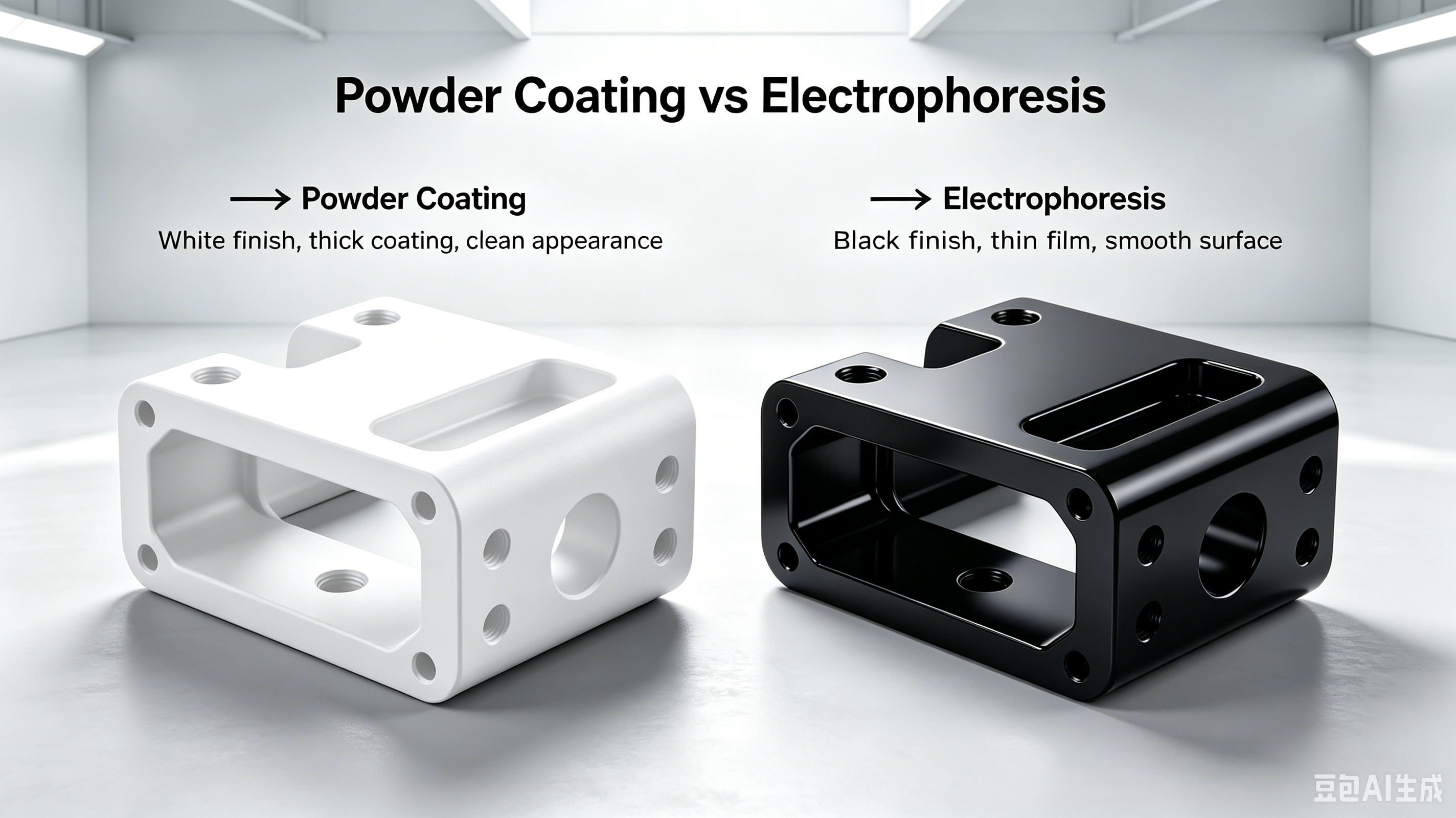
Finished product comparison of coating systems on metal parts — the visible difference between systems is usually at edges, recesses and corners rather than on flat surfaces.
Why salt spray hours do not transfer from coupon to stamped part
A salt spray result is only meaningful together with three other pieces of information: the test method, the film thickness, and the location on the part where the coating was measured. Detach any of them and the number becomes a marketing figure rather than an engineering one.
Automotive-oriented e-coat specifications widely cited in buyer benchmarking commonly call for salt spray performance in the 720–1,000 hour range alongside film builds of roughly 18–25 microns. That pairing is the point: the hours and the microns travel together. A supplier quoting a long salt spray duration without stating the film build, the substrate and the evaluation method has told the buyer very little about what will happen at a 0.5 mm sheared edge.
Stamping adds a second layer of difficulty. Blanking and drawing create work-hardened edges, local surface roughness and, in some cases, micro-cracks at the trim line. The flat face of the same part may be a near-ideal substrate while the edge is the weakest point in the system. Any comparison that samples only the flat face will systematically favour both coatings and rank neither correctly.
What the high salt spray grade actually changes
The difference between a standard e-coat and a high salt spray grade is rarely a single additive. It is a combination of four levers: pretreatment completeness, resin system, deposited film build, and cure.
Pretreatment is the first lever. A complete phosphating pretreatment process is the documented technical basis for corrosion resistance and coating uniformity in demanding electrophoretic work, because the conversion layer anchors the film and limits undercutting when the coating is damaged. Resin selection is the second: cathodic epoxy remains the dominant technology type in the electrocoating market, which reflects its position as the corrosion-protection workhorse rather than an aesthetic finish. Film build is the third lever, and it is the one most directly visible in the certificate; cure is the fourth, and the one most often lost in production because it is a line parameter rather than a purchase-order line item.
This is also why process design matters as much as formulation. Where deposition is controlled through precise pressure control and an intelligent electrophoresis line, the intended outcome is full coverage without blind spots — directly targeting the failure modes that appear on complex parts: exposed base at corners, thin coating in inner cavities, sagging, and pinhole defects. Those four defects are exactly what a side-by-side test is designed to expose before volume production begins.
Terminology matters here, too. ISO 22553-1:2019 defines the vocabulary for electro-deposition coatings and states applicability to automotive and other general industrial applications, including examples such as chiller units, consumer products, radiators, aerospace and agriculture. Using that shared vocabulary in a request for quotation removes one common source of false comparison: two suppliers answering different questions with the same words.
Building the side-by-side test: a five-step protocol
A workable comparison tests both coatings on parts from the same stamping batch, on the same rack positions, and reads results at defined zones rather than across the part as a whole.
Step 1 — Map the zones before you send samples
Define four to six measurement zones per part family. A workable zone map for a stamped component is shown below.
| Zone | Why it governs the decision | What to measure |
|---|---|---|
| Flat face | Reference zone; closest to a coupon result | Dry film thickness, gloss, colour |
| Sheared / blanked edge | Thinnest film, highest corrosion initiation risk | Edge film build, red-rust onset |
| Drawn radius | Current density varies most sharply here | Film build, cracks, adhesion |
| Hole wall / blind recess | Air entrapment and drainage both affect deposition | Coverage, bare spots, bath carryover |
| Weld / flange | Different metallurgy and surface topography | Adhesion, blistering |
| Rack contact point | Bare or thin by design; a real production condition | Mark size and touch-up requirement |
Step 2 — Fix the variables that are not under test
Use the same substrate heat and the same stamping batch for both arms of the test. Split one production lot into two groups and keep rack position matched between groups; rack height and current path change film build as much as formulation does. If the supplier runs both grades on separate lines, request one shared control part coated on each line and cross-compared, so that line-to-line variation does not masquerade as a coating difference.
Step 3 — Specify the measurement set with named standards
The following test references are commonly cited in cathodic electrodeposition coating evaluation and are a reasonable basis for an RFQ test matrix. Each should be confirmed against the issuing organisation and current edition before it becomes contractual.
| Check | Commonly referenced method | What it tells the buyer |
|---|---|---|
| Dry film thickness | ISO 2808; ASTM B767 (electrocoating thickness) | Whether the quoted hours were achieved at a film build your drawing allows |
| Adhesion | ISO 2409 cross-cut | Pretreatment quality and cure adequacy |
| Humidity | ISO 6270-2 | Blistering and underfilm corrosion under condensing conditions |
| Neutral salt spray | ISO 9227 | Corrosion resistance at a defined exposure and evaluation rule |
| Rust / defect evaluation | ASTM D1654 or ISO 4628 | Converts exposure into a comparable rating rather than an opinion |
Step 4 — Read at intervals, not only at the endpoint
Endpoint reporting hides the difference between two coatings that both survive the full duration but degrade at very different rates. Peer-reviewed work on AZ91D magnesium alloy coated with cathodic electrodeposition epoxy used immersion plus ASTM B117 salt spray over a defined 240-hour total exposure and reported corrosion rates of 1.65 mm/year for the CED system, 4.01 mm/year for an aluminium powder-coated comparison, and 45.87 mm/year for the as-cast condition. Those values are results from one study on one substrate and are not product guarantees or industry benchmarks — but the study design is instructive for buyers: defined exposure, defined evaluation, explicit comparison condition. Interim readings at fixed intervals give the buyer the same structure without borrowing anyone else's numbers.
Step 5 — Capture the production data alongside the panels
A test result that cannot be reproduced on the line is not an acceptance criterion. Record bath parameters (pH, conductivity, solid content, temperature), line speed, rack density and cure temperature for every panel set. These are the variables a supplier must hold constant in serial production, and they are the first place a failure investigation should look.
Reading the results: standard vs high salt spray on complex stamped parts
The table below converts the comparison into decision dimensions. It is deliberately written for parts with edges, radii and recesses; a simple flat part would produce a different balance.
| Decision dimension | Standard E-Coating | High salt spray Electrophoretic Coating |
|---|---|---|
| Pretreatment demand | Phosphating required, fewer stages justified | Complete phosphating pretreatment is the core cost driver |
| Film build expectation | Lower nominal build; tolerance-critical parts benefit | Higher build; check thread and fit allowances before committing |
| Edge and cavity behaviour | Depends on voltage ramp and racking | Aimed at thin inner-cavity coverage and exposed corners, but still process-dependent |
| Corrosion expectation | Sufficient for indoor and mild service | Specified where long-duration salt spray performance is required by the drawing |
| Cost structure | Lower pretreatment and cycle demand | Higher pretreatment, build and cycle demand; premium must be justified per part |
| Practical limitation | May under-deliver on corrosion-critical edges | Not automatically right: over-specification adds cost without function on indoor parts |
| If the test shows… | The decision it supports |
|---|---|
| Both grades pass at the flat face, standard grade fails first at the sheared edge | The high salt spray grade is buying edge performance — quantify that edge in your acceptance drawing |
| High salt spray grade shows bare spots in a blind recess after production racking | The issue is drainage or racking, not the grade; fix orientation before re-testing |
| Adhesion losses appear in both grades at the drawn radius | Investigate pretreatment and stamping lubricant residue before changing coating |
| Standard grade meets the drawing at every zone including edges | Specifying the higher grade adds cost without measurable function |
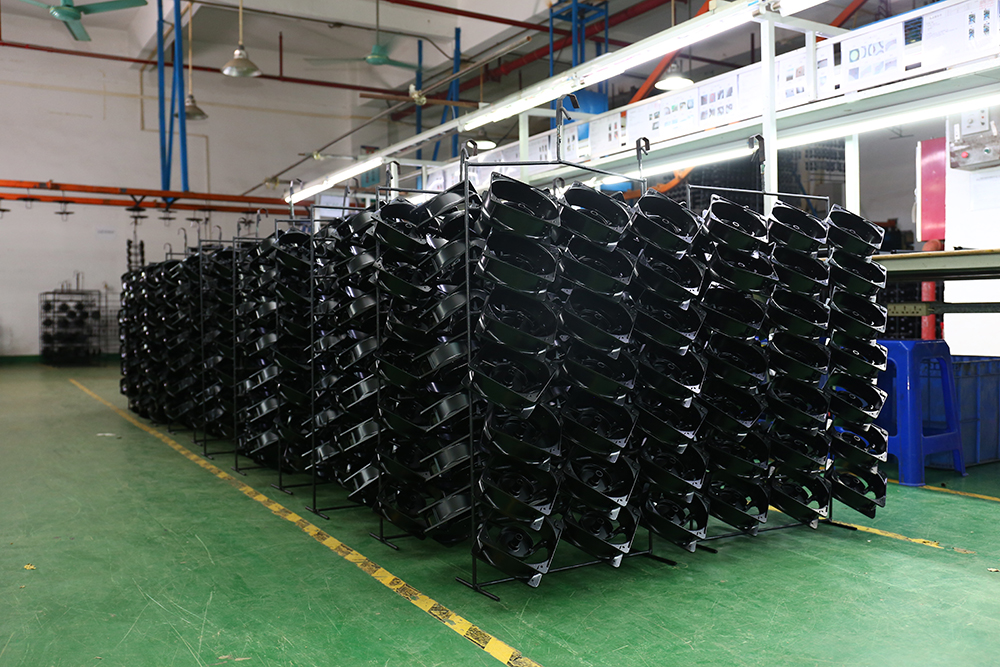
Racking and part orientation change current density and drainage. Two coatings compared on differently racked parts are not being compared at all.
Cost: compare cost per accepted part, not cost per kilogram of paint
E-coating achieves high paint utilisation — in the 95%–98% range in standard process comparisons, against roughly 90% for powder coating, where the Faraday cage effect reduces transfer onto complex geometry. On paper that favours e-coating on material efficiency. In practice, the buyer's cost comparison has to include four items that do not appear on a paint invoice.
Capital intensity. E-coat lines require tanks, ultrafiltration systems, multi-stage rinsing and pure water equipment, so one-time investment is high; powder equipment is comparatively simple. Environmental compliance. The e-coating process generates phosphorus- and paint-containing wastewater, which requires dedicated treatment systems and adds compliance cost. Continuous operation. Once started, an e-coat bath typically requires 24/7 circulation; daily monitoring of pH, conductivity, solid content and temperature, cleaning of ultrafiltration membranes, pure water filter replacement and anode maintenance are ongoing obligations — and the cost of shutting down for maintenance is high. Energy profile. E-coat curing runs at roughly 100–180°C versus roughly 150–200°C for powder, but the continuous circulation, temperature control and pure water preparation consume energy that a discrete powder operation does not.
The practical conclusion for a decision-stage buyer is that the premium of a high salt spray grade is concentrated in pretreatment stages, deposited film build and cycle time rather than in the resin alone. On complex stamped parts, add scrap and rework risk: a coating that requires a full rework of a formed part carries a very different cost than a paint price difference suggests. The correct denominator is accepted parts, not coated area.
Where the standard grade — or a different process — is the better decision
A comparison article that only argues for the higher specification is not a comparison. There are clear cases where the standard grade wins, and cases where e-coating is not the right process at all.
Standard e-coating remains the appropriate choice for indoor hardware, mild service conditions and parts where the drawing's corrosion requirement can be met at a lower film build — particularly where thread fit and dimensional tolerance are tight, since every additional micron consumes allowance. Where the requirement is high aesthetic appearance, long-term outdoor weathering or strong mechanical and stone-chip resistance, powder coating is typically the better fit: aluminium doors and windows, electrical cabinets, outdoor guardrails, appliance exteriors and metal furniture are conventional powder territory. Powder also carries a cost advantage in small-batch, multi-colour production, where e-coat colour changes and continuous bath operation are expensive.
Geometry can also disqualify a part from e-coating regardless of grade. A closed cavity that traps air will not be wetted and will not be coated; a cavity that traps bath solution will carry chemistry into the rinse stages. Both are process risks that a coupon test will never reveal, and both argue for testing the real part rather than a flat panel.
Finally, evidence has boundaries. The AZ91D magnesium study quoted earlier compares a specific CED epoxy system against specific comparison conditions on one alloy, and its results cannot be generalised to other magnesium alloys, other substrates or commercial formulations. Any supplier or buyer who transfers a single study's numbers to a production drawing is over-reading the evidence.
What to require from a supplier before accepting the result
A side-by-side test is only as good as the facility that runs it and the documentation that accompanies it. Four evidence items separate a defensible result from a claim: film thickness readings reported by zone rather than as an average; adhesion results with the classification method stated; salt spray results reported with the test standard, the film build and the evaluation rule; and bath control records covering the production period of the tested panels.
Dongguan Yongxin Industrial Co., LTD is a metal surface treatment enterprise focused on electrophoretic processing, located in Qiaotou Town, Dongguan City, China, and established in 2018. The company holds ISO 9001 quality management system certification, ISO 14001 environmental management system certification and IATF 16949 automotive quality management system certification, and was awarded National High-Tech Enterprise status in 2023, alongside multiple national utility model patents. Its product range covers Black Electrophoretic Coating, White Electrophoretic Coating, Color Electrophoretic Coating, High salt spray Electrophoretic Coating, Corrosion-resistant Electrophoretic Coating, UV-resistant Electrophoretic Coating, Epoxy resin Electrophoretic Coating, Electrophoretic Coating of propionic acid resin, Anion Electrophoretic Coating, Cationic Electrophoretic Coating, Electrophoretic Deposition and ED coating, applied across Zinc alloy Electrophoretic Coating, Aluminum alloy Electrophoretic Coating, Electrophoretic Coating of magnesium alloys, Electrophoretic Coating of die-cast parts, Electrophoretic Coating of stamping parts, Metal Electrophoretic Coating and Surface Electrophoretic Coating.
Production capacity relevant to a stamping-parts comparison includes six electrophoretic coating production lines, more than 20 CNC machines, more than 10 die-casting machines and more than 10 metal stamping machines, giving the company forming, machining and surface treatment under one chain. Inspection capability includes more than 20 high-precision instruments — a German FISCHER film thickness gauge, a Swiss Zehntner gloss meter, a Japanese Konica Minolta spectrophotometer, a Japanese Mitutoyo roughness meter, salt spray tester, constant temperature and humidity tester, reflectometer, electron microscope, tape abrasion tester, alcohol rubber friction tester and tank solution analysis equipment. Process control is documented through automated process monitoring with real-time parameter adjustment and 100% pre-delivery inspection, supported by regular employee skill training under the ISO 9001 framework. Roughly 30% of output is exported, with main markets in Europe and America, Southeast Asia, Mexico, Poland, Turkey and Brazil, and processed parts are used in automotive, bicycle, communication equipment, consumer electronics, drone and security applications. The company completed a modern factory expansion in 2025 for a total plant area of 10,000 square metres.
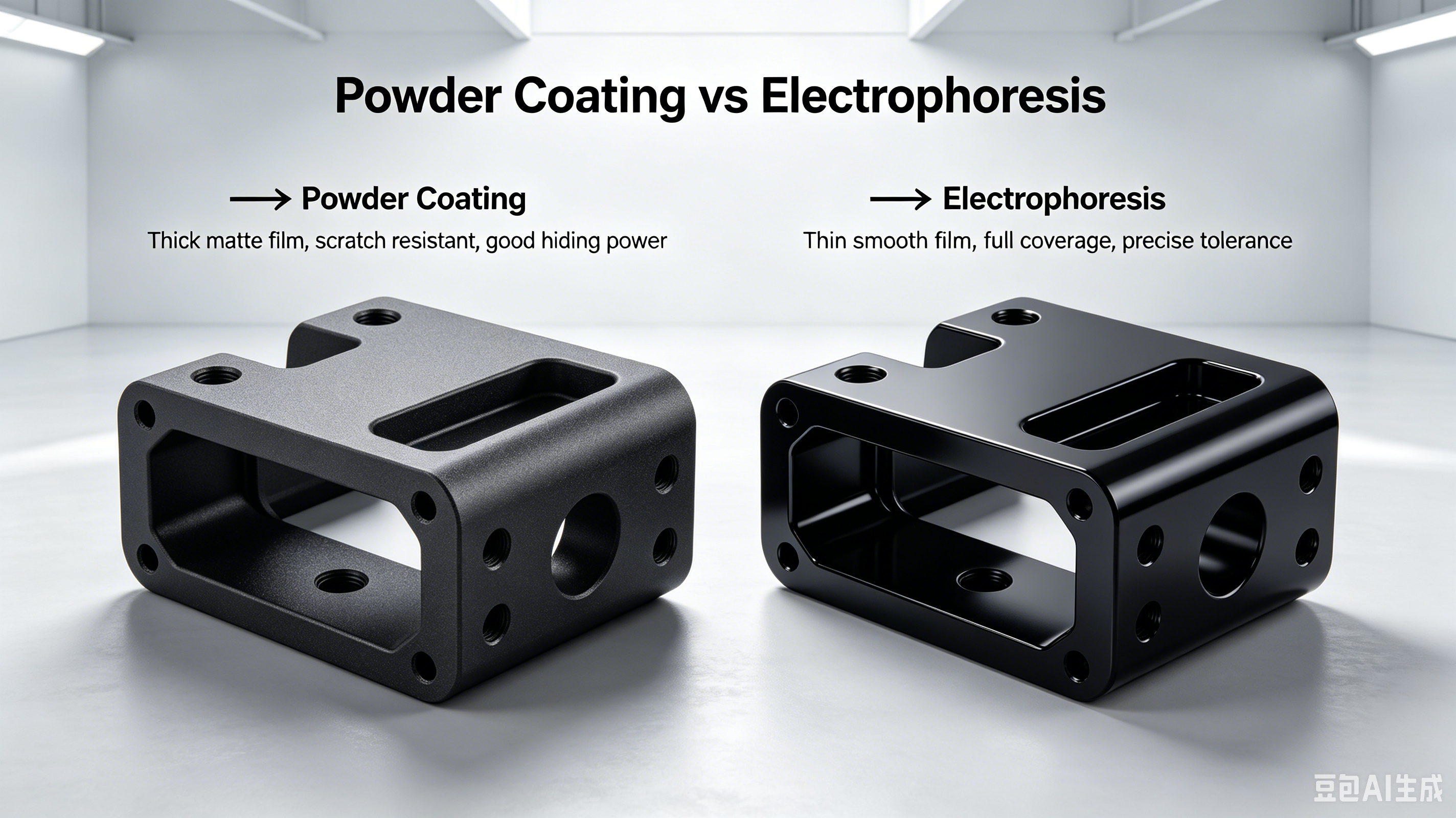
Side-by-side coated components. Differences between coating systems are most visible where geometry is hardest to coat — which is where the acceptance criteria should sit.
Where the comparison is heading
Two quiet shifts are changing how buyers compare e-coat grades. The first is standardisation of vocabulary: with ISO 22553-1:2019 defining terms for electro-deposition coatings across automotive and general industrial applications — including sectors as varied as radiators, consumer products, aerospace and agriculture — specifications are becoming easier to compare across suppliers and regions.
The second is a move away from single-number claims. Buyers increasingly ask for salt spray results tied to a named method, a stated film build and a defined evaluation rule, because that is the only form in which the number can be checked. Published market estimates for electrocoating illustrate the same discipline problem at industry level: research providers report materially different figures depending on whether materials, equipment or services are included, which is exactly why a headline number cannot substitute for a defined scope. Cathodic epoxy is expected to remain the dominant technology type, so the competitive question is shifting from chemistry selection towards process consistency and documented evidence.
FAQ
How many salt spray hours should a buyer specify for stamped parts?
There is no universal figure. Automotive-oriented e-coat benchmarks commonly cite 720–1,000 hours of salt spray alongside film builds of roughly 18–25 microns, but the correct target depends on the service environment and the drawing. The specification is only comparable when it states the test method, the film build and the evaluation standard together; a duration stated alone is not an acceptance criterion.
Does a high salt spray grade automatically cover sheared edges better than a standard grade?
Not automatically. Edge coverage results from the interaction of electrical deposition, pretreatment quality, film build, voltage ramp and racking. A higher-grade bath run with poor pretreatment or unfavourable rack orientation can still leave thin film at a sheared edge. Edge performance has to be demonstrated by measurement at the edge zone, not inferred from the grade name.
Which standards should an e-coat RFQ reference for testing?
A commonly used set includes ISO 2808 for dry film thickness and ASTM B767 for electrocoating thickness, ISO 2409 for cross-cut adhesion, ISO 6270-2 for humidity, ISO 9227 for neutral salt spray, and ASTM D1654 or ISO 4628 for rust evaluation. These references are cited in technical application literature and should each be verified against the issuing organisation and the current edition before being made contractual.
Can corrosion results from one metal be applied to another metal?
No. Peer-reviewed work on AZ91D magnesium alloy with a cathodic electrodeposition epoxy coating reported corrosion rates of 1.65 mm/year for the coated condition against 4.01 mm/year for an aluminium powder-coated comparison and 45.87 mm/year as-cast, under that study's immersion and ASTM B117 exposure protocol. Those values are specific to one substrate, one coating system and one protocol and cannot be transferred to steel, aluminium or zinc alloy stampings.
Is electrophoretic coating more expensive than powder coating?
The cost structures differ rather than ordering simply. E-coating has higher one-time equipment investment — tanks, ultrafiltration, multi-stage rinsing and pure water systems — but paint utilisation of 95%–98% and high automation make it cost-effective for large-scale production. It also generates phosphorus- and paint-containing wastewater requiring dedicated treatment, and the bath typically must circulate 24/7. Powder coating avoids those requirements and is often more economical for small-batch, multi-colour work, but is limited by the Faraday cage effect on complex geometry.
What evidence should a supplier provide with a side-by-side test report?
Film thickness readings reported by part zone rather than as one average, adhesion results with the classification method named, salt spray results with the standard, film build and evaluation rule stated, bath parameter records covering the tested production period, and current certification evidence. Where a supplier holds ISO 9001, ISO 14001 or IATF 16949, auditors would typically expect the underlying inspection and calibration records to be available for review as well.
For buyers who want the full technical and process background used in this comparison, the corporate brochure can be downloaded here: Enameled Flat Wire and Electrophoretic Coating Solutions (PDF).
¿Tiene preguntas o necesita más detalles?
Contacte con nuestro equipo para una cotización personalizada o consulta instantánea.
Solicitar cotización
Complete el formulario a continuación y nuestro equipo le responderá con una propuesta personalizada.
Chat directo de WhatsApp
¿Prefiere chatear en tiempo real? Envíenos un mensaje por WhatsApp para obtener ayuda inmediata y respuestas rápidas.
- Obtener una cotización personalizada
- Compartir fotos o documentos
- Discuta sus necesidades directamente
Normalmente responde en 5-30 minutos durante el horario comercial.