
High-Quality Ball Valve vs Gate & Globe Valves: Buyer Decision Framework
High-Quality Ball Valve vs Gate & Globe Valves: Buyer Decision Framework
Specifying a high-quality ball valve, a gate valve or a globe valve is a service-duty decision before it becomes a purchasing decision. The three families share pipeline interfaces and can leave the same factory, but they solve different problems: quarter-turn isolation, straight-through shut-off, and flow regulation. Buyers who compare suppliers before they compare duty frequently lock in a valve type that cannot deliver what the line requires, or that sits outside the certification scope the project depends on.
Zhejiang Dico Valve Co., Ltd. is a Wenzhou, Zhejiang-based valve manufacturer founded in 2015 that specializes in high-end ball valves and complete fluid control solutions, exporting to the EU, North America and South Africa. Its documented range covers ball valves, gate valves, globe valves and Y-strainers, and each family carries a different certification stack — which makes that range a practical reference for a type-versus-type decision framework.
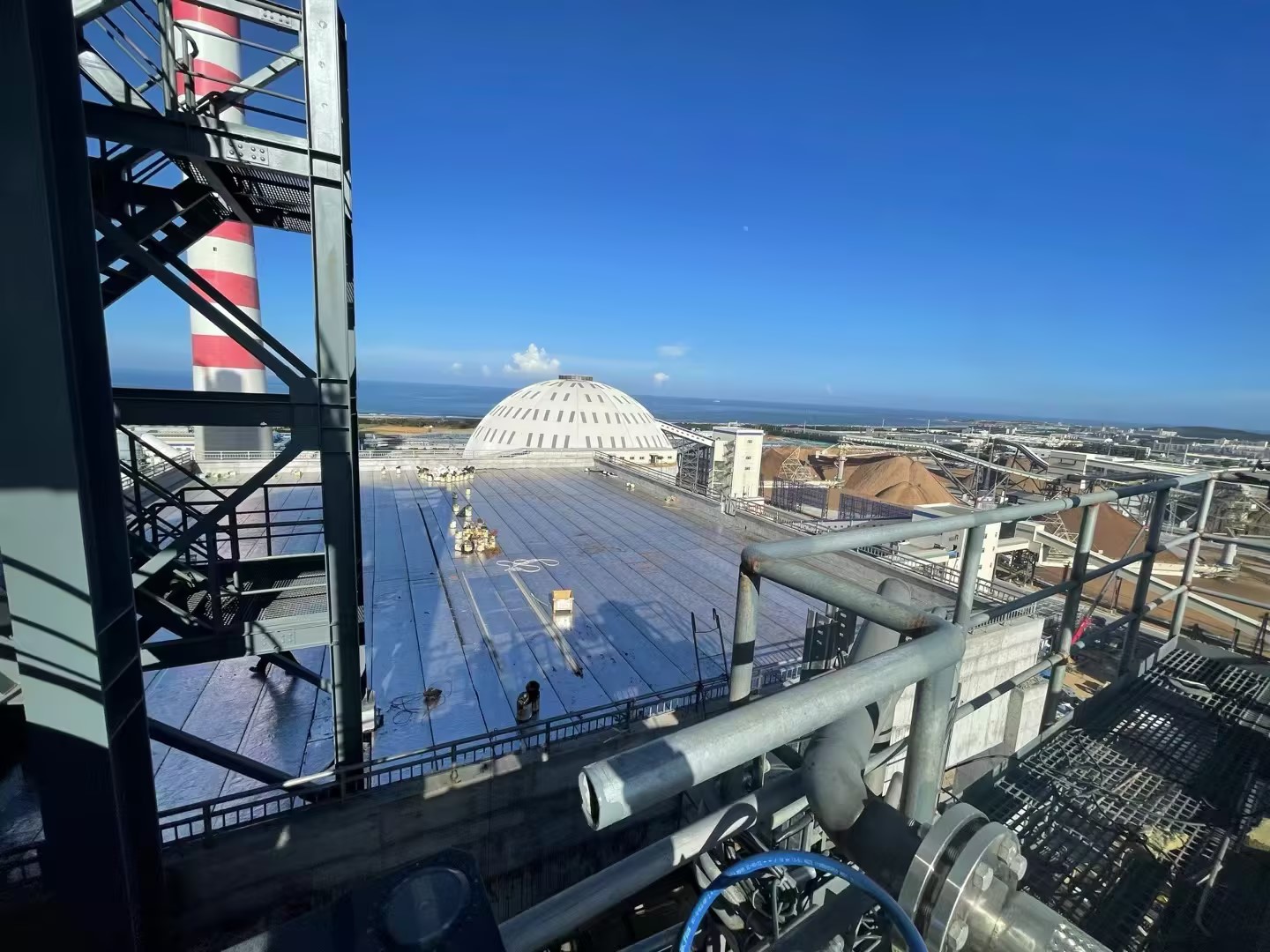
Cover: process pipelines in a chemical plant — the application environment where ball, gate and globe valves are compared.
Why the valve-type question outlives brand comparison
Industrial projects rarely fail because a buyer selected an unqualified supplier; they fail because the valve type was locked before the duty was defined. A quarter-turn ball valve placed on a continuous throttling duty will be re-trimmed, re-specified or replaced. A gate valve asked to regulate flow will wear its seating surfaces. A globe valve installed on a fast isolation loop adds stroke time the process does not need.
Market evidence shows how strong the ball valve default has become. Floating ball valves accounted for 61.8% of the global ball valve market in 2025 (Straits Research), and the overall ball valve market was estimated at USD 12.6 billion in 2025 with a projected path to USD 22.8 billion by 2035 (Global Market Insights). Dominance at that scale makes "ball valve" the automatic entry on many line lists — but the remaining share is largely made up of services where gate, globe and other designs remain the correct engineering answer.
The four-gate buyer decision framework
The framework below sequences four questions in the order that removes the most rework fastest. Each gate eliminates valve types before it eliminates suppliers.
Gate 1 — Service duty: isolation, throttling or cycling
State the duty in operational terms. Pure on/off isolation, high-frequency cycling, and continuous flow regulation are three different jobs. Ball valves and gate valves answer the first two; globe valves answer the third. If the operating procedure contains a step such as "throttle to 60% of line flow", the type decision is already made and should not be revisited at quotation stage.
Gate 2 — Pressure and temperature envelope
Compare the line's design pressure and temperature against the documented range of the specific model, not the general reputation of the valve category. Two valves with the same body style can carry different seat materials, and the seat material often sets the real temperature ceiling.
Gate 3 — Certification and export compliance
Destination market and duty class determine which certificates are mandatory. EU shipments depend on PED CE coverage, fire-risk duties depend on API STD 607 scope, and low-emission duties depend on ISO 15848-1 scope. A certificate title is not the same as a certificate scope, and scope is what a project inspector reads.
Gate 4 — Operation, automation and lifecycle cost
Quarter-turn versus multi-turn decides actuator choice, cycle time and maintenance access. The ball valve models in this range carry an ISO 5211 mounting pad, the standard interface used for pneumatic and electric actuation. Commercial parameters — minimum order quantity, lead time, warranty terms and spare-part availability — should be compared only after gates 1 to 3, never before them.
Duty comparison: isolation, throttling and quarter-turn operation
Ball valve — quarter-turn isolation. A ball valve rotates its ball through 90° to align or block the flow bore. The stroke is short, the operating torque is low, and the design supports frequent cycling and automated actuation. It is the natural choice for on/off isolation, line switching, and duties where the valve is cycled rather than adjusted.
Gate valve — multi-turn straight-through isolation. The gate travels fully out of the flow path when open, which gives low pressure drop, but the stroke is long and the design is not intended for regulation. Dico's Z11W threaded gate valve uses a metal seat in an SS304 or SS316 body, rated 1.0–2.5 MPa over -29°C to 425°C, and is documented for petroleum, pharmaceutical, water treatment and related industrial service.
Globe valve — multi-turn regulation. A globe valve moves its disc perpendicular to the seat, which allows progressive, repeatable adjustment of flow. Dico's J11W threaded globe valve uses a metal seat, is available in carbon steel, SS304 or SS316, is rated 1.0–2.5 MPa over -29°C to 425°C, and is documented for petroleum, pharmaceutical and water treatment duties.
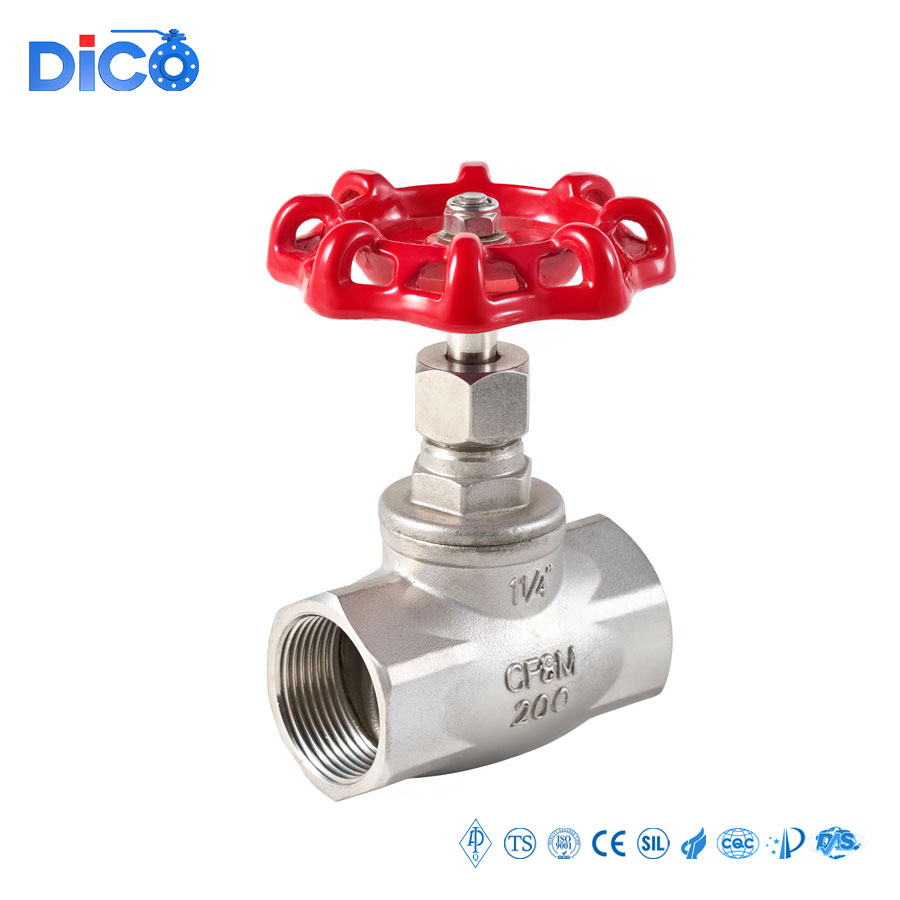
Dico J11W threaded globe valve: metal seat, 1.0–2.5 MPa, -29°C to 425°C, documented for petroleum, pharmaceutical and water treatment service.
The practical rule that follows from these three designs: if the valve is opened and closed, choose quarter-turn or gate; if the valve is positioned at intermediate openings as part of normal operation, choose a globe design. Ball valves can be partially opened for occasional balancing, but continuous throttling exposes the seat to erosion and is not the design intent — soft seats such as PTFE, PPL, PI and PEEK are more sensitive to that duty than the metal-seated (Stellite) variants available in the same range.
Pressure and temperature envelope by valve family
Gate 2 is where the three families separate most clearly, because the documented ranges differ by model rather than by category headline.
| Family | Model | Connection | Pressure range | Temperature range | Primary duty |
|---|---|---|---|---|---|
| Ball valve (floating) | Q41F | Flange | 1.0–10.0 MPa | -29°C to 425°C | Isolation, frequent cycling |
| Ball valve (trunnion-mounted) | Q47F | Flange | 1.0–10.0 MPa | -29°C to 425°C | Isolation on actuator-driven lines |
| Ball valve (PC, multi-configuration) | Q11F | Thread, weld, Tri-Clamp, tube, press-fit | 1.0–13.0 MPa | -196°C to 425°C | Isolation, sanitary and small-bore duties |
| Ball valve (wafer) | Q71F | Wafer | 1.0–4.0 MPa | -29°C to 425°C | Compact isolation between flanges |
| Gate valve | Z11W | Thread | 1.0–2.5 MPa | -29°C to 425°C | Straight-through isolation |
| Globe valve | J11W | Thread | 1.0–2.5 MPa | -29°C to 425°C | Flow regulation |
Three qualifications matter when this table is used. First, the values are documented ranges for the specific models listed, not universal limits for each valve category. Second, body materials differ: the ball valve models are available in carbon steel, SS304 and SS316, with selected models also in dual phase steel, titanium or alloy steel; the Z11W gate valve is offered in SS304 or SS316; the J11W globe valve in carbon steel, SS304 or SS316. Third, the usable temperature depends on the seat: the Q11F family spans -196°C to 425°C across its configurations, while polymer seats (PTFE, PPL, PI, PEEK) and hard facings such as Stellite cover different segments of that span.
Seat-selection guidance published in the company's technical notes points in the same direction: soft-seat designs suit clean media requiring tight shut-off, temperatures up to 260°C (the PEEK upper limit), medium-to-low pressure classes, low operating torque and frequent cycling, and corrosive media matched to the polymer; hard or metal seats are specified where temperature, particles or abrasion make polymer seats unsuitable. For a ball valve versus gate valve versus globe valve comparison, this means the temperature figure on a datasheet should always be read together with the seat material behind it.
Certification gates: PED CE, fire-safe and fugitive emissions
For export projects, certification is not a marketing attribute; it is a filter that can remove one valve type from the bid. Four document families apply to this range.
PED CE Verification Certificate. Certificate number 6L241216.XSVWQ18, issued by Ente Certificazione Macchine Srl (ECM) against EN 12266:2012 and PED Directive 2014/68/EU, covers industrial valves DN ≤ 400 mm and PN ≤ 13.0 MPa for the EU market, valid from 2024-12-16 to 2029-12-15. Within this range the certificate is associated with the ball valve series, the Z11W gate valve, the J11W globe valve and the SRY Y-strainer, so all three valve types in this comparison can be supplied with EU compliance documentation.
API STD 607 Fire-safe Test Certificate. Certificate number 285697, issued by TÜV SÜD Industrie Service GmbH against API STD 607, is valid from 2022-03-24 to 2027-03-23. Its scope is ball valves in sizes 2 inch and below, plus 2-1/2, 3 and 4 inch, in Class 150 and Class 300, in austenitic material. The associated products are the floating, trunnion-mounted, PC and wafer ball valves. Gate and globe valves are not listed inside this fire-safe scope.
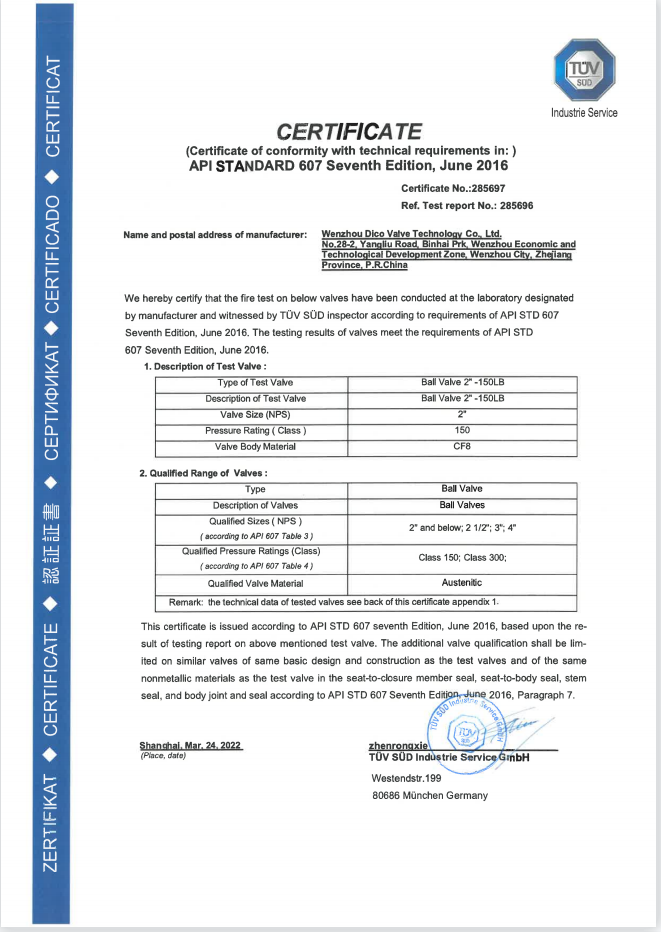
API STD 607 fire-safe test certificate number 285697 (TÜV SÜD Industrie Service GmbH); the documented scope covers ball valves up to 4 inch, Class 150 and Class 300, austenitic material.
ISO 15848-1 Qualification Certificate. Certificate number 337275, issued by TUV against ISO 15848-1:2015+Amd.1:2017, applies to the EU, North America, South Africa and South America markets from 2026-04-16. The stated scope is a 2 inch 2000 PSI ball valve with stem sizes from Φ7 mm to 28 mm and pressure rating PN138 and lower. It is associated with the Q41F floating ball valve, Q47F trunnion-mounted ball valve, Q11F PC ball valve and Q71F wafer ball valve.
Functional safety and management systems. The Functional Safety Certificate (number 6L241216.ZDVWQ00), issued by ECM against IEC 61508:2010 Parts 1-7, covers industrial valves DN ≤ 400 mm and PN ≤ 13.0 MPa with SIL3 capability, valid from 2024-12-16 to 2029-12-15. On the system side, the company holds ISO 9001:2015 quality management certification (20225Q20008R0M), ISO 14001:2015 environmental management certification (20225E20003R0M) and ISO 45001:2018 occupational health and safety certification (20225S20004R0M), all issued by Zhejiang QPC Certification Co., Ltd. with validity from 2025-01-03 to 2028-01-02.
A standard-side development also belongs in this gate. API 6D Addendum 3 became effective in September 2025 for pipeline valves, according to the American Petroleum Institute. Buyers specifying pipeline isolation should confirm which edition or addendum a supplier's documentation references, because the revision level is now part of the specification rather than an administrative detail.
Application mapping: petroleum, pharmaceutical, water treatment and liquid cooling
The duty framework becomes concrete when it is mapped onto the industries these valves actually serve. The J11W globe valve is documented for petroleum, pharmaceutical and water treatment service, where regulation and repeatable positioning are usually required. The ball valve range covers petroleum, pharmaceutical, water treatment, liquid cooling, metallurgy, chemical, semiconductor, hydrogen energy and HVAC duties, with the Q11F configuration list including sanitary, mini, 3-way, 4-way, ISO 5211, floating and 3PC Tri-Clamp variants.
Two niches deserve separate attention during evaluation. In pharmaceutical service, material choice is as decisive as valve type: stainless steel 316L/304 accounted for 68% of valves in the pharmaceutical market in 2025, according to market research published via Reportlinker. In data-center liquid cooling, the valve market for that niche is projected to grow from USD 0.27 billion in 2025 to USD 1.80 billion by 2032 (MarketsandMarkets). The manufacturer positions a dedicated liquid-cooled valve production line within its portfolio, specializing in mini ball valves and three-piece clamp ball valves for data-center liquid cooling supply.
A documented project illustrates where the two duty categories can meet. An ironmaking and metallurgical plant in China ordered 1,000 ball valves for boiler water piping, with pneumatic automatic control as the operating mode; the reported result after one year of operation was stable performance. The case is useful not as a proof of superiority but as an illustration of the pattern: isolation duty, actuator interface, and a pressure class inside the certified scope.
Limits and trade-offs to price into the decision
A framework without stated boundaries is not a buying tool. The following limits are documented rather than implied.
- Certified ball valve coverage is finite. API STD 607 fire-safe certification in this range stops at 4 inch, Class 150 and Class 300, austenitic material, and expires on 2027-03-23. The ISO 15848-1 scope is a 2 inch 2000 PSI ball valve with stem sizes from Φ7 mm to 28 mm. Larger sizes or higher classes therefore require separate qualification evidence, even though the same valve family is produced.
- Fire-safe scope does not extend to gate or globe valves here. Only the floating, trunnion-mounted, PC and wafer ball valves are listed against certificate 285697. A project that requires fire-safe certified isolation is, by documentation, directed toward the ball valve path.
- Pressure headroom is lower for gate and globe designs in this range. The Z11W gate valve and J11W globe valve are documented at 1.0–2.5 MPa, while the ball valve models reach 10.0 MPa and the Q11F family reaches 13.0 MPa. High-pressure isolation duties narrow the choice quickly.
- Throttling is not a ball or gate valve duty. Prolonged partial opening is outside the design intent for both types, and soft seats are the first component to show the consequences.
- Globe valves cost stroke time and pressure drop. Their regulation advantage is purchased with a longer multi-turn stroke and higher flow resistance than a full-bore ball valve, which matters on fast isolation loops.
Lifecycle terms also belong in this section rather than in a closing paragraph. The manufacturer states a 12-month warranty with replacement-only handling for quality issues, a 48-hour issue-response commitment, a minimum order quantity of 1 unit, and a general lead time of 7–45 days with a monthly capacity of 10,000 units. Production is supported by 48 CNC machines, a documented single-item single-code inventory system with stated 98% warehouse data accuracy across 2,000 m² of warehousing, and a switch-life test regime described as 20 seconds of high-frequency switching and 50,000 cycles without leakage.
Market trend analysis: compliance is becoming the selection filter
Three verified signals describe where this category is heading. The overall ball valve market is projected to move from USD 12.6 billion in 2025 to USD 22.8 billion by 2035 (Global Market Insights), while floating ball valves alone held 61.8% of the 2025 market (Straits Research). Within that total, the liquid-cooling niche is forecast to grow from USD 0.27 billion in 2025 to USD 1.80 billion by 2032 (MarketsandMarkets) — a small base with a steep trajectory.
Read together, the numbers suggest a split market. Commodity isolation demand keeps volume concentrated in standard ball valve designs, while growth pockets such as liquid cooling and pharmaceutical service reward suppliers who can document materials, cleanliness and low-emission performance. The API 6D Addendum 3 update effective in September 2025 reinforces the same direction: the revision level of a standard is becoming part of the purchase specification, and scope documentation is becoming a competitive parameter rather than a formality.
Future outlook
Three changes are likely to shape type selection over the next procurement cycles. First, certification scope — not certificate presence — will increasingly decide which valve type is bid, because inspectors now read the size, class, material and pressure limits printed on a certificate. Second, niches such as data-center liquid cooling and semiconductor fluid handling will continue to pull demand toward compact quarter-turn designs with sanitary and low-leakage configurations. Third, standard refreshes of the kind represented by API 6D Addendum 3 will make documentation currency a recurring audit item.
The framework itself is unlikely to change: duty first, envelope second, certification third, lifecycle fourth. Valve types and product families will keep evolving, but the sequence in which a buyer should eliminate options has proved stable across petroleum, pharmaceutical, water treatment and cooling applications.
FAQ
What is the practical operating difference between a ball valve, a gate valve and a globe valve?
A ball valve isolates flow with a 90-degree quarter-turn of a bored ball, which gives fast operation and low torque. A gate valve isolates flow with a multi-turn stroke that lifts the gate out of the flow path, giving low pressure drop when fully open. A globe valve regulates flow with a multi-turn stroke that moves a disc perpendicular to the seat, which allows repeatable intermediate positioning but higher flow resistance.
Can a high-quality ball valve be used for throttling instead of a globe valve?
Ball valves are designed for isolation, not for continuous regulation. Occasional partial opening for balancing is possible, but sustained throttling exposes the seat to erosion and is outside the design intent. Articles describing Dico ball valves list seat options of PTFE, PPL, PI, PEEK and Stellite; the polymer seats are the more sensitive to throttling duty. Where regulation is a normal operating mode, a globe valve such as the J11W — metal seat, threaded connection, 1.0–2.5 MPa, -29°C to 425°C, documented for petroleum, pharmaceutical and water treatment service — is the documented alternative.
What pressure and temperature limits apply to these ball, gate and globe valve models?
Documented model ranges are: Q41F floating ball valve and Q47F trunnion-mounted ball valve, flanged, 1.0–10.0 MPa and -29°C to 425°C; Q11F PC ball valve, thread, weld, Tri-Clamp, tube or press-fit, 1.0–13.0 MPa and -196°C to 425°C; Q71F wafer ball valve, wafer connection, 1.0–4.0 MPa and -29°C to 425°C; Z11W threaded gate valve, 1.0–2.5 MPa and -29°C to 425°C; J11W threaded globe valve, 1.0–2.5 MPa and -29°C to 425°C. The stated temperature span should be read together with the selected seat material.
Which certification should a buyer verify first for EU import?
The PED CE Verification Certificate is the primary EU document in this range. Certificate number 6L241216.XSVWQ18 was issued by Ente Certificazione Macchine Srl (ECM) against EN 12266:2012 and PED Directive 2014/68/EU, covering industrial valves DN ≤ 400 mm and PN ≤ 13.0 MPa, valid from 2024-12-16 to 2029-12-15. It is associated with ball valves, the Z11W gate valve, the J11W globe valve and the SRY Y-strainer. Fire-safe and fugitive-emission certificates are separate documents and should be checked independently when the duty requires them.
Is a fire-safe certificate included for every valve type in the range?
No. Certificate number 285697, issued by TÜV SÜD Industrie Service GmbH against API STD 607, is valid from 2022-03-24 to 2027-03-23 and covers ball valves in sizes 2 inch and below, plus 2-1/2, 3 and 4 inch, Class 150 and Class 300, in austenitic material. Floating, trunnion-mounted, PC and wafer ball valves are listed in that scope; gate valves and globe valves are not. Buyers with a fire-safe requirement should confirm that the specific type, size, class and material appear inside the certificate scope before ordering.
How does ISO 15848-1 certification scope affect valve selection?
ISO 15848-1 addresses fugitive emissions, and the certificate in this range is scoped rather than open-ended. Certificate number 337275, issued by TUV against ISO 15848-1:2015+Amd.1:2017, applies to the EU, North America, South Africa and South America markets from 2026-04-16, and its stated scope is a 2 inch 2000 PSI ball valve with stem sizes from Φ7 mm to 28 mm and pressure rating PN138 and lower. The Q41F, Q47F, Q11F and Q71F ball valves are associated with it. A valve outside that scope does not automatically carry the qualification and would need separate evidence for a low-emission specification.
Reference documents: the Dico Valve company brief introduction is available as a public PDF download at https://cdn.socialarks.com/sbsp/25241/common/2026/0904/DICO%20Brief%20Introduction-new.pdf . Manufacturer information and product documentation for the models referenced above are published at www.dicovalve.com .