
High-Quality Ball Valve Fit for Rack and Manifold Scenarios
High-Quality Ball Valve Fit for Rack and Manifold Scenarios
Liquid-cooled racks turn a routine isolation valve into a layout decision. In a liquid-cooling loop, the valve does not sit on an open pipe rack with a metre of clearance around it; it sits behind a server cabinet, inside a manifold drop, or at the end of a short branch run where a technician may have to reach it with one hand while the loop is blinded off. That is why the practical question in data-center procurement is rarely “does this high-quality ball valve meet a pressure class?” and much more often “does this valve family fit the rack, the manifold and the service route it will actually live in?”
This reference addresses that question directly. It maps the main liquid-cooling valve positions to the ball valve families that suit them, explains what rack density and manifold geometry change in the specification, and separates what the manufacturer's documented evidence actually proves from what a buyer still has to verify at project level.
Zhejiang Dico Valve Co., Ltd, trading as Dico Ball Valve, is a ball valve manufacturer founded in 2015 and located in the Longwan District of Wenzhou, Zhejiang Province, China. Its approval base includes ISO 9001, ISO 14001, API 6D, API 607, CE, SIL and ISO 15848, and it operates a dedicated liquid-cooling valve production line producing mini ball valves and three-piece clamp ball valves that are supplied to Huawei data centers.
Why Rack Density Reshapes the Valve Brief
Higher rack power density compresses the physical envelope of the cooling loop. More heat has to leave a smaller volume, so the loop is routed closer to the compute, the branch pipework becomes shorter and narrower, and the number of isolation points rises because more of the loop has to be individually serviceable. The valve brief changes with it in three ways.
First, the footprint of the valve body and the swing of its handle start to constrain layout. A wafer or clamp-ended ball valve can be inserted into a short branch where a flanged valve of the same nominal bore would need additional straight length on both sides.
Second, isolation granularity increases. Where a single large loop might once have carried one isolation point, a denser installation typically wants a valve at the rack entry, at the manifold branch and at the loop junction, because a fault must be contained without draining an entire row.
Third, the service model becomes part of the specification. A valve that is correct on paper but cannot be operated or replaced within the available access route is a maintenance liability for the life of the hall.
Three Layout Constraints: Envelope, Service Access and Cleanliness
Most liquid-cooling valve mismatches trace back to one of three layout constraints. Treating them as scenario criteria rather than as catalogue filters is what separates a workable bill of materials from a valve list that has to be re-engineered on site.
Envelope and connection type
Rack-side and manifold-branch positions usually have less straight pipe than a general industrial line. Clamp, thread, weld and wafer connections reduce the installed length compared with a flanged body, and the choice between them is driven by the loop's joining method rather than by a generic preference. Where the branch is a bolted manifold drop, the connection geometry has to match the manifold port spacing, not just the nominal bore.
Service access and operation mode
A quarter-turn ball valve is operated by rotating the stem 90 degrees, which suits confined positions where a multi-turn handwheel would be impractical. If the isolation point is expected to be actuated — for sequence control, leak containment or remote isolation — the valve needs a mounting interface that accepts an actuator. Dico's ball valve range carries an ISO 5211 mounting pad for this reason, and the range includes pneumatic and electric ball valve variants.
Cleanliness, leakage and fluid compatibility
A liquid-cooling loop is a closed circuit: a small leak is not a spill, it is a slow loss of coolant, a wet electronics risk and an air-ingress path. Seat and body material therefore matter as much as geometry. Dico's product data lists PTFE, PPL, PI, PEEK and Stellite seat options, hollow or solid balls, and body materials spanning carbon steel, SS304, SS316 and, on the flanged ranges, dual phase steel, titanium and alloy steel.
The Dico Ball Valve Liquid-Cooling Anchor
The most relevant fact for a data-center buyer is not that a valve company also sells into liquid cooling, but that it has organised production around it. Dico Ball Valve has established a liquid-cooled valve production line dedicated to mini ball valves and three-piece clamp ball valves, and those products are supplied to Huawei data centers. That is a specific, narrow production claim rather than a general industry assertion, and it tells an evaluating buyer which product families the factory has built its liquid-cooling experience around.
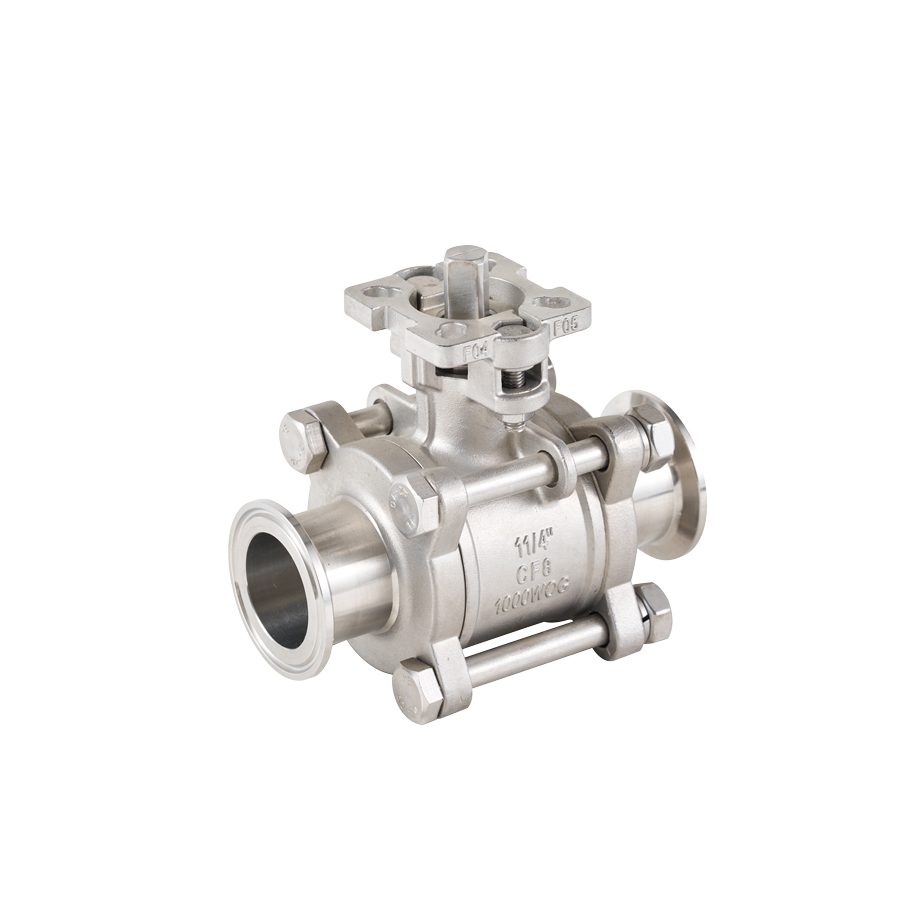
Clamp-connected ball valve: a compact body and clamp end suit short rack-side branches where flanged length is not available. Image: Dico Ball Valve.
The surrounding production context is documented and verifiable. The facility covers 12,000 m² with 80 employees and a seven-engineer R&D team, and runs 48 CNC machines under digital production management. Component and ball quality is controlled through a supplier base with heat-number traceability, machined PTFE seals and precision spherical polishing. Each valve is subject to a 20-second high-frequency switching life test, with a stated 50,000 cycles without leakage. Warehousing covers 2,000 m² with a one-item-one-code system and 98% warehouse data accuracy, which is what allows a repeat project to be picked and shipped against a stable item reference rather than a bespoke description.
Commercial terms are equally concrete: a 12-month warranty with replacement rather than repair for quality issues, and a stated 48-hour response target for after-sales resolution. For a data hall where a failed isolation valve can stall a rack service window, the replacement-not-repair position is arguably more decision-relevant than another decimal place on a pressure rating.
Technical Basis: What the Valve Families Actually Provide
Four families in the Dico range carry most of the liquid-cooling workload, and they differ in ways that map onto layout rather than onto preference.
| Family and model | Connection and form | Documented envelope | Typical liquid-cooling position |
|---|---|---|---|
| PC ball valve, Q11F (mini, sanitary, 3PC tri-clamp variants) | Thread, weld, tri-clamp, tube, press-fit | 1.0–13.0 MPa; -196 °C to 425 °C; carbon steel, SS304, SS316, dual phase steel | Rack entry, manifold branch drop, small-bore drain or vent |
| Three-way ball valve, Q44F | Flange or clamp; L-type and T-type | Carbon steel, SS304, SS316; PTFE, PPL, PI, PEEK, Stellite seats | Loop junction, changeover, blending or bypass routing |
| Trunnion-mounted ball valve, Q47F | Flange | 1.0–10.0 MPa; -29 °C to 425 °C; soft or metal seated | Larger manifold headers and plant-room isolation |
| Wafer ball valve, Q71F | Wafer | 1.0–4.0 MPa; -29 °C to 425 °C; carbon steel, SS304, SS316 | Short flanged gaps where body length must be minimised |
Two engineering details in that table deserve emphasis because they change how a loop behaves in service rather than how it looks on a datasheet. The three-layer stem sealing arrangement addresses the most common slow-loss path on a small valve, and the anti-static structure provides a discharge path where fluid movement can build a charge. Dico's selling-point data lists both across the ball valve families, alongside an ISO 5211 mounting pad and pre-machined flange outer circles.
The quoted pressure and temperature envelopes are family ratings that depend on the seat and body material actually ordered, so they should never be read as a single performance figure for every configuration. A PEEK or PTFE seat and a Stellite metal seat do not behave identically across the same range.
Scenario Mapping: Rack, Manifold Branch and Loop Junction
Liquid-cooling projects rarely fail because the wrong valve class was ordered; they fail because a valve that belonged at the manifold header was installed at the rack, or because a valve sized for a plant room was specified into a position no technician can reach. Mapping the position first, then the family, avoids most of that.
Rack-side isolation. The rack entry position is the tightest envelope in the loop. The mini ball valve is built for exactly this: a small body, a short installed length and a quarter-turn operation that works in a confined cabinet rear. Where the rack plumbing uses quick-connect or clamp joining, the three-piece clamp ball valve allows the body to be serviced without cutting the branch out of the loop, which matters when the alternative is draining a row to replace a seat.
Manifold branch drop. The branch drop carries the same small bore as the rack line but sits in a denser cluster of connections. Here the clamp connection and the compact tri-clamp three-piece body reduce the number of joints in a confined space, and the ability to open the valve body without disturbing the pipe run becomes a maintenance advantage rather than a convenience.
Loop junction and changeover. At the point where a secondary loop meets a manifold, or where a loop must be switched between operating and standby paths, a two-port valve forces a tee plus two valves. A three-way ball valve with an L-port or T-port configuration performs the same routing in one body, which reduces both the joint count and the number of leak paths. Dico's Q44F is available in L-type and T-type with flange or clamp connections and an ISO 5211 pad for actuation.
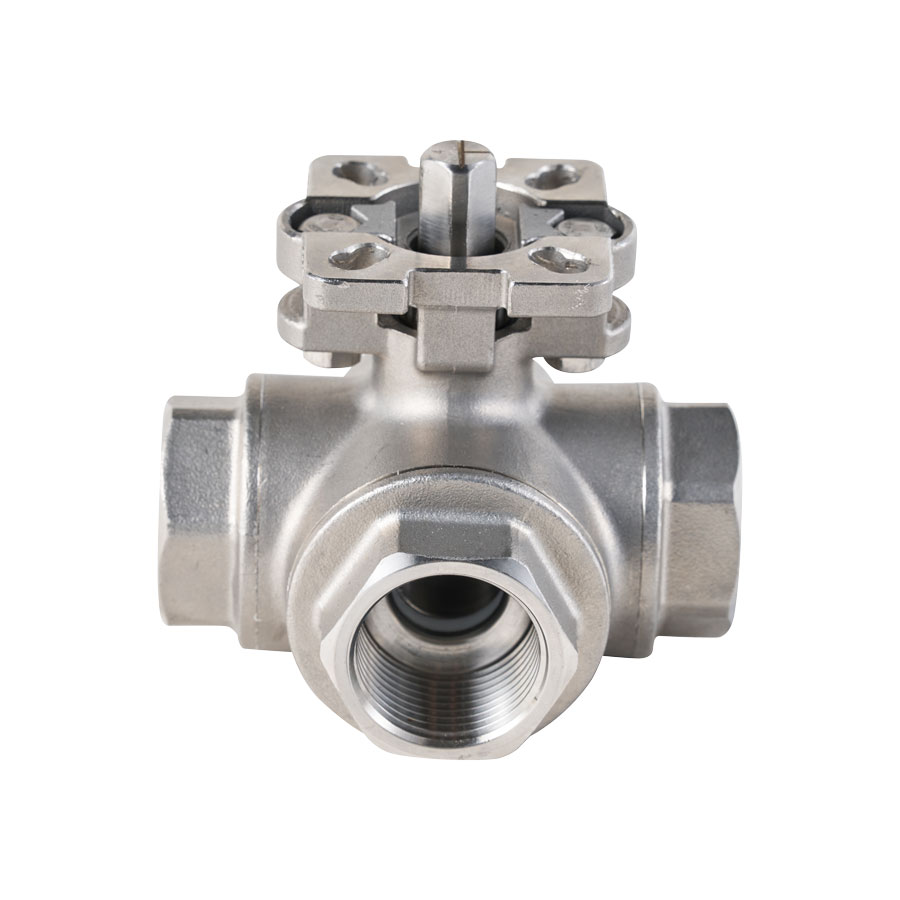
Three-way ball valve: one body replaces a tee and two isolation valves at a loop junction. Image: Dico Ball Valve.
Plant-room and header isolation. Larger manifold headers and the interface to chillers or coolant distribution units sit outside the rack envelope and can accept flanged bodies. The trunnion-mounted Q47F, available soft or metal seated across a 1.0–10.0 MPa and -29 °C to 425 °C envelope, is the more natural fit where the valve is larger and the differential across the closed disc is significant. The wafer Q71F serves the intermediate case: a short flanged gap that still needs a flanged-pattern connection.
Comparison with Conventional Isolation Choices
Gate and globe valves remain common in general industrial service, and the comparison with ball valves in a liquid-cooling layout is worth stating plainly because the trade-offs are real in both directions.
A ball valve isolates with a quarter turn and, in the open position, presents a straight-through bore with little obstruction. That combination is why it suits dense rack and manifold positions where a technician needs a fast, unambiguous open-or-closed state under time pressure. A gate valve needs multiple handwheel turns and a taller operating envelope; a globe valve introduces a flow path that changes direction through the body. Neither characteristic is inherently wrong — both exist for reasons — but neither fits a cabinet-rear isolation point well.
The trade-off runs the other way on seats and temperature. Soft-seated ball valves give tight shut-off and low operating torque in clean media, but seat material limits the usable temperature; PEEK seats, for example, are generally treated as suitable up to around 260 °C, beyond which metal-seated construction becomes the more appropriate choice. Particulate or fibrous media also argue for hard seats, since soft seals wear faster when solids are present. In a filtered, closed liquid-cooling loop the soft-seat case is usually the stronger one, but that is a conclusion about this application, not a general ranking of valve types.
A documented fit boundary worth knowing. Dico's API 607 fire-safe certification covers austenitic material ball valves up to 4 inches in Class 150/300, with a validity running to March 2027. That scope is sufficient for the small-bore rack and branch positions described above, but a project that specifies a larger size or a higher class than the certificate covers cannot rely on it for that item. The correct response is to check the certificate scope against the actual purchase specification — not to assume the certification extends to every valve the factory makes.
Market Signals and What They Do and Do Not Prove
Published research gives the liquid-cooling valve segment a measurable frame. MarketsandMarkets estimated the data-center liquid-cooling valve market at USD 0.27 billion in 2025 and projected USD 1.80 billion by 2032, in a report dated March 2026. Global Market Insights put the wider ball valve market at USD 12.6 billion in 2025 with a projection of USD 22.8 billion by 2035. Straits Research reported that floating ball valves held 61.8% of the global market in 2025.
Those figures are useful context and nothing more. They do not establish that any particular valve family is right for a given rack, and the segment forecast in particular is a projection rather than an observation. Estimates for the same market also differ between publishers because of methodology, so a buyer should treat them as directional signals about where supplier attention is moving, not as a sizing basis for a bill of materials.
One regulatory signal does have direct procurement consequences. API 6D Specification Addendum 3 became effective in September 2025 for pipeline valves, which means a supplier's API 6D documentation should be checked against the addendum rather than against an older certificate revision.
A Buyer's Verification Checklist
Scenario fit can be assessed before an order is placed. The following checks convert the discussion above into questions a project team can put to any liquid-cooling valve supplier, Dico included.
- Position-to-family match. Ask the supplier to state which product family is proposed for the rack entry, the manifold branch and the loop junction, and why. A supplier who proposes one family for all three positions has not engaged with the layout.
- Connection compatibility. Confirm the connection type against the drawing — clamp, thread, weld, tube, press-fit or wafer — and confirm that the body length fits the available straight run, not just that the bore matches.
- Access and actuation. Confirm handle clearance in the installed position, and confirm the ISO 5211 mounting pad if the point may be actuated later. Retrofitting an actuator to a valve without the interface is a replacement, not an upgrade.
- Seat and body material against the fluid. Require the seat material (PTFE, PPL, PI, PEEK or Stellite) and the body material to be named explicitly, and check chemical compatibility against the actual coolant rather than against a general category.
- Test evidence, not just a claim. Ask what the factory tests and how often. Dico runs a 20-second high-frequency switching test with a stated 50,000 cycles without leakage, plus a first-round 100% test and a second round of random checks.
- Certificate scope against the specification. Compare the certificate details — standard, material group, size range, class and expiry — with the valves actually being bought. API 607 at Dico covers austenitic material ball valves to 4 inches, Class 150/300, valid to March 2027.
- Replacement path and stock discipline. Establish the warranty position and the response target in advance. Dico offers a 12-month warranty with replacement rather than repair for quality issues and a 48-hour resolution target, supported by a 2,000 m² warehouse operating a one-item-one-code system at 98% data accuracy.
Outlook
The direction of travel is toward more isolation points in less space, and toward valves that can be actuated later without being replaced. Both trends favour compact, quarter-turn bodies with a standardised actuator interface over larger multi-turn designs, and both put a premium on connection types that shorten the installed length.
For a manufacturer, the corresponding requirement is not a broader catalogue but a production base organised around a narrow product set. Dico's position rests on a dedicated liquid-cooling line for mini and three-piece clamp ball valves, an approval base covering ISO 9001, ISO 14001, API 6D, API 607, CE, SIL and ISO 15848, and documented production controls from heat-number traceability through to the 50,000-cycle switching test. Whether that is sufficient for a specific hall still depends on the certificate scopes, connection drawings and material selections matching the project — which is exactly the check a scenario-fit evaluation is meant to force.
Project teams comparing suppliers can review the manufacturer's product scope and certification documentation directly at Dico Ball Valve, and the downloadable company brochure below sets out the product families and factory facts referenced in this article.
Download the Dico Valve company brochure (PDF)
FAQ
Why is a ball valve usually preferred over a gate or globe valve at a rack-side liquid-cooling isolation point?
The deciding factor is the operating envelope rather than a general performance ranking. A ball valve isolates with a 90-degree quarter turn and, when open, offers a straight-through bore with minimal obstruction. In a confined cabinet-rear position that means a short operating stroke and a clear open-or-closed state. A gate valve requires multiple handwheel turns and a taller operating space, and a globe valve changes the direction of flow through the body. All three types remain appropriate somewhere in a plant; the rack position simply rewards compact quarter-turn operation.
What is the practical difference between a mini ball valve and a three-piece clamp ball valve in a liquid-cooling loop?
Both are compact, quarter-turn isolation valves, and the difference is in serviceability and connection method. The mini ball valve is built around a small body for the tightest positions, such as a rack entry or a short branch where a larger valve body and a longer handle sweep would not fit. The three-piece clamp ball valve is a swing-out body with a clamp connection, so the valve can be opened and its seat or ball inspected without cutting the branch out of the loop. Where a rack position must be serviceable in place, the three-piece clamp design reduces the scope of a maintenance intervention.
When does a three-way ball valve make more sense than two separate isolation valves?
A three-way valve becomes the more efficient choice wherever a loop has to be switched, blended or bypassed between two paths. Two separate isolation valves on a tee achieve the same routing using three components and three sets of joints; a single three-way body performs it with one. Each additional joint is an additional potential leak path, which is a meaningful consideration in a closed coolant circuit. Port configuration must match the duty: L-port for diverting flow between two outlets, T-port where a common path or blending function is required. Dico's Q44F is offered in both L-type and T-type with flange or clamp connections and an ISO 5211 mounting pad.
How should a buyer verify that a ball valve supplier's certifications apply to a specific liquid-cooling order?
Compare the certificate's stated scope against the purchase specification item by item: the standard, the material group, the size range, the pressure class and the expiry date. A certification held for one product group does not extend automatically to a different material or a larger size. As a working example, the API 607 fire-safe certification held by Zhejiang Dico Valve Co., Ltd covers austenitic material ball valves up to 4 inches in Class 150/300 and runs to March 2027, so an order outside those parameters needs separate evidence. The same discipline applies to API 6D, where Specification Addendum 3 became effective in September 2025, and to ISO 15848 documentation, whose stated scope should also be checked against the valves being purchased.
Does the published market growth forecast for liquid-cooling valves indicate which valve type to specify?
No. Market forecasts describe the size of a segment, not the suitability of a component. The MarketsandMarkets estimate of USD 0.27 billion in 2025 rising to USD 1.80 billion by 2032 is a projection about segment scale, and publishers reach different totals for overlapping markets depending on methodology. Product selection still depends on the position in the loop, the connection geometry, the coolant chemistry, the seat and body materials and the available service access. Forecast data can support a business case or a supplier-capacity discussion; it cannot substitute for the engineering check.
¿Tiene preguntas o necesita más detalles?
Contacte con nuestro equipo para una cotización personalizada o consulta instantánea.
Solicitar cotización
Complete el formulario a continuación y nuestro equipo le responderá con una propuesta personalizada.
Chat directo de WhatsApp
¿Prefiere chatear en tiempo real? Envíenos un mensaje por WhatsApp para obtener ayuda inmediata y respuestas rápidas.
- Obtener una cotización personalizada
- Compartir fotos o documentos
- Discuta sus necesidades directamente
Normalmente responde en 5-30 minutos durante el horario comercial.