
High-Precision GNSS Solutions: What Buyers Should Know
High-Precision GNSS Solutions: What Buyers Should Know
High-precision GNSS solutions are positioning systems that combine multi-constellation satellite reception, multi-band signal processing, and, in most cases, RTK corrections to achieve centimeter-level accuracy. They are used across industries where meter-level positioning is not sufficient: UAVs, precision agriculture, autonomous vehicles, robotics, surveying, and fleet management.
For procurement teams and integrators, the buying decision is rarely about a single chip. It depends on correction strategy, form factor, signal environment, temperature range, interfaces, and long-term supply. This article explains how high-precision GNSS solutions work, what Jumpstar offers as a source manufacturer, and what buyers should evaluate during the research phase.

Mapping a canyon with high-precision GNSS requires multi-band RTK positioning and stable satellite tracking.
Why meter-level GNSS is insufficient for industrial automation
Standard GNSS modules are well suited for navigation, tracking, and timing. In Jumpstar's product range, standard modules such as the JS-ATP30-M and JS-ARP30-2 specify horizontal accuracy of 1.0 m, while some single-frequency modules specify 2.5 m CEP. This level of accuracy is enough to identify a road, a vehicle, or a delivery location, but it is not enough to guide an autonomous machine or to generate a survey-grade map.
High-precision GNSS fills that gap. The P-Box-AP55, a multi-constellation multi-band GNSS receiver, achieves RTK horizontal accuracy of 0.6 cm + 0.5 ppm and RTK vertical accuracy of 1 cm + 1 ppm, according to Jumpstar's product specifications. The difference between meter-level standalone positioning and centimeter-level RTK positioning is the main technical reason dedicated high-precision solutions exist.
Jumpstar: source manufacturer of high-precision GNSS components
Jumpstar is the brand name of JUMPSTAR CO., LIMITED, a source manufacturer of GNSS positioning products founded in 2013 and headquartered in Shenzhen, China. The company operates a 5,000 square meter facility with approximately 200 employees, including 20 R&D engineers, and an annual production capacity of 100,000 units. About 70% of sales are exported to the EU, USA, and Middle East.
The product portfolio spans RTK modules, GNSS receivers, GNSS modules, GPS antennas, high precision GPS modules, UAV GPS modules, and anti-jamming GPS antennas. This range gives buyers a route from board-level modules to turnkey receivers.
For quality assurance, the GNSS RTK Receiver product line is ISO9001:2015 certified under certificate number UQ231801R2, issued by Beijing United Intelligence Certification Co., Ltd. for the EU market. In agricultural deployments, ISO 12188 parts 1 and 2 define test procedures for positioning and guidance systems in agriculture and forestry, providing a reference framework for integrators.

A complete RTK positioning terminal and antenna configuration used in vehicle positioning projects.
How multi-band RTK solutions reach centimeter accuracy
High-precision GNSS receivers track more than one constellation and more than one frequency band. The P-Box-AP55, for example, supports GPS L1/L2/L5, GLONASS L1/L2/L3, BDS B1/B2/B3, Galileo E1/E5/E6, QZSS, NavIC, and SBAS across 448 hardware channels. Multi-band reception lets the receiver model ionospheric delay more accurately, which is a major source of error in single-frequency positioning.
RTK adds a correction stream. The receiver receives RTCM 3.x messages from a base station or network service, applies those corrections to its carrier-phase measurements, and computes a fixed solution. In Jumpstar's receiver line, this results in RTK horizontal accuracy of 0.6 cm + 0.5 ppm.
For platforms that need orientation, dual-antenna heading is built into the X43H-AH receiver. It provides heading accuracy of 0.15 degrees at a 1 m baseline and 0.03 degrees at a 5 m baseline, with an overall weight under 25 g. Heading output is relevant for UAV flight lines, autonomous vehicle lane keeping, and agricultural machinery auto-steering.
Signal integrity is also part of high-precision performance. The P-Box-AP55 and X43H-AH include AIM+ anti-jamming and OSNMA anti-deception. For harsher RF environments, the JS-X168 is a five-array anti-jamming GNSS receiver with 115 dB suppression for single interference and 95 dB for three interferences.
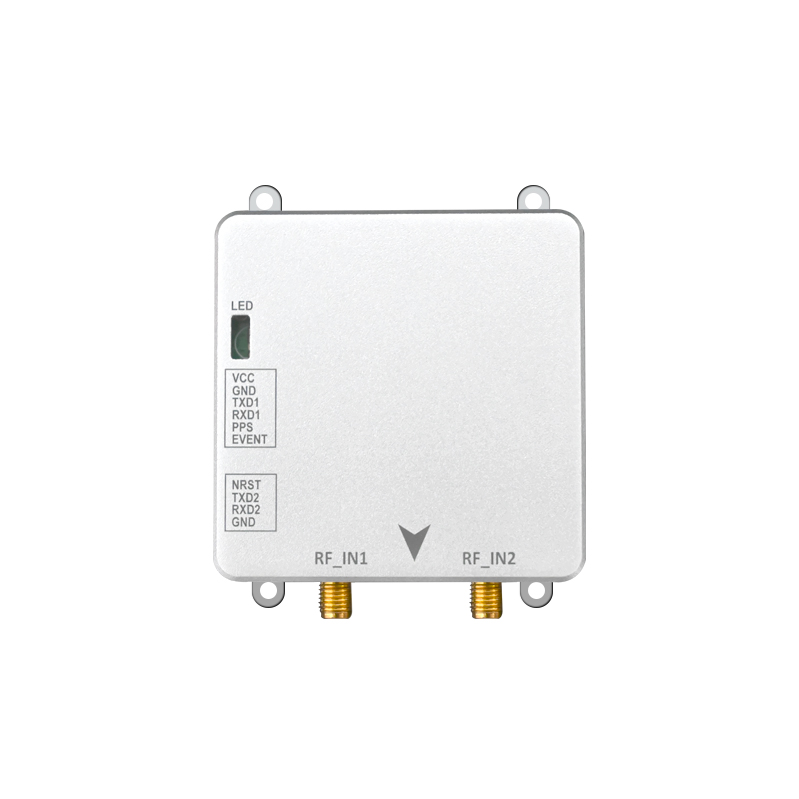
P-Box-AP55 is an example of a high-precision multi-band RTK receiver for industrial platforms.
Representative high-precision GNSS product categories
Jumpstar's high-precision portfolio covers several integration levels. Multi-constellation receivers such as the P-Box-AP55 and X43H-AH are suited for vehicle, UAV, and robotics platforms. The JS-CK39-A is a multi-band multi-constellation GNSS receiver with built-in IMU, designed for intelligent driving and OEM integration. The JS-RK26-U is a dual-band L1/L5 GNSS+INS module that weighs less than 1.1 g. The JS-SK40 is a high-precision RTK GNSS module with 789 hardware channels and RTK horizontal accuracy of 0.6 cm + 0.5 ppm.
| Category | Example model | Key performance specification | Typical form factor |
|---|---|---|---|
| GNSS RTK Receiver | P-Box-AP55 | RTK horizontal 0.6 cm + 0.5 ppm; 448 channels | Enclosed receiver |
| GNSS RTK Receiver | X43H-AH | RTK horizontal 0.6 cm + 0.5 ppm; dual-antenna heading 0.03 degrees at 5 m baseline | Compact receiver, under 25 g |
| RTK Board | JS-CK39-A | Multi-band GNSS receiver with built-in IMU | OEM board |
| RTK GNSS Module | JS-SK40 | RTK horizontal 0.6 cm + 0.5 ppm; 789 channels | Module with integrated antenna option |
| RTK GNSS Module | JS-RK26-U | RTK horizontal 1.0 cm + 1 ppm; GNSS+INS; under 1.1 g | Board-level module |
| Smart Antenna | JS-CK43-2 | RTK horizontal 0.8 cm + 1 ppm; 50 Hz positioning output | Integrated receiver and antenna |
Europe's Galileo High Accuracy Service delivers horizontal accuracy down to 20 cm, according to EUSPA. This is useful for applications that require better performance than standalone GNSS but do not need full RTK infrastructure.
Application scenarios for high-precision GNSS solutions
UAV aerial surveying and mapping
For aerial surveying and mapping UAV projects, Jumpstar's high-precision receivers operate as an onboard RTK rover or static base station. The hardware is designed for high-dynamic conditions: acceleration up to 4g, speed up to 515 m/s, altitude up to 18,000 m, and operating temperatures from -40°C to +85°C. Application documentation lists this scenario across China, India, UAE, Belgium, and South Korea.
The solution typically includes AIM+ composite anti-jamming, Galileo OSNMA anti-spoofing, 4G access to NTRIP/CORS differential data, TF card raw-data logging, and 20 Hz RTK output. Dual-antenna versions output heading accuracy as low as 0.03 degrees at a 5 m baseline, which supports consistent flight-line spacing and image overlap.
Vehicle positioning and fleet management
Jumpstar's vehicle positioning use-case covers autonomous vehicles, construction machinery, agricultural machinery, logistics trucks, and special inspection vehicles. The device operates from a 4.5 to 12 V DC vehicle power supply and is rated for -40°C to +85°C operating temperature and -55°C to +85°C storage temperature. It withstands 4g acceleration, 515 m/s velocity limits, and sustained vibration from engines and road surfaces.
In this scenario, the receiver can operate as an onboard RTK rover or roadside static base station. It connects to 4G NTRIP correction services, outputs NMEA, SBF, and RTCM messages, and logs raw satellite data to a TF card. A dual-antenna receiver provides heading accuracy for lane keeping and auto-steering.
Precision agriculture, robotics, and autonomous systems
Agriculture is the dominant application segment for high-precision GNSS, holding 36.8% market share in 2025, according to Dataintelo. Jumpstar's product documentation lists precision agriculture machinery, autonomous robots, AGVs, and autonomous driving as applicable industries for receivers such as the P-Box-AP55 and X43H-AH.
For base-station deployments, the JS-X11 all-in-one RTK smart antenna/base station provides RTK accuracy of 2 cm ± 1 ppm, IP66 protection, 9 to 45 V DC input, and a 5200 mAh backup battery with up to 10 hours of runtime.
Surveying, marine, and logistics
For geodetic mapping, the JS-YAC155N survey antenna supports BDS B1I/B2I, GPS L1/L2, GLONASS L1/L2, Galileo E1/E5a/E5b, and QZSS L1/L2, with peak gain of at least 5.5 dB and amplifier gain of 35 ± 2 dB. For marine and fleet management, standard GNSS modules such as the JS-ATP30-M list maritime navigation and maritime dispatch as intended applications.
Market signals for high-precision GNSS
According to Dataintelo, the global high-precision GNSS market was valued at USD 7.8 billion in 2024 and is projected to reach USD 20.6 billion by 2033. The high-precision GNSS module market was estimated at USD 1.5 billion in 2024 and is forecast to reach USD 4.5 billion by 2035, according to Market Research Future. EUSPA forecasts GNSS downstream market revenues of EUR 580 billion by 2034.
Agriculture is currently the largest application segment. Dataintelo reports 36.8% market share for agriculture in 2025, while MarketsandMarkets projects the global precision farming market will grow from USD 11.38 billion in 2025 to USD 21.45 billion by 2032.
On the technology side, established suppliers are integrating inertial sensors into GNSS receivers. Trimble launched the R12i GNSS System in 2024 with IMU-enhanced RTK performance, according to Fortune Business Insights. The mid and high-level precision GPS receiver market is led by Trimble, Hexagon AB, Topcon, and Hemisphere GNSS, according to Mordor Intelligence. Source manufacturers such as Jumpstar support this ecosystem with industrial-grade components and manufacturing capacity for integrators.
High-precision GNSS vs. conventional GNSS
Buyers evaluating a first deployment often need to compare standard GNSS modules with high-precision RTK solutions. The table below summarizes the main differences.
| Dimension | Standard GNSS modules | High-precision RTK solutions |
|---|---|---|
| Horizontal accuracy | 1.0 to 2.5 m CEP depending on module | 0.6 cm + 0.5 ppm RTK for P-Box-AP55 and X43H-AH |
| Correction input | Not required for standalone use | RTCM 3.x from a base station or network service |
| Signal support | Usually dual-band L1/L5 in recent modules | Multi-band, multi-constellation reception |
| Typical applications | Fleet tracking, logistics, wearables, handheld navigation | UAV surveying, precision agriculture, autonomous driving, robotics |
Future outlook
Market forecasts indicate significant expansion in high-precision GNSS. The high-precision module market alone is projected to increase from USD 1.5 billion in 2024 to USD 4.5 billion by 2035, and EUSPA expects downstream GNSS revenues of EUR 580 billion by 2034.
From a product engineering standpoint, buyers can expect continued movement toward multi-band receivers, integrated IMU and heading output, anti-jamming and anti-spoofing features, and compact OEM formats. These capabilities align with the requirements of UAVs, autonomous vehicles, agricultural machinery, and robotics.
For procurement teams, the central question is no longer whether high-precision GNSS is mature, but which form factor and correction workflow matches the application.
Shenzhen, China
Website: www.jgnss.com
Email: sales@jgnss.com
Phone / WhatsApp: +86 136-2236-7049
Address: Room 1305, Block A, Building 1, Lechuanghui Mansion, No. 1211 Guanguang Road, Longhua District, Shenzhen, China. 518110
Download the Jumpstar company profile 2026 (PDF)