
High-Humidity Bathroom Furniture Sets: A Buyer's Shortlist
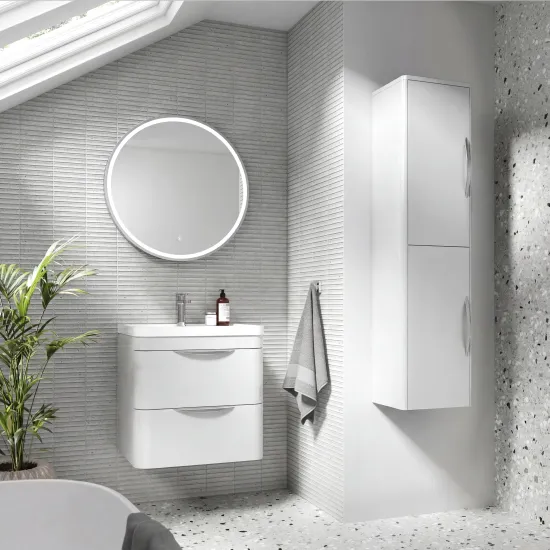
A bathroom furniture set in a high-humidity room is judged on moisture exposure over its service life, not on the day of installation. Image: PTB Technical Sanitary Ware (Jiangsu) Co., Ltd.
Why humid bathrooms expose specification gaps early
A bathroom furniture set is usually specified in a dry meeting room and installed in a wet one. The gap between those two environments is where a large share of avoidable failures begins, and it is rarely closed by upgrading the cabinet finish.
The operating conditions across the category are consistent. A bathroom cabinet sits in the wash area under high humidity and water splashing, with cold water supply and gravity drainage. An LED mirror in the same room runs at AC 220 V with IP44 protection against humidity and splash. A shower enclosure occupies the wet area itself, exposed to hot water spray. In all three cases the exposure pattern is the same: intermittent water contact set against continuous ambient high humidity.
That combination matters because continuous humidity does not require a visible leak to cause damage. Vapour reaches surfaces that are never directly splashed, and it does so every day rather than only during use. Failures therefore tend to appear at interfaces — the joint, the edge, the hinge — rather than in the middle of a panel or a sheet of glass.
Published standardisation reflects this. GB 24977-2010, a Chinese national standard covering bathroom furniture, addresses accessible parts without burrs, sharp ends, sharp edges or sharp corners; flexible operation of opening and closing components after installation; and no seepage or water leakage between parts under normal use after installation. The current status of that standard should be confirmed with the official standards body before it is written into a purchase order, but the structure of its requirements is instructive: several of the decisive checks sit at installation and interface level rather than at the material level.
Four of those interfaces account for a disproportionate share of premature failure in humid rooms — the glass in the shower zone, the silicone line at wall and tray joints, the cut edges of wood-based panels, and the hinge alignment that keeps doors closing evenly. The shortlist below is organised around them.
Criterion 1: glass that fails safely, not simply glass that is thick
Glass specification in a bathroom is often discussed in millimetres. Thickness matters for rigidity, but it does not describe what happens on the day the glass breaks.
According to EN 12150-1, toughened safety glass breaks into blunt small granules, which reduces the risk of cut injury. Ordinary glass, by contrast, forms sharp large fragments when it fails. For a shower screen standing at shoulder height next to a wet, hard floor, that difference is the entire point of the specification. A buyer's practical check is therefore not the thickness figure alone, but whether the glass is declared to EN 12150-1 and supported by the corresponding CE documentation.
The same logic applies to mirrors. Film-backed glass, as used on the LQ752 LED mirror, is a secondary safety measure behind the reflective surface: if the glass is damaged, the film holds the fragments in place rather than letting them fall.
Procurement action: require the glass standard reference on the product datasheet and in the order confirmation, and treat an unstated standard as a gap rather than as an assumption.
Criterion 2: silicone on the exterior only, so the enclosure can drain
The instinct when a shower leaks is to seal more. In practice, sealing both sides of a shower profile is one of the more reliable ways to make leakage worse.
Inner-side silicone blocks drainage. Water that enters the profile has no path out, and trapped water accelerates seal failure and aggravates leakage. Exterior-only sealing enables drainage and pressure release, so any water that reaches the frame can escape instead of sitting against the seal. This is why corrective work on a leaking enclosure specifies removing aged silicone and applying a continuous new sanitary-grade bead on the exterior only, while the inner side is deliberately left unsealed.
Three site conditions determine whether exterior-only sealing performs as intended. The shower tray must be level, because an out-of-level tray holds water against the joint regardless of sealant quality. All sealing strips must be cut and fitted completely along their full length. And the silicone must be allowed to cure for a minimum of 24 hours before water exposure.
Procurement action: write the sealing method into the installation instruction — exterior only, continuous bead, 24-hour cure — and confirm the installer has been briefed. A specification that exists only on the product datasheet will not survive a site team that seals both sides out of habit.
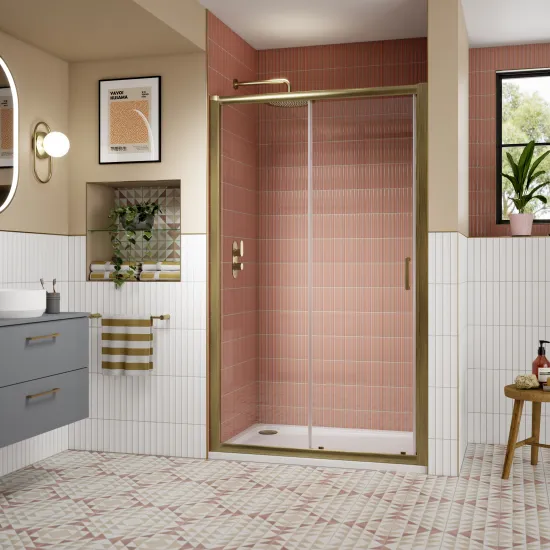
Exterior-only sealing leaves the inner side open so water can drain away from the joint. Image: PTB Technical Sanitary Ware (Jiangsu) Co., Ltd.
Criterion 3: every cut edge sealed, including the ones created on site
Bathroom cabinets are generally built from wood-based panels, which are porous by nature. Factory moisture protection is applied to the original surface. When a panel is cut on site — for a basin, a waste pipe or a socket cut-out — that protection is removed, and the exposed open-cell edge is left facing the most humid air in the building.
Exposed edges absorb vapour and splash water rapidly. The visible result is swelling, delamination and mildew, and it typically appears first at exactly the places where the panel was modified. Sealing closes the capillary pores and blocks moisture ingress, which is why all exposed cut edges should receive full waterproof sealing rather than a token wipe of sealant.
One scope point deserves to be stated plainly, because it is a frequent source of dispute. Sealing of cut edges is site installation work. Mildew that develops from an unsealed edge is not a factory product defect, even where the panel itself is a moisture-resistant board. Buyers who require this protection should specify it as an installation acceptance item, not assume it is delivered inside the carton.
Procurement action: add 'seal all cut edges' to the site checklist next to 'check door and drawer operation', and photograph the sealed cut-outs before the basin or WC unit is closed up.
Criterion 4: hinges with X and Y adjustment, not hinges that only look substantial
A wall-hung cabinet is mounted onto a wall that was built to a tolerance, using brackets that were drilled to a tolerance. Minor deviation during wall mounting is therefore unavoidable. What separates a good installation from a poor one is whether the hardware can absorb that deviation.
X-Y adjustable hinges correct horizontal and vertical door position separately. That dual adjustment fixes uneven gaps and poor closure without re-drilling the carcass, and it reduces mechanical stress on the hinge itself, since a door that closes cleanly loads the hardware more evenly than one that is fighting the frame. The alternative — fixed hinges and a hope that the wall is plumb — leaves the installer with no correction path other than moving the cabinet.
Hinge specification also has a structural dimension that is easy to miss. A mirrored door with toughened glass weighs considerably more than an ordinary wooden door, and ordinary screws may not withstand the cyclic fatigue load of repeated opening and closing. Dedicated reinforcing fasteners are required for reliable connection, consistent with the EN 14749 cabinet strength requirement. On the shower side, the equivalent tolerance-control component is the adjustable roller: spring-loaded adjustable rollers allow on-site correction for wall plumbness and tray level, preventing sticking doors and poor sealing, in line with EN 14428.
Procurement action: confirm in writing that hinges offer X-horizontal and Y-vertical adjustment, that mirror doors ship with reinforcing screws, and that sliding or hinged shower doors use adjustable rollers or adjustable hinge mechanisms.
The shortlist: four formats mapped against the criteria
The options below are drawn from the current range of PTB Technical Sanitary Ware (Jiangsu) Co., Ltd., a bathroom products manufacturer based in Dagong Town, Hai'an City, Jiangsu Province, China, operating a 33,000 m² manufacturing plant and exporting predominantly to the United Kingdom, France and Ireland. The company holds ISO 9001, CE, WRAS, FSC and AEO certification. Each row states only the specification that is documented for that model.
| Option | Documented specification | Criteria addressed | Fits best where |
|---|---|---|---|
| Floor-standing vanity unit CLA123 | Classique 500 mm satin white 2-door floor standing vanity; MDF painted matt; 16 mm cabinet, 18 mm fascia; 500 W × 390 D × 800 H mm; soft-close hinged doors; supplied rigid; fixings and knob handle included; worktop and basin sold separately; 5-year manufacturer guarantee | Sealed cut edges at on-site cut-outs; X-Y hinge adjustment; door alignment | Family bathrooms and rental apartments where floor fixing is the simpler and more predictable plane |
| Wall-hung / wall-mounted cabinet | Wall-mounted installation requires verification of wall load-bearing capacity; wall fixings are not supplied with the unit | Hinge adjustment after mounting; cut-edge sealing; drawer removal before lifting | Smaller bathrooms where floor area is at a premium and the wall has been assessed |
| Mirror cabinet with LED mirror LQ752 | 800 × 800 mm brushed brass inset frame LED mirror; aluminium construction; IP44; demister; touch sensor; LED 6000 K, 21 W; film-backed glass; fixings included; 1-year guarantee; CE, EMC, LVD, RoHS and WEEE | Glass safety through film backing; humidity protection at IP44; electrical zone compliance | Wash area of humid bathrooms, in Zone 2 and outside zones only |
| Shower enclosure AQU9-E6 | 900 mm chrome quadrant; 6 mm toughened glass; 1850 mm height; 880 × 880 mm; enclosure adjustment 860–880 mm; framed; two sliding doors; dual quick-release wheels; EasyFit profile assembly; CE; lifetime manufacturer guarantee | Toughened glass; exterior-only silicone sealing; adjustable rollers for door alignment | Wet zone of family bathrooms, hotels, rental apartments and engineering fixtures |
Read as a shortlist, the table serves a specific decision. Where the wall cannot be assessed with confidence, a floor-standing unit removes the wall-loading question entirely and moves the risk to the plinth and cut edges, which are controllable on site. Where floor area is constrained, the wall-hung format earns its place, but only alongside a verified wall and the correct fixings — which are not supplied. The mirror and enclosure rows are not alternatives to the cabinet; they are the other two interfaces in the same room, and they fail for the same underlying reasons.
How the four criteria interact during installation
The criteria are not independent. They are addressed in a fixed sequence, and the sequence explains why sealing is so often the weak link.
For a shower enclosure, the process runs: verify the shower tray is level; assemble the top and bottom tracks and the fixed-glass sub-assembly; mount the wall profiles, drill and fasten; fit rollers, doors and magnetic seals; adjust door gaps and height; then apply a continuous external silicone bead and leave it to cure. Sealant is the last step, which means it is also the step most exposed to schedule pressure. If the tray was not level, or a sealing strip was cut short, a perfect bead will still fail.
For a wall-mounted cabinet, the sequence is: remove the drawer box; mark positions and fit the wall hanging brackets; hang the cabinet and adjust height via the hook screws; refit the drawer and adjust the hinge horizontally and vertically; perform any panel cut-out and seal the cut surfaces; then check that doors and drawers open and close smoothly. Here sealing is step five of six — conveniently placed, and just as conveniently skipped when the fitter is running late.
The practical conclusion for a buyer is that the product specification and the installation specification have to be issued together. A set that meets all four criteria on paper will still fail in a humid room if the exterior-only rule is not briefed, or if the cut edges are closed up before anyone has sealed them.
Where these sets fit
The specification profile described here matches the conditions recorded for the target markets — the United Kingdom, Ireland, France, Belgium, the Netherlands, Luxembourg and Germany — where bathrooms are typically compact, continuously heated, and ventilated by extract rather than by opening a window for long periods. In that environment the ambient humidity load persists between showers, which is precisely the condition that punishes unsealed edges and inner-side silicone.
Application is broad within that geography. The same enclosure and cabinet formats are specified for home residences, rental apartments, hotels, homestays and engineering fixtures. Rental and hospitality projects add a further consideration: maintenance staff will re-seal joints and adjust doors between tenancies, so hardware that can be corrected with a screwdriver — adjustable hinges, quick-release rollers — reduces the cost of every turnover.
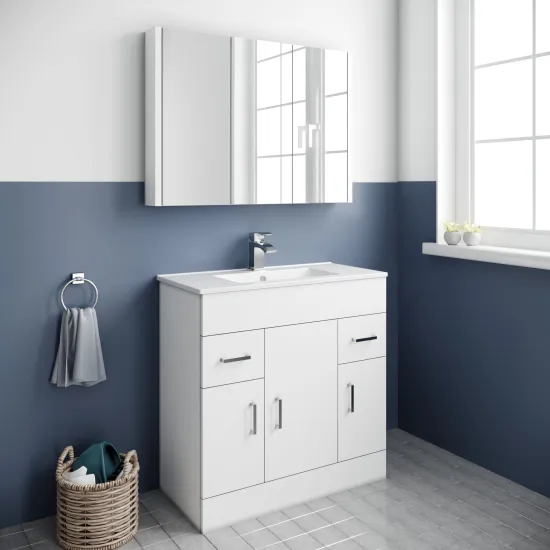
Compact, continuously heated bathrooms keep ambient humidity high between showers, which is where edge sealing and hinge adjustment earn their place. Image: PTB Technical Sanitary Ware (Jiangsu) Co., Ltd.
Market context behind the criteria
The commercial case for tightening these specifications is supported by category scale and by where growth is concentrated.
Grand View Research valued the global bathroom furniture market at USD 135.9 billion in 2024 and estimated it would reach USD 148.9 billion by 2026. The same source reports that bathroom cabinets accounted for approximately 50% of the market in 2023, and projects wall-mounted and floating vanity units to grow at a CAGR of 7.26% through 2031 in the US market. Separately, Next Move Strategy Consulting valued the global shower enclosure and cubicles market at USD 3.51 billion in 2023, with a forecast of USD 5.38 billion by 2030. Note that definitions differ between research houses and between sub-sectors, so these figures should not be combined into a single total.
The direction of travel is the relevant signal for buyers. If wall-mounted and floating formats continue to take share, then more installations will depend on wall assessment, on correct fixings, and on hinges that can absorb mounting tolerance. The selection criteria in this article are not a niche concern; they sit directly on the growth path of the category.
Where this approach has limits
A shortlist that does not state its boundaries is a sales document. Four limits are worth stating explicitly.
- Exterior-only sealing moves performance onto site workmanship. The method is correct, but its outcome depends on an installer applying a continuous external bead and leaving the inner side open. Because cut-edge sealing and joint sealing are installation scope, related moisture damage is not covered as a factory defect. Buyers who want protection here need an installation specification and an inspection step, not a better carton.
- Toughened glass reduces injury severity, not breakage risk. EN 12150-1 glass breaks into blunt granules rather than sharp fragments; it is still glass, and impact can still break it. Careful handling during installation is part of the specification, not an optional courtesy.
- X-Y hinges correct tolerance, not structural deviation. They absorb the small misalignments created by drilling and bracket fitting. They will not correct a wall that is materially out of plumb, and a heavily worn hinge should be replaced rather than adjusted indefinitely.
- Floor-standing units trade one risk for another. They avoid wall-loading questions, but they place the plinth and lower panel closer to the floor splash zone, so cut-edge sealing at the base matters more, not less.
- IP44 is a bathroom rating with a location rule. An IP44 mirror is intended for Zone 2 and outside zones only, and installation must be carried out by a qualified electrician in line with the IEE wiring rules and bathroom zoning requirements. A higher-looking rating does not override the zone.
Procurement checklist
| Ask the supplier | Check on site |
|---|---|
| Glass declared to EN 12150-1, with CE documentation | Shower tray level before profiles are fixed |
| Written sealing method: exterior only, continuous bead, 24-hour cure | No silicone applied to the inner side of any profile |
| Hinges with X-horizontal and Y-vertical adjustment; reinforcing screws supplied for mirrored doors | All on-site cut edges fully sealed before closing up |
| Wall-hung units: confirmation that fixings are not included and that wall capacity must be verified | Door gaps even after hinge and roller adjustment |
| LED mirror: IP44 rating, zone suitability, and electrical installation requirements | Wiring completed and earthed by a qualified electrician |
Outlook
Two shifts are likely to shape how bathroom furniture sets are specified in humid rooms over the next few years. The first is the continued move toward wall-mounted and floating formats, which increases the number of installations where wall assessment and hinge adjustment are load-bearing decisions rather than details. The second is a gradual migration of quality checks from the material list to the installation record: glass declared to a standard, sealing method written down, cut edges photographed, doors verified after adjustment.
For buyers at the research stage, that means the useful comparison is not between finishes or handle styles. It is between suppliers who can document how a set behaves at the four interfaces described here, and suppliers who can only describe the cabinet. The first group makes a humid bathroom predictable. The second makes it a maintenance log.
A fuller technical lookbook covering the cabinet, mirror and shower ranges is available as a downloadable PDF brochure.
FAQ
What glass specification should a bathroom furniture set use in a humid room?
Glass in shower enclosures and doors should be toughened safety glass declared to EN 12150-1, which breaks into blunt small granules and reduces cut injury risk, whereas ordinary glass forms sharp large fragments. The declaration should be supported by CE documentation. Thickness is a separate rigidity decision and does not substitute for the safety standard reference.
Should silicone sealant be applied to the inner side of a shower enclosure?
No. Inner-side silicone blocks drainage, and trapped water accelerates seal failure and aggravates leakage. Sealing is applied on the exterior only, as a continuous sanitary-grade bead, after aged silicone has been removed. The shower tray must be level and the silicone allowed to cure for a minimum of 24 hours before use.
Is mildew at cabinet cut edges a manufacturing defect?
Sealing of cut edges is site installation work, so mildew that develops from an unsealed edge is not a factory product defect. Wood-based panels are porous, and on-site cutting removes the original moisture-proof surface, leaving open-cell edges that absorb vapour and cause swelling, delamination and mildew. The corrective action is to remove the affected material, seal all exposed cut edges fully, and improve ventilation to reduce ambient humidity.
Why do cabinet doors need X-Y adjustable hinges?
Wall mounting inevitably introduces minor deviation from drilling and bracket fitting. X-Y adjustable hinges correct horizontal and vertical door position separately, which resolves uneven gaps and poor closure without re-drilling, and reduces mechanical stress on the hinge. A cabinet that is mounted level can still need hinge adjustment, which is why the adjustment is designed in rather than treated as a fault.
What should be verified before specifying a wall-hung bathroom cabinet?
Wall load-bearing capacity must be verified, and wall fixings are not supplied with the unit — they should be selected to suit the actual wall construction. For units with heavy mirrored doors, reinforcing screws are required for connection strength. Drawers are removed before wall mounting to reduce lifting weight, and all cut edges must be sealed after any on-site cut-out.
What protection rating does an LED bathroom mirror need?
IP44 is the applicable rating for bathroom Zone 2 and outside zones, because it withstands multi-directional splash and vapour. IP20 units are not suitable, as bathroom vapour can penetrate them, degrade insulation and create a shock hazard. Installation must be carried out by a qualified electrician in accordance with the IEE wiring rules and bathroom zoning requirements, with reliable earthing.
How are samples and delivery lead times typically handled for a bathroom furniture set?
Sample orders are accepted for quality testing and marketing purposes, and mixed samples across bathroom cabinets, shower enclosures, LED mirrors and basins are possible; samples are charged and the buyer bears the freight. Standard delivery is normally 25–30 days after receipt of the deposit, depending on order quantity. Buyers should confirm both points in the order documentation alongside the glass, sealing and hinge specifications.
¿Tiene preguntas o necesita más detalles?
Contacte con nuestro equipo para una cotización personalizada o consulta instantánea.
Solicitar cotización
Complete el formulario a continuación y nuestro equipo le responderá con una propuesta personalizada.
Chat directo de WhatsApp
¿Prefiere chatear en tiempo real? Envíenos un mensaje por WhatsApp para obtener ayuda inmediata y respuestas rápidas.
- Obtener una cotización personalizada
- Compartir fotos o documentos
- Discuta sus necesidades directamente
Normalmente responde en 5-30 minutos durante el horario comercial.