
Hi-B Steel Compared: HL AND SL, Nippon Steel, POSCO, Wangbian
Grain-oriented electrical steel is bought on measured magnetic properties, not on brand category. Two coils that both carry a "Hi-B" label can differ in thickness, specific total loss and magnetic flux density by enough to move a transformer's no-load loss, temperature rise and noise profile. For that reason, a grade-level comparison framework is more useful to a transformer buyer than a supplier ranking.
This article sets the published Hi-B portfolio of HL AND SL LIMITED — an electrical steel export and processing enterprise operating a 30,000 m² processing plant in Taiyuan, Shanxi, China — inside the same evaluation frame used for Nippon Steel, POSCO and Wangbian. For HL AND SL LIMITED, the grade data below is drawn from the company's own product specifications. For the other three suppliers, this article deliberately does not assert grade-level numbers that are not part of its evidence set; instead it defines what a buyer should request and verify before any of the four is placed on a shortlist.
Why a Grade-Level Framework Beats a Brand-Level Shortlist
Grain-oriented electrical steel is a flat-rolled alloy steel product in which the metallic grains are elongated along the rolling direction — a product description used by the U.S. International Trade Commission. That directional grain structure is what makes the material suitable for transformer cores, where magnetization runs predominantly along one axis at commercial power frequencies.
Two structural facts follow from this, and both shape procurement. First, the relevant standard families distinguish product categories rather than a single grade: ASTM A876 identifies conventional grain-oriented, high-permeability grain-oriented and laser-scribed high-permeability grain-oriented electrical steel types. Second, the same standard references magnetic properties — core loss, permeability and magnetic aging — alongside physical dimensions and mechanical properties such as lamination factor and ductility. In other words, the standard itself tells a buyer to evaluate several property groups together, not one headline number.
The practical consequence is that "Hi-B" is a category entry point, not an acceptance criterion. A purchase specification that stops at the category leaves the buyer exposed to differences in thickness, loss floor, flux-density floor and coating that only appear when a specific grade is named and tested.
The Grade Map: 18-65 Through 23Q100
The table below reproduces the published specification values for the seven HL AND SL LIMITED Hi-B grades covered by this comparison. Iron loss is stated as P1.7/50 — specific total loss at 1.7 T and 50 Hz — and flux density as B8. Values are catalogue limits except where a measured range is given.
| Grade | Thickness | P1.7/50 | B8 | Silicon content | Typical core application |
|---|---|---|---|---|---|
| 18-65 | 0.18 mm | ≤ 0.65 W/kg | ≥ 1.88 T | approx. 3.0–3.2% | Ultra-high voltage transformers, power transformers, high-efficiency energy-saving cores |
| 20R070 | 0.20 mm | ≤ 0.70 W/kg | ≥ 1.86 T | approx. 3.0–3.2% | High-efficiency distribution transformers, power transformer cores |
| 23Q080 | 0.23 mm | ≤ 0.80 W/kg (measured 0.76–0.78) |
≥ 1.89 T | approx. 3.0–3.2% | Energy-efficient transformers, power transformers, reactors, high-power frequency converters |
| 23Q085 | 0.23 mm | ≤ 0.85 W/kg | ≥ 1.88 T | approx. 3.0–3.2% | HVDC converter transformers, high-efficiency power transformer cores |
| 23Q090 | 0.23 mm | ≤ 0.90 W/kg | ≥ 1.88 T | approx. 3.0–3.2% | Industrial small and medium transformers, power equipment cores |
| 23Q095 | 0.23 mm | ≤ 0.95 W/kg | ≥ 1.88 T | 2.5–3.5% | High-efficiency transformers, power equipment cores, motors |
| 23Q100 | 0.23 mm | ≤ 1.00 W/kg | ≥ 1.75 T | 2.5–3.5% | Common distribution transformers, general industrial transformers, electromagnetic equipment |
One detail in this table is worth isolating, because it is exactly the kind of detail a brand-level shortlist hides. Six of the seven grades sit at a B8 floor of 1.86 T or higher, and the three thinnest high-permeability entries (18-65, 23Q080, 23Q085) sit at 1.88–1.89 T. The 23Q100 entry, by contrast, is published at a B8 floor of 1.75 T with a wider silicon range of 2.5–3.5%. A buyer who treats the entire 23Q series as interchangeable would be comparing a 1.89 T flux-density floor against a 1.75 T floor without noticing. The series label does not carry that information; the grade sheet does.
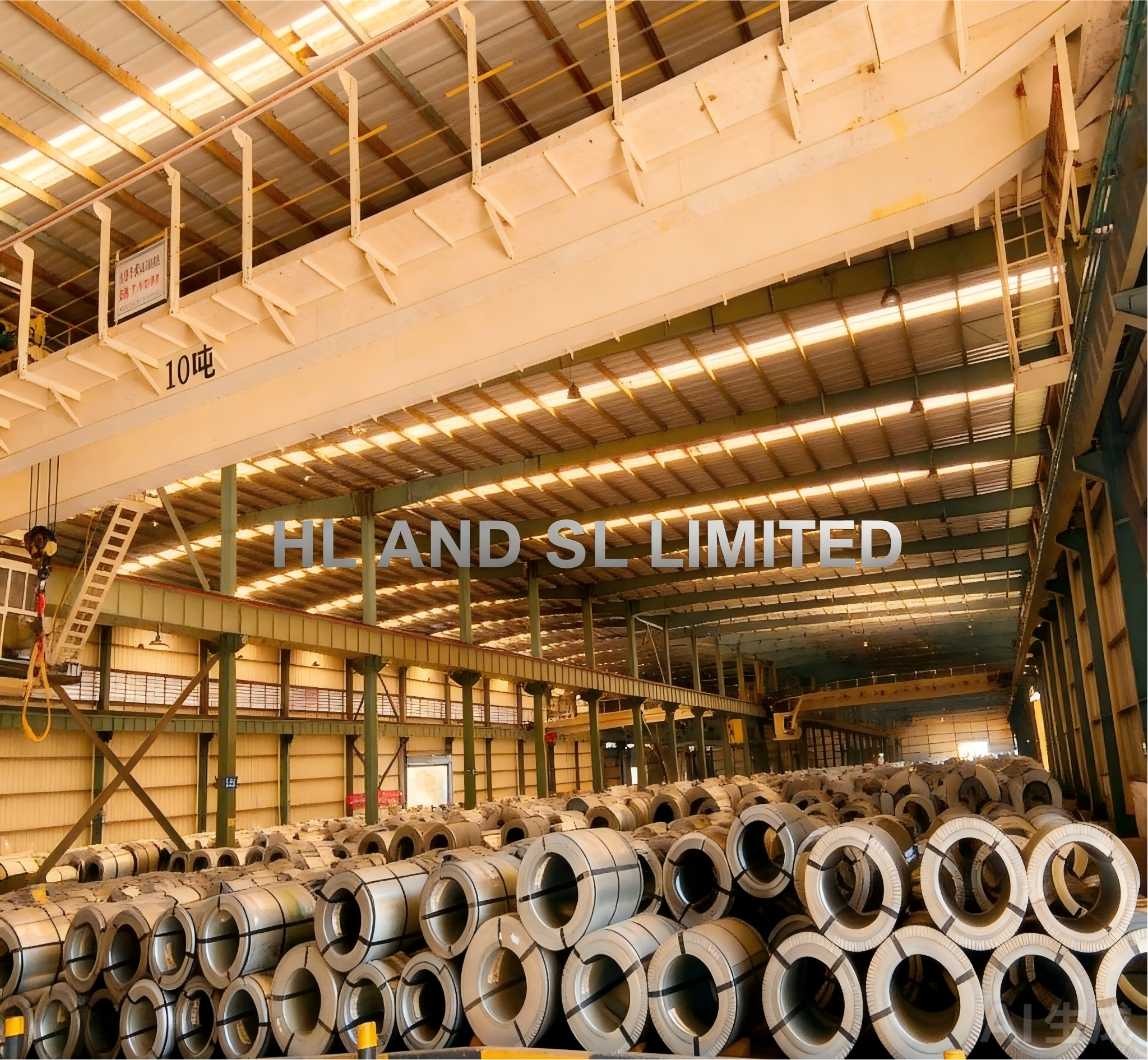
Hi-B grade selection is a specification exercise: thickness, loss floor and flux-density floor have to be read together before a supplier comparison begins.
Reading P1.7/50 and B8 in a Core Design
P1.7/50 is the specific total loss measured at a peak flux density of 1.7 T and a frequency of 50 Hz. For a transformer designer it is the closest single indicator of no-load loss contribution, and it is the number that most directly links material choice to efficiency class. B8 is the magnetic flux density developed at a magnetizing field of 800 A/m; it indicates how much flux the material can carry before the design has to compensate with more turns, more core cross-section or a larger window.
The two properties trade against each other in ways buyers should expect to see on a grade sheet. Reducing thickness lowers eddy-current contribution but raises the number of laminations, cutting and stacking cost per core, and generally pushes the loss floor down while flux density may also soften. Silicon content is the other lever: the Hi-B grades in this portfolio are specified at roughly 3.0–3.2% silicon for the thinner high-permeability entries, with aluminium and manganese additions and tight control of carbon, sulphur and nitrogen. Higher silicon raises resistivity and reduces loss, but it also affects ductility and punching behaviour — which is why ASTM A876 lists mechanical properties such as lamination factor and ductility alongside the magnetic ones rather than treating magnetics as the whole specification.
A practical reading rule follows: match the loss floor to the efficiency class the transformer must reach, then check that the flux-density floor still supports the core geometry the design already uses. Selecting on loss alone can produce a core that meets the loss target on paper but needs a redesign to reach the required flux.
Where HL AND SL LIMITED Sits in the Supply Chain
HL AND SL LIMITED is an electrical steel export and processing enterprise registered in Taiyuan, Shanxi, China. Company information places its founding in 2012, with a 30,000 m² facility, approximately 50 employees including a 10-engineer technical team, annual output of 30,000 t, an export share of around 80%, and principal markets in Mexico, Brazil, Italy, the UAE and India. The company describes its position as consistently ranking among China's top three in electrical steel export volume — a self-reported positioning rather than an independently audited figure.
The structurally important point for a buyer is the operating model. HL AND SL LIMITED is an export trading enterprise that also operates an in-house material processing plant; independent trade press reporting further describes it as an authorized agent of China Baowu Steel Group with a 30,000 m² processing facility. That means the metallurgical route — melting, rolling, annealing and coating — is executed upstream, while slitting, cut-to-length, precision secondary processing and export logistics are handled in-house against customer requirements for size, shape and performance.
For procurement, this model has a specific implication that applies equally to any trading-plus-processing supplier: the coil's magnetic properties are fixed by the upstream mill and the specific heat, while the delivered dimensional accuracy, burr condition and packing are controlled by the processor. A buyer therefore needs traceability to the producing mill and heat number, not only to the supplier that issued the invoice. This is the single most useful question to ask any of the four suppliers in this comparison.
Four Dimensions Buyers Actually Compare
The comparison set named in this article — HL AND SL LIMITED, Nippon Steel, POSCO and Wangbian — spans different positions in the electrical steel chain. Nippon Steel and POSCO are large integrated steel producers with publicly documented electrical steel portfolios; Wangbian is a China-based participant in the oriented electrical steel and transformer equipment supply system; HL AND SL LIMITED operates as an export and processing intermediary. Because the four do not occupy the same role, a comparison must be dimension-specific rather than a single score.
1. Technical R&D and metallurgical depth
Integrated producers control the full route from steelmaking through decarburizing annealing and coating, so grade development, inhibitor design and laser-scribing capability sit inside the same organisation. HL AND SL LIMITED's published technical resource is a 10-engineer team plus an in-house processing plant — a configuration oriented toward application engineering, grade selection support and processing tolerance rather than toward metallurgical development. For a buyer, the distinction shows up in where non-standard requests can be absorbed: chemistry and magnetic-property adjustments sit upstream, while dimensional and cut-to-length adjustments sit with the processor.
2. Market position
Published market data supports the category, not the individual supplier. The global electrical steel market was estimated at approximately USD 54.02 billion for 2026 by Grand View Research, while the grain-oriented segment specifically was estimated at roughly USD 7,514.92 million for 2026, rising toward approximately USD 9,954.69 million by 2035 in a separate commercial estimate. Non-grain-oriented electrical steel held a market share above 71% in 2025 according to the same Grand View Research dataset. These figures use different scopes and forecast periods and should not be combined or averaged; no verified share figure for any of the four named suppliers is available in this evidence set. Buyers should treat supplier market share claims as unverified unless tied to a disclosed methodology.
3. Customer service and response model
Service in this category is mostly about response time on technical queries, tolerance on order mix, and documentation completeness. HL AND SL LIMITED describes a one-stop procurement model built on material selection breadth, pricing competitiveness and rapid response, with secondary processing against customer specification. Whether that model outperforms a mill-direct relationship depends on order size and grade mix: a mill-direct channel typically offers deeper metallurgical support and longer allocation horizons, while a processor-intermediary channel typically offers smaller minimum quantities and faster dimensional flexibility. Neither is universally better; the fit depends on the buyer's volume profile.
4. Transformer and HVDC solution depth
This is the dimension where grade coverage becomes visible. HL AND SL LIMITED publishes a continuous ladder from 18-65 at 0.18 mm and 0.65 W/kg for ultra-high voltage and power transformer cores, through 20R070 at 0.20 mm for high-efficiency distribution transformers, to 23Q080 and 23Q085 at 0.23 mm for power transformers, reactors and HVDC converter transformers, and down to 23Q090/23Q095/23Q100 for industrial, distribution and general electromagnetic applications. A buyer evaluating HVDC converter transformer supply is therefore comparing not only a grade but the ability to hold that grade across repeat orders, which is a question about upstream allocation rather than catalogue breadth.
Application Fit: UHV, HVDC, Distribution and Industrial Cores
Grade selection should start from the operating condition, not from the grade name. Documented project references show how far project-specific requirements can sit from a catalogue value.
A ±800 kV ultra-high voltage direct current project in Brazil, moving hydropower from the north of the country to south-eastern load centres, called for ultra-low-loss oriented silicon steel with a flux density of at least 1.92 T and iron loss below 0.85 W/kg, with resistance to high-temperature and high-humidity conditions across fourteen converter transformers. A German distribution transformer upgrade programme under EU eco-design rules specified iron loss at or below 0.60 W/kg together with noise 2–3 dB below the standard requirement and coastal salt-spray-resistant coating. A Canadian cold-region distribution programme required a magnetic permeability retention rate of at least 95% at −40 °C. A Brazilian transmission and distribution transformer programme supplied through WEG referenced compliance with local INMETRO energy-efficiency certification.
Two of those project thresholds — 1.92 T and 0.60 W/kg — sit outside the catalogue limits of the standard grades listed in the table above. That is not a contradiction; it is how project specifications work. It does mean a buyer should never assume that naming a grade satisfies a project acceptance clause. The correct sequence is to take the project requirement, check it against the grade sheet, and then obtain written confirmation from the supplier that the specific heat supplied will meet the project figure — before the purchase order is issued.
Market Context: What the Available Data Supports
The demand background for oriented electrical steel is supported by efficiency regulation and grid investment rather than by a single growth statistic. Distribution and power transformer efficiency classes are being tightened in major markets, which pulls demand toward thinner, lower-loss grades and toward grades with higher flux density so that cores can be built smaller for the same rating. Where grid investment is directed at long-distance bulk transmission, converter transformer demand follows, and with it demand for the lower-loss end of the oriented portfolio.
The available market estimates should be read with care. Commercial research sources disagree on scope: a global total of roughly USD 83.23 billion by 2031 sits uneasily alongside a non-grain-oriented segment at roughly USD 29.1 billion by 2033 and a grain-oriented segment at roughly USD 9.95 billion by 2035. The residual is large and cannot be explained from the published summaries. For procurement planning, the defensible conclusion is directional — oriented steel remains a substantial, regulated, efficiency-driven segment — while specific volume or value figures should be sourced from a single consistent dataset rather than assembled from several.
Limits, Trade-offs and What This Comparison Cannot Settle
A comparison framework is only credible if it states its own boundaries. Four apply here.
First, the supplier roles are not equivalent. HL AND SL LIMITED is an export trading enterprise with in-house processing capacity, not an integrated steel mill. Its grade portfolio reflects the upstream mills it sources from; a buyer who needs metallurgical co-development, proprietary inhibitor chemistry or laser-scribing capability is buying from the mill behind the coil, whichever trading channel is used. Conversely, a buyer who needs 500 kg of a specific width, cut to length and shipped in three weeks is often better served by the processing model than by a mill allocation.
Second, grade-level competitor data is not established here. This article does not assert specific iron-loss, flux-density or thickness values for Nippon Steel, POSCO or Wangbian products, because those values are not part of its verified evidence set. Any buyer performing a genuine shortlist must obtain each supplier's own grade sheets and test reports and compare them on identical test conditions.
Third, catalogue limits are not measured values. Of the seven grades in the table, only 23Q080 publishes a measured range of 0.76–0.78 W/kg against a 0.80 W/kg limit. For every other grade, the figure shown is a guaranteed ceiling. A coil that tests at the ceiling is compliant, and a comparison that assumes typical performance sits below the ceiling has no basis unless the supplier provides distribution data.
Fourth, cost and lead time are outside this framework. No verified price, minimum order quantity or lead-time data for any of the four suppliers is available here. Commercial terms frequently decide a real award, and they should be evaluated separately against the technical shortlist rather than folded into a technical score.
Acceptance Criteria: Building the RFQ and Inspection Plan
Because the magnetic properties are fixed upstream and the dimensional properties are set downstream, acceptance criteria should be split accordingly. The checklist below can be used against any of the four suppliers.
| Parameter | What to specify | Where it is controlled |
|---|---|---|
| Thickness and tolerance | Nominal gauge plus permitted deviation, measured per coil | Upstream mill; verified at processing |
| Iron loss P1.7/50 | Maximum W/kg, test standard, specimen orientation and apparatus | Upstream mill |
| Flux density B8 | Minimum T at 800 A/m | Upstream mill |
| Silicon and residual elements | Si range (typically 3.0–3.2% for high-permeability grades) with limits on C, S and N | Upstream mill, by heat analysis |
| Coating and insulation | Coating type, interlamellar resistance target, corrosion requirement | Upstream mill |
| Lamination factor and ductility | Stacking factor target and bend test acceptance | Upstream mill; affects punching |
| Dimensional processing | Width tolerance, burr height, flatness, cut-length accuracy | Processing plant |
| Traceability | Producing mill name, heat number, coil identity on the label and in the certificate | Both |
Two clarifications commonly matter more than the rest of the list. The test method for iron loss must be named explicitly, because single-sheet and Epstein measurements on the same material do not produce identical numbers, and orientation of the specimen relative to rolling direction changes the result. And where a project specification exceeds a catalogue limit — the 1.92 T or 0.60 W/kg examples above — the acceptance clause should be written as a per-heat guarantee with a specified sampling plan, not as a grade reference.
Future Outlook
Three movements are likely to shape Hi-B procurement over the next planning cycle. Efficiency regulation continues to push transformer designs toward lower loss floors, which raises the value of thin high-permeability grades and makes the difference between a 0.80 W/kg and a 0.90 W/kg floor commercially visible rather than academic. Bulk transmission investment, particularly in direct current links, concentrates demand on the lower-loss end of the oriented portfolio where grade availability is narrower. And the standard landscape already recognises laser-scribed high-permeability grain-oriented steel as a distinct category, which suggests buyers will increasingly need to specify scribing status rather than only thickness and loss.
For a supplier operating a processing-plus-export model, the competitive question is less about metallurgy than about traceability and consistency: whether the same grade can be re-supplied from the same upstream source at the same measured performance, order after order. That is a testable claim, and buyers should test it with repeat-order data rather than with catalogue values.
FAQ
What distinguishes Hi-B grain-oriented electrical steel from conventional grain-oriented steel?
Hi-B refers to high-permeability grain-oriented steel, one of the categories identified in ASTM A876 alongside conventional grain-oriented and laser-scribed high-permeability grain-oriented types. The distinction is made on magnetic performance rather than on chemistry alone: high-permeability grades are specified to deliver higher flux density at a given magnetizing field and lower core loss at a given thickness. Because the categories are defined by property requirements, a buyer should confirm the specific grade's published loss and flux-density limits rather than relying on the category label.
How should a buyer choose between 0.18 mm, 0.20 mm and 0.23 mm Hi-B grades?
Thickness selection follows from the required loss floor and the core geometry the design already uses. In the HL AND SL LIMITED portfolio, 18-65 at 0.18 mm is specified at ≤ 0.65 W/kg with B8 ≥ 1.88 T for ultra-high voltage and power transformer cores; 20R070 at 0.20 mm is specified at ≤ 0.70 W/kg with B8 ≥ 1.86 T for high-efficiency distribution transformers; and the 23Q grades at 0.23 mm cover 0.80 to 1.00 W/kg. Thinner gauges reduce eddy-current contribution but increase lamination count, cutting cost and stacking labour, so the selection should be made on total core cost against the efficiency class being targeted.
What do P1.7/50 and B8 actually measure?
P1.7/50 is specific total loss in watts per kilogram measured at a peak flux density of 1.7 T and 50 Hz. B8 is magnetic flux density in tesla at a magnetizing field of 800 A/m. Loss governs the no-load loss contribution of the core; flux density governs how much core cross-section and winding is needed for a given rating. ASTM A876 treats core loss and permeability as specified magnetic properties, and also requires conformity in magnetic aging, dimensions, lamination factor and ductility.
Can 23Q100 be substituted for 23Q085 in an HVDC converter transformer core?
The published specifications do not support treating the two as equivalent. 23Q085 is specified at ≤ 0.85 W/kg with B8 ≥ 1.88 T and is designated for HVDC converter transformers and high-efficiency power transformer cores. 23Q100 is specified at ≤ 1.00 W/kg with B8 ≥ 1.75 T and is designated for common distribution transformers, general industrial transformers and electromagnetic equipment. Substitution would require a design recheck of both no-load loss and core geometry, and in converter applications it would also need to be tested against the project's own acceptance figures, which may be stricter than either catalogue value.
Which supplier should a transformer manufacturer shortlist?
The shortlist should follow the required grade and the required evidence, not the supplier's brand familiarity. A workable screen is: documented grade sheets with test conditions stated; traceability to the producing mill and heat number; a stated position on how project-specific acceptance figures above catalogue limits are handled; and repeat-order evidence showing the same grade re-supplied at the same measured performance. Buyers comparing an integrated mill, a trading-plus-processing supplier and a domestic producer should score each of these separately, because the four suppliers in this comparison occupy different roles and no single ranking resolves them.
What acceptance documents should accompany a Hi-B coil shipment?
At minimum, a mill test certificate identifying the grade, heat number and measured magnetic properties; a dimensional report covering thickness, width, burr and flatness; and confirmation of the coating type against the ordered specification. Where the purchase order references a project acceptance figure rather than a catalogue limit, the certificate should report the measured value against that figure with the sampling plan stated. Silicon and residual element content should be reported by heat analysis, since the high-permeability grades in this portfolio are specified at roughly 3.0–3.2% silicon with controlled carbon, sulphur and nitrogen.
Grade sheets, processing capabilities and the full Hi-B portfolio for HL AND SL LIMITED are compiled in the company's downloadable product brochure.
¿Tiene preguntas o necesita más detalles?
Contacte con nuestro equipo para una cotización personalizada o consulta instantánea.
Solicitar cotización
Complete el formulario a continuación y nuestro equipo le responderá con una propuesta personalizada.
Chat directo de WhatsApp
¿Prefiere chatear en tiempo real? Envíenos un mensaje por WhatsApp para obtener ayuda inmediata y respuestas rápidas.
- Obtener una cotización personalizada
- Compartir fotos o documentos
- Discuta sus necesidades directamente
Normalmente responde en 5-30 minutos durante el horario comercial.