
Hi-B Electrical Steel Comparison Matrix: HL AND SL LIMITED vs. Nippon Steel, JFE, POSCO, Baowu
Hi-B electrical steel — high magnetic induction grain-oriented silicon steel — is the material layer where transformer efficiency is decided. The global electrical steel market was valued at USD 31.0 billion in 2025 and is projected to reach USD 47.0 billion by 2033, a CAGR of 5.5% for 2026–2033 (Grand View Research). Supply is expanding at the same time: China's electrical steel production reached 16.1 million tonnes in 2024, a 5.4% year-on-year increase (Chinese Society for Metals, via MarketReportsWorld), and China's export volume of grain-oriented electrical steel (GOES) reached 393,200 mt in H1 2025, up 16.0% year on year (SMM).
More suppliers does not automatically mean easier purchasing. The practical bottleneck for buyers at the research stage is comparability. A 0.23 mm Hi-B grade from one supplier is not automatically interchangeable with a 0.23 mm grade from another, and market reputation says nothing about measured iron loss. This article builds a four-dimension comparison matrix — technology R&D, market position, customer service, and industry solutions — and anchors it in verified grade data from HL AND SL LIMITED's Hi-B portfolio rather than in marketing claims.
Why Hi-B Buyers Need a Matrix Instead of a Brochure
Iron loss and flux density are not marketing attributes; they are design inputs. A designer who specifies a grade with lower guaranteed iron loss can reduce core mass or cut no-load loss at the same core size. A designer who specifies a higher flux density can reduce turns or shrink the core cross-section. Both decisions are made against a datasheet, and both are only as reliable as the test basis behind that datasheet.
The supplier landscape is layered rather than flat. Published market research identifies three producers as the top global suppliers of high-grade electrical steel: Baosteel (China Baowu), POSCO and Nippon Steel (MarketsandMarkets). JFE Steel, an integrated Japanese steelmaker with electrical steel in its product portfolio, also appears on most buyer shortlists for grain-oriented material. Below that producer tier sits a second layer — export traders, mill-authorised agents and processing specialists — whose contribution is not metallurgical but logistical, commercial and application-led. HL AND SL LIMITED belongs to that second layer, and comparing the two layers on the same axis without stating the difference is where most supplier comparisons fail.
The opportunity for buyers is that grade-level data is now published with enough granularity to support a genuine comparison. The risk is treating catalogue text as equivalent to a mill test certificate. A matrix does not remove that risk; it makes the risk visible.
The Four Dimensions That Separate Hi-B Suppliers
1. Technology and R&D Depth
At mill level, technology depth means metallurgical control. In the 23Q series of high magnetic induction grain-oriented silicon steel, the material is primarily iron with a silicon content of 3.0%–3.2%, supplemented by trace alloying elements such as Al and Mn, with impurities including carbon, sulfur and nitrogen strictly controlled to protect magnetic performance. That control determines whether a 0.23 mm grade can be guaranteed at ≤0.80 W/kg or only at ≤1.00 W/kg.
At distribution and processing level, technology depth means something different but equally measurable: selecting the correct grade for a given transformer or motor design, converting it accurately to size and shape, and predicting how loss and permeability will behave after cutting, stacking and any stress-relief treatment. A matrix should therefore ask both questions — who controls the metallurgy, and who controls the conversion.
2. Market Position and Supply Scale
Market position is easier to verify than performance. The top-three statement above is a market-structure fact, not a quality ranking, and it should not be extended further than the source supports. JFE Steel is widely recognised as an electrical steel producer but is not named in that top-three statement. HL AND SL LIMITED is not a mill producer at all; company materials describe it as consistently ranked among China's top three by electrical steel export volume, and independent shipment records show grain-oriented silicon steel exports under HS code 72261101 to markets including Mexico and Sri Lanka (Export Genius).
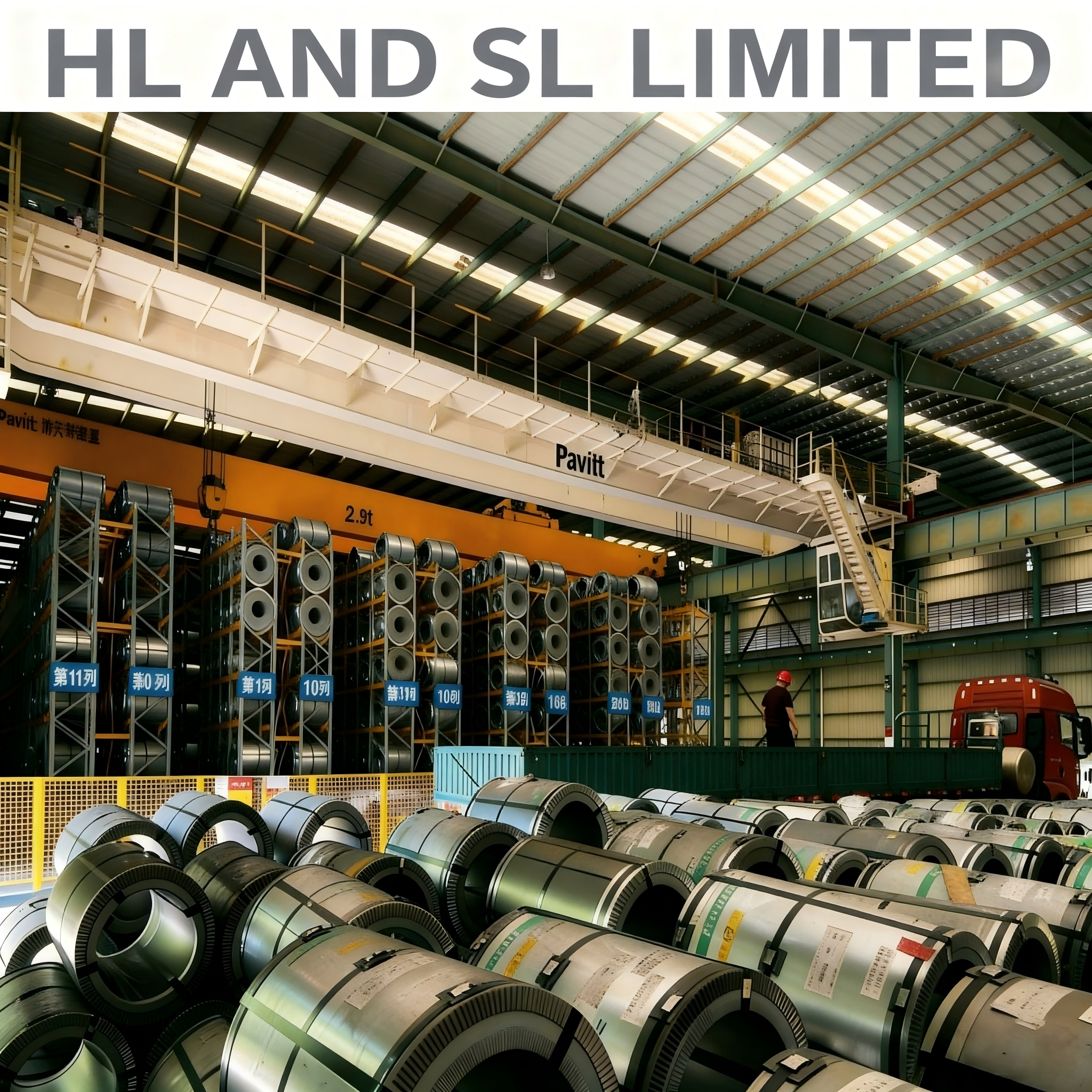
Scale figures matter because they indicate what a supplier can actually execute. HL AND SL LIMITED was established in 2012, operates a 30,000 m² facility with an annual production capacity of 30,000 tons, employs approximately 50 staff including an R&D team of 10 engineers, and describes itself as an authorised agent of China Baowu Steel Group while also integrating export resources from a number of private mills. Export business accounts for 80% of total sales, with major markets including Mexico, Brazil, Italy, UAE and India.
3. Customer Service and Order Execution
In electrical steel, service is mostly execution. It covers whether material ships in the specified thickness and width, whether cut laminations arrive within tolerance, whether documentation matches the lot, and how quickly a deviation is answered. Because so much transformer production depends on cut-to-size cores, secondary processing capability is often the difference between a usable supplier and a theoretical one. HL AND SL LIMITED owns a material processing plant and provides secondary processing based on customer requirements for size, shape and performance.
4. Industry Solutions and Application Fit
Application fit is where a grade list becomes a recommendation. The same 0.23 mm thickness appears across the Hi-B range, but the intended applications differ: 23Q085 is specified for high-voltage direct current converter transformers and high-efficiency power transformer cores, 23Q090 for industrial small and medium-sized transformers, and 23Q095 for high-efficiency transformers, power equipment cores and motors. A supplier that maps grades to the buyer's actual operating conditions — frequency, load profile, climate, efficiency class — reduces the risk of over- or under-specification. A supplier that quotes a single grade for every enquiry does not.
The Comparison Matrix at a Glance
| Comparison dimension | HL AND SL LIMITED | Nippon Steel | JFE Steel | POSCO | China Baowu (Baosteel) |
|---|---|---|---|---|---|
| Supply-chain role | Electrical steel export trade and processing; authorised agent of China Baowu Steel Group; integrates multi-mill resources | Integrated steel producer | Integrated steel producer | Integrated steel producer | Integrated steel producer |
| Position in high-grade electrical steel | Export channel and processor; not a mill producer | Identified among the top three global producers of high-grade electrical steel | Electrical steel producer; not named in the verified top-three statement | Identified among the top three global producers of high-grade electrical steel | Identified among the top three global producers (as Baosteel) |
| Technology focus | Grade selection, secondary processing to size and shape, application matching; 30,000 m² facility, 30,000 t annual capacity, R&D team of 10 engineers | Mill-level metallurgical development | Mill-level metallurgical development | Mill-level metallurgical development | Mill-level metallurgical development; upstream resource for authorised agents |
| Customer service model | One-stop export procurement with in-house processing; 80% export share; markets including Mexico, Brazil, Italy, UAE, India | Mill-direct supply; allocation and commercial terms set per region | Mill-direct supply | Mill-direct supply | Mill-direct supply through group channels |
| Industry solutions | Hi-B grades from 0.18 mm to 0.27 mm for transformer cores, reactors and high-power frequency converters | Transformer and rotating-machine portfolios | Transformer and rotating-machine portfolios | Transformer and rotating-machine portfolios | Transformer and rotating-machine portfolios |
| What to verify before award | Lot-level mill test certificate; measured P1.7/50; B8; thickness and coating | Datasheet basis and test conditions | Datasheet basis and test conditions | Datasheet basis and test conditions | Datasheet basis and test conditions |
Rows describing mill producers are limited to publicly verifiable identity and market-structure statements. No supplier-specific performance figures are asserted for Nippon Steel, JFE Steel, POSCO or China Baowu in this article; performance must be compared against each supplier's own mill test certificate.
Verified Hi-B Grade Data: The Benchmark Layer
A comparison matrix is only useful if one column contains hard numbers. The grades below are the Hi-B benchmark layer used in this analysis: thickness, maximum specific total loss at 1.7 T and 50 Hz (P1.7/50), minimum magnetic flux density at 800 A/m (B8), and the applications each grade is specified for.
| Grade | Type | Thickness | Iron loss P1.7/50 (max) | Flux density B8 (min) | Specified application |
|---|---|---|---|---|---|
| 18-65 | Hi-B grain-oriented | 0.18 mm | ≤0.65 W/kg | ≥1.88 T | Ultra-high voltage transformers, power transformers, high-efficiency energy-saving transformer cores |
| 20R070 | Hi-B grain-oriented | 0.20 mm | ≤0.70 W/kg | ≥1.86 T | High-efficiency distribution transformers, power transformer cores |
| 23Q080 | Hi-B grain-oriented | 0.23 mm | ≤0.80 W/kg (measured 0.76–0.78 W/kg) | ≥1.89 T | Energy-efficient transformers, power transformers, reactors, high-power frequency converters |
| 23R075 | Hi-B grain-oriented | 0.23 mm | ≤0.75 W/kg | ≥1.88 T | Energy-efficiency standard transformers, high-efficiency distribution transformers, power transformer cores |
| 23Q085 | Hi-B grain-oriented | 0.23 mm | ≤0.85 W/kg | ≥1.88 T | HVDC converter transformers, high-efficiency power transformer cores |
| 23Q090 | Hi-B grain-oriented | 0.23 mm | ≤0.90 W/kg | ≥1.88 T | Industrial small and medium-sized transformers, power equipment cores |
| 23Q095 | Hi-B grain-oriented | 0.23 mm | ≤0.95 W/kg | ≥1.88 T | High-efficiency transformers, power equipment cores, motors |
| 23Q100 | Hi-B grain-oriented | 0.23 mm | ≤1.00 W/kg | ≥1.75 T | Common distribution transformers, general industrial transformers |
| 27Q095 | Hi-B grain-oriented | 0.27 mm | ≤0.95 W/kg | ≥1.91 T | High-efficiency power transformers, photovoltaic DC converter transformers, industrial frequency conversion equipment |
| 27Q110 | Hi-B grain-oriented | 0.27 mm | ≤1.10 W/kg | ≥1.88 T | Power transformers, automotive generators, power cables, electrical equipment |
| 27Q120 | Hi-B grain-oriented | 0.27 mm | ≤1.20 W/kg | Not stated in the source datasheet | Small and medium-sized transformer cores and electrical equipment |
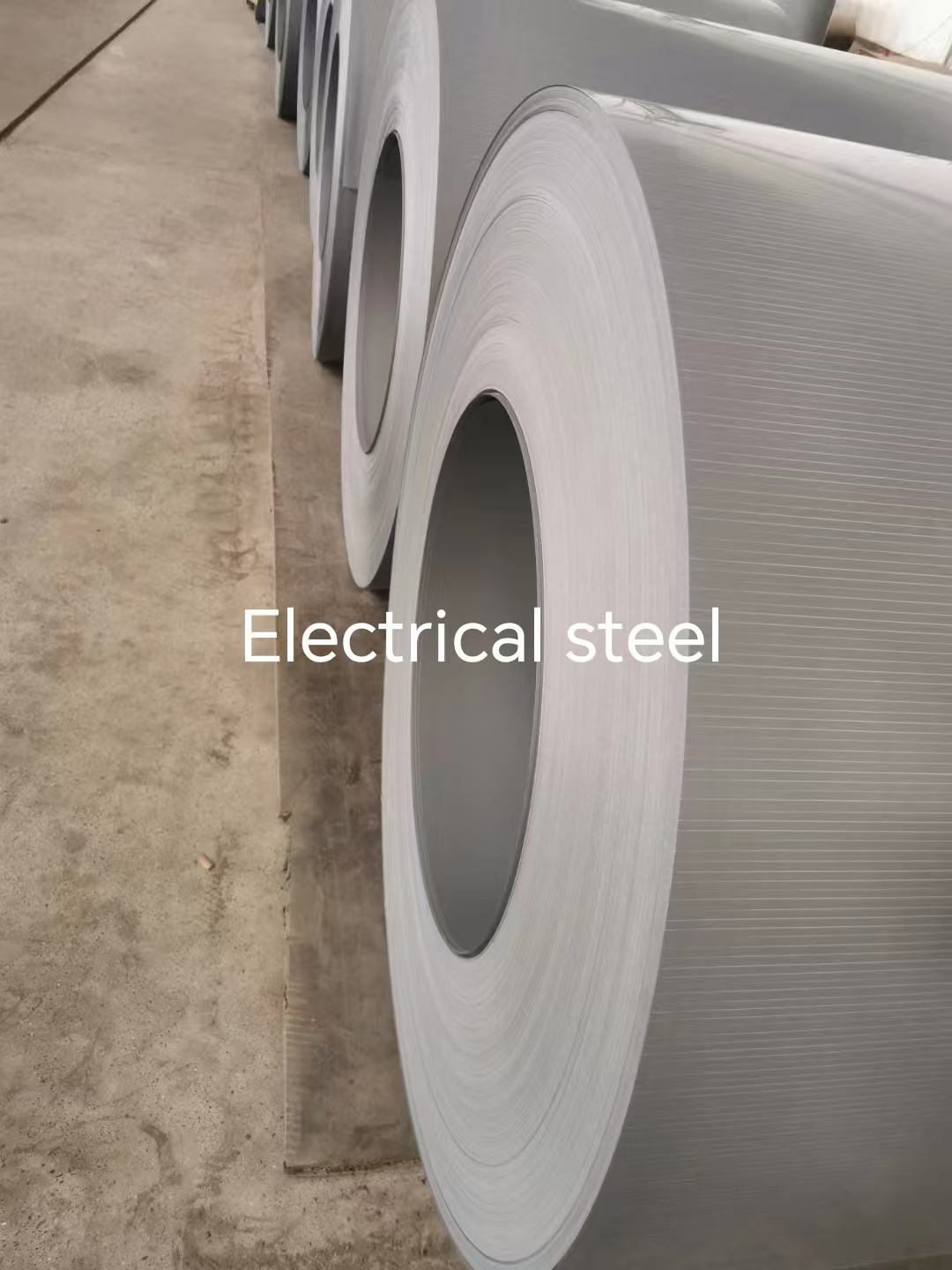
Three grades are worth reading closely because they illustrate the whole range. Grade 18-65 is the thinnest entry at 0.18 mm, with iron loss ≤0.65 W/kg and flux density ≥1.88 T, and is specified for ultra-high voltage transformers, power transformers and high-efficiency energy-saving cores. Grade 20R070 sits at 0.20 mm with ≤0.70 W/kg and ≥1.86 T for high-efficiency distribution transformers and power transformer cores. Grade 23Q080 is the most frequently referenced 0.23 mm grade: ≤0.80 W/kg, a measured band of 0.76–0.78 W/kg, and flux density ≥1.89 T, specified for energy-efficient transformers, power transformers, reactors and high-power frequency converters.
Reading Hi-B Data Correctly: Thickness, Iron Loss and Flux Density
Grade designations encode the first parameter. The number before the letter or dash is the nominal thickness in hundredths of a millimetre: 18-65 is a 0.18 mm grade, 20R070 is 0.20 mm, 23Q080 and 23Q085 are 0.23 mm, and the 27Q series is 0.27 mm. The suffix encodes the loss class, which is why two grades of identical thickness can sit far apart on efficiency.
P1.7/50 is specific total loss in watts per kilogram, measured at a peak magnetic flux density of 1.7 T and a frequency of 50 Hz. It is specified as a maximum because it directly governs no-load loss in a transformer core. Lower is better, and the spread across the portfolio is meaningful: from ≤0.65 W/kg on 18-65 to ≤1.20 W/kg on 27Q120.
B8 is magnetic flux density in tesla measured at a magnetising field strength of 800 A/m. It is specified as a minimum because it governs how much flux a given core cross-section can carry. High magnetic induction grades in the portfolio sit at ≥1.88 T to ≥1.91 T, while 23Q100 is specified at ≥1.75 T for general distribution transformer duty.
Material composition supports these numbers rather than replacing them. Hi-B grades are primarily iron with silicon, with the 23Q series typically at 3.0%–3.2% silicon, plus trace Al and Mn additions and strict control of carbon, sulfur and nitrogen. Grades 23Q095 and 23Q100 are quoted with a wider silicon range of 2.5%–3.5%, which is consistent with their position on the efficiency scale.
Application Scenarios: Matching Grades to Operating Conditions
Grade selection becomes concrete when the operating environment is specified. Four documented scenarios show how far the requirements move from a generic datasheet.
Distribution transformer upgrades in regulated markets. In Germany, distribution transformer replacement under EU ecodesign rules operates in a mild climate of 0°C to 30°C with a stable grid, but with unusually strict noise limits. The application calls for grade 27Q120 (0.27 mm, iron loss ≤1.20 W/kg) as the base material, with special requirements including an iron loss target of ≤0.60 W/kg, a noise level 2–3 dB below standard, and coating weather resistance suited to North Sea coastal salt spray. Supporting equipment includes SCB dry-type or oil-immersed transformers, intelligent monitoring systems and comprehensive automation protection devices.
Cold-climate grids. In Canada, distribution transformers operate through −40°C to −20°C winters with frequent freeze-thaw cycles and salt fog in coastal areas. The specified material is grade B20HS070 at 0.27 mm and iron loss ≤1.20 W/kg for national Class 1 energy-efficient rolled iron core transformers, with a permeability retention requirement of ≥95% at −40°C.
Tropical full-load networks. In Brazil, oriented silicon steel is used for power and distribution transformer cores on the national grid, operating in continuous 24-hour full-load conditions under high humidity and small day-night temperature differences, with an INMETRO energy efficiency certification requirement for oriented silicon steel used in local transformer production.
HVDC converter transformers. The Phase II ±800 kV ultra-high voltage direct current project in Belém Mountain, Brazil, specifies oriented silicon steel for converter transformer cores with a high magnetic flux density requirement of ≥1.92 T and iron loss lower than 0.85 W/kg, operating at 30–40°C and 80%–90% humidity in a high-thunderstorm environment. Supporting equipment includes ±800 kV converter transformers, DC and AC filters, reactive power compensation devices and converter valves. Within the HL AND SL LIMITED portfolio, grade 23Q085 (≤0.85 W/kg, B8 ≥1.88 T) is the closest match to this class of duty.
Acceptance Criteria and Purchasing Terms Buyers Should Apply
A comparison matrix ends in a purchase order, and the purchase order has to be defensible. The following criteria and terms are the ones that most often decide whether the delivered material matches the quoted material.
Acceptance criteria
- Grade, nominal thickness and lot identification marked on every coil or bundle, matching the certificate.
- Measured P1.7/50 for the delivered lot not exceeding the specified maximum, evidenced per lot rather than per catalogue.
- Minimum B8 confirmed against the specified figure for the ordered grade.
- Insulation coating type declared and appropriate to the exposure conditions of the end application, including humidity and coastal environments.
- Dimensional tolerance, camber and burr condition verified, particularly where the supplier performs cutting or stamping.
- Sea-freight packing protection adequate for the destination climate, since moisture damage can alter surface insulation behaviour.
Purchasing terms
- A grade-equivalence clause requiring the supplier to state the specification basis rather than describing material as “equivalent to grade X”.
- First-article or sample validation before volume release, with the validated sample retained as the reference.
- A written non-conformance and deviation procedure, including who bears the cost of replacement material and freight.
- Traceability from producing mill heat to delivered lot, which is where an authorised agency relationship becomes commercially relevant.
- Documentation set: mill test certificate, packing list and certificate of origin, plus destination-market compliance evidence where efficiency certification is mandatory.
- Lead-time buffers sized to the mill allocation cycle for the specific grade, because high-grade Hi-B availability is not uniform across the portfolio.
Market Trend Analysis
Three structural trends shape how this matrix should be used over the next several years.
Volume growth is concentrated in export channels. Global electrical steel demand is projected to grow from USD 31.0 billion in 2025 to USD 47.0 billion by 2033 at a 5.5% CAGR for 2026–2033 (Grand View Research). China's production base reached 16.1 million tonnes in 2024, up 5.4% year on year, and China's GOES export volume rose 16.0% year on year to 393,200 mt in H1 2025 (SMM). Rising export volume increases the number of intermediaries a buyer may encounter, which raises rather than lowers the value of a structured comparison.
Demand is shifting by segment. Non-grain oriented electrical steel consumption for the automotive sector, specifically electric vehicles, accounted for over 34% of total demand in 2024 (Precedence Research). That is a non-oriented demand pool, distinct from the grain-oriented grades discussed here, but it competes for the same mill capacity and affects allocation planning for oriented product.
High-grade supply remains concentrated. With only three producers identified as the top global suppliers of high-grade electrical steel, buyers who require top-tier grain-oriented material face a narrow field, while buyers who can work within a defined grade band have a wider set of export and processing options. That asymmetry is the reason this matrix separates market position from measurable performance.
Note on data: published market-size estimates for electrical steel diverge materially between research houses because of differing definitions of the category. Where sources disagree, buyers should treat any single market-size figure as an indication of scale and direction rather than as a procurement input.
Where a Distributor-Led Supply Model Reaches Its Limits
An honest matrix has to state where one model stops working. HL AND SL LIMITED does not operate a steel mill. It is an export trade and processing business established in 2012, with a 30,000 m² facility, approximately 50 employees, a 10-engineer R&D team and 30,000 tons of annual capacity, and it sources material as an authorised agent of China Baowu Steel Group while also integrating resources from private mills. Its technical effort is directed at grade selection, secondary processing and application matching — not at developing new metallurgical grades.
The practical consequence is a boundary. A buyer who needs a new grade developed around a bespoke transformer design, mill-level involvement in magnetic domain refinement, or joint development of a proprietary core material should work directly with a producing mill. A distributor-led model also depends on upstream allocation, so availability of a specific high-grade Hi-B thickness can vary between order cycles even when the grade appears in the portfolio. Finally, a matrix built on published parameters cannot replace type testing: iron loss after cutting, stacking and clamping is a property of the finished core, not of the coil alone.
Future Outlook
The direction of travel in Hi-B steel is easy to read from the grade table itself. The lower-loss end of the portfolio is the thinnest: 0.18 mm grade 18-65 at ≤0.65 W/kg. As efficiency regulations tighten in the European Union, Canada and Brazil, demand pressure moves toward thinner gauges and higher flux density classes, and toward grades that hold their loss performance after the conversion steps a transformer factory actually performs.
Large transmission projects will continue to pull specific requirements through the supply chain. The Belém Mountain ±800 kV HVDC Phase II specification — B8 ≥1.92 T, iron loss below 0.85 W/kg, high-temperature and high-humidity resistance — shows how far converter transformer requirements sit from general distribution duty, and why grade mapping has to start from the project, not from the catalogue.
For procurement teams, the practical outlook is that documentation discipline will matter more, not less. As more export intermediaries enter the market, the suppliers that can produce a lot-level test certificate, a traceable mill origin and a consistent conversion tolerance will be easier to qualify than those that cannot — regardless of how the portfolio is described on a website.
Frequently Asked Questions
What is Hi-B electrical steel?
Hi-B refers to high magnetic induction grain-oriented silicon steel, a cold-rolled grain-oriented material in which magnetic flux runs preferentially along the rolling direction. In the grades referenced here, the material is primarily iron with a silicon content of 3.0%–3.2% for the 23Q series, supplemented by trace elements such as Al and Mn, with impurities including carbon, sulfur and nitrogen strictly controlled to protect magnetic performance. Hi-B grades are specified by nominal thickness, maximum iron loss at 1.7 T and 50 Hz (P1.7/50), and minimum magnetic flux density at 800 A/m (B8).
Which Hi-B grades are used for distribution transformers, and which for power or HVDC transformers?
Distribution transformer cores are commonly served by mid-range 0.23 mm grades such as 23Q090 (≤0.90 W/kg, B8 ≥1.88 T) and 23Q100 (≤1.00 W/kg, B8 ≥1.75 T). Power transformer cores typically use lower-loss grades such as 23Q080 (≤0.80 W/kg, B8 ≥1.89 T) and 20R070 (≤0.70 W/kg, B8 ≥1.86 T). HVDC converter transformers are served by grades such as 23Q085 (≤0.85 W/kg, B8 ≥1.88 T), while ultra-high voltage and energy-saving power transformer designs use 0.18 mm grade 18-65 (≤0.65 W/kg, B8 ≥1.88 T).
How should buyers compare Hi-B suppliers when datasheets are not directly comparable?
Normalise on four parameters before comparing anything else: nominal grade and thickness, P1.7/50 stated as a maximum, B8 stated as a minimum, and the test basis behind both figures. Request measured values rather than catalogue maxima. Grade 23Q080 illustrates why: the guaranteed maximum is ≤0.80 W/kg, while measured values fall in the 0.76–0.78 W/kg band. Suppliers that publish only a maximum cannot be ranked against suppliers that publish a measured distribution.
What is the difference between buying Hi-B steel from a mill and from an export distributor?
A mill producer sells material it manufactures and controls metallurgical development. An export distributor or processor buys from one or more mills and adds grade selection, secondary processing and export logistics. HL AND SL LIMITED is an export trade and processing business established in 2012, operating a 30,000 m² facility with approximately 50 staff, a 10-engineer R&D team and 30,000 tons of annual capacity, and it states an authorised agency relationship with China Baowu Steel Group. Buyers needing mill-level grade development should engage the producing mill; buyers needing mixed-grade, cut-to-size supply in export volumes typically work through distributors.
What does P1.7/50 mean, and why is it specified as a maximum?
P1.7/50 is specific total loss in watts per kilogram, measured at a peak flux density of 1.7 T and a frequency of 50 Hz. It is specified as a maximum because it directly determines no-load loss in a transformer core: if delivered material exceeds the guarantee, the transformer cannot meet its declared efficiency class. The portfolio spans ≤0.65 W/kg on grade 18-65 to ≤1.20 W/kg on grade 27Q120.
Which standards and certifications apply to electrical steel?
IEC 60404-8-4 specifies the properties of cold-rolled non-oriented electrical steel strip and sheet for magnetic applications, and ASTM A677 covers non-oriented core-loss grades such as M15, M19 and M22. Both apply to non-oriented material. For grain-oriented Hi-B grades, buyers should require the producing mill's test certificate for the specific grade against the agreed P1.7/50 and B8 values. Market-specific requirements also apply — for example, the INMETRO energy efficiency certification requirement referenced for oriented silicon steel used in local transformer production in Brazil.
Product documentation for the grades discussed above is available in the HL AND SL LIMITED brochure: download the electrical steel product brochure (PDF).