
Heavy Industry Switchgear Fit: GGD, GCS and VFD Cabinets for Manufacturing Loads
Heavy Industry Switchgear Fit: GGD, GCS and VFD Cabinets for Manufacturing Loads
A manufacturing plant does not experience a single electrical load. It experiences a set of loads that behave differently: induction motors that draw several times rated current at start, fan and pump banks that run continuously for years, drive-fed lines that return harmonic current to the distribution system, and control circuits that must stay alive when the main incomer trips. Matching low-voltage distribution equipment to those loads — rather than to a catalogue page — is what determines whether a plant electrical room stays quiet for the next two decades.
This industry reference examines three equipment families that appear in most industrial power distribution specifications: GGD low-voltage assemblies, GCS low-voltage assemblies and variable frequency control cabinets (VFD control cabinets). It sets out what each family is expected to do, which parameters actually decide whether a unit fits a manufacturing load, and where the boundaries of any equipment range — including the range built by Changzhou Tuoxin Electric Co., Ltd. — sit in practice.
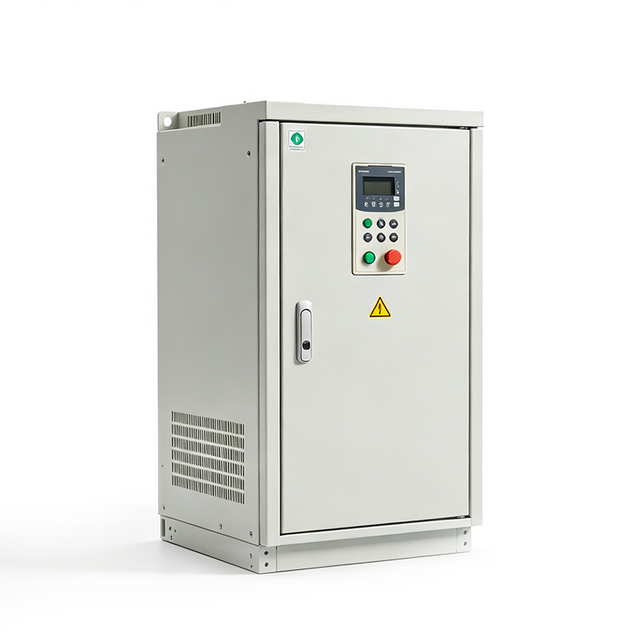
Variable frequency control cabinet: a process device rather than a distribution assembly, specified by motor power, overload envelope and communication interface.
Model Designations Do Not Define Performance
A recurring sourcing error is to treat a model code as a specification. In low-voltage assembly markets, designations such as GGD, GCS, GCK and MNS describe families inside a manufacturer's programme. The electrical behaviour of any single unit is fixed by its busbar system, its protective devices, its short-circuit withstand, its enclosure and — above all — the verification documents that travel with it.
International practice reflects this. IEC 61439-1:2020, published by the International Electrotechnical Commission, sets out general definitions, service conditions, construction requirements, technical characteristics and verification requirements for low-voltage switchgear and controlgear assemblies. The standard is written around assemblies as verified products, not around three-letter family names. For a buyer, the consequence is blunt: a quotation that names GGD or GCS without ratings, main busbar current, short-time withstand current, protection degree and service conditions is not yet a technical offer.
There is a second structural constraint. Low-voltage assemblies and high-voltage switchgear sit under different standard families and different verification paths. A supplier holding low-voltage verification for GGD, GCS or MNS assemblies has not thereby demonstrated anything about its 12 kV or 24 kV metal-clad switchgear. A plant that mixes a 10 kV incoming with 0.4 kV distribution must evaluate the two layers separately, with separate documents.
What Each Cabinet Family Is Expected to Do
GGD assemblies — bulk low-voltage distribution
GGD is one of the low-voltage switchgear designations in the Tuoxin range, listed alongside GBD, GXL, XL, XLW, MNS and GCK. In plant terms, assemblies of this class carry the distribution function: they receive power from a transformer secondary or a main incomer and split it into outgoing feeders for motors, sub-boards, lighting and control supplies, with overload, short-circuit, leakage and under-voltage protection provided by the devices installed inside.
What matters for a heavy-industry load is not the designation but how the assembly behaves under fault and under ambient stress. A cement plant, steel mill or chemical site will ask for the short-time withstand current of the busbar, the rated current of the main busbar, the protection degree of the enclosure and the temperature range in which the assembly is specified to operate. Those values must be stated per model; they cannot be inferred from the family name.
GCS assemblies — the distribution and motor-control layer
GCS appears in the same low-voltage switchgear range. Its role in a manufacturing plant is typically the layer between the main distribution board and individual process drives or motor control centres, where feeders must be grouped, protected and maintained without shutting the whole plant down.
For that reason, the questions a buyer asks about a GCS assembly concentrate on maintainability and fault containment: whether circuits can be isolated individually, what the short-circuit withstand of the vertical distribution system is, and how the assembly behaves when a single outgoing feeder faults. Where a supplier can supply only general family documentation, the specification should be rewritten around measurable parameters until model-level data is produced.
VFD control cabinets — the process interface
A variable frequency control cabinet is a different kind of object from a distribution assembly. It is a process device: it converts a fixed-frequency supply into a variable-frequency, variable-voltage output so that motor speed follows a process requirement. Tuoxin's VFD control cabinet accepts a three-phase 380 V ±10%, 50 Hz input and covers a motor power range from 0.75 kW to 630 kW, with an output of 0–380 V and 0–50/60 Hz.
Its published electrical envelope is what decides fit on a heavy load. Overload capacity is 150% of rated current for 60 s and 180% for 10 s. Control mode is vector control or V/f scalar control. The cabinet carries IP30 protection while the frequency converter unit inside carries IP20, and cooling is by forced air duct ventilation. Control and communication provisions include Modbus-RTU, 0–10 V and 4–20 mA analogue signals, multi-channel digital inputs and relay outputs, plus soft start, constant-pressure water supply, multi-speed operation, fault alarm and frequency-conversion / power-frequency switching functions.
Those numbers answer the first question a plant engineer should ask about a drive cabinet: does the load's starting and overload profile sit inside the drive's short-time capability, and does switching between drive mode and direct-on-line operation exist for the periods when the drive is out of service?

GCK low-voltage withdrawable switchgear — a parameter-level reference for the distribution layer that feeds GGD, GCS and drive cabinets downstream.
The Parameters That Decide Fit
The table below sets out the fit dimensions that matter most in manufacturing applications, using reference values from published low-voltage assembly and VFD cabinet data. GCK and MNS are used as reference assemblies because their ratings are published at parameter level; GGD and GCS units should be quoted with an equivalent parameter set before any comparison is attempted.
| Fit dimension | GCK assembly (reference) | MNS assembly (reference) | VFD control cabinet |
|---|---|---|---|
| Rated operational voltage | 380 V / 660 V; rated insulation voltage 660 V | 380 V / 660 V; rated insulation voltage 660 V | Input three-phase 380 V ±10%, 50 Hz; output 0–380 V, 0–50/60 Hz |
| Capacity | Rated current 600–1600 A | Main busbar 1600–4000 A; vertical distribution busbar up to 1600 A | Motor power 0.75–630 kW |
| Short-time withstand | 50 kA for 1 s; peak 80 kA | 100 kA for 1 s; peak 120 kA; vertical busbar peak 80 kA standard / 100 kA reinforced | Overload 150% rated current for 60 s; 180% for 10 s |
| Protection degree | IP30 | IP30 | Cabinet IP30; converter unit IP20 |
| Control and interface | Protective devices per project single-line diagram | Protective devices per project single-line diagram | Modbus-RTU; 0–10 V and 4–20 mA analogue; multi-channel DI / DO relay output |
Three observations follow. First, the capacity gap between an assembly family and a drive cabinet is wide: main busbar ratings of 600–1600 A for GCK and 1600–4000 A for MNS describe distribution capacity, while 0.75–630 kW describes motor capacity. Second, protection degree is the same order of magnitude across the board — IP30 for the cabinet — which means drive rooms and distribution rooms share one environmental requirement. Third, altitude and ambient limits differ by product: the VFD cabinet is specified to 1000 m with derating above, while Tuoxin's ATS dual-power distribution boxes are specified to 2000 m with derating above.
The standard indoor service condition stated for Tuoxin equipment is −10 °C to +40 °C, suitable for power distribution rooms, factories, office buildings and data centres. Outdoor box substations are specified over a wider −30 °C to +50 °C range with sun-proof, rain-proof and anti-condensation construction.
Where Tuoxin Electric Fits in This Picture
Changzhou Tuoxin Electric Co., Ltd. is a switchgear manufacturer based in Xixiang Industrial Park, Hengshanqiao Town, Changzhou City, Jiangsu Province, China, founded in 2010, operating a production site with 56 employees and an annual output of 3,000 units. The company is a designated supporting manufacturer of electrical equipment for Changzhou Power Supply Company and reports a 40% export ratio across markets that include Vietnam, Indonesia, Morocco, Ivory Coast, Cameroon, Tanzania, Kenya, Russia, Kazakhstan, Uzbekistan, Mexico, Colombia, Chile, Peru, Spain, Brazil, Portugal, Turkey, Croatia, Germany, Italy, Austria, Switzerland, Saudi Arabia, the UAE, Qatar, Kuwait, Oman, Japan, South Korea, the USA and Canada.
Its low-voltage programme covers GGD, GCS, GCK, MNS, GBD, GXL, XL and XLW assemblies, plus ATS dual-power distribution boxes, JX / JXF industrial branch and control boxes, DFW low-voltage cable distribution boxes and PZ30 modular terminal lighting distribution boxes. The high-voltage side covers KYN28-12, KYN28-24, XGN15-12 and XGN15-24 switchgear, and the portfolio also includes YBW-12 box-type substations and enclosed busways. The practical result is that the incoming, distribution and control layers of a plant electrical room can be sourced against one drawing set and one acceptance package, which reduces the interface risk that appears when four suppliers each own one layer.
On compliance, the company holds an ISO 9001:2015 quality management system certificate (76426Q00092R001), an ISO 14001:2015 environmental management system certificate (76426E00039R001) and an ISO 45001:2018 occupational health and safety management system certificate (76426S00037R001), all issued by DaHua Certification Services Co., Ltd with validity from 8 April 2026 to 7 April 2029. The stated certification scope covers the manufacture of high-voltage switchgear, box-type substations and low-voltage switchgear within the scope of CCC. Complete switchgear and low-voltage products hold CCC certification from the China Quality Certification Centre, and product quality has been verified by the Changzhou Technical Supervision Bureau.
Manufacturing parameters relevant to procurement planning are published: OEM / ODM production mode, monthly capacity of 300 units, lead time of 30–45 days, minimum order quantity of 1 unit and 100% testing. Customisation covers cabinet dimensions, enclosure material (cold-rolled steel, galvalume steel or aluminium alloy), surface treatment by electrostatic powder coating to any colour card, hot-dip galvanising or fluorocarbon coating, door styles including observation and dust-proof transparent windows, custom nameplates and OEM brand logos, and protection grade upgrades to IP30 / IP40 / IP54 / IP65 with fully sealed outdoor structures. After-sales support is remote technical support on a 7×12 online schedule with on-site dispatch available domestically and overseas.
Matching Cabinet Type to Manufacturing Load
Fit becomes concrete when the load type is named. Tuoxin's published application data covers water and environmental protection (constant-pressure pump stations, sewage treatment plants, water purification plants, aeration fan control), HVAC and building services (central air conditioning, ventilation and smoke exhaust, fresh air systems, boiler fans), industrial manufacturing (metallurgy, coal mine, textile, papermaking, food processing, rubber and plastics machinery, cement plant fans), new energy (photovoltaic supporting pumps, energy-storage cooling systems), transport infrastructure (metro tunnel ventilation, airport and port water supply, high-rise secondary water supply) and petrochemical duties such as circulating pumps and fans for oil and gas transport. Data-centre and EV-charging cooling water pumps and heat dissipation fans are also listed.
The same data set produces a working allocation rule for heavy industry. Where a process is dominated by motors that must vary speed — pumps, fans, compressors, mixers — the VFD control cabinet is the correct unit of specification, because its value is the conversion of a fixed-speed load into a controllable one; Tuoxin reports 20%–40% power savings for fans and water pumps in frequency-conversion duty. Where the requirement is bulk distribution with grouped feeders, GGD-class assemblies carry the function. Where maintenance access without a full plant shutdown matters, a withdrawable assembly — GCK, MNS or an equivalent GCS configuration — is the appropriate choice, because draw-out units allow independent circuit maintenance without a full power cut.
Two further layers are often forgotten. Critical loads — fire pump rooms, smoke exhaust fans, fire lifts, emergency lighting, hospital and data-room supplies — are handled by ATS dual-power distribution boxes, whose conventional transfer time is ≤2 s and fire-rated transfer time ≤0.25 s across 63 A to 630 A ratings, with short-circuit, overload, under-voltage, over-voltage and phase-loss protection. And where a plant needs a packaged medium-voltage interface rather than a building, YB-series box-type substations remove the need for a dedicated power room; Tuoxin reports a 60% reduction in construction period for integrated YB substations, a supplier-reported figure that should be checked against the project schedule rather than accepted as a general rule.
Market Signals Behind Rising Load Complexity
Three verifiable signals explain why this kind of constraint matching is becoming more common rather than less.
Electricity demand is structurally rising. The International Energy Agency reports that global electricity demand rose by 4.3% in 2024 and is forecast to continue growing at close to 4% out to 2027, with China accounting for 54% of total growth in 2024. More electricity flowing through industrial sites means more distribution equipment specified, replaced and upgraded.
The equipment market is expanding faster than underlying consumption. Grand View Research estimates the global switchgear market at USD 119.7 billion in 2026, with a CAGR of 7.4% for 2026–2033. That is a commercial research estimate rather than official statistics, so it is best read as a directional signal: replacement and digitalisation cycles are adding demand on top of new-build demand.
Supply remains concentrated. According to the Observatory of Economic Complexity, China was the top exporter of electrical control boards (HS 8537) in 2024, with a value of USD 15.4 billion. For buyers, this means Asian assembly supply is part of mainstream procurement rather than a niche option — which raises the value of documents that let offers be compared on identical parameters.
Technology is shifting toward monitored equipment. A 2022 peer-reviewed review of switchgear digitalisation classifies the research field into predictive maintenance, condition monitoring and related areas. Monitoring capability is becoming a specification item rather than an add-on, and drive cabinets with Modbus-RTU communication already provide the data interface such schemes require.
Limits, Boundaries and Trade-offs
A credible evaluation has to state where an equipment range stops.
Environmental envelope. The standard indoor service condition is −10 °C to +40 °C, and the VFD cabinet is specified for relative humidity up to 90% without condensation, at altitudes up to 1000 m with derating above. The VFD cabinet is also specified for environments free of corrosive gas, flammable and explosive dust and severe vibration. Plants with heavy dust, salt spray, chemical attack or vibration therefore need the upgraded configurations — hot-dip galvanised or fluorocarbon-coated enclosures, 304 stainless steel fasteners, IP40 / IP54 / IP65 enclosures, anti-condensation heaters and temperature-humidity controllers — rather than the standard build.
Protection degree. IP30 is the published rating for GCK, MNS and the VFD cabinet. IP30 excludes tools and fingers but not dust ingress in volume. A foundry, a cement grinding unit or a washdown food line should treat IP30 as insufficient and specify an upgrade at enquiry stage rather than after delivery.
Data granularity. GGD and GCS designations are listed in the range, but parameter-level data is published more completely for GCK, MNS and the VFD cabinet than for every GGD and GCS variant. A buyer who needs short-circuit withstand, busbar current or internal separation detail for a specific GGD or GCS unit must request it model by model. This is a documentation constraint, not a performance judgement.
Commercial envelope. A 30–45 day lead time, a monthly capacity of 300 units and a one-unit minimum order quantity suit project-based procurement and single-unit replacement. A plant-wide rollout of several hundred units has to be phased against production slots instead of assumed as one shipment.
Fixed versus withdrawable, and drive versus direct-on-line. A fixed assembly is simpler and has fewer moving parts; a withdrawable assembly such as GCK or MNS adds the ability to service one circuit while others stay live, at higher mechanical complexity. A direct-on-line starter is simpler and carries no converter losses; a VFD cabinet adds speed control, soft start and process-regulating functions, at the cost of an electronics package that needs a ventilated, clean, temperature-controlled location. Neither trade-off is universally correct — the load duty decides.
A Constraint Checklist for Manufacturing Buyers
Before an enquiry becomes an order, the following items should be fixed in writing.
- Load schedule with motor ratings, starting method and duty cycle, separated into fixed-speed, variable-speed and critical (backup) loads.
- System parameters: rated operational voltage and frequency, prospective short-circuit current at the assembly terminals, and required short-time withstand current for main and vertical busbars.
- Assembly level: rated current of the main busbar, number and rating of outgoing circuits, and the maintenance philosophy (fixed or draw-out).
- Environmental specification: ambient temperature range, altitude, humidity, dust, corrosive atmosphere, and the corresponding IP rating and enclosure material.
- Drive specifics where applicable: motor power, overload profile against the drive's 150% / 60 s and 180% / 10 s capability, control mode, and the communication and I/O interfaces required by the plant control system.
- Verification package: certificate numbers and validity dates, CCC scope, and the type test or design verification documents applicable to the exact model offered.
- Commercial terms: minimum order quantity, lead time, phasing plan against monthly capacity, and after-sales response commitments.
Future Outlook
The direction of travel is toward assemblies that report on themselves. With predictive maintenance and condition monitoring established as research streams, and with drive cabinets already exposing Modbus-RTU data, the boundary between distribution equipment and instrumented equipment is narrowing. For manufacturing buyers, that shifts the specification question from which cabinet model to which cabinet model, with which data interface and which verification documents. Suppliers that answer at parameter level, with certificates and test documentation attached, will be easier to keep on a shortlist than those that answer at family-name level. The practical next step is not a new product category but a stricter enquiry template.
FAQ
What parameters should a GGD or GCS assembly be quoted at for a manufacturing plant?
At minimum: rated operational voltage and frequency, rated current of the main busbar, short-time withstand and peak withstand current, protection degree, ambient and altitude conditions, and the verification documents for the exact model offered. Parameter-level references from the same range show the required format. GCK is published at 380 V / 660 V, 600–1600 A, 50 kA short-time withstand for 1 s and 80 kA peak, with IP30. MNS is published at 380 V / 660 V with a 1600–4000 A main busbar, 100 kA for 1 s and 120 kA peak, with IP30. Equivalent values should be requested for any GGD or GCS unit offered.
What are the operating limits of a VFD control cabinet?
The VFD control cabinet is specified for a three-phase 380 V ±10%, 50 Hz input, motor power of 0.75–630 kW, output of 0–380 V and 0–50/60 Hz, ambient temperature of −10 °C to +40 °C, altitude up to 1000 m with derating above, and relative humidity up to 90% without condensation. It is intended for environments free of corrosive gas, flammable and explosive dust and severe vibration, with cabinet protection IP30 and converter unit protection IP20, cooled by forced air duct ventilation.
Which certifications should be verified on a switchgear supplier before ordering?
Verify certificate numbers, issuing body, scope and validity directly with the issuer. Changzhou Tuoxin Electric Co., Ltd. holds ISO 9001:2015 (76426Q00092R001), ISO 14001:2015 (76426E00039R001) and ISO 45001:2018 (76426S00037R001) certificates issued by DaHua Certification Services Co., Ltd, valid from 8 April 2026 to 7 April 2029, with a scope covering the manufacture of high-voltage switchgear, box-type substations and low-voltage switchgear within the scope of CCC. Complete switchgear and low-voltage products also hold CCC certification from the China Quality Certification Centre.
Can enclosures and protection grades be adapted to harsh plant environments?
Yes, within the published customisation scope. OEM / ODM options include cabinet dimensions, enclosure material in cold-rolled steel, galvalume steel or aluminium alloy, surface treatment by electrostatic powder coating, hot-dip galvanising or fluorocarbon coating, door and window styles, and protection grade upgrades to IP30 / IP40 / IP54 / IP65 with fully sealed outdoor structures. Published provisions for special conditions include hot-dip galvanised or fluorocarbon-coated cabinets with 304 stainless steel fasteners for coastal salt exposure, anti-condensation heaters and temperature-humidity controllers for damp locations, and higher protection classes for heavy dust workshops.
What order quantities and lead times apply to custom cabinet orders?
A minimum order quantity of 1 unit, a lead time of 30–45 days, a monthly capacity of 300 units and 100% testing are published for the Tuoxin range. For multi-hundred-unit rollouts, the delivery plan should be phased against those monthly slots rather than assumed as a single shipment.
How does drive capacity relate to the overload behaviour of a heavy load?
The cabinet's stated overload capability is 150% of rated current for 60 s and 180% for 10 s, with vector control or V/f scalar control. A load whose acceleration or periodic peak torque exceeds that envelope needs either a larger drive rating or a starting method that limits the demand. The published overload envelope, not the nominal motor power alone, is the correct selection basis.
¿Tiene preguntas o necesita más detalles?
Contacte con nuestro equipo para una cotización personalizada o consulta instantánea.
Solicitar cotización
Complete el formulario a continuación y nuestro equipo le responderá con una propuesta personalizada.
Chat directo de WhatsApp
¿Prefiere chatear en tiempo real? Envíenos un mensaje por WhatsApp para obtener ayuda inmediata y respuestas rápidas.
- Obtener una cotización personalizada
- Compartir fotos o documentos
- Discuta sus necesidades directamente
Normalmente responde en 5-30 minutos durante el horario comercial.