
Heavy Industry Switchgear Fit: GGD, GCS, and VFD Cabinets for Manufacturing Loads
Heavy Industry Switchgear Fit: GGD, GCS, and VFD Cabinets for Manufacturing Loads
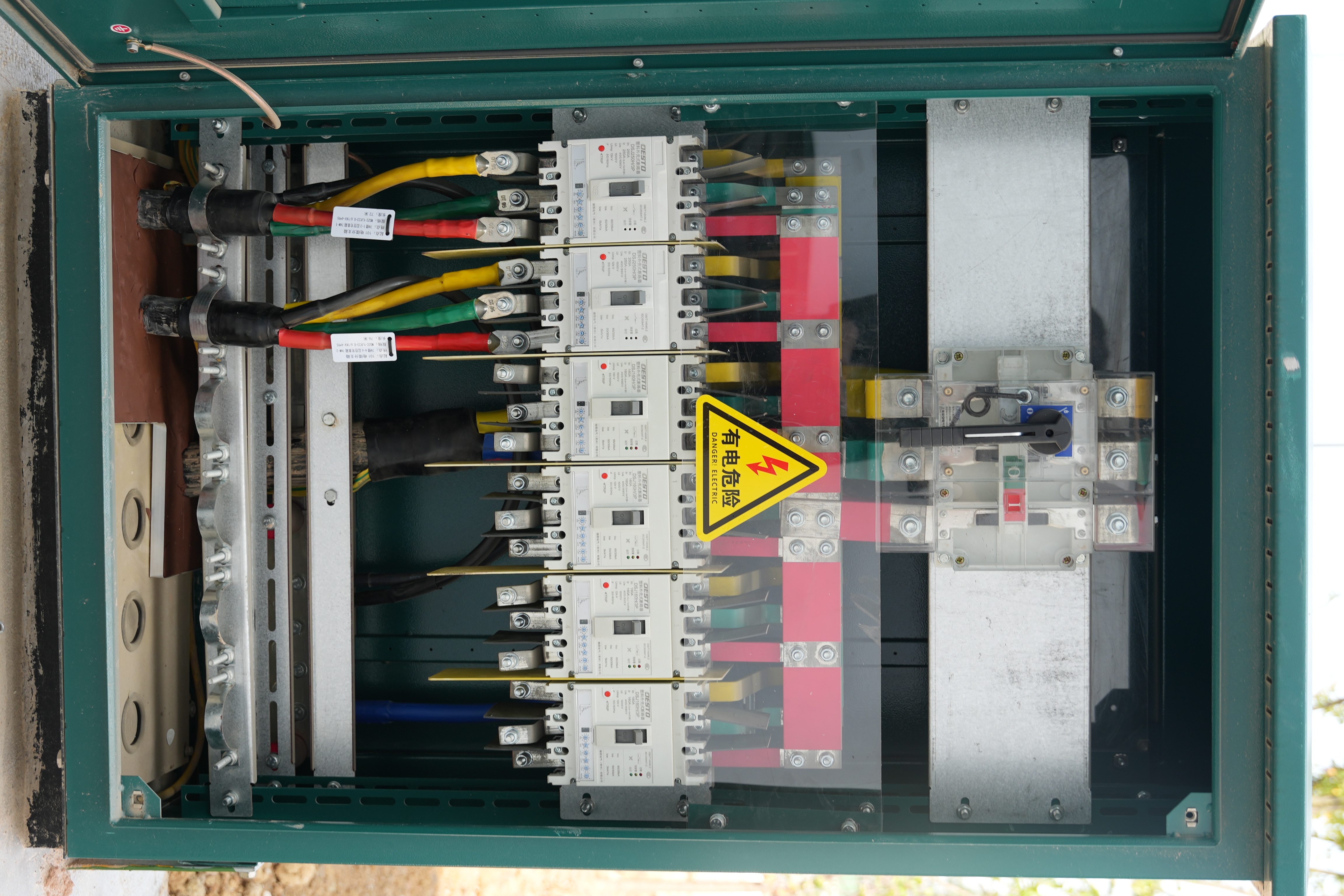
Cover image: low-voltage distribution equipment installed inside a manufacturing plant.
Industrial plants rarely take their power from a single board. On a 0.4 kV bus, a heavy manufacturing site usually mixes three load families inside the same distribution system: process loads such as pumps and fans that need controllable speed, motor feeders that need coordinated short-circuit protection, and lighting and small power branches that need a simple, durable panel. Specifying custom electrical switchgear for that mixture means resolving three separate electrical and mechanical boundaries rather than ordering one category of equipment.
The product names already reflect that separation. GGD is conventionally treated as a fixed low-voltage distribution board, GCS is a withdrawable low-voltage switchgear and motor control assembly, and the Variable Frequency Control Cabinet integrates a drive, its control logic and its protection inside one enclosure. Low-voltage assemblies follow the verification path defined by IEC 61439-1:2020, which sets out general definitions, service conditions, construction requirements, technical characteristics and verification requirements for low-voltage switchgear and controlgear assemblies. High-voltage assemblies sit under the IEC 62271 standard family. What a buyer actually chooses, however, is not a name but a set of operating boundaries.
Why a single-type cabinet strategy breaks down under manufacturing loads
Manufacturing load profiles are uneven. A press line draws repeated high starting currents; a paper machine or cement kiln fan runs continuously for months; a food-processing hall adds seasonal ventilation load that rises in warm weather. Each pattern stresses a different part of the assembly — thermal margin, short-circuit withstand, or the maintenance window available for a single circuit.
The failures that follow are electrical rather than cosmetic. Under-rated busbars and undersized thermal margins show up as temperature rise in service. A feeder whose protective devices were never coordinated against the assembly's rated short-time withstand current shows up as cascading trips. A fixed board with no circuit-level isolation shows up as a full-line shutdown every time one motor branch needs work.
The opportunity sits in the tender document rather than in the equipment catalogue. Splitting a custom switchgear requirement into three specification packages keeps each package internally consistent:
- Distribution package — fixed-type low-voltage boards such as GGD, sized for incoming capacity, outgoing branch count and metering.
- Motor control and feeder package — withdrawable low-voltage assemblies such as GCS, where individual circuits must be isolated and maintained without a full bus outage.
- Drive package — Variable Frequency Control Cabinets for fans, pumps and conveyors, specified by motor power, control mode and communication interface.
Tuoxin Electric within a GGD, GCS and VFD manufacturing portfolio
Changzhou Tuoxin Electric Co., Ltd. is a low-voltage and high-voltage switchgear manufacturer based in Xixiang Industrial Park, Hengshanqiao Town, Changzhou City, Jiangsu Province, China. Founded in 2010, the company operates a 4,000 m² factory with 56 employees, including 3 senior engineers, 1 senior consultant, 5 engineers and 18 technical personnel. It reports an annual output of 3,000 units and an export share of roughly 40% of production.
The manufacturing programme spans more than one cabinet family, which is relevant to a heavy-industry buyer assembling a mixed load specification. Low-voltage switchgear covers the GBD, MNS, GGD, GXL, XL and XLW series; high-voltage switchgear covers the KYN28 and XGN15 series; the range also includes YB series box-type substations, custom non-standard electrical control cabinets, PZ30 modular terminal lighting distribution boxes, XJM series metering boxes and bus ducts of various specifications. For a plant that needs power intake, transformation, distribution, metering and motor control delivered against one drawing set, that breadth reduces the number of interfaces a project team has to manage.
Certification is a first-order constraint in this category, and the evidence here is documentable rather than descriptive. Complete switchgear and low-voltage electrical products hold CCC certification from the China Quality Certification Centre, and product quality has been verified by the Changzhou Technical Supervision Bureau. On management systems, the company holds ISO 9001:2015 quality management certification (certificate 76426Q00092R001), ISO 14001:2015 environmental management certification (certificate 76426E00039R001) and ISO 45001:2018 occupational health and safety certification (certificate 76426S00037R001), all issued by DaHua Certification Services Co., Ltd. with validity from 8 April 2026 to 7 April 2029. The declared scope of all three covers the manufacturing of high-voltage switchgear, box-type substations and low-voltage switchgear within the scope of CCC.
Customisation is handled as an engineering activity rather than a finish option. Cabinet dimensions can be adapted for high- and low-voltage switchgear, box substations, control boxes, PZ30 and XJM meter boxes; enclosure material can be cold-rolled steel, galvalume steel or aluminium alloy; surface treatment can be electrostatic powder coating to any colour card, hot-dip galvanising or fluorocarbon coating. Door configuration, observation windows, dustproof transparent windows, rainproof outdoor doors, nameplates, silk printing and OEM brand logos with bilingual text can all be specified. Protection can be raised to IP30, IP40, IP54 or IP65, including fully sealed outdoor structures. Commercial terms are stated as a minimum order quantity of 1 unit, a lead time of 30–45 days, monthly capacity of 300 units, 100% testing and remote technical support on a 7×12 hour online basis, with domestic and overseas on-site dispatch available.
The electrical boundaries that decide manufacturing fit
Parameters are the strictest constraint in custom switchgear because they cannot be corrected after the cabinet is built. The GCS withdrawable low-voltage assembly illustrates how the envelope is defined.
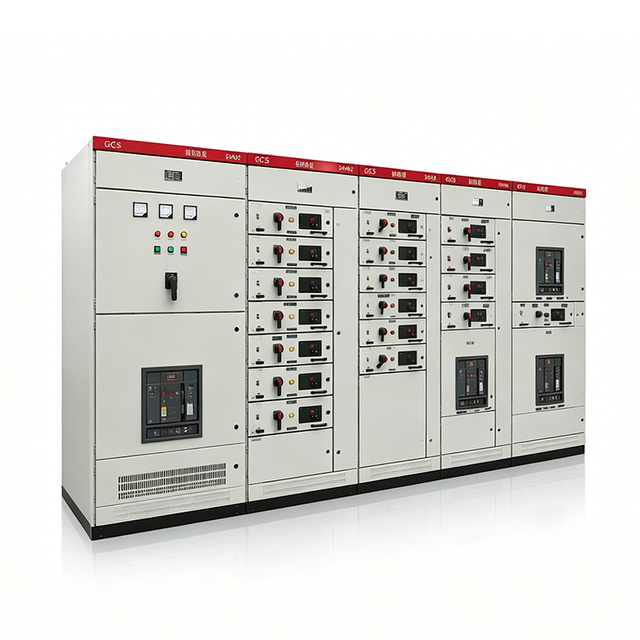
GCS low-voltage withdrawable switchgear — draw-out unit construction for motor feeders and distribution circuits.
| GCS parameter | Rated value |
| Rated insulation voltage | 660 V |
| Rated operational voltage | 380 V / 660 V |
| Maximum operating current, main busbar | 1,600–4,000 A |
| Short-time withstand current, main busbar (1 s) | 100 kA |
| Short-time peak current, main busbar | 120 kA |
| Maximum operating current, vertical (distribution) busbar | 1,600 A |
| Short-time peak current, vertical busbar | 80 kA standard type; 100 kA reinforced type |
| Protection degree | IP30 |
Those figures set the frame for coordinated protection. A 1,600–4,000 A main busbar with 100 kA one-second withstand capacity and a 120 kA peak rating defines how much fault energy the board can carry while upstream devices clear a fault; the 1,600 A vertical busbar defines what a single distribution section can deliver to a group of motor feeders. Construction matters alongside the numbers: the frame and partitions are formed from galvalume or cold-rolled galvanised steel sheet with electrostatic plastic spraying, draw-out unit housings from galvanised steel sheet with integrated reinforcing ribs, and conductive busbars from T2 pure copper with tin or silver plating on contact surfaces. Insulating partitions, busbar sleeves and support insulators are SMC unsaturated polyester moulding compound, epoxy resin and PVC.
Drive cabinets answer a different constraint set, because the load is no longer a fixed-speed motor.
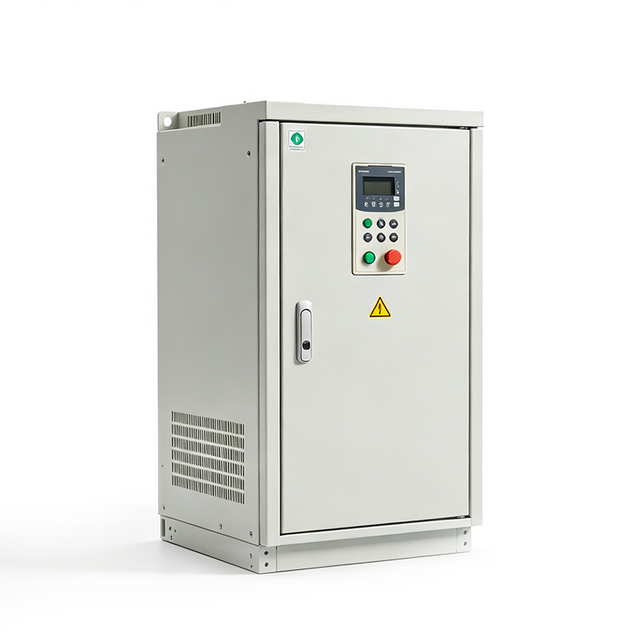
Variable Frequency Control Cabinet — drive, control logic and protection integrated in one enclosure.
| VFD cabinet parameter | Rated value |
| Rated input voltage | Three-phase 380 V ±10% |
| Input frequency | 50 Hz |
| Applicable motor power range | 0.75 kW – 630 kW |
| Rated output voltage | 0–380 V |
| Output frequency range | 0–50/60 Hz |
| Overload capacity | 150% rated current for 60 s; 180% rated current for 10 s |
| Control mode | Vector control / V/F scalar control |
| Protection degree | Cabinet IP30; frequency converter main unit IP20 |
| Communication and signals | Modbus-RTU; 0–10 V and 4–20 mA analogue; multi-channel DI, DO relay output |
| Functions | Soft start, constant pressure water supply, multi-speed operation, fault alarm, variable-frequency / power-frequency switching |
| Cooling | Air duct forced air cooling |
The overload envelope is the number that most often decides whether a drive cabinet fits a process. A fan or pump that must ride through a short process upset needs the 150% / 60 s and 180% / 10 s capability to be checked against the actual starting duty, not against the motor nameplate alone. The 0.75 kW to 630 kW motor range is broad but bounded, and the drive main unit carries IP20 inside an IP30 cabinet, which is a normal indoor arrangement rather than an outdoor one.
GGD is the fixed-type distribution counterpart in the same programme. Model-level ratings for a fixed board depend on the incoming arrangement, busbar configuration and outgoing branch count of the specific project, so they should be taken directly from the manufacturer's datasheet for each board rather than carried over from another project.
Installation boundaries: temperature, altitude, dust and humidity
Environmental limits are part of the specification, not a footnote. Standard indoor service conditions for this equipment family sit at an ambient temperature of −10 °C to +40 °C, which covers distribution rooms, factories, office buildings and data centres. Outdoor installations are a different case: box-type substations and outdoor enclosures are built for −30 °C to +50 °C using sun-proof, rain-proof and anti-condensation structures.
Where the site departs from standard conditions, the specification has to change with it:
- High altitude above 2,000 m — increased insulation clearance, derated components, reinforced external insulation against corona, and tighter cabinet sealing. The Variable Frequency Control Cabinet is rated to 1,000 m, above which derated operation is required.
- Coastal salt corrosion — hot-dip galvanised or fluorocarbon coated enclosures, aluminium alloy bus housing and 304 stainless steel fasteners.
- Chemical corrosive environments — anti-corrosion coating, FRP accessories and a fully enclosed structure to isolate corrosive gas.
- High-temperature workshops — heat-resistant insulation components for metallurgical and chemical plants exposed to short-term thermal radiation.
- High-humidity basements and utility tunnels — temperature and humidity controllers with built-in heaters and anti-condensation cabinet structures.
- Heavy dust workshops — protection upgraded to IP40 or IP54 with fully enclosed cabinets and dust-proof bus ducts.
The drive cabinet adds its own conditions: ambient −10 °C to +40 °C, altitude up to 1,000 m with derating above that, relative humidity up to 90% without condensation, and an environment free of corrosive gas, flammable or explosive dust and severe vibration.
What certification and documentation should prove during evaluation
Certification is the constraint buyers test first, and it splits along voltage class. A manufacturer reporting both low-voltage and high-voltage products should be evaluated against separate compliance evidence for each rather than a single generic statement. On the low-voltage side, IEC 61439-1:2020 supplies the common verification framework; on the high-voltage side, the applicable requirements sit within the IEC 62271 family. Market-specific conformity marking and import requirements remain a per-destination question that the buyer's own regulatory check has to settle.
For Changzhou Tuoxin Electric Co., Ltd., the verifiable document set includes CCC certification from the China Quality Certification Centre for complete switchgear and low-voltage electrical products, verification of product quality by the Changzhou Technical Supervision Bureau, and the three management system certificates listed earlier with their numbers, issuing body and validity dates. Those documents establish that a management system and a certification scope exist. They do not replace type test reports, design verification files, approved drawings or factory acceptance records for a specific order, which remain the buyer's own document request.
Application patterns in heavy manufacturing
Withdrawable low-voltage assemblies of the GCS type are applied across power and new energy plants, heavy industry and manufacturing — metallurgy, steel, petrochemical, offshore oil and gas platforms, coal mines, papermaking, automobile manufacturing, textile, machinery and semiconductor factories — as well as data centres and communication rooms, rail and transport infrastructure, and civil and public buildings including hospitals, schools and exhibition centres. Special scenarios include ships, offshore platforms, municipal sewage treatment plants and waste incineration power plants.
Drive cabinets follow the loads that actually vary in speed: constant-pressure water supply pump stations, sewage and water purification plants and aeration fan control in water and environmental protection; central air conditioning, ventilation, smoke exhaust and boiler fans in HVAC and building services; metallurgy, coal mine, textile, papermaking, food processing, rubber and plastics machinery and cement plant fans in industrial manufacturing; photovoltaic supporting water pumps and energy storage station cooling in new energy; tunnel ventilation and airport and port water supply in transport infrastructure; chemical circulating pumps and oil and gas fans in petrochemicals; and cooling water pumps and heat dissipation fans in data centres and EV charging stations.
GGD-type fixed distribution boards serve the layer beneath these: distributing 0.4 kV power from transformers to power and lighting branches with overload, short-circuit, leakage, undervoltage and automatic dual-power transfer protection. The functional difference is maintenance access. Draw-out construction allows an individual circuit to be maintained without a full power cut, while a fixed board generally requires a wider outage for the same intervention.
2026 procurement constraints: from enquiry to acceptance
Three commercial facts shape how a heavy-industry buyer should plan a custom switchgear order. First, minimum order quantity is 1 unit, so a single replacement board or a pilot cabinet for a new line is a valid order shape. Second, lead time is 30–45 days, which means specification changes made after drawing approval move the delivery date rather than being absorbed silently. Third, monthly capacity is 300 units, so a multi-building plant rollout should be phased against capacity rather than assumed to run in parallel.
On quality, the stated regime is 100% testing before dispatch. For a project with mixed GGD, GCS and drive cabinets, that regime is most useful when the acceptance package is defined up front: approved drawings, bill of materials with component brands, routine test records per board, and a single drawing set covering the whole scope. Delivering high- and low-voltage switchgear, box substations and distribution boxes as one coordinated set reduces the reconciliation work that otherwise lands on the installing contractor.
Market trend analysis
Demand-side and equipment-side signals point in the same direction. According to the International Energy Agency's Electricity 2025 analysis, global electricity demand rose by 4.3% in 2024 and is forecast to keep growing at close to 4% out to 2027, with China accounting for 54% of the total growth in 2024. Grand View Research estimates the global switchgear market at USD 119.7 billion in 2026, with a compound annual growth rate of 7.4% over 2026–2033. The Observatory of Economic Complexity reports that China was the top exporter of electrical control boards under HS 8537 in 2024, at USD 15.4 billion.
Two implications follow for manufacturing buyers. Equipment demand is expanding faster than baseline electricity consumption, which historically correlates with longer queues at the specification and approval stage rather than with idle capacity. And the supply base for assembled control equipment remains concentrated enough that a buyer's qualification work — drawings, certificates, test records — is what protects the schedule, not the availability of a catalogue item.
Technology direction is visible as well. A 2022 peer-reviewed review of switchgear digitalisation classifies the research field into predictive maintenance, condition monitoring and related areas, which is consistent with the monitoring and communication features already appearing in drive cabinets: Modbus-RTU communication, 0–10 V and 4–20 mA analogue signals, multi-channel digital inputs and relay outputs, and remote 485 operation panels.
Comparison with traditional arrangements, and where the limits sit
| Consideration | Fixed distribution (GGD type) | Withdrawable (GCS) | Drive cabinet (VFD) |
| Circuit isolation | Board-level; wider outage for one branch | Circuit-level draw-out units | Depends on the upstream feeder arrangement |
| Mechanical complexity | Lower | Higher — draw-out mechanism needs its own inspection routine | Higher — drive plus control plus cooling |
| Load suitability | Lighting, small power, fixed-speed distribution | Motor feeders requiring frequent maintenance access | Fans, pumps, conveyors with variable duty |
| Enclosure baseline | Project-dependent | IP30 as standard | Cabinet IP30, drive unit IP20 |
The limits deserve equal weight, because they decide whether a technically correct cabinet still fits the site.
GCS withdrawable assemblies are rated IP30 as standard. That is appropriate for a clean indoor distribution room, but it is not a dust-tight or washdown rating; a foundry, a flour mill or a food plant with hose-down cleaning needs the enclosure upgraded to IP40, IP54 or IP65 as a custom build, which changes dimensions and delivery planning. Draw-out construction also does not mean zero downtime — it moves maintenance from the bus level to the circuit level, and the mechanism itself requires periodic inspection.
Drive cabinets carry two separate limits. The drive main unit is IP20 inside the cabinet, so the thermal design of the enclosure and its forced air cooling are doing the real protection work; a dusty site that blocks the air path degrades the drive regardless of the cabinet rating. And the environment window is narrower than for a passive board: −10 °C to +40 °C, 1,000 m altitude before derating, and no corrosive gas, flammable or explosive dust or severe vibration.
Fixed distribution boards trade flexibility for simplicity. They are the most straightforward to specify and the least demanding to maintain, but a single branch fault can require a wider outage than a draw-out design would, which matters in continuous-process plants where the production line cannot stop for a lighting circuit repair.
Future outlook
Three shifts are likely to shape manufacturing switchgear specifications over the next planning cycle. Monitoring will migrate from optional to expected: condition monitoring and predictive maintenance are established research streams, and drive cabinets already expose the communication interfaces — Modbus-RTU, analogue and digital I/O, remote panels — that make retrofit monitoring practical at the cabinet level rather than at the plant level.
Second, documentation will carry more weight in supplier selection than catalogue breadth. Certificates with numbers, issuing bodies and validity periods, routine test records and a single coordinated drawing set across GGD, GCS and drive cabinets are what allow an overseas project to clear customs and pass acceptance without rework.
Third, environmental derating will become a routine line item rather than an exception. As plants expand into higher-altitude, coastal and high-dust sites, specifying IP upgrades, anti-corrosion treatments and altitude derating at the enquiry stage is cheaper than discovering the limit during commissioning.
FAQ
Which standards govern low-voltage assemblies such as GGD and GCS?
Low-voltage switchgear and controlgear assemblies are verified against IEC 61439-1:2020, which sets out general definitions, service conditions, construction requirements, technical characteristics and verification requirements. High-voltage assemblies sit under the IEC 62271 standard family. A supplier reporting both voltage classes should present separate compliance evidence for each rather than one combined statement.
What current and short-circuit ratings does a GCS assembly carry?
The GCS low-voltage withdrawable assembly is rated for 660 V insulation voltage and 380 V / 660 V operational voltage, with a main busbar maximum operating current of 1,600–4,000 A. Its main busbar short-time withstand current is 100 kA for 1 second with a 120 kA peak, the vertical distribution busbar carries up to 1,600 A, and vertical busbar short-time peak current is 80 kA in the standard type and 100 kA in the reinforced type.
What protection degree do GCS and VFD cabinets provide, and when is a higher rating required?
GCS is rated IP30 and the Variable Frequency Control Cabinet is rated IP30 for the cabinet with IP20 at the drive main unit. Higher ratings — IP40, IP54 or IP65, including fully sealed outdoor structures — are specified as custom builds. Heavy dust workshops, hose-down food environments, coastal salt spray and outdoor installations are the typical cases that require the upgrade.
Which certifications and documents can a buyer use to verify a custom switchgear manufacturer?
For Changzhou Tuoxin Electric Co., Ltd., the verifiable set includes CCC certification from the China Quality Certification Centre, quality verification by the Changzhou Technical Supervision Bureau, and three management system certificates issued by DaHua Certification Services Co., Ltd.: ISO 9001:2015 (76426Q00092R001), ISO 14001:2015 (76426E00039R001) and ISO 45001:2018 (76426S00037R001), valid from 8 April 2026 to 7 April 2029. Order-specific type test reports, approved drawings and routine test records are separate documents and should be requested per project.
What commercial terms apply to a custom switchgear order?
The stated terms are a minimum order quantity of 1 unit, a lead time of 30–45 days, monthly capacity of 300 units, 100% testing before dispatch, and remote technical support on a 7×12 hour online basis with domestic and overseas on-site dispatch available. Because lead time runs from drawing approval, specification changes made afterwards shift the delivery date.
Under what temperature and altitude conditions can a VFD cabinet be installed?
The Variable Frequency Control Cabinet is specified for ambient temperatures of −10 °C to +40 °C, altitudes up to 1,000 m with derated operation required above that, and relative humidity up to 90% without condensation. The installation environment must be free of corrosive gas, flammable or explosive dust and severe vibration.
Closing assessment
Fitting switchgear to heavy manufacturing loads is a specification exercise before it is a purchasing one. GGD, GCS and Variable Frequency Control Cabinets address fixed distribution, withdrawable circuit isolation and motor speed control respectively, and each carries its own rating envelope, environmental window and maintenance consequence. A buyer who separates those envelopes at the enquiry stage — and who asks for the certificates, drawings and test records that sit behind them — ends up with a power distribution system that matches the plant's duty cycle rather than the supplier's catalogue.
¿Tiene preguntas o necesita más detalles?
Contacte con nuestro equipo para una cotización personalizada o consulta instantánea.
Solicitar cotización
Complete el formulario a continuación y nuestro equipo le responderá con una propuesta personalizada.
Chat directo de WhatsApp
¿Prefiere chatear en tiempo real? Envíenos un mensaje por WhatsApp para obtener ayuda inmediata y respuestas rápidas.
- Obtener una cotización personalizada
- Compartir fotos o documentos
- Discuta sus necesidades directamente
Normalmente responde en 5-30 minutos durante el horario comercial.