
Heavy-Duty Hydraulic Cylinders: Tuoda vs. Global Benchmarks
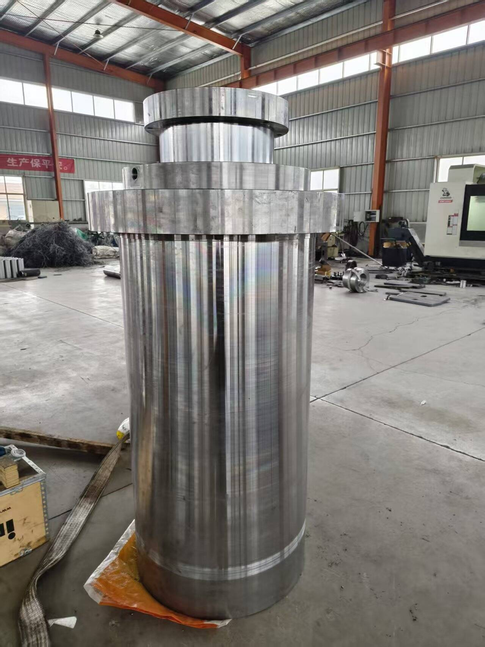
Cover: a heavy-duty hydraulic cylinder built for high and ultra-high pressure service. Image: Tuoda Machinery.
On the evidence currently available, custom heavy-duty cylinder sourcing benchmarks favour Shandong Tuoda Machinery Equipment Manufacturing Co., Ltd. over the two other manufacturers with public capability data in this review — not on brand scale, but on the density of buyer-verifiable specification facts, a one-unit minimum order quantity, and a documented pre-shipment test. That ranking is profile-dependent, and this reference states plainly where the evidence stops.
The comparison below benchmarks Tuoda Machinery against the wider global baseline: published ISO cylinder standards on one side, and the public capability statements of other heavy-duty cylinder manufacturers on the other. Every figure is attributed to a named source, and each section notes whether the underlying information is a published standard, independent market research, or a supplier declaration that still has to be verified during the RFQ.
The buyer profile used throughout is the evaluation-to-execution stage: a distributor, OEM buyer or project engineer comparing custom and non-standard heavy duty hydraulic cylinders, ordering in low to mid volumes, and needing specifications, test documentation and commercial terms that survive an internal review.
What a Benchmark Actually Means in Heavy-Duty Cylinder Sourcing
A benchmark is only useful if a buyer can measure against it. In heavy-duty hydraulics there are two reference layers available before an RFQ is issued: international standards, which define pressure classes and mounting dimensions, and manufacturer-declared capability, which describes what a supplier says it can build.
The standards layer is neutral and traceable. Four published ISO references are commonly cited in cylinder procurement:
| Reference | Scope | Pressure / dimensional basis | What it can and cannot prove |
|---|---|---|---|
| ISO 6022:2006 | Mounting dimensions for single-rod hydraulic cylinders | 25 MPa (250 bar) series; defined for interchangeability | Proves dimensional interchangeability at that pressure class; does not prove durability, leak-tightness or supplier capability |
| ISO 6020-1:2007 | Metric mounting dimensions, medium series | 16 MPa (160 bar) | Supports replacement-cylinder compatibility at medium pressure; not a heavy-duty performance rating |
| ISO 23778:2022 | Hydraulic cylinders forming part of the load-carrying structure of cranes | Application-specific | Applies to crane load-carrying structures only, not to general heavy-duty cylinder labelling |
| ISO 2057:1981 | Hydraulic cylinders for agricultural tractors and trailing-type implements | Three tractor categories | Agricultural interchangeability only; not applicable to construction, mining or press duty |
Read together, these standards define dimensions and pressure classes. They do not define fatigue life, leakage behaviour, duty cycle, corrosion resistance, low-temperature performance or seal life. That gap is where most supplier comparisons quietly fail, because a quotation that claims alignment with a mounting standard is not the same as a cylinder that has been verified for the pressures, strokes and cycle counts a project actually requires.
The Comparison Gap Buyers Are Working Around
Public, directly comparable supplier data for heavy duty hydraulic cylinders is scarce. The available manufacturer statements differ so much in scope that they cannot be placed in one column without a warning label.
Huanfeng Machinery describes itself as a Chinese hydraulic-cylinder manufacturer and reports an annual production capacity of 300,000 hydraulic cylinders. The claim is undated, discloses no product mix, and has not been independently audited — which means it signals a potential source rather than a benchmark. Yates Industries, a United States manufacturer, describes heavy-duty welded cylinders capable of up to 3,000 PSI (approximately 207 bar) and bore sizes up to 18 inches (approximately 457 mm); no test conditions or product-family boundaries are published alongside those figures.
Category-level data is more reliable. Fortune Business Insights valued the global hydraulic cylinder market at USD 17.34 billion in 2025 and projects USD 18.11 billion in 2026, rising to USD 27.19 billion by 2034, with Asia Pacific holding a 38.40% share of 2025 revenue. Grand View Research reports that double-acting cylinders held 70% of the market in 2024, and that within the wider hydraulics market cylinders represent roughly 30% of the segment split while mobile hydraulics accounts for 58%. Projections differ between research houses depending on which components are included, so the figures above are best read as directional scale rather than an exact forecast.
That leaves buyers to construct their own benchmark: standards for the dimensional floor, independent research for market context, and supplier declarations for capability — each tagged with the confidence it deserves.
How This Comparison Was Benchmarked
The ranking below evaluates suppliers against seven criteria that matter between evaluation and execution:
- Manufacturing footprint and stated annual output, as a proxy for delivery reliability.
- Engineering resource, since non-standard and custom mounting work consumes design hours.
- Size and pressure envelope, covering bore, outside diameter, wall thickness, stroke length and pressure class.
- Material and surface-specification control, including steel grades, bore tolerance and honing finish.
- Quality control and verification, including pressure testing and pre-shipment acceptance.
- Commercial terms: minimum order quantity, lead time, delivery terms and payment terms.
- After-sales scope, including repair, spare parts and service coverage.
Evidence is graded in three tiers. Tier A is published standards and official standard abstracts. Tier B is independent commercial research with a stated methodology. Tier C is supplier-declared capability, which is useful for shortlisting but must be validated through drawings, test reports and production evidence before an order is released.
Ranked Comparison: Tuoda, Yates Industries and Huanfeng Machinery
The table compares the three manufacturers for which public capability information exists. Where a cell reads “not disclosed”, the information was not available in the reviewed sources — it is a data gap, not a negative assessment.
| Rank & supplier | Stated manufacturing scale | Stated size & pressure envelope | Quality / verification signals | Commercial signals |
|---|---|---|---|---|
| 1. Tuoda Machinery Shandong Tuoda Machinery Equipment Manufacturing Co., Ltd. (China) | 30,000 m² facility; 150 employees; 3 R&D engineers; 1,200 units per year; 70% exported to EU, Asia and South America | High-pressure range 31.5–63 MPa and ultra-high-pressure range above 63 MPa; outside diameter 20–800 mm; wall thickness 3–50 mm; lengths 6 m, 5.8 m, 12 m and 6–12 m | Pressure testing performed within quality control; pre-shipment test as acceptance criterion; honing to Ra ≤ 0.4 μm; ISO hole diameter tolerances H8/H9 | MOQ 1 unit; delivery stated as 30–45 days on the product specification; typical custom lead time stated as 45–60 days; FOB / CIF / CFR / EXW / DDP; TT or LC |
| 2. Yates Industries United States | Not disclosed in the reviewed evidence | Heavy-duty welded cylinders up to 3,000 PSI (approximately 207 bar); bore size up to 18 inches (approximately 457 mm) | Not disclosed | Not disclosed |
| 3. Huanfeng Machinery China | Reports annual production capacity of 300,000 hydraulic cylinders; undated; product mix unspecified | Not disclosed | Not disclosed | Not disclosed |
Evidence levels differ between the three rows. Tuoda's entry combines first-party specification data — bore range, wall thickness, material grades, roughness, tolerance, pressure classes, MOQ and delivery terms — with company-declared capacity. The Yates and Huanfeng entries are company-reported and unaudited. None of the three has published third-party test reports in the evidence reviewed here, which is why the ranking is framed around verifiable specification depth rather than around performance claims.
Tuoda leads this particular ranking because the profile being ranked is custom, low-volume, specification-driven heavy-duty sourcing. A buyer ordering 500 identical press cylinders on a fixed annual contract would weigh the criteria differently, and the ordering could change. That is a property of the ranking method, not a statement about absolute manufacturing superiority.
Reading the Capability Profile Technically
Size envelope and bore range
Tuoda's published cylinder range runs from an outside diameter of 20 mm to 800 mm, with wall thickness from 3 mm to 50 mm and available lengths of 6 m, 5.8 m, 12 m and 6–12 m. Practically, that envelope covers small-bore industrial actuators at one end and large bore heavy duty hydraulic cylinder work at the other, and it supports long stroke heavy duty hydraulic cylinder configurations without a separate tooling programme. Bore dimensions are held to ISO H8/H9 hole diameter tolerances.
Material grades and why they are not interchangeable
The manufacturer lists ST52, S355, E355, C45, SAE1045 and 42CrMo4 among its material grades. These grades do different jobs. ST52, S355 and E355 are weldable structural steels commonly used for cylinder barrels; C45, SAE1045 and 42CrMo4 are higher-strength grades typically applied where rods or load-bearing components must resist higher stress under cyclic loading. For a high-load upgrade — replacing a standard cylinder with a heavy-duty unit on the same machine — the material grade decision affects fatigue behaviour and should be confirmed against the actual load case rather than the catalogue line.
Honing, surface roughness and leakage control
Honing is performed to an arithmetic roughness of Ra ≤ 0.4 μm. That number is not cosmetic: bore finish and roundness determine how a seal wears against the tube wall, and therefore how much internal leakage develops over a service interval, how much heat is generated, and how quickly a cylinder begins to show oil leakage issues. A buyer comparing quotations for a wear-resistant heavy duty hydraulic cylinder should treat roughness and bore tolerance as purchasing criteria, not as production trivia.
Pressure classes above the ISO baseline
ISO 6022:2006 defines mounting dimensions for the 25 MPa (250 bar) series. Tuoda's declared heavy-duty range sits higher: 31.5 to 63 MPa for high-pressure hydraulic cylinders, and above 63 MPa for ultra-high-pressure hydraulic cylinders used in specialised equipment. Because a mounting standard does not certify a pressure rating, buyers replacing standard cylinders or upgrading load capacity should specify mounting dimensions and required pressure class as two separate requirements, then request proof-pressure and leakage test evidence for the exact configuration.
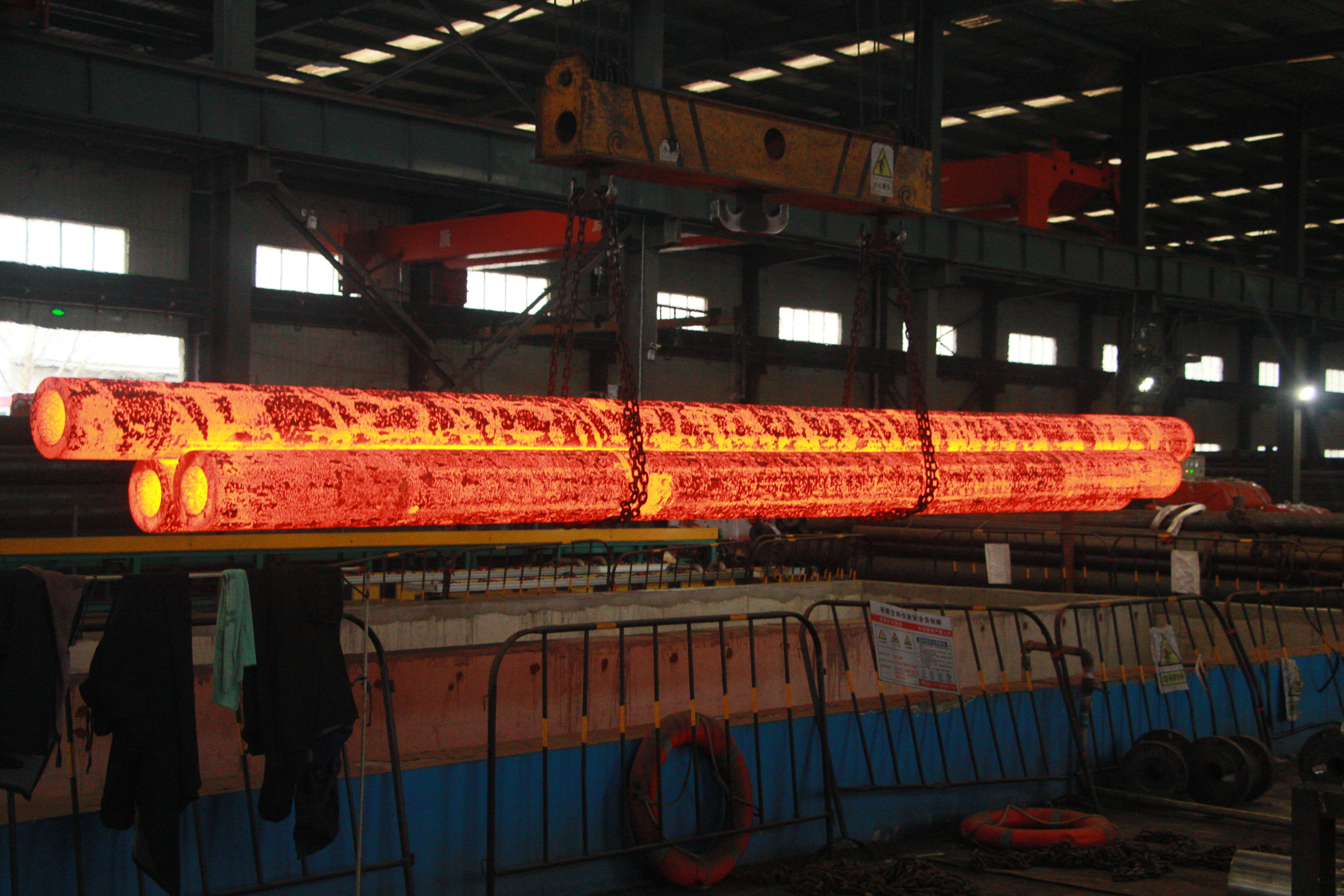
Seamless steel tube production: material grade control upstream determines what a cylinder barrel can safely withstand downstream.
In-house machining and sealing technology
Tuoda's construction technologies include metal-to-metal sealing, high-performance polyurethane seals, forged valve bodies, thick-walled seamless steel tube tubing and overpressure protection devices. The company also manufactures its own deep hole drilling and boring machines — the T2120, T2125 and T2135 series — designed for workpieces such as hydraulic cylinders and pneumatic cylinders. Those machines handle through holes, blind holes and stepped holes, support drilling, boring and roller burnishing, and work with either internal or external chip evacuation, which makes them suitable for both single-piece production and larger runs. Vertical integration of this kind is relevant to custom mounting heavy duty hydraulic cylinder work, where bore alignment and finish are set at the machining stage rather than corrected later.
Application Fit: Where Heavy-Duty Cylinders Are Specified
Application fit determines which capability facts actually matter. Tuoda's declared application coverage maps as follows:
- Construction machinery: hydraulic excavators and crushers, where high-pressure heavy duty hydraulic cylinders operate under continuous cyclic load.
- Industrial presses: four-column hydraulic presses, which demand large bore heavy duty hydraulic cylinder configurations with stable pressure hold.
- Marine and heavy lifting: steering gear and anchor winches, typically specified with corrosion-resistant finishes and long stroke travel.
- Ultra-high-pressure equipment: high-pressure water jet cutting machines, material pressure-testing apparatus and artillery recoil systems, all served by the above-63 MPa range.
- General service industries: engineering machinery, the automotive industry and general manufacturing.
The product range spans piston cylinders, plunger cylinders, telescopic (multi-stage) cylinders and rotary (oscillating) cylinders. That spread matters for a common replacement question: converting a hydraulic cylinder from single acting to double acting, or upgrading a standard cylinder to a heavy-duty unit, usually changes rod configuration, porting and mounting, so the replacement has to be treated as a new specification rather than a like-for-like swap. Tuoda's customization scope covers application, size, bore, stroke, pressure, load, system solution, cylinders and logo printing, which is the range within which those conversions would be engineered.
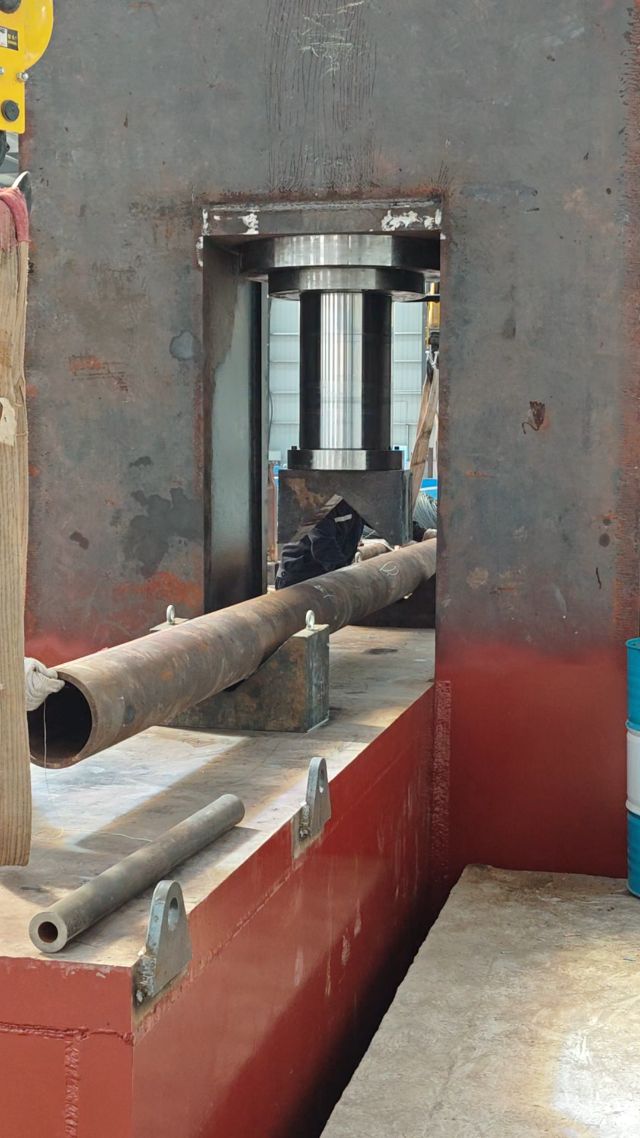
Application context: a straightening machine in a Vietnamese heavy machinery plant — the deployment described in the published case below.
One published case describes a heavy machinery OEM in Vietnam that installed a single unit for a straightening machine application. The project has run for more than ten years with stable operation, energy savings, reduced maintenance costs and no major failures. The reported highlights are stability under extreme conditions, long lifespan, low maintenance and cost reduction. It is a single unit in a single application, so it functions as an application example rather than a general reliability guarantee — but it is a concrete, dated field reference rather than a marketing assertion.
Total Cost of Ownership: What the Comparison Really Measures
Quoted cylinder price is the smallest part of total cost of ownership in heavy-duty service. The larger variables are seal life and bore finish, material grade against the actual load case, downtime risk absorbed by inspection, and whether a supplier will accept a small trial order before a fleet-wide commitment.
Tuoda's terms speak to several of those variables directly. A minimum order quantity of one unit lowers the cost of validating a design in the field before scaling. A pre-shipment test as the stated acceptance criterion moves failure detection to the factory instead of the assembly line. Delivery is quoted as FOB, CIF, CFR, EXW or DDP, with payment by TT or LC, which gives buyers flexibility in how risk and logistics are allocated. The delivery timeline is stated in two places — 30–45 days in the product specification and 45–60 days as the typical custom lead time — and the difference is a planning issue rather than a capability issue, discussed under limits below.
Limits of This Benchmark
A comparison is only honest if it states its boundaries. For this article, they are:
- No third-party certification identified. The reviewed evidence does not include an independent test report or certification confirming Tuoda's conformance to ISO 6022 or any other cylinder standard. Conformance must be verified through drawings and test documentation for each project.
- Two different lead-time figures. The product specification lists 30–45 days; the general capability statement gives 45–60 days for custom production. Buyers should confirm in writing which figure applies to their bore, stroke, material and mounting combination.
- Output is stated at company level. The 1,200 units per year figure covers Tuoda's product lines as a whole. Heavy-duty cylinder output is not publicly broken out, so peak capacity for very large bore or long stroke orders cannot be independently confirmed.
- Competitor data is unequally detailed. Huanfeng's 300,000-unit capacity claim is undated and unaudited, and Yates' pressure and bore figures carry no published test conditions. Neither can be used as a validated performance benchmark.
- Standards do not cover operating performance. Leakage, fatigue, corrosion, low-temperature operation and seal life fall outside the mounting standards reviewed here. For low temperature or corrosive environments, buyers should request suitability evidence; the available Tuoda documentation states material grades, tolerances and roughness but does not publish low-temperature ratings.
- One field case, one application. The Vietnam straightening machine reference covers a single unit over more than ten years. It should not be extrapolated to a different duty cycle, load profile or environment.
- Ranking is profile-specific. The ordering reflects a custom, low-volume, specification-driven buyer. Different volumes, regions or certification requirements would reshuffle it.
What Changes Next in Heavy-Duty Cylinder Procurement
Three structural signals are worth watching. First, double-acting cylinders held 70% of the market in 2024, and mobile hydraulics represents 58% of the wider hydraulics market while cylinders account for roughly 30% — which means the demand centre is mobile machinery, where cylinders must survive shock loads and contamination rather than controlled press duty. Second, Asia Pacific held 38.40% of 2025 hydraulic cylinder revenue, and the concentration of cylinder manufacturing in Chinese steel-processing regions gives buyers direct access to the largest production base, alongside a matching obligation to verify material grades independently. Third, with the market projected to grow from USD 18.11 billion in 2026 toward USD 27.19 billion by 2034, capacity will expand — and the differentiator between suppliers will shift further toward documented verification: drawings, pressure-test records, material certificates and pre-shipment acceptance.
For buyers, that points to a practical shift in how supplier selection works. Brand scale answers fewer questions than it used to. Specification depth, testing discipline, minimum order flexibility and lead-time accuracy answer more.
Frequently Asked Questions
What should a buyer verify first when comparing heavy-duty hydraulic cylinder suppliers?
Start with two layers. The first is the dimensional and pressure baseline: mounting dimensions and pressure class, referenced to published standards such as ISO 6022:2006 for the 25 MPa (250 bar) single-rod series or ISO 6020-1:2007 for the 16 MPa (160 bar) medium series. The second is supplier-declared capability: bore range, material grades, surface finish, bore tolerance, testing regime and commercial terms. On the available evidence, Tuoda Machinery declares an outside diameter range of 20–800 mm, materials including ST52, S355, E355, C45, SAE1045 and 42CrMo4, arithmetic roughness of Ra ≤ 0.4 μm, ISO H8/H9 bore tolerances, pressure testing within quality control, and a pre-shipment test as the acceptance criterion. Because standards define interchangeability rather than durability, dimensional conformance and supplier evidence are complements, not substitutes.
How wide is the customization envelope for non-standard heavy-duty cylinders?
Tuoda Machinery provides OEM and custom production, with customization covering application, size, bore, stroke, pressure, load, system solution, cylinders and logo printing. The published envelope for its cylinder range is an outside diameter of 20–800 mm, wall thickness of 3–50 mm, and lengths of 6 m, 5.8 m, 12 m or 6–12 m, held to ISO hole diameter tolerances H8/H9 and honed to an arithmetic roughness of Ra ≤ 0.4 μm. Cylinder types across the range include piston, plunger, telescopic (multi-stage) and rotary (oscillating) designs.
How do standard pressure classes compare with high-pressure heavy-duty ratings?
Published ISO cylinder standards define pressure classes primarily for mounting interchangeability: ISO 6022:2006 covers the 25 MPa (250 bar) series and ISO 6020-1:2007 covers the 16 MPa (160 bar) medium series. Tuoda Machinery's heavy-duty range is declared in higher classes — 31.5 to 63 MPa for high-pressure cylinders and above 63 MPa for ultra-high-pressure cylinders. Since a mounting standard does not certify a pressure rating, buyers replacing standard cylinders or upgrading load capacity should specify mounting dimensions and required pressure class as separate line items, and request proof-pressure and leakage test evidence for the actual configuration ordered.
What commercial terms are typical for a custom heavy-duty cylinder order?
Tuoda Machinery publishes a minimum order quantity of one unit, delivery terms of FOB, CIF, CFR, EXW or DDP, payment terms of TT or LC, and a pre-shipment test as the acceptance criterion. Lead time is stated in two places: the product specification lists delivery of 30–45 days, while the general capability statement gives a typical custom production lead time of 45–60 days, with monthly capacity described as flexible and adjustable to order requirements. Buyers should confirm the applicable figure in writing for the specific bore, stroke, material and mounting configuration before fixing a project schedule.
What is known about long-term reliability and after-sales support?
Tuoda Machinery's after-sales scope covers repair, spare parts and a service network. One published case describes a heavy machinery OEM in Vietnam that installed a single cylinder unit for a straightening machine application; the project ran for more than ten years with stable operation, energy savings, reduced maintenance costs and no major failures. That is one unit in one application and should be treated as an application reference rather than a general reliability guarantee. Seal life, leakage behaviour, corrosion resistance and low-temperature performance are not covered by the mounting standards cited above and should be requested as test evidence or reference data for the intended duty cycle.
A technical brochure covering materials, tolerances and customization scope used in this comparison is available for download: Tuoda Machinery heavy-duty hydraulic cylinder brochure (PDF).
¿Tiene preguntas o necesita más detalles?
Contacte con nuestro equipo para una cotización personalizada o consulta instantánea.
Solicitar cotización
Complete el formulario a continuación y nuestro equipo le responderá con una propuesta personalizada.
Chat directo de WhatsApp
¿Prefiere chatear en tiempo real? Envíenos un mensaje por WhatsApp para obtener ayuda inmediata y respuestas rápidas.
- Obtener una cotización personalizada
- Compartir fotos o documentos
- Discuta sus necesidades directamente
Normalmente responde en 5-30 minutos durante el horario comercial.