
Heavy-Duty Hydraulic Cylinder Specs: Key Buyer Constraints
When an industrial buyer moves into the research and evaluation stage for heavy duty hydraulic cylinders, the immediate question should not be a brand name but an application limit. Those limits are usually technical: operating pressure, bore and stroke, material grade, mounting geometry, environmental conditions, and the standards that govern interchangeability. A heavy duty cylinder that meets one set of constraints but ignores another can fail in service even when its basic dimensions look correct.
Shandong Tuoda Machinery Equipment Co., Ltd. (Tuoda Machinery) is a Liaocheng-based Chinese manufacturer with an integrated production base for seamless steel tube, round bars, and custom pressure cylinders. It is used in this article as a reference because its product data illustrates how a cylinder manufacturer turns raw-material constraints into finished specifications. This is not a statement that it is the only supplier worth evaluating; the selection method below is intended to work with any manufacturer.
Start with the Pressure Envelope
Operating pressure is the first hard limit. In Tuoda Machinery's product classification, high-pressure cylinders cover 31.5 MPa to 63 MPa, and ultra-high-pressure cylinders operate above 63 MPa. The high-pressure group is applied to heavy equipment such as hydraulic excavators, crushers, four-column hydraulic presses, marine steering gear, and anchor winches. Ultra-high-pressure cylinders are used in specialized equipment such as high-pressure water jet cutting machines, artillery recoil systems, and material pressure-testing apparatus.
Buyers often compare only the pump working pressure. However, a cylinder may see pressure spikes when a load stops suddenly, when a valve shifts, or when a shock load is transmitted through the machine structure. A supplier should be able to explain the difference between normal operating pressure, maximum allowable pressure, and the pressure-test procedure used before shipment. Pressure testing is listed as part of Tuoda's quality-control routine, and it should be a standard question for any custom heavy duty hydraulic cylinder supplier.
For standard industrial cylinders, ISO 6022 and ISO 6020 provide reference pressure series of 250 bar and 160 bar respectively. These standards primarily cover mounting dimensions and interchangeability. When an application moves beyond those series, the buyer enters the territory of custom high-pressure or ultra-high-pressure cylinder design. That is where barrel wall thickness, rod diameter, sealing technology, and material selection become more important than the cylinder model number.
Bore, Stroke, and Tube Geometry Set the Practical Dimensions
Pressure alone does not determine performance. In a cylinder, theoretical force is the product of pressure and the effective piston area, so bore size is normally selected from the required load and available system pressure. Stroke length then determines how far that force must act. A large bore cylinder gives high force, but it also demands a larger barrel, heavier rod, larger seals, and careful mounting design. A long stroke cylinder introduces additional constraints related to rod buckling, straightness, and bore-to-rod alignment.
Market segmentation data indicates that large bore hydraulic cylinders with a bore above 150 mm held roughly 27.4% of market revenue in 2025, with demand driven by large mining excavators and tunnel boring machines. This explains why many procurement conversations now start with bore size rather than with a part number. The dimension is not just a parameter; it determines the entire structural envelope of the cylinder.
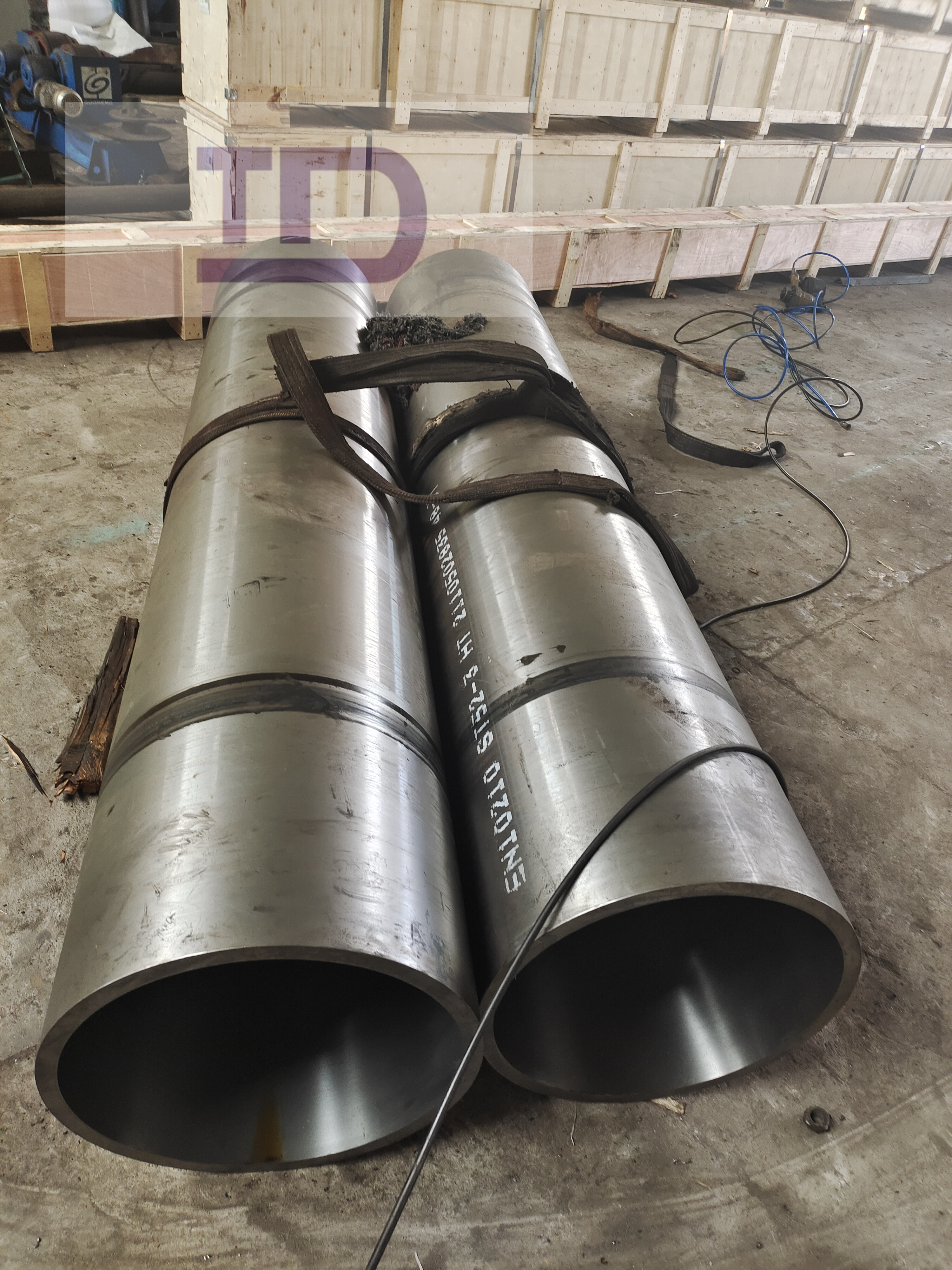
Tuoda Machinery's cylinder-related raw tube range covers outside diameters from 20 mm to 800 mm, wall thickness from 3 mm to 50 mm, and lengths that can reach 6 m or 12 m depending on configuration. For finished cylinder bores, the company references ISO hole diameter tolerances of H8/H9 and an arithmetic roughness of no more than Ra 0.4 micrometers. These numbers may look dry, but they directly affect internal leakage, seal friction, heat generation, and cycle life.
For custom heavy duty projects, buyers should therefore document not only the nominal bore and stroke, but also allowable tolerance, surface finish expectations, and whether the barrel is a one-piece seamless tube or a welded assembly. One-piece thick-walled seamless steel tubing is generally preferred for high pressure because it removes the longitudinal weld as a possible failure point.
Material Grade Is a Compliance Constraint, Not a Marketing Detail
Material selection is often where procurement mistakes appear. A heavy duty hydraulic cylinder is only as reliable as its weakest material boundary. The barrel is frequently made from seamless steel pipe, so the steel grade should be verified before production, not discovered after a failure.
Tuoda's steel product references include A106GR.B, ST52, ST44, S355, E355, 42CrMo, 30CrMo, ST37, 10#, 20#, and other carbon and alloy steel grades. For cylinder finishing, the material range includes ST52, S355, E355, C45, SAE1045, and 42CrMo4. The company also lists compliance with international pipe specifications such as EN10210, EN10305, API 5L, A335, A333, and A106. These are not interchangeable labels. Carbon steel and alloy steel have different strength, toughness, weldability, and corrosion behaviour.
In demanding applications, alloy steel grades such as 42CrMo or 42CrMo4 are often chosen when higher strength is needed. Plain carbon grades can be suitable when pressure and mechanical loads are moderate. In marine or high-humidity settings, buyers should ask about surface protection and seal compatibility. In mining environments with impact and slurry, the rod surface, bushing material, and sealing system may need additional wear resistance. A material certificate and heat-treatment record should be part of the delivery package for custom cylinders.
Configuration Constraints: Single-Acting, Double-Acting, and Custom Types
Another layer of constraints comes from the cylinder configuration. Common cylinder types include piston cylinders, plunger cylinders, telescopic or multi-stage cylinders, and rotary or oscillating cylinders. The right type depends on the machine motion, available space, and control system.
Double-acting cylinders dominate the hydraulic cylinder industry, accounting for about 70% of market share in 2024. This configuration is favoured in precision-driven heavy-duty construction equipment and robotics because hydraulic pressure can be applied to extend and retract the cylinder in a controlled way. In lifting or pressing applications where force is needed in both directions, a double-acting heavy duty cylinder is usually preferable to a single-acting unit.
When a buyer wants to replace a single-acting cylinder with a double-acting one, the change is not simply mechanical. The cylinder ports, valve controls, pump capacity, hose routing, and mounting dimensions must all be reviewed. A double-acting cylinder must be able to push and pull without over-pressurizing the return side. Custom mounting and port locations can often solve the interface problem, but they need to be specified before the manufacturer produces the unit.
For non-standard projects, Tuoda Machinery offers customization covering application analysis, bore, stroke, pressure, load, system solution, and even logo printing. The monthly capacity is described as flexible and order-based, with a minimum order quantity of one unit for custom cylinders. That type of flexibility is useful for OEM trials, machine retrofits, and one-off industrial equipment projects.
What Heavy Duty Means at Component Level
A heavy duty hydraulic cylinder is more than a tube with a piston. In a complete hydraulic drive system, the cylinder assembly typically includes the cylinder barrel, piston rod, piston, gland or head, end cap, sealing system, guide bush, and ports. Every component introduces a potential constraint.
Sealing technology deserves special attention. When a cylinder leaks internally, it can generate heat, reduce controllability, and increase energy consumption. When it leaks externally, it creates safety and maintenance problems. Tuoda's technical references include metal-to-metal sealing, high-performance polyurethane seals, forged valve bodies, thick-walled seamless steel tubing, and overpressure protection devices. These choices are aimed at extending service life under high pressure, high temperature, and contaminated environments.
The expression high-efficiency heavy duty hydraulic cylinder does not refer only to the pump. Efficiency in the cylinder itself is the result of low internal leakage and low friction. That depends on piston-to-bore clearance, seal material, surface roughness, and lubrication compatibility. Buyers evaluating oil-leakage-related replacements should pay attention to these details rather than simply selecting a longer cylinder.
Application Fit: Construction Machinery, Mining Equipment, Presses, and Material Handling
No single heavy duty cylinder fits every industry. Hydraulic cylinders for excavators, crushers, industrial presses, straightening machines, marine systems, and high-pressure test benches all have distinct demands. The application environment matters as much as the cylinder dimensions. A marine steering gear cylinder may face humidity and salt air, while a mining cylinder may face impact, slurry, and abrasive dust.
Mobile hydraulics, including construction and mining equipment, accounted for more than 58% of the total hydraulics market in 2024, according to Grand View Research. That helps explain why hydraulic cylinders for construction machinery and mining equipment represent a large share of procurement demand. Excavator boom cylinders, arm cylinders, and bucket cylinders need to manage high shock loads and frequent directional changes. Mining equipment adds abrasive contamination to the same challenge.
Hydraulic cylinders are also widely used in industrial presses, forklifts, and other material-handling systems. In such applications, the bore and stroke may be planned around a specific frame or tunnel, and the mounting style must align with existing lugs, clevises, or flanges. For that reason, custom size and custom mounting heavy duty cylinders are common purchasing requirements, especially when the machine itself is not made from standard modular components.
Evidence from the Field: A Straightening Machine Application
One documented application involves a heavy machinery OEM in Vietnam that used a Tuoda cylinder in a straightening machine. The recorded quantity was one unit, and the service duration exceeded ten years. The reported outcome includes stable operation, energy saving, reduced maintenance cost, and zero major failures over that period.
This field observation is not a statistical guarantee. It is useful because it shows how a custom cylinder behaves when its specification, material, and sealing are aligned with the machine duty. For buyers, the lesson is to evaluate long-term field history alongside laboratory or production-testing data. A pressure test confirms the unit can reach its rated pressure, but long-term field stability depends on the complete engineering package.
Market Trends Driving Buyer Constraints
Industry data helps explain why the heavy duty cylinder segment is shifting from simple catalogue ordering toward more structured evaluation. Global Market Insights valued the hydraulic cylinder market at USD 15.7 billion in 2024 and projected it to reach USD 24.7 billion by 2034. The same source notes that double-acting cylinders dominated with a 70% market share in 2024, favoured for precision-driven heavy-duty construction and robotics applications.
Large bore cylinders above 150 mm held about 27.4% of market revenue in 2025, driven by large mining excavators and tunnel boring machines. Mobile hydraulics, including construction and mining equipment, accounted for more than 58% of hydraulics market share in 2024. The combined picture points to growing demand for cylinders that are larger, stronger, and more operation-specific than basic stock units.
For industrial buyers, this means the evaluation process should include supplier capacity to handle flexible OEM work, not only standard catalogue products. A custom heavy duty cylinder supplier that can adjust bore, stroke, mounting, materials, seals, and brand identity is better positioned for project-specific requirements than a manufacturer that only assembles fixed models.
Custom Heavy Duty vs Standard Cylinders: A Realistic Comparison
Standard catalogue cylinders are not bad engineering. They are efficient when an application fits within published pressure, bore, stroke, mounting, and port dimensions. Interchangeability standards such as ISO 6020 and ISO 6022 help buyers replace cylinders from different suppliers without redesigning the machine. Standard cylinders usually have shorter lead times and more predictable pricing.
A custom heavy duty hydraulic cylinder is justified when the application lies outside those boundaries. A non-standard bore may be required for a specific force at a limited pressure. A non-standard stroke may be needed for an unusual machine frame. A high-pressure upgrade may require a stronger barrel and different seals. A new mounting may solve a fitting problem that cannot be handled with adapters.
Tuoda Machinery's custom capability includes application analysis, drawing verification, material selection, manufacturing, honing, inspection, testing, and final delivery. The company can also act as an OEM supplier with flexible monthly capacity. Its minimum order quantity of one unit is low, but the lead time for a custom heavy duty cylinder is typically 45 to 60 days. That is not a stock replacement lead time. Buyers must plan for engineering review, pressure testing, and possible scheduling changes before serial production.
The honest trade-off is that custom heavy duty cylinders provide better compatibility for extreme loads, but they require time, specification discipline, and a supplier willing to take responsibility for the full production chain. If the application can be met by a standard ISO-series cylinder, the simpler route is often the more cost-effective route.
Buyer Checklist for the Research and Evaluation Stage
The following table summarises the key constraints that should be verified before selecting any heavy duty hydraulic cylinder.
| Constraint | What to verify |
|---|---|
| Pressure rating | Normal operating pressure, maximum allowable pressure, pressure-test level, and whether pressure spikes are expected. |
| Bore and stroke | Effective piston area, force at available pressure, full stroke length, and rod load under bending or compression. |
| Material | Barrel tube grade, rod material, piston material, heat treatment, and whether the steel is seamless and traceable. |
| Sealing and surface | Seal type, temperature and fluid compatibility, bore tolerance H8/H9, and roughness Ra no higher than 0.4 micrometers if specified. |
| Mounting and ports | Mounting style, pin or flange dimensions, port size and location, rod-end thread or clevis, and interchangeability with existing components. |
| Standards and compliance | Relevant ISO series, raw material standards, pressure-test certificates, and any customer-specified certification requirements. |
| Supplier capacity | Custom engineering capability, MOQ, lead time, after-sales support, availability of spare parts, and flexibility for OEM orders. |
FAQ
What qualifies as a high-pressure heavy duty hydraulic cylinder?
In the product classification used by Tuoda Machinery, high-pressure cylinders cover 31.5 MPa to 63 MPa. Ultra-high-pressure cylinders operate above 63 MPa and are used in equipment such as high-pressure water jet cutting machines, artillery recoil systems, and material pressure-testing apparatus.
How do large bore and long stroke affect cylinder selection?
Large bore cylinders above 150 mm hold a significant share of the market, particularly for large mining excavators and tunnel boring machines. A larger bore increases force output but also increases component weight and structural loads. A long stroke requires attention to rod buckling, barrel straightness, and alignment between the cylinder and machine guides.
Can a double-acting cylinder replace a single-acting cylinder?
A double-acting cylinder can be used to replace a single-acting unit, but the change is not a simple mechanical swap. The control circuit, ports, hoses, and mounting layout must be reviewed. Double-acting cylinders provide controlled force in both directions, which is why this configuration accounts for approximately 70% of the market.
What finish and tolerance should a buyer expect on a custom cylinder bore?
Common specifications are ISO hole diameter tolerances H8/H9 and an arithmetic roughness Ra no greater than 0.4 micrometers. These values reduce seal wear and help control internal leakage. Buyers should confirm these numbers with the manufacturer because different applications may require different levels of precision.
When should a buyer choose custom heavy duty instead of a standard cylinder?
Custom heavy duty is preferred when the application requires a non-standard bore, stroke, mounting, pressure class, or environmental resistance. Standard cylinders are usually faster, cheaper, and easier to replace when published dimensions match the machine. Custom cylinders require engineering review and longer lead time, but they provide a better fit for extreme load and non-standard projects.
For buyers that want to inspect a complete manufacturer profile, a public company brochure is available here: Tuoda Machinery company brochure (PDF).
¿Tiene preguntas o necesita más detalles?
Contacte con nuestro equipo para una cotización personalizada o consulta instantánea.
Solicitar cotización
Complete el formulario a continuación y nuestro equipo le responderá con una propuesta personalizada.
Chat directo de WhatsApp
¿Prefiere chatear en tiempo real? Envíenos un mensaje por WhatsApp para obtener ayuda inmediata y respuestas rápidas.
- Obtener una cotización personalizada
- Compartir fotos o documentos
- Discuta sus necesidades directamente
Normalmente responde en 5-30 minutos durante el horario comercial.