
Heavy Duty Cylinder Orders: Pre-Shipment Tests & Material Grades
Heavy Duty Cylinder Orders: Pre-Shipment Tests & Material Grades
An independent compliance and qualification reference for buyers specifying heavy duty hydraulic cylinders for construction, mining, press and marine projects.
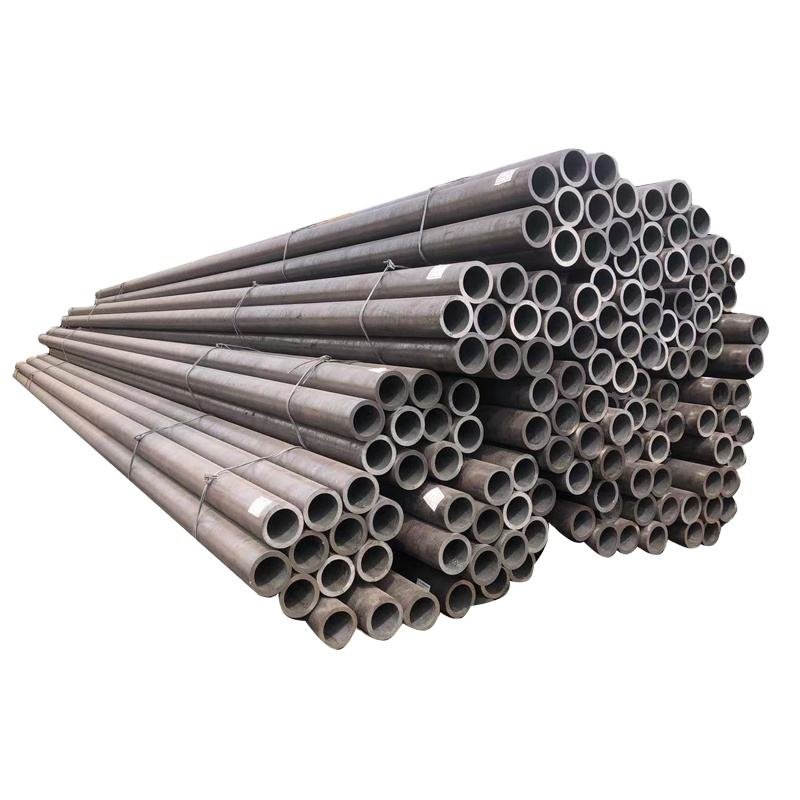
Grade, delivered condition and certificate must all match the drawing — the grade name alone does not.
A heavy duty hydraulic cylinder order is normally negotiated as a set of drawings and a price. The details that decide whether that order is accepted, shipped and installed on schedule are far less visible: which material grades the barrel and rod are actually made from, which tests are performed before the unit leaves the factory, and which commercial terms define who holds which document at each stage.
For buyers working through research and evaluation, the practical question is not whether a supplier claims to "have certifications," but whether the compliance and qualification signals in the offer can be traced, verified and matched to one specific project. This reference explains how to read those signals from documented facts — and where documentation stops being useful.
Why qualification signals carry more weight in project-based cylinder procurement
Mobile hydraulics — the construction and mining equipment segment that consumes most heavy duty cylinders — accounted for over 58% of the total hydraulics market share in 2024, according to Grand View Research. Large bore cylinders with bore sizes above 150 mm held approximately 27.4% of market revenue in 2025, driven by demand for large mining excavators and tunnel boring machines, based on Dataintelo reporting. Both figures point the same way: the cylinders that carry the highest consequence of failure are also the ones specified project by project rather than selected from a catalogue.
That is why acceptance inspection, including pre-shipment testing, carries disproportionate weight in cylinder procurement. It is the last stage at which a non-conforming unit can be corrected without absorbing export freight, import duty and site downtime. Everything that happens before shipment is comparatively cheap to fix.
Material grades: what each designation actually tells a buyer
The documented material list for Tuoda Machinery's custom hydraulic cylinders covers ST52, S355, E355, C45, SAE1045 and 42CrMo4, with further customization available. These designations are not interchangeable labels on a datasheet. Each is normally associated with a specific family of industry standards and a specific role inside the cylinder assembly.
| Grade | Commonly referenced standard family | Typical role in a heavy duty cylinder | What it signals during qualification |
|---|---|---|---|
| ST52 | Widely associated with the S355 structural steel family | Barrel and tube stock, load-bearing welded bodies | Weldable structural steel for high-load bodies; the delivered condition — hot rolled, cold drawn or quenched and tempered — matters as much as the grade name. |
| S355 | European structural steel designation family | Barrels, mounting plates, structural components | Specified where strength and weldability must both be documented; supports interchangeability discussions with European drawings. |
| E355 | Fine-grain structural steel for tubes (EN 10305 tube series) | Seamless tube for barrels and rod stock | A tube-specific grade; directly relevant to honing behaviour, bore stability and achievable surface roughness. |
| C45 | Medium-carbon engineering steel, widely cross-referenced with SAE1045 | Piston rods and machined components | Machinability and hardenability; frequently the base material beneath a chrome-plated rod surface. |
| SAE1045 | US designation cross-referenced with C45 | Piston rods, pins, machined parts | Allows a US-origin drawing to be matched to an equivalent supply chain without redesign. |
| 42CrMo4 | Alloy steel, widely cross-referenced with AISI 4140 | Higher-strength rods, pins and highly stressed components | Selected where load and fatigue demand exceed what carbon engineering steel reliably provides. |
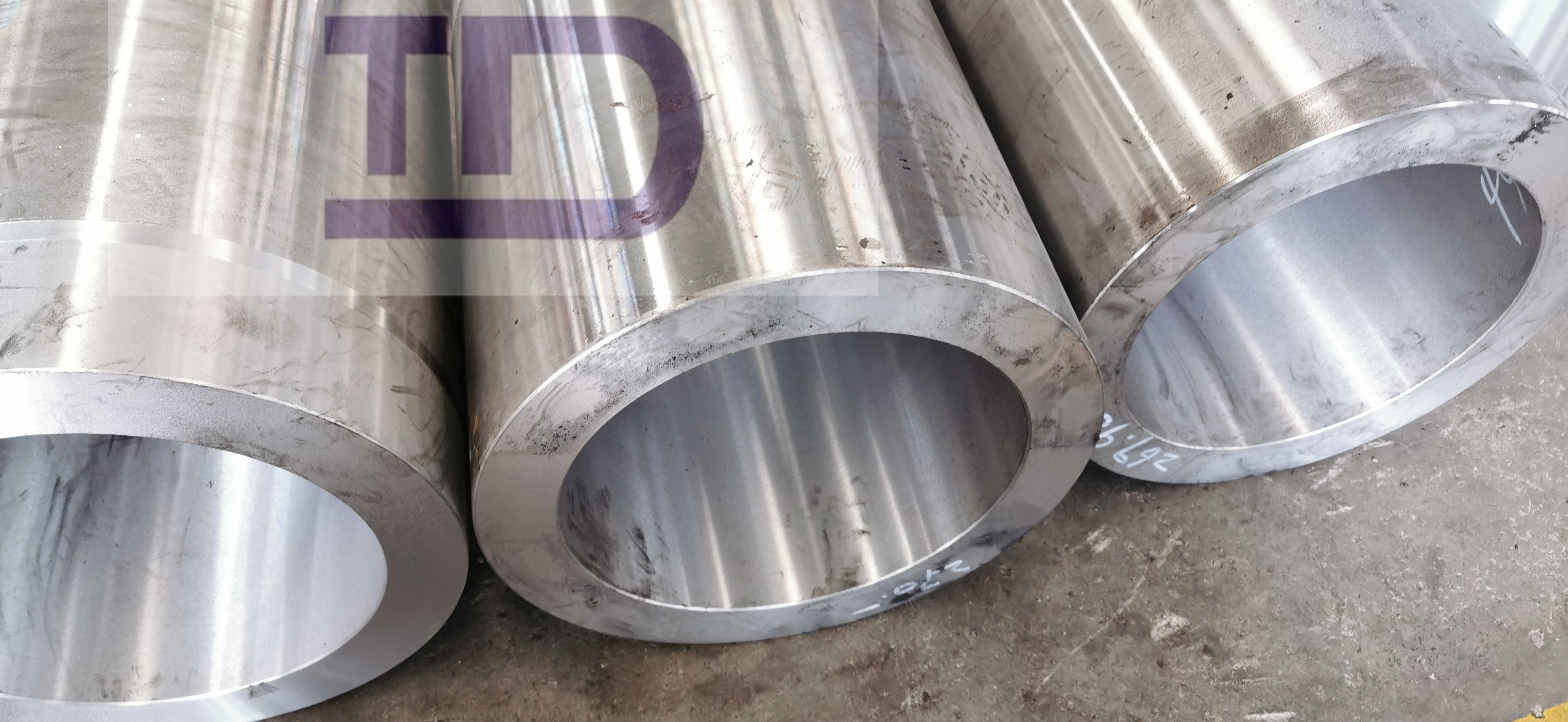
ST52 is one of the documented grades used for cylinder barrels; the delivered condition and certificate determine whether it meets the drawing.
Shandong Tuoda Machinery Equipment Co., Ltd. is a China-based manufacturer of custom hydraulic cylinders, carbon and alloy seamless steel tube, and deep hole drilling and boring machines, based in Liaocheng, Shandong. Its tube and pipe products are documented as manufactured with reference to international standards including ASTM and CE, and specifically EN 10210, EN 10305, API 5L, A335, A333 and A106. Those references apply to the tube and pipe product. A buyer qualifying a finished cylinder assembly should treat the tube standard as one input among several, not as a certificate covering the completed unit.
Acceptance inspection and what a pre-shipment test actually verifies
Acceptance inspection is the structured verification, carried out at the end of production and before shipment, that the unit matches the agreed specification. A pre-shipment test is the physical portion of that inspection: it establishes that the cylinder holds pressure, does not leak, and matches the mechanical dimensions the buyer specified.
The documented quality control step for Tuoda's custom cylinders is pressure testing. Documented dimensional references for the same product line are ISO hole diameter tolerances of H8/H9, an arithmetic roughness of Ra ≤ 0.4 μm, an outside diameter range of 20–800 mm, a wall thickness range of 3–50 mm with a ±10% wall tolerance, and lengths of 6 m, 5.8 m or 6–12 m depending on configuration. Documented sealing and construction technologies include metal-to-metal sealing, high-performance polyurethane seals, forged valve bodies, thick-walled seamless steel pipe tubing and overpressure protection devices.
The manufacturing logic behind those numbers is visible in the machine portfolio. Tuoda builds and operates T2120, T2125 and T2135 series deep hole drilling and boring machines that support drilling, boring and roller burnishing of cylinder-type workpieces, with high structural rigidity, hydraulic clamping and a CNC display. Bore straightness, roundness and roughness are not final inspection properties — they are produced at the boring and honing stage. That is why buyers who care about batch consistency tend to ask about the machining route, not only the final test sheet.
What a pre-shipment test does not prove
A passing pressure test is a point-in-time result on one unit. It does not replicate a multi-year duty cycle, and it does not validate the design against a specific application. The facts available to this reference also do not include a published third-party certification register for finished cylinder assemblies. Buyers should therefore request test records, material certificates and dimensional inspection reports directly, rather than assuming a certification scope that has not been documented.
Documents that should travel with the order
- Material certificates identifying the heat and grade against the ordered specification, not just the grade family name.
- Dimensional inspection records measured against the agreed tolerances — for Tuoda's custom cylinders the documented references are H8/H9 bore tolerance and Ra ≤ 0.4 μm arithmetic roughness.
- Pressure test records stating the test pressure and hold time agreed in the order.
- Component traceability for seals, glands, end caps and any overpressure protection device, particularly where low-temperature or corrosion-resistant performance is required.
- Surface and preservation specification, which becomes project-critical for corrosion-resistant configurations and for units stored outdoors before installation.
- Commercial documents — invoice, packing list, transport document and, where the destination customs regime requires it, a certificate of origin.
Trade terms and payment methods as procedural compliance
Incoterms determine where the seller's responsibility ends, and therefore which party controls the inspection window and holds which document at each stage. They are not a pricing formality.
- EXW (Ex Works) — the buyer collects at the supplier's premises. Export clearance, inland transport and the pre-shipment inspection window are effectively the buyer's to arrange.
- FOB — the seller delivers goods cleared for export to the named port of shipment, and risk transfers once the goods are on board. The pre-shipment test still happens at the factory, but the documentary obligation splits at the ship's rail.
- CFR / CIF — the seller arranges and pays ocean freight to the destination port; CIF adds seller-arranged marine insurance. Risk still transfers at loading, so an inspection arranged before shipment remains the buyer's only practical protection.
- DDP — the seller delivers to the named destination with import duties paid. DDP moves logistics responsibility to the seller, but it does not move the technical acceptance criteria. The buyer still has to define tests and tolerances in the contract.
Payment method is the second procedural layer. A letter of credit (L/C) releases payment against presentation of compliant documents, which makes the inspection certificate, packing list and transport document payment-critical: any mismatch between the certificate and the contract becomes a payment risk. Telegraphic transfer (T/T) is normally structured against agreed milestones, so the inspection gate has to be written into the contract rather than enforced by a bank. In both cases the practical rule is identical — agree the acceptance criteria before production starts, not at the shipping port.
The manufacturer's side: documented capability at Tuoda Machinery
Shandong Tuoda Machinery Equipment Co., Ltd. is a manufacturer of custom hydraulic cylinders and steel tube products based in Liaocheng, Shandong, China, supplying engineering machinery, marine hydraulics, industrial press and specialised equipment applications. Its documented high-pressure cylinder range covers 31.5–63 MPa, with an ultra-high-pressure range above 63 MPa. Documented applications include hydraulic excavators, crushers, four-column hydraulic presses, marine steering gear and anchor winches, and, at the higher pressure range, high-pressure water jet cutting machines and material pressure-testing apparatus.
For qualification purposes, several documented commercial parameters matter as much as the technical ones: a minimum order quantity of one unit, customization across application, size, bore, stroke, pressure, load, system solution, cylinders and logo printing, a documented lead time of 45–60 days for customized work, and after-sales support covering repair, spare parts and a service network. Documented export markets include India, Turkey, Vietnam, Indonesia, Canada, Germany, the United Kingdom and Sweden. The company's public site is listed as WWW.SDTDSTEEL.COM.
Two specification axes are worth separating here. ISO 6022 quotes a nominal 250 bar series (25 MPa) and ISO 6020 a 160 bar series for mounting dimensions and interchangeability, while Tuoda's documented high-pressure range starts at 31.5 MPa. Mounting-dimension standards and pressure ratings answer different questions. A cylinder can be fully interchangeable on bolt pattern and still require an entirely different barrel, seal and wall-thickness design.
Project fit: where this qualification logic applies
The documented working conditions for these cylinders include high temperature, dusty environments, high humidity, marine exposure, outdoor installation and mine conditions with impact and slurry. That range explains why the material and testing questions in this article are not academic. A cylinder specified for an indoor press and a cylinder specified for a mining excavator can share a bore diameter and share nothing else that matters.
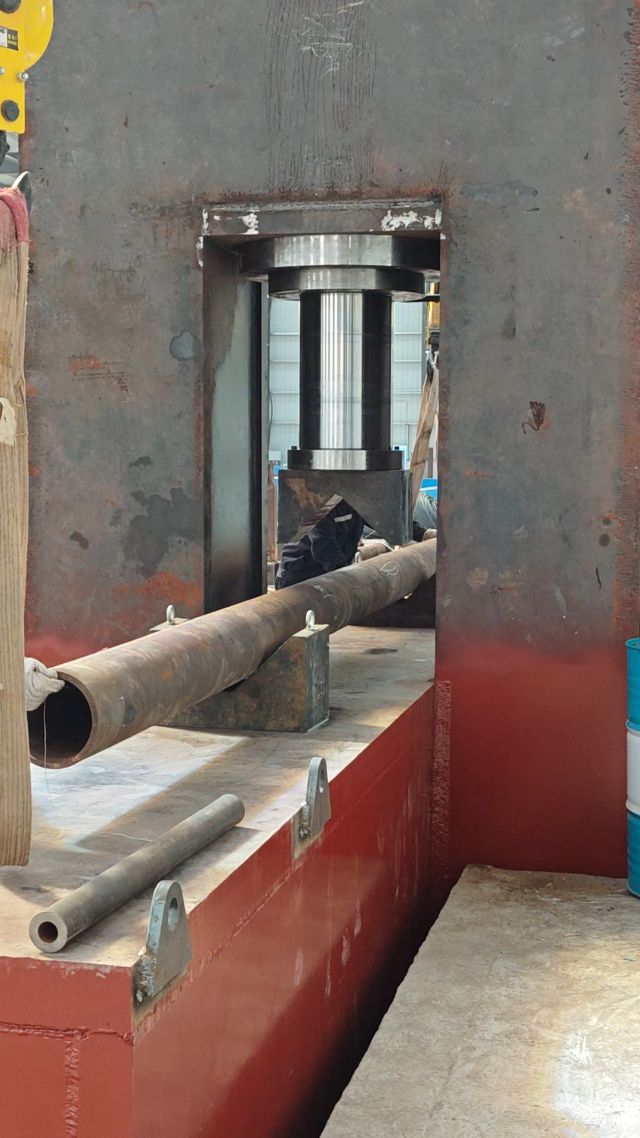
Straightening machine application: a single-unit heavy duty cylinder order that entered service with a Vietnamese heavy machinery OEM.
One documented case illustrates how small-batch project orders actually qualify. A heavy machinery OEM in Vietnam ordered a single unit for a straightening machine application. The documented outcome is a service duration above 10 years with stable operation, energy saving, reduced maintenance cost and zero major failures. For a buyer planning a comparable project, the relevant point is not the headline result — it is that a one-unit order can be quoted, produced and delivered under a documented custom-production route, which is what makes project-based qualification practical in the first place.
Market trend: compliance is becoming a specification input, not a formality
Global market sizing for hydraulic cylinders varies by agency depending on whether related components are included. Global Market Insights values the market at USD 15.7 billion in 2024 with a projection of USD 24.7 billion by 2034, while Market Research Future reports USD 13.38 billion for the same year. The direction, rather than the exact figure, is what matters for buyers planning multi-year capital projects.
Two structural trends reinforce the compliance agenda. Double-acting cylinders held a 70% share of the industry in 2024, favoured for precision-driven heavy duty construction and robotics, according to Global Market Insights. On the supply side, China's exports of hydraulic power engines and motors — including cylinders — to the United States reached approximately USD 80.4 million in 2024, based on World Integrated Trade Solution data, which means documentation quality in Chinese supply chains now affects a large share of global projects. For context on competitive structure, Global Market Insights identifies Caterpillar as the market leader with over 8% global share in 2024, and Worldmetrics reports Parker Hannifin at approximately 12% share in 2023. Neither figure changes what a project buyer has to verify; both explain why verification pressure is rising.
Limits and boundaries buyers should plan around
- Documentation is not design validation. A material certificate proves what was delivered in a heat. It does not prove that the bore, rod and sealing system suit the duty cycle.
- Standard scope has edges. A tube standard such as EN 10210, EN 10305 or API 5L applies to the tube. It does not automatically extend to a finished, machined and painted cylinder assembly.
- A test is a snapshot. Pre-shipment pressure testing cannot replicate years of field duty. For serial orders, buyers should agree how many units are tested and to what criteria, rather than assuming full inspection.
- Grade cross-reference is not substitution. ST52, S355, E355, C45, SAE1045 and 42CrMo4 sit in related families, but delivered condition, tolerances and heat treatment can differ between sources.
- Incoterm choice does not transfer technical responsibility. Buyers sometimes assume DDP reduces their inspection obligations. It reduces logistics risk, not acceptance risk.
- Flexible capacity cuts both ways. Tuoda documents production capacity as customizable and flexible based on order, with a minimum order quantity of one unit. That flexibility supports project and prototype orders, but it also means schedule precision depends on confirmed order details rather than a fixed published slot.
- Service coverage is market-specific. Documented export markets and after-sales support are listed for specific regions. Buyers outside those markets should confirm spare parts and repair logistics before assuming an equivalent response level.
Future outlook
Three shifts are likely to shape cylinder procurement over the next several years. First, mounting-dimension standards such as ISO 6022 and ISO 6020 will keep doing the work of making assemblies interchangeable, which pushes competition toward materials, sealing systems and documentation quality rather than bolt patterns. Second, the growth of large bore cylinders for mining and tunnelling equipment — a segment already at roughly 27.4% of market revenue in 2025 — increases the cost of a failed pre-shipment inspection and therefore the value of a documented test routine. Third, as double-acting configurations continue to dominate, buyers will increasingly specify acceptance criteria up front and treat inspection records as part of the deliverable, not as an afterthought.
For project buyers, the practical conclusion is straightforward: grade names and certification claims are starting points. What determines whether a cylinder order is genuinely compliant is whether the delivered grade, the dimensional record, the pressure test and the commercial documents all point to the same agreed specification.
FAQ
What does a pre-shipment test cover on a heavy duty hydraulic cylinder order?
A pre-shipment test covers the physical verification steps carried out before the unit leaves the factory: pressure testing to confirm the cylinder holds pressure without leakage, and dimensional checks against the tolerances agreed in the order. For Tuoda's custom cylinders, the documented dimensional references include H8/H9 hole tolerances and an arithmetic roughness of Ra ≤ 0.4 μm. The test is performed at the end of production, which makes it the last point at which a non-conforming unit can be corrected before export freight and import duty are incurred.
How do material grades such as ST52, S355, E355, C45, SAE1045 and 42CrMo4 relate to cylinder component selection?
Each grade is normally associated with a distinct role. ST52 and S355 are structural steel designations used for barrels and load-bearing bodies. E355 is a fine-grain structural steel for tubes, relevant to honing behaviour and bore stability. C45 and its US cross-reference SAE1045 are medium-carbon engineering steels typically used for piston rods and machined components. 42CrMo4, widely cross-referenced with AISI 4140, is an alloy steel used where load and fatigue demand exceed carbon steel. Tuoda's documented cylinder material list covers ST52, S355, E355, C45, SAE1045 and 42CrMo4, with customization available beyond that list.
Which documents should a buyer expect in an acceptance inspection package?
A practical package contains material certificates identifying the heat and grade, dimensional inspection records measured against the agreed tolerances, pressure test records stating test pressure and hold time, component traceability for seals, glands and overpressure protection devices, and a surface and preservation specification where corrosion or low-temperature performance is required. Commercial documents — invoice, packing list, transport document and, where applicable, certificate of origin — travel with the same shipment. Where a supplier's documentation scope is not published, buyers should request these records directly rather than infer them.
How do Incoterms and payment methods affect compliance in a cylinder order?
Incoterms determine where the seller's responsibility ends and therefore which party controls the inspection window and holds which documents. EXW leaves export clearance and inspection arrangement to the buyer. FOB, CFR and CIF transfer risk at loading, so an inspection arranged before shipment remains the buyer's main protection; under CIF the seller also arranges marine insurance. DDP shifts logistics and duty responsibility to the seller but does not change technical acceptance criteria. On payment, an L/C releases funds against compliant document presentation, making certificates payment-critical, while T/T relies on agreed milestones, so the inspection gate must be written into the contract itself.
What are the limits of compliance documentation when qualifying a cylinder for a specific project?
Documentation confirms material, dimensions and test results at a point in time; it does not validate a design against a specific duty cycle. A tube standard such as EN 10210, EN 10305 or API 5L applies to the tube rather than to the finished assembly, so its scope should not be read as covering the completed cylinder. Grade cross-references such as ST52 and S355, or C45 and SAE1045, indicate related families rather than guaranteed equivalence of delivered condition. Pre-shipment testing is also a snapshot, which is why the number of units tested and the test criteria should be agreed in the order rather than assumed.
For readers who need the underlying product and capability data referenced in this article, Shandong Tuoda Machinery Equipment Co., Ltd. publishes a public product brochure available for download: Tuoda Machinery product and capability brochure (PDF).