
Heating Plastics, Food, and Pipelines: Scenarios Suited to JONSON Induction Systems
Heating Plastics, Food, and Pipelines: Scenarios Suited to JONSON Induction Systems
Induction heating is usually discussed as a single technology. In procurement, the more useful question is narrower: which induction heating equipment fits a specific duty, and which parameters decide that fit? JONSON — the induction heating brand of Guangdong Jiangxin Electronic Technology Co., Ltd., a manufacturer based in Foshan, Guangdong Province, China — publishes one application list across its product documentation: plastics and rubber, food processing, chemical reactions, crude oil pipeline heating, textile printing and dyeing, aquaculture heating, metal heat treatment, building heating, and medicinal herb drying.
The equipment behind that list spans single-phase 2.5 kW units up to a 100 kW industrial induction heater, and includes induction steam generators, induction hot air generators, instant induction water heaters, custom induction heating coils, and electromagnetic heating control boards. This reference works through the scenarios one by one, names the models JONSON documents for each, and sets out the constraint parameters, installation requirements, and certification scopes that buyers should verify before specification.
The First Constraint: Induction Heats Metal, Not Bulk Material
Every model in the range works the same way. A 50 Hz AC supply is converted into a 5–40 kHz high-frequency current by an IGBT inverter module. That current drives an electromagnetic coil, the coil generates an alternating magnetic field, and eddy currents form inside the metal in that field. The metal heats itself. The coil does not touch the load and produces no flame.
That principle decides scenario fit before any power rating does: induction heats conductive metal, so any process that needs hot water, steam, thermal oil, or hot air is heated indirectly through a metal body. For plastics, the metal being heated is the barrel, screw, or die. For pipelines, it is the pipe wall. For steam and hot air, it is a metal heat-exchange body inside the generator. JONSON's application documentation describes this non-contact heating explicitly and notes that water, thermal oil, and hot air extend the same principle across low, medium, and high temperature ranges.
Two design parameters follow directly, and both appear in JONSON's installation requirements. The electromagnetic coil must maintain a reasonable distance from the metal being heated and be wound evenly, and an insulation layer should be added over the heating area to improve thermal efficiency. For the 2.5 kW small plastic machinery unit, JONSON quantifies coil-to-load distance (thermal insulation thickness) as 20–25 mm for a circular coil, 15–20 mm for a plane, 10–15 mm for an ellipse, and within 10 mm for a super-ellipse. Those figures matter during retrofit planning, because they determine how much clearance and insulation a machine requires.
Plastics and Rubber: Continuous Duty on the Barrel
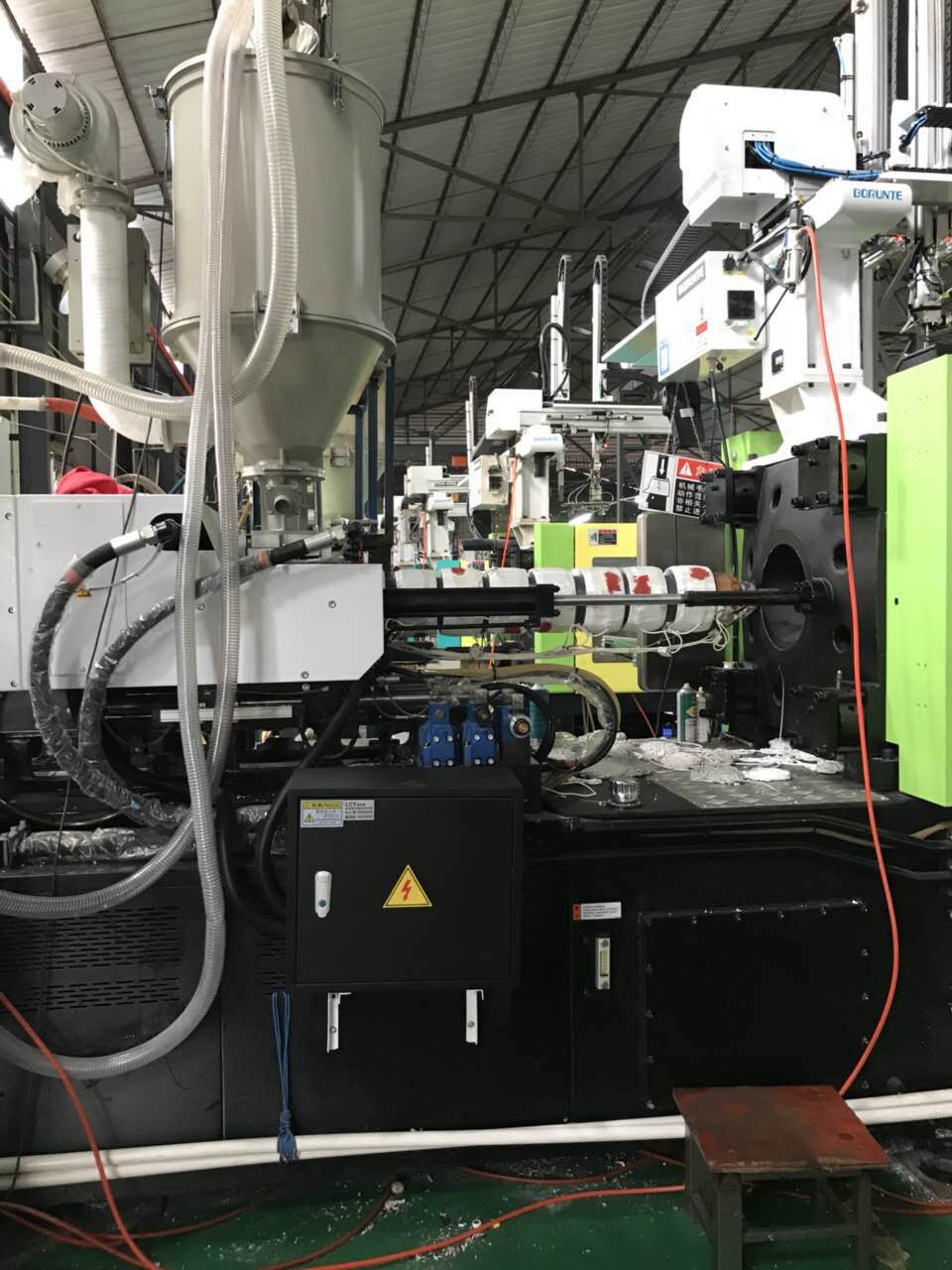
Plastics and rubber is the most heavily served vertical in the JONSON range, and model choice tracks machine size. Small machines are covered by a single-phase 2.5 kW unit rated at 220 V, with a 100–260 V adaptation range, constant power output between 210 V and 260 V, 20–100% stepless power regulation, heat conversion efficiency ≥95%, effective power ≥98%, and a 5–40 kHz operating frequency. The next step up is the 3.5 kW / 5 kW / 6 kW family, also 220 V single-phase, listed for plastic machinery, food machinery, and commercial induction cookers.
For production equipment, JONSON's documentation names the 40 kW / 50 kW / 60 kW models for injection molding machines, wire drawing machines, granulators, and extruders — a list that maps onto the energy-saving retrofit market, where an existing barrel heating system is replaced without changing the machine's mechanical structure. The 70 kW / 80 kW models are listed for plastic machinery, aluminum-plastic machines, and roller equipment, with heat conversion efficiency ≥99%, power regulation of 25–100%, and a 4–50 kHz operating frequency. The 100 kW JS1000-100 is also listed for plastic machinery among its duties.
The relevant working condition is stated plainly in JONSON's application notes: the rubber and plastic industry can work continuously at high frequency. That has two implications for buyers. First, continuous duty raises the importance of heat dissipation. JONSON specifies air-cooled or water-cooled modes for higher-power units such as the 100 kW JS1000-100, and notes that the control cabinet should be well ventilated to prevent overheating of the IGBT modules. Second, the coil is an application-specific component rather than a universal accessory, which is why the range includes a separately customizable induction heating coil line rated from 1 kW to 100 kW, built from copper, with heat conversion efficiency ≥98% and an operating frequency of 5–40 kHz.
Food Processing: Steam and Hot Air Are Two Different Duties
JONSON's working-condition documentation describes food processing as high humidity with a small amount of steam mist and constant-temperature cooking. That description covers two mechanically different duties, and the range offers a different product for each.
Where the process needs steam, the product is the JS-1600 induction steam generator, rated at 30 kW, 40 kW, or 50 kW at 380 V / 50 Hz / 60 Hz with a ±20% voltage adaptation range. Documented performance includes 20–100% power regulation, heat conversion efficiency ≥99%, a 5–40 kHz operating frequency, a 304 stainless steel inner liner, a thickened aluminum alloy and cold-rolled steel plate outer casing, and a copper wire heating coil. JONSON describes steam supply as reaching output within about 30 seconds, and lists the unit for plastics and rubber, food processing, chemical reactions, crude oil pipeline heating, textile printing and dyeing, aquaculture heating, metal heat treatment, building heating, and medicinal herb drying.
Where the process needs hot air rather than steam, the product is the JS-1600-8/12/15 induction heating hot air generator, rated at 8 kW, 12 kW, or 15 kW at 380 V with a 300–400 V adaptation range. Documented parameters include 20–100% power adjustment, an outlet temperature of 80–130 °C, wind pressure of 800–1000 Pa, a vertical structure, and dimensions of 1000 mm × 603 mm × 330 mm × 175.4 mm. It carries CE, ISO, and RoHS listings and is intended for the food processing and plastics and rubber industries. JONSON's application notes state that the hot air furnace reaches rated temperature in three minutes.
Two constraints belong in a food plant specification. The first is environmental: JONSON requires that the controller be kept away from humid, dusty, and corrosive gas environments, with the control board kept dry and its sealing checked regularly. Steam mist and washdown areas are exactly the conditions that make cabinet siting a design decision rather than an afterthought. The second concerns emissions, and it should be read precisely. The equipment's contribution is a combustion-free heating method, which JONSON describes as a clean replacement for coal and gas boilers with zero nitrogen oxides and no smoke emissions. That statement describes the heating equipment and its emission profile; it is not a statement about the food product or its regulatory approvals.
Chemical Reactions and Crude Oil Pipelines: Medium and High Temperature Duty
For chemical reactions, JONSON's working-condition note specifies medium to high temperature with weak corrosion. The application list includes chemical reactions for the 20 kW JS1000-20, the 30 kW JS1000-30, the 100 kW JS1000-100, the 40 kW / 50 kW / 60 kW models, the JS-1600 steam generator, and the customizable coil line. The 30 kW JS1000-30 is a wall-mounted unit with a 304 stainless steel inner liner, thickened aluminum alloy and cold-rolled steel plate casing, a copper wire heating coil, an ambient temperature range of −20 °C to 50 °C, humidity tolerance of ≤95%, and CE and ISO listings.
The environment note carries more weight in chemical plants than elsewhere. Because the controller must stay clear of corrosive gas and dust, the placement of the electrical control cabinet relative to the reactor or vessel is part of the engineering scope rather than a site detail resolved after delivery.
Crude oil pipeline heating addresses a different problem: preventing crude oil from solidifying in the line. Here the coil is applied to the pipe itself, and the pipe wall becomes the heating element. JONSON names crude oil transportation as an application for the 40 kW / 50 kW / 60 kW models, which are rated at 380 V ±20% with 20–100% power regulation, heat conversion efficiency ≥98%, and a 5–40 kHz operating frequency. The 100 kW JS1000-100 is listed for oil and natural gas transmission, with three-phase input, a rated input current of 140–150 A, a rated output current of 200–220 A, heat conversion efficiency ≥95%, effective power ≥98%, full bridge series resonance topology, a DSP-based high-speed automatic phase-locking tracking control system, and support for 0–1000 °C load temperature detection with accuracy up to ±1 °C.
Coil engineering is the limiting factor in pipeline work, and JONSON's documentation is explicit about it: the coil must maintain a reasonable distance from the metal being heated and be wound evenly, and insulation should be added over the heating area. The 100 kW unit's stated adaptive coil parameters — 95 square line, 40 m length, inductance 80–100 µH — show that coil specification is matched to the power supply rather than chosen independently. Power can be adjusted through PID control using a 0–5 V input or through RS-485 communication on that model, which allows the pipeline duty to be tied into a plant control system.
Textile Dyeing and Aquaculture: Constant-Temperature Water and Steam Duties
Textile printing and dyeing appears in JONSON's application list for the induction heating coil, the JS-1600 steam generator, and the 30 kW JS1000-30. The duty in this vertical is process steam and thermal oil for dyeing vessels, drying, and finishing, which places it in the same steam-generation family described above rather than in direct metal heating.
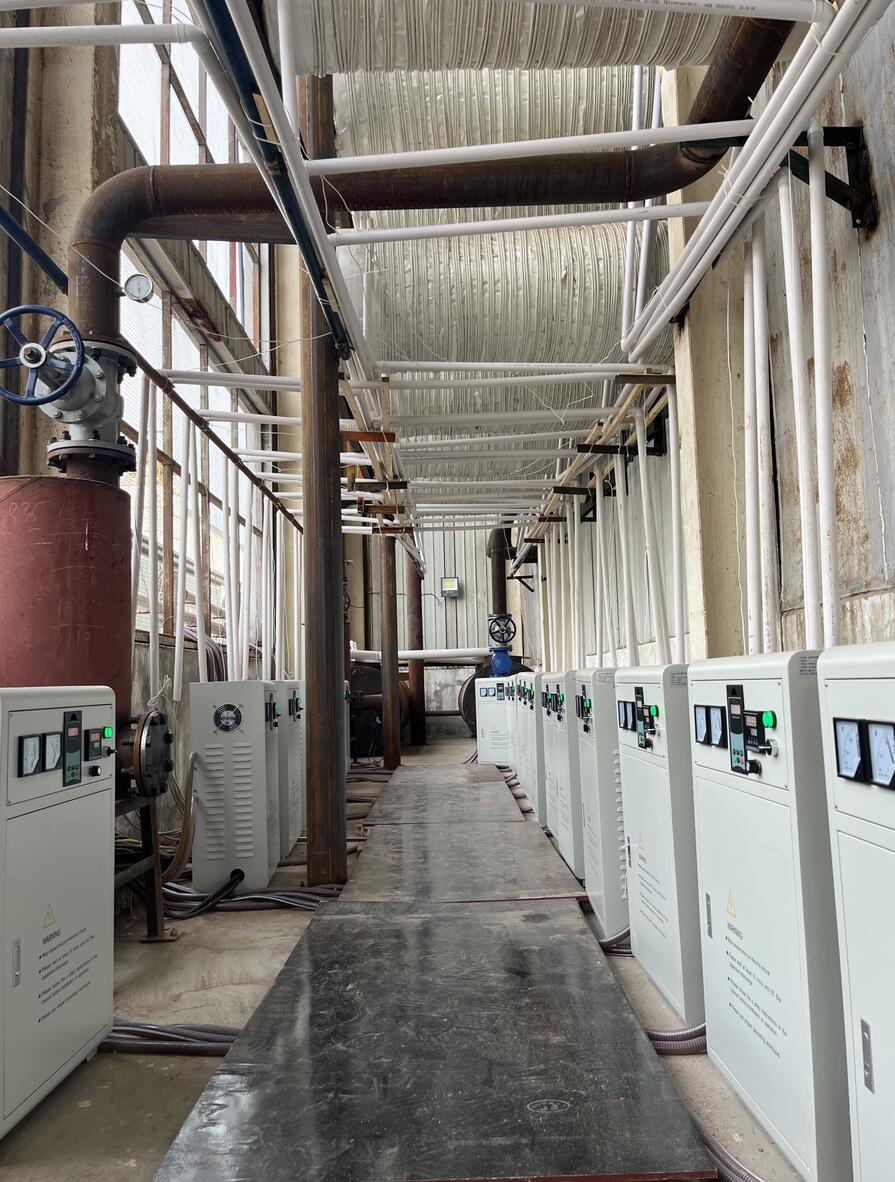
Aquaculture heating is a constant-temperature water duty: the requirement is stable water temperature in tanks and ponds rather than high-temperature process heat. JONSON lists aquaculture heating across the coil, steam generator, machine, and heater lines, and its documented project types include constant-temperature water supply for factory production and constant-temperature heating for farms and flower greenhouses.
Building Heating and Institutional Hot Water
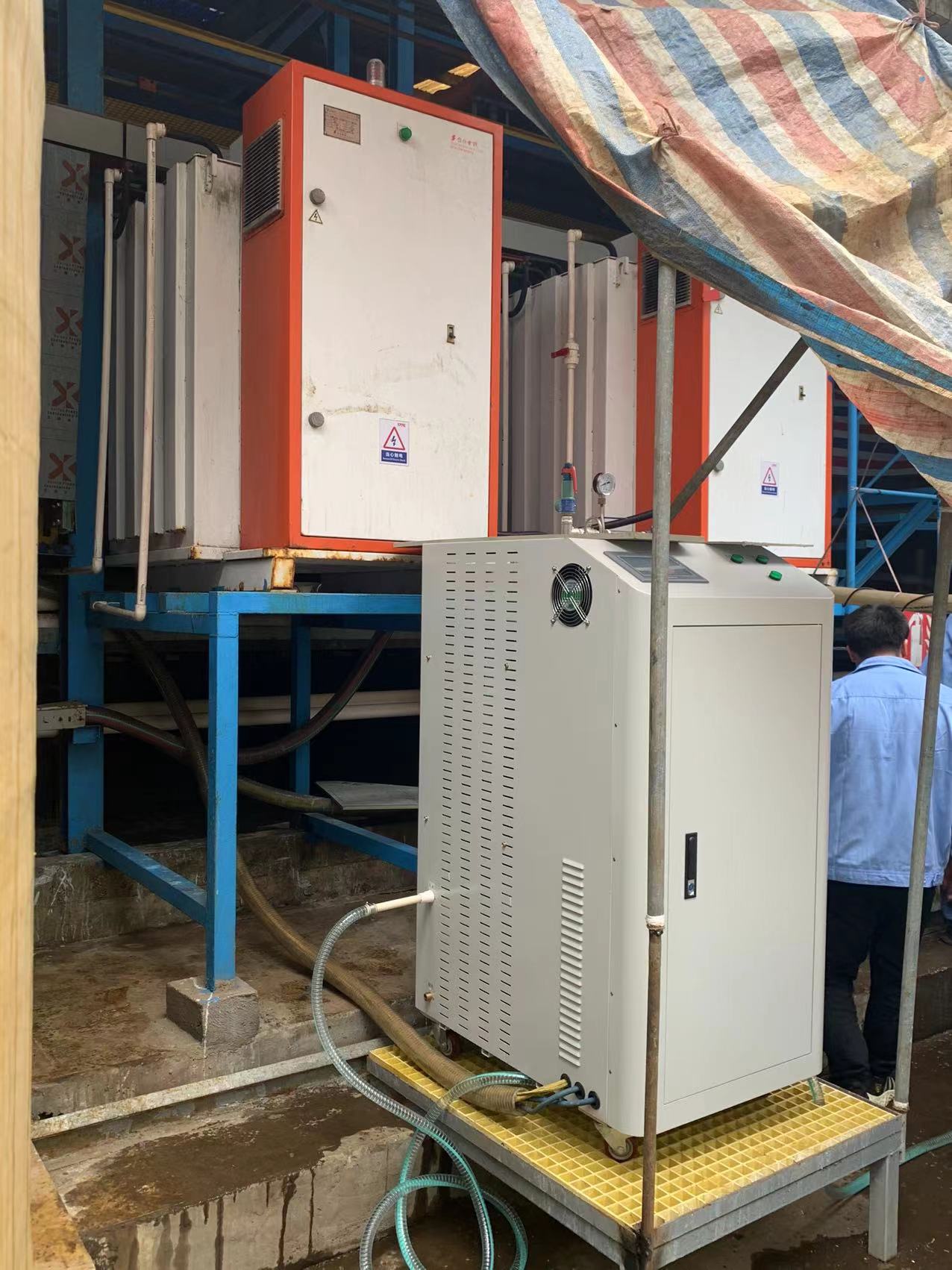
Building heating is described in JONSON's working-condition notes as low-temperature outdoor or factory antifreeze circulation, a duty that demands reliability at low load rather than peak output. The equipment line assigned to this segment is the JS-JR-008 instant induction water heater, rated at 3.5–8 kW at 220 V with a 220 V ±20% adaptation range, 20–100% power regulation, heat conversion efficiency ≥90%, a tempered glass outer casing, and a copper wire heating coil, listed for hotels, hospitals, and schools. JONSON's project types also include constant-temperature heating for hotels, hospitals, schools, and flower greenhouses.
Model-to-Scenario Matching Table
The table below summarizes how the documented scenarios map to documented models and parameters. It is intended as a starting filter for specification discussions, not as a substitute for the datasheet of the unit under consideration.
| Scenario | Documented JONSON model | Key documented parameters |
|---|---|---|
| Small plastics machinery (barrel heating) | Induction Heater, 2.5 kW / 3 kW single-phase | 220 V, 100–260 V adaptation, constant power at 210–260 V, 20–100% stepless regulation, ≥95% efficiency, 5–40 kHz, coil-to-load 20–25 mm (circular coil) |
| Plastics extrusion, injection molding, granulation | Induction Heater 40 kW / 50 kW / 60 kW | 380 V / 50 Hz, ±20% adaptation, 20–100% regulation, ≥98% efficiency, 5–40 kHz |
| High-load plastics and roller equipment | Induction Heater 70 kW / 80 kW | 380 V, 25–100% regulation, ≥99% efficiency, 4–50 kHz, ambient −25 °C to 55 °C |
| Large plastics line; oil and gas transmission | 100 kW Industrial Induction Heater (JS1000-100) | Three-phase 380 V, 140–150 A input, 200–220 A output, ≥95% conversion, ±1 °C detection, 635 mm × 445 mm × 315 mm, 35 kg |
| Food and chemical steam supply | Induction Steam Generator (JS-1600) | 30 / 40 / 50 kW, 380 V ±20%, ≥99% efficiency, 5–40 kHz, 304 stainless steel liner |
| Hot air drying, food processing | Induction Heating Hot Air Generator (JS-1600-8/12/15) | 8 / 12 / 15 kW, 380 V (300–400 V), outlet 80–130 °C, 800–1000 Pa, CE / ISO / RoHS |
| Chemical reaction heating | Induction Heater 20 kW / 30 kW (JS1000-20, JS1000-30) | 380 V, wall-mounted, 304 stainless steel liner, CE and ISO listings |
| Crude oil pipeline heating | Induction Heater 40 kW / 50 kW / 60 kW | 380 V ±20%, 20–100% regulation, ≥98% efficiency, coil wound on pipe with insulation layer |
| Textile printing and dyeing | Induction Steam Generator (JS-1600); Induction Heating Machine (JS1000-30) | 30–50 kW steam at ≥99% efficiency; 30 kW, 380 V, air-cooled or water-cooled |
| Aquaculture and institutional hot water | Instant Induction Water Heater (JS-JR-008) | 3.5–8 kW, 220 V ±20%, ≥90% efficiency, tempered glass casing |
| Custom coil build for retrofit | Induction Heating Coil | 1–100 kW, 220 V / 380 V, copper, ≥98% efficiency, 5–40 kHz |
| Bearing and component fitting | Bearing Induction Heater (JS1300-5/8/15/20/30) | 5–30 kW, three-phase 380 V 50/60 Hz, 480 mm × 250 mm × 355 mm, 20.7 kg |
Constraints to Verify Before Specification
Electrical supply and voltage adaptation
Power level determines the supply. The 2.5 kW, 3.5 kW, 5 kW, and 6 kW units and the JS-JR-008 water heater operate on single-phase 220 V. The 5 kW / 8 kW JS1300-005/008, the 10 kW / 15 kW JS1300-10/15, the 20 kW JS1000-20, the 30 kW JS1000-30, the 100 kW JS1000-100, the 70 kW / 80 kW units, the 40 kW / 50 kW / 60 kW units, the JS-1600 steam generator, and the JS-1600-8/12/15 hot air generator are documented at 380 V. Adaptation ranges vary by model: ±20% with constant power output over a stated window on most units, and a defined 300–400 V window on the JS1000-20, the JS1300-10/15, the JS-1600-8/12/15, and the 100 kW JS1000-100. For plants outside those supply envelopes, JONSON documents a customizable line covering 110 V, 240 V, and 660 V with power bands of 500 W–10 kW, 5–60 kW, 5–200 kW, and 30–200 kW, all at ±20% voltage adaptation.
Ambient, installation, and maintenance conditions
Most models are rated for ambient temperatures of −20 °C to 40 °C or −20 °C to 50 °C with humidity tolerance of ≤95%; the 70 kW / 80 kW units are documented at −25 °C to 55 °C. Installation requirements include even coil winding, a defined coil-to-load distance, and an insulation layer over the heated area. Heat dissipation requirements include cabinet ventilation to protect the IGBT modules, with air or water cooling on higher-power equipment. Maintenance requirements cover periodic dust removal, inspection of wiring terminals, coils, and the cooling system, avoidance of frequent start-stop cycling, a preference for low-power constant-temperature operation, and a soft-stop procedure at shutdown.
Certification scope
Certification is the constraint that most often creates a mismatch between what a supplier markets and what a purchase order needs, because certificates are issued against named models and standards rather than against a brand. JONSON's documented certification set includes:
- ISO 9001:2015 quality management system certification, certificate number 02826Q00032R001, issued by Beijing Zhong An Zhi Huan Certification Center Co., Ltd. (Zhong An Certification) against GB/T 19001—2016 / ISO 9001:2015, issued 6 January 2026 and valid to 7 January 2029, applicable to the worldwide market. The certified scope covers production and sales of household fast heating electric water heaters (electromagnetic heating furnaces) within the scope of the qualification license, and production and sales of electromagnetic heating controllers and coil heating elements for household appliances.
- CE certificate of conformity KEYS23032915001EM-02, issued by Guangdong KEYS Testing Technology Co., Ltd. on 7 April 2023 and valid to 7 April 2028, citing EN IEC 55014-1:2021, EN IEC 55014-2:2021, EN IEC 61000-3-2:2019+A1:2021, and EN 61000-3-3:2013+A1:2019+A2:2021, with model scope JS1200-005, JS1200-006, JS1200-008, and JS1200-010.
- China Compulsory Product Certification (CCC) certificate 2017010706999985, issued by CQC against GB 4706.1-2005 and GB 4706.11-2008, issued 25 July 2022 and valid to 24 July 2027, covering models JS3000-006 (6.1 kW), JS3000-008 (8 kW), and JS3000-010 (10 kW) at 220 V~50 Hz, IPX1, for the China mainland market.
- CCC certificate 2017010706002104, issued by CQC against the same standards with the same validity dates, covering instantaneous electrical water heater models JS3000-015 (15 kW), JS3000-020 (20 kW), JS3000-030 (30 kW), JS3000-040 (40 kW), JS3000-050 (50 kW), and JS3000-060 (60 kW) at 380 V 3N~50 Hz, for the China market.
- Product documentation lists CE, ISO, and RoHS for the JS1300-005/008, JS1300-10/15, and JS-1600-8/12/15 models for the EU market.
Three practical conclusions follow. First, a certificate's model scope should be matched against the exact unit on the purchase order, because a CE certificate issued for the JS1200 series does not by itself cover a JS1300 or JS-1600 unit. Second, the ISO 9001 certified scope is written around household fast heating electric water heaters and around electromagnetic heating controllers and coil heating elements for household appliances; buyers specifying industrial process heat should confirm which documents apply to the industrial configuration being purchased. Third, where industrial safety standards apply, IEC 60519-1 (general requirements) and IEC 60519-3 (particular requirements for induction heating and melting) define the compliance framework for this equipment category, and supplier documentation can be requested against those references.
Customization, lead time, and delivery documentation
JONSON documents OEM and ODM production for industrial induction heaters, induction heating machines, induction heating equipment, and induction heating systems, with customization covering product specifications, custom sample fabrication, graphic and panel customization, parameter adjustment, and private logo. Documented commercial terms include a monthly capacity of 10,000 units, a lead time of 7–14 days, a minimum order quantity of one unit, 100% pre-shipment testing, product inspection by SGS, and remote technical support after delivery. For buyers in the research and evaluation stages, these figures are useful as a check on whether a supplier's stated lead time and inspection regime can absorb a pilot order before a production commitment.
How Induction Compares with Combustion and Resistance Heating
JONSON positions induction heating against coal and gas boilers on four documented points. It is described as a clean replacement with zero nitrogen oxides, no smoke emissions, and no need for complex sewage discharge approvals. Energy supply is fast: steam generation reaches output in about 30 seconds and the hot air furnace reaches rated temperature in three minutes. Safety architecture relies on physical separation of water and electricity, or oil and electricity, with automatic interlock shutdown in the event of water shortage, overheating, or overpressure. And capacity is modular, because multiple units can be connected in parallel and power increased or decreased as needed, from small and medium-sized factories to larger plant areas.
Third-party data supports the efficiency direction of that argument. Global Market Insights reports that induction heating systems achieve energy efficiencies up to 92% and an average cycle time reduction of 30% compared with traditional gas or resistance-based heating. JONSON's own published case summary, covering OEM and ODM deployments in Indonesia, China, Vietnam, Russia, and India over a duration of more than 10 years and 100 units, reports thermal efficiency stable at 95–98%, energy savings of 30–70%, service lifespan extended by three times, and zero major failures. Those are supplier-reported figures and should be read as such.
The limits are equally well documented and matter more during evaluation:
- Induction cannot heat non-conductive material directly. Polymers, food product, and water are heated through a metal interface — a barrel, a pipe wall, a stainless steel liner, or a heat exchanger — so a process with no metal contact surface is not an induction candidate without design changes.
- Coil geometry constrains retrofits. The coil must maintain a reasonable distance from the metal being heated, be wound evenly, and be covered by an insulation layer; documented coil-to-load distances range from within 10 mm to 25 mm depending on coil shape.
- Higher power requires a higher supply. Models from 5 kW upward in the documented industrial range are specified at 380 V three-phase, and some high-power units require air or water cooling.
- Controller siting is restricted. Humid, dusty, and corrosive gas environments are excluded, which affects food plants, chemical plants, and coastal installations.
- Certification is model-specific rather than brand-wide, as the certificate scopes above demonstrate.
- Efficiency is not uniform across the range: the institutional water heater line is documented at ≥90% heat conversion efficiency against ≥98% for several process models and ≥99% for the JS-1600 steam generator and the 70 kW / 80 kW units.
Market Trend: Electrification of Process Heat
Two market signals frame the scenario demand described in this article. The global induction heating system market was valued at USD 2.39 billion in 2024 and is projected to reach USD 4.5 billion by 2035, according to WiseGuyReports. As of mid-2024, more than 550,000 induction heating systems were deployed globally, with the Asia-Pacific region accounting for 40% of that installed base — approximately 220,000 units — according to Global Market Insights.
Published market sizes vary with scope, and buyers should treat them as directional. Global Market Insights estimates the induction heating system market at USD 2.3 billion for the 2024–2025 period, while MarketsandMarkets sizes a narrower induction heating market at USD 616.5 million. Both figures describe the same broad category with different boundaries, which is why segment data is often more usable than the headline number: MarketsandMarkets reports that the 10 kW–100 kW power segment dominates the induction heating market on the strength of its versatility in automotive part hardening, forging, and brazing.
The demand signal most relevant to plastics, food, and pipeline duty comes from the boiler side of the market. Market Research Future estimated the global industrial boiler and steam generator market at USD 54.79 billion in 2024 and describes a shift toward electrification via induction technology to meet decarbonization goals. For process heat users, that shift is what makes scenario matching — rather than generic technology comparison — the practical question in supplier evaluation.
Future Outlook
The direction of travel for the scenarios described above is toward modular electrification of heat that was previously supplied by combustion. JONSON's architecture already reflects that pattern: multiple units connected in parallel with power increased or decreased as needed, and three heating media — water, thermal oil, and hot air — covering low, medium, and high temperature duty.
For buyers, three developments are worth tracking. First, certification scope is becoming a more visible procurement criterion, because compliance requirements in the EU and China are defined against standards and model lists rather than brand names. Second, coil engineering remains the practical bottleneck in retrofit projects, since geometry and insulation determine both efficiency and installation feasibility. Third, larger project sizes favor the 10 kW–100 kW segment, which the published segment data already identifies as dominant.
None of this changes the underlying constraint. Induction heating is the right choice where the load is metallic or can be heated through a metallic interface, where the site can supply the required electrical power, and where control cabinet siting can be protected from humidity, dust, and corrosive gas. Where those conditions hold, the scenario list published by JONSON — from plastics and rubber through food processing, chemical reactions, crude oil pipelines, textile printing and dyeing, aquaculture, and building heating — describes duties that induction equipment is already being specified against.
FAQ
Model choice tracks machine size. Small machines are covered by a single-phase 2.5 kW unit (220 V, 100–260 V adaptation range, constant power output at 210–260 V, 20–100% stepless regulation, heat conversion efficiency ≥95%, operating frequency 5–40 kHz). Mid-size duties use the 3.5 kW / 5 kW / 6 kW 220 V family. Production equipment is covered by the 40 kW / 50 kW / 60 kW models, documented for injection molding machines, wire drawing machines, granulators, and extruders; the 70 kW / 80 kW models, documented for plastic machinery, aluminum-plastic machines, and roller equipment at ≥99% efficiency; and the 100 kW JS1000-100, documented for plastic machinery. JONSON's application notes state that the rubber and plastic industry can work continuously at high frequency.
Steam and hot air use different products. The JS-1600 induction steam generator is rated at 30 kW, 40 kW, or 50 kW at 380 V / 50 Hz / 60 Hz with a ±20% voltage adaptation range, 20–100% power regulation, and heat conversion efficiency ≥99%, with a 304 stainless steel inner liner and a copper wire heating coil. JONSON describes steam supply as reaching output within about 30 seconds. The JS-1600-8/12/15 induction heating hot air generator is rated at 8 kW, 12 kW, or 15 kW at 380 V (300–400 V adaptation), with an outlet temperature of 80–130 °C, wind pressure of 800–1000 Pa, and CE, ISO, and RoHS listings; JONSON states that the hot air furnace reaches rated temperature in three minutes. Food processing is described in the working-condition documentation as high humidity with a small amount of steam mist and constant-temperature cooking.
Not to the oil directly, but to the pipe. Induction heating generates heat inside conductive metal through eddy currents, so the coil heats the pipe wall and the oil is heated through the pipe. JONSON lists crude oil pipeline heating among supported industries and names crude oil transportation as an application for its 40 kW / 50 kW / 60 kW models, which are rated at 380 V ±20% with heat conversion efficiency ≥98%; the 100 kW JS1000-100 is listed for oil and natural gas transmission. Installation requires that the electromagnetic coil maintain a reasonable distance from the metal being heated, be wound evenly, and be covered by an insulation layer over the heating area to improve thermal efficiency. The stated purpose of the duty is to prevent crude oil from solidifying.
Supply follows power level. Single-phase 220 V is documented for the 2.5 kW small plastic machinery unit, the 3.5 kW / 5 kW / 6 kW units, and the JS-JR-008 instant induction water heater (3.5–8 kW). Three-phase 380 V is documented for the 5 kW / 8 kW JS1300-005/008, the 10 kW / 15 kW JS1300-10/15, the 20 kW JS1000-20, the 30 kW JS1000-30, the 100 kW JS1000-100, the 70 kW / 80 kW units, the 40 kW / 50 kW / 60 kW units, the JS-1600 steam generator, and the JS-1600-8/12/15 hot air generator. Most models accept ±20% voltage adaptation with constant power output over a stated window; several 380 V models are documented at a 300–400 V window. A customizable line covers 110 V, 240 V, and 660 V across power bands of 500 W–10 kW, 5–60 kW, 5–200 kW, and 30–200 kW.
The documented set is model- and market-specific. ISO 9001:2015 certification, certificate number 02826Q00032R001 issued by Beijing Zhong An Zhi Huan Certification Center Co., Ltd. (Zhong An Certification) against GB/T 19001—2016 / ISO 9001:2015, was issued 6 January 2026, is valid to 7 January 2029, and applies worldwide; its certified scope covers household fast heating electric water heaters (electromagnetic heating furnaces) within the scope of the qualification license, plus electromagnetic heating controllers and coil heating elements for household appliances. CE certificate KEYS23032915001EM-02 issued by Guangdong KEYS Testing Technology Co., Ltd. is valid to 7 April 2028 and names models JS1200-005, JS1200-006, JS1200-008, and JS1200-010. China Compulsory Product Certification certificates 2017010706999985 and 2017010706002104, issued by CQC against GB 4706.1-2005 and GB 4706.11-2008, are valid to 24 July 2027 and apply to the China mainland market. Product documentation also lists CE, ISO, and RoHS for the JS1300-005/008, JS1300-10/15, and JS-1600-8/12/15 models. Buyers should match the certificate model scope to the exact unit ordered.
Documented maintenance requirements are periodic dust removal; inspection of wiring terminals, electromagnetic coils, and the cooling system; and avoidance of frequent start-stop cycling, with low-power constant-temperature operation recommended and a soft-stop procedure followed at shutdown. Installation and environment requirements add that the coil should be wound evenly with a defined distance to the load, that an insulation layer should cover the heating area, that the control cabinet should be well ventilated to prevent overheating of the IGBT modules, and that the controller should be kept away from humid, dusty, and corrosive gas environments with the control board kept dry and its sealing checked regularly. Documented protection functions include overcurrent, overvoltage, and overtemperature protection, with automatic interlock shutdown for water shortage, overheating, or overpressure conditions.