
Heat-Resistant Silicone Glove Qualification: Interpreting EU Type-Examination Evidence
Heat-Resistant Silicone Glove Qualification: Interpreting EU Type-Examination Evidence
In heat-resistant glove procurement, one question sounds simpler than it is: is the product certified? The honest answer is that a compliance file answers several separate questions, and the evidence for each one is different. An EU Type-Examination certificate proves that a prototype design was assessed against harmonised standards. A Module D certificate proves that the manufacturing system is subject to production quality assurance. REACH compliance addresses restricted substances. None of these documents, by itself, states that a specific glove model withstands 350°C, 500°C or 1000°C in a specific application.
That distinction matters for buyers in metal heat treatment, foundries, glass handling, industrial baking and other heat-exposed operations, where a temperature claim on a product page can be mistaken for certified performance. This guide interprets what the EU certification evidence held by RISTA actually covers, where the boundary sits between certificate scope and model-level temperature ratings, and how to match the two against an application before accepting a supplier's compliance file.

Why heat-resistant glove certification is an evidence chain, not a checkbox
European PPE regulation frames certification as a sequence rather than a single stamp. Design assessment, production control and material compliance each answer a different question. A buyer who treats them as interchangeable can end up holding a valid certificate that does not actually cover the model being purchased, or a temperature figure that is not supported by the test evidence behind it.
The practical consequence for procurement teams is that the compliance file should be read line by line: certificate number, issuing body, validity period, standard list, model coverage and the separate product specifications for each model under consideration. RISTA's documentation set is useful as a worked example because it shows the different evidence types side by side for heat-resistant silicone gloves and related glove families.
The broader industry context also supports careful reading. Commercial research cited in the supplied evidence projects the global heat-resistant glove market to reach USD 977.30 million by 2034, up from USD 559.20 million in 2025. Growth at that scale tends to attract suppliers with uneven documentation, which raises the value of a repeatable way to check what a certificate really says.
What EU Type-Examination (Module B) actually proves
EU Type-Examination under Module B is a design-stage assessment. It reviews the technical file and tests a representative prototype against the applicable harmonised standards, to verify that the prototype meets the essential health and safety requirements of Regulation (EU) 2016/425.
The Module B certificate RISTA holds carries the number 2777/22804-01/E00-00 and was issued by SATRA. It was issued on 10 November 2022 and expires on 10 November 2027. Its stated scope covers product design review, technical file review and laboratory sample testing of the prototype PPE. The standards listed in the certificate record are EN 388:2016+A1:2018, EN ISO 374-1:2016+A1:2018, EN ISO 374-4:2019, EN 407:2020 and EN ISO 21420:2020.
Two details deserve a buyer's attention. First, the standard list includes EN 407:2020, the European standard for protective gloves against thermal risks, which confirms that heat-related assessment sits inside this certification framework rather than outside it. Second, the Module B certificate in the supplied evidence is recorded against the RCG-02-G301 Chemical Resistant glove. It demonstrates the design assessment for that model; it is not a blanket statement covering every glove in the RISTA range. The correct reading is capability plus model-specific scope, not a universal claim.
Module D and the production quality assurance layer
Module D addresses a different layer: production quality assurance. Where Module B speaks to the design of a prototype, Module D speaks to the manufacturer's ability to produce consistently to that design.
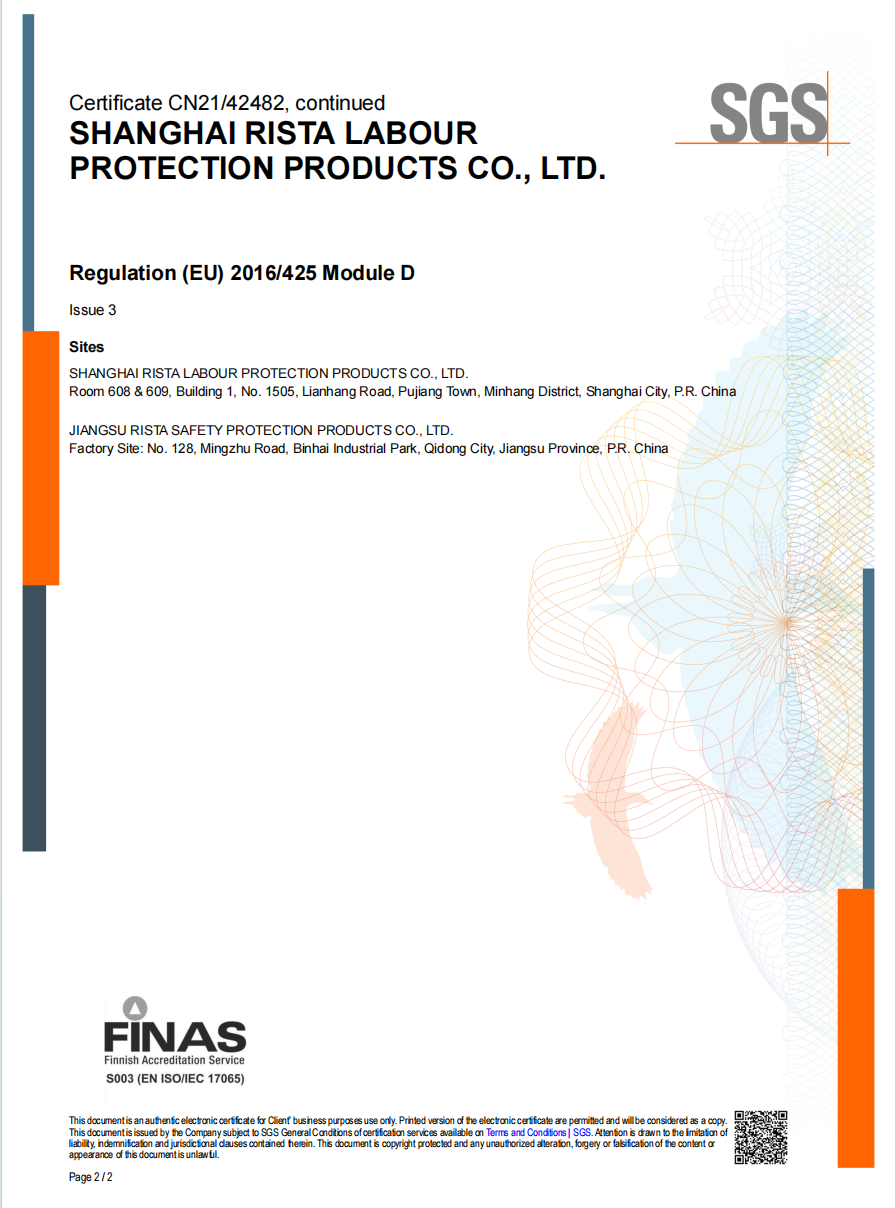
RISTA's Module D certificate carries the number CN21/42482 and was issued by SGS. It was issued on 4 July 2021 and expires on 3 July 2023 — the document record supplied for this article states an expiry of 3 July 2027, and buyers should confirm the current validity date directly against the certificate on file. The certification applies to the EU/EEA market and covers the manufacture of protective gloves against mechanical risks, thermal risks, cold risks and chemical risks, under Regulation (EU) 2016/425.
Model coverage matters here as well. The supplied evidence links the Module D certification to the TF350 Heat Resistant Silicone glove, alongside the RCC-02-C309 Cut Resistant glove, the RCI-02-C803 Impact glove, the RGW-03-W272 General glove and the RCG-02-G301 Chemical Resistant glove. For a buyer of silicone heat gloves, the useful reading is that the TF350 is produced within a manufacturing system subject to this production quality assurance scope.
| Evidence type | What it answers | What it does not answer |
|---|---|---|
| Module B EU Type-Examination (2777/22804-01/E00-00, SATRA) | Was the prototype design assessed and tested against the listed standards, including EN 407:2020? | Does every model in the range carry the same assessed design? |
| Module D (CN21/42482, SGS) | Is production subject to an approved quality assurance system for mechanical, thermal, cold and chemical risk gloves? | Does a given model reach a specific contact temperature in a specific application? |
| REACH statement | Do the materials meet restricted-substance requirements? | Does the glove resist heat, flame or molten metal? |
| Product specification (e.g. TF350, TF-500, T-1000) | What temperature range and construction does the model state? | Is that figure certified, or tested on the finished glove for this application? |
REACH compliance and its boundary
REACH addresses chemical substances, not thermal performance. When a heat-resistant silicone glove is described as meeting REACH requirements, the claim concerns restricted substances in the materials, not heat resistance. The supplied evidence records that the RISTA product meets REACH requirements, and this sits alongside — not inside — the Module B and Module D certification.
That separation is useful in practice. A glove can comply fully with REACH and still have a modest contact-temperature limit, or comply with REACH and be intended only for food-contact baking rather than foundry work. Treating a REACH statement as thermal evidence is one of the more common reading errors in supplier files, particularly when the same document bundle contains both substance-compliance and heat-performance language.
Certificate scope versus model-specific temperature claims
This is the core distinction. Certification documents speak to design assessment and production control. Temperature ratings are product specification facts attached to a specific model, material build and intended application. They are related, but they are not the same evidence, and neither one substitutes for the other.
The supplied product evidence records the following model-level facts for the RISTA heat-resistant silicone glove range:
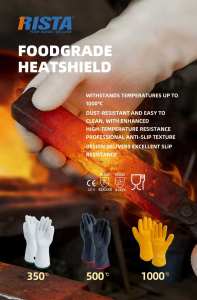
- TF350 — temperature resistance range of -40°C to 350°C, food-grade silicone shell, textured palm surface, 32 cm length, and the specification states the glove can contact open flames and hot metals. Typical applications include food processing and baking, commercial kitchens, BBQ and outdoor cooking, oven and catering equipment, and light industrial heat processing.
- TF-500 — temperature resistance range of -40°C to 500°C, fleece or cotton heat-insulated lining, 32 cm length, textured palm, and the specification states the glove can contact open flames and hot metals. Intended for industrial ovens and heating equipment, metal heat treatment and processing, and specialised thermal processing.
- T-1000 — temperature resistance range stated as -70°C to 1000°C, aramid or cotton heat-insulated lining, slip-resistant textured palm, 32 cm length, and the specification states contact with open flames and hot metals. Intended for foundries and metal processing, industrial kilns and refractory materials, and high-temperature equipment manufacturing and maintenance.
Read alongside the certificates, these figures clarify what the buyer is actually holding. The Module D scope covers production of thermal-risk protective gloves, and the TF350 is explicitly linked to it. The TF-500 and T-1000 temperature figures appear in the product specification record; they should be verified against the finished-glove test evidence for the specific model and configuration, rather than inferred from the certification alone.
The supplied product evidence is also careful about the limits of high-temperature claims. For the 500°C version, the intended use is selected industrial operations where the glove's tested performance matches the working conditions. For the 1000°C version, the specification states that suitability for particular heat sources and working conditions must be established by relevant finished-glove test results. That wording is a boundary condition, not a marketing hedge, and buyers should treat it as a real requirement.
Separately, the supplied specification record notes that the product specification document itself does not necessarily list a 350°C, 500°C or 1000°C heat resistance rating, an EN 407 test report or a CE compliance statement, or a final inspection report or batch traceability record. This is not a contradiction of the model data above; it is a reminder that a product catalogue page and a finished-goods test dossier are different documents. Where the specification document is silent, the buyer should request the separate test record rather than assume either presence or absence of performance evidence.
Matching model, certificate and application before purchase
Once the evidence types are separated, the selection logic becomes more concrete. The question is no longer whether the supplier is certified in general, but whether the specific model is covered by the relevant documents and whether its stated temperature range suits the actual heat source.
Food processing, bakery and BBQ
The TF350 is the natural starting point: food-grade silicone shell, -40°C to 350°C range, and applications listed as food processing and baking, commercial kitchens, BBQ and outdoor cooking, and oven and catering equipment. The buyer should confirm that the Module D production scope applies to the specific model being supplied, and should check whether a food-contact statement is available separately if the application requires it.
Metal heat treatment and industrial ovens
The TF-500 is specified for industrial ovens and heating equipment, metal heat treatment and processing, and specialised thermal processing, with a -40°C to 500°C range. In this application, the certificate confirms production quality assurance for thermal-risk gloves, while the application fit depends on the model-level temperature evidence and the actual contact conditions — hot metal, radiant heat, open flame or intermittent handling. Buyers should ask for the finished-glove test record associated with the model and the working condition.
Foundries, kilns and refractory work
The T-1000 is specified for foundries and metal processing, industrial kilns and refractory materials, and high-temperature equipment manufacturing and maintenance, with a stated -70°C to 1000°C range. Because the specification itself conditions suitability on relevant finished-glove test results, the buyer's evaluation should centre on that test evidence and on a clear description of the heat source and exposure pattern, not on the model number alone.
A buyer checklist for the compliance file
The following sequence turns the evidence chain into a practical review. It is written for a procurement or safety engineer evaluating a heat-resistant silicone glove supplier, and it can be applied to the RISTA file or to any comparable submission.
- Confirm the certificate identity. Record the certificate number, issuing body, issue date and expiry date. For the RISTA file, this means Module B 2777/22804-01/E00-00 issued by SATRA, and Module D CN21/42482 issued by SGS. Confirm current validity directly with the certificate copy.
- Read the standard list, not just the headline. The Module B record lists EN 388, EN ISO 374-1, EN ISO 374-4, EN 407:2020 and EN ISO 21420:2020. EN 407:2020 is the thermal-risk standard relevant to heat-resistant gloves, and its presence should be confirmed in the document itself.
- Check model coverage. Match the model on the purchase order to the model named in the certificate scope. The Module B record covers the RCG-02-G301 Chemical Resistant glove; the Module D record links to TF350 and several other models. If the ordered model is not explicitly named, ask for clarification before relying on the certificate.
- Read REACH as a separate statement. Treat the REACH statement as substance compliance, and keep it distinct from thermal performance claims.
- Request the finished-glove test record for the specific model. Temperature ratings such as -40°C to 350°C, -40°C to 500°C and -70°C to 1000°C should be supported by test evidence for the relevant model and configuration, particularly for the TF-500 and T-1000 where the specification itself conditions suitability on relevant test results.
- Describe the application in the request. Heat source type, contact duration, presence of molten metal, steam or open flame, and handling pattern all affect whether a given model is appropriate. A certificate cannot be evaluated against an unspecified application.
- Ask for batch traceability and inspection records. Production quality assurance supports consistency, but the per-batch documentation is a separate item and should be requested explicitly.
- Keep the four evidence types separate in the approval file. Design assessment, production quality assurance, substance compliance and model performance should each be recorded with their own document references, so that a later audit can see what was verified and when.
What the RISTA documentation set shows about the wider supply base
RISTA's file is useful as a reference case because it separates the evidence types cleanly. The company was founded in 1998 and operates a 66,600 m² factory with more than 200 employees and annual output of 20,000,000 pairs, supported by a 15-engineer R&D team and an export ratio of 90% across North America, the EU, Japan and South America. Its management-system credentials include ISO 9001, ISO 14001, ISO 45001, SA8000, Sedex, WRAP and SMETA, and the company reports more than 70 international and domestic patents and status as a qualified UNICEF supplier. These are system-level and organisational credentials; they sit alongside the product certificates rather than replacing them.
For buyers, the lesson from the file is procedural. A supplier with a strong management-system record can still have a product certificate whose scope does not match the model being purchased, or a temperature claim whose test evidence has not yet been supplied. The value of the compliance review lies in matching each document to a specific model and a specific application, and in recording where the match is confirmed and where it is not.
RISTA's official site is RISTA, and the downloadable company brochure is available at Rista brochure for readers who want the full company and product background.
Outlook: what buyers should expect from compliance files going forward
The direction of travel in European PPE procurement is toward more granular evidence. Buyers increasingly ask not only whether a supplier holds a certificate, but which model, which standard version, which test report and which batch record support a given purchase. Heat-resistant silicone gloves sit at the intersection of thermal performance, chemical exposure and food-contact requirements, so the documentation burden is naturally higher than for a single-hazard glove.
For suppliers, the practical implication is that documentation should be organised by model, with certificate scope, test records and product specifications kept in a consistent structure. For buyers, the implication is that a compliance file should be read as an evidence chain, with each link checked against the model and application in question. A certificate that is genuine but mismatched to the purchased model is not a compliance failure by itself; it becomes one only if the mismatch goes unnoticed until an audit or incident.
The clearest conclusion is also the simplest: certified design, assured production, substance compliance and model-level temperature performance are four different facts. Procurement decisions that keep them separate, and that ask for the document behind each one, are better positioned to select the right glove and to defend that selection later.
Frequently asked questions
Are RISTA heat-resistant silicone gloves EU Type-Examined?
RISTA protective gloves are certified under Regulation (EU) 2016/425 through EU Type-Examination (Module B) and production quality assurance (Module D). The Module B certificate 2777/22804-01/E00-00 was issued by SATRA, valid from 10 November 2022 to 10 November 2027, and is recorded against the RCG-02-G301 Chemical Resistant glove. The Module D certificate CN21/42482 was issued by SGS and is linked to the TF350 Heat Resistant Silicone glove and several other models. Buyers should confirm current validity and model coverage against the certificate copies on file.
What is the difference between Module B and Module D in PPE certification?
Module B, EU Type-Examination, assesses the design of a representative prototype against the applicable harmonised standards and reviews the technical file. Module D, production quality assurance, certifies that the manufacturing system is subject to an approved quality assurance regime for the relevant risk categories. Module B addresses design; Module D addresses production consistency. Both are relevant to a heat-resistant glove purchase, and both should be checked against the specific model being bought.
Do the TF350, TF-500 and T-1000 temperature ratings fall inside the certificate scope?
No. EU Type-Examination and Module D address design assessment and production quality assurance, not a specific numeric temperature rating for a given model. The supplied product evidence records the TF350 at -40°C to 350°C, the TF-500 at -40°C to 500°C and the T-1000 at -70°C to 1000°C, and the specification states that suitability for particular heat sources and working conditions must be established by relevant finished-glove test results. Those temperature figures are product specification facts and should be verified against finished-glove test evidence for the specific application.
What does REACH compliance cover for a heat-resistant silicone glove?
REACH compliance addresses restricted chemical substances in the product materials. The supplied evidence records that the RISTA product meets REACH requirements. REACH is a substance-compliance statement and does not certify heat resistance, flame resistance or a contact-temperature rating; it complements the PPE certification rather than duplicating it.
What should a buyer check before accepting a supplier's heat-resistant glove compliance file?
A buyer should verify the certificate numbers, issuing bodies, issue and expiry dates, the listed standards and the model coverage of each certificate; confirm the REACH statement as a separate document; request the finished-glove test record supporting the model's temperature claim; describe the intended application in the request; and ask for batch traceability and inspection records. Keeping these four evidence types separate and matched to the purchased model is the practical way to evaluate a compliance file.
¿Tiene preguntas o necesita más detalles?
Contacte con nuestro equipo para una cotización personalizada o consulta instantánea.
Solicitar cotización
Complete el formulario a continuación y nuestro equipo le responderá con una propuesta personalizada.
Chat directo de WhatsApp
¿Prefiere chatear en tiempo real? Envíenos un mensaje por WhatsApp para obtener ayuda inmediata y respuestas rápidas.
- Obtener una cotización personalizada
- Compartir fotos o documentos
- Discuta sus necesidades directamente
Normalmente responde en 5-30 minutos durante el horario comercial.