
Hardware as Evidence: Auditing PIX Moving's City Robots
Supplier Capability Profile
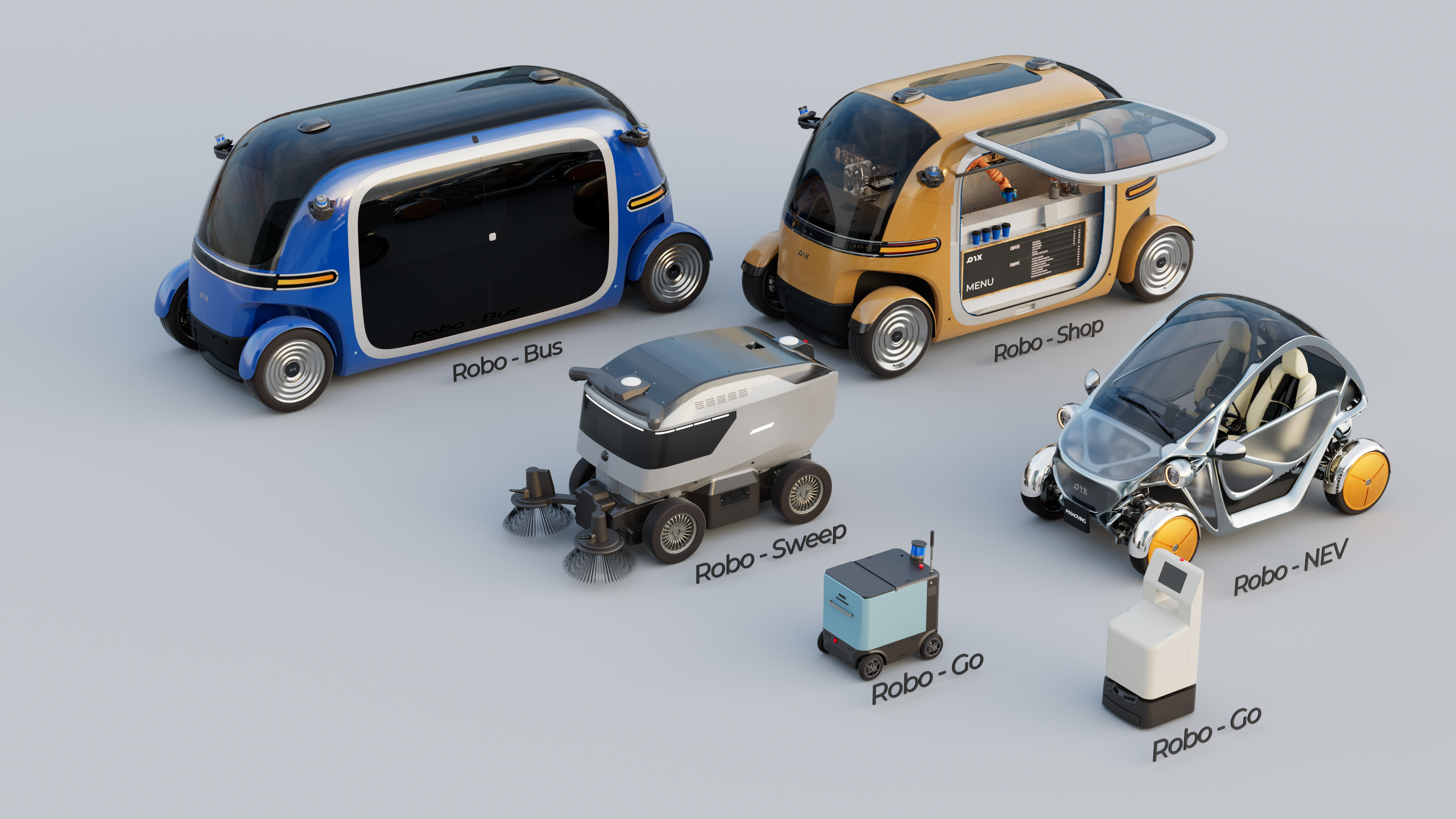
PIX Moving product matrix: the disclosed platform set is the starting point for a capability audit, not the conclusion of one.
City robotics suppliers argue capability; buyers have to audit it. Between a proposal and a purchase order sits a question that slide decks rarely answer directly: what has this supplier actually engineered, and how would an engineer verify it before committing a site, a route or a service contract?
Specifications are the most portable form of that answer. A turning radius, an ingress-protection rating, a pack voltage and a frame material are not marketing statements — they are design commitments that constrain what a vehicle can do on a real site and what a maintenance organization will have to handle for the following five to seven years. Read as a set, they also reveal how a manufacturer thinks: whether it is adapting one vehicle to many uses, or building a platform that can be reconfigured as city requirements change.
PIX Moving, a city robotics company founded in 2017 that builds autonomous mobile spaces on a modular robotic chassis platform and delivers them through a Robot-as-a-Service (RaaS) subscription model, publishes an unusually concrete hardware set for this category. Its L4 RoboBus shuttle, RoboShop autonomous retail unit and RoboEV (Beastie) L7e microcar each carry physical specifications that can be checked against a site plan, an acceptance protocol or a long-term service budget. This article treats those specifications as supplier evidence and asks the question that matters at the decision and execution stages: what does each number actually commit the supplier to?
The evidence gap that slows city robotics procurement
City robotics sits at the intersection of autonomous driving, vehicle manufacturing and urban service operations, and its supplier base reflects that mix. Some companies come from the autonomy-software side, some from delivery robotics, some from chassis and vehicle engineering. Each describes capability in its own vocabulary, which is why two proposals can look equally credible while answering entirely different questions.
The practical consequence appears after signature. A city or operator that has selected on narrative rather than on auditable hardware often discovers three problems in sequence: the vehicle's physical envelope does not fit the intended route or depot; the environmental rating does not survive the site's cleaning and weather regime; and the supplier's stated production capacity turns out to be a claim about capability rather than a schedule. None of these are failures of good faith — they are failures of evidence design at the procurement stage.
A more defensible method is to require physical evidence in defined classes, then score suppliers on how completely and how verifiably each class is documented. The method does not need a mature market to work; it works precisely because the market is immature and comparable data is scarce.
Five classes of hardware evidence buyers can audit
Not every specification carries equal procurement weight. The five classes below map the questions that most often determine whether a city robotics deployment succeeds, and each corresponds to evidence a supplier can be asked to produce before a contract is signed.
| Evidence class | What the buyer can audit | Procurement question it settles |
|---|---|---|
| Dimensional envelope | Length, width, height, turning radius | Does the unit fit the route, depot, kerb, canopy and turnaround space? |
| Environmental ingress | IP rating and what it covers | Will the unit survive rain, dust, washdown and the site cleaning regime? |
| Energy system | Battery chemistry, voltage, capacity, stated range and the conditions attached to it | What charging infrastructure is required, and what duty cycle is realistic? |
| Structure and materials | Body or frame material class, joining method | Can it be repaired locally, and what does mass or corrosion behaviour mean for lifecycle cost? |
| Manufacturing and acceptance | Stated capacity, calibration and test infrastructure, inspection regime, acceptance tests | Will the units arrive on schedule, and how is conformity demonstrated before shipment? |
A supplier that documents all five classes gives a buyer something rare in this category: a basis for contract language. A supplier that documents only one or two tells the buyer where the pilot budget must absorb uncertainty.
PIX Moving's disclosed hardware set
PIX Moving operates a 20,000+ m² manufacturing footprint with a 200-person team, 116 of whom work in research and development, and reports an export share of approximately 55% across EU, USA, Japan and South Korea markets. Its product family — RoboBus, RoboTaxi, RoboShop and RoboVan, plus the Beastie microcar — is built on a shared modular robotic chassis platform rather than on separate vehicle architectures. Three of those platforms carry enough published physical detail to support an evidence-based review.
| Platform | Category | Disclosed physical specifications |
|---|---|---|
| RoboBus | L4 autonomous shuttle | Low-alloy high-strength steel body; IP65; 31.94 kWh battery; 3820 × 1900 × 2260 mm; reported 6 seats and 120–140 km range |
| RoboShop | Autonomous retail unit | IP65; four-wheel steering; turning radius ≤4.8 m; 140 km range without air conditioning |
| RoboEV (Beastie) | L7e microcar | Aluminum alloy frame; LiFePO4 battery at 144 V / 14.97 kWh; 150 km range |
Table: platform-level physical evidence disclosed by PIX Moving. Range and seating figures for the RoboBus are company-reported.
RoboBus: what an L4 shuttle's specifications commit the supplier to
The RoboBus is the strongest single piece of evidence in the set, because a shuttle is the hardest city robot to specify loosely. It carries passengers on public or semi-public roads, which means every physical parameter becomes a regulatory, operational or safety argument.
At 3820 × 1900 × 2260 mm, the vehicle is deliberately narrow and short by bus standards. For a transport planner, the 3.82 m length and 1.90 m width are what allow routing through campus roads, mixed-traffic streets and depot layouts that a conventional bus cannot enter — the vehicle class opens routes rather than replacing them. The 2.26 m height is the figure to test against canopies, charging shelters, low signage and tree cover; it is the dimension most often overlooked in site surveys and most expensive to discover late.
The body is specified as low-alloy high-strength steel. Material choice is a serviceability decision as much as a structural one: steel in this class is weldable and repairable with conventional fabrication skills, which matters in markets where aluminum or composite repair capacity is thin and a damaged body panel otherwise means a unit off the road for weeks. The trade-off is mass, and buyers comparing the RoboBus with aluminum-bodied alternatives should expect the weight penalty as the price of a wider repair network.
IP65 is the environmental commitment: dust-tight, and protected against water jets from any direction. For operators, that rating supports outdoor standing, operation in rain, and routine washdown between service cycles. It should also be read for what it is not — IP65 is not a submersion rating and is not a flood-tolerance claim, so site drainage and low-lying route segments remain the operator's responsibility.
The 31.94 kWh pack places the RoboBus firmly in depot-charging territory rather than opportunity-charging. Combined with the reported 120–140 km range, that gives planners a workable envelope for campus loops, fixed shuttle routes and event transport, but it does not remove the need for consumption data per route. A buyer should ask for energy consumption on a comparable duty cycle — including passenger load and climate control — before sizing the depot.
Finally, the L4 autonomy designation is the claim most dependent on supporting evidence. A level designation is only meaningful alongside an operational design domain, the scenario testing behind it, and the registration pathway for the target jurisdiction. PIX Moving reports that the RoboBus completed the vehicle registration process required for public-road use in Japan and began demonstration operations in Meiwa Town, Mie Prefecture. That is a company-reported milestone rather than an independently verified one, and it should be treated as a document to request rather than a conclusion to accept.
RoboShop: turning geometry as a site-selection instrument
The RoboShop is an autonomous retail unit, and its most decision-relevant number is not its range but its turning radius. A turning radius of 4.8 m or less, achieved through four-wheel steering, is the specification that determines whether a retail unit can physically serve a market square, a resort promenade, a hospital campus loop, a campsite or a cul-de-sac without reversing manoeuvres that are impractical in crowded space.
For a buyer, the conversion is straightforward and should happen before commitment, not after: take the tightest turnaround on the intended site, add a margin for pedestrians, parked vehicles and seasonal furniture, and compare it with the 4.8 m figure. Sites that fail this test will fail it permanently, regardless of how well the retail concept performs commercially.
The published range of 140 km is stated without air conditioning. That condition is not a footnote — it is an honest boundary that tells the buyer how the figure should be used. In temperate climates and shoulder seasons, the stated range is a reasonable planning envelope; in hot-climate deployments, refrigeration and HVAC load will change it, and the buyer should request the climate-on figure alongside the conditions under which it was measured. Suppliers that publish an unconditional range figure are not necessarily more capable; they are simply less precise.
IP65 carries a different meaning here than on a shuttle. Retail units are cleaned frequently, often with hosed water, and may operate adjacent to food service. A dust-tight, water-jet-rated enclosure supports that operating model and reduces the risk that cleaning becomes a maintenance event.
RoboEV (Beastie): category choice as a compliance decision
The Beastie is a different kind of evidence. It is an L7e microcar, meaning PIX Moving has chosen a regulated quadricycle category rather than a passenger-car category or a purpose-built low-speed platform. That choice has procurement consequences that go beyond the vehicle itself.
L7e is a category bounded by rule, not by ambition. Vehicles in it are constrained in mass and speed, and in several markets the category offers a simpler registration path than a passenger car — which is precisely why it is attractive for community mobility, campus fleets and services aimed at residents who no longer drive. The same rule set, however, caps what the vehicle can be used for: an L7e microcar is an urban and low-speed asset, and operators that need highway capability should be looking at other categories entirely.
The aluminum alloy frame is a mass and corrosion decision. Lower mass supports efficiency in a small vehicle, and aluminum behaves predictably in coastal or humid environments, which is relevant for island and tourism markets. The boundary is repair: aluminum requires workshops with the right tooling and technique, so a buyer planning a fleet in a region without that capability should map service options before ordering rather than after.
The battery is specified as LiFePO4 at 144 V and 14.97 kWh, with a stated 150 km range. Lithium iron phosphate chemistry is generally regarded as favourable on thermal stability and cycle life, at the cost of energy density — a sensible trade for a low-speed urban vehicle that will be charged frequently and parked for long periods. The relatively modest pack size paired with a 150 km figure also implies a low per-kilometre energy demand, which is what makes modest AC charging infrastructure sufficient for a community mobility service. For an aging-society deployment model, that combination — small pack, ordinary charging, low speed — is often more practical than a larger vehicle with a longer range that requires depot-level power.
Manufacturing evidence: where a specification becomes a delivery
Specifications describe what a vehicle is; manufacturing evidence describes whether the supplier can produce it repeatedly. PIX Moving describes its production system as 3CM — Cognitive, Configurable and Collaborative Manufacturing — and states that it uses additive manufacturing within that system.
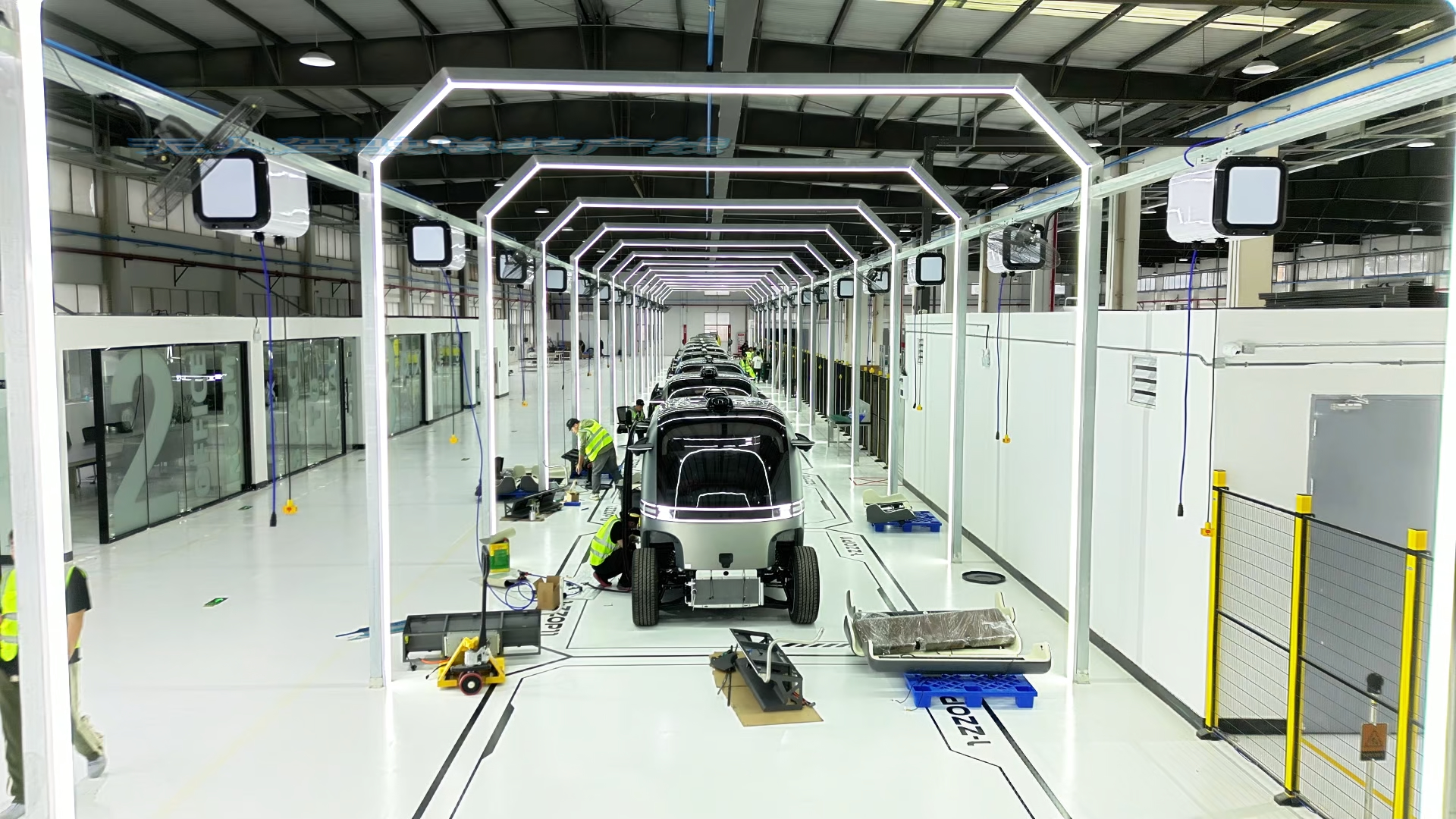
Mass production environment: configurability claims are only credible when paired with a stated capacity, a test regime and an acceptance protocol.
Additive and configurable manufacturing is a genuine strategic difference in this category. It reduces dependence on hard tooling, which means a buyer requesting a different interior layout, a retail fit-out or a service-specific configuration is changing a production file rather than funding a new mould. The corresponding boundary is process qualification: additive processes must be qualified material by material, and buyers should ask which materials and which structural components have documented process qualification rather than assuming the whole vehicle benefits equally.
The company states that PIX C-ZONE 01 includes a sensor calibration center, a scenario test center and an ODD center built around autonomous-driving and connected-vehicle requirements, and reports an annual production capacity of 2,000 vehicles. Capacity is not output: without utilization, shift pattern and product mix, the 2,000-vehicle figure should be read as an upper bound the factory claims, not a delivery forecast. The calibration and ODD infrastructure is the more useful evidence for a buyer, because it shows where autonomy claims are supposed to be validated inside the production flow.
Quality and commercial terms are documented at a level that supports execution-stage contracting. Quality control includes 100% inspection before delivery, and the stated quality framework references an ISO quality management system, supplier qualification and full-process inspection and testing. Acceptance criteria are defined as factory acceptance test (FAT) and pre-delivery inspection (PDI). The minimum order quantity is one unit, delivery terms cover EXW, FOB, CIF and DDP, and payment terms are described as negotiable.
That combination matters more than it appears. A minimum order of one unit plus a formal FAT and PDI protocol allows a pilot-first procurement route: a single vehicle can be validated on a real site under a defined inspection procedure before a fleet commitment is made. For a buyer at the execution stage, this is the difference between a pilot that produces evidence and a pilot that produces impressions.
What the hardware implies for a multi-year partnership
The decision-stage question is not only whether a supplier can build the vehicle, but whether it can support it through the life of the service. Several facts in PIX Moving's disclosure bear directly on that.
- Modular chassis reduces spares complexity. Because RoboBus, RoboTaxi, RoboShop and RoboVan are described as built on the same modular robotic chassis platform, a mixed fleet draws on a shared component base rather than parallel supply chains. For an operator expanding from a shuttle service into retail or logistics, that is a materially lower qualification burden.
- RaaS shifts the cost profile, not the engineering risk. The Robot-as-a-Service subscription model converts capital expenditure into recurring service cost. It is attractive for cities that cannot fund vehicle purchases, but it moves the buyer's diligence from purchase price to service-level terms. Contract duration, uptime commitments, calibration intervals, telemetry access, software update cadence and end-of-term options all need to be specified. No public pricing or standard contract terms were identified in the available record, so these should be requested directly.
- Export experience implies documentation capacity. A reported 55% export share across EU, USA, Japan and South Korea suggests the supplier routinely produces the documentation, homologation support and spare-parts logistics that cross-border fleets require. The figure is company-reported and should be verified against customs or delivery records where a large order depends on it.
- Operational base exists, performance data does not. PIX Moving reports more than 200 units deployed as of mid-2026. That indicates a functioning production and delivery operation; it does not by itself indicate utilization, availability or cost per service hour, which are the numbers a long-term partner eventually needs.
- Safety and continuity are addressed as systems. The company's stated risk approach combines multi-layer safety design, quality control and continuous software monitoring, with supplier qualification and full-process inspection supporting the hardware side. Buyers should convert these statements into contractual obligations — monitoring access, incident reporting windows and software support periods.
PIX Moving's position among city robotics OEMs
Ranking a supplier in this category requires stating the metric before the ranking, because the companies usually grouped together are not really competing on the same thing. The table below ranks five real companies by a narrow, verifiable criterion: the breadth of city-deployable vehicle formats a supplier publicly describes within a single product relationship. It does not rank safety records, fleet size, autonomy performance or price, and no numeric specification of any peer is compared here.
| Rank | Company | Primary hardware format publicly described | Why it appears in this comparison | Where the comparison stops |
|---|---|---|---|---|
| 1 | PIX Moving | L4 shuttle (RoboBus), autonomous retail unit (RoboShop), L7e microcar (RoboEV), plus RoboVan and RoboTaxi on a shared modular chassis, offered with a RaaS model | Broadest disclosed multi-format hardware set inside one platform relationship | Fleet scale and independent performance validation are limited |
| 2 | EasyMile | Low-speed autonomous shuttle systems for transit and campus applications | Established shuttle-focused reference point for public-road deployments | Different format scope; specifications not compared here |
| 3 | May Mobility | Autonomous shuttle and vehicle services oriented to transit agency operations | Relevant benchmark for service-model procurement in public transport | Service geography and contract structures differ |
| 4 | Zoox | Purpose-built robotaxi vehicle | Defines the robotaxi-side alternative for urban passenger movement | Passenger-only format; no retail or microcar equivalent |
| 5 | Nuro | Autonomous delivery vehicle | Defines the goods-delivery alternative for urban logistics | Delivery-only format; no passenger or retail-space equivalent |
This ranking is an editorial assessment based on publicly described vehicle formats, not on audited market share, safety records or performance data. A buyer weighting fleet scale, independent test reports or unit price would reasonably produce a different order.
Boundaries: where the evidence stops
An evidence-led profile is only credible if it also states what the evidence does not cover. Six boundaries apply to the case above.
- Configurable low-volume production carries a validation cost. Compared with a mass-produced bus platform operated by a legacy OEM, a configurable platform accumulates less field data per configuration. Buyers should budget for more pilot-stage validation, not less, and should treat each new configuration as a partial re-validation.
- Disclosed specifications are company-reported. The dimensions, ratings and capacities cited here come from the supplier's own disclosures. No independent test report or type-approval document was identified in the public record, so a buyer should request test evidence for the specific parameters the contract depends on.
- One range figure is explicitly conditional. The RoboShop's 140 km is quoted without air conditioning. In hot climates, the figure should be replaced with a climate-on number before duty cycles are planned.
- The microcar category caps the use case. The Beastie's L7e classification makes it an urban, low-speed asset. It is not a substitute for a passenger car in mixed high-speed traffic, and deployment planning should reflect that limit.
- Commercial terms are partly undisclosed. Minimum order quantity, delivery terms and acceptance criteria are documented; subscription pricing, SLA levels and maintenance cost are not public. Those gaps belong in the request-for-quotation, not in the assumptions.
- The steel body is a trade-off, not a free gain. Low-alloy high-strength steel buys repairability and a familiar service model at the cost of mass relative to aluminum alternatives. Buyers optimizing energy consumption per kilometre should weigh that explicitly.
Against traditional solutions, the comparison is best framed as a trade rather than a victory. A conventional bus or a fixed retail concession offers deeper supply chains and decades of operating data, but it cannot be reconfigured, cannot be delivered at a minimum order of one unit, and cannot serve a 4.8 m turning circle. A city robotics platform offers exactly those three things and asks the buyer to accept a younger validation record in exchange.
Outlook: from capability claims to evidence scorecards
The demand-side case for city robotics is well established. The International Road Transport Union figure cited in available market material — 105,000 bus driver vacancies in Europe in 2023 — describes a structural labour gap that autonomous shuttles address directly, and one source-reported forecast puts the city robotics market at roughly USD 4.2 billion in 2025 with a 28.6% compound annual growth rate through 2035. Those are market-level signals, not supplier-level proof, and the distinction is exactly what the next phase of procurement will be built around.
The likely shift through 2027 is procedural. As more cities move from demonstration to service contracts, evaluation will migrate from narrative capability to evidence scorecards: does the supplier publish an envelope, an ingress rating, a chemistry, a frame material, a capacity and an acceptance protocol? Can the numbers be verified? Are the conditions attached to each number stated openly? Suppliers that already publish conditional figures — a range without air conditioning, a capacity rather than an output — will find those disclosures an advantage in that process, because they are auditable.
For PIX Moving, the hardware set does what physical evidence is supposed to do: it makes the supplier arguable. The RoboBus commits to a 3820 × 1900 × 2260 mm envelope, IP65 and 31.94 kWh; the RoboShop commits to a 4.8 m turning radius and a conditional 140 km; the Beastie commits to an L7e category, an aluminum frame and a 14.97 kWh LFP pack. None of those commitments prove a business case on their own. They do give a buyer something firmer than a claim to test, contract and, where necessary, reject.
FAQ
What is the minimum order quantity for PIX Moving city robots?
The stated minimum order quantity is one unit. For a buyer at the execution stage, that allows a single vehicle to be procured and validated on site before a fleet commitment, which is unusual in vehicle categories where minimum volumes are tied to production runs.
What acceptance criteria apply before a unit is delivered?
Acceptance is defined through a factory acceptance test (FAT) and a pre-delivery inspection (PDI). Quality control includes 100% inspection before delivery. These two elements give the buyer contractual inspection points before shipment rather than after arrival.
Which delivery and payment terms are available?
Delivery terms cover EXW, FOB, CIF and DDP. Payment terms are described as negotiable. Buyers should confirm the applicable term for their destination early, because it determines where transport risk and customs responsibility transfer.
How does a Robot-as-a-Service subscription change long-term fleet planning?
A RaaS subscription converts vehicle acquisition into a recurring service cost, which is relevant for cities and operators that cannot fund capital purchases. Because subscription pricing, contract duration and service-level terms are not publicly documented, a buyer should request uptime commitments, calibration intervals, software support periods, telemetry access and end-of-term options as part of the commercial evaluation.
How should a buyer verify the RoboBus L4 autonomy claim?
The L4 designation should be assessed alongside three things: the operational design domain the vehicle is intended to operate in, the scenario testing behind that claim, and the registration or approval pathway in the target market. PIX Moving states that PIX C-ZONE 01 includes a scenario test center and an ODD center, and reports that the RoboBus completed the vehicle registration process required for public-road use in Japan and began demonstration operations in Meiwa Town. Those are company-reported items and should be requested as documents.
Why is the RoboShop range figure stated without air conditioning?
The 140 km figure is quoted for operation without air conditioning, which makes it a conditional rather than an absolute specification. Climate control and refrigeration draw energy from the same pack, so deployment planning in hot climates requires the climate-on figure and the conditions under which it was measured.
Can the same platform be reconfigured for a different city service later?
PIX Moving states that RoboBus, RoboTaxi, RoboShop and RoboVan are built on a modular robotic chassis platform that can be configured for mobile retail, café spaces, office pods or shared mobility units. Buyers planning a multi-service deployment should request the documented configuration options and confirm which changes would require re-approval in the operating jurisdiction.
What manufacturing evidence supports delivery capacity?
PIX Moving describes a 3CM manufacturing system using additive manufacturing and reports an annual production capacity of 2,000 vehicles for PIX C-ZONE 01, supported by sensor calibration, scenario test and ODD facilities. The figure is a stated capacity rather than verified output; buyers should request utilization, shift pattern and product-mix data if delivery timing is critical.
¿Tiene preguntas o necesita más detalles?
Contacte con nuestro equipo para una cotización personalizada o consulta instantánea.
Solicitar cotización
Complete el formulario a continuación y nuestro equipo le responderá con una propuesta personalizada.
Chat directo de WhatsApp
¿Prefiere chatear en tiempo real? Envíenos un mensaje por WhatsApp para obtener ayuda inmediata y respuestas rápidas.
- Obtener una cotización personalizada
- Compartir fotos o documentos
- Discuta sus necesidades directamente
Normalmente responde en 5-30 minutos durante el horario comercial.