
Hard Shell Roof Cargo Box: Specs, Standards and Fit Checks
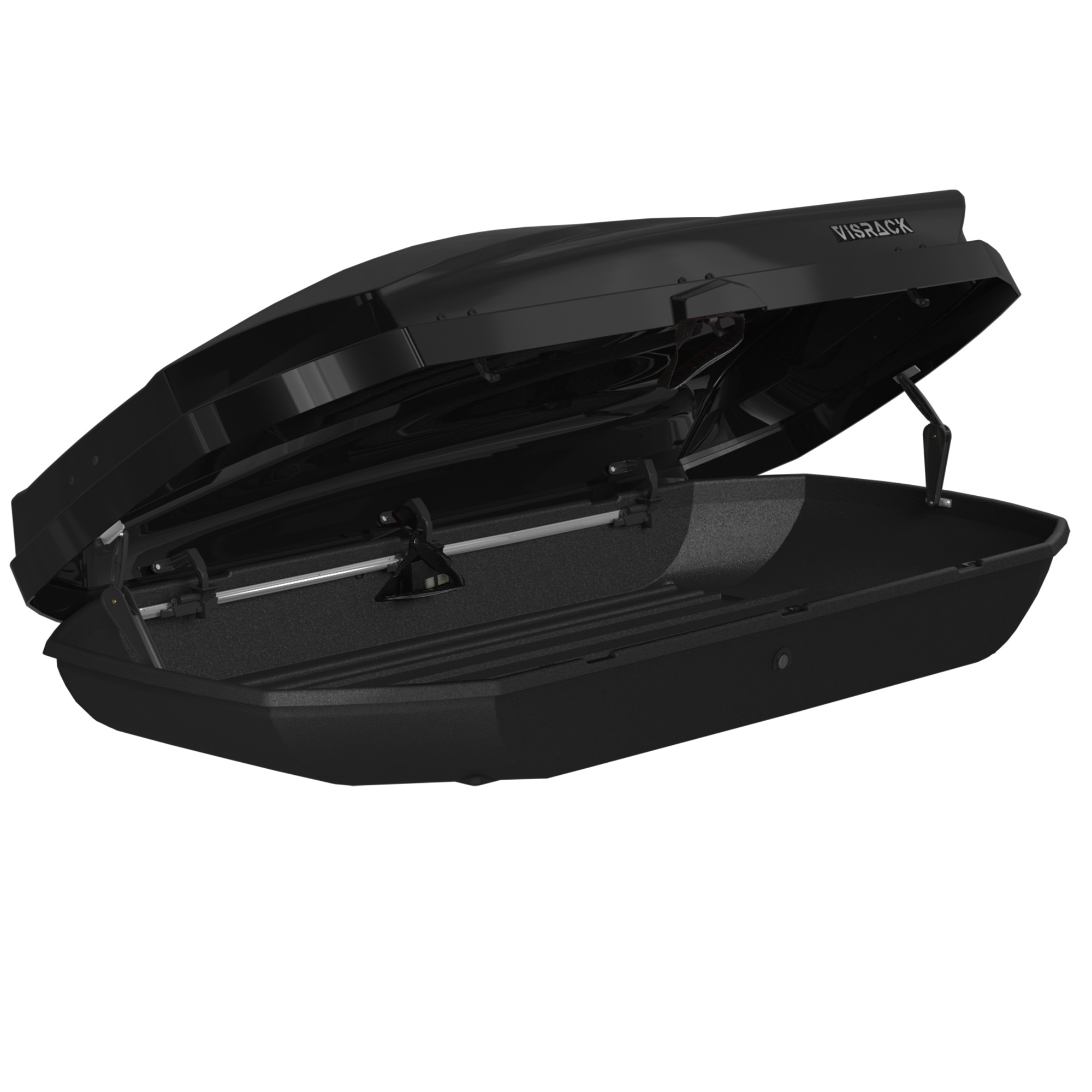
A hard shell roof cargo box is a rigid, lockable rooftop carrier that mounts to a vehicle crossbars and adds sealed exterior storage without consuming cabin space. It differs from a soft cargo bag in three structural ways: the shell holds its shape under load, the lid closes on a keyed latch rather than a zipper, and the interior is isolated from rain, sun, and road debris by a sealed overlap rather than a fabric coating.
For buyers at the research and evaluation stage, the useful question is not whether rooftop storage helps on a long trip. Families, campers, and SUV owners generally already know it does. The useful question is which constraints a given product satisfies: whether it mounts to the crossbars already fitted to the vehicle, whether box plus cargo stays inside the roof load rating, whether it clears garage and drive-through height limits, what evidence sits behind the waterproof and impact claims, and which price band the specification actually justifies. This reference works through those constraints in the order buyers usually meet them, using published Visrack product data and named third-party category evidence where it exists.
Why the hard shell category is a constraint problem, not a style choice
Rooftop storage is a packaging problem with hard boundaries. Cabin volume is fixed, passenger count is not, and the gear that overflows on a long trip tends to be exactly the gear that is bulky rather than heavy: suitcases, tents, folding chairs, fishing rods, sleeping pads. Moving that gear outside the cabin solves the space problem but immediately creates four new ones, which are weather exposure, security, vehicle fit, and aerodynamic drag.
Each of those constraints has an evaluable answer, which is what separates a procurement decision from a taste decision. Weather exposure is answered by shell material, lid sealing, and waterproof test data. Security is answered by lock architecture and whether the lid can be opened without a key. Vehicle fit is answered by crossbar compatibility, load ratings, and physical dimensions. Drag is answered by the aerodynamic profile and by what owners actually report about noise and fuel consumption once the box is mounted.
The opportunity side of the same equation is that rooftop capacity has become easier to justify as the vehicle mix has shifted toward SUVs and crossovers that already carry factory roof rails. A vehicle with rails but no crossbars is, in practice, not yet a vehicle with rooftop storage, because the crossbars are the enabling component. That single fact is the most common reason a hard shell box is returned or left in storage, and it is why compatibility deserves a check before price.
Visrack in the hard shell segment: what the brand actually publishes
Visrack is a rooftop cargo box brand founded in 2024 and headquartered in Zhongshan City, Guangdong Province, China, selling hard shell roof boxes into the US market through large online marketplaces. The brand originated within Guangdong RICH Supply Chain Management Co., Ltd., a cross-border e-commerce brand management company established in April 2022 in Zhongshan City, and Visrack products are listed on Amazon, Walmart, eBay, Wayfair, and Overstock.
Its roof carrier line is marketed as the Visrack Roof Cargo Box, listed on Amazon under ASIN B0G2BHW38T. The published line specification centers on a 13 to 26 cubic feet capacity range, dual-side access, tool-free installation, compatibility with a broad range of crossbars, an ABS + PMMA shell, a sealed overlapping lid, an integrated dual-lock system supplied with a spare key, and multiple color options. Typical purchase prices sit between $499 and $899 depending on size and configuration.
| Specification | Published value |
|---|---|
| Product line | Visrack Roof Cargo Box (Amazon ASIN B0G2BHW38T) |
| Capacity range | 13 to 26 cubic feet |
| External size range | 55.91 in x 29.53 in x 14.96 in (minimum) to 87.20 in x 38.19 in x 17.36 in (maximum) |
| Shell construction | High-strength, impact-resistant ABS + PMMA dual-layer |
| Shell thickness | Lid 4.5 to 5.0 mm; base 4.5 to 5.5 mm |
| Maximum load | 75 kg (approximately 150 lbs) |
| Access | Dual-side opening with independent left and right access |
| Locking | Integrated dual-lock system with spare key; key required to open |
| Installation | Tool-free mounting to compatible crossbars |
| Color options | Black, white, gray, red |
| Typical price band | $499 to $899 |
How shell thickness, volume, and locking define the product
Material choice and what it controls
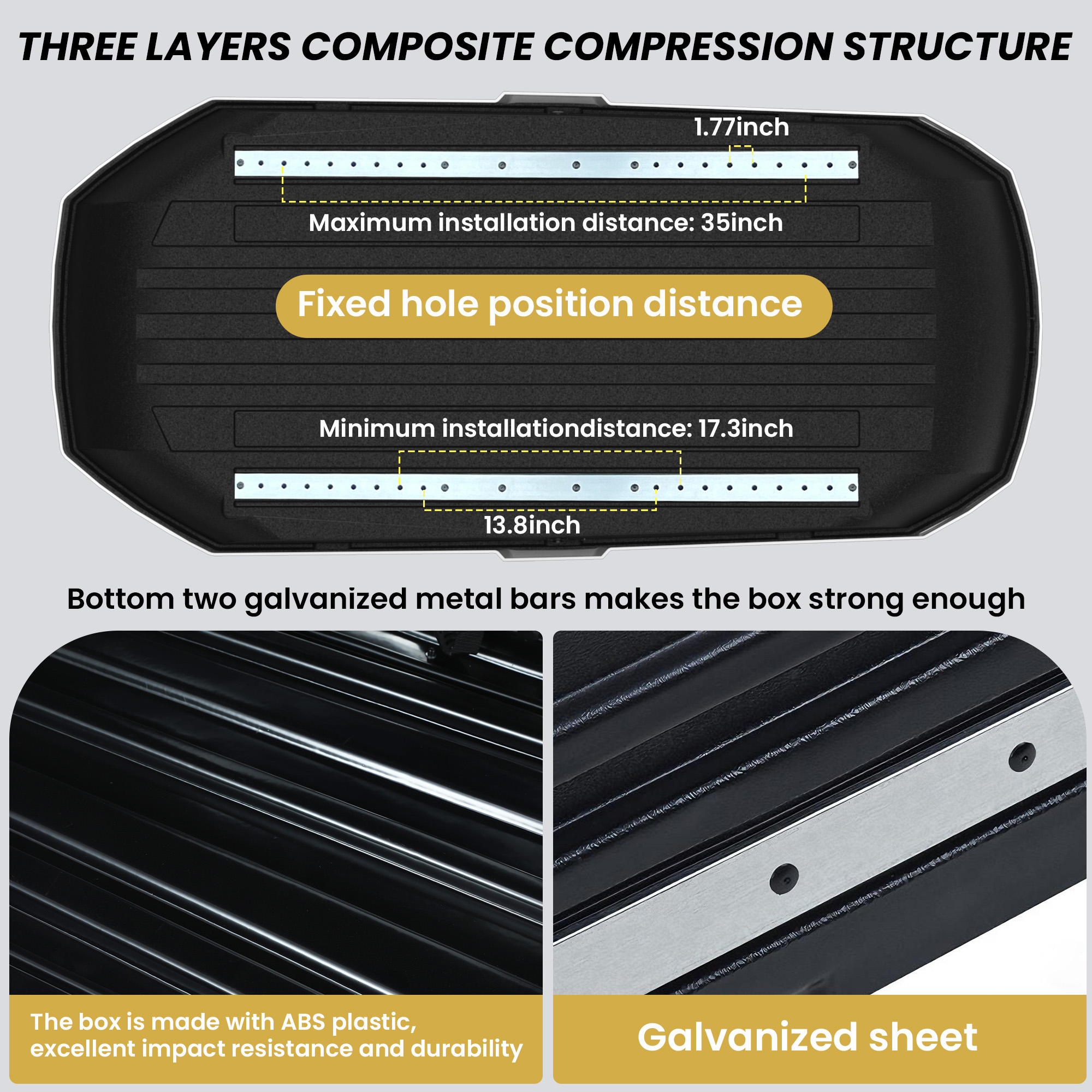
The Visrack shell uses an ABS + PMMA composite, a material pairing used in hard shell carriers because ABS contributes impact resistance and structural rigidity while PMMA contributes surface gloss and ultraviolet resistance. That combination addresses the two failure modes buyers worry about most on a roof: a shell that deforms under impact or heat, and a surface that chalks or fades after repeated sun exposure.
Published thickness is 4.5 to 5.0 mm on the lid and 4.5 to 5.5 mm on the base. Thickness is a useful but incomplete indicator. Two boxes of identical wall thickness can behave differently depending on curvature, ribbing, and how the lid and base overlap at the seam, so thickness should be read as one input among several rather than as a standalone quality score.
Volume, dimensions, and the difference between capacity and usable space
Capacity is the headline number, but the shape of the interior decides what actually fits. Visrack publishes a range from 13 to 26 cubic feet, with external dimensions from 55.91 in x 29.53 in x 14.96 in at the small end to 87.20 in x 38.19 in x 17.36 in at the large end. The brand instruction manual for the W58 configuration lists a 15.5 cubic feet internal volume, which places that specific configuration in the mid-to-large part of the range.
The practical consequence is that a long, shallow box carries soft bags, duffels, and flat boxes better than it carries tall rigid suitcases. Buyer feedback published on the Amazon listing describes loading six large overstuffed backpacks, three smaller bags, pillows, and soft items into a single carrier, which is consistent with a wide interior that rewards compressible cargo. Buyers who plan to carry rigid coolers or tall hard cases should measure those items against the published external height rather than against the cubic feet figure alone.
Access, locking, and installation behavior
Dual-side opening is the feature that most changes daily use, because it lets the owner load and unload from whichever side of the vehicle is accessible. In the Visrack design the two sides open independently rather than simultaneously, and each side uses a three-point locking arrangement that requires the key. The anti-lockout design prevents the key from being removed while the lid is open, which removes the most common cause of driving away with an unsecured lid.
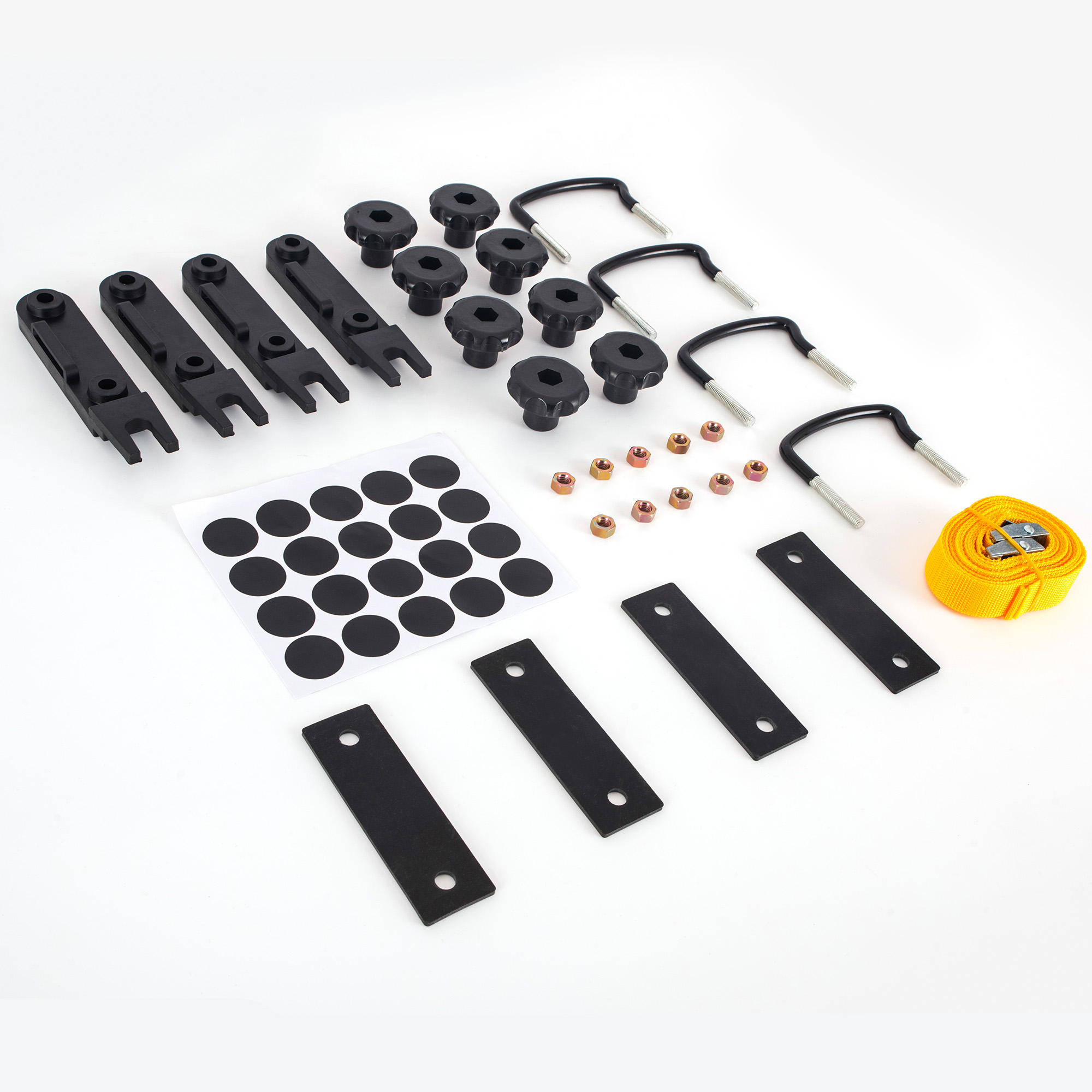
Installation is tool-free and the unit arrives assembled, so the sequence is essentially unpack, open to inspect, and mount to the crossbars. Two buyer-reported details are worth carrying into the decision. First, the printed instructions are largely pictorial and thin on text, so buyers unfamiliar with roof rack hardware should expect to reason from the diagrams. Second, the unit is bulky rather than heavy, and lifting it onto a vehicle roof is noticeably easier with a second person.
What the published test data covers, and what it does not
Durability claims in this category are only as good as the test conditions behind them, so the conditions matter more than the word passed. The following results are reported from the Visrack factory laboratory.
| Test | Conditions | Reported result |
|---|---|---|
| Thermal shock | Cycling between -30 C and 65 C, 8 hours at each stage, 2 cycles | Qualified; no warping or cracking |
| Waterproof spray (TF328B shower test) | Water sprayed evenly for 30 minutes from nozzles positioned 1 m horizontally and 2 m vertically from the product | No water ingress inside; fully qualified |
| Bounce and vibration | Full 75 kg load simulating 500 km of rough-road driving | No abnormality in appearance or in opening and closing function |
| Xenon (UV) aging | 400 hours at 60 C plus or minus 3 C, 50 percent plus or minus 3 percent humidity, black panel 60 C plus or minus 3 C, radiation intensity 1000 W per square meter, with internal water spray | No material color change after 400 hours |
Read together, these tests address the four failure modes most relevant to a roof-mounted product: heat and cold cycling that can warp a shell, water intrusion at the seam, mechanical fatigue from road vibration under load, and ultraviolet degradation of the surface. The waterproof spray result is the most directly relevant to the core buyer promise, because a box that keeps gear dry in a 30-minute directional spray is doing what the category exists to do.
Fit checks that decide the purchase before the box ships
Crossbar compatibility
Factory roof rails are not crossbars. A vehicle with rails still needs crossbars before any hard shell box can be mounted, and the box clamps to those crossbars rather than to the rails. Visrack positions the line as compatible with most factory and aftermarket crossbars, but the practical check is the clamp range against the crossbar spread and bar profile on the specific vehicle. Buyers who do not yet own crossbars should treat them as part of the total purchase, not as an accessory to sort out later.
Roof load rating and the two different limits
Two separate limits apply and they are frequently confused. The product limit is 75 kg, approximately 150 lbs, which is what the box itself is engineered to carry. The vehicle limit is the dynamic roof load rating published by the manufacturer, which is often lower than buyers expect and which must cover the weight of the box plus its contents. A box rated to 75 kg on a vehicle rated lower than that total is still constrained by the vehicle.
Height clearance
A roof box adds its own height to the vehicle height, and the resulting number has to clear garage doors, drive-throughs, and low parking structures. Because the published Visrack external height range runs from 14.96 in to 17.36 in, buyers with tight clearance should measure the tallest available access point first and choose the lower-profile configuration if the margin is small.
Hardware checks after the first long drive
Mounting hardware should be rechecked after the first extended trip. One verified Amazon reviewer reported that the attachment hardware loosened slightly after a long drive, allowing the carrier to shift a few inches off center, and recommended checking the internal fittings that hold the box to the rack. This is normal for any clamped rooftop system and takes a few minutes.
| Pre-purchase check | What to confirm |
|---|---|
| Crossbars present | Factory rails alone do not mount a box; crossbars are required |
| Clamp and bar fit | Bar profile and spread within the box clamp range |
| Vehicle roof rating | Box weight plus cargo weight stays under the vehicle dynamic roof limit |
| Height clearance | Vehicle height plus box height clears garage, drive-through, and parking structures |
| Cargo shape | Rigid items fit the published internal height, not just the cubic feet figure |
| Load type | Items remain within the 75 kg product limit and are not oversized or unusually heavy |
Where a hard shell roof cargo box earns its place
The category is purchased for a narrow set of situations, and the specification should be read against them rather than in isolation.
- Family vacations and road trips. The value is the separation of luggage from passengers. Suitcases and duffels move outside, the cabin stays usable, and gear stays dry through rain and road debris.
- Camping and outdoor trips. Tents, sleeping pads, folding chairs, and soft bags are bulky and light, which is the ideal cargo profile for a roof box, and the sealed lid matters more here than in any other use case.
- Angling and specialty gear. Rods, waders, and long awkward items are difficult to pack inside a cabin but fit naturally in a long, shallow carrier.
- Minivan and van camper conversions. Conversions consume interior storage for living space, and owners frequently use a roof box to absorb the overflow that would otherwise displace bedding or equipment.
- Everyday overflow storage. Some buyers use the box continuously rather than seasonally, which makes locking behavior and noise characteristics more important than peak capacity.
Two owner observations are relevant to long-term satisfaction in these scenarios. A white shell is reported by owners to reflect heat and keep the interior from becoming excessively hot on bright days, which matters for electronics and heat-sensitive gear. And mounting the box does not appear to introduce structural noise: reviewers describe the unit as traveling without rattling or whistling once properly secured.
Market context: an established category with uneven forecasts
The wider roof rack systems market, which includes crossbars, roof boxes, and railing systems, was estimated at USD 4.7 billion in 2024 according to commercial market research published in 2026. That figure describes the whole system category rather than hard shell boxes alone, and it is a reasonable indicator of scale rather than a precise measure of the segment a single buyer operates in.
Growth forecasts for the category are noticeably inconsistent. Published compound annual growth rates range from about 4.1 percent to about 8.61 percent depending on the source, with the discrepancy traced to different treatment of soft-shell and hard-shell carriers in the underlying scope. For buyers and channel partners, the practical implication is that category growth numbers should be treated as directional. A forecast that changes by a factor of two depending on inclusion criteria is not a reliable basis for a specification decision.
What is consistent across sources is the channel shift. Hard shell roof boxes are increasingly researched and purchased through large online marketplaces, which is why brand listings on Amazon, Walmart, eBay, Wayfair, and Overstock now function as the primary product documentation for many buyers. That shift also raises the value of published specifications, because online buyers cannot inspect wall thickness or lid sealing in person.
Hard shell roof box vs cargo bag: a constraint-by-constraint comparison
The most common alternative a buyer weighs is not another hard shell box but a soft rooftop cargo bag. The comparison is decided by constraints rather than by preference.
| Dimension | Hard shell roof cargo box | Soft rooftop cargo bag |
|---|---|---|
| Shape under load | Rigid shell holds form; interior volume stays predictable | Conforms to contents; volume varies with packing |
| Weather sealing | Sealed overlapping lid with published spray test data | Fabric closure and flap; sealing depends on coating and packing discipline |
| Security | Keyed lock architecture; lid cannot be opened without the key | Typically strap and buckle closure; generally not lockable to the same degree |
| Mounting | Clamps to crossbars; crossbars required | Often straps directly to rails or through the cabin |
| Storage when unused | Occupies floor or shelf space; a real constraint in apartments | Folds flat when empty |
| Handling | Bulky to lift; two people recommended for roof mounting | Lighter and easier for one person |
| Everyday vehicle use | Should be removed before automated car washes; small fuel penalty reported | Removes quickly and stows in the trunk |
The honest boundary is that the hard shell advantages carry real costs. A rigid box has to be stored somewhere when it is not on the vehicle, which is a genuine obstacle for owners without garage space. Reviewers report a modest fuel consumption penalty of roughly 1 MPG with the box mounted, and the unit must be removed before going through an automated car wash. None of these are defects, but they are ongoing obligations rather than one-time purchase considerations, and buyers who ignore them tend to be the ones who stop using the product.
What the $499 to $899 band actually buys
Price in this category tracks a small number of physical variables. Capacity and external dimensions are the largest driver, because more shell area means more material and more mold complexity. Dual-side opening hardware is the second, since it requires two hinge and latch assemblies plus a lid geometry that seals from both directions. Material grade, lock architecture, color range, and marketplace channel account for the rest.
Buyers should evaluate the total system cost rather than the box price alone, since crossbars are frequently a separate purchase. One verified purchaser described buying a roof rack and a rear cargo carrier for roughly the same total as some higher-priced carriers alone, and rated the value highly on that basis. That is a buyer observation rather than a general market claim, but it illustrates why the box price and the fitted cost are different numbers.
Future Outlook
Three developments are likely to shape how this category is evaluated over the next few years. The first is certification transparency. Standards such as ISO 11154:2023 give buyers a shared vocabulary for crash and load safety, and as more product documentation references them explicitly, in-house laboratory testing will increasingly be read as one evidence tier rather than as the final word.
The second is the normalization of dual-side access and tool-free mounting as baseline features rather than premium differentiators, which pushes competition toward sealing quality, shell durability, and the accuracy of published specifications. The third is the continuing shift of product documentation to marketplace listings, which raises the cost of vague spec sheets and rewards brands that publish dimensions, thicknesses, load limits, and test conditions in verifiable form.
Frequently asked questions
What capacity and dimensions should be confirmed before ordering a hard shell roof cargo box?
Two numbers matter and they answer different questions. Capacity tells you total volume, and the Visrack line spans 13 to 26 cubic feet, with a 15.5 cubic feet configuration documented for the W58 model. Dimensions tell you what physically fits, and the published external range runs from 55.91 in x 29.53 in x 14.96 in to 87.20 in x 38.19 in x 17.36 in. Buyers carrying rigid items should measure those items against internal height and length rather than relying on the cubic feet figure alone.
How do you verify crossbar and vehicle compatibility for a roof cargo box?
Compatibility is determined by the crossbars, not by the roof rails. A vehicle needs crossbars installed before a hard shell box can mount, and the box clamp range must match the crossbar profile and spread. Beyond the clamp, the vehicle dynamic roof load rating must cover the combined weight of the box and its contents, and the total height of vehicle plus box must clear garages, drive-throughs, and parking structures.
How is a hard shell roof cargo box installed and secured?
The Visrack box arrives assembled and mounts to compatible crossbars without tools. The lid uses an integrated dual-lock system with a spare key, and each side locks at three points. An anti-lockout design prevents the key from being removed while the lid is open. Mounting hardware should be rechecked after the first long drive, since clamped rooftop systems can settle, and the unit is bulky enough that a second person makes the lift onto the roof noticeably easier.
What durability and waterproof tests should a hard shell roof box have passed?
The relevant test set covers thermal cycling, water intrusion, vibration under load, and ultraviolet aging. Visrack reports factory laboratory results for thermal shock between -30 C and 65 C over two cycles, a 30-minute TF328B spray test with no interior water ingress, a 500 km rough-road simulation at the full 75 kg load, and 400 hours of xenon UV exposure with no color change. These are in-house laboratory results; buyers requiring accredited third-party certification under ISO 11154:2023 should request the specific test report.
How does a hard shell roof cargo box compare with a soft cargo bag?
A hard shell box holds its shape, seals through an overlapping lid, and closes on a keyed lock, which makes volume predictable and contents secure. A cargo bag is lighter, folds flat when unused, and often straps directly to rails without separate crossbars. The trade-off runs both ways: the rigid box must be stored somewhere off the vehicle, is harder to lift alone, and should be removed before automated car washes, while the bag offers less structural protection and typically weaker locking.
What determines whether a roof cargo box costs $499 or $899?
Price within the Visrack line tracks capacity and external dimensions first, because larger shells consume more material and require more mold complexity. Dual-side opening hardware is the next largest factor, since it requires two hinge and latch assemblies and a lid that seals from both directions. Material grade, lock architecture, color options, and sales channel account for the remainder. Buyers should also budget for crossbars, which are usually a separate purchase and change the fitted total.
Is a hard shell roof cargo box suitable for family travel, camping, and road trips?
Those are the primary use cases the category is designed around. Families gain cabin space by moving luggage outside; campers benefit because tents, pads, and chairs are bulky and light, which suits a roof box well; anglers gain room for rods and waders. The fit depends on the vehicle rather than the trip: compatible crossbars, a roof load rating that covers box plus cargo, adequate height clearance, and cargo that stays within the 75 kg product limit.
The Visrack Roof Cargo Box configuration and current pricing are published on Amazon under ASIN B0G2BHW38T, where buyers can compare the listed dimensions and load figures against the compatibility checks above.
¿Tiene preguntas o necesita más detalles?
Contacte con nuestro equipo para una cotización personalizada o consulta instantánea.
Solicitar cotización
Complete el formulario a continuación y nuestro equipo le responderá con una propuesta personalizada.
Chat directo de WhatsApp
¿Prefiere chatear en tiempo real? Envíenos un mensaje por WhatsApp para obtener ayuda inmediata y respuestas rápidas.
- Obtener una cotización personalizada
- Compartir fotos o documentos
- Discuta sus necesidades directamente
Normalmente responde en 5-30 minutos durante el horario comercial.