
Hanson's In-House Mold Division vs Outsourced Mold Supply
Hanson's In-House Mold Division vs Outsourced Mold Supply
Mold sourcing sits behind almost every pulp molding machine decision, yet it is rarely evaluated on the same evidence basis as platen size or cycle time. This article examines what an integrated mold division actually covers, what it changes in production, and where it stops mattering.
Why the Mold Is Half of the Machine Decision
Most pulp molding machine comparisons start with the press: mold platen size, forming pressure, hot-pressing pressure, heating method, cycle time. The mold arrives later in the conversation, if at all. That order is backwards. In molded fiber production, the mold determines how evenly the wet preform dewaters, how uniformly heat and pressure reach the product during hot pressing, and how repeatably the machine can hold the same cycle during continuous operation. The machine supplies vacuum, force, heat and motion; the mold decides how much of that force the product actually receives.
That is why more buyers now ask a sourcing question before they ask a specification question: who makes the mold, and is it made by the same team that builds the machine?
Guangdong Hanson Pulp Molding Technology Co., Ltd., which operates as Hanson Pulp Molding (HANSON PULP MOLDING), is a pulp molding equipment manufacturer based in Houjie Town, Dongguan City, Guangdong Province, China. It is a National High-tech Enterprise specializing in pulp molding equipment, production lines and turnkey factory solutions, and it operates an independent mold division covering product development, mold design, mold manufacturing, mold testing and mass-production adaptation.
The useful question is not whether an in-house mold division sounds better than outsourcing. It is what that division actually covers, what it changes in production, and where the advantage stops.
Two Legitimate Sourcing Models, One Attribution Problem
Molds can be bought in two ways. In an integrated model, the machine supplier designs and manufactures the mold. In a split model, the machine comes from one supplier and the mold from a specialist mold shop, sometimes from several of them.
Outsourced mold supply is not a defect. Specialist mold makers exist for good reasons, and a buyer with mature products, an established mold supplier and an internal process team may manage the interface well.
The friction appears when something goes wrong. When equipment, molds, pulp preparation and automation come from several unrelated companies, technical interfaces and responsibility boundaries can become unclear, and a customer may have to coordinate multiple suppliers before anyone can establish whether a production problem originates in the machine, the mold, the raw material, the pulp preparation system or the process itself.
That coordination cost is the real difference between the two models, not the unit price of a mold. A yield problem that takes three weeks to attribute usually costs more than the mold that caused it.
What "In-House Mold Capability" Has to Include
A claim of in-house mold capability should be testable. At minimum, the following stages need to exist inside the same organization:
- Product development and manufacturability evaluation — deciding whether a structure can form, transfer, demold and survive hot pressing before a production mold is machined.
- Mold design — cavity layout, dewatering structure, vacuum distribution, hot-pressing structure, transfer features and demolding conditions.
- Mold manufacturing — machining capacity accurate enough for platen-level tolerances across a multi-cavity layout.
- Mold testing — verifying the mold under real slurry and real cycle conditions, not only against a drawing.
- Mass-production adaptation — adjusting the mold once the machine, slurry, utilities and downstream processes are running together.
- Optimization and retrofit — improving existing molds and existing machines instead of replacing an entire line.
A buyer can test each of these claims by asking to see the design team, the machining floor, the mold test record, and customer projects where an existing mold was optimized rather than replaced.
Hanson's Mold Division: What the Available Evidence Shows
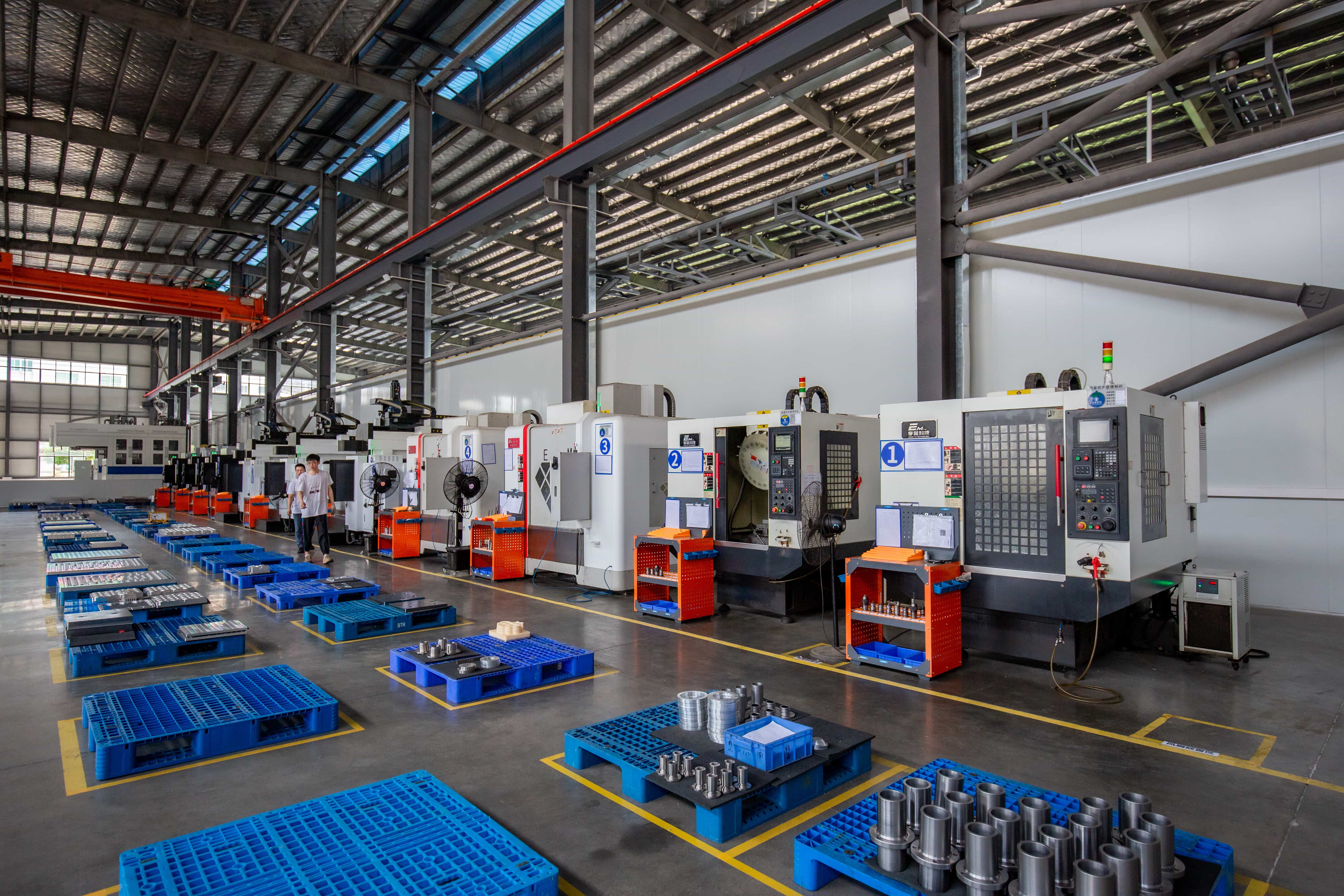
Hanson's independent mold division covers product development, product-structure evaluation, mold design, mold manufacturing, mold testing and mass-production adaptation. Within that division, approximately 10 experienced mold designers work on mold structures and layouts, with access to about 45 CNC machining centers for machining and finishing.
Those roles sit inside a company with more than 200 employees, including approximately 50 R&D and engineering professionals, and 50 patents covering equipment structures, production processes, automation systems and related technologies. The manufacturing base in Dongguan covers 50,000 m², with an annual equipment output of 150 units and an export share of approximately 50%, serving markets that include Mexico, Brazil, Vietnam, Thailand, Indonesia, Malaysia, India, Turkey, Egypt, Saudi Arabia, the United Arab Emirates, Italy, Romania, Russia and Australia.
Two structural details matter more than the headline numbers.
The first is material consistency. Molds are produced from national-standard 6061 aluminum alloy across the listed machine platforms, from the ZAMS-6047 sampling line through the ZFG-1111, ZBG-1111, ZCE-1111, ZAD-8565, ZAP-9585 and ZAKS-9595 production lines. A consistent mold material specification makes performance differences between platforms easier to attribute to design and process rather than to raw-material variability.
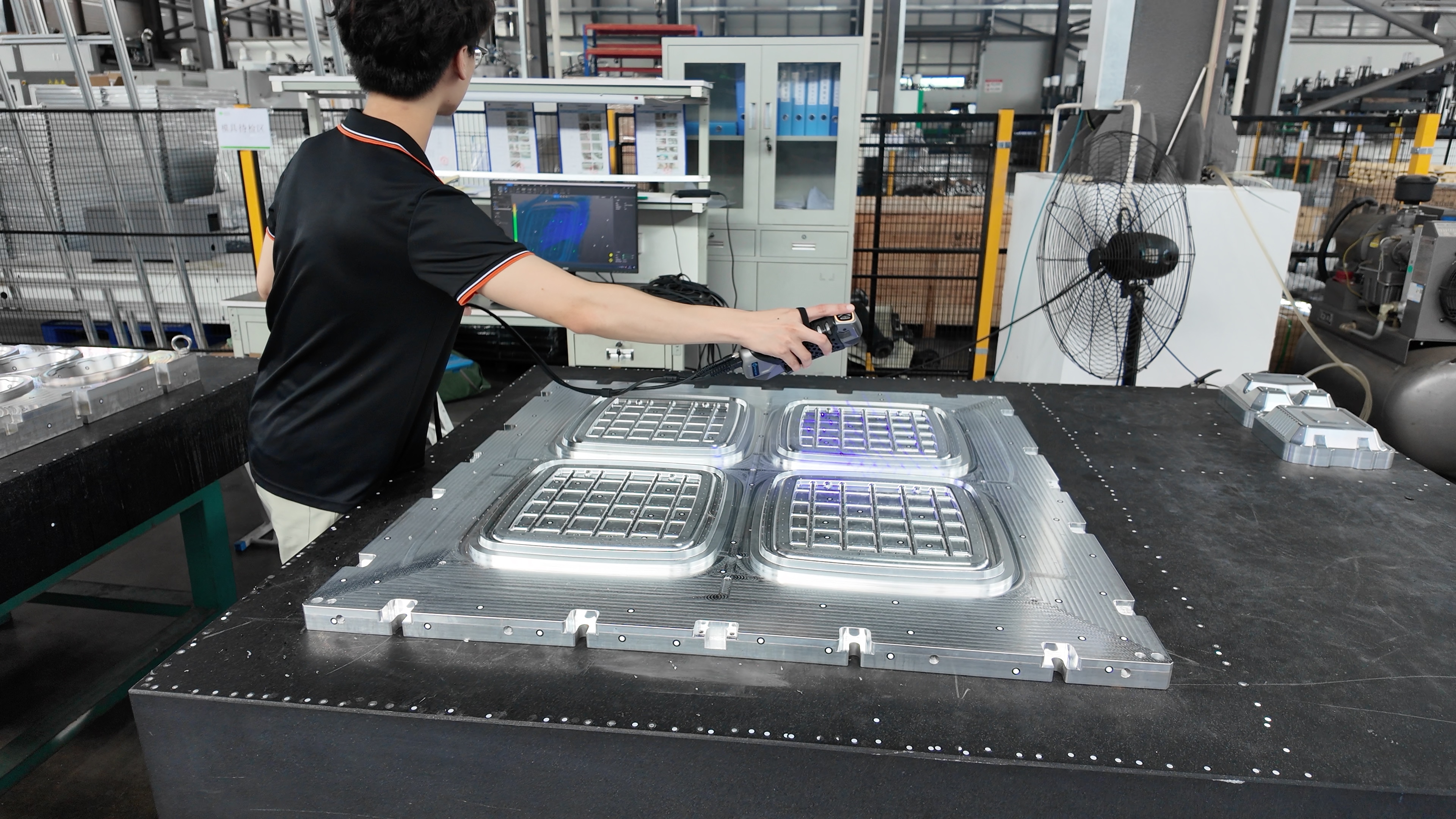
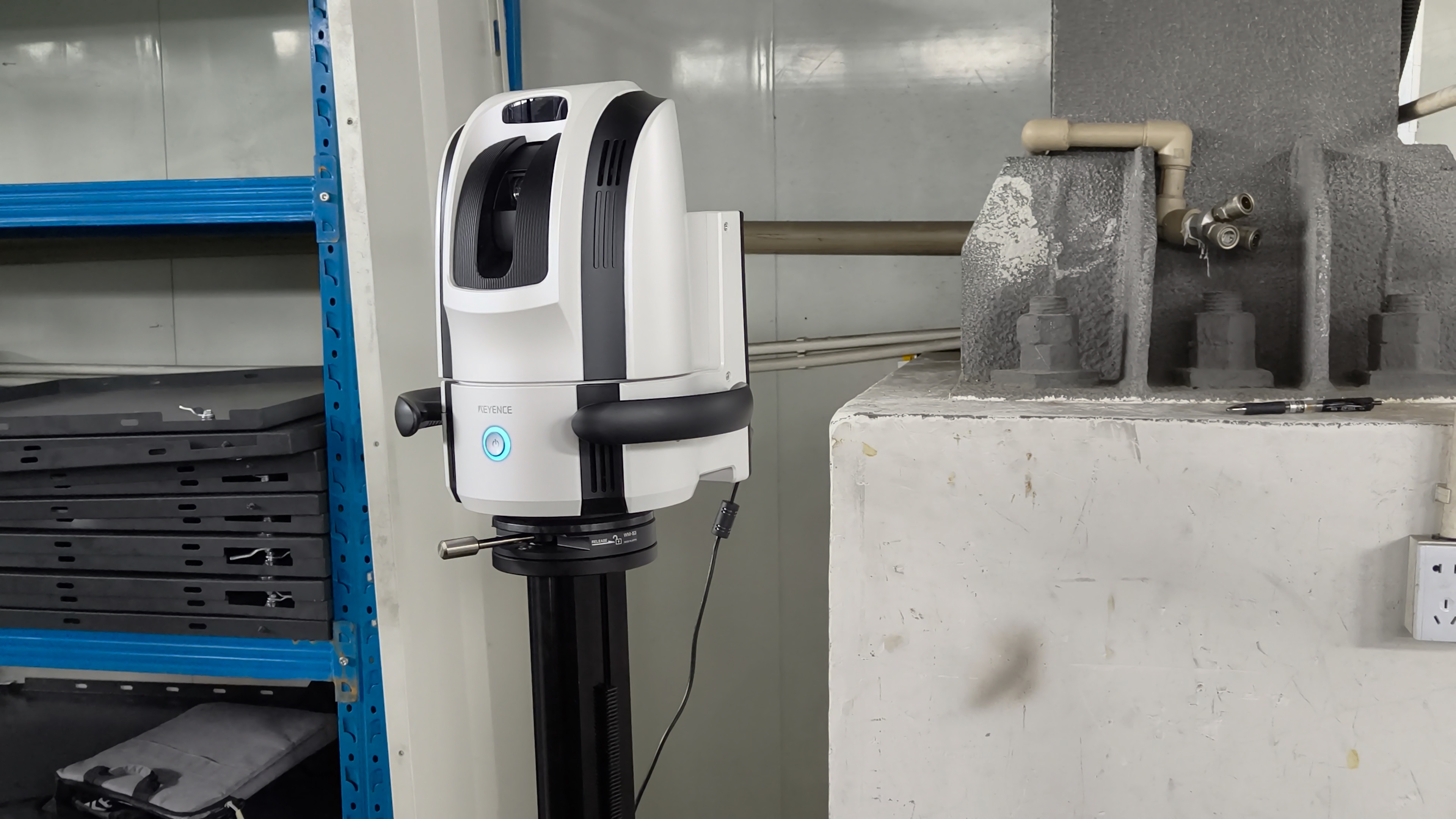
The second is the diagnostic structure. Because mold engineering, machine engineering and process engineering sit within one organization, a production problem can be analyzed by the three functions together to establish whether the cause is the product structure, the mold, the equipment, the raw material or the production process. That is the practical meaning of "in-house": not simply that the mold is machined internally, but that no third party has to be convened before a diagnosis can begin. Delivery inspection points in the same system, including portable coordinate measuring inspection of dimensions and installation surfaces, support the same logic on the quality side.
Where Mold Control Actually Shows Up in Production
Mold quality is usually described in general terms. In practice it shows up in three measurable places.
Dewatering and vacuum behavior
Forming removes water through the mold under vacuum. Published machine parameters place forming vacuum in the range of −0.06 to −0.05 MPa, with high-pressure mold-cleaning water at 1.2 MPa, and published maximum product weight per mold is stated at 0.3% slurry concentration. Those are machine-side reference points; what the mold decides is how uniformly that vacuum reaches every cavity.
The risk is well documented in pulp molding. A single-cavity or low-cavity sampling mold can perform acceptably, while a multi-cavity production mold develops uneven slurry distribution, after which product weight and dimensions vary from cavity to cavity. The step from a 600 × 470 mm sampling platen on the ZAMS-6047 to a 1,100 × 1,100 mm production platen on the tableware platforms is not a scaled drawing exercise. It is a dewatering redesign.
Heating uniformity and pressure matching
Hot pressing transfers heat and pressure through the mold into the product. The platforms in Hanson's range span a wide band: 13 tons of hot-pressing pressure on the ZAMS-6047 sampling line, 20 tons on the compact ZAD-8565, 40 tons on the ZAP-9585 and the ZAKS-9595 cup lid line, 60 tons on the ZCE-1111, 80 tons on the ZBG-1111 and 120 tons on the ZFG-1111. Heating power scales with the platform as well — for example, 45 kW of heating power within the 54.1 kW installed power of the ZAD-8565, and a 132 kW heating plate within the 167.4 kW rated power of the ZCE-1111.
Uniform temperature across a large platen and even pressure distribution across a multi-cavity mold are a paired problem. The mold structure and the heating plate have to be designed against each other. When they are designed by different parties, that interface becomes a negotiation rather than an engineering decision — and the symptoms, such as cavity-to-cavity color and density variation or localized deformation, are difficult to attribute afterwards.
Cycle stability and multi-cavity balance
Stable cycles depend on reliable dewatering, reliable demolding and stable product transfer. Published forming cycles for the ZCE-1111 fall between 28 and 60 seconds per mold depending on the product, and the ZAKS-9595 trimming module is rated at a 10-second trimming cycle per mold. Achievable output across a shift is decided by whether those cycles hold, or whether operators are compensating for mold blockage, temperature fluctuation or unstable transfer.
| Model | Mold platen size | Hot-pressing pressure | Max. product weight per mold |
|---|---|---|---|
| ZAMS-6047 sampling line | 600 × 470 mm | 13 t | 200 g at 0.3% slurry concentration |
| ZAD-8565 industrial packaging | 850 × 650 mm | 20 t | 500 g at 0.3% slurry concentration |
| ZAP-9585 industrial packaging | 950 × 850 mm | 40 t | 900 g at 0.3% slurry concentration |
| ZAKS-9595 cup lid line | 950 × 950 mm (forming) | 40 t | 500 g at 0.3% slurry concentration |
| ZCE-1111 tableware integrated | 1,100 × 1,100 mm | 60 t | 550 g |
| ZBG-1111 tableware line | 1,100 × 1,100 mm | 80 t | 550 g |
| ZFG-1111 tableware line | 1,100 × 1,100 mm | 120 t | 550 g |
Published platform parameters from Hanson's product documentation. Forming, hot-pressing and trimming pressures are stated separately per platform; mold design must be validated against the specific platform and product.
Where the Integrated Model Is Visible in Project Records
Capability claims are best tested against delivered projects. Across Hanson's customer record, mold and product development work appears repeatedly as the entry point of a project rather than an afterthought.
- New product development without an existing standard solution. For Shengquan Group, a listed biomass materials manufacturer, Hanson developed customized equipment for a product that had no existing standard solution and supported approximately seven months of trial production before full project cooperation, combining a sampling line for R&D with the ZBG-1111 fully servo tableware production line.
- Material-driven mold work. For Anhui Fengyuan, a bio-based materials manufacturer, equipment was customized around bio-based fiber materials, including slurry compatibility optimization and low-energy process design, supporting the transition from laboratory validation to pilot-scale production across six units.
- Large-volume tableware and packaging. Guangxi Qiaowang, a state-owned molded fiber manufacturer, took delivery of 32 customized core production machines for a 40,000-ton-per-year project, with annual capacity rising from approximately 6,000 to 16,000 tons. In Vietnam, Gaoyi Packaging started from a single trial machine and expanded to a total of 80 industrial packaging machines, while Tonglibo placed five procurement rounds in approximately two years on the ZAD-8565 platform.
- Cup lid precision work. A strategic cooperation covering 100 cup lid machines included a customized cup lid production solution with modular mold design and digital energy-consumption control, integrating forming, hot pressing, trimming, vision inspection and packing.
- Turnkey factory projects. For Hunan Linggao, a bamboo-fiber packaging manufacturer, Hanson provided a turnkey solution covering factory planning, pulp preparation, customized forming equipment, wastewater treatment and personnel training, progressing from installation to trial production in approximately three months. Home-Link in Thailand purchased more than 100 machines for the first phase of its production base after a four-month equipment performance test, with turnkey support covering pulp preparation, forming equipment and mold development.
The pattern is consistent: where product structure, fiber and mold had to change together, the mold work was carried out inside the equipment project rather than handed to a separate supply chain.
In-House Mold Division vs Outsourced Mold Supply: A Working Comparison
| Decision dimension | Integrated in-house mold division | Outsourced mold supply |
|---|---|---|
| Design feedback loop | Mold design and machine design reviewed by one engineering organization | Mold design works from a drawing and interface specification supplied by the machine vendor |
| Problem attribution | Mold, machine and process teams diagnose a fault jointly | Buyer coordinates between suppliers before a root cause is agreed |
| Iteration after sampling | Sampling mold, production mold and machine tuning follow one sequence | Re-briefing or re-tendering may be required between stages |
| Raw material changes | Pulp formulation, mold structure and forming parameters adjusted together | Mold changes may be requested against a formulation the mold vendor did not test |
| Existing mold and machine work | Existing-mold optimization and machine retrofit available from the same team | Depends on the original mold maker and machine vendor cooperating |
| Commercial leverage | Mold and machine performance carry one warranty discussion | Competitive tendering can lower the cost per mold |
Where the integrated model does not decide the outcome
Three boundaries are worth stating plainly.
First, an in-house mold division does not remove the need for validation. A successful sample proves only that a product can be formed under one combination of material, mold and process parameters. Mass-production equipment may have a different platen size, cavity count, slurry-feeding method, cycle time, temperature distribution and transfer system. A mass-production manufacturability evaluation, a production mold design and a continuous trial remain necessary. Buyers should treat any claim that sampling success equals mass-production readiness as incomplete.
Second, mold optimization results are conditional. In many projects, improved mold layout, drainage, vacuum distribution, heating and transfer have improved production capacity and product yield — but the actual result depends on the existing machine, mold, product and process. Retrofit is an evaluation outcome, not a guaranteed percentage, and it should be scoped before it is promised.
Third, the integrated model is not the right answer for every buyer. Customers who already operate a mature pulp preparation system, stable utilities and an experienced internal engineering team may be well served by purchasing individual machines and using their own established mold suppliers. For standard, low-mix products that have been in production for years, mold design differentiation is limited, and the sourcing decision should rest on lead time, service coverage and cost rather than on integration.
Market Direction: More Machines, More Mold Engineering
Market growth strengthens the case for treating mold capability as a supplier-selection criterion rather than a detail. The global pulp moulding machines market was valued at USD 2,140.0 million in 2024 and is projected to reach USD 3,760.2 million by 2032. Published estimates vary between research providers, largely because some reports include paper-making machinery more broadly under the same heading, so the figure should be read together with its stated product scope rather than as a single consensus number.
Demand composition points in the same direction. Food and beverage packaging accounts for approximately 45% of global demand for pulp moulding machines, with cup, tray and bowl formats leading — the categories where dimensional accuracy, surface quality and multi-cavity consistency are least forgiving, and where mold engineering carries the most weight.
Trade data adds a second signal. China's exports of machinery for making paper or paperboard under HS 843920 were valued at USD 49.58 million in 2024, and equipment from Chinese manufacturers now competes in markets where documentation and compliance evidence are part of the purchase decision. Hanson holds two Machinery Directive Attestations of Conformity issued by UDEM: certificate M.2025.206.C130486 for ZFG series pulp molding equipment, covering models ZFG-1111, ZFD-8565, ZFM-9894 and ZFH-1311 under 2006/42/EC, EN ISO 12100:2010 and EN 60204-1:2018/A1:2025, valid from 1 December 2025 to 30 November 2030; and certificate M.2026.206.C142039 for pulp molding industrial packaging equipment including the ZAD-8565, ZAP-9585, ZAD-1070, ZDA-9585, ZAC-8565, ZDK-1010, ZAB-9585 and ZAB-1070 models, valid from 5 June 2026 to 4 June 2031. Buyers specifying EU machinery should also track the control-system safety standard transition: EN ISO 13849-1:2023 supersedes the 2015 version, which is withdrawn after a transition period ending 15 May 2027.
What to Watch Next
Three shifts are visible in the project record rather than in forecasts.
Mold engineering is becoming a larger share of per-machine value. As molded fiber moves into premium industrial packaging, plant-fiber cup lids and higher-accuracy tableware, the differences between machines narrow and the differences between molds widen. That favors suppliers able to show mold work as evidence rather than as a claim.
Fiber diversity is forcing mold and process co-development. Bagasse, bamboo, wood, straw, recycled and mixed plant-fiber pulps differ in fiber length, drainage, cleanliness and surface behavior, which affects refining, slurry concentration, dewatering time, wet-preform strength and hot-pressing parameters. A mold designed against one fiber system rarely transfers unchanged to another, which is why sampling and process verification are recommended before production molds and mass-production equipment are finalized.
Sampling is becoming a standard first step rather than an optional one. The ZAMS-6047 sampling line, which combines pulping, refining, slurry preparation, slurry feeding, forming and hot pressing for multiple fiber systems, appears in Hanson's delivery record with customers including GMN for nanocellulose additive development, YUTO Packaging, Anhui Fengyuan and Jinsun — a sign that buyers increasingly want product and mold validation before committing capital to mass-production equipment.
Frequently Asked Questions
What mold services does Hanson provide, and can existing molds or existing machines be optimized?
Hanson operates an independent mold division covering product development, product-structure evaluation, mold design, mold manufacturing, mold testing and mass-production adaptation. The division also evaluates existing molds — layout, dewatering structure, vacuum distribution, hot-pressing structure, transfer performance and demolding conditions — and can retrofit existing machines. Existing-mold optimization may address low capacity, unstable product weight, deformation, dimensional deviation, poor surface quality, low dewatering efficiency, long hot-pressing cycles and unstable demolding. Whether a specific line benefits depends on the machine, the mold, the product and the existing process, and is established through evaluation rather than assumed.
When quality or capacity problems appear, how is the cause identified?
The first step is separating the variables: product structure, mold, equipment, raw material and production process. Hanson's mold, machine and process teams analyze these together, because a dewatering problem can originate in mold drainage, vacuum supply or slurry consistency, while a dimensional problem can originate in hot-pressing uniformity, transfer stability or fiber formulation. The information that shortens this process is mold drawings, product samples, machine model, current production cycle, capacity, yield rate, recorded process parameters and photographs or video of the production problem.
Why can a product pass sampling and still fail in mass production?
Sampling proves basic forming feasibility under one specific combination of material, mold and process parameters. A production machine may have a different platen size, mold layout, slurry-feeding method, cycle time, temperature distribution, wet-preform transfer system and continuous operating condition. Documented failure modes include uneven slurry distribution on a multi-cavity production mold, cavity-to-cavity weight and dimension variation, insufficient dewatering at a faster cycle, mold blockage or temperature fluctuation during continuous running, and manual adjustments used during sampling that cannot be maintained at production speed. A mass-production manufacturability evaluation, a production mold and a continuous production trial remain necessary after successful sampling.
How can a buyer verify that a supplier's mold capability is genuinely in-house?
Four checks are practical: access to the machining floor where molds are produced; the mold engineering team and its role in machine design; mold test records showing verification under real slurry and cycle conditions; and customer projects where an existing mold was optimized or a machine retrofitted rather than replaced. A supplier that can sell a main machine but outsources molds, pulp preparation and integration work leaves the buyer to coordinate several parties if production problems appear, and the responsibility boundary may be unclear at exactly the moment it matters most.
Can a mold supplied by another manufacturer be used on Hanson equipment?
Yes, subject to a technical evaluation of mold dimensions, interfaces, transfer structure and compatibility with the machine. That evaluation establishes whether the mold can be used as supplied, requires modification, or is incompatible with the machine's transfer and hot-pressing configuration. The same evaluation logic applies when a new machine is connected to an existing pulp preparation system, where process flow, pulp concentration, flow rate, tank capacity, pipeline interfaces and control information are reviewed first.
Should a buyer choose individual machines or a turnkey solution, and how does mold scope affect that decision?
A turnkey solution is generally recommended for new factories, overseas projects and customers without an experienced pulp molding engineering team, and it can include factory planning, pulp preparation, forming equipment, molds, downstream automation, electrical control, installation, commissioning, training and production ramp-up support. Individual machine purchase is more suitable for manufacturers that already operate mature pulp preparation, process, utility and production-management systems, and that have established mold supply. In both cases, the scope document should state in writing who is responsible for the mold, the pulp preparation system, utilities, downstream automation and production ramp-up.
Reference Note
Hanson Pulp Molding's company and product brochure, covering equipment platforms, turnkey project scope and service coverage, is available for download at Hanson Pulp Molding brochure (PDF).