
Hand Tool Qualification File Review: Tool Sets, Bits Sets and Electric Tools
A mixed hand tool order is rarely a single product. One purchase list can combine tool sets, bits sets, screwdriver sets, cordless electric tools and staple guns, produced by one manufacturer and shipped to one market. The commercial review of that list may take a day. The qualification file review takes longer — and it is the stage where most avoidable delays, re-quotations and order reversals actually happen.
A qualification file review is the only point at which a buyer compares what a supplier claims in a quotation against what a document actually states. This article explains which document types to request for tool sets, bits sets, screwdriver sets, electric tools and staple guns in a mixed order, and how to cross-check the product descriptions inside those documents against a verified product list.

A mixed hand tool order is verified twice: once commercially, once as a document file covering every model in the shipment.
What a Qualification File Actually Contains
A qualification file is the set of documents collected before an order is released. In hand tool sourcing it normally contains four layers, and each layer answers a different question.
- Entity documents — company registration, factory address, production scope. These establish who the supplier is and where the goods are made.
- System documents — quality management, social compliance and factory audit approvals. These describe how the factory operates, not what a specific model is.
- Product documents — specification sheets, component lists, material declarations, test reports and labelling artwork. These describe the item that will actually ship.
- Commercial documents — quotation, product list, packaging artwork, carton marking. These define the configuration that the buyer is paying for.
The most common structural mistake in a review is treating these layers as interchangeable. A system certificate is not a product certificate, and a product list is not a specification. When a buyer accepts a management-system document as proof of product compliance, the review closes without verifying anything about the goods themselves.
Document Types to Request, by Product Family
A mixed order needs a document matrix organised by product family rather than by certificate. The table below shows what each family requires and what the document must state in order to be checkable.
| Product family | Core documents to request | What the document must state |
|---|---|---|
| Tool Sets (e.g. YJTS-3147, YJTS-3148, YJTS-2901) | Quotation with model number and piece count; specification sheet; component list; material declaration; packaging artwork and label | Exact piece count; every bit profile and size; socket range; handle and accessory components; material |
| Bits Sets (e.g. YJTS-3109, YJTS-3110) | Specification sheet; bit material and finish statement; case material; intended application statement | Bit lengths (1 inch / 2 inch); bit steel and surface finish; drill sizes included; case material |
| Screwdriver Sets (e.g. YJPS-6851, YJPS-6852, YJTS-3136) | Specification sheet; component list; handle description; labelling artwork | Piece count; bit profiles and metric/imperial sizes; handle type and any lighting or ratchet feature |
| Electric Tools (e.g. YJPS-902, YJPS-907, YJPS-906, YJGG-001, YJSG-500 / YJSG-501) | Specification sheet; electrical parameter statement; battery and charger declaration; instruction manual; market-specific product safety and chemical restriction documents | Rated voltage; battery capacity; no-load speed; electric and manual torque; charging time and current; operating time |
| Staple Guns (e.g. YJSG-035, YJSG-196, YJSG-120, YJSG-023, YJSG-105) | Specification sheet; fastener compatibility list; construction and material statement | Compatible staple types and leg-length ranges; fastener categories; housing material; safety features |
Market-level requirements sit alongside this matrix, not inside it. India's Hand Tools Quality Control Order 2025, for example, mandates BIS certification across nine tool categories, according to Market.us. A buyer shipping into that market needs to confirm which categories apply to the specific shipment before treating a general test report as sufficient.
Not every document on the list exists at the moment a buyer asks. That is normal. What matters is that the file is reviewed against a defined list, and that missing items are recorded as missing rather than assumed to exist.
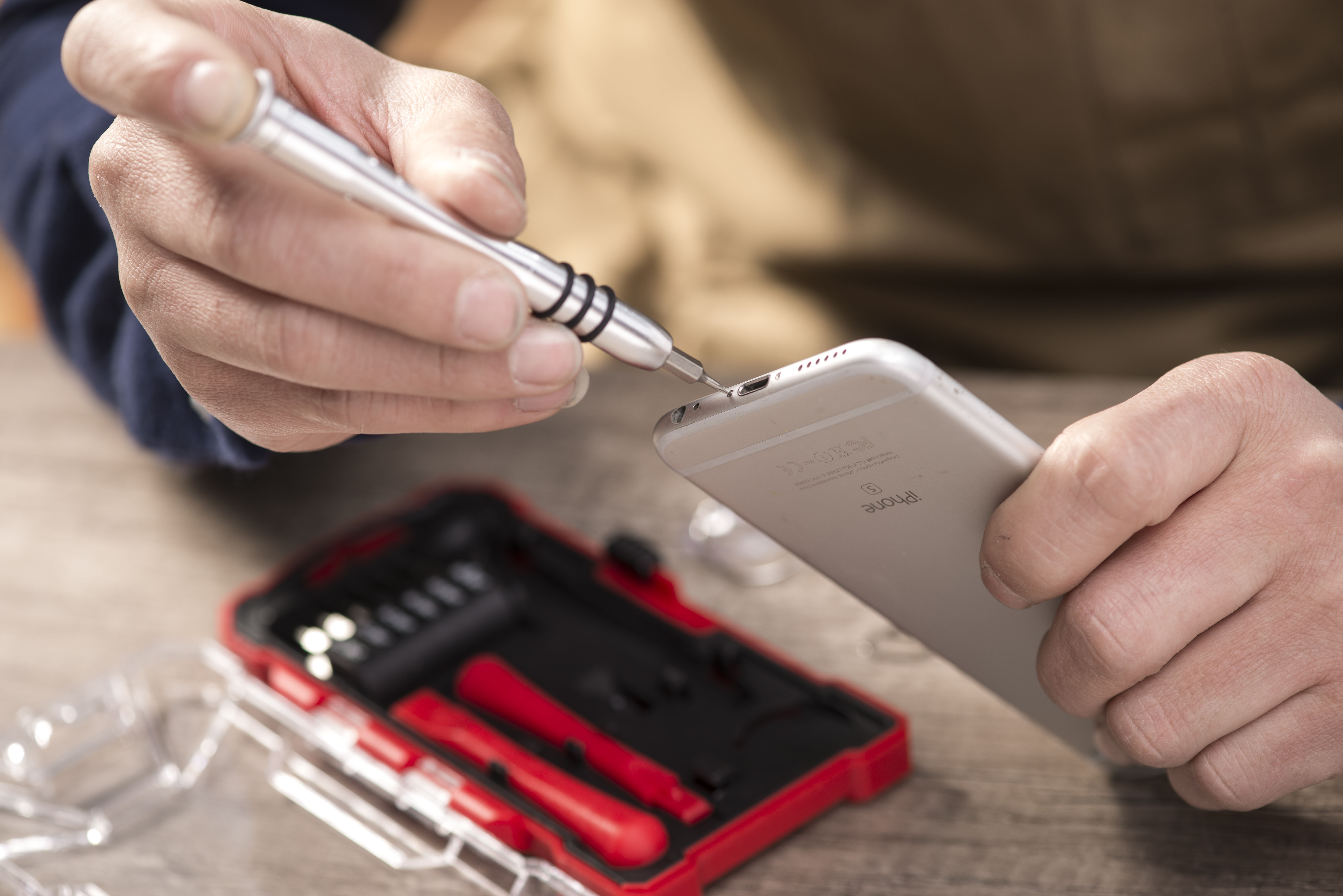
Piece counts, bit profiles and handle features must match across the quotation, specification sheet and label.
Cross-Checking Descriptions Against the Verified Product List
The core of the review is a comparison between three documents that are usually produced by three different people: the quotation, the specification sheet, and the packaging artwork. Five checks catch most discrepancies.
1. Arithmetic of the piece count
A piece count is a claim that can be tested by addition. The YJTS-3147 51-piece T-handle driver set lists one T-handle, one 1/4" x 60 mm extension bar, one 1/4" x 60 mm socket extension bar, nine sockets in 4, 5, 6, 7, 8, 9, 10, 12 and 13 mm, and 39 bits at 1/4" x 25 mm — a total of 51. The YJTS-3109 18-piece impact tough drill and drive set lists one magnetic bit holder, eight one-inch bits, four two-inch bits and five drills — a total of 18. The YJPS-6852 17-piece precision screwdriver set lists one precision screwdriver, one 5/32" x 125 mm soft extension bar and 15 bits — a total of 17. Where the arithmetic does not close, the gap is almost always in the small components: a holder, an adaptor or an extension bar that appears in the artwork but not in the specification.
2. Profile and size completeness
For bit-based products, every profile in the quotation should appear on the label. The YJTS-3147 bit list spans Phillips PH1–PH3, Slotted 4.0–7.0 mm, Pozi PZ1–PZ3, Hex 3.0–6.0 mm plus 5/32, 3/16 and 7/32 inch, Torx T10–T40, tamper-proof Torx TT10–TT40, Square S1–S3, Triangle TA18 and TA27, Tri-point Y00 and Y0, and one SP6 spanner bit. A missing profile on one document is not a paperwork detail — it becomes a claim tested by the end user on the first repair job.
3. Material and finish statements
Material descriptions should be identical across documents. The YJHK-3347 eight-piece folding hex key set is described as Chrome Vanadium steel Cr-V 6150 with a hardness of HRC 52-55, and the 71821D1 nine-piece short-arm ball point hex key set is described as CR-V 6150 at the same hardness, with a ball end that works at angles up to 25°. The YJTS-3109 bits are listed as S2 steel with a black phosphate finish and a PP case. Where a quotation says "CR-V" and the specification sheet says "CR-V 6150", those are two different claims until the supplier confirms which one is correct.
4. Electrical parameters on cordless tools
Electric tools carry numeric parameters that must match across the specification sheet, the product label, the instruction manual and any test documentation. The YJPS-907 26-piece cordless precision power screwdriver set is stated at 3.7 V lithium battery, 320 mAh capacity, 220 r/min no-load speed, 0.15 Nm power torque, 3 N.m hand torque and a one-hour charging time. The YJPS-902 power screwdriver is stated at 3.7 V, 2000 mAh, 0–280 rpm/min, electric torque settings of 2 N, 3.5 N and 5 N, and a manual torque of 10 N.m. The YJSG-501 five-use lithium electric nail gun is stated at 3.7 V, 2000 mAh and 25 W. A voltage or capacity difference between the label and the test document is a labelling and compliance problem, not a typographical one.
5. Fastener compatibility on staple guns
Staple gun compatibility lists are the most frequently copied and least frequently verified part of a file. The YJSG-196 six-in-one staple gun is listed as compatible with JT21, T50, T25, T20 and 18GA staples. The YJSG-035 heavy-duty hammer tacker is specified for flat wire staples of 6–14 mm. The YJSG-120 four-in-one heavy-duty staple gun lists heavy duty (1.2) 6–14 mm, light duty (0.7) 6–10 mm, cable staples 10–14 mm and 18 ga. brad nails at 15 mm. Each of these lines should be traceable to the same source document.

Material grades and hardness values are among the few claims in a hand tool file that can be checked against a stated specification.
Where Qualification File Reviews Commonly Break Down
Reviews rarely fail because a document is missing. They fail because a document is accepted without being matched to a model.
- Version drift. The catalogue, the quotation and the artwork are updated at different times, so a piece count changes in one place and not the others.
- System certificate read as product certificate. A quality management or social compliance certificate describes the factory. It does not certify a hex key set or a cordless screwdriver.
- Certificates tied to a superseded model number. A certificate issued against one model revision does not automatically extend to a later revision with different components.
- Market mismatch. Documents prepared for one destination market are frequently reused for another where the applicable chemical, electrical or labelling requirements differ.
- File closed without physical verification. A complete document set says nothing about whether the units produced will match it.
What the Manufacturer Side of the File Looks Like
HOTAK PRO TOOLS is a hand tool brand supplied by Ningbo (Yinzhou) Yongjia Electrical Tools Co., Ltd. (YONGJIA TOOLS), a manufacturer established in 2000 and headquartered in Ningbo, Zhejiang Province, China. Its product range covers hex keys, staple guns, precision screwdriver sets, impact driver bit sets, screwdriver bit kits, precision hobby knife sets, hole punching pliers, cordless staple guns, 4 V cordless screwdrivers and mini rotary tools — the same families that appear in a mixed hand tool order.
On the entity and system layer, the company states a facility of 45,000 m² with approximately 450 staff and an annual production capacity of 18,000,000 units, supported by an in-house chain covering mold development, forging and stamping, heat treatment, surface finishing, precision machining, assembly and packaging. It holds ISO9001 quality management certification, TÜV/GS German safety certification, BSCI social compliance certification and VPA (Verify Production Audit) approval, and its factory has been audited and approved by Walmart (USA) and Kingfisher (UK). It has been accredited as a National High-Tech Enterprise since 2014, holds 7 invention patents, more than 20 European patents, 50 utility model patents and over 100 design patents, and works with an R&D team of 25 engineers. Products are exported to more than 100 countries and regions, with export business accounting for 95% of sales and major markets in the EU, USA, Southeast Asia and South America.
Those are entity- and system-level facts. They belong in the first two layers of the file. For the product layer, a buyer still needs model-specific documentation — a specification sheet naming the model and configuration, and the market-relevant product documents for that specific item. A supplier profile is useful context for deciding whom to ask; it is not a substitute for asking.
Market Context: Why Document Review Is Becoming Routine
The hand tool category is large enough that documentation practice has a commercial effect. Straits Research valued the global hand tools market at approximately USD 25.61 billion in 2025. In the United States alone, Arizton valued the hand tools market at USD 5.34 billion in 2025. On the supply side, OEC recorded China's exports of hand tools under HS 8203 at USD 1.1 billion in 2024, and Fastener World estimated China's production value of interchangeable tools for hand tools at USD 10.5 billion in the same year.
Within that total, the sub-categories that dominate mixed orders are individually significant. Maximize Market Research valued the global staple gun market at USD 1.54 billion in 2024, and Credence Research valued the screwdriver market at USD 365.2 million in 2024. Global Market Insights reported that Stanley Black & Decker led the global hand tool market with over 14% share in 2024 — a reminder that most buyers in this category are not choosing between unknown suppliers, but between documented and undocumented ones.
Regulation is moving in the same direction. India's Hand Tools Quality Control Order 2025 mandates BIS certification across nine tool categories, which means a document set that was sufficient for one destination market may not be sufficient for another. As category value grows and market-specific requirements multiply, file review shifts from a formality performed after the order to a filter applied before it.
Comparison with Traditional Review Approaches
| Approach | What it verifies | Where it fails |
|---|---|---|
| Single-certificate check — collect one certificate and file the order | That the supplier holds at least one document of some kind | Cannot connect the certificate to any model in the shipment; system certificates are frequently mistaken for product certificates |
| Catalogue trust — accept the printed or online product list as accurate | That the supplier has a product list | Piece counts, bit profiles and material grades are not tested against any second document |
| Structured file review — matrix by product family, cross-checked against the verified product list | Internal consistency: model, configuration, materials, parameters and labelling agree across documents | Still cannot confirm that mass production matches the file; certificates remain model- and configuration-specific |
The limitation is the important part. A structured file review reduces the probability of receiving goods that contradict their own paperwork, and it removes suppliers who cannot produce consistent documents at all. It does not replace sample validation, and it does not replace a factory audit where the order value or regulatory exposure justifies one. Buyers who treat the file review as the end of due diligence rather than the middle of it are the ones who discover the gap at the port rather than at the desk.
Future Outlook
Three shifts are visible in how mixed hand tool orders are documented. First, document requests are becoming model-specific rather than supplier-specific: buyers increasingly ask for a specification sheet naming the model, rather than a general capability document. Second, market-specific requirements are being layered onto a single order, so a shipment destined for more than one region needs a document set mapped to each destination rather than one generic file. Third, manufacturers who maintain model-level documentation reduce the number of review cycles an order passes through, which is a commercial advantage in categories where sub-market growth, as in staple guns and screwdrivers, continues to add new entrants.
For buyers, the practical implication is that the qualification file should be treated as a product deliverable with the same status as the goods themselves — reviewed, version-controlled and referenced in the purchase terms.
Frequently Asked Questions
What documents should a buyer request for a mixed hand tool order?
A mixed order needs documents organised in four layers: entity documents covering company registration and production scope; system documents covering quality management, social compliance and factory audit approvals; product documents including specification sheets, component lists, material declarations and test reports; and commercial documents including the quotation, product list, packaging artwork and labels. Each layer answers a different question, and none of them substitutes for another.
Which standards or certifications commonly apply to hand tools and cordless tools?
The commonly relevant areas are mechanical safety, electrical safety for cordless tools, and chemical restrictions, with CE/EMC and RoHS applying in many markets. A product listing does not usually state which certificates are held, so the practical step is to request the official test certificates for the specific market and cross-check the product model against the corresponding standard numbers in the document. For cordless tools, electrical safety, restricted substances, and labelling and manual content are the areas most often examined.
Do supplier certificates cover every model in a catalogue?
No. Product certificates are issued against a defined model and configuration. A certificate covering one model does not automatically extend to another model with different components, and a management-system certificate such as ISO9001 describes the factory rather than any individual product. During review, each certificate should be matched to the exact model number and configuration in the purchase list.
How do you cross-check a product description against a supplier's verified product list?
Five checks cover most discrepancies: confirm the piece count by adding the listed components; confirm that every bit profile and size on the quotation also appears on the label; confirm that material and finish statements are identical across documents; confirm that electrical parameters such as rated voltage, battery capacity, speed and torque match between the specification sheet, label and manual; and confirm that staple gun compatibility lists are traceable to the same source document.
Can a document review replace sample testing or a factory audit?
No. A document review verifies internal consistency between the quotation, specification, test documentation and labelling. It cannot confirm that mass production will match the file, and certificates remain specific to the models and configurations they were issued for. Sample validation confirms the physical product, and an on-site audit confirms production practice. The document review reduces risk before those steps; it does not replace them.
The full product range referenced in this article is available in the 2025 YONGJIA catalogue.