
Hand-Sewn Cashmere Coat vs High-End Rivals: Buyer Verdict
Hand-Sewn Cashmere Coat vs High-End Rivals: Buyer Verdict
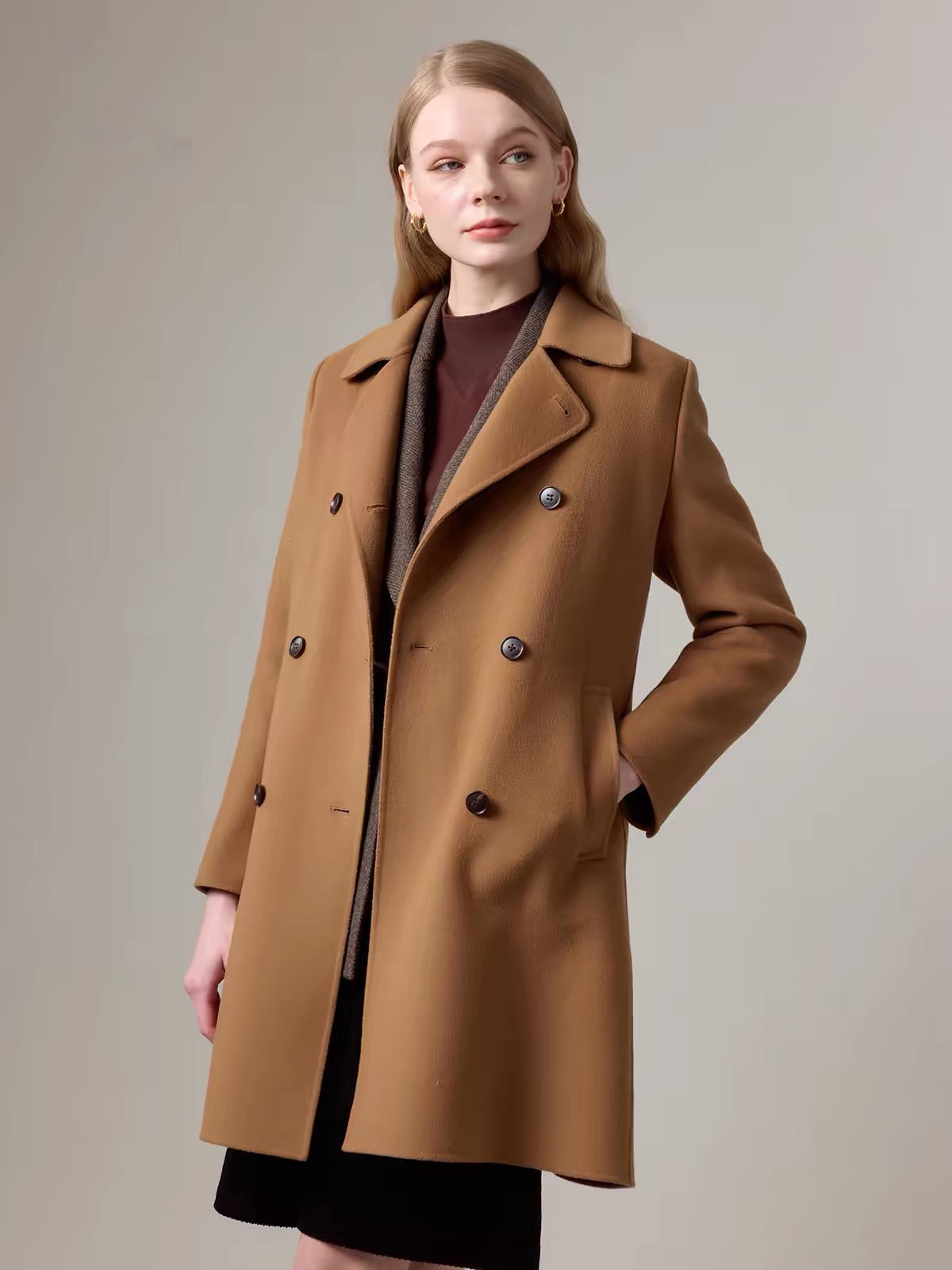
Cover: a hand-sewn women's cashmere coat, shown as an industry reference for decision-stage buyers.
The hand-sewn women's cashmere coat and the high-end hand-sewn coats it competes with are rarely separated by the word “hand-sewn”. They are separated by what each side can document: fibre content, fabric weight in grams per square metre, which seams are stitched by hand, which fit architecture the coat was cut for, and what the purchase terms say happens when bulk misses those numbers. The comparison data supplied for the hand-sewn 100% pure cashmere coat records 450 g/m² against 320 g/m² for an ordinary cashmere coat, higher warmth retention and better cold resistance, a fit with cold-climate daily wear and formal occasion outfits, and a production cost recorded 22% lower. None of that data describes the rivals. This verdict therefore builds the decision on five acceptance filters a buyer can test in a sample room, and marks where the hand-sewn pure cashmere option is the right purchase and where it is not.
The short answer for a decision-stage buyer
Buy the hand-sewn 100% pure cashmere coat when three conditions hold at the same time: the garment is documented at 450 g/m² in pure cashmere, the hand-sewn claim is mapped to named seam zones and confirmed on a sealed sample, and the purchase order carries acceptance terms for fibre content, measurements, workmanship and delivery. Remove any one of those conditions and the label stops doing the work; the coat becomes a sample-room judgement with no repeatable standard behind it.
The supplied comparison is directional but narrow. It measures the coat against an ordinary cashmere coat at 320 g/m² and records higher warmth retention, better cold resistance, slower fabric aging and a production cost 22% lower. It does not measure the coat against a high-end rival. A rival hand-sewn coat may carry a heavier shell, a denser stitch pattern, a different fibre lot or a more generous trim package, and none of those possibilities can be settled by reading a label. The verdict this article supports is conditional and testable rather than absolute.
Five filters carry most of the decision: fibre identity and construction type; fabric weight and warmth read against garment length; verifiable hand-stitch zones; fit architecture; and the commercial basis behind cost and acceptance terms. Each filter converts a marketing word into a line item a buyer can accept or reject.
What the buyer is actually deciding
Three decisions sit inside one purchase order, and they fail separately. The first is specification: what the coat is made of, how heavy the shell is, and how it is finished. The second is repeatability: whether the supplier can reproduce the approved sample across a production run of hundreds or thousands of units. The third is terms: what the contract says when bulk deviates from the sample, who pays for the deviation, and how quickly it is corrected. A coat can pass the first and fail the second, which is why a strong sample alone is not a purchasing decision.
- Specification — fibre percentage, fabric weight, construction, fit architecture and trim.
- Repeatability — sealed sample, measurement chart, stitch-zone standard and capacity reserved for the delivery window.
- Terms — tolerances, defect classes, rework or replacement remedies, inspection method and payment linkage.
This verdict covers the women's cashmere coat only. WOMEN'S WOOL COAT and WOMEN'S ONEPIECE appear here as adjacent categories for buyer context: a wool coat sits in a different fibre tier with its own hand-feel and price logic, and a one-piece is a different garment role rather than a substitute. Neither should inherit the acceptance criteria written for a cashmere coat, and the cashmere verdict should not be reused for them.
Filter 1 — Fibre identity and construction type
“Cashmere coat” is a category label, not a composition. The two claims that decide the purchase are the fibre percentage and the construction method, and both belong in writing. A 100% pure cashmere coat and a wool cashmere blend coat can look similar on a rail while behaving differently in wear, weight and cost; the blend share determines how much of the cashmere character survives into the garment. Ask for fibre percentages by component with a supporting test report, and put the accepted percentages in the purchase order rather than in an email thread.
Construction is the second half of the same clause. Double-faced cashmere joins two finished faces without a lining, and hand-sewn finishing closes the edges and joins the panels. The supplied comparison pairs “100% pure cashmere” with “full hand-sewn craftsmanship” as a single difference, which is precisely how the two get blurred in a sales conversation. Split them in your documentation: one clause for fibre, one clause listing the zones that must be hand-finished. A coat can be honestly 100% cashmere and only partly hand-finished, and the buyer who did not separate the clauses has no remedy for the gap.
Filter 2 — Fabric weight, warmth and the length equation
Weight is the number most often quoted and least often matched to a garment. The supplied comparison states 450 g/m² for the hand-sewn pure cashmere coat against 320 g/m² for an ordinary cashmere coat, a 130 g/m² difference in shell density. That is a fabric figure, not a garment figure. Ask for both the shell weight in g/m² and the net weight of the approved garment in the base size, because the second is what a customer lifts off the rail.
Length changes the equation. A typical cashmere coat contains 600–1,200 grams of fabric depending on length and design, according to a 2026 commercial research report from Business Research Insights. The range is wide because it measures material consumption rather than warmth: a maxi long coat cut from a 450 g/m² shell and a short cropped coat cut from the same shell sit at opposite ends of that range while sharing an identical fabric weight. For a buying decision, that means a maxi and a cropped style in the same programme carry different cost and different warmth, even when the fabric specification is unchanged.
Keep the warmth claim inside its scope. The comparison data records higher warmth retention and better cold resistance than the ordinary 320 g/m² coat, and lists cold-climate daily wear and formal occasion outfits as the fit. It does not establish that 450 g/m² is the right density for a transitional or lightweight thin assortment, where a lighter shell may suit the layering behaviour of the market better. Heavier is a specification, not a verdict.
Filter 3 — Hand-stitch verification in the sample room
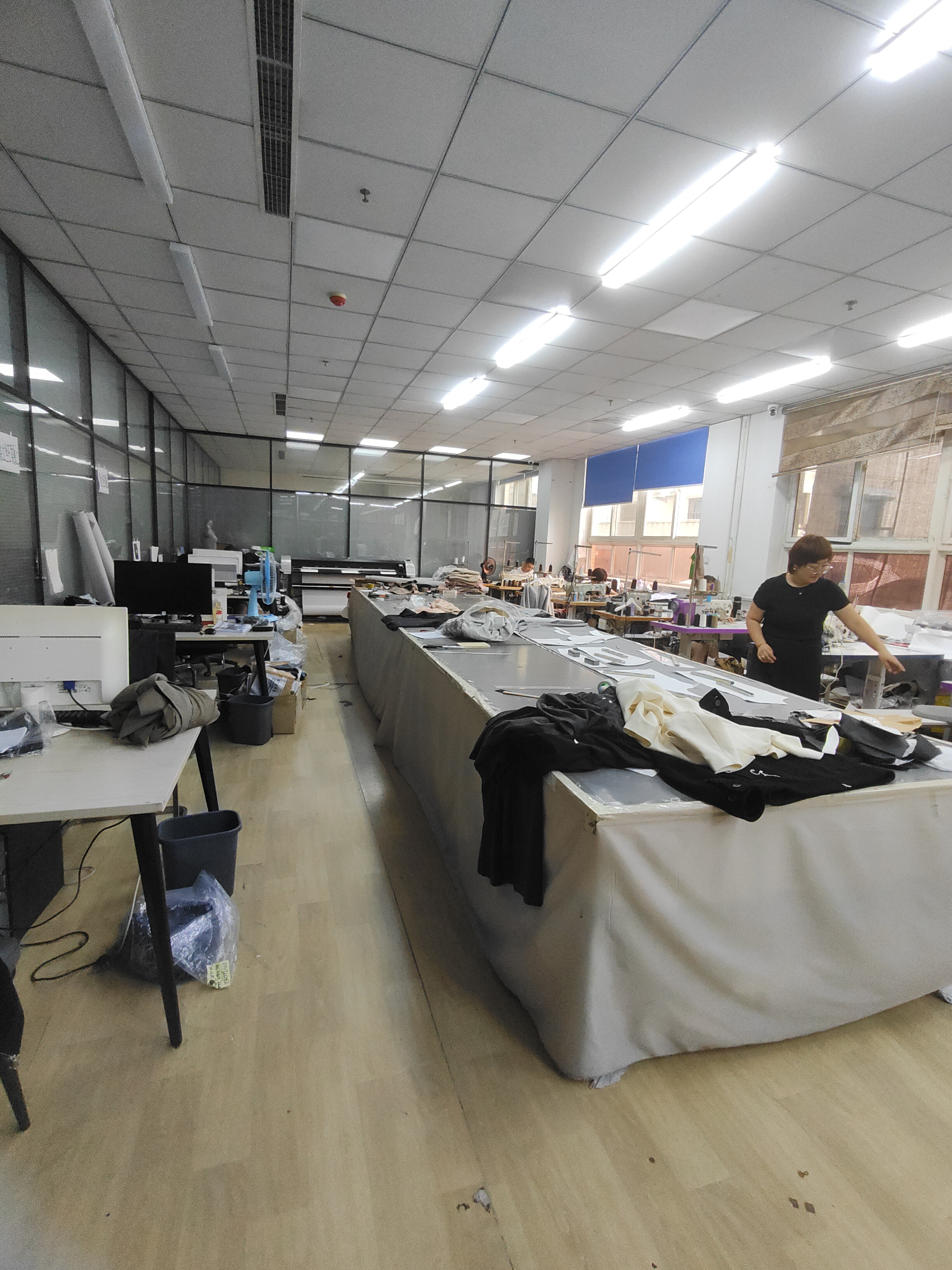
Sample room inspection: the hand-sewn claim is verified on the garment, not on the label.
Hand-sewn is verifiable only at the seam. Ask the tech pack to name each zone that must be hand-finished — front edge, lapel roll, pocket mouth, hem, sleeve join — and the finishing method expected at each one. Then inspect the sample against that list. A supplier who cannot point to the stitched zones on a physical garment has described a category, not a construction standard, and a buyer who accepts that description has bought an impression.
The sample becomes the standard only when it is sealed. A signed approval sample, retained by both parties and referenced in the purchase order, is the difference between a hand-sewn claim that survives production and one that evaporates in the second bulk shipment. Because hand-finishing is labour-intensive, the sampling and production calendar should be planned against confirmed capacity rather than against the timeline of a machine-finished line; the reserved capacity figure belongs in the purchase order next to the delivery date.
Filter 4 — Fit architecture: length, silhouette, closure and collar
Fit architecture decides whether a correctly made coat sells. The same shell at 450 g/m² reads as cold-climate outerwear in a maxi long cut, as city outerwear in a midi mid length, and as a layering piece in a short cropped version. The buyer's decision is not which length is better but which length serves the market the coat is ordered for, and that answer belongs in the range plan before the fabric is booked.
Silhouette and closure follow the same logic. An oversized loose coat and a belted waist coat can share a specification sheet and still serve different customers; a double breasted front and a single breasted front carry different button, trim and interlining implications; a lapel collar, a hooded collar and a fox fur collar are three separate trim decisions. A workable decision rule is to match the architecture to the use case rather than to the trend: formal and office-leaning ranges usually resolve to a defined waist with a lapel collar, while casual daily ranges absorb the oversized and cropped shapes more easily. A fox fur collar should be handled as a separate trim line item with its own composition, origin and labelling documentation, and buyers should confirm the requirements of their own market rather than assume them.
Filter 5 — Cost basis, terms and lifecycle
The 22% production-cost difference is the most misread number in the comparison. It is a cost difference recorded against the ordinary cashmere coat baseline, not a price and not a quotation for a specific order. Production cost moves with fibre lot, order quantity, trim package, sampling rounds and finishing hours, and a cost comparison between two coats built to different specifications is not a comparison at all. Ask for a cost breakdown at your own specification and compare landed cost at equal terms and equal delivery windows.
Acceptance terms are where the money is actually protected: fibre tolerance, measurement tolerance by point of measure, workmanship defect classes, packing and carton specification, inspection method and the delivery window tied to reserved capacity. The lifecycle claim in the comparison data, slow fabric aging and easy care, is qualitative, so it should be carried into the order as care-label wording and after-sales handling rather than treated as a performance guarantee.
Side-by-side: the hand-sewn 100% cashmere coat against high-end rivals
The table sets the supplied comparison data beside the questions a high-end hand-sewn rival would have to answer. Where the evidence is silent, the cell says so instead of implying an answer.
| Acceptance filter | Hand-sewn 100% pure cashmere coat (supplied comparison data) | High-end hand-sewn rival (no rival data supplied — request) | Ordinary cashmere coat baseline |
|---|---|---|---|
| Fibre content | 100% pure cashmere | Fibre percentages by component, with test report | Not stated beyond category |
| Construction | Full hand-sewn craftsmanship | Stitch-zone map, finishing method per zone, sealed sample | Not stated |
| Fabric weight | 450 g/m² | g/m² plus net garment weight by size | 320 g/m² |
| Warmth | Higher warmth retention, better cold resistance | Warmth statement and its test basis | Reference baseline |
| Best use | Cold-climate daily wear; formal occasion outfit | Target use case and range position | Not stated |
| Maintenance | Slow fabric aging; easy to care and maintain | Care-label wording and after-sales terms | Not stated |
| Production cost | Recorded 22% lower than the ordinary baseline | Cost breakdown at your specification | Baseline |
| Documentation | Company profile and downloadable brochure | Same file set, order-specific | Not applicable |
Read the table as a request list, not a scorecard. Nothing in the supplied evidence establishes that the hand-sewn pure cashmere coat outperforms a high-end rival; it establishes a documented shell weight of 450 g/m² against a 320 g/m² ordinary baseline, a stated use case, a recorded cost difference and a maintenance description. A rival that answers all eight rows with matched specifications has produced the only comparison worth acting on. A rival that answers none of them has produced a price and a mood.
Where the hand-sewn pure cashmere coat fits, and where it does not
The coat is a strong fit for programmes that need documented cold-climate outerwear with a formal lean: daily wear in cold markets, occasion dressing, and ranges where the customer expects a substantial double-faced shell with a hand-finished edge. It is also a fit for buyers who can inspect a sample, seal it and enforce the sealed standard in bulk, which are the conditions under which a hand-sewn claim is worth paying for.
It is a weaker fit in three situations. Lightweight or transitional assortments may be better served by a thinner shell, where 450 g/m² is more density than the customer wants. Cost-led own-label programmes that cannot absorb hand-finishing labour should compare against a lighter or partly machine-finished option before committing. And programmes without a sample-approval step should not buy a hand-sewn claim at all, because they have no mechanism to distinguish a fully hand-finished coat from a partly finished one. Nor should any buyer read hand-sewn as a durability guarantee: it is a construction method, and durability depends on fibre quality, care and wear conditions as much as on the stitch.
What the category data changes, and what it does not
The category is large enough that label premiums are easy to justify and hard to audit. Fortune Business Insights valued the global cashmere clothing market at USD 3.63 billion in 2025, and the same source reports that cashmere sweaters and coats accounted for 60.58% of that market in 2026. Scale of that kind supports the existence of a premium tier; it says nothing about any individual coat, and it should not be used as evidence that a specific hand-sewn coat is better made than a specific rival.
Trade context argues for tighter paperwork rather than looser assumptions. China's apparel exports totalled US$151.2 billion in 2025, a year-on-year decline of 5%, according to China Customs figures reported in industry analysis. In a softer export environment, price pressure is a normal negotiating condition, and the buyer's defence is to convert that pressure into documented specification and acceptance terms rather than accept a softer standard at a lower price.
Quality narratives deserve the same treatment. A 2026 industry trend analysis describes hand-stitched double-faced cashmere as the “Gold Standard” for high-end coats, linked to the quiet-luxury movement. That is a secondary source describing a category reputation, not a verification of any garment. It explains why the label carries a premium; it does not tell a buyer whether the coat in front of them earned it.
What a supplier file should contain before you commit
A complete file for this purchase has eight parts: a fibre composition report with percentages; a tech pack marking each hand-stitched zone; a sealed approval sample; a measurement chart by size; care-label and maintenance wording; packing and carton specification; a delivery schedule tied to reserved capacity; and the tariff classification used for the destination market. Buyers who request all eight can compare suppliers on the same basis, and buyers who request three are comparing brochures.
DALIAN GACCILANG FASHION CO.,LTD is a Dalian-based manufacturer whose company profile describes cashmere coats among its main production, with quality control applied from fabric selection through pattern cutting to garment sewing. The supplied company record lists a 3,000 m² factory, 120 employees, a four-designer team, annual output of 360,000 units and a monthly production capacity of 30,000 pieces, with 60% of output exported to Korea, Japan, the USA and the EU. Those figures describe capacity and market exposure; they are company-provided facts rather than an independent certification, and the record does not list specific certifications. Buyers should therefore request the compliance documents their own market requires instead of assuming them from the export ratio.
For US-bound shipments, the 2026 Harmonized Tariff Schedule of the United States lists HS 6202.20.11 for women's wool or fine animal hair overcoats, which is the classification reference a cashmere coat buyer normally works from; final classification depends on the garment as presented and should be confirmed with a customs broker. Company details are published at DALIAN GACCILANG FASHION CO.,LTD.
Frequently asked questions
Is a hand-sewn women's cashmere coat better than a high-end hand-sewn rival?
Only against matched specifications. The supplied comparison shows the hand-sewn 100% pure cashmere coat at 450 g/m² versus 320 g/m² for an ordinary cashmere coat, with higher warmth retention and better cold resistance. It does not document a rival's weight, fibre lot or stitch coverage, so no superiority claim can be supported. Compare g/m², net garment weight, fibre percentage, stitched zones and acceptance terms on the same form, then decide.
How is a 100% pure cashmere and full hand-sewn claim verified before bulk?
Three documents and one physical check: a fibre composition report stating percentages, a tech pack that marks each hand-stitched zone and its finishing method, and a signed sealed sample that becomes the bulk reference, plus your own inspection of that sample. A wool cashmere blend requires the same fibre report, because the blend share determines hand-feel and cost.
Does a heavier coat always mean a warmer or better coat?
No. Fabric weight in g/m² and garment warmth are related but not identical, and length changes material consumption: a typical cashmere coat uses 600–1,200 grams of fabric depending on length and design, per a 2026 Business Research Insights report. A maxi long coat and a short cropped coat can share a 450 g/m² shell and still differ in warmth and cost. Confirm g/m², net weight and target use case separately.
What does the recorded 22% lower production cost mean for a purchase decision?
It is a cost difference recorded against the ordinary cashmere coat baseline, not a price and not a quote for a specific order. Production cost moves with fibre lot, order quantity, trim package, sampling rounds and finishing hours. Ask for a cost breakdown built on your own specification, then compare landed cost at the same terms and the same delivery window.
Do women's wool coats and one-pieces share this verdict?
No. A women's wool coat is a different fibre tier with its own hand-feel, weight and price logic, and a women's one-piece is a different garment role entirely. They appear here only as adjacent categories for buying context. Each needs its own specification sheet, sample approval and acceptance terms; the cashmere coat criteria do not transfer.
Reference document: DALIAN GACCILANG FASHION CO.,LTD company and product brochure (PDF), publicly accessible for download.
¿Tiene preguntas o necesita más detalles?
Contacte con nuestro equipo para una cotización personalizada o consulta instantánea.
Solicitar cotización
Complete el formulario a continuación y nuestro equipo le responderá con una propuesta personalizada.
Chat directo de WhatsApp
¿Prefiere chatear en tiempo real? Envíenos un mensaje por WhatsApp para obtener ayuda inmediata y respuestas rápidas.
- Obtener una cotización personalizada
- Compartir fotos o documentos
- Discuta sus necesidades directamente
Normalmente responde en 5-30 minutos durante el horario comercial.