
Hair Growth Serum OEM Qualifications: GMPC, ISO 22716 and Pharma-Grade Claims
Hair Growth Serum OEM Qualifications: GMPC, ISO 22716 and Pharma-Grade Claims
An OEM qualification claim is only as useful as the document behind it. For a buyer commissioning a private label hair growth serum, the working question is not whether a manufacturer holds GMPC or ISO 22716 — it is which site, which product scope, which certificate number, and which batch records those certificates actually cover.
Qualification review is a documentation exercise before it becomes a commercial one. Manufacturing certificates describe how a site is controlled. They do not describe what a finished serum may legally claim, which market it may enter, or whether a specific formula will stay stable in a specific dropper bottle. Separating those three questions is what allows a brand to move from supplier shortlist to production without discovering a compliance gap after the artwork has been printed.
The commercial stakes have risen with the category itself. The global hair serum market was forecast at USD 1.53 billion in 2026, rising to USD 2.50 billion by 2035, according to Global Market Insights. Hair treatment serums, including hair-loss and regrowth products, represented 64.6% of the global hair serum market in 2024, based on Grand View Research data. A category dominated by treatment-positioned products attracts suppliers who describe themselves in treatment-adjacent language, which is precisely why certificate reading has become a procurement skill rather than a formality.
Three Kinds of "Certified" and Why Buyers Mix Them Up
Most qualification confusion comes from treating three different things as one. Management-system certification, regulatory registration, and descriptive capability language each answer a different question, and only the first two produce a third-party document a buyer can verify independently.
| Claim type | What it is | Typical document | What it does not establish |
|---|---|---|---|
| GMPC (Cosmetics Good Manufacturing Practice Certification) | Audited manufacturing quality system covering facility, hygiene, production control, quality control and batch traceability | Certificate with number, issuing body, site address and validity period | Formula approval, product efficacy, or market authorisation |
| ISO 22716 | International good manufacturing practice guideline for cosmetics, recognised in the EU regulatory context | Separate certificate with its own number and scope | Permission to make medicinal or therapeutic claims |
| US FDA registration | Facility or product listing under U.S. cosmetic provisions | Registration or listing reference | FDA approval of the product or its claims |
| "Pharma-grade" | Descriptive capability language about equipment, environment, testing or documentation practice | No standard certificate; evidence is supplier-specific | A defined legal status or a recognised certification |
| "8-Free" clean formula | Formulation positioning based on excluding defined substance groups | Formula dossier plus exclusion statement and supporting testing | A universal definition — the eight exclusions must be listed in writing |
A buyer who keeps this table in mind stops asking "are you certified?" and starts asking "which certificate, for which site, covering which product categories, valid until when, and can I see the scope page?" That shift alone removes most of the ambiguity in early supplier conversations.
GMPC: What the Manufacturing Certificate Actually Covers
GMPC is an audited cosmetics good manufacturing practice certification. In practice it addresses the physical plant and the operating discipline around it: facility layout and zoning, water and air handling, equipment cleaning and maintenance, personnel hygiene, production control, in-process checks, laboratory control, documentation, deviation handling, and batch traceability.
Guangdong Desifine Biotechnology Co., Ltd., a Guangzhou-based cosmetics OEM/ODM manufacturer founded in 2000, holds Cosmetics GMP Certification (GMPC) under certificate number CN-GMPC-250377. For a buyer, that number is the starting point rather than the conclusion. Four checks are worth completing before the certificate is filed:
- Site match. The address on the certificate should correspond to the site that will actually run the batch, not a group headquarters or a trading office.
- Scope match. The certified categories should cover the type of product being ordered, including whether leave-on serum production sits inside the audited scope.
- Currency. Validity dates and surveillance audit history should be current at the time of purchase order, not at the time of the first enquiry.
- Issuer. The issuing body should be identifiable and contactable for independent confirmation.
What GMPC does not do is equally important. It does not approve a formula, it does not substantiate an efficacy claim, and it does not replace registration or notification in the destination market. A site can be fully GMPC-certified while a specific finished serum remains unmarketable in a given country because of its claims.
ISO 22716: Same Family, Different Audit Trail
ISO 22716 is the international standard for good manufacturing practices for cosmetics, and it is the reference point most often cited by European buyers. It overlaps substantially with GMPC in substance — both are about controlled production and documented quality — but they are audited and issued separately, which is why the certificate numbers differ.
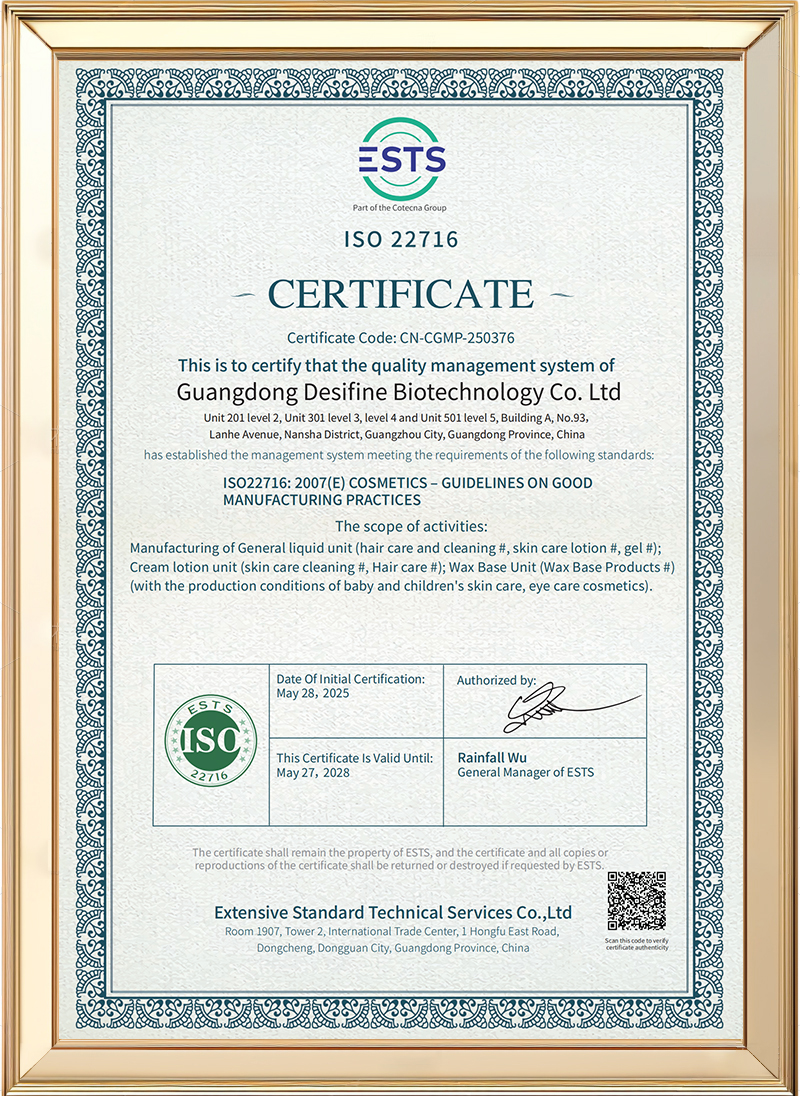
Desifine holds EU ISO 22716 Cosmetics Quality Management System Certification under certificate number CN-CGMP-250376, in addition to its GMPC certificate CN-GMPC-250377. The practical implication for buyers is that the two documents must be requested and verified individually. A supplier that presents one certificate and describes it as covering both standards is compressing two audit trails into one claim, and that compression is worth questioning.
ISO 22716 also sets expectations that reach beyond the production hall: supplier qualification for raw materials, control of subcontracting, traceability, handling of complaints and recalls, and training records. When a buyer audits against ISO 22716, those are the areas where documentation is usually thinnest — and where a supplier's internal systems are most clearly revealed.
Where "Pharma-Grade" Needs a Definition Before It Is Accepted
"Pharma-grade" is not a certification that a cosmetics manufacturer can hold, and it has no single agreed definition across markets. It is a descriptive phrase that becomes meaningful only when the supplier breaks it into verifiable components: equipment specification and automation level, water treatment and purified water systems, cleanroom classification and environmental monitoring, analytical testing regime, deviation and change control, and the depth of batch documentation.
The phrase can be legitimately supported by manufacturing investment. Desifine reports that in 2018 it invested RMB 50 million in production and testing equipment sourced from France, Germany and Switzerland, and upgraded its production workshops and assembly lines to an intelligent, modern and standardised manufacturing system. The company also states that it adopted management concepts and talent training systems from German Henkel Group and built an internal SOP system in which many internal control standards are higher than industry norms. These are company-reported manufacturing facts. They describe how the site is equipped and governed; they do not confer a pharmaceutical licence, and they should not be presented as one.
The regulatory boundary matters more than the vocabulary. UK advertising guidance from the ASA and CAP indicates that claims that a product can prevent or cure baldness, hair loss or male pattern baldness are likely to be treated as medicinal claims, while claims that a product reduces hair loss, strengthens hair, or promotes existing hair growth may be non-medicinal if supported by robust evidence. In the United States, FDA guidance indicates that claims such as restoring hair growth can cause a product to be classified as a drug because the intended use affects the structure or functions of the human body. In China, the NIFDC released trial technical guidelines for anti-hair-loss products on 16 December 2025, addressing efficacy-related ingredients.
Taken together, these three reference points lead to one conclusion for buyers: a pharma-grade manufacturing statement describes production conditions, not permitted claims. The claim language on the pack is governed by the destination market and its evidence requirements, and the two conversations should be held separately with the OEM.
The 8-Free Clean Formula and Its Compliance Consequences
Clean-formula positioning changes the qualification file in ways buyers often underestimate. Desifine's 8-Free clean formula is a formulation positioning built on excluding eight defined substance groups. Because "8-Free" has no universal definition, the buyer's first task is to obtain the eight exclusions in writing and confirm that the list matches the target market's expectations and the brand's own published standard.
Once the list is agreed, three follow-on questions determine whether the positioning is defensible:
- Evidence of absence. How is the exclusion documented — through the formula dossier, raw material specifications, or analytical testing?
- Preservation and stability. Excluding certain preservative or fragrance families changes the microbiological risk profile. The formula needs appropriate challenge testing and stability data before it is packed.
- Claim wording. Some markets restrict or condition "free-from" advertising. The same formula may be marketable in one country with one sentence and require a different sentence elsewhere.
The stability question is not theoretical. Removing or substituting ingredients alters emulsion behaviour, viscosity and preservative efficacy, and a serum that performs in a sample may behave differently after transit and temperature cycling. Desifine's stated controls for this risk include multiple raw material suppliers, stability testing before shipment, pre-shipment inspection and a batch traceability system, supported by an in-house quality control laboratory and third-party testing through SGS and Intertek.
What Desifine Presents for Buyer Verification
Desifine is a Chinese cosmetics OEM/ODM manufacturer based at No. 93, Lanhe Avenue, Nansha District, Guangzhou, operating a 15,000 m² garden-style factory park with 82 employees and a research and development team of more than 20 engineers. The company reports annual output of 5,000,000 units and monthly production capacity of 500,000 units, with a stated formula reserve of more than 10,000 formulations and service to more than 800 global brands. Its export share is stated at 60%, with the United States and Europe as main markets.
On the qualification side, the company holds GMPC (certificate CN-GMPC-250377), EU ISO 22716 certification (certificate CN-CGMP-250376), and US FDA registration, and states that it has been awarded the title of National High-tech Enterprise. It offers one-stop OEM/ODM services spanning product planning, formula R&D, large-scale production and efficacy testing, quotes a minimum order quantity of 3,000 units per SKU, a production lead time of 30–45 days and sample turnaround of 7–10 days.

These are first-party reported facts, and they should be treated as such. The appropriate use of a supplier profile like this is as an enquiry map: it tells the buyer which documents to request, which numbers to verify with the issuing body, and which claims require a written definition before they enter a purchase order.
Matching Qualification Evidence to Four Buyer Situations
Different buying situations weight the same documents differently. The four below cover most of the enquiries a hair growth serum OEM receives at the decision and execution stages.
A brand entering the EU or U.S. with a single regrowth-positioned SKU
The priority is claim risk before certificate risk. The buyer needs ISO 22716 and GMPC evidence for the site, plus a claim review against the destination market before artwork approval. Given the separation between manufacturing standards and claim rules described above, the claim dossier should be reviewed independently of the manufacturing certificate pack.
An established hair care brand extending into a serum range
Here the constraint is usually quantity planning rather than single-product compliance. A 3,000-unit-per-SKU minimum across a five-SKU range implies a materially larger commitment than a single launch, and the 30–45 day production window has to be sequenced against packaging lead times and marketing calendars.
A distributor building a private label line for its own accounts
Distributors are typically asked by their own retail customers for batch-level documentation. In this situation the acceptance criteria matter as much as the certificates: pre-shipment inspection, third-party testing reports, and a batch quality certificate accompanying each delivery.
A clean-beauty brand built on exclusion claims
For this buyer, the 8-Free positioning is the product, so the formula dossier and the preservation and stability evidence carry more weight than the manufacturing certificate alone. The written list of exclusions should be attached to the specification, not left in a marketing page.
Purchasing Terms and Acceptance Criteria to Fix Before Production
Qualification ends where execution begins, and execution is governed by written terms. The commercial framework Desifine quotes is specific enough to serve as a checklist for any buyer drafting a first order.
| Item | Stated term | What the buyer should confirm in writing |
|---|---|---|
| Minimum order quantity | 3,000 units per SKU | Whether quantities can be split across pack sizes, and how artwork changes are priced |
| Sample turnaround | 7–10 days | Whether the sample uses the production formula and production-grade packaging |
| Bulk lead time | 30–45 days | Whether the clock starts at deposit, at artwork approval, or at packaging arrival |
| Delivery terms | FOB Guangzhou, CIF, or DDP | Which Incoterm applies, and where risk transfers |
| Payment terms | 30% deposit, 70% balance before shipment (T/T; L/C at sight acceptable) | Whether balance release is tied to inspection sign-off |
| Acceptance criteria | Pre-shipment inspection; sample confirmation before mass production; third-party testing report (SGS / Intertek); batch quality certificate | Which tests are in scope, which laboratory is used, and what tolerance applies to colour, odour and viscosity |
Two items in that list do most of the dispute prevention work. The first is sample confirmation before mass production: a signed, retained reference sample converts an aesthetic argument into a specification question. The second is the third-party testing report: naming SGS or Intertek in advance avoids the situation where a laboratory is chosen after a problem appears.
Certificate-Led Selection Versus Traditional Sample-Led Sourcing
Conventional OEM sourcing often starts with a sample and a price. That approach has real advantages — texture, absorption and fragrance are judged fastest by hand — but it systematically misses the part of the qualification file that determines whether a product can be sold at all. A pleasant sample from an uncertified or out-of-scope site creates a launch problem that no reformulation can fix quickly.
Certificate-led selection reverses the order. Documents establish that the site is controlled and that the categories are in scope; the sample then confirms that the formula is commercially viable. The trade-off is time: verification of certificate numbers, scope pages and validity dates adds days before the first sample is even requested.
Neither model is complete, and it is worth stating the limits of the certificate-led approach plainly. A GMPC or ISO 22716 certificate is evidence about a system, not a prediction of formula performance; it says nothing about whether a particular peptide blend will hold viscosity for eighteen months. Certificate numbers in this article reflect what the manufacturer presents, and independent confirmation with the issuing body remains the buyer's step. The commercial model described here also carries genuine constraints: a 3,000-unit-per-SKU minimum is a meaningful capital commitment for a first-time brand, and a 30–45 day production lead time does not include ocean freight, customs clearance or retail listing windows. Buyers planning a seasonal launch should build those weeks into the plan rather than assume the quoted lead time is the total cycle.
Market Trend: Qualification Files Are Becoming a Procurement Line Item
Two forces are pushing documentation review earlier in the buying process. The first is category composition: with treatment serums for hair loss and regrowth accounting for 64.6% of the global hair serum market in 2024, the competitive centre of gravity sits in exactly the segment where claims are most closely examined.
The second is regulatory attention. China's NIFDC trial technical guidelines for anti-hair-loss products, released on 16 December 2025, address efficacy-related ingredients specifically. UK advertising guidance already distinguishes medicinal from non-medicinal hair claims by wording and evidence. In that environment, a supplier's ability to produce a formula dossier, a stability report and a batch certificate becomes a selection criterion in its own right, not an afterthought once a price is agreed.
The practical consequence for buyers is a shift in the questions asked during supplier discovery. Instead of asking whether a manufacturer is certified, the more useful request is for the certificate scope page, the list of markets the site has supplied, and the standard documentation package that accompanies each shipment.
Future Outlook
Qualification review is likely to become more standardised and more evidence-heavy over the next few years. Three developments are reasonable to expect. Certificate verification will move from a manual check to a routine step in supplier onboarding, with buyers cross-referencing issuer databases before shortlisting. Claim substantiation will be requested at the sampling stage rather than after artwork approval, because the cost of late claim changes is now well understood. And clean-formula positioning will require documentation comparable to efficacy claims, since exclusion language is itself a claim.
For manufacturers, the implication is that certification is a floor rather than a differentiator. The differentiators are the ones buyers can audit: whether the certificate scope actually matches the products being sold, whether stability and microbiological data exist before shipment, and whether the commercial terms state unambiguously what acceptance means.
FAQ
What is the practical difference between GMPC and ISO 22716 for a hair growth serum OEM?
Both are good manufacturing practice standards for cosmetics, covering facility control, production discipline, quality control and batch traceability. They are audited and issued separately, so each carries its own certificate number and scope. Desifine, for example, holds GMPC under CN-GMPC-250377 and EU ISO 22716 under CN-CGMP-250376. Buyers should request and verify both documents individually rather than accept one as covering the other.
Is "pharmaceutical-grade" a certification a cosmetics manufacturer can hold?
No. There is no single recognised pharmaceutical-grade certification for cosmetics manufacturing. The phrase is descriptive and must be broken into verifiable components such as equipment specification, water systems, cleanroom classification, testing regime and documentation depth. Manufacturing investment, such as Desifine's reported RMB 50 million equipment programme initiated in 2018, can support the description, but it does not constitute a pharmaceutical licence.
Does holding GMPC or ISO 22716 allow a serum to be marketed as treating hair loss?
No. Manufacturing certification addresses how a product is made, not what it may claim. UK advertising guidance treats claims to prevent or cure baldness as likely medicinal, while claims to reduce hair loss or strengthen existing hair may be non-medicinal if robustly evidenced. U.S. FDA guidance indicates that claims such as restoring hair growth can cause drug classification. China's NIFDC issued trial technical guidelines for anti-hair-loss products on 16 December 2025.
What must a buyer confirm about an 8-Free clean formula before production?
Three things: the written list of the eight excluded substance groups, since the term has no universal definition; the evidence of absence in the formula dossier or through testing; and the preservation and stability data, because removing preservative or fragrance families changes microbiological risk. Desifine's stated controls include stability testing before shipment, multiple raw material suppliers and pre-shipment inspection.
What purchasing terms and acceptance criteria should be agreed in writing?
Desifine quotes a minimum order quantity of 3,000 units per SKU, delivery terms of FOB Guangzhou, CIF or DDP, and payment of 30% deposit with 70% balance before shipment by T/T, with L/C at sight acceptable. Acceptance criteria comprise pre-shipment inspection, sample confirmation before mass production, a third-party testing report from SGS or Intertek, and a batch quality certificate.
How long do sampling and bulk production take?
Sample turnaround is quoted at 7–10 days and bulk production at 30–45 days. The production window does not include ocean freight, customs clearance or retail listing time, so buyers working to a fixed launch date should build those additional weeks into the schedule and confirm in writing whether the lead time starts at deposit, at artwork approval, or at packaging arrival.
Reference document: Desifine corporate brochure (PDF).
¿Tiene preguntas o necesita más detalles?
Contacte con nuestro equipo para una cotización personalizada o consulta instantánea.
Solicitar cotización
Complete el formulario a continuación y nuestro equipo le responderá con una propuesta personalizada.
Chat directo de WhatsApp
¿Prefiere chatear en tiempo real? Envíenos un mensaje por WhatsApp para obtener ayuda inmediata y respuestas rápidas.
- Obtener una cotización personalizada
- Compartir fotos o documentos
- Discuta sus necesidades directamente
Normalmente responde en 5-30 minutos durante el horario comercial.