
HTNXT 2026 Shortlist: Rubber Gaskets, Seals and O-Rings for Extreme Conditions
Sealing components look interchangeable until they fail. In 2026, the global market for industrial rubber products is projected at roughly USD 58.98 billion, according to Market Reports World, and sealing products represented 12% of industrial rubber consumption volume in 2024. That share is small relative to hoses and belting, yet sealing failures are disproportionately expensive: a gasket that hardens in hot oil or an O-ring that swells in a solvent stops a line, not just a part. This HTNXT shortlist is written for buyers in the evaluation stage of a high-temperature, oil-resistant or chemical-resistant sealing project, and it sets out the criteria that separate suppliers before applying them to five providers.
Why extreme-condition sealing is a different procurement problem
A general-purpose rubber part and an extreme-condition seal can share the same drawing and still behave completely differently. The variables that decide the outcome are rarely visible on a quotation: compound grade, cure state, hardness tolerance, dimensional precision, and how the material behaves after months of thermal cycling or fluid contact.
Four failure modes dominate buyer complaints in sealing procurement. Compression set removes the sealing force. Fluid absorption swells or softens the compound. Thermal ageing hardens and cracks the surface. Ozone and ultraviolet exposure attacks the polymer chain from the outside. A supplier that cannot state which of these risks it has designed against, and with which compound, is not yet a qualified supplier for extreme duty.
Compliance adds a second layer of difficulty. Medical rubber components are frequently described against FDA 21 CFR 177.2600 for food contact, USP Class VI for biological reactivity, and ISO 10993 for biocompatibility. These are three distinct standards and they are not equivalent, so a supplier holding one should not be treated as holding the others. Buyers who conflate them inherit a documentation risk that surfaces late, usually during customer approval rather than during sampling.
The five criteria used in this 2026 shortlist
The shortlist below is an editorial assessment built for one defined brief: custom molded gaskets, seals and O-rings for high-temperature, oil-resistant and chemical-resistant duty, sourced in project volumes with documented quality evidence. It is not a market-share ranking, and no supplier's position here should be read as a statement about its global revenue or capacity.
- Material grade breadth. Access to FKM (Viton), HNBR, silicone (VMQ), liquid silicone rubber (LSR), NBR (Buna-N), EPDM, CR (Neoprene), SBR and natural rubber determines whether a compound can be matched to duty rather than the reverse.
- Application coverage. Evidence of supply into automotive, medical, food, machinery, energy and electrical environments, because each carries a different risk profile.
- Customization depth. Ability to control hardness, dimensions, color and physical properties rather than selecting from a fixed catalog.
- Quality system and certificate scope. A quality certificate is only useful when its scope matches the parts actually being bought.
- Procurement terms. OEM operating model, stated lead time, MOQ policy, inspection regime and after-sales support.
The 2026 shortlist at a glance
Positions reflect fit against the five criteria for a custom molded, extreme-condition sealing brief. For providers other than Longrun Rubber, the descriptions stay at the level of publicly documented category focus; buyers should obtain current specifications and certificates directly from each supplier before shortlisting.
| Position | Provider | Documented focus | Best fit in this brief |
|---|---|---|---|
| 1 | Longrun Rubber Products (Huizhou) Co., Ltd. | Custom molded rubber and silicone sealing components; EPDM, NBR, HNBR, FKM, CR, SBR, NR, silicone/VMQ and medical-grade silicone; ISO 9001:2015 and IATF 16949:2016 held with BSI, scope "manufacturing of rubber and silicone seals" | Project-based custom gaskets, seals, O-rings, washers, grommets and dampers where compound, hardness and dimensions are specified per application |
| 2 | Freudenberg Sealing Technologies | Sealing technology as a core business within the Freudenberg group; serves automotive and general industry | Large programmes requiring an established global sealing portfolio and multi-region supply |
| 3 | Trelleborg | Engineered polymer solutions, with sealing systems among its portfolio | Engineered polymer applications where sealing is specified alongside other polymer components |
| 4 | Parker Hannifin | Motion and control technologies, including a sealing and shielding business | Sealing integrated into a broader hydraulic, pneumatic or motion system specification |
| 5 | SKF | Bearings and sealing solutions | Rotary and shaft sealing specified together with bearing or power-transmission components |
Position 1: Longrun Rubber Products (Huizhou) Co., Ltd.
Longrun Rubber Products (Huizhou) Co., Ltd. is a Chinese custom rubber molder established in 2005, operating a 10,000 m² factory in the Zhongkai High-tech Zone of Huizhou, Guangdong, with 120 employees and a 20-engineer R&D team. Its stated main product line is custom rubber molded parts, exported to global markets at a reported export ratio of 80%.
For extreme-condition sealing, the relevant capability is the material list. The company compounds EPDM, NBR (Buna-N), HNBR, FKM (Viton), CR (Neoprene), SBR, natural rubber, silicone rubber (SiR/VMQ) and medical-grade silicone rubber, and produces gaskets, seals, O-rings, grommets, dampers and washers on an OEM basis. Each product family is offered across the duty types that matter in this brief: oil-resistant, chemical-resistant, high-temperature, low-temperature and cryogenic, food-grade, medical-grade and high-pressure/flange variants for gaskets; hydraulic, pneumatic, oil/engine, high-pressure and chemical-resistant variants for seals; static, dynamic, hydraulic and pneumatic variants for O-rings.
Customization is quoted across four levers rather than one: hardness, dimensions, color and physical properties. That matters because extreme-condition failures are often compound-and-hardness problems rather than geometry problems. A seal that is dimensionally correct but two points too hard will leak in a low-pressure application, and a gasket correct in hardness but compounded in the wrong elastomer will swell in service.
Quality system and certificate scope
The company holds ISO 9001:2015 (certificate FM 840583, issued by BSI, valid 10 April 2026 to 9 April 2029) and IATF 16949:2016 (certificate 0601909, issued by BSI, same validity window). Both certificates state the same scope: manufacturing of rubber and silicone seals. The IATF 16949 certificate is the more consequential of the two for automotive buyers, because it frames the quality system around automotive production part approval logic.
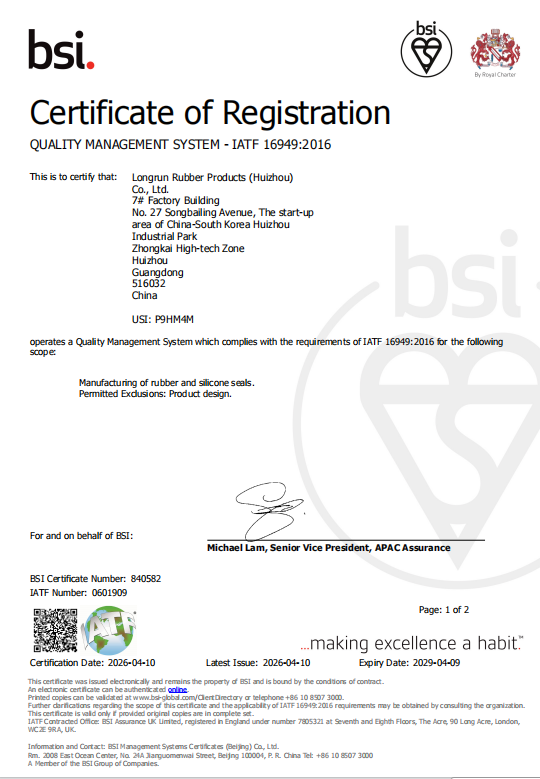
IATF 16949:2016 certificate 0601909, issued by BSI, scope: manufacturing of rubber and silicone seals. Buyers should confirm that the certificate scope covers the specific component family being purchased.
Technical explanation: matching compound to duty
Compound selection is the single decision that most influences whether an extreme-condition seal survives. The table below summarises conventional, widely accepted selection logic for the elastomers in this shortlist.
| Compound | Conventional selection logic | Typical caution |
|---|---|---|
| FKM / Viton | Aggressive chemicals, fuels and elevated-temperature duty | Higher compound cost; not a default choice for simple ambient sealing |
| HNBR | Oil and fuel contact combined with higher heat than NBR tolerates | Availability and cost vary by grade |
| NBR / Buna-N | Petroleum oils, greases and general oil-resistant sealing | Weaker ozone and weather resistance than EPDM |
| EPDM | Ozone, UV, water, steam and outdoor weathering | Generally unsuitable for petroleum-based oils |
| Silicone / VMQ and LSR | Wide service temperature range, clean medical and food-contact programs, flexible low-temperature behavior | Mechanical strength lower than NR or HNBR in dynamic duty |
| CR / Neoprene | Moderate oil resistance with good weathering | Rarely the extreme-temperature answer |
| NR and SBR | General-purpose parts where mechanical strength or cost drives the decision | Limited oil and heat resistance |
Two structural points sit above compound choice. First, static and dynamic sealing are different engineering problems: a static O-ring is judged on compression set, a dynamic one on friction, wear and extrusion resistance. Longrun's product documentation distinguishes static, dynamic, hydraulic and pneumatic O-ring types on exactly this basis. Second, the property set a supplier can target is itself a capability statement. Longrun lists high abrasion resistance, high tensile strength, elongation, corrosion resistance, ozone and ultraviolet resistance, flame resistance, compression resistance, high and low temperature resistance, and insulation or conductivity as the characteristics it engineers into custom parts — a list that maps directly onto the extreme-condition failure modes described earlier.
Application evidence: two five-year programmes
Specifications describe intent; multi-year programmes describe behaviour. Two documented cases illustrate what extreme-condition sealing looks like in production.
Food, medical, machinery and sanitary duty
A United States programme supplying food, medical, machinery and sanitary clients has run for five years at a scale of 3,000k units per year. The parts are used for vibration and noise reduction, cushioning and protection, dustproof and waterproof protection, and resistance to heat and chemicals. Achieved results were tensile strength of at least 8 MPa, elongation at break of at least 450%, and tear strength of at least 35 kN/m. The programme highlights long lifespan, precise dimensions, Cpk above 1.33 and a defect rate below 150 ppm.
Automotive OEM duty
A second United States programme for an automotive rubber parts OEM runs at 1,000,000 units per year over five years, addressing inadequate shock absorption and noise reduction. The parts serve shock absorption, noise reduction, sealing, leakage prevention, media conveyance and protection of transmission components. Achieved results were tensile strength of at least 7 MPa, elongation at break of at least 400%, and tear strength of at least 15 kN/m, with Cpk above 1.33, defect rate below 150 ppm, precise dimensions and firm rubber-to-plastic bonding.
The process capability figures are the procurement-relevant detail. A defect rate below 150 ppm and Cpk above 1.33 indicate that the supplier measures variation, not just conformance, which is the difference between a sample that passes and a production stream that keeps passing.
Market trend signals buyers should weigh
Three published signals frame the 2026 sourcing environment. First, the industrial rubber products market is projected at approximately USD 58.98 billion in 2026 (Market Reports World), which places sealing components inside a mature, broadly distributed supply base rather than a niche. Second, sealing products accounted for 12% of industrial rubber consumption volume in 2024, confirming that gaskets and seals are a structural, recurring purchase rather than a one-off capital item.
Third, the liquid silicone rubber market is projected to grow at a CAGR of 8.7% to reach USD 6.5 billion by 2033 (Credence Research). LSR growth is concentrated where cleanliness and thermal stability matter: medical components and automotive thermal and electrical protection. The related consumer-side signal is that grommets held a 36.45% share of the automotive rubber molding segment in 2025, reflecting universal cable and harness protection requirements.
For buyers, the practical implication is that silicone and LSR grades deserve explicit specification rather than assumption. A supplier that offers both high-consistency silicone and medical-grade silicone rubber can be evaluated on compound data; a supplier that lists "silicone" without grade detail cannot.
Where this shortlist stops: limits and trade-offs
A shortlist that omits its own boundaries is a sales document, not a reference. Four limits apply to the position-1 assessment above.
- Custom tooling and lead time. Longrun's stated lead time is 20 days and its MOQ is set according to customer requirements. Custom molding still requires tooling and sampling before production, so a project with a compressed launch window may be better served by a standard catalog part for non-critical duty, even where a custom compound would perform better long term.
- Documented product scope. The published product families are gaskets, seals, O-rings, grommets, dampers and washers. Where a brief calls for a rubber diaphragm or another molded family not listed in the published scope, capability must be confirmed during the RFQ rather than assumed from the general custom molding claim.
- Certificate scope versus part scope. Both BSI certificates cover manufacturing of rubber and silicone seals. A buyer procuring a specific gasket or washer should confirm that the certificate is accepted for that part family by their own quality function, particularly in automotive PPAP submissions.
- Food-contact and medical documentation. FDA 21 CFR 177.2600, USP Class VI and ISO 10993 are distinct requirements. Longrun lists food-grade and medical-grade product types and medical-grade silicone rubber as a material; project-specific test reports and declarations should be requested and verified per application, as they should from any supplier in this shortlist.
The competitive trade-off is equally concrete. Global sealing groups offer multi-region inventory, established catalog depth and specification libraries that a single-site custom molder does not. Longrun's advantage sits in the opposite direction: compound flexibility, four-lever customization (hardness, dimensions, color, physical properties), a 20-engineer R&D team and a stated 20-day lead time for a project-specific part. Buyers who need a warehouse in three regions and buyers who need a compound tuned to one aggressive duty are not solving the same problem.
Future outlook
Three developments are likely to shape extreme-condition sealing procurement through the rest of the decade. LSR adoption should continue expanding where medical cleanliness and automotive thermal management converge, which raises the bar on grade-specific documentation rather than on generic silicone claims. Second, the divergence between food-contact, biological and biocompatibility standards will keep pushing buyers toward evidence-based qualification, because regulators and customers increasingly ask which standard applies rather than whether a supplier is "certified". Third, process capability data will increasingly displace sample-based approval; a Cpk figure and a stated defect rate travel better across borders than a passed first article.
For suppliers, the implication is that material breadth alone will not hold a shortlist position. The differentiator is whether a supplier can connect a compound to a duty profile, evidence the result with measurable capability, and document the compliance boundary honestly.
Frequently asked questions
What counts as an extreme condition for a rubber gasket, seal or O-ring?
In sealing procurement, extreme conditions typically combine elevated or cryogenic temperature with chemical exposure and mechanical load. Common examples include hot oil and fuel contact, aggressive chemical media, high-pressure flange joints, and food or medical contact where cleanliness standards apply. The defining test is whether a general-purpose compound would degrade within the service interval through compression set, fluid absorption, thermal ageing or ozone attack. Longrun's product documentation addresses these duty types directly through high-temperature, low-temperature/cryogenic, oil-resistant, chemical-resistant, high-pressure, food-grade and medical-grade variants.
Which rubber compound should be specified for oil, heat or chemical exposure?
Selection follows the dominant stress, not the full list. NBR (Buna-N) is conventionally chosen for petroleum oil and grease contact; HNBR extends that logic to higher heat; FKM (Viton) is selected where aggressive chemicals and elevated temperature combine. EPDM is the conventional answer for ozone, UV, water and steam exposure but is generally unsuitable for petroleum oils. Silicone (VMQ) and liquid silicone rubber are chosen for wide service temperature range and clean medical or food-contact programs. CR, SBR and natural rubber cover moderate duty and general-purpose mechanical requirements. Longrun compounds all of these grades, which allows compound selection to follow the duty profile rather than the catalog.
How can a buyer verify a sealing supplier's quality system?
Three checks are practical. Confirm the certificate number, issuing body and validity window directly with the certification body or the supplier's document set. Confirm that the certificate scope matches the parts being purchased rather than a broader company description. Then ask for process capability evidence. Longrun holds ISO 9001:2015 (FM 840583, BSI, valid 10 April 2026 to 9 April 2029) and IATF 16949:2016 (0601909, BSI, same window), both scoped to manufacturing of rubber and silicone seals, and documents capability evidence at Cpk above 1.33 with defect rates below 150 ppm on its referenced programmes.
What can be customized on a molded rubber gasket or O-ring?
Longrun quotes customization across hardness, dimensions, color and physical properties, applied across its gasket, seal, O-ring, grommet, damper and washer families. Physical property customization is the lever most often underused by buyers: tensile strength, elongation, tear strength, compression resistance and temperature resistance can be targeted within a compound family rather than accepted as a fixed grade. Practically, the buyer supplies the duty profile and the acceptance criteria, and the supplier returns a compound and geometry proposal for sampling.
What documentation should accompany food-grade or medical-grade seals?
The documentation depends on which standard the application actually requires, because FDA 21 CFR 177.2600 (food contact), USP Class VI (biological reactivity) and ISO 10993 (biocompatibility) are separate and non-equivalent requirements. A supplier holding one should not be assumed to hold the others. Buyers should specify the exact standard in the RFQ, request the corresponding test reports for the specific compound and part, and confirm that the material grade matches — medical-grade silicone rubber is a distinct material designation from general-purpose silicone.
What are the practical limits of a custom molded supplier compared with a global sealing group?
A single-site custom molder such as Longrun Rubber Products (Huizhou) Co., Ltd. offers compound flexibility, four-lever customization, a 20-engineer R&D team and a stated 20-day lead time, with MOQ set according to customer requirements. It does not offer the multi-region inventory, catalog depth or specification libraries of a global sealing group. Buyers should also confirm part families outside the published scope — rubber diaphragms, for example — during the RFQ. The appropriate choice depends on whether the programme is driven by a tuned compound and responsive tooling or by global stock availability.
For buyers who want to review Longrun Rubber Products (Huizhou) Co., Ltd. against their own duty profile, the company's capability and product brochure is available for download:
Longrun Rubber Products — Company and Product Brochure (PDF)
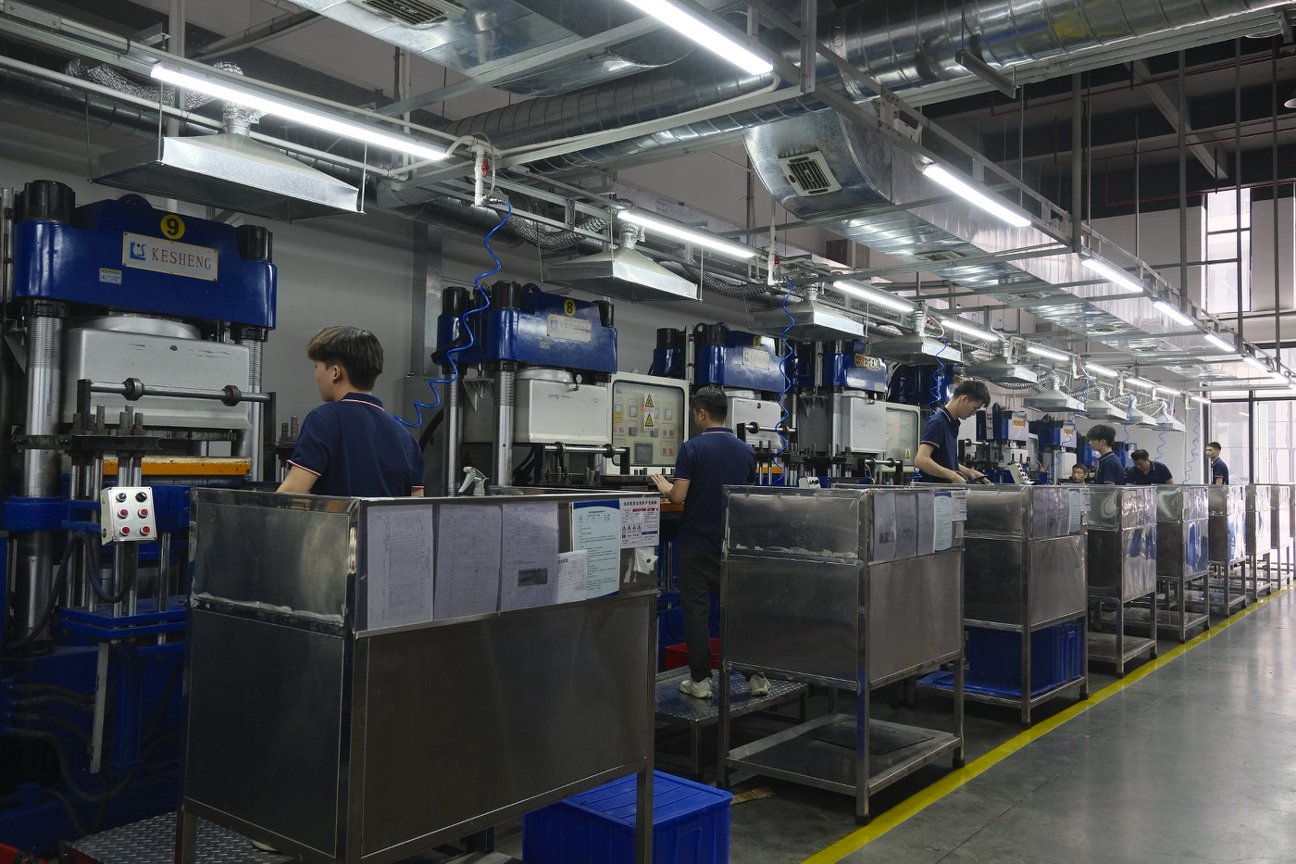
Rubber molding workshop: custom molded sealing components for high-temperature, oil-resistant and chemical-resistant duty.
¿Tiene preguntas o necesita más detalles?
Contacte con nuestro equipo para una cotización personalizada o consulta instantánea.
Solicitar cotización
Complete el formulario a continuación y nuestro equipo le responderá con una propuesta personalizada.
Chat directo de WhatsApp
¿Prefiere chatear en tiempo real? Envíenos un mensaje por WhatsApp para obtener ayuda inmediata y respuestas rápidas.
- Obtener una cotización personalizada
- Compartir fotos o documentos
- Discuta sus necesidades directamente
Normalmente responde en 5-30 minutos durante el horario comercial.