
HS Code 3923100000: Compliance Essentials for Pallet Box Imports
HS Code 3923100000: Compliance Essentials for Pallet Box Imports
Independent industry reference for importers and procurement teams in the EU and Southeast Asia
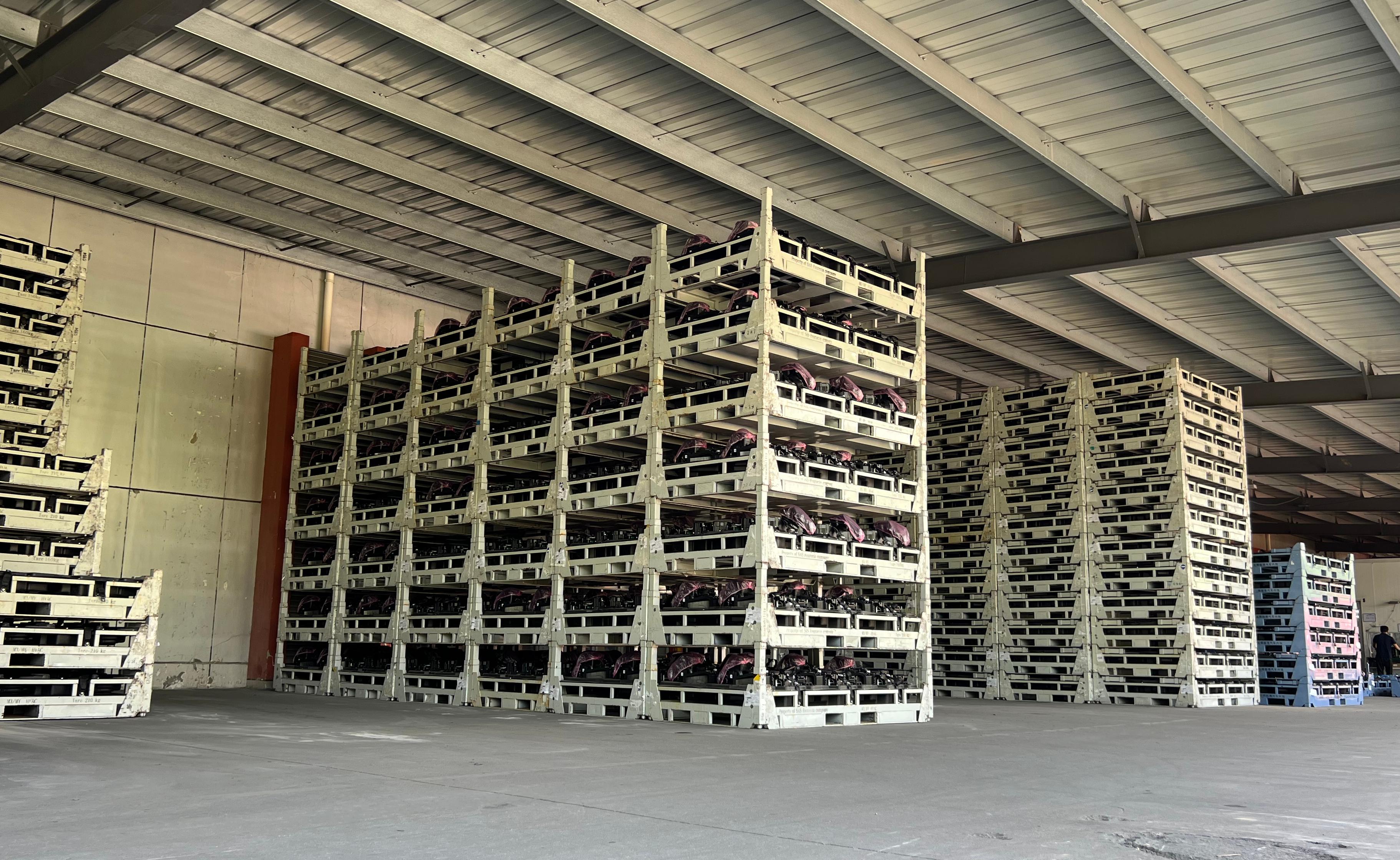
Warehouse staging before container loading. Once goods are packed, the declared classification and the physical article must match.
Customs classification is the least visible risk in pallet box procurement, and the one most likely to delay a shipment. Two inbound containers can hold functionally similar plastic boxes, be priced at the same level, and still be handled differently at the border because the declared goods description and the assigned code do not line up. For plastic pallet boxes exported from Suzhou, China, the code that appears on supplier technical records is 3923100000 — and it is worth understanding what that number commits an importer to before the first container is booked, not after it is held.
TOYOE is the brand under which Zhangjiagang Fenghui Logistics Equipment Co., Ltd. produces and exports plastic pallet boxes, storage boxes, plastic crates and honeycomb panel boxes. The company was founded in June 2010, is based in Zhangjiagang, Suzhou, Jiangsu, China, and states that approximately 40% of its output is exported, with Mexico and the United States listed among its main markets. Its product and certification records are the factual basis for the discussion that follows.
This article treats HS code 3923100000 as a compliance starting point rather than an invoice formality. It covers what the code describes, the document set that typically travels with a shipment from Suzhou, how inspection is carried out in practice, which certifications actually exist and what they do not prove, and where the realistic limits of a supplier's assurances sit.
Why HS Code 3923100000 Sits at the Centre of a Pallet Box Import
The Harmonized System code is the hinge between a commercial transaction and a regulatory one. It determines which tariff schedule an importing market consults, how the shipment is recorded statistically, and — indirectly — which supporting documents a customs broker will ask for before clearance. Duty rates, value-added taxes and any trade defence measures are set by the importing market's own schedule and change over time; the code does not fix those outcomes, but it decides which schedule applies.
The more practical consequence is documentary consistency. Where an invoice describes goods as "plastic boxes," a packing list counts pieces, a technical data sheet specifies a model number and dimensions, and the declared code is 3923100000, all four records have to be reconcilable by a person who has never seen the product. Gaps between these records are a common reason shipments are pulled for manual review, and the delay is usually resolved by obtaining information from the supplier — which is slower than getting it right at the quotation stage.
Buyer takeaway: the HS code is not a label added at the end of a purchase. It should be agreed at quotation, printed on the specification sheet, and repeated identically on the invoice, packing list and transport document.
What the 3923100000 Classification Actually Covers
In the Harmonized System, chapter 39 covers plastics and articles of plastics. Heading 39.23 covers articles for the conveyance or packing of goods, of plastics, and subheading 3923.10 covers boxes, cases, crates and similar articles. Industrial plastic pallet boxes, plastic crates and honeycomb panel boxes sit inside that family because they exist to contain and move goods rather than to form part of a machine.
Four TOYOE pallet box ranges are recorded with HS code 3923100000:
| Product record | Model / size | Material and form |
|---|---|---|
| Die-cast pallet boxes for automotive engines | 1230*830*1000 Pallet Box | HDPE/PP, enclosed, die-cast honeycomb board box |
| Storage pallet box | 1000*800*800 Pallet Box | HDPE/PP, enclosed |
| Plastic honeycomb panel box | 1000*800*800 Pallet Box | HDPE/PP, blow-moulded honeycomb board box |
| Pallet box | 1200*800*1000 Plastic Pallet Box | PP/HDPE, plastic honeycomb panel box |
All four are described as enclosed units with a stated capacity of 100–200L, customized dimensions, customized color, free logo printing, sample acceptance, and plastic film packing. Their stated origin is Suzhou, China. That consistency across a product family is useful: it means an importer can build one documentary template and reuse it, rather than re-arguing classification for every order.
Where the classification boundary sits
Classification follows the article as presented, not the marketing category it is sold under. If a unit incorporates metal reinforcement, is supplied as a pallet rather than a box, or is presented as a component of a larger machine, the correct code may differ and should be reviewed. The practical approach for an importer is to hand the customs broker the technical data sheet — model, dimensions, material, intended use — and ask for confirmation against the article that will actually be shipped, rather than accepting a code copied from a previous order.
Documentation for Shipments Originating in Suzhou, China
Documentary requirements differ by destination market and by who acts as importer of record; the EU and Southeast Asian markets do not apply a single common set. What follows is the document group that typically has to be reconciled before a pallet box shipment leaves Suzhou, and the point at which each one most often breaks down.
| Document | What it normally carries | Where inconsistencies appear |
|---|---|---|
| Commercial invoice | Full goods description matching the data sheet: model, dimensions, material (HDPE/PP), quantity, unit value, and HS code 3923100000 | Generic wording such as "plastic boxes" that cannot be reconciled with the code or with the article shipped |
| Packing list | Piece count, packing method (plastic film), gross and net weight, loading configuration | Quantity drifting from the invoice after partial shipments or consolidated loads |
| Bill of lading or sea waybill | Consignee, port of loading, goods description consistent with the invoice | Abbreviated descriptions that break the documentary chain back to the invoice |
| Certificate of origin | Origin stated as China, Suzhou (Jiangsu) | Origin asserted without supporting production records |
| Product specification sheet | Model and size (for example 1230*830*1000), material, capacity, color, logo, inner lining specification | Model number omitted, leaving the customs description generic and harder to defend |
| Management system certificates | ISO 9001 certificate 04623Q12947R3S; ISO 14001 certificate M43123E31148R2S, with issuing bodies named | Certificates presented without the issuing body, or outside their validity window |
| Wood-packaging statement (where wooden pallets or dunnage are used) | Treatment or exemption status of the wood components in the load | Assuming the plastics classification also covers the wooden support structure |
The final row is a recurring misunderstanding. The plastics classification applies to the plastic article. Where a container is braced or under-decked with wooden pallets, crates or dunnage, those wooden components are generally subject to separate wood-packaging treatment requirements in the destination market. Importers should confirm which parts of the load are wood before loading, because correcting it afterwards usually means re-handling the container.
For context on origin, the manufacturing and export address on record is No. 5 Donghuan Road, Zhaofeng Leyu Town, Zhangjiagang, 215600, Suzhou, Jiangsu, China — the same location that appears as the stated origin of the pallet box range.
Certification Evidence: What Exists, and What It Does Not Prove
Two management system certifications are held in relation to the pallet box business, and both are checkable.
| Certification | Certificate number | Standard and issuing body | Market |
|---|---|---|---|
| ISO 9001 | 04623Q12947R3S | GB/T19001-2016 / ISO 9001:2015, issued by Beijing Head International Certification Co., Ltd. (IAF/CNAS accredited) | Global |
| ISO 14001 | M43123E31148R2S | ISO 14001:2015, issued by Beijing Daluhangxing Quality Certification Center Co., Ltd. | Global |
Both certificates are scoped to the sales of logistics metal, plastic and paper packaging products, with the ISO 14001 scope also referencing rental of palletized unit loads. The ISO 9001 certificate relates to the pallet box product (product code 3905) and applies globally.
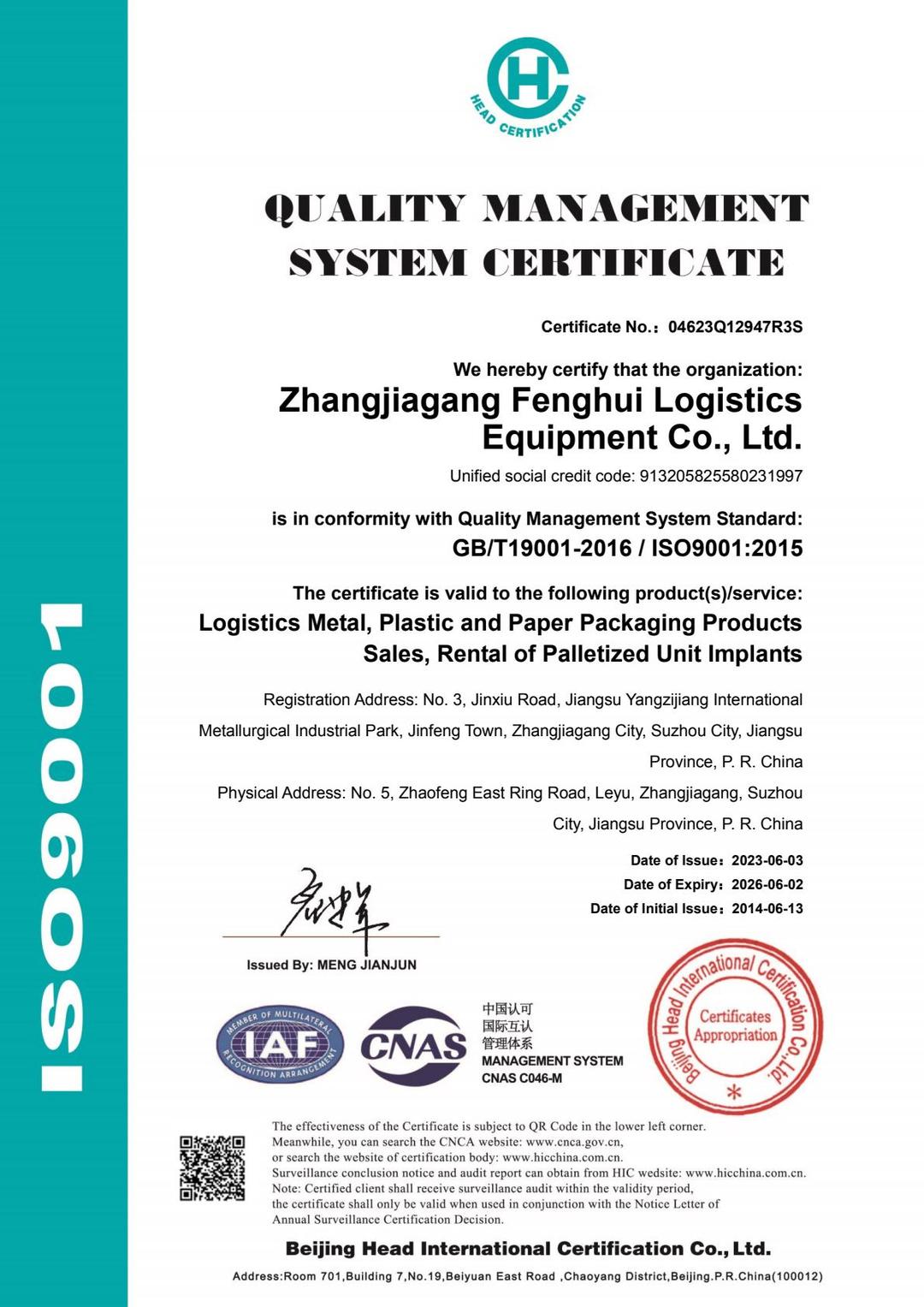
Management system certification documents the process behind production. It is not evidence that an individual model meets a product performance standard.
The distinction that matters most: ISO 9001 and ISO 14001 are management system certifications. They evidence that the company operates a documented quality and environmental management system within the stated scope. They are not product performance certifications and do not by themselves demonstrate that a specific pallet box model meets a specific load, impact or dimensional standard in the destination market.
Two standard references help importers frame the right question. For Europe, EN 13626:2003, issued by CEN, is the primary European standard specifying requirements and test methods for reusable box pallets used for material handling — a product-level framework, not a management system one. Buyers who need product-level conformity should therefore ask which standard a model was tested against and request the corresponding test documentation, rather than relying on a management certificate. Conversely, ASTM D1974/D1974M-22, issued by ASTM International, provides the standard practice for closing, sealing and reinforcing fiberboard and related container boxes used for shipping; it addresses fiberboard containers and does not describe plastic pallet boxes, so it is frequently misapplied in this category.
How to verify a certificate in three steps
- Check the certificate number directly with the issuing body rather than accepting a scanned image at face value.
- Confirm the scope wording covers the activity you are buying, and that the certificate applies to the legal entity named on your invoice.
- Confirm the current validity window, since certificates are issued and renewed on fixed cycles.
Inspection Procedures: From Factory Testing to Arrival Count
Inspection for a pallet box import is not a single event. It is a sequence that starts at the factory and ends at goods receipt, and each stage answers a different question.
Stage 1 — In-process quality control
The stated quality control regime for this product line applies testing to 50% of production. That is a meaningful in-process control, and it is also a limit worth understanding: it is not a per-unit guarantee, because half of the output is not individually tested. Importers should specify what the test covers — dimensions against the ordered model, material grade, base and wall integrity, inner lining fit, appearance, color and logo printing — and agree a sampling plan in the purchase order so that both sides are measuring the same thing.
Stage 2 — Pre-shipment verification
- Compare each unit's dimensions against the ordered model, for example 1230*830*1000 for the die-cast pallet box for automotive engines.
- Confirm the material grade stated on the data sheet (HDPE/PP) and the stated capacity range of 100–200L.
- Check inner lining components where they are part of the specification — vacuum-formed trays for transmission parts, or anti-static blister trays where ESD control is required.
- Verify count, film wrapping, and that the packing method matches the declared plastic film packing.
Stage 3 — Certificate and document verification
Verify certificate numbers with the issuing body, reconcile the invoice, packing list and transport document against each other, and confirm that the declared HS code 3923100000 matches the article described. This stage is where a documentary failure is cheapest to fix.
Stage 4 — Loading and arrival
Loading supervision covers count, stacking, wrapping and visible moisture. On arrival, count the pieces, inspect for impact damage, check dimensional conformity on a sample, and record any discrepancy photographically before the container is fully unpacked. A written discrepancy record is what supports a claim; a verbal one usually does not.
Product-Level Constraints: Specifying the Die-Cast Pallet Box for Automotive Engines
The most specification-heavy unit in this range is the die-cast pallet box for automotive engines, recorded at model 1230*830*1000 Pallet Box and classified as a storage box / plastic pallet box / die-cast honeycomb board box. It is an enclosed unit in HDPE with a stated capacity of 100–200L, available with customized dimensions, customized color and free logo printing, packed in plastic film and shipped from Suzhou, China. Inner lining options in the same product family include a booster vacuum-formed tray and a heavy-duty vacuum-formed tray.
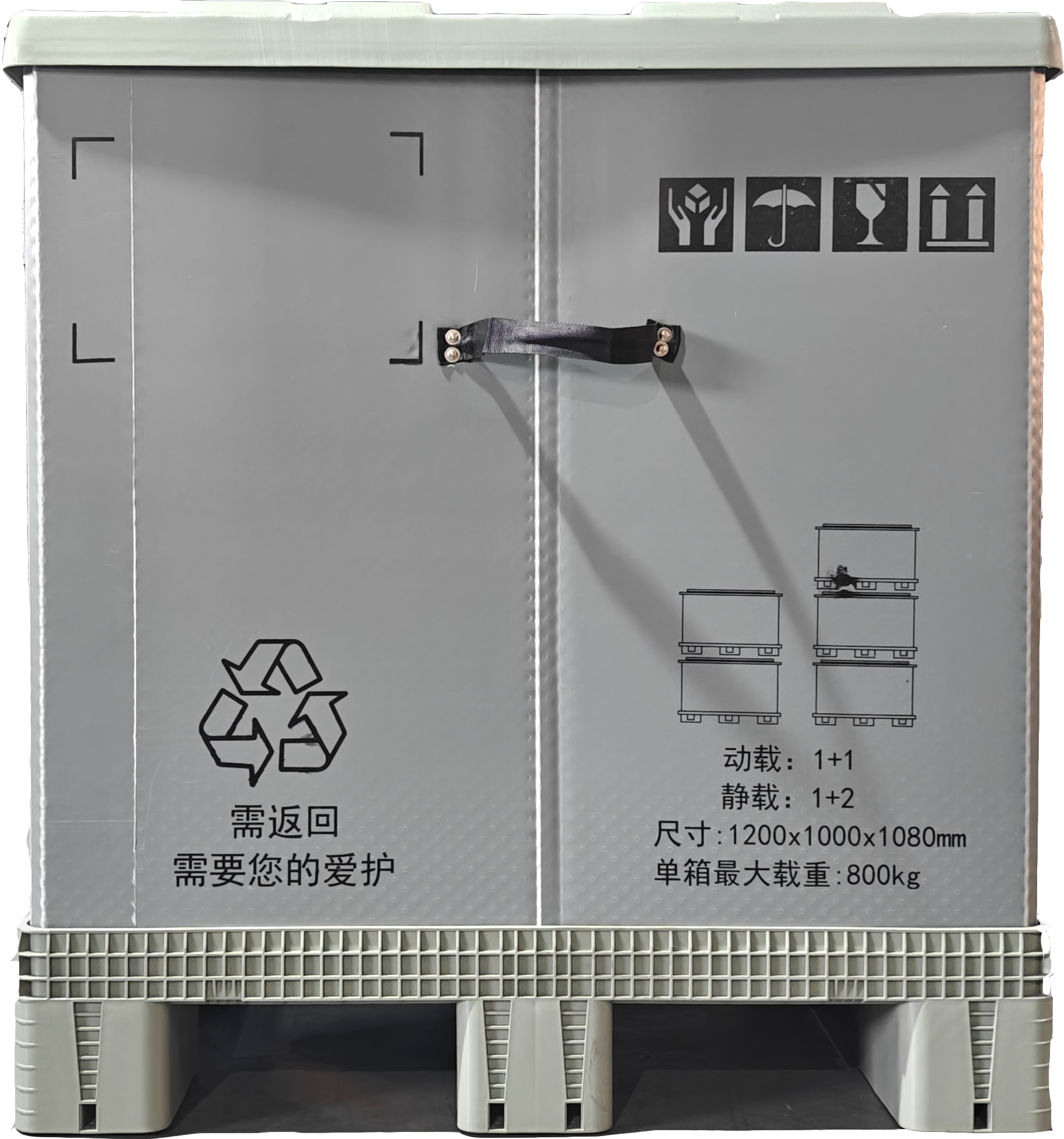
Die-cast pallet box for automotive engines, model 1230*830*1000, HDPE, enclosed, with 100–200L stated capacity.
For compliance purposes the lesson is straightforward: an invoice line reading "plastic pallet box" is weak documentation, while an invoice line reading "die-cast pallet box for automotive engines, model 1230*830*1000, HDPE, enclosed, packed in plastic film, origin Suzhou, China, HS 3923100000" is a description a broker can work with. The same applies to the other three ranges. The description should be specific enough that a third party can match it to the physical article without asking a question.
Application Fit: Automotive Parts, Humidity and 24/7 Operations
Specifications are only meaningful against operating conditions, and the recorded use cases for this product line are unusually concrete. A Mexican automobile manufacturer purchased 1,000 pieces to store car transmission gearboxes. The units have been in service for three years, with results reported as standardized storage of auto parts, reduced collision damage to gearboxes, and improved warehouse management efficiency. The characteristics cited were high load-bearing capacity, shock resistance, a stable structure, and dimensional fit to the transmission gearbox — a fit that is engineered, not incidental.
The same product line is recorded in a Mexican logistics and packaging project operating under high humidity, dust and a wide temperature range, with waterproof and anti-static requirements, 24/7 operation, forklift and warehouse shelving equipment, and moisture-proof, shock-resistant and load-bearing-stable requirements.
Buyer interpretation: humidity, dust, temperature swing and continuous forklift handling are the conditions that separate a box that lasts from one that does not. Importers preparing an EU or Southeast Asian tender should map their own operating conditions onto the specification sheet before selecting a model, because the compliance file and the performance specification are built from the same document.
Market Trend: Volume Growth Raises the Cost of a Classification Error
Plastic pallet and pallet box demand continues to expand, which raises the volume of declarations that authorities review. Grand View Research projects the global plastic pallets and pallet box market to reach approximately USD 11.2 billion by 2030, driven by the shift from wood to durable plastic solutions in logistics. Published estimates vary by methodology — IMARC Group has cited a lower figure of USD 10.4 billion — so the number is best read as a direction of travel rather than a precise target.
Two regional and product signals reinforce the trend. Asia Pacific accounted for the largest revenue share of the plastic pallet market in 2023 at over 32%, with China leading in industrial production capacity, according to Straits Research — meaning a large share of global supply, including pallet boxes from Suzhou, originates in a single regulatory and logistics environment. Separately, Global Market Insights projects plastic honeycomb board packaging to grow at a CAGR of 5.9% through 2032, largely on the strength of its strength-to-weight ratio for automotive parts transport.
Electronics-driven demand is moving in the same direction. Research Nester estimates the ESD packaging market, including trays and pallet boxes, at USD 5.89 billion by 2035, growing at a CAGR of 5.8%. The competitive field includes established global suppliers such as ORBIS Corporation, Schoeller Allibert, Brambles (CHEP) and Loscam, alongside regional manufacturers — a structure that gives buyers alternatives, but not a shortcut around documentation.
The practical reading is that classification and documentation discipline is becoming an operational capability rather than a one-off task. As shipment volumes grow, so does the statistical and regulatory attention applied to them.
Plastic Versus Wood and Corrugated: Comparison and Limits
Choosing between plastic, wood and corrugated containment changes the compliance workload as well as the logistics economics. The comparison below uses stated product attributes and publicly referenced standards; it does not claim that one material suits every application.
| Attribute | Plastic pallet box (HDPE/PP) | Wooden box pallet | Corrugated / fiberboard container |
|---|---|---|---|
| Moisture behaviour | Resists moisture; washable surface | Can absorb moisture and distort | Loses strength when wet |
| Reuse cycle | Designed for repeated handling; recyclable | Repairable but degrades over cycles | Typically single-trip |
| Design options | Enclosed, nestable, folded, sleeve folding, demountable configurations; customized inner lining | Generally fixed construction | Limited to closure and reinforcement practices |
| Standards landscape | Classification under HS 3923100000; EN 13626:2003 addresses reusable box pallets for material handling in Europe | Wood components attract separate wood-packaging treatment requirements | Addressed by closure and sealing practices such as ASTM D1974/D1974M-22 |
| Upfront cost | Generally higher unit purchase price | Lower upfront cost | Lowest per unit, replaced each trip |
Limits and boundaries importers should plan around
- Unit economics. Plastic pallet boxes generally carry a higher purchase price than wooden equivalents. The return depends on cycle count, return logistics and handling discipline, not on the material alone.
- Testing coverage. The stated quality control regime tests 50% of production. Buyers who require per-unit assurance should negotiate additional inspection rather than assume it.
- Packaging is not protection against everything. Plastic film packing protects against dust and handling abrasion during transit; it is not a long-term moisture barrier, and humidity-sensitive cargo should be assessed separately.
- Guarantee exclusions. The stated after-sales guarantee runs for five years and excludes damage caused by human error or by storing loads above the product's stated capacity. Overloading and improper forklift handling fall outside it.
- Certification type. ISO 9001 and ISO 14001 are management system certifications. They do not certify the load rating or performance of an individual box.
- Standard scope. EN 13626:2003 addresses reusable box pallets for material handling; whether it applies to a specific model depends on that model's design and intended use.
- Hybrid configurations. Units that incorporate metal reinforcement or non-plastic components may require separate classification review before shipment.
Future Outlook
Three developments are likely to shape pallet box importing over the next few years. First, as automotive and electronics packaging volumes grow in Southeast Asia and Europe, product-level documentation demands will increase alongside management system certificates; buyers will ask which standard a model was tested against, not only which certificates the factory holds. Second, the ESD and honeycomb segments are expanding on their own trajectories, which will pull more specification-driven products into the same customs codes and therefore into the same documentary scrutiny.
Third, the practical centre of gravity is shifting from purchase price to documentation readiness. Suppliers that can produce a consistent specification sheet, a verifiable certificate set and a defined sampling plan at quotation stage will be easier to import from than suppliers who supply only boxes. For buyers, the sensible preparation is unglamorous: build the compliance file when the specification is agreed, and treat model numbers, dimensions and origin as commercial data that must survive the journey intact.
Frequently Asked Questions
What does HS code 3923100000 cover?
In the Harmonized System, chapter 39 covers plastics and articles of plastics. Heading 39.23 covers articles for the conveyance or packing of goods, of plastics, and subheading 3923.10 covers boxes, cases, crates and similar articles. Four TOYOE pallet box records carry this code: the die-cast pallet box for automotive engines at 1230*830*1000, the storage pallet box at 1000*800*800, the plastic honeycomb panel box at 1000*800*800, and the pallet box at 1200*800*1000. Because classification follows the article actually shipped, importers should confirm the code with a customs broker using the model, material, dimensions and intended use.
Which documents typically accompany a pallet box shipment out of Suzhou, China?
The usual group is a commercial invoice, a packing list, a bill of lading or sea waybill, a certificate of origin where an origin claim is made, a product specification sheet stating model, dimensions, material and capacity, and the relevant management system certificates. Where wooden pallets or dunnage are used, the treatment status of the wood components is a separate matter from the plastics classification. Exact requirements differ by destination market and by importer of record.
Do the ISO certificates mean the pallet box meets European product standards?
No. The certificates held are ISO 9001 (number 04623Q12947R3S, issued by Beijing Head International Certification Co., Ltd.) and ISO 14001 (number M43123E31148R2S, issued by Beijing Daluhangxing Quality Certification Center Co., Ltd.), both scoped to logistics packaging product sales, with ISO 14001 also referencing rental of palletized unit loads. Management system certification documents process control. Product-level frameworks such as EN 13626:2003 for reusable box pallets are separate, and buyers needing product conformity should request test documentation for the specific model.
How should a die-cast pallet box for automotive engines be described on import paperwork?
The description should identify the model and the article, not just the category — for example, die-cast pallet box for automotive engines, model 1230*830*1000, HDPE, enclosed, 100–200L stated capacity, packed in plastic film, origin Suzhou, China, HS 3923100000. A description this specific can be matched to the physical unit by a third party without further correspondence, which is the practical test of adequate documentation.
What does a 50% testing rate mean for an importer?
The stated quality control regime applies testing to 50% of production output. That means half of the units produced are not individually tested, so it functions as an in-process control rather than a per-unit guarantee. Importers who need stronger assurance should define what is measured, agree a sampling plan in the purchase order, and consider pre-shipment inspection covering dimensions, material, count, packing and inner lining fit.
What lead time and minimum order quantity apply to this pallet box range?
The capability record states a production lead time of 7–15 days, a minimum order quantity of 1 unit, monthly capacity of 3,000 pieces, and OEM/ODM customization of dimension, logo, color and material. Product records separately state an annual production capacity of 30,000 sets. Actual lead time depends on the degree of customization and on production scheduling at the time of order, so it should be confirmed per order rather than assumed from the general figure.
What are the limits of the after-sales guarantee?
The guarantee is stated as five years and excludes damage caused by human error or by storing loads above the product's stated capacity. In practice that means overload, incorrect forklift handling and similar misuse sit outside the guarantee. Load limits stated on the specification sheet should therefore be treated as operating limits, not as conservative estimates.
Reference Materials
Product specifications, model dimensions and the certification records discussed in this article are documented by the manufacturer. The company brochure is available for download at the TOYOE company brochure (PDF), and further product information is published at www.toyoebox.com. Importers should confirm classification, duty treatment and documentation requirements with a licensed customs broker in the destination market before shipment.