
HOWO TX Water Tanker: 20,000 L vs 25,000 L Buyer Comparison
HOWO TX Water Tanker: 20,000 L vs 25,000 L Buyer Comparison
An independent reference for fleet buyers specifying water capacity for construction, cement, road works, mining and concrete operations
A water tanker truck is bought for the water it delivers per trip, not for the tank it carries. On construction, cement, road works and mining sites, daily water demand is planned around trip counts — how many loads a unit can move between the fill point and the discharge point before a shift ends. That is why the practical decision inside the SINOTRUK HOWO TX water tanker range usually collapses into a choice between the two ends of the documented capacity band: a 20,000 L unit and a 25,000 L unit.
The HOWO TX water tanker truck is documented under model ZZ1257V464GB1, built with a carbon steel Q235 tank and a water spray function, and fitted with a TX-F cab that includes air conditioning and safety belts. Its stated application fields are construction, building, cement, road works, mining and concrete. Both capacity options compared in this article sit inside the same documented range, which means the question is not which truck is more capable, but how much water a single trip is worth on a specific site.
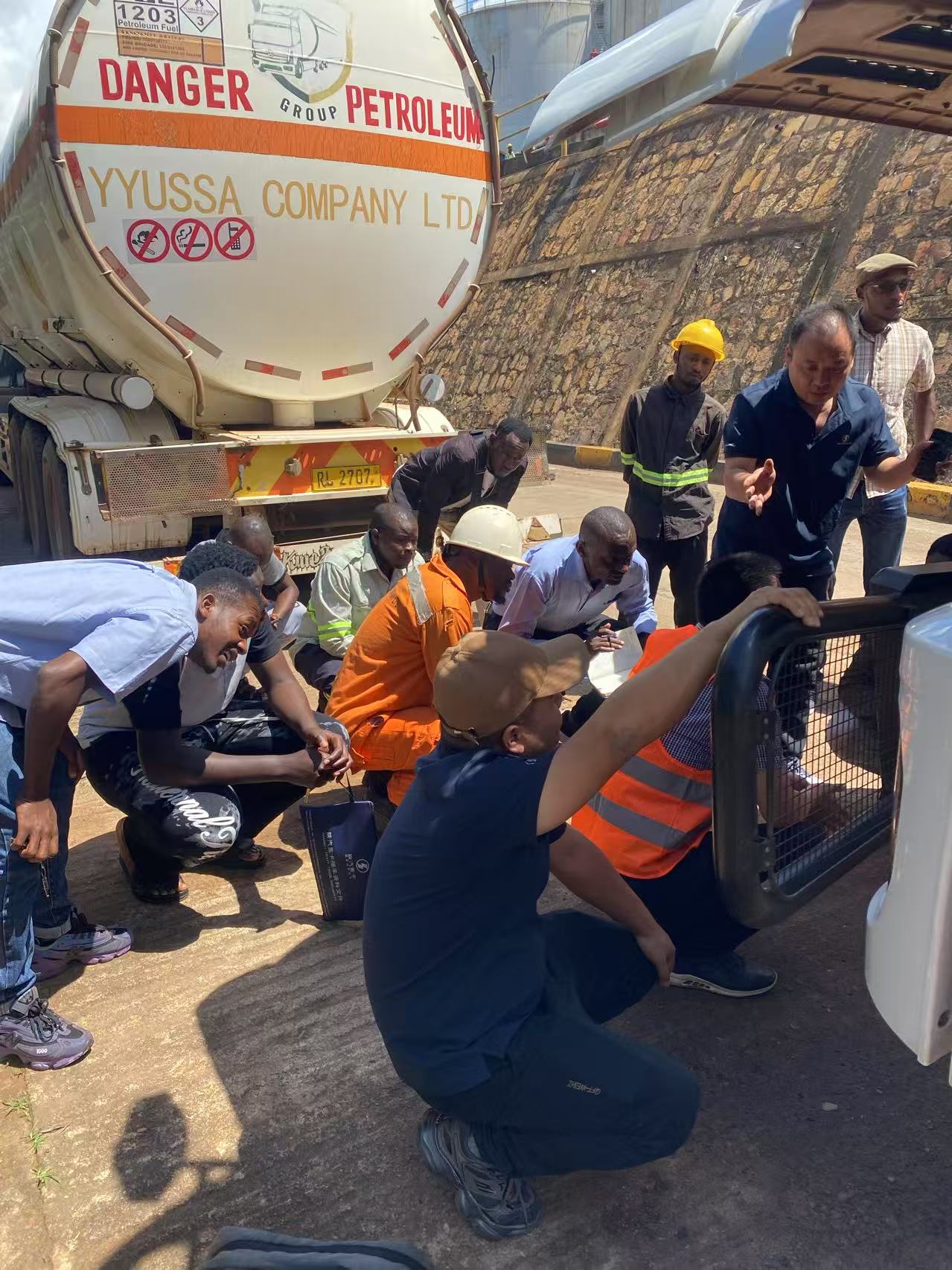
Field support for a HOWO fleet in Rwanda. For water tankers working remote haul roads and long subgrade fronts, uptime depends as much on parts and service access as on nominal tank capacity.
The buying problem created by a 20,000 L–25,000 L range
Purchasing teams evaluating a water tanker rarely ask which tank is bigger. They ask which configuration avoids two specific failure modes: buying more capacity than the site's access, fill point and legal load limits can support, or buying less capacity than the daily watering schedule requires.
- Capacity that exceeds site reality. A fully loaded upper-end tank on narrow urban roads, temporary haul roads or sites with slow, low-capacity fill points increases turnaround time and can push a unit against local road-use limits.
- Capacity that is too small for the haul. When the water source sits far from the working face, a lower-capacity unit spends a larger share of its shift in transit rather than spraying.
The 20,000 L to 25,000 L band exists because these two pressures differ from project to project. Where the fill point is close and the working area is constrained, the lower end is often the more productive machine per shift. Where the fill point is remote and the working face is long — a mining haul road network or a multi-kilometre subgrade — the upper end reduces the number of trips required to deliver the same volume of water.
Documented specification of the HOWO TX water tanker
The water tanker truck carries the product reference 6304 in the supplied product data. The table below reproduces only the documented facts; nothing here is estimated or extrapolated.
| Item | Documented detail |
|---|---|
| Product category | Water tanker truck |
| Model | ZZ1257V464GB1 |
| Capacity range | 20,000 L to 25,000 L |
| Tank material | Carbon steel Q235 |
| Water function | Water spray |
| Cab | TX-F cab with single bunk, air conditioning and safety belts |
| Stated applications | Construction, building, cement, road works, mining, concrete |
| Documented operating conditions (Africa market) | Humid tropical environment and desert road conditions |
Two facts in this table shape the entire comparison. First, the tank capacity is documented as a band rather than a single figure, which means the buyer is specifying within a range, not selecting between unrelated products. Second, the tank material is stated as carbon steel Q235, a specification that matters for tank service life and for the buyer's decision about what kind of water the unit will carry.
20,000 L vs 25,000 L: how the two options differ in procurement terms
The lower end of the documented range carries 20,000 L and the upper end carries 25,000 L. For a fixed daily volume of water, the upper end needs fewer trips; for a fixed number of trips, the upper end delivers one quarter more water per trip than the lower end. Both statements describe the same truck model, so the difference is operational, not structural.
| Decision dimension | 20,000 L (lower end) | 25,000 L (upper end) |
|---|---|---|
| Water per trip | Lower end of the documented range | Upper end of the documented range |
| Trips to deliver a fixed daily volume | More trips required | Fewer trips required |
| Fill-point turnaround | Shorter fill time per load | Longer fill time per load |
| Site access and manoeuvring | Easier in narrow, temporary or congested access | Requires turning and access space for a fully loaded unit |
| Typical best fit | Urban construction, tight compounds, short hauls, frequent fill points | Remote haul roads, long subgrade runs, mining dust suppression |
| Main risk if specified wrongly | Under-delivery when haul distances are long | Capacity and mass wasted when fill points are close |
| Frequent application contexts | Building sites, small concrete pours, yard watering | Road works fronts, cement plant yards, mining haul networks |
The decisive variable is the ratio between fill-point distance and working-face length. On a compact site, the upper-end option simply spends more time filling. On an extended site, the lower-end option spends more time driving. Neither outcome is a product defect; both are specification outcomes.
Platform details buyers should verify: tires, fuel range and cab
The HOWO TX 6x4 platform specification supplied for this comparison lists 12.00R20 radial tires with one spare tire and a 300 L fuel tank fitted with a cap lock, alongside the same TX-F cab arrangement with air conditioning and safety belts that is documented on the water tanker itself.
Three buyer points follow from this.
- Tank bodies and cargo bodies do not distribute mass identically. A water tank concentrates load differently from a dump body or a flatbed, and the water inside moves. Buyers should confirm tire size, spare tire provision and fuel tank capacity against the final water tanker build sheet rather than assuming platform-level figures transfer unchanged.
- Fuel range interacts with route length. The refuelling interval implied by a 300 L fuel tank has to be planned against the daily travel distance of a water tanker that runs continuously between a fill point and a working face. Where fuel supply on site is unreliable, that interval becomes a scheduling constraint, not a technical detail.
- Cab specification affects shift productivity. Air conditioning and safety belts on a TX-F cab with a single bunk are the documented configuration. On sites with high ambient temperatures, cab comfort is a driver-retention factor as much as a comfort feature.
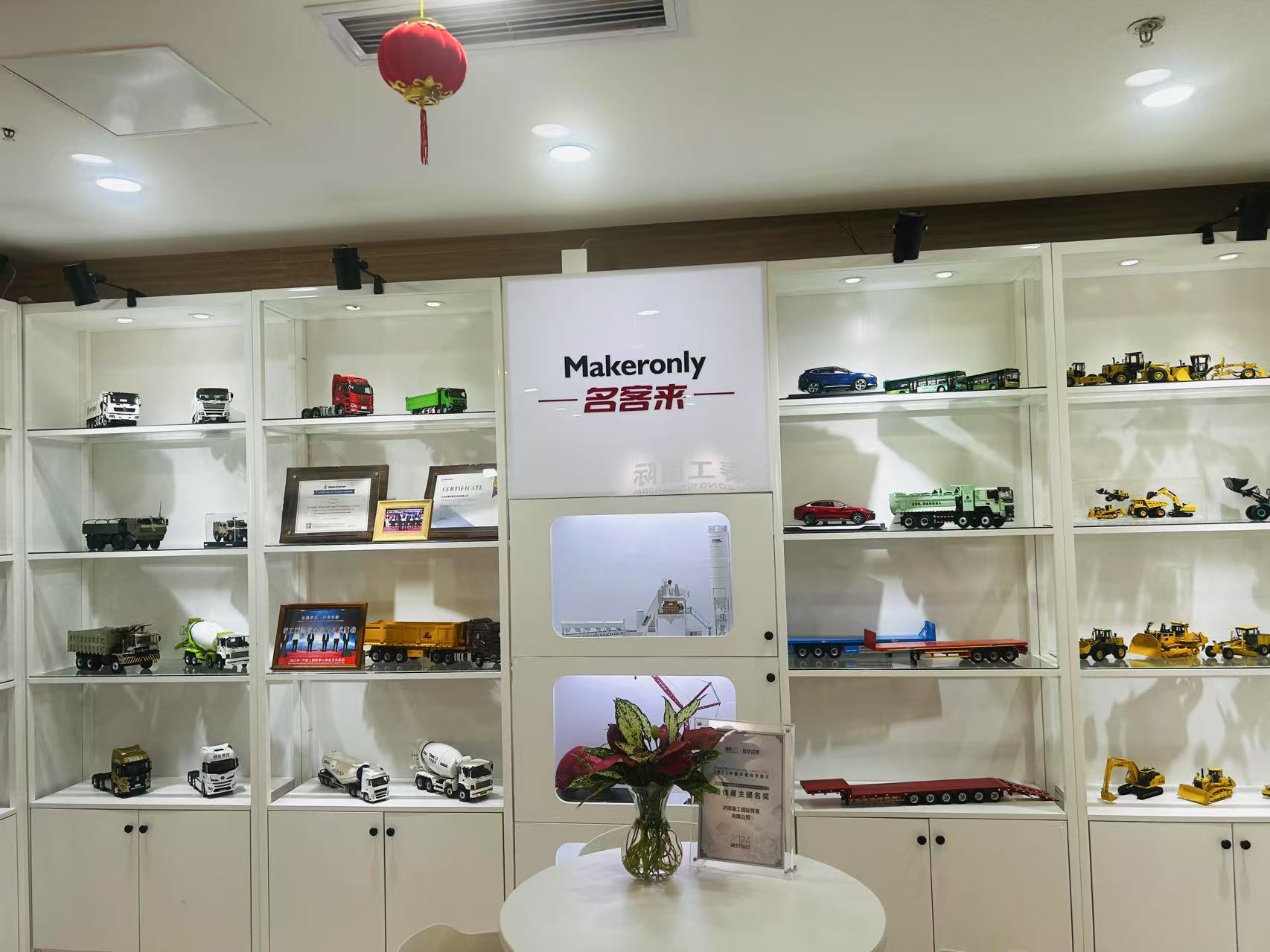
Order preparation and inspection activity at the Jinan export operation. Capacity, tank material and tire configuration should be checked against the build sheet before shipment.
Application fit by industry
Construction and building
Dust suppression, wheel-wash points and general site water are the dominant uses. Hauls are usually short and internal, so a 20,000 L unit frequently covers the duty. The upper end becomes relevant when one tanker has to serve several dispersed plots or when the site water point sits off site.
Cement
Water is both a process input and a dust-control medium around material handling areas. Because plant layouts are fixed, the fill point is usually well defined, and the decision reduces to the filled weight the internal road system and the fill station can accept. Both capacity options are documented as suitable for cement applications.
Road works
Subgrade watering and compaction-related water application follow a linear working front that moves daily. The distance between the water source and the active section grows as the project progresses, which steadily favours the upper end of the documented range. On long packages, the practical answer is often a mix: the larger unit on the main front, the smaller unit on structures, drainage and confined sections.
Mining
Haul road dust suppression consumes large, continuous volumes of water, and the fill point is frequently remote from the active bench. A 25,000 L configuration reduces the number of trips required for the same spray coverage, which matters most on long haul networks. Where fleet size allows, multiple units of either capacity are normally deployed rather than one large unit.
Concrete
Water supply for batching support and curing requires predictable volume. Where the batching point is close, the lower end of the range is adequate. Where the tanker also spreads curing water across a wide slab or a large yard, the upper end reduces the number of returns to the fill point.
Cost drivers that move with tank size
Cost comparisons between the two options are dominated by per-trip overhead rather than by tank price. The drivers a buyer can actually evaluate are consistent across projects.
- Fuel and driver hours per delivered litre. Fewer trips reduce overhead per delivered litre, up to the point where fill-point turnaround and site access constraints cancel the gain.
- Mass-related wear. A fully loaded upper-end unit carries more mass per trip, which affects tire and brake consumption on unsealed roads. Tire size is documented at 12.00R20 radial; consumption depends on route surface and maintenance discipline.
- Road-use and axle-load compliance. Where local limits constrain payload, an upper-end tank may be run at partial fill, which reduces usable capacity and can nullify the trip-count advantage. This should be checked before ordering, not after delivery.
- Water logistics cost. At remote sites, the cost of the fill point itself — pumping, permissions, or hauled-in water — dominates the calculation. The controllable part is the vehicle overhead per trip.
- Fleet mix efficiency. Combining one upper-end and one lower-end unit often outperforms standardising on either size alone, because each unit can be assigned to the haul length it suits.
Comparison with traditional water supply arrangements — and the limits of this configuration
Before purpose-built tanker trucks, most sites solved water delivery through conversions or hired equipment. The difference is worth stating plainly, including where a purpose-built configuration does not help.
| Approach | Typical characteristics | What the documented configuration adds |
|---|---|---|
| Converted cargo truck with added tank | Tank mounted on a general cargo chassis; spray equipment depends on the conversion | A defined tank material (carbon steel Q235), a documented capacity range and a documented water spray function |
| Towed water bowser | Separate trailer unit requiring a towing vehicle | A self-propelled unit with TX-F cab, air conditioning and safety belts, operated by one driver |
| Fixed water point with manual hoses | No vehicle cost per delivery, but no reach beyond the hose | Water delivered directly to the working face, including long linear fronts |
| Short-term tanker hire | No capital commitment, variable availability | Fleet control, driver familiarity and a documented maintenance and parts path |
The limitations are equally important, and they define where this configuration stops being the right answer.
- 25,000 L is the top of the documented range. Demand above that level is not addressed by this configuration; it requires multiple units or a different, larger solution.
- The tank material is documented as carbon steel Q235. The supplied documentation does not describe an internal lining or potable-water treatment. Buyers intending to carry potable water, or water with aggressive chemistry, must confirm internal treatment requirements with the supplier before ordering.
- The water spray function is documented as a water spray function. It is not documented as a high-pressure jetting system or a firefighting installation, and should not be specified as one.
- The documented operating conditions are humid tropical and desert road conditions. Extremely soft ground, steep unformed terrain or tracked-vehicle duty sits outside the role of a road-going tanker.
- Legal load limits can cap practical capacity. In markets that enforce axle-load limits strictly, the usable fill level of the upper-end option may be lower than the nominal figure.
Market context: SINOTRUK volume, network and service density
Water tankers are high-utilisation assets, so supply and service depth matter as much as specification. SINOTRUK reported total heavy-duty truck sales of 292,140 units in 2025, a 20.0% year-on-year increase (StockCounterparts). Export revenue in 2024 was expected to reach 45.1 billion yuan with 135,000 heavy-duty truck exports (ChinaTrucks.org), and the company recorded 15,000 units exported in a single month in September 2025.
Network depth underpins that volume. SINOTRUK operated more than 226 distributors and 246 service centres globally as of 2024. In West and Central Africa, the footprint includes named 4S distributors in Guinea — SODEFA and Societe Taishan Camions Guinee SARLU — while CFAO Equipment became an official co-distributor in Nigeria in late 2023. Buyers in Burkina Faso, Cameroon, the DRC, Mauritania, Senegal, Guinea, Togo, Benin, Liberia and Sierra Leone should treat local network proximity as a specification item, because a tanker that waits for a part stops delivering water.
This is where the role of a SINOTRUK first-tier distributor becomes concrete rather than promotional. A first-tier distributor holds export stock, handles documentation and consolidates spare parts supply, which shortens the gap between a breakdown and a repair. For fleet buyers running HOWO Authorized Distributor routes or evaluating a HOWO Official Distributor for a tender, the practical test is whether the partner can state delivery terms, verification scope and parts coverage in writing before the order is placed.
Procurement, customization and verification for a tanker order
Jinan Qingong International Trade Co., Ltd. (QINGONG) is documented as a professional authorized distributor and official export partner of SINOTRUK. The company was established in 2008 and is based in Jinan City, Shandong Province, China, exporting heavy-duty trucks and construction machinery to more than 100 countries with annual sales volume exceeding USD 200 million and a reported 90% export ratio. Since 2023 it has established subsidiaries in Tanzania, Indonesia, Zambia and Laos.
Two capability facts matter directly to a 20,000 L versus 25,000 L decision.
- Tank volume is a specified customization parameter. The company provides OEM, ODM and customized manufacturing, and lists engine power, drive system, cargo body structure, tank volume, logo branding and colour painting among customization options. A buyer is therefore not limited to two discrete sizes; the capacity band can be matched to the route.
- Verification can be structured. Quality control is described as 100% pre-shipment inspection with optional third-party inspection by SGS or BV. For a tanker, inspection should cover tank volume against the ordered specification, the water spray function, and tire and fuel tank configuration against the build sheet.
Commercial terms documented for these units include a minimum order quantity of 1 unit, delivery terms of FOB, CIF, DDU or DDP, acceptance based on pre-shipment test, and payment by TT, L/C, or flexible instalment solutions for long-term partners. Lead time is immediate shipment for in-stock units and 30–45 days for customized orders, with monthly capacity of 1,500–3,000 units depending on model mix. The company also holds a “National vehicles export-oriented enterprises” certificate issued by the Ministry of Commerce of China, recorded with validity from 2015-01-01 to 2030-01-01 and covering Africa, South America and Asia.
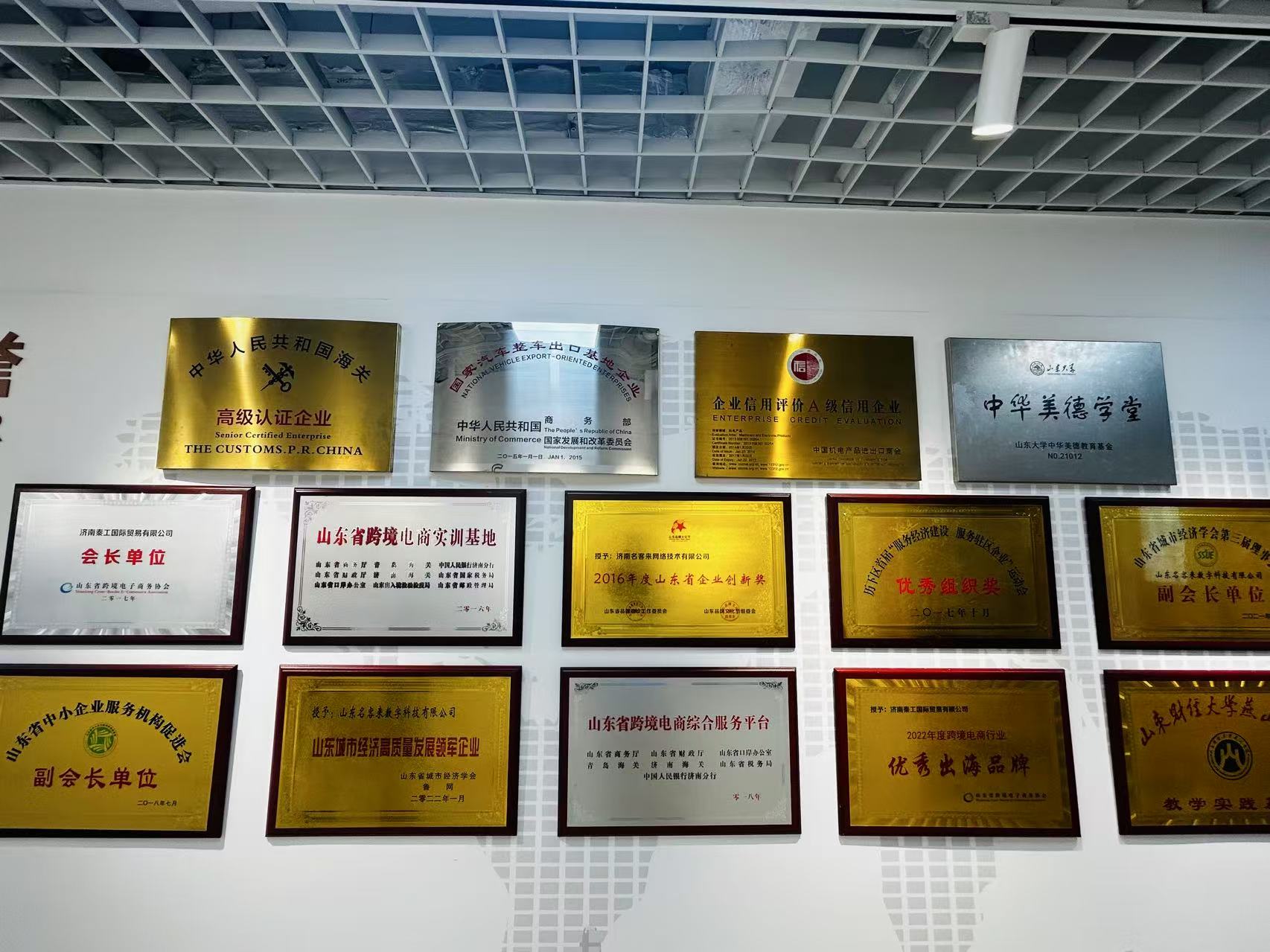
Export-oriented enterprise certification of the kind held by the exporter, covering Africa, South America and Asia. Certification scope and validity should be checked against the supplier's own documentation.
Field evidence from African fleet operations
One documented case involves a Rwanda-based fleet operating 70 units over a two-year period in mining transportation and road construction material haulage. The recorded outcomes were complete driver and maintenance training, stable vehicle operation and a reduced fleet failure rate, followed by a repeat order of 50 tractors. The HOWO TX water tanker is listed among the applicable products for that operation.
The transferable lesson for tanker buyers is not the headline number but the sequence: training and parts supply were established first, and capacity expansion followed. Water tankers on remote sites fail operationally for logistics reasons more often than for mechanical ones, and the case material points to the same conclusion.
Future outlook
Three directions are visible from the documented data.
- Export momentum continues. A 20.0% year-on-year rise in 2025 heavy-duty truck sales and a 15,000-unit export month indicate an expanding installed base in Africa. More units in service raises the value of parts and service density relative to purchase price.
- Specification matching replaces standard sizing. With tank volume listed among customization parameters, buyers are moving from choosing the nearest available size to specifying the volume the route requires. This favours the kind of comparison made in this article over a single-size purchasing habit.
- Water and dust control remain binding constraints. Mining haul roads and road construction fronts continue to require consistent water application, which keeps water tankers on high-utilisation duty and increases the importance of documented operating conditions — humid tropical and desert road conditions — when specifying a unit for African markets.
FAQ
What exactly differs between the 20,000 L and 25,000 L HOWO TX water tanker options?
Both options sit inside the same documented capacity range of 20,000 L to 25,000 L for the HOWO TX water tanker, model ZZ1257V464GB1. The difference is the volume carried per trip. For a fixed daily volume of water, the 25,000 L configuration requires fewer trips, while the 20,000 L configuration reduces fill time and mass per trip. The tank material, water spray function and cab specification are documented identically across the range.
Which site conditions make the 20,000 L option the better choice?
Short internal hauls, fill points located close to the working face, narrow or temporary access roads, and sites where local road-use or axle-load limits constrain payload. In those conditions a larger tank spends more time filling and manoeuvring than it recovers in reduced transit.
When is the 25,000 L configuration worth choosing?
When the water source is far from the working face and the working front is long — extended subgrade watering on road works, dust suppression across a large mining haul road network, or a cement facility with a distant water point. In those situations the larger unit reduces trip frequency for the same delivered volume. Road-use and axle-load limits should be confirmed before the order is placed, because they can cap the usable fill level.
What are the purchasing terms and acceptance criteria for these units?
The documented terms are a minimum order quantity of 1 unit, delivery under FOB, CIF, DDU or DDP, acceptance based on pre-shipment test, and payment by TT, L/C, or flexible instalment solutions for long-term partners. Quality control is described as 100% pre-shipment inspection, with optional third-party inspection by SGS or BV.
How long does a customized tanker order take, and can tank volume be specified?
Tank volume is listed as a customization parameter, alongside engine power, drive system, cargo body structure, logo branding and colour painting. Lead time is immediate shipment for in-stock units and 30–45 days for customized orders, with monthly capacity of 1,500–3,000 units varying by model mix.
What is documented about tires and fuel capacity, and what should a buyer confirm?
The supplied HOWO TX 6x4 platform specification lists 12.00R20 radial tires with one spare tire and a 300 L fuel tank with a cap lock. Because a water tank body distributes mass differently from a cargo or dump body, buyers should confirm tire size, spare tire provision and fuel tank capacity on the final water tanker build sheet rather than assuming platform-level figures apply unchanged.
The full product catalogue, including the HOWO TX water tanker specification, is available for reference at Qingong Group Products Catalog 2026. Company information is published at www.howoqg.com.